Overview
Mixture problems are a fundamental category of word problems that appear regularly on the GRE Quantitative Reasoning section. These problems involve combining two or more substances, solutions, or groups with different characteristics (such as concentration, price, or composition) to create a new mixture with specific properties. Understanding how to solve gre mixture problems is essential because they test multiple mathematical skills simultaneously: algebraic reasoning, proportional thinking, weighted averages, and the ability to translate complex verbal descriptions into mathematical equations.
On the GRE, mixture problems typically appear as one or two questions per exam, making them high-yield content that can directly impact your score. These problems are particularly valuable because they assess your ability to work with percentages, ratios, and systems of equations—all core competencies that appear throughout the Quantitative Reasoning section. The skills developed while mastering mixture problems transfer directly to other question types, including data interpretation, rate problems, and work problems.
Mixture problems connect to broader Quantitative Reasoning concepts through their reliance on conservation principles (the total amount of a substance remains constant), weighted averages (the final mixture represents a balance between the components), and algebraic modeling (translating real-world scenarios into solvable equations). Mastering this topic strengthens your overall problem-solving framework and builds confidence in tackling multi-step word problems that require careful organization and systematic thinking.
Learning Objectives
- [ ] Identify when Mixture problems is being tested
- [ ] Explain the core rule or strategy behind Mixture problems
- [ ] Apply Mixture problems to GRE-style questions accurately
- [ ] Construct and solve systems of equations from mixture problem descriptions
- [ ] Calculate weighted averages and final concentrations in combined mixtures
- [ ] Recognize and apply the mixture table method for organizing information
- [ ] Distinguish between replacement mixture problems and combination mixture problems
Prerequisites
- Basic algebra and equation solving: Essential for setting up and manipulating the equations that represent mixture relationships
- Percentages and decimal conversions: Necessary for working with concentrations, solutions, and proportions in mixture contexts
- Ratio and proportion concepts: Fundamental to understanding how different components relate to each other and to the whole
- Weighted average calculations: The mathematical foundation underlying most mixture problem solutions
- Systems of linear equations: Required for problems involving multiple unknowns and constraints
Why This Topic Matters
Mixture problems have significant real-world applications across numerous fields. Chemists use mixture calculations to prepare solutions of specific concentrations, pharmacists compound medications with precise active ingredient percentages, financial analysts calculate portfolio returns from mixed investments, and manufacturers determine product compositions to meet specifications. These practical applications make mixture problems relevant beyond standardized testing, developing quantitative reasoning skills applicable to professional and everyday decision-making.
On the GRE, mixture problems appear with moderate frequency—typically 1-2 questions per exam—but carry high importance due to their difficulty level and point value. According to GRE question analysis, mixture problems fall into the medium-to-hard difficulty range, meaning they effectively differentiate between average and high-scoring test-takers. Successfully solving these problems can significantly boost your percentile ranking, particularly in the 160+ score range where every question matters.
Mixture problems appear on the GRE in several distinct formats: solution concentration problems (mixing liquids with different alcohol, salt, or acid percentages), price mixture problems (combining items of different costs to achieve a target average price), alloy problems (combining metals with different purity levels), and replacement problems (removing some mixture and replacing it with a pure substance). The GRE often embeds mixture problems within data interpretation questions or presents them as Quantitative Comparison questions where you must determine relationships between mixture properties. Recognizing these various manifestations is crucial for exam success.
Core Concepts
The Fundamental Mixture Equation
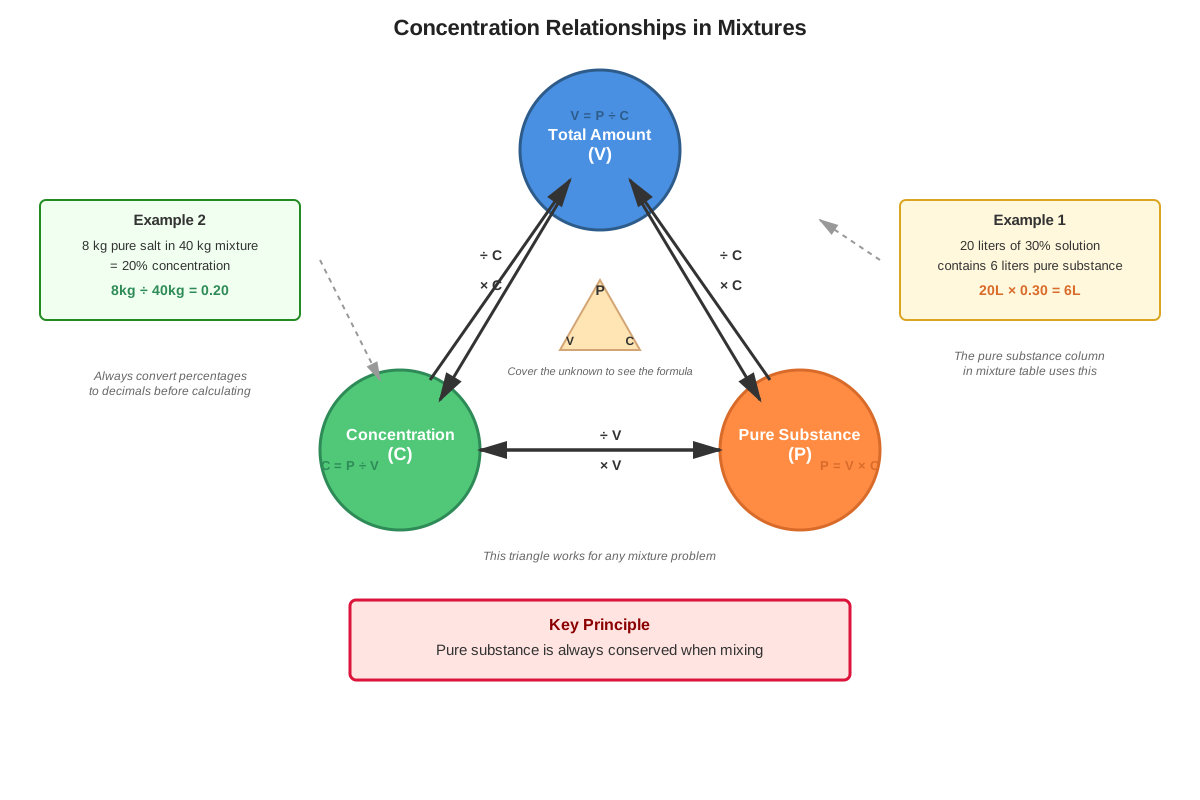
The foundation of all mixture problems rests on a simple conservation principle: the total amount of a specific component in the final mixture equals the sum of that component from all sources. This can be expressed as:
(Amount₁ × Concentration₁) + (Amount₂ × Concentration₂) = (Total Amount × Final Concentration)This equation captures the essence of mixture problems: when you combine substances, the absolute quantity of each component is preserved, even though concentrations change. For example, if you mix 10 liters of 20% salt solution with 5 liters of 50% salt solution, the total salt in the final mixture equals the salt from both sources combined.
The Mixture Table Method
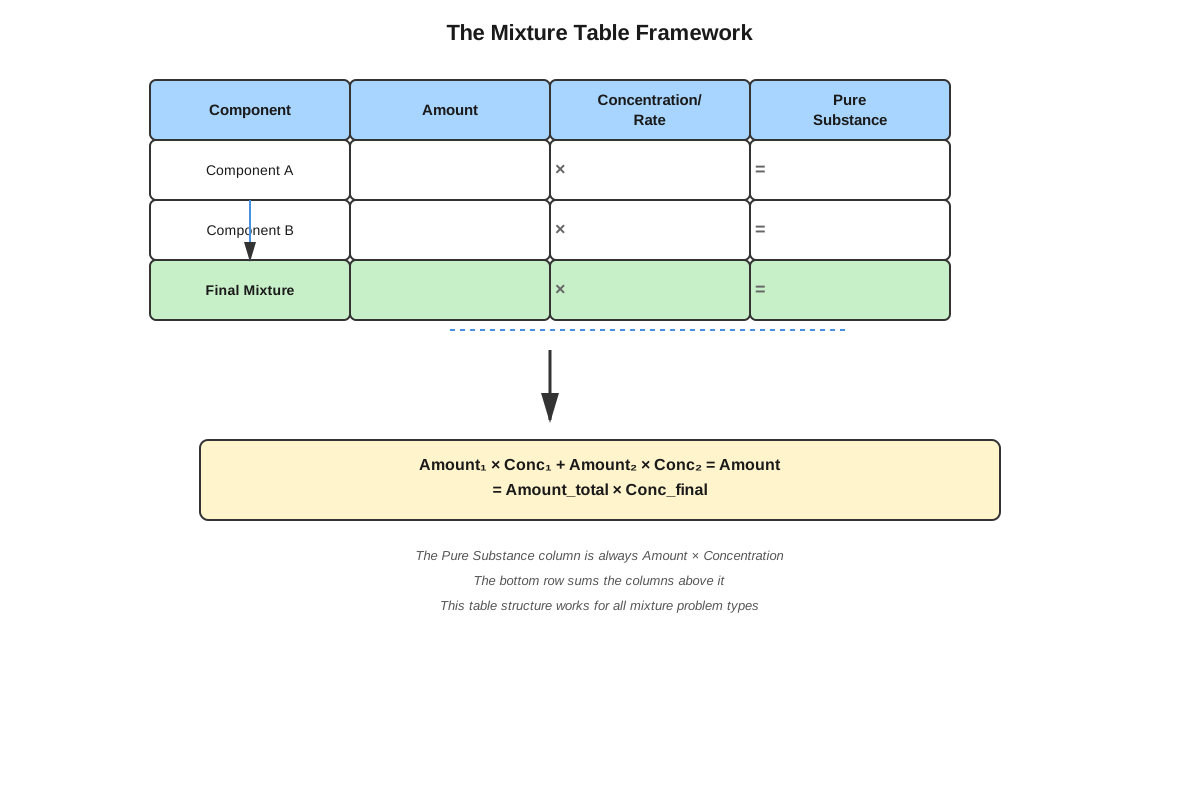
The most reliable approach for organizing mixture problem information is the mixture table method. This systematic framework prevents errors and ensures you account for all relevant quantities:
| Component | Amount | Concentration/Price | Total Value |
|---|---|---|---|
| Source 1 | A₁ | C₁ | A₁ × C₁ |
| Source 2 | A₂ | C₂ | A₂ × C₂ |
| Final Mixture | A₁ + A₂ | C_final | (A₁ + A₂) × C_final |
The key insight is that the "Total Value" column must balance: the sum of values from sources equals the total value of the mixture. This table structure works for any mixture problem type—solutions, prices, alloys, or other combinations.
Types of Mixture Problems
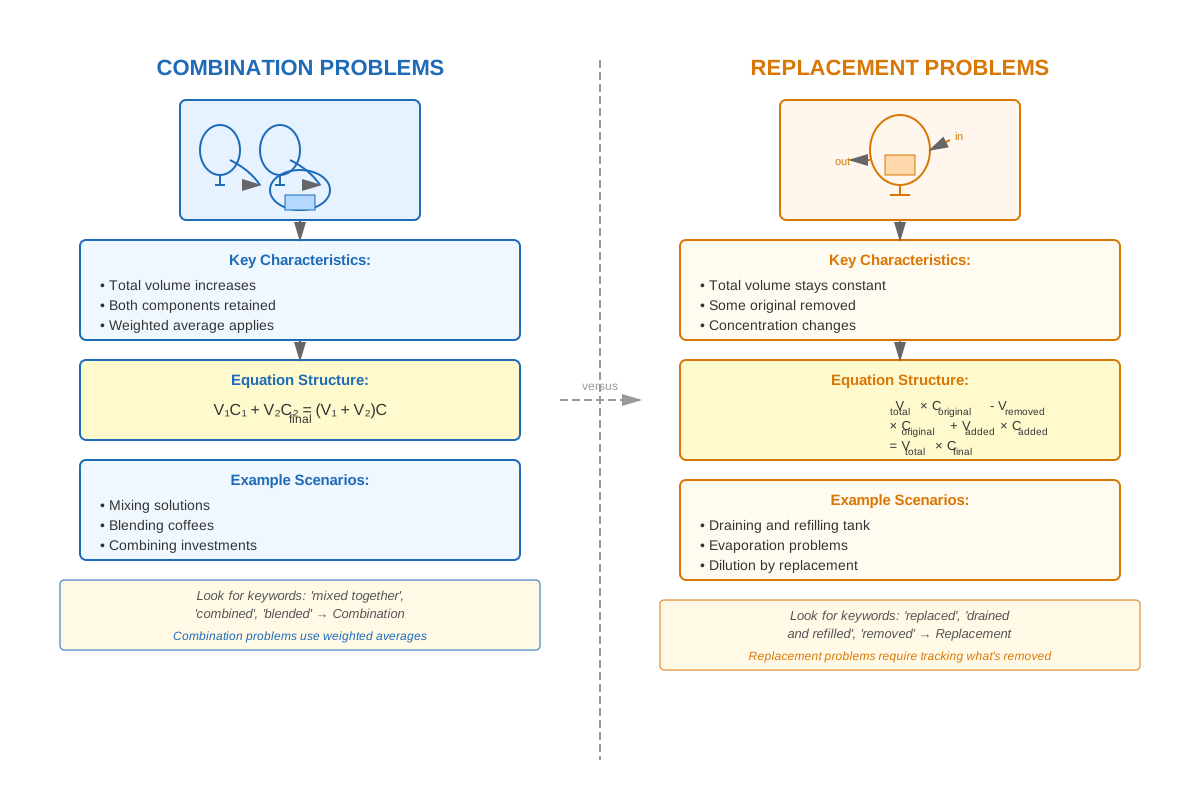
Combination Problems involve mixing two or more distinct substances to create a new mixture. The total volume or mass increases by the sum of the components. Example: mixing 3 liters of juice with 2 liters of water creates 5 liters of diluted juice.
Replacement Problems involve removing some amount of a mixture and replacing it with a different substance (often pure solvent or a different concentration). These problems require careful attention because the total volume remains constant, but the composition changes. The key formula for replacement problems is:
Final Concentration = Original Concentration × (1 - Fraction Removed)^n + Added Concentration × [1 - (1 - Fraction Removed)^n]where n represents the number of replacement operations.
Weighted Average Approach
Many mixture problems can be solved efficiently using weighted averages. When mixing two components, the final concentration lies between the two original concentrations, positioned according to the relative amounts:
C_final = (A₁ × C₁ + A₂ × C₂) / (A₁ + A₂)This approach is particularly powerful for Quantitative Comparison questions where you need to determine relationships without calculating exact values. If you mix equal amounts of two solutions, the final concentration is the simple average. If amounts differ, the final concentration is closer to the concentration of the larger component.
The Allegation Method
The allegation method provides a shortcut for two-component mixture problems. This technique uses the differences between concentrations to determine the ratio of amounts:
Ratio of Amount₁ to Amount₂ = (C_final - C₂) : (C₁ - C_final)This method is especially efficient when the problem asks for ratios rather than absolute quantities. For example, if you need to mix 30% and 60% solutions to create a 45% solution, the ratio is (45-30):(60-45) = 15:15 = 1:1, meaning equal amounts.
Multiple Mixture Problems
Some GRE problems involve three or more components or sequential mixing operations. For these complex scenarios, the systematic approach is to:
- Apply the fundamental mixture equation to each component separately
- Set up a system of equations representing all constraints
- Solve systematically, often by substitution or elimination
- Verify that the solution satisfies all original conditions
Concentration Conversions
Mixture problems require fluency with different concentration expressions:
- Percentage: parts per 100 (e.g., 25% = 0.25)
- Ratio: parts of component to parts of total (e.g., 1:4 means 1 part in 5 total)
- Fraction: direct proportion (e.g., 3/5 = 0.6 = 60%)
- Parts per notation: ppm (parts per million), ppb (parts per billion)
Converting between these forms accurately is essential for setting up correct equations.
Concept Relationships
The concepts within mixture problems form an interconnected framework. The fundamental mixture equation serves as the foundation, from which the mixture table method provides organizational structure. The table method naturally leads to weighted average calculations, which represent a simplified form of the mixture equation when dealing with two components. The allegation method emerges as an algebraic shortcut derived from the weighted average formula, specifically optimized for finding ratios.
Combination problems and replacement problems represent two distinct applications of the fundamental equation, differing in whether total volume changes or remains constant. Both problem types can be solved using the mixture table method, but replacement problems require additional consideration of the sequential nature of operations.
These mixture problem concepts connect to prerequisite topics through multiple pathways: percentages and decimals → enable concentration calculations → feed into mixture equations. Similarly, ratios and proportions → provide the framework for allegation method → which simplifies two-component problems. The systems of equations prerequisite becomes essential when multiple mixture problems involve several unknowns requiring simultaneous solution.
Mixture problems also connect forward to related topics: the weighted average concept extends to statistics and data interpretation, the conservation principle applies to work and rate problems, and the algebraic modeling skills transfer to optimization problems and function word problems.
High-Yield Facts
⭐ The total amount of pure component in the mixture equals the sum of pure component from all sources: This conservation principle is the foundation of every mixture equation.
⭐ In a two-component mixture, the final concentration always lies between the two original concentrations: This allows immediate elimination of answer choices outside this range.
⭐ When mixing equal volumes of two solutions, the final concentration is the arithmetic mean of the two concentrations: This shortcut saves calculation time on specific problem types.
⭐ The mixture table has three columns that must balance: Amount × Concentration = Total Value: Setting up this table correctly leads directly to the solution equation.
⭐ In replacement problems, the concentration after n replacements follows an exponential decay pattern: Each replacement reduces the original component by a constant fraction.
- The allegation method ratio is calculated using differences from the final concentration: (Final - Lower):(Higher - Final) gives the ratio of higher to lower concentration components.
- Percentage concentrations must be converted to decimals before multiplication: 25% solution means 0.25, not 25, in calculations.
- The total volume in combination problems equals the sum of component volumes: This provides one equation in systems with multiple unknowns.
- When a problem asks for the ratio of components, you don't need to find absolute amounts: The allegation method or setting up proportions is more efficient.
- Mixture problems often involve two equations with two unknowns: One equation from the mixture principle, another from a given constraint (like total volume).
- Pure substance has 100% concentration (1.0 in decimal form): This is crucial for replacement problems where pure solvent is added.
- Water or pure solvent has 0% concentration of the dissolved substance: When diluting, the added water contributes zero to the component total.
Quick check — test yourself on Mixture problems so far.
Try Flashcards →Common Misconceptions
Misconception: When mixing two solutions, you can simply average the concentrations to find the final concentration.
Correction: The final concentration is a weighted average based on the amounts of each solution. Only when equal amounts are mixed does the simple average apply. For unequal amounts, the final concentration is closer to the concentration of the larger volume.
Misconception: In replacement problems, removing 25% of a mixture and replacing it with pure solvent reduces the concentration by 25%.
Correction: The concentration is multiplied by 0.75 (reduced to 75% of its original value), which is not the same as reducing by 25 percentage points. If you start with 60% concentration, after replacing 25% of the mixture with pure solvent, you have 60% × 0.75 = 45% concentration, not 35%.
Misconception: The total volume in a mixture problem always equals the sum of the component volumes.
Correction: This is true for combination problems but not for replacement problems. In replacement problems, the total volume remains constant—you remove some mixture and replace it with an equal volume of another substance.
Misconception: You can add percentages directly when combining mixtures.
Correction: Percentages represent proportions, not absolute amounts. You must first convert percentages to absolute amounts of the component (percentage × volume), add these absolute amounts, then convert back to a percentage of the total volume.
Misconception: The allegation method can be used for any mixture problem.
Correction: The allegation method is specifically designed for two-component mixture problems where you're finding the ratio of amounts. It doesn't directly apply to replacement problems, multiple-component mixtures, or problems asking for absolute quantities rather than ratios.
Misconception: When a problem states "20% solution," this means 20% of the solution is water.
Correction: A "20% solution" typically means 20% is the solute (dissolved substance) and 80% is the solvent (usually water). Always read carefully to determine what the percentage represents—the component of interest or the solvent.
Worked Examples
Example 1: Classic Two-Component Combination Problem
Problem: A chemist needs to create 15 liters of a 40% acid solution by mixing a 25% acid solution with a 55% acid solution. How many liters of the 25% solution should be used?
Solution:
Step 1: Set up the mixture table to organize information.
| Component | Amount (liters) | Concentration | Total Acid |
|---|---|---|---|
| 25% solution | x | 0.25 | 0.25x |
| 55% solution | 15 - x | 0.55 | 0.55(15 - x) |
| Final mixture | 15 | 0.40 | 0.40(15) |
Step 2: Apply the fundamental mixture equation (total acid from sources = total acid in mixture).
0.25x + 0.55(15 - x) = 0.40(15)Step 3: Solve for x.
0.25x + 8.25 - 0.55x = 6
-0.30x + 8.25 = 6
-0.30x = -2.25
x = 7.5
Step 4: Verify the solution makes sense.
- 7.5 liters of 25% solution contains 7.5 × 0.25 = 1.875 liters of pure acid
- 7.5 liters of 55% solution contains 7.5 × 0.55 = 4.125 liters of pure acid
- Total acid: 1.875 + 4.125 = 6 liters
- Final concentration: 6/15 = 0.40 = 40% ✓
Answer: 7.5 liters of the 25% solution should be used.
Connection to Learning Objectives: This example demonstrates identifying a mixture problem (combining solutions with different concentrations), applying the core strategy (mixture table and fundamental equation), and solving accurately with verification.
Example 2: Replacement Problem with Sequential Operations
Problem: A 20-liter container is filled with a solution that is 30% alcohol. If 5 liters of this solution are removed and replaced with pure water, what is the concentration of alcohol in the resulting mixture?
Solution:
Step 1: Identify this as a replacement problem where total volume stays constant at 20 liters.
Step 2: Calculate the amount of pure alcohol initially present.
Initial alcohol = 20 liters × 0.30 = 6 liters of pure alcoholStep 3: Determine how much alcohol is removed.
When we remove 5 liters of the 30% solution, we remove:
Alcohol removed = 5 liters × 0.30 = 1.5 liters of pure alcoholStep 4: Calculate remaining alcohol after removal.
Remaining alcohol = 6 - 1.5 = 4.5 liters of pure alcoholStep 5: Determine the final concentration.
The 5 liters of pure water added contains 0 liters of alcohol. The total volume returns to 20 liters.
Final concentration = 4.5 liters / 20 liters = 0.225 = 22.5%Alternative approach using the replacement formula:
Final concentration = Original concentration × (1 - Fraction removed)
Final concentration = 0.30 × (1 - 5/20) = 0.30 × 0.75 = 0.225 = 22.5%Answer: The final concentration is 22.5% alcohol.
Connection to Learning Objectives: This example shows how to distinguish replacement problems from combination problems, apply the appropriate strategy, and recognize that the replacement formula provides an efficient shortcut for this problem type.
Exam Strategy
When approaching GRE mixture problems, begin by carefully reading the problem to identify the trigger words that signal a mixture question: "mixing," "combining," "solution," "concentration," "alloy," "blend," "average price," "dilute," or "replace." These words indicate you should activate your mixture problem framework.
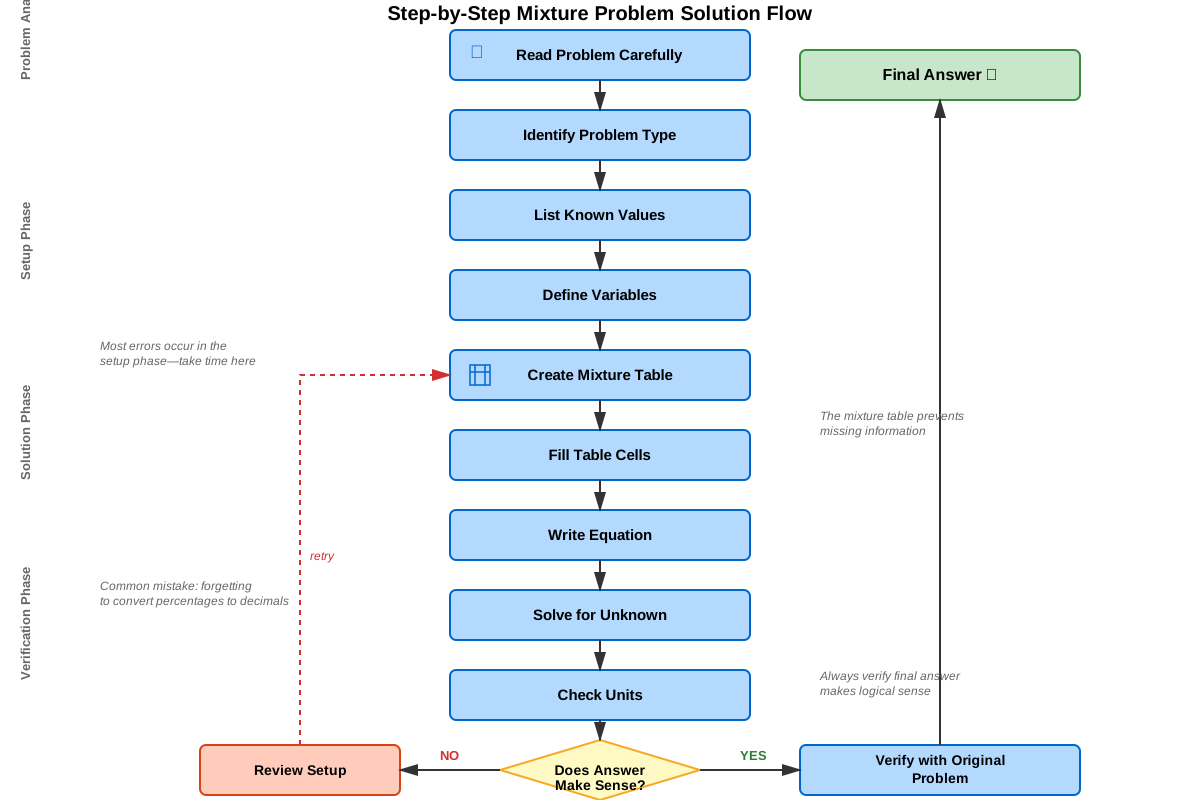
Immediate first step: Draw a mixture table or diagram before attempting any calculations. This organizational step prevents the most common errors—mixing up which quantities go together and losing track of what the variables represent. Spend 15-20 seconds setting up your table; this investment saves time and increases accuracy.
Process of elimination strategies specific to mixture problems:
- Range checking: The final concentration must fall between the two original concentrations (for combination problems). Immediately eliminate any answer choices outside this range.
- Weighted average logic: If the problem mixes unequal amounts, the final concentration is closer to the concentration of the larger component. Use this to eliminate choices that violate this principle.
- Extreme case testing: If mixing equal amounts, the final concentration should be the arithmetic mean. If the problem allows, test whether answer choices satisfy this special case.
- Unit consistency: Verify that answer choices use the correct units (liters vs. milliliters, percentage vs. decimal). Eliminate choices with unit errors.
Time allocation: Budget 2-3 minutes for mixture problems. If you're not making progress after 90 seconds, consider these time-saving tactics:
- For Quantitative Comparison questions, use weighted average logic to determine the relationship without calculating exact values
- For multiple-choice questions, work backwards from answer choices when the algebra becomes complex
- Skip and return if the problem involves three or more components and you're running short on time
Common GRE twists to watch for:
- Problems that ask for the amount of one component when you've calculated the other (always check what the question asks)
- Questions that give you the ratio of components and ask for the final concentration (requires an additional step)
- Quantitative Comparison questions where both quantities involve mixtures with different parameters
Memory Techniques
Mnemonic for the Mixture Table: "ACT" - Amount, Concentration, Total
- This reminds you of the three essential columns in every mixture table
- The product of Amount and Concentration gives you the Total (value)
Visualization strategy: Picture mixture problems as "balancing scales". The left side of the scale holds the components you're mixing (each with its own weight and concentration), and the right side holds the final mixture. The scale balances when the total "concentration-weight" on both sides is equal. This mental image reinforces the conservation principle.
Acronym for problem-solving steps: "RITE"
- Read carefully and identify the mixture type
- Identify what you're solving for
- Table setup with all known information
- Equation from the mixture principle
Replacement problem memory aid: Think "REMOVE-REPLACE-REDUCE"
- REMOVE some mixture (taking away both solvent and solute proportionally)
- REPLACE with new substance (often pure solvent)
- REDUCE concentration by the fraction remaining: multiply by (1 - fraction removed)
Allegation method shortcut: Remember "CROSS-SUBTRACT"
- Draw a cross/X diagram with the two original concentrations on the left, final concentration in the middle
- CROSS from final to each original and SUBTRACT to get the ratio
- The ratio is inverted: (Final - Lower) gives the amount of Higher concentration needed
Summary
Mixture problems are high-value GRE questions that test your ability to translate complex verbal descriptions into mathematical equations and solve systematically. The fundamental principle underlying all mixture problems is conservation: the total amount of each component in the final mixture equals the sum of that component from all sources. This principle translates into the equation (Amount₁ × Concentration₁) + (Amount₂ × Concentration₂) = (Total Amount × Final Concentration). The mixture table method provides the most reliable organizational framework, with three columns—Amount, Concentration, and Total Value—that must balance. Distinguishing between combination problems (where total volume increases) and replacement problems (where total volume remains constant) is essential for selecting the correct approach. Weighted average thinking enables efficient solution of two-component problems and provides powerful elimination strategies for Quantitative Comparison questions. The allegation method offers a shortcut for finding ratios in two-component mixtures. Success on GRE mixture problems requires careful problem setup, systematic equation solving, and verification that answers satisfy all constraints and fall within logical ranges.
Key Takeaways
- The mixture table (Amount × Concentration = Total Value) is your most reliable tool for organizing information and preventing errors in mixture problems
- Final concentration in combination problems always falls between the original concentrations, enabling immediate elimination of out-of-range answer choices
- Replacement problems follow the formula: Final = Original × (1 - Fraction Removed), which differs fundamentally from combination problems
- Convert all percentages to decimals before performing calculations to avoid errors in the mixture equation
- The allegation method provides a ratio shortcut: (Final - Lower):(Higher - Final) gives the ratio of higher to lower concentration components
- Weighted average logic is powerful for Quantitative Comparison questions, allowing you to determine relationships without calculating exact values
- Always verify your answer by checking that the total component amount balances and the final concentration makes logical sense given the inputs
Related Topics
Weighted Averages: Mixture problems are a specific application of weighted average concepts. Mastering mixture problems strengthens your ability to handle weighted average questions in statistics and data interpretation contexts, where different data points contribute unequally to overall measures.
Work and Rate Problems: These problems share the same conservation principle as mixture problems—total work equals the sum of individual contributions. The equation-building skills developed through mixture problems transfer directly to work problems involving multiple workers or machines.
Ratio and Proportion Problems: The allegation method and ratio-based approaches to mixture problems deepen your understanding of proportional reasoning, which appears throughout GRE Quantitative Reasoning in geometry, probability, and data analysis questions.
Systems of Equations: Complex mixture problems involving multiple unknowns provide excellent practice for setting up and solving systems of linear equations, a skill tested across various GRE problem types including coordinate geometry and optimization.
Percent Change and Growth: Replacement mixture problems involve iterative percentage changes, connecting to compound interest, population growth, and other exponential change scenarios that appear on the GRE.
Practice CTA
Now that you've mastered the concepts, strategies, and techniques for mixture problems, it's time to solidify your understanding through active practice. Attempt the practice questions designed specifically for this topic, focusing on applying the mixture table method and identifying problem types quickly. Use the flashcards to reinforce key formulas, trigger words, and common pitfalls until they become automatic. Remember: mixture problems reward systematic thinking and careful setup more than computational speed. Each practice problem you solve strengthens your pattern recognition and builds the confidence you need to tackle these high-value questions efficiently on test day. Your investment in mastering this topic will pay dividends across multiple areas of GRE Quantitative Reasoning!
Sign up free to keep reading
Create a free AnvayaPrep account to finish this GRE guide on Mixture problems — plus flashcards and practice questions.