Overview
Distance rate time problems form one of the most frequently tested categories within GRE Quantitative Reasoning word problems. These questions require students to understand the fundamental relationship between how far something travels, how fast it moves, and how long the journey takes. While the underlying formula is straightforward, the GRE tests this concept through increasingly complex scenarios involving multiple travelers, varying speeds, relative motion, and combined journeys that demand careful analysis and systematic problem-solving approaches.
Mastering gre distance rate time questions is essential because they appear regularly on the exam in various forms—from straightforward single-traveler problems to complex scenarios involving two objects moving toward or away from each other. These questions test not only mathematical computation but also logical reasoning, the ability to translate verbal descriptions into mathematical relationships, and skill in organizing information systematically. Students who develop strong competency in this area gain confidence in tackling word problems more broadly, as the analytical framework used here transfers to other quantitative scenarios.
Within the broader landscape of Quantitative Reasoning, distance-rate-time problems connect to fundamental algebraic manipulation, unit conversion, ratio and proportion reasoning, and systems of equations. They serve as practical applications of linear relationships and provide opportunities to demonstrate problem-solving methodology that the GRE values highly. Success with these problems requires both conceptual understanding of the relationships between variables and procedural fluency in setting up and solving equations efficiently under timed conditions.
Learning Objectives
- [ ] Identify when Distance rate time is being tested
- [ ] Explain the core rule or strategy behind Distance rate time
- [ ] Apply Distance rate time to GRE-style questions accurately
- [ ] Distinguish between different types of distance-rate-time scenarios (same direction, opposite direction, round trips)
- [ ] Convert between different units of measurement within distance-rate-time problems
- [ ] Construct and solve systems of equations for multi-traveler problems
- [ ] Recognize and apply relative speed concepts in meeting and overtaking problems
Prerequisites
- Basic algebraic manipulation: Essential for isolating variables and solving for unknowns in the distance formula
- Unit awareness and conversion: Necessary for working with miles/kilometers, hours/minutes, and ensuring dimensional consistency
- Ratio and proportion understanding: Helps in comparing speeds and scaling distances appropriately
- Linear equation solving: Required for setting up and solving the equations that emerge from distance-rate-time relationships
- Fraction and decimal operations: Needed when dealing with fractional speeds or time periods
Why This Topic Matters
Distance-rate-time problems have immediate real-world relevance in everyday situations: calculating travel times for commutes, determining fuel efficiency, planning trips, and understanding relative motion. These practical applications make the mathematical relationships intuitive once properly understood, and they demonstrate how quantitative reasoning applies beyond abstract mathematics.
On the GRE specifically, distance-rate-time questions appear with high frequency—typically 1-3 questions per Quantitative Reasoning section. They manifest in multiple formats: as standard problem-solving questions requiring calculation of a specific value, as Quantitative Comparison questions asking students to compare two scenarios, and occasionally within Data Interpretation sets. The GRE particularly favors scenarios involving two travelers, round trips with different speeds, or situations requiring students to recognize that average speed differs from the average of two speeds.
Common exam presentations include: trains or cars traveling toward each other from different cities; cyclists or runners moving at different speeds on the same route; round-trip journeys where return speed differs from outbound speed; and scenarios involving headwinds, tailwinds, or currents that affect effective speed. The exam writers deliberately create scenarios that punish hasty assumptions and reward careful, systematic analysis of the relationships between variables.
Core Concepts
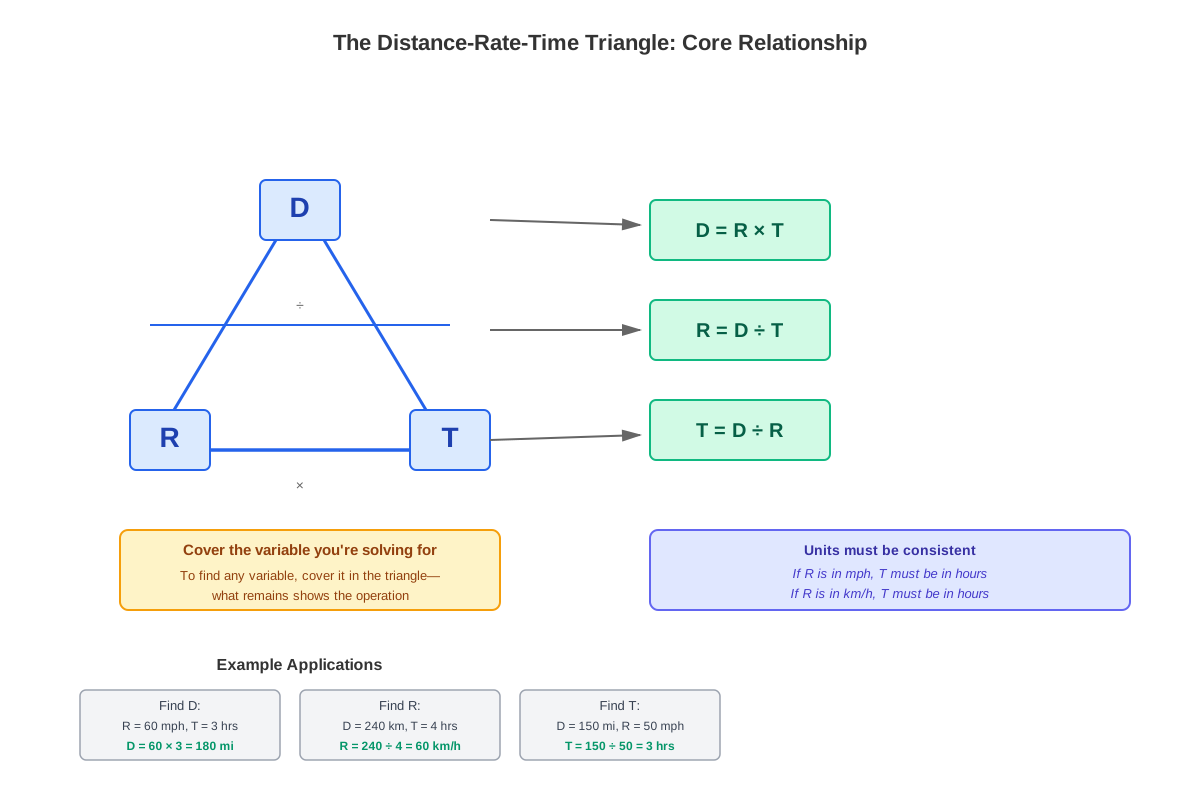
The Fundamental Formula
The foundation of all distance rate time problems rests on a single relationship that connects three variables:
Distance = Rate × TimeThis formula can be algebraically rearranged into three equivalent forms:
- D = R × T
- R = D / T
- T = D / R
Each form proves useful depending on which variable the problem asks students to find. The rate represents speed (distance per unit time), time represents duration, and distance represents the total length traveled. Understanding that these three quantities are intrinsically linked—changing one necessarily affects the others—forms the conceptual foundation for all problem-solving in this domain.
Units and Dimensional Consistency
A critical aspect often tested on the GRE involves ensuring that all measurements use compatible units. If rate is given in miles per hour, time must be in hours and distance in miles. Common unit conversions include:
| Time Conversion | Calculation |
|---|---|
| Minutes to hours | Divide by 60 |
| Hours to minutes | Multiply by 60 |
| Seconds to hours | Divide by 3,600 |
| Distance Conversion | Calculation |
|---|---|
| Kilometers to miles | Multiply by 0.621 |
| Miles to kilometers | Multiply by 1.609 |
| Feet to miles | Divide by 5,280 |
The GRE frequently presents mixed units deliberately to test whether students recognize the need for conversion before applying formulas. A problem might state that a car travels at 60 miles per hour for 45 minutes—students must convert 45 minutes to 0.75 hours before calculating distance.
Single-Traveler Problems
The simplest category involves one object moving at a constant speed. These problems typically provide two of the three variables and ask for the third. The solution process follows these steps:
- Identify which variables are given and which is unknown
- Ensure all units are consistent
- Select the appropriate form of D = R × T
- Substitute known values and solve
For example: "A train travels at 80 miles per hour for 2.5 hours. How far does it travel?" Here, R = 80 mph and T = 2.5 hours, so D = 80 × 2.5 = 200 miles.
Two-Traveler Problems: Opposite Directions
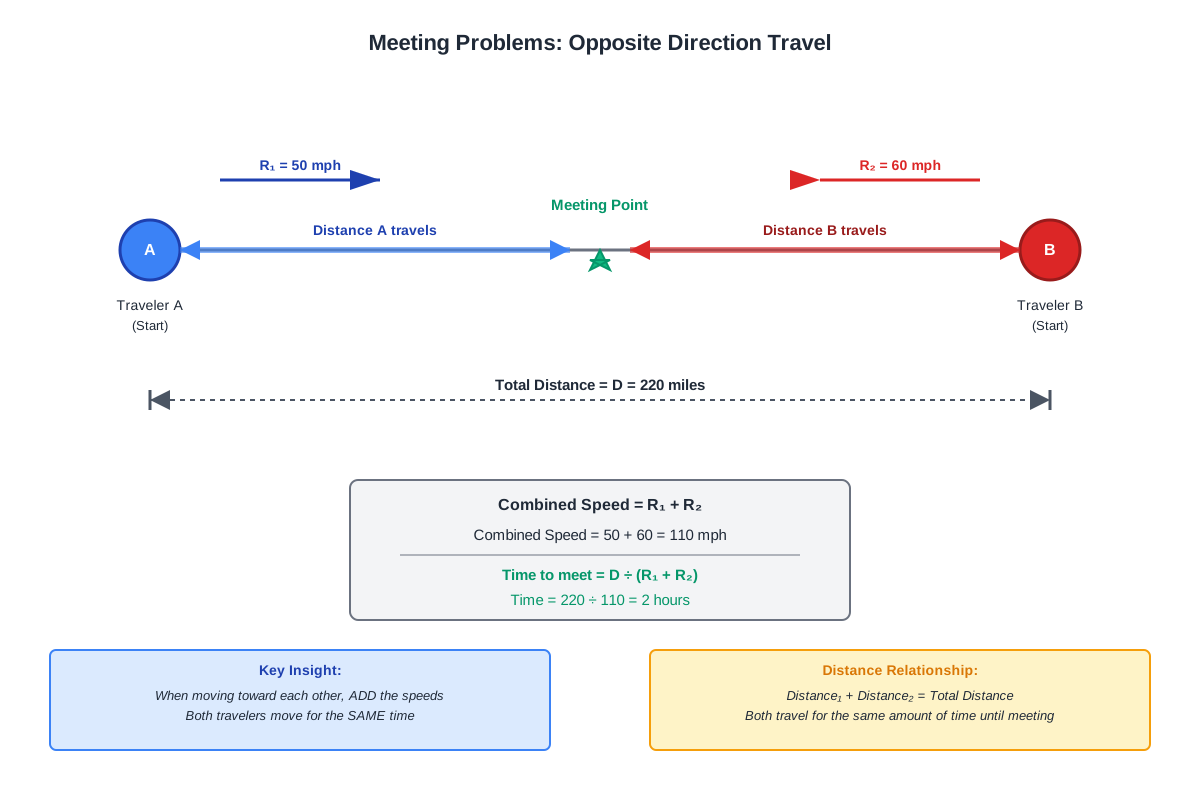
When two objects move in opposite directions from the same starting point (or toward each other from different points), their distances add together. If they start at the same location and move apart, or start at different locations and move toward each other, the key insight is that their combined distance equals the sum of individual distances.
The approach involves:
- Define variables for each traveler's distance (D₁ and D₂)
- Express each distance using D = R × T with their respective rates
- Recognize that total distance = D₁ + D₂
- Note that both travelers move for the same time period (usually)
For meeting problems: If two cars start 300 miles apart and drive toward each other at 50 mph and 70 mph respectively, their combined rate is 50 + 70 = 120 mph. Time to meet = 300 / 120 = 2.5 hours.
Two-Traveler Problems: Same Direction
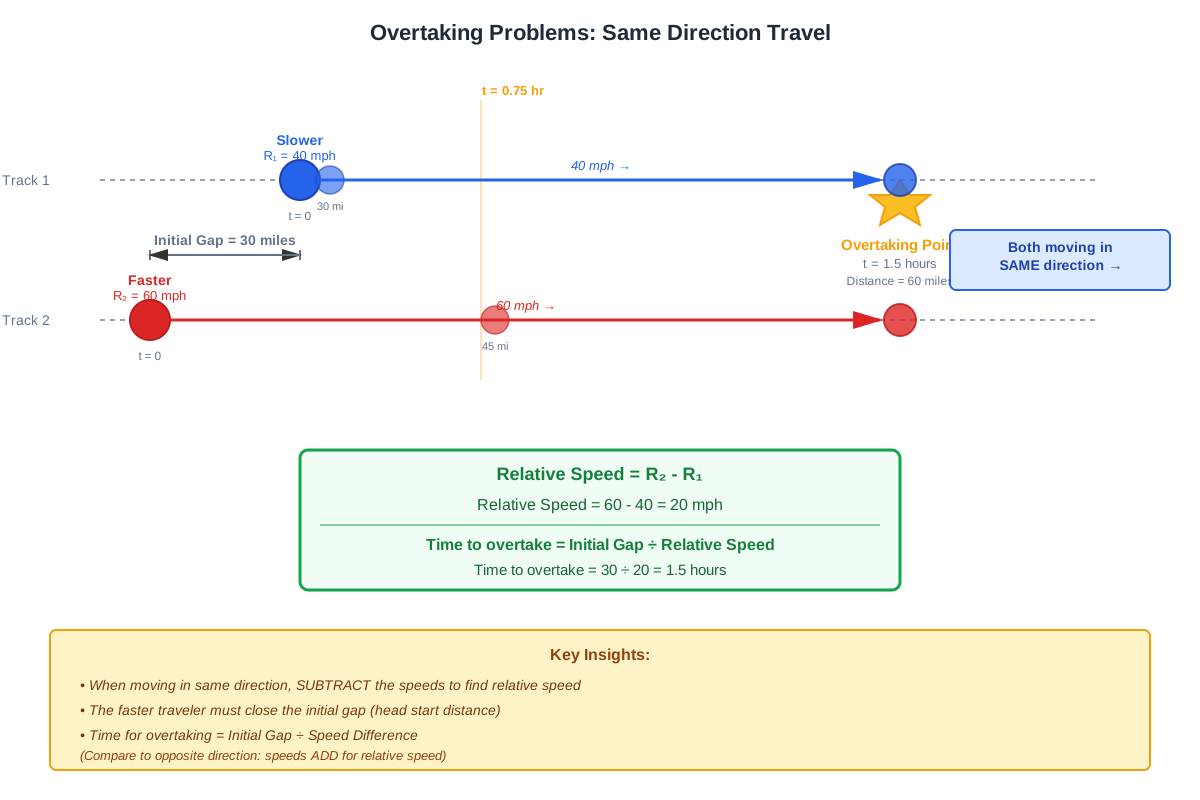
When two objects move in the same direction, the faster one either catches up to the slower one or increases the distance between them. The critical concept here is relative speed—the difference between the two speeds.
For overtaking problems: If a faster traveler starts behind a slower one, the time to catch up depends on the initial separation distance and the relative speed (faster speed minus slower speed).
Formula: Time to catch up = Initial separation / (Faster rate - Slower rate)
For example: Car A travels at 60 mph and Car B at 45 mph. If Car B has a 30-mile head start, how long until Car A catches up? Relative speed = 60 - 45 = 15 mph. Time = 30 / 15 = 2 hours.
Round-Trip Problems
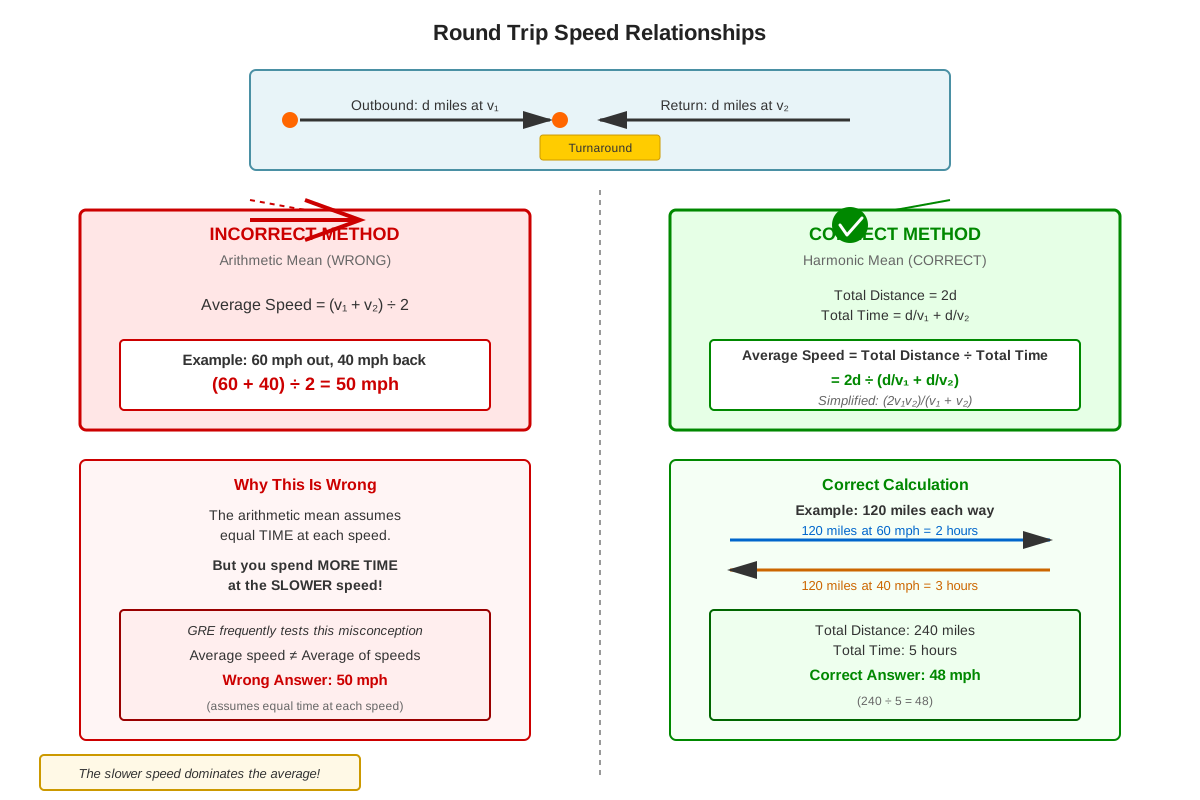
Round-trip scenarios involve traveling to a destination and returning, often at different speeds. A crucial GRE concept: average speed for a round trip does NOT equal the average of the two speeds. Instead, average speed always equals total distance divided by total time.
Process for round-trip problems:
- Calculate time for outbound journey: T₁ = D / R₁
- Calculate time for return journey: T₂ = D / R₂
- Total distance = 2D (same route both ways)
- Total time = T₁ + T₂
- Average speed = 2D / (T₁ + T₂)
This often simplifies to: Average speed = 2R₁R₂ / (R₁ + R₂), which is the harmonic mean of the two speeds.
Problems with Varying Conditions
Some GRE problems involve changing conditions during the journey—such as wind affecting airplane speed or current affecting boat speed. The key principle: effective speed equals the object's speed in still conditions plus or minus the environmental factor.
- With tailwind/downstream: Effective speed = Object speed + Wind/Current speed
- Against headwind/upstream: Effective speed = Object speed - Wind/Current speed
These problems often require setting up two equations (one for each direction) and solving the system to find the object's speed in still conditions and the environmental factor's speed.
Concept Relationships
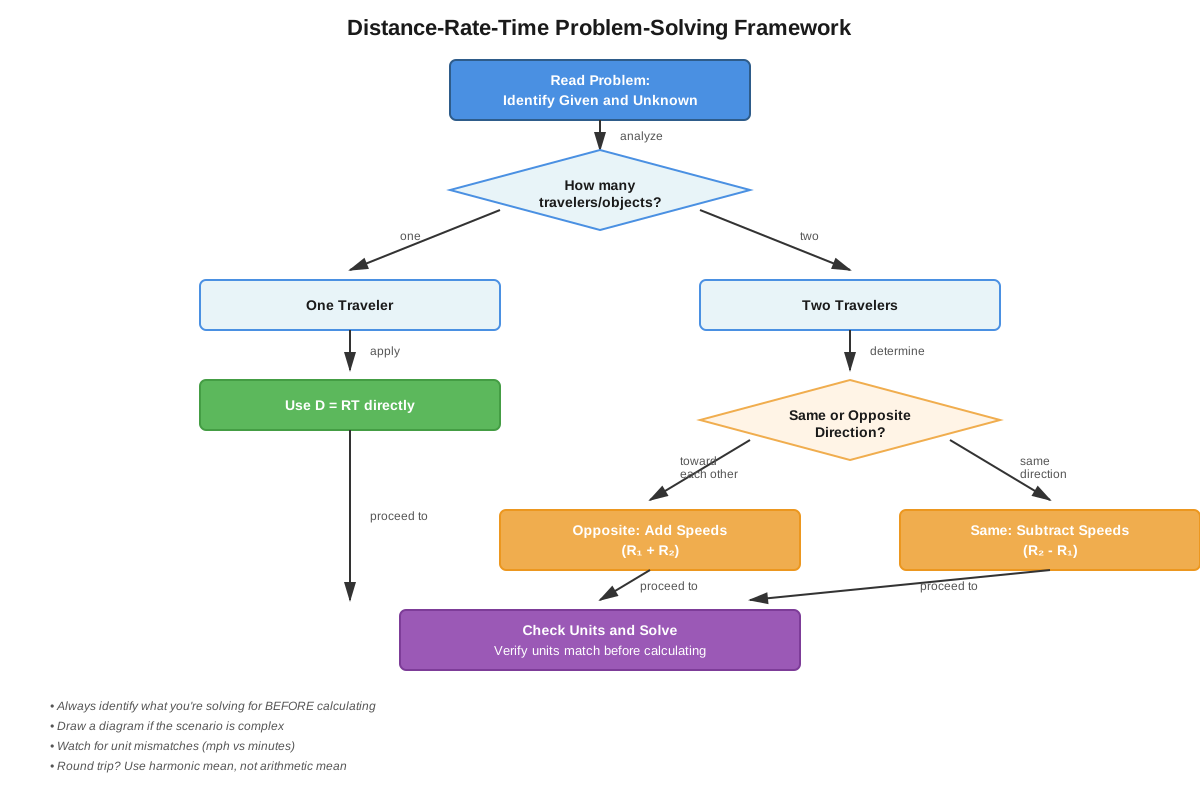
The fundamental D = R × T formula serves as the anchor from which all other concepts derive. Single-traveler problems represent the direct application of this formula, requiring only substitution and basic algebra. This foundational understanding leads to two-traveler problems, which extend the basic formula by recognizing that multiple objects can be analyzed simultaneously using the same time variable.
Two-traveler problems branch into two categories based on direction: opposite-direction problems (where distances add) and same-direction problems (where relative speed matters). Both categories rely on the insight that when multiple objects move for the same duration, their individual D = R × T equations can be combined through addition or subtraction.
Round-trip problems represent a synthesis of single-traveler concepts applied twice with different rates, connected by the crucial understanding that average speed requires total distance divided by total time—not a simple average of speeds. This connects back to the fundamental formula while introducing the concept of weighted averages based on time spent at each speed.
Problems with varying conditions (wind, current) build upon two-traveler logic by treating the environmental factor as a second "traveler" that either aids or opposes the primary object's motion. This creates a system of equations that connects to prerequisite knowledge of solving simultaneous equations.
The progression flows: Basic formula → Single application → Multiple simultaneous applications → Complex scenarios requiring systems of equations. Each level builds upon and reinforces the previous, with unit conversion serving as a critical skill that applies across all levels.
Quick check — test yourself on Distance rate time so far.
Try Flashcards →High-Yield Facts
⭐ The fundamental relationship D = R × T can be rearranged to solve for any of the three variables
⭐ When two objects move toward each other, their combined rate equals the sum of their individual rates
⭐ When two objects move in the same direction, relative speed equals the difference between their rates
⭐ Average speed for a round trip equals total distance divided by total time, NOT the average of the two speeds
⭐ Always verify that units are consistent before performing calculations (hours with hours, miles with miles)
- In meeting problems where objects start simultaneously, they travel for equal time periods
- The harmonic mean formula 2R₁R₂/(R₁ + R₂) gives average speed for equal-distance round trips
- Effective speed with wind/current: add when favorable, subtract when opposing
- Distance covered equals the area under a speed-time graph
- If speed doubles while time remains constant, distance doubles; if speed doubles while distance remains constant, time halves
- Problems stating "how much faster" or "how much farther" often require subtraction of two calculated values
- When one traveler starts later, adjust by calculating how far the first traveler has gone before the second starts
Common Misconceptions
Misconception: Average speed equals the arithmetic mean of two speeds → Correction: Average speed always equals total distance divided by total time. For a round trip at speeds R₁ and R₂, the average is 2R₁R₂/(R₁ + R₂), which is always less than (R₁ + R₂)/2 unless R₁ = R₂.
Misconception: In same-direction problems, the faster object always catches the slower one → Correction: The faster object only catches up if it starts behind or at the same point. If the slower object has enough of a head start, the faster one may never catch up within the problem's constraints.
Misconception: When two objects meet, they've each traveled half the total distance → Correction: They've each traveled for the same time, but the faster object covers more distance. The ratio of distances traveled equals the ratio of their speeds.
Misconception: Converting 30 minutes to hours gives 0.30 hours → Correction: 30 minutes equals 30/60 = 0.5 hours. The decimal 0.30 represents 30/100 of an hour, which is 18 minutes.
Misconception: If a car travels 60 mph for one hour and 40 mph for one hour, it travels 100 miles total → Correction: This is actually correct (60 + 40 = 100), but students often incorrectly apply this logic to situations where time periods differ. The misconception emerges when they assume equal time periods without verification.
Misconception: Relative speed applies to opposite-direction problems → Correction: Relative speed (difference of speeds) applies only to same-direction motion. For opposite directions, use combined speed (sum of speeds).
Worked Examples
Example 1: Two Travelers Meeting
Problem: Two cyclists start from towns 150 miles apart and ride toward each other. Cyclist A travels at 18 mph while Cyclist B travels at 12 mph. How long will it take them to meet?
Solution:
Step 1: Identify the scenario type. Two travelers moving toward each other from different starting points—this is an opposite-direction meeting problem.
Step 2: Recognize that when they meet, the sum of distances traveled equals the total separation.
- Distance traveled by A: D_A = 18t (where t is time in hours)
- Distance traveled by B: D_B = 12t
- Total distance: D_A + D_B = 150
Step 3: Set up the equation.
18t + 12t = 150
30t = 150
Step 4: Solve for time.
t = 150/30 = 5 hours
Step 5: Verify the answer makes sense. In 5 hours, Cyclist A travels 18 × 5 = 90 miles, and Cyclist B travels 12 × 5 = 60 miles. Total: 90 + 60 = 150 miles ✓
Answer: They will meet after 5 hours.
Connection to learning objectives: This example demonstrates identifying a distance-rate-time scenario (opposite-direction meeting), applying the core D = R × T formula to multiple travelers, and solving accurately.
Example 2: Round Trip with Different Speeds
Problem: Maria drives from home to the beach at an average speed of 60 mph. She returns home along the same route at an average speed of 40 mph due to traffic. What is her average speed for the entire trip?
Solution:
Step 1: Recognize the trap. The average speed is NOT (60 + 40)/2 = 50 mph.
Step 2: Use the principle that average speed = total distance / total time. Let the one-way distance be D miles.
Step 3: Calculate time for each leg.
- Time to beach: T₁ = D/60 hours
- Time returning: T₂ = D/40 hours
Step 4: Calculate total distance and total time.
- Total distance = 2D miles
- Total time = D/60 + D/40
Step 5: Find a common denominator to add the times.
D/60 + D/40 = 2D/120 + 3D/120 = 5D/120 = D/24 hours
Step 6: Calculate average speed.
Average speed = 2D / (D/24) = 2D × 24/D = 48 mph
Alternative approach using the harmonic mean formula:
Average speed = 2R₁R₂/(R₁ + R₂) = 2(60)(40)/(60 + 40) = 4800/100 = 48 mph
Answer: Maria's average speed for the entire trip is 48 mph.
Connection to learning objectives: This example illustrates a common GRE trap, demonstrates the correct strategy for round-trip problems, and shows how the harmonic mean formula provides an efficient shortcut.
Exam Strategy
When approaching gre distance rate time questions, begin by carefully reading the problem to identify the scenario type: single traveler, two travelers (same or opposite direction), round trip, or varying conditions. This classification immediately suggests which strategy to employ.
Trigger words and phrases to watch for:
- "Toward each other" or "in opposite directions" → Use combined speed (sum of rates)
- "Catches up" or "overtakes" → Use relative speed (difference of rates)
- "Average speed for the entire trip" → Calculate total distance / total time, not arithmetic mean
- "Returns along the same route" → Round-trip problem requiring harmonic mean approach
- "With the wind" or "downstream" → Add environmental speed to object speed
- "Against the wind" or "upstream" → Subtract environmental speed from object speed
Systematic approach:
- Draw a simple diagram showing starting points, directions, and distances
- Create a table with columns for Rate, Time, and Distance for each traveler
- Identify which variable is the same for all travelers (usually time)
- Write D = R × T equations for each traveler
- Combine equations based on the scenario type
- Solve systematically, checking units throughout
Process-of-elimination tips:
- Eliminate answer choices with incorrect units
- For round-trip problems, eliminate the arithmetic mean of the two speeds
- Check if answer choices are reasonable given the constraints (e.g., average speed must be between the two individual speeds for a round trip)
- Verify that faster speeds correspond to shorter times for the same distance
Time allocation: Allocate 1.5-2 minutes for straightforward single-traveler problems, 2-3 minutes for two-traveler or round-trip problems. If a problem requires more than 3 minutes, mark it for review and move on—these problems can be time traps if the setup isn't immediately clear.
GRE Tip: When a problem seems complex, assign a simple value to an unknown distance (like D = 120 miles, which divides evenly by many common speeds). This concrete approach often clarifies the relationships and leads to the correct answer more quickly than pure algebraic manipulation.
Memory Techniques
D.R.T. Mnemonic: Remember "Distance Requires Time" to recall that D = R × T. The formula reads naturally: distance requires (equals) rate times time.
Opposite vs. Same Direction: Use the acronym O.A.S.S.
- Opposite directions → Add speeds
- Same direction → Subtract speeds
Round-Trip Average Speed: Visualize a seesaw that's unbalanced. The slower speed takes more time, so it "weighs" more heavily in the average. This explains why average speed is always closer to the slower speed and never equals the arithmetic mean unless both speeds are equal.
Unit Conversion: Remember "60-60-24" for time conversions:
- 60 seconds in a minute
- 60 minutes in an hour
- 24 hours in a day
Meeting Problems: Picture two people walking toward each other with arms outstretched. When they meet, their combined arm-reach (combined speed) determines how quickly they close the gap.
Harmonic Mean Formula: For equal-distance round trips, remember "2 on top, sum on bottom": 2R₁R₂/(R₁ + R₂). The "2" represents the two equal distances.
Summary
Distance-rate-time problems on the GRE test the fundamental relationship D = R × T through increasingly sophisticated scenarios. Success requires recognizing problem types (single traveler, two travelers in opposite or same directions, round trips, and varying conditions), ensuring unit consistency, and applying the appropriate strategy. The most critical concepts include understanding that average speed equals total distance divided by total time (not the arithmetic mean of speeds), recognizing when to add speeds (opposite directions) versus subtract them (same direction), and calculating relative or combined speeds appropriately. Students must avoid common traps like confusing arithmetic and harmonic means, misapplying relative speed concepts, and making unit conversion errors. Systematic problem-solving—drawing diagrams, organizing information in tables, writing explicit equations, and verifying answers—proves more reliable than mental shortcuts. Mastery of these problems requires both conceptual understanding of the relationships between distance, rate, and time, and procedural fluency in translating word problems into mathematical equations that can be solved efficiently under timed conditions.
Key Takeaways
- The formula D = R × T and its rearrangements (R = D/T and T = D/R) form the foundation for all distance-rate-time problems
- Always verify unit consistency before calculating; convert minutes to hours or vice versa as needed
- For opposite-direction problems, add the speeds; for same-direction problems, subtract to find relative speed
- Average speed for round trips equals 2R₁R₂/(R₁ + R₂), which is always less than the arithmetic mean unless speeds are equal
- Draw diagrams and create organized tables to systematically track multiple travelers and their relationships
- Effective speed with environmental factors: add when favorable (tailwind/downstream), subtract when opposing (headwind/upstream)
- Practice identifying trigger words that signal specific problem types and solution strategies
Related Topics
Systems of Equations: Many complex distance-rate-time problems require setting up and solving systems of two or more equations, particularly when dealing with unknown speeds or distances in both directions.
Ratios and Proportions: Understanding how speeds relate proportionally helps solve problems involving scaled distances or comparing travel times at different rates.
Work Rate Problems: These follow an identical mathematical structure (Work = Rate × Time) and the strategies learned for distance-rate-time transfer directly to work problems involving multiple workers.
Unit Conversion and Dimensional Analysis: Deeper study of unit conversion techniques prevents errors and builds confidence in handling mixed-unit problems across all quantitative topics.
Average, Weighted Average, and Harmonic Mean: Understanding different types of averages and when each applies extends beyond distance problems to data interpretation and statistics questions.
Practice CTA
Now that you've mastered the core concepts, strategies, and common traps in distance-rate-time problems, it's time to solidify your understanding through practice. Attempt the practice questions designed specifically for this topic, starting with straightforward applications and progressing to complex multi-step problems that mirror actual GRE questions. Use the flashcards to reinforce key formulas, trigger words, and solution strategies until they become automatic. Remember: confidence in distance-rate-time problems comes from recognizing patterns and applying systematic approaches—skills that develop through deliberate practice. Each problem you solve strengthens your ability to quickly identify problem types and execute the correct strategy under timed conditions. You've got this!
Sign up free to keep reading
Create a free AnvayaPrep account to finish this GRE guide on Distance rate time — plus flashcards and practice questions.