Overview
Work problems represent a fundamental category of word problems that appear consistently on the GRE Quantitative Reasoning section. These problems involve scenarios where one or more individuals, machines, or entities complete tasks at specified rates, and test-takers must calculate how long it takes to complete work individually or collaboratively. The mathematical foundation of work problems rests on the relationship between rate, time, and work completed, making them closely related to rate problems and ratio problems. Understanding work problems requires translating real-world scenarios into algebraic expressions and manipulating these expressions to find unknown quantities.
The GRE frequently tests work problems because they assess multiple mathematical competencies simultaneously: algebraic reasoning, fractional arithmetic, conceptual understanding of rates, and the ability to set up and solve equations. These problems appear in both Quantitative Comparison and Problem Solving formats, often requiring students to work backwards from given information or combine rates in non-intuitive ways. Mastery of gre work problems is essential because they can appear as straightforward single-worker scenarios or complex multi-step problems involving workers with different efficiencies working together or in sequence.
Work problems connect to broader Quantitative Reasoning concepts including proportional reasoning, systems of equations, and unit conversions. They serve as practical applications of algebraic thinking and demonstrate how mathematical models represent real-world situations. The skills developed through mastering work problems—particularly the ability to conceptualize work as a quantity that can be measured and manipulated—transfer directly to other problem types involving rates, such as distance-rate-time problems and mixture problems.
Learning Objectives
- [ ] Identify when Work problems is being tested
- [ ] Explain the core rule or strategy behind Work problems
- [ ] Apply Work problems to GRE-style questions accurately
- [ ] Convert individual work rates into combined work rates for multiple workers
- [ ] Solve problems involving workers with different efficiencies working sequentially or simultaneously
- [ ] Recognize and apply the reciprocal relationship between time to complete work and work rate
- [ ] Distinguish between scenarios requiring addition versus subtraction of work rates
Prerequisites
- Algebraic equation solving: Work problems require setting up and solving linear equations and sometimes systems of equations to find unknown rates or times
- Fraction operations: Adding, subtracting, and manipulating fractions is essential since work rates are typically expressed as fractions of a job per unit time
- Ratio and proportion: Understanding proportional relationships helps in scaling work rates and comparing different workers' efficiencies
- Unit analysis: Tracking units (jobs per hour, hours per job) prevents conceptual errors and ensures correct setup of equations
Why This Topic Matters
Work problems have significant real-world applications in project management, resource allocation, manufacturing efficiency, and workforce planning. Understanding how to calculate combined productivity when multiple resources work together is fundamental to operations research, business analytics, and engineering. These problems model situations like determining staffing needs, estimating project completion times, and optimizing resource utilization—skills valuable far beyond standardized testing.
On the GRE, work problems appear with moderate to high frequency, typically comprising 1-2 questions per Quantitative Reasoning section. They appear in multiple formats: as straightforward Problem Solving questions asking for completion time, as Quantitative Comparison questions comparing different work scenarios, and occasionally as Data Interpretation questions embedded in tables showing worker productivity. The GRE particularly favors problems involving two workers with different rates working together, scenarios where workers alternate or work in sequence, and problems requiring students to find individual rates when given combined rates.
Common GRE presentations include: "Worker A can complete a job in X hours, Worker B can complete the same job in Y hours—how long will it take them working together?"; "Machine A and Machine B working together complete a task in X hours, and Machine A alone takes Y hours—how long does Machine B take alone?"; and "Pipe A fills a tank in X hours while Pipe B drains it in Y hours—how long to fill the tank with both pipes open?" These variations test whether students truly understand the underlying principles rather than simply memorizing formulas.
Core Concepts
The Fundamental Work Equation
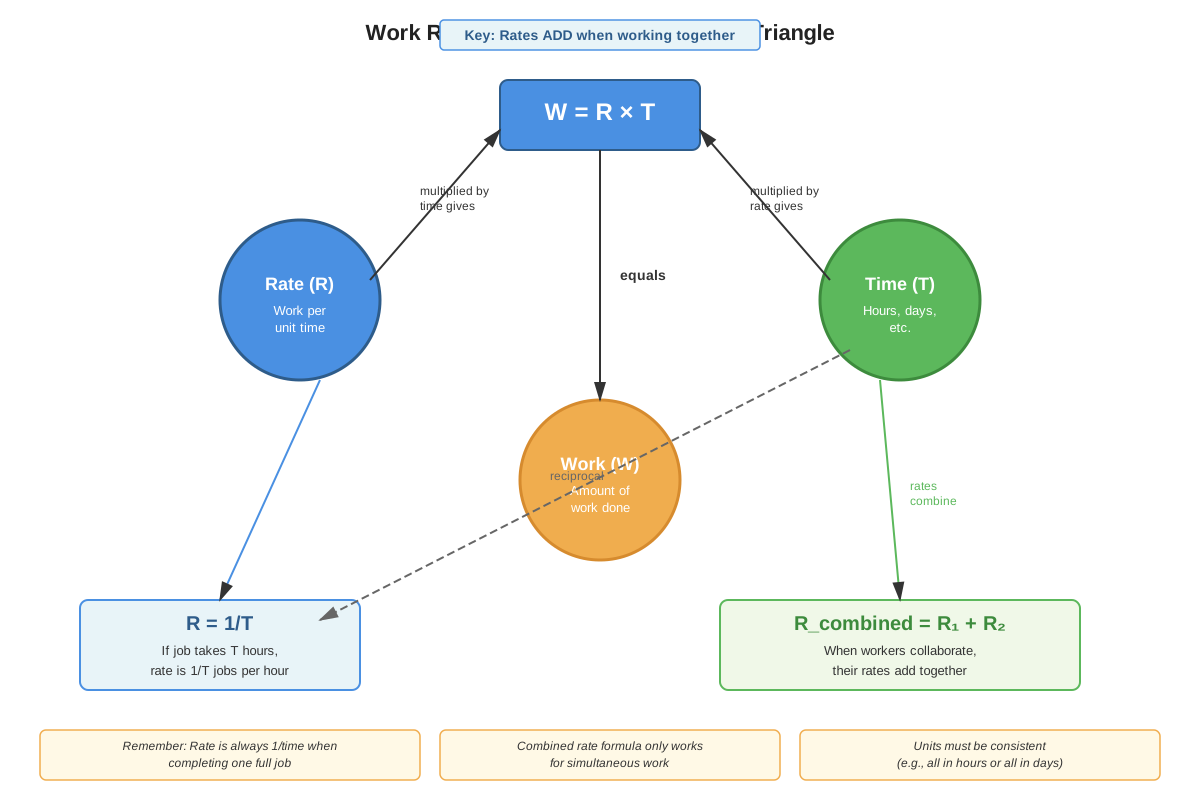
The foundation of all work problems rests on a simple relationship: Work = Rate × Time. This equation parallels the distance formula (Distance = Rate × Time) and operates on the same logical principles. In work problems, "work" represents the entire job or task to be completed, typically normalized to 1 (representing one complete job). The rate represents the fraction of the job completed per unit time, and time represents the duration spent working.
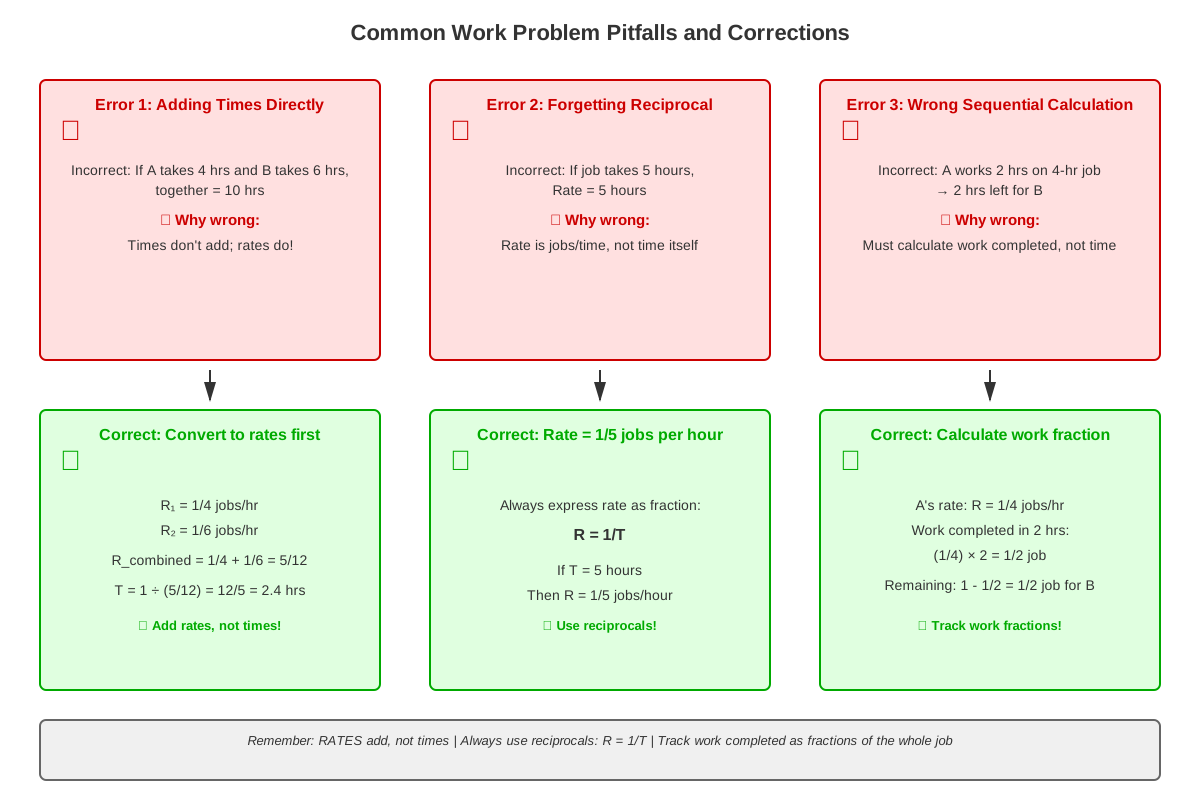
When a worker can complete a job in T hours, their work rate is 1/T jobs per hour. This reciprocal relationship is crucial: if someone completes a job in 5 hours, they complete 1/5 of the job each hour. Conversely, if someone works at a rate of 1/8 jobs per hour, they complete the entire job in 8 hours. This reciprocal nature often confuses students but represents the core insight needed to solve work problems efficiently.
Combined Work Rates
When multiple workers collaborate on the same task simultaneously, their individual rates add together to produce a combined rate. If Worker A completes 1/a of a job per hour and Worker B completes 1/b of a job per hour, their combined rate is:
Combined Rate = 1/a + 1/b = (b + a)/(ab) jobs per hourThe time to complete one job working together is the reciprocal of the combined rate:
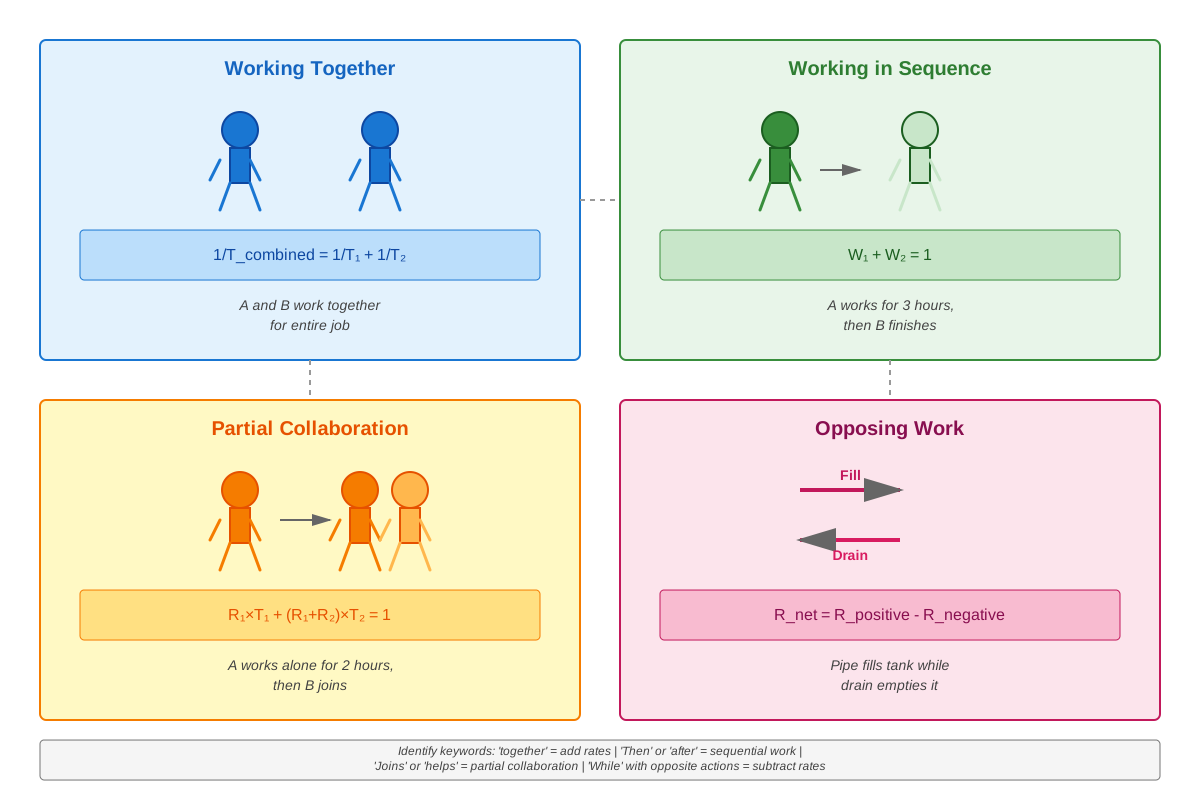
Time Together = 1 / (1/a + 1/b) = ab/(a + b) hoursThis formula appears frequently on the GRE, but memorizing it is less important than understanding why rates add. Each worker contributes their portion of work independently, so in each hour of collaborative work, the fraction of the total job completed equals the sum of individual contributions.
Working in Opposite Directions
Some GRE problems involve entities working against each other—for example, one pipe filling a tank while another drains it, or one worker building while another dismantles. In these scenarios, rates subtract rather than add. If Worker A completes work at rate 1/a and Worker B undoes work at rate 1/b, the net rate is:
Net Rate = 1/a - 1/b jobs per hourThe key distinction: determine whether the workers contribute toward the same goal (add rates) or work in opposition (subtract rates). The GRE tests this conceptual understanding by presenting scenarios where students must decide which operation applies.
Sequential Work
Problems involving workers who alternate or work in sequence require a different approach. Rather than combining rates, calculate the work each person completes during their working period, then sum these contributions until the total reaches one complete job.
For example, if Worker A works for 2 hours completing 2/a of the job, then Worker B works for 3 hours completing 3/b of the job, the total work completed is 2/a + 3/b. If this equals 1 (one complete job), the task is finished. Sequential problems often require setting up equations where the sum of fractional work contributions equals 1.
Partial Work and Remaining Work
Many GRE problems describe situations where one worker completes part of a job, then another finishes it. The approach: calculate the fraction completed by the first worker, subtract from 1 to find the remaining fraction, then determine how long the second worker needs to complete that remaining portion.
If Worker A (rate = 1/a) works for time t₁, they complete t₁/a of the job. The remaining work is 1 - t₁/a. If Worker B (rate = 1/b) finishes this remaining work, the time required is:
Time for B = (1 - t₁/a) / (1/b) = b(1 - t₁/a) hoursVariable Efficiency and Changing Rates
Advanced GRE work problems may involve workers whose rates change over time or scenarios with more than two workers. The fundamental principle remains constant: work completed equals rate multiplied by time. For multiple workers with rates r₁, r₂, r₃, etc., the combined rate is simply r₁ + r₂ + r₃ + ... when working together toward the same goal.
Some problems present rates directly (e.g., "Worker A completes 1/6 of the job per hour") rather than stating completion times. These problems skip the reciprocal conversion step but otherwise follow identical solution methods.
Setting Up Equations
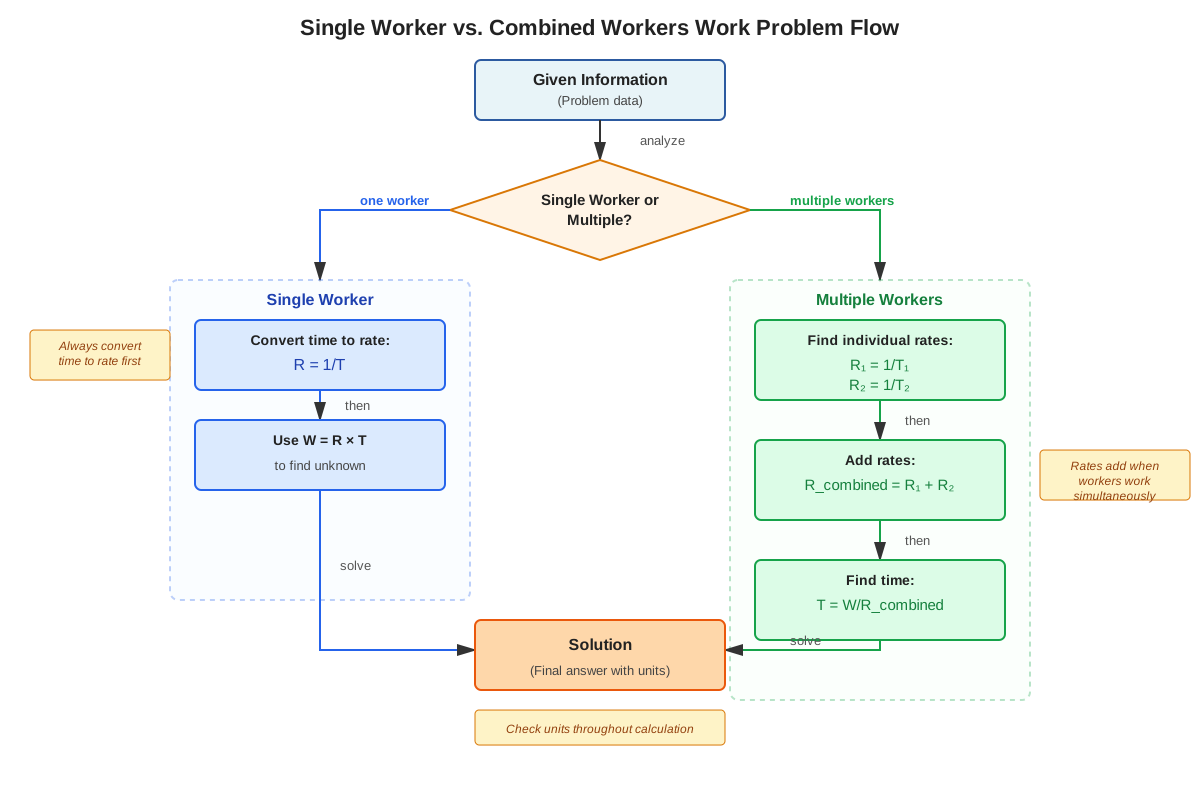
The most challenging aspect of work problems for many students is translating word problems into mathematical equations. A systematic approach:
- Define variables: Assign letters to unknown quantities (usually rates or times)
- Express rates: Convert all given information into rates (jobs per unit time)
- Write work equations: Use Work = Rate × Time for each worker or scenario
- Set up relationships: Create equations based on problem constraints (e.g., "working together they complete the job in X hours")
- Solve systematically: Use algebraic techniques to isolate and solve for unknowns
Concept Relationships
The concepts within work problems form a hierarchical structure. The Fundamental Work Equation (Work = Rate × Time) serves as the foundation from which all other concepts derive. Understanding this equation leads directly to recognizing the reciprocal relationship between completion time and work rate—a worker who takes T hours to complete a job works at rate 1/T.
This reciprocal relationship enables the concept of Combined Work Rates, where multiple workers' rates add when working together. The addition of rates connects to the broader mathematical principle that independent contributions to a total sum linearly. Working in Opposite Directions represents a variation where rates subtract rather than add, requiring students to recognize the conceptual difference between collaborative and oppositional work.
Sequential Work and Partial Work problems build upon the fundamental equation by applying it multiple times within a single problem—once for each worker or time period. These concepts require understanding that work is cumulative: the total work completed equals the sum of all individual contributions across all time periods.
The relationship map: Fundamental Work Equation → Reciprocal Relationship → Combined Rates → branches into Collaborative Work (rates add) and Oppositional Work (rates subtract) → both connect to Sequential/Partial Work (multiple applications of the fundamental equation).
These work problem concepts connect to prerequisite topics: algebraic equation solving provides the tools to manipulate work equations; fraction operations enable rate calculations and combinations; ratio and proportion help compare worker efficiencies and scale rates. Work problems also relate to other word problem types: rate problems (distance-rate-time) use identical mathematical structures, and mixture problems involve similar additive reasoning when combining different components.
High-Yield Facts
⭐ The work rate of someone who completes a job in T hours is 1/T jobs per hour
⭐ When workers collaborate on the same task, their individual rates add: Combined Rate = 1/a + 1/b
⭐ Time to complete a job together = 1 / (Combined Rate) = ab/(a+b) when individual times are a and b
⭐ When entities work in opposition (filling vs. draining), subtract rates: Net Rate = 1/a - 1/b
⭐ Work completed = Rate × Time; this equation applies to each worker individually and to combined work
- If Worker A is twice as fast as Worker B, then Worker A's rate is 2 × Worker B's rate, or Worker A's time is 1/2 × Worker B's time
- The total work in a standard problem is normalized to 1 (representing one complete job)
- When a worker completes a fraction f of a job, the remaining work is 1 - f
- If n identical workers complete a job in T hours, one worker alone takes nT hours
- Three workers with times a, b, and c working together complete the job in time 1/(1/a + 1/b + 1/c)
Quick check — test yourself on Work problems so far.
Try Flashcards →Common Misconceptions
Misconception: When two workers take times a and b to complete a job individually, they complete it in time (a + b)/2 working together → Correction: The combined time is ab/(a + b), not the arithmetic mean. Rates add, not times. If Worker A takes 4 hours and Worker B takes 6 hours, together they take (4×6)/(4+6) = 24/10 = 2.4 hours, not 5 hours.
Misconception: A faster worker has a larger time value → Correction: A faster worker has a smaller time value but a larger rate value. If Worker A completes a job in 3 hours and Worker B in 5 hours, Worker A is faster (rate = 1/3 > 1/5).
Misconception: If two workers together take T hours, each worker alone takes 2T hours → Correction: This is only true if both workers have identical rates. Generally, knowing only the combined time provides insufficient information to determine individual times without additional constraints.
Misconception: When one pipe fills and another drains, always subtract the smaller rate from the larger → Correction: Subtract the draining rate from the filling rate (or vice versa), which may yield a negative result if draining exceeds filling. The sign indicates whether the tank fills or empties.
Misconception: Work problems require memorizing multiple formulas → Correction: All work problems derive from the single fundamental equation Work = Rate × Time. Understanding this relationship and the concept that rates add (or subtract) eliminates the need for formula memorization.
Misconception: If Worker A works for half the time and Worker B for the other half, each completes half the work → Correction: Each completes work proportional to their rate multiplied by their time. If rates differ, work contributions differ even with equal time periods.
Worked Examples
Example 1: Basic Combined Work
Problem: Machine A can complete a manufacturing job in 6 hours. Machine B can complete the same job in 9 hours. How long will it take both machines working together to complete the job?
Solution:
Step 1: Identify individual rates
- Machine A's rate = 1/6 jobs per hour
- Machine B's rate = 1/9 jobs per hour
Step 2: Calculate combined rate
- Combined rate = 1/6 + 1/9
- Find common denominator: 1/6 = 3/18 and 1/9 = 2/18
- Combined rate = 3/18 + 2/18 = 5/18 jobs per hour
Step 3: Calculate time to complete one job
- Time = Work / Rate = 1 / (5/18) = 18/5 = 3.6 hours
Answer: 3.6 hours or 3 hours 36 minutes
Connection to Learning Objectives: This problem demonstrates the core strategy of converting individual completion times to rates, adding rates for collaborative work, and finding the reciprocal to determine combined completion time.
Example 2: Finding Individual Rate from Combined Information
Problem: Working together, Pump X and Pump Y can fill a swimming pool in 4 hours. Pump X alone can fill the pool in 6 hours. How long would it take Pump Y alone to fill the pool?
Solution:
Step 1: Set up known information
- Combined rate = 1/4 pools per hour
- Pump X's rate = 1/6 pools per hour
- Pump Y's rate = unknown (let's call it 1/y)
Step 2: Use the relationship that combined rate equals sum of individual rates
- 1/4 = 1/6 + 1/y
Step 3: Solve for y
- 1/y = 1/4 - 1/6
- Find common denominator: 1/4 = 3/12 and 1/6 = 2/12
- 1/y = 3/12 - 2/12 = 1/12
- Therefore, y = 12
Answer: Pump Y alone takes 12 hours to fill the pool
Connection to Learning Objectives: This problem requires working backwards from combined information to find an individual rate, demonstrating the flexibility needed to apply work problem strategies in various formats. It also shows how to set up and solve equations when some information is given and other information must be derived.
Example 3: Sequential Work with Partial Completion
Problem: Worker A can paint a house in 8 days. Worker A works alone for 3 days, then Worker B joins and they complete the job together in 2 more days. How long would it take Worker B to paint the house alone?
Solution:
Step 1: Calculate work completed by Worker A alone
- Worker A's rate = 1/8 houses per day
- Work completed in 3 days = 3 × (1/8) = 3/8 of the house
Step 2: Calculate remaining work
- Remaining work = 1 - 3/8 = 5/8 of the house
Step 3: Set up equation for combined work
- Let Worker B's rate = 1/b houses per day
- Combined rate = 1/8 + 1/b
- In 2 days, they complete: 2 × (1/8 + 1/b) = 5/8
Step 4: Solve for b
- 2/8 + 2/b = 5/8
- 2/b = 5/8 - 2/8 = 3/8
- 2/b = 3/8
- b = 16/3 = 5.33... days
Answer: Worker B alone would take 16/3 days (approximately 5.33 days or 5 days 8 hours)
Connection to Learning Objectives: This problem combines multiple concepts—partial work completion, sequential work periods, and finding unknown rates from combined information. It demonstrates the importance of tracking work completed in different phases and setting up equations that account for all contributions.
Exam Strategy
When approaching GRE work problems, begin by identifying the question type: Are you finding combined time, individual time, or comparing scenarios? This determines your solution path. Look for trigger phrases such as "working together," "working alone," "complete the job," "at this rate," and "how long will it take." These phrases signal work problems and indicate what information is given versus what must be found.
Systematic setup prevents errors: Always write down rates explicitly before attempting calculations. Convert all completion times to rates (using the reciprocal) and label them clearly (e.g., "Rate_A = 1/6"). This extra step takes seconds but prevents conceptual confusion between rates and times.
For Quantitative Comparison questions involving work problems, avoid full calculations when possible. Instead, use logical reasoning: if Worker A is faster than Worker B individually, their combined time will be closer to Worker A's time than to Worker B's time. If comparing two different collaborative scenarios, consider which combination has the faster average rate.
Process of elimination works effectively when answer choices differ significantly. If Worker A takes 4 hours and Worker B takes 6 hours individually, their combined time must be less than 4 hours (the faster worker's time). Eliminate any answer choices ≥ 4 hours immediately. Similarly, the combined time must be greater than 2 hours (half of the faster worker's time, which would require two identical workers as fast as Worker A).
Time management: Straightforward two-worker problems should take 60-90 seconds. If a problem requires more than 2 minutes, consider whether you've chosen the most efficient approach. Complex problems with sequential work or multiple workers may justify 2-3 minutes, but recognize when to make an educated guess and move forward.
Common trap answers include the arithmetic mean of individual times (a + b)/2 and the harmonic mean without proper calculation. The GRE deliberately includes these as incorrect answer choices. Also watch for problems where rates subtract rather than add—these require careful reading to identify oppositional work.
Unit consistency matters: Ensure all rates use the same time unit (hours, days, minutes). If one worker's time is given in hours and another's in days, convert before combining rates. The GRE occasionally tests whether students notice unit mismatches.
Memory Techniques
"Rate-Time-Work" Triangle Mnemonic: Visualize a triangle with "Work" at the top and "Rate" and "Time" at the bottom corners. Cover any one element to see the formula: Work = Rate × Time, Rate = Work / Time, Time = Work / Rate. This single visualization captures all three relationships.
"Flip for Rate" Rule: To convert completion time to work rate, "flip" the number and add "per hour" (or appropriate time unit). 5 hours to complete → 1/5 per hour. This simple rule prevents confusion about the reciprocal relationship.
"Add for Together, Subtract for Against": When workers collaborate toward the same goal, add their rates. When they work in opposition (filling vs. draining, building vs. demolishing), subtract rates. The prepositions "together" and "against" signal which operation to use.
"One Job" Anchor: Always normalize the total work to 1 (one complete job). This standardization simplifies all calculations and makes rates directly comparable. Think "one job = 1" as your starting point for every problem.
"ABC Formula" for Two Workers: For workers with individual times a and b, remember "a times b over a plus b" for combined time: ab/(a+b). The alliteration "a times b" and "a plus b" helps recall which operation goes where.
Summary
Work problems on the GRE test the fundamental relationship between work, rate, and time through scenarios involving individuals or machines completing tasks. The core principle—Work = Rate × Time—underlies all work problems, with the critical insight that a worker completing a job in T hours works at rate 1/T jobs per hour. When multiple workers collaborate, their rates add to produce a combined rate, and the time to complete one job together equals the reciprocal of this combined rate. Problems may involve finding combined completion times, determining individual rates from combined information, or analyzing sequential work scenarios where different workers contribute during different time periods. Success requires converting between times and rates fluently, setting up equations that capture problem constraints, and recognizing whether rates should add (collaborative work) or subtract (oppositional work). The GRE presents work problems in various formats but consistently tests whether students understand the underlying mathematical relationships rather than simply memorizing formulas. Mastery comes from recognizing the problem type quickly, systematically converting all information to rates, and applying the fundamental equation appropriately to each phase of work.
Key Takeaways
- Work problems fundamentally rely on Work = Rate × Time, with work typically normalized to 1 (one complete job)
- The reciprocal relationship is essential: completion time T corresponds to rate 1/T, and vice versa
- When workers collaborate toward the same goal, add their rates; when working in opposition, subtract rates
- Combined completion time for workers with individual times a and b is ab/(a+b), always less than either individual time
- Sequential and partial work problems require tracking work completed in each phase and ensuring total work sums to 1
- Convert all information to rates before attempting calculations to avoid confusion between rates and times
- Recognize trigger phrases like "working together" and "working alone" to identify work problems quickly
Related Topics
Rate Problems (Distance-Rate-Time): These problems use identical mathematical structures to work problems, with distance replacing work as the quantity calculated. Mastering work problems provides direct transferable skills to distance problems.
Ratio and Proportion: Understanding how to compare worker efficiencies and scale rates connects to broader ratio concepts. Work problems often involve proportional reasoning when comparing different scenarios.
Systems of Equations: Complex work problems with multiple unknowns require setting up and solving systems of equations, building on algebraic skills developed through work problem practice.
Mixture Problems: These problems involve combining substances with different concentrations, using additive reasoning similar to combining work rates. The conceptual framework transfers between these problem types.
Optimization Problems: Advanced applications of work concepts appear in optimization scenarios where the goal is to minimize time or maximize efficiency given constraints.
Practice CTA
Now that you've mastered the core concepts, strategies, and common pitfalls of work problems, it's time to solidify your understanding through practice. Attempt the practice questions associated with this topic, focusing on applying the systematic approach outlined in this guide. Work through problems methodically—convert times to rates, identify whether rates add or subtract, and set up equations carefully. Use the flashcards to reinforce the reciprocal relationship between time and rate until it becomes automatic. Remember, work problems appear frequently on the GRE, and the time invested in mastering them pays dividends across multiple questions on test day. Each practice problem strengthens your pattern recognition and solution speed, bringing you closer to your target score. You've built the foundation—now apply it with confidence!
Sign up free to keep reading
Create a free AnvayaPrep account to finish this GRE guide on Work problems — plus flashcards and practice questions.