Overview
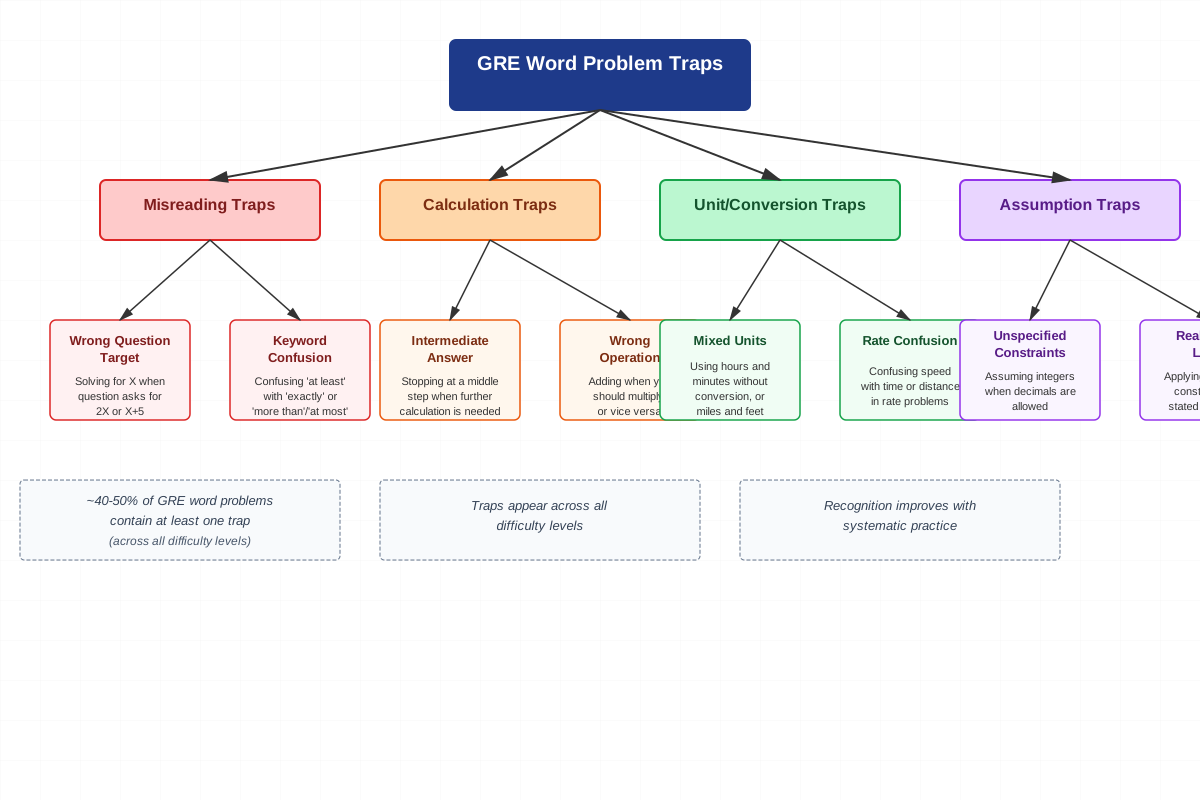
GRE word problem traps are deliberately designed question features that exploit common reasoning errors, misreading tendencies, and calculation shortcuts that test-takers make under time pressure. These traps appear across all quantitative word problem types—from rate problems to probability scenarios—and represent one of the most significant obstacles between average and exceptional GRE Quantitative scores. Understanding these traps is not about learning new mathematical content; rather, it involves developing metacognitive awareness of how the test writers craft wrong answer choices and misleading question stems.
The GRE Quantitative section tests mathematical reasoning more than computational ability, and word problem traps exemplify this philosophy. Test writers create problems where the "obvious" approach leads directly to an incorrect answer choice, where misreading a single word changes the entire problem, or where intermediate calculations appear as tempting wrong answers. These gre word problem traps systematically target predictable errors: confusing "what" is being asked, using the wrong units, stopping calculations prematurely, or making unwarranted assumptions about problem constraints.
Mastering trap recognition connects directly to broader Quantitative Reasoning success because it develops the critical reading skills and strategic thinking that distinguish high scorers. Word problem traps appear in arithmetic, algebra, geometry, and data interpretation contexts, making this topic a cross-cutting skill that enhances performance across the entire Quantitative section. Students who internalize trap patterns not only avoid wrong answers but also work more efficiently, as they learn to anticipate where problems will attempt to mislead them and can verify their answers against common error patterns.
Learning Objectives
- [ ] Identify when GRE word problem traps is being tested
- [ ] Explain the core rule or strategy behind GRE word problem traps
- [ ] Apply GRE word problem traps to GRE-style questions accurately
- [ ] Distinguish between intermediate values and final answers in multi-step problems
- [ ] Recognize language patterns that signal potential misinterpretation
- [ ] Develop a systematic verification process to catch trap answers before submission
- [ ] Analyze wrong answer choices to understand the specific error each represents
Prerequisites
- Basic arithmetic operations: Word problem traps often involve simple calculations where the trap lies in problem interpretation rather than computational difficulty
- Algebraic equation setup: Understanding how to translate words into mathematical expressions is essential for recognizing when trap language leads to incorrect equations
- Unit conversion fundamentals: Many traps exploit confusion between different units (hours vs. minutes, miles vs. kilometers)
- Reading comprehension skills: Parsing complex sentence structures and identifying what the question actually asks forms the foundation of trap avoidance
- Percentage and ratio concepts: Numerous traps involve confusing percentage increase with final value or mixing up ratio relationships
Why This Topic Matters
Word problem traps represent a high-leverage study area because they appear in approximately 40-50% of GRE Quantitative word problems across all difficulty levels. Unlike content gaps that require learning new mathematical concepts, trap awareness can be developed relatively quickly and yields immediate score improvements. The GRE deliberately includes these traps to differentiate between test-takers who carefully analyze problems and those who rush to calculation, making trap recognition a key discriminator at higher score ranges (160+).
In real-world applications, the skills developed through trap recognition—careful reading, assumption checking, and systematic verification—transfer directly to professional and academic contexts where misinterpreting requirements or making unwarranted assumptions leads to costly errors. Graduate programs value these analytical habits because they reflect the careful reasoning required in research and professional practice.
On the exam, gre gre word problem traps appear most frequently in Quantitative Comparison questions (where trap answers exploit incomplete analysis), Problem Solving questions with multiple steps (where intermediate values appear as wrong answers), and Data Interpretation sets (where questions ask about specific subgroups but test-takers calculate for the entire dataset). The most common trap categories include: asking for one quantity but tempting calculation of another, using confusing language about increases versus final amounts, presenting problems where the "obvious" setup is incorrect, and including unnecessary information that misleads problem-solving approaches.
Core Concepts
The Question-Answer Mismatch Trap
The most prevalent gre word problem trap involves calculating a correct value for the wrong quantity. Test writers craft problems where the natural calculation flow produces a value that answers a related but different question than what is actually asked. For example, a problem might provide information to calculate John's age, require multiple steps of reasoning, but ultimately ask for Mary's age—with John's age appearing as a trap answer choice.
This trap succeeds because test-takers often begin calculating before fully processing what the question asks. Under time pressure, the cognitive load of setting up equations and performing calculations causes the actual question to fade from working memory. The trap is particularly effective in multi-step problems where intermediate values feel like natural stopping points.
Recognition strategy: Before beginning any calculation, underline or mentally note exactly what variable or quantity the question asks for. After completing calculations, explicitly verify that the final answer corresponds to this quantity. If the problem involves multiple people, objects, or time periods, label all intermediate calculations clearly.
The Intermediate Value Trap
Multi-step word problems naturally generate intermediate values during the solution process. Test writers systematically include these intermediate values as wrong answer choices, knowing that test-takers who stop calculating prematurely or lose track of problem requirements will select them. This trap appears most frequently in rate problems, percentage change problems, and sequential calculation scenarios.
For instance, a problem might ask for total distance traveled, requiring calculation of distance in segment one (50 miles), distance in segment two (30 miles), and then summing them (80 miles). Both 50 and 30 will appear as trap answers. The intermediate value trap exploits both premature stopping and the psychological tendency to recognize familiar numbers from one's own calculations.
Recognition strategy: In multi-step problems, write out the complete solution path before beginning calculations. Mark intermediate values with labels like "Step 1 result" to maintain awareness that further calculation is needed. Before selecting an answer, count the number of steps required and verify that all have been completed.
The Unit Confusion Trap
Problems frequently provide information in one unit system but ask for answers in another, or mix units within a single problem. The gre word problem traps in this category include: providing rates in hours but asking for answers in minutes, giving dimensions in feet but requiring area in square yards, or presenting speeds in miles per hour while distances are in kilometers. Trap answers include the correct numerical value with wrong units or the result of failing to convert.
| Given Units | Required Units | Trap Answer Pattern |
|---|---|---|
| Hours | Minutes | Correct value ÷ 60 |
| Miles/hour | Feet/second | Correct value without conversion factor |
| Square feet | Square yards | Correct value without dividing by 9 |
| Percentage increase | Final percentage | Original + increase (wrong) vs. final value (correct) |
Recognition strategy: Circle all units in the problem statement and the question. Before calculating, determine if conversion is needed and write out the conversion factor. After obtaining a numerical answer, verify that the units match what the question requires.
The Assumption Trap
These traps exploit unstated assumptions that test-takers make based on real-world expectations or incomplete problem reading. Common assumption traps include: assuming rates remain constant when the problem doesn't specify this, assuming geometric figures are drawn to scale when they explicitly aren't, assuming all members of a group have a property when only "some" are specified, or assuming processes are reversible when they aren't.
For example, a problem might state "some of the students are seniors" and ask about the total number of students, but test-takers assume all students mentioned are seniors. Or a rate problem might describe two different rates for different time periods, but test-takers assume a single constant rate throughout.
Recognition strategy: Identify every constraint and condition explicitly stated in the problem. Actively question assumptions, particularly: "Does the problem state this rate is constant?" "Does the problem confirm all members have this property?" "Is this figure stated to be drawn to scale?" When information seems missing, consider whether the problem is actually solvable without making assumptions—if so, the assumption is likely a trap.
The Percentage vs. Absolute Value Trap
Percentage problems generate numerous traps by exploiting confusion between percentage change and final percentage, between percentage of different bases, and between successive percentage changes. A classic example: "A price increases by 20% then decreases by 20%—is the final price the same as the original?" The trap answer is "yes" (assuming changes cancel), but the correct answer is "no" because the decrease applies to a larger base.
Other variations include asking for the percentage one quantity represents of another, but test-takers calculate the percentage change instead. Or providing a percentage increase and asking for the final amount, but trap answers show just the increase amount or the original amount.
Recognition strategy: In percentage problems, explicitly identify: (1) What is the base/reference amount? (2) Is the question asking for a percentage or an absolute value? (3) If multiple percentage changes occur, do they apply to the same base? Create a simple table showing original value, change, and final value to maintain clarity.
The Ratio and Proportion Trap
Ratio problems create traps through confusion between part-to-part and part-to-whole relationships, between ratios and actual quantities, and through changes in ratio relationships. For example, if boys to girls is 3:2, test-takers might incorrectly conclude boys are 3/2 of the total rather than 3/5 of the total.
Another common trap: when a ratio is given and one quantity changes, test-takers often incorrectly assume the ratio remains constant. If the ratio of apples to oranges is 2:3 and 10 apples are added, the new ratio is not 2:3 unless oranges are also added proportionally.
Recognition strategy: For any ratio problem, immediately convert the ratio to actual quantities by introducing a variable (if ratio is 3:2, let quantities be 3x and 2x). Clearly distinguish between part-to-part ratios and part-to-whole fractions. When quantities change, recalculate the ratio from the new actual quantities rather than trying to adjust the ratio directly.
The Unnecessary Information Trap
The GRE includes extraneous information in word problems to test whether students can identify relevant data. This trap works in two ways: test-takers waste time incorporating irrelevant information into complex calculations, or they assume all provided information must be used and create incorrect solution approaches to force its inclusion.
Recognition strategy: Before calculating, identify what information is actually needed to answer the question. If certain data points aren't used in the solution, verify that the answer is indeed determinable without them—if so, the unused information was deliberately extraneous. Don't force information into the solution simply because it was provided.
The Language Precision Trap
Subtle word choices dramatically change problem meaning, and traps exploit misreading or imprecise interpretation. Critical distinctions include: "at least" vs. "exactly" vs. "at most," "increased by" vs. "increased to," "factor of" vs. "percent of," "average" vs. "median," and "consecutive" vs. "distinct."
For example, "the price increased by 50%" means multiply by 1.5, while "the price increased to 50%" means the new price is 50% of some reference (likely the original, making it a decrease). "A number is a factor of 24" means the number divides 24, while "a number is 24 times a factor" means something entirely different.
Recognition strategy: Slow down when reading the problem and question. Circle or underline key qualifying words. Mentally rephrase the question in your own words and verify the rephrasing matches the original. Be especially careful with prepositions (by, to, of, from) as they often carry critical meaning.
Concept Relationships
The various trap categories interconnect and often appear in combination within a single problem. The Question-Answer Mismatch Trap represents the highest-level category, as any other trap type can combine with asking for the wrong quantity. For instance, a problem might involve both Unit Confusion (requiring conversion) and Intermediate Value traps (where the converted value is an intermediate step, not the final answer).
Language Precision Traps → enable → Assumption Traps: Misreading qualifying language like "some" as "all" creates false assumptions about problem constraints. Similarly, Percentage vs. Absolute Value Traps often combine with Ratio and Proportion Traps in problems involving percentage changes in quantities that are related by ratios.
The Unnecessary Information Trap interacts with all other categories by adding cognitive load that makes other traps more effective. When working memory is occupied tracking irrelevant details, test-takers are more likely to make question-answer mismatches or unit conversion errors.
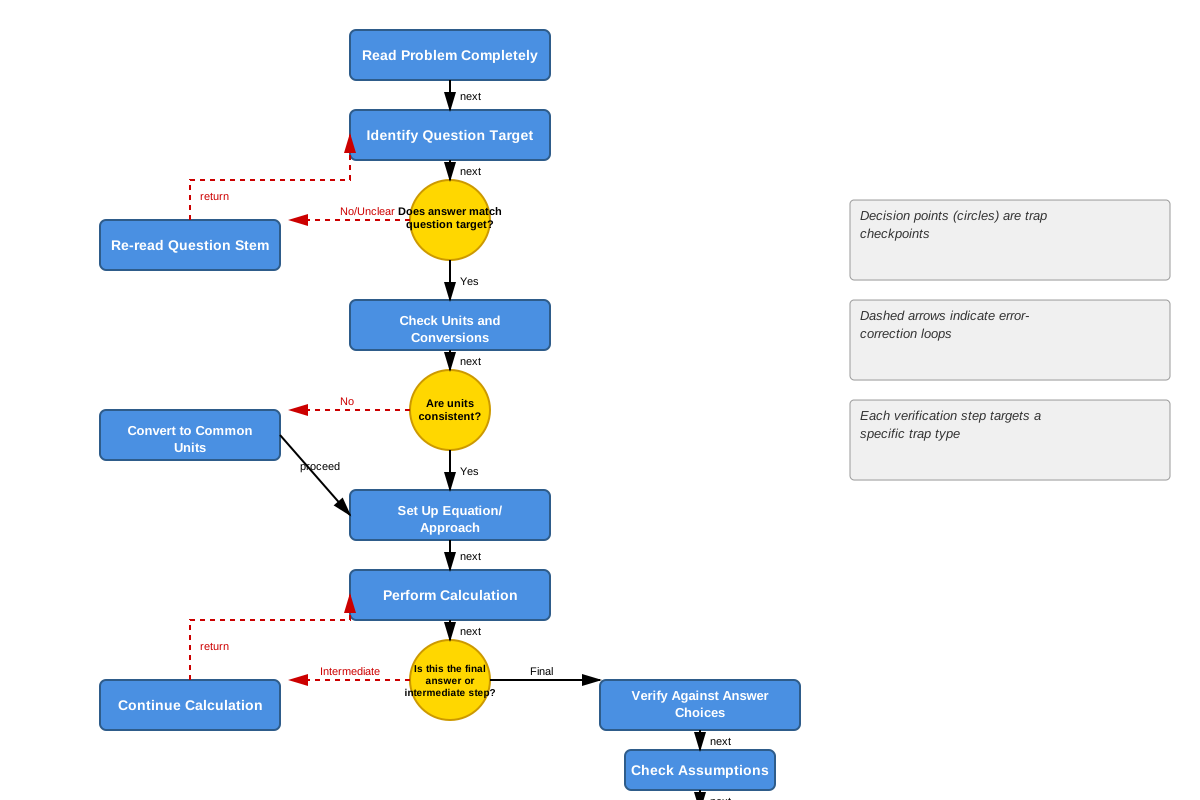
Understanding these relationships enables a systematic approach: first, eliminate unnecessary information; second, parse language precisely to avoid assumptions; third, identify what the question asks and what units are required; fourth, plan the complete solution path to avoid stopping at intermediate values; and finally, verify the answer against common trap patterns.
Quick check — test yourself on GRE word problem traps so far.
Try Flashcards →High-Yield Facts
⭐ Approximately 70% of word problem wrong answers represent intermediate calculation values or answers to related but different questions than what was asked
⭐ When a problem provides information in one unit but asks for an answer in another unit, the unconverted value almost always appears as a trap answer
⭐ In percentage problems, if the question asks for a final amount, the percentage change amount (not the final value) typically appears as a trap answer
⭐ Ratio problems that ask for a part-to-whole fraction commonly include the part-to-part ratio as a trap answer choice
⭐ Multi-step problems systematically include the result of stopping after each intermediate step as wrong answer choices
- Problems using "increased by X%" have trap answers showing "increased to X%" calculations and vice versa
- When geometric figures state "not drawn to scale," trap answers exploit assumptions based on visual appearance
- Questions asking "at least" commonly include trap answers that calculate "exactly" or "at most"
- In rate problems with changing rates, trap answers assume a single constant rate throughout
- When a problem asks for one person's age/amount/quantity, other people's values appear as trap answers
- Successive percentage changes never simply add or subtract (20% increase then 20% decrease ≠ no change)
- Problems with "some," "several," or "a few" have trap answers that assume "all" or specific numerical values
Common Misconceptions
Misconception: All information provided in a word problem must be used in the solution → Correction: The GRE deliberately includes extraneous information to test whether students can identify relevant data. Not all provided information is necessary, and forcing it into the solution often leads to incorrect approaches.
Misconception: If a calculated value appears among the answer choices, it must be correct → Correction: The GRE systematically includes intermediate values and answers to related questions as wrong choices. Seeing your calculated value in the choices confirms only that you performed some calculation, not that you answered the correct question.
Misconception: Percentage changes are reversible (if something increases 20% then decreases 20%, it returns to the original value) → Correction: Percentage changes apply to different bases. A 20% increase followed by a 20% decrease results in a net decrease because the second percentage applies to a larger base (original × 1.20 × 0.80 = original × 0.96).
Misconception: In ratio problems, if the ratio of A to B is 3:2, then A represents 3/2 of the total → Correction: A represents 3/(3+2) = 3/5 of the total. The ratio 3:2 is a part-to-part relationship, while 3/5 is the part-to-whole relationship. These are fundamentally different and must not be confused.
Misconception: "Increased by 50%" and "increased to 50%" mean the same thing → Correction: "Increased by 50%" means the new value is 150% of the original (multiply by 1.5), while "increased to 50%" typically means the new value is 50% of some reference, often representing a decrease if the reference is the original value.
Misconception: When a problem seems to lack sufficient information, assumptions should be made to solve it → Correction: If a GRE problem appears unsolvable, first verify whether it's actually asking for a specific numerical answer or a relationship/comparison. Many Quantitative Comparison questions are designed to be answerable without complete information. Making unwarranted assumptions is a trap.
Misconception: Geometric figures on the GRE are drawn to scale unless otherwise noted → Correction: The opposite is true—GRE geometric figures are explicitly NOT drawn to scale unless stated otherwise. Trap answers exploit visual assumptions about angle sizes, relative lengths, and shape properties.
Worked Examples
Example 1: Multi-Trap Rate Problem
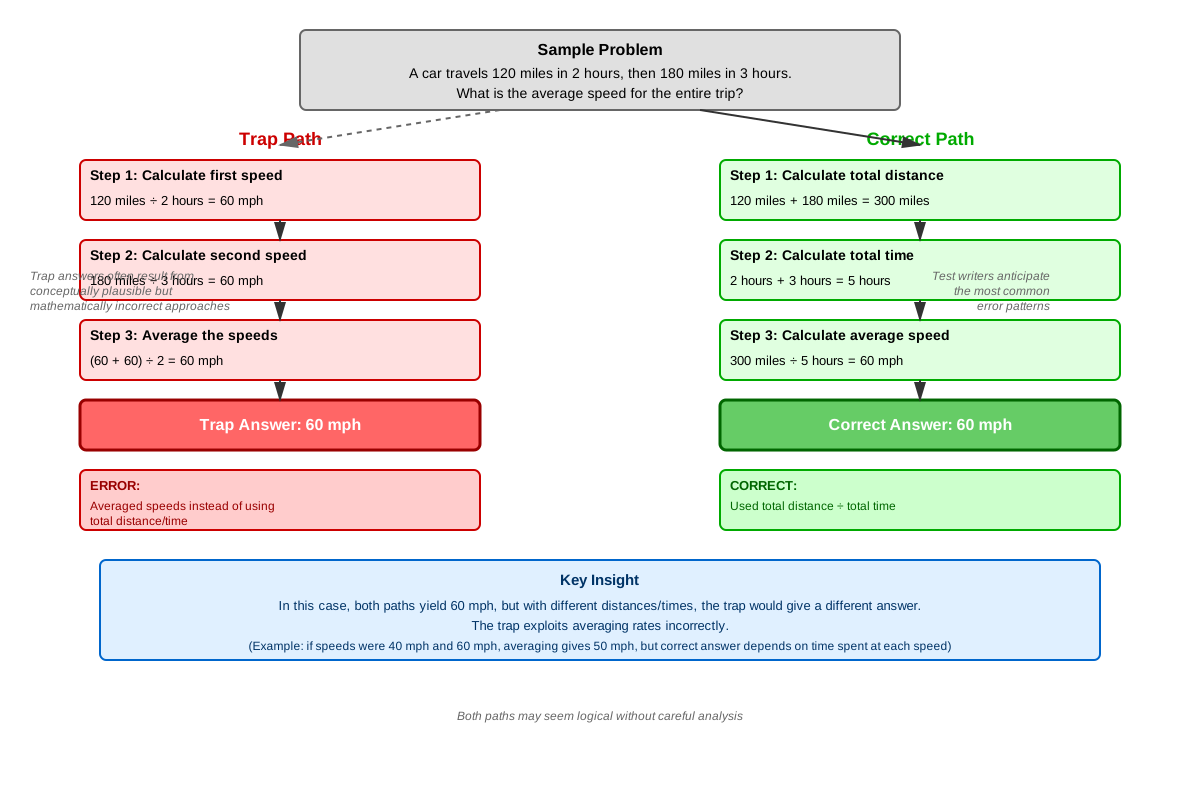
Problem: Sarah drives from City A to City B at an average speed of 60 miles per hour. The trip takes 2.5 hours. On the return trip, she drives at 50 miles per hour. What is Sarah's average speed for the entire round trip?
Trap answers likely include: 55 mph (arithmetic mean of speeds), 150 miles (total distance one way), 300 miles (total distance round trip)
Solution with trap analysis:
Step 1: Identify what the question asks. The question asks for average speed for the entire round trip (not distance, not the arithmetic mean of the two speeds).
Step 2: Recognize the trap. The most tempting trap is calculating (60 + 50)/2 = 55 mph. This is the arithmetic mean of the speeds, but average speed = total distance / total time, not the arithmetic mean of speeds.
Step 3: Calculate distance from A to B.
- Distance = speed × time = 60 mph × 2.5 hours = 150 miles
- Note: 150 miles will appear as a trap answer (intermediate value)
Step 4: Calculate time for return trip.
- Time = distance / speed = 150 miles / 50 mph = 3 hours
Step 5: Calculate average speed for round trip.
- Total distance = 150 + 150 = 300 miles (this will also be a trap answer)
- Total time = 2.5 + 3 = 5.5 hours
- Average speed = 300 miles / 5.5 hours ≈ 54.5 mph
Verification: The answer (54.5 mph) is less than the arithmetic mean (55 mph), which makes sense because Sarah spent more time traveling at the slower speed, pulling the average down. The answer is not 55, not 150, and not 300—all trap values we calculated along the way.
Learning objective connection: This example demonstrates identifying when traps are being tested (multiple intermediate values), explaining the strategy (calculate total distance and total time separately, then divide), and applying the concept accurately (avoiding the arithmetic mean trap).
Example 2: Percentage and Language Precision Trap
Problem: The price of a stock increased by 25% in January. In February, the price decreased by 20%. By what percentage did the stock price change over the two months compared to its original price?
Trap answers likely include: 5% increase (25% - 20%), 0% (assuming changes cancel), 20% decrease (February's change)
Solution with trap analysis:
Step 1: Identify the language precision issue. "Increased by 25%" means multiply by 1.25. "Decreased by 20%" means multiply by 0.80. The question asks for the overall percentage change compared to the original price.
Step 2: Recognize the trap. The most obvious trap is calculating 25% - 20% = 5% increase. This fails because the 20% decrease applies to the increased price, not the original price.
Step 3: Use a concrete value for clarity. Let original price = $100 (choosing 100 makes percentage calculations transparent).
Step 4: Calculate January price.
- Price after January = $100 × 1.25 = $125
Step 5: Calculate February price.
- Price after February = $125 × 0.80 = $100
Step 6: Calculate overall percentage change.
- Change = $100 - $100 = $0
- Percentage change = ($0 / $100) × 100% = 0%
Verification: The answer is 0% (no net change), not 5% increase. This occurs because 25% of 100 is 25, but 20% of 125 is also 25, so the changes exactly cancel. This is a special case; in general, successive percentage increases and decreases do not cancel.
Alternative approach: Multiply the factors: 1.25 × 0.80 = 1.00, confirming the final price equals the original price (0% change).
Learning objective connection: This example shows how language precision ("by" vs. "to") affects problem setup, how percentage traps exploit the assumption that percentages simply add or subtract, and how systematic calculation with concrete values avoids traps.
Exam Strategy
When approaching GRE word problems, implement a systematic trap-avoidance protocol:
Pre-calculation phase (15-20 seconds):
- Read the entire problem, then read the question separately
- Underline or mentally note exactly what quantity the question asks for
- Circle all units in the problem and question
- Identify qualifying words: at least, at most, exactly, some, all, increased by, increased to
- Scan for potential traps: multiple people/objects (question-answer mismatch likely), percentages (base confusion likely), rates (unit conversion likely)
Calculation phase:
- Label all intermediate calculations clearly (don't just write numbers)
- If the problem has multiple steps, write out the complete solution path before calculating
- For percentage problems, use concrete values (let original = 100)
- For ratio problems, introduce variables (if ratio is 3:2, use 3x and 2x)
- Keep track of units throughout calculations
Verification phase (10-15 seconds):
- Confirm your answer corresponds to what the question asked (not a related quantity)
- Verify units match what the question requires
- Check that you completed all necessary steps (didn't stop at an intermediate value)
- If your answer appears in the choices, be suspicious—verify it's not a trap
- Quickly consider what trap answers might be and confirm you didn't fall for them
Trigger words and phrases to watch for:
- "Increased by" vs. "increased to" (different operations)
- "At least" vs. "exactly" vs. "at most" (different constraints)
- "Average" vs. "median" (different calculations)
- "Factor of" vs. "multiple of" (inverse relationships)
- "Some" vs. "all" (different scope)
- "Ratio of A to B" (part-to-part) vs. "A as a fraction of total" (part-to-whole)
Time allocation: Spend proportionally more time on careful reading and verification than on calculation. A 2-minute word problem should break down approximately as: 20 seconds reading and trap identification, 60 seconds calculation, 20 seconds verification, with 20 seconds buffer. Rushing through reading to "save time" for calculation is counterproductive when it leads to solving the wrong problem.
Process of elimination: When using POE, eliminate answers that represent obvious traps: intermediate values you calculated, the arithmetic mean when average rate is asked, unconverted units, and answers to related but different questions. Often, recognizing what the traps are eliminates 3-4 choices, making the correct answer clear even if you're uncertain about your calculation.
Memory Techniques
TRAP acronym for systematic checking:
- Target: What exactly does the question ask for?
- Read carefully: Check for precision words (by/to, some/all, at least/exactly)
- All steps: Did you complete every step or stop at an intermediate value?
- Proper units: Do your answer's units match what the question requires?
The "Two-Question" visualization: Imagine every word problem as actually containing two questions: (1) the question the test writers want you to answer incorrectly (the trap), and (2) the question actually asked. Your job is to identify both and answer the second one.
Percentage change formula mnemonic: "New is Old times One-plus-change"
- New = Old × (1 + percentage change as decimal)
- For increases: New = Old × (1 + 0.25) for 25% increase
- For decreases: New = Old × (1 - 0.20) for 20% decrease
- This prevents "by" vs. "to" confusion
The "100 trick" for percentages: Whenever a problem involves percentages without specific values, let the original value = 100. This makes all percentage calculations transparent and eliminates abstract thinking that leads to errors.
Unit conversion check: Before submitting any answer, glance at the units in your answer and the units in the question. If they don't match, you've fallen for a unit trap. This 2-second check prevents a category of errors entirely.
The "label everything" rule: Never write a naked number during calculations. Every value should have a label: "John's age," "distance segment 1," "price after increase," etc. This prevents question-answer mismatches and keeps track of what each calculation represents.
Summary
GRE word problem traps represent systematic patterns of wrong answer choices and misleading problem features designed to exploit predictable errors in reasoning, reading, and calculation. The most prevalent traps include question-answer mismatches (calculating a correct value for the wrong quantity), intermediate value traps (stopping calculation prematurely), unit confusion (failing to convert between measurement systems), assumption traps (making unwarranted inferences), percentage vs. absolute value confusion, ratio misinterpretation, unnecessary information distractions, and language precision issues. Success requires developing a systematic approach: carefully identifying what the question asks before calculating, parsing language precisely to avoid assumptions, planning complete solution paths to avoid stopping at intermediate values, labeling all calculations clearly, and verifying answers against common trap patterns. These traps appear in 40-50% of quantitative word problems and represent a high-leverage study area because trap awareness can be developed quickly and yields immediate score improvements. The key insight is that GRE word problems test careful analytical thinking more than computational ability—the mathematics is typically straightforward, but the problem construction deliberately guides test-takers toward predictable errors that distinguish careful reasoners from hasty calculators.
Key Takeaways
- GRE word problem traps systematically exploit predictable errors in reading, reasoning, and calculation rather than testing advanced mathematical content
- The most common trap involves calculating a correct value for the wrong quantity—always verify your answer corresponds to what the question actually asks
- Intermediate values from multi-step calculations almost always appear as wrong answer choices; complete all necessary steps before selecting an answer
- Language precision matters enormously: "increased by" vs. "increased to," "some" vs. "all," and "at least" vs. "exactly" completely change problem meaning
- Percentage problems generate numerous traps through confusion between percentage change and final value, between percentages of different bases, and through successive percentage changes that don't simply add or subtract
- Implement a systematic verification process: check that your answer matches what was asked, that units are correct, that all steps are complete, and that you haven't made common assumptions
- Seeing your calculated value among the answer choices confirms only that you performed some calculation, not that you answered the correct question—be suspicious and verify
Related Topics
Rate and Work Problems: Mastering word problem traps provides the careful reading and systematic approach essential for complex rate problems involving multiple workers, changing rates, or combined work scenarios. Trap recognition prevents common errors like assuming constant rates or confusing individual rates with combined rates.
Percentage and Percent Change: Deep understanding of percentage traps in word problems transfers directly to dedicated percentage problems, particularly those involving successive changes, percentage point vs. percentage change distinctions, and compound percentage calculations.
Ratio and Proportion Applications: The ratio traps covered here (part-to-part vs. part-to-whole confusion, changing ratios) form the foundation for more complex ratio problems involving scaling, mixture problems, and proportional reasoning.
Quantitative Comparison Strategy: Many word problem traps appear in Quantitative Comparison format, where trap answers exploit incomplete analysis or unwarranted assumptions about the relationship between quantities. Trap awareness is essential for QC success.
Data Interpretation: Word problem trap recognition skills transfer directly to data interpretation questions, where traps involve calculating for the wrong subgroup, using the wrong year's data, or confusing percentages with absolute values in charts and tables.
Practice CTA
Now that you understand the systematic patterns behind GRE word problem traps, it's time to put this knowledge into practice. Attempt the practice questions for this topic, actively identifying which trap category each wrong answer represents. As you work through problems, implement the TRAP verification system and notice how trap awareness transforms your approach from reactive calculation to strategic analysis. The flashcards will help you internalize trap patterns so recognition becomes automatic under test conditions. Remember: every trap you learn to recognize represents points you'll gain on test day—this is one of the highest-yield areas for score improvement because the underlying mathematics is typically straightforward once you avoid the traps. You've got this!
Sign up free to keep reading
Create a free AnvayaPrep account to finish this GRE guide on GRE word problem traps — plus flashcards and practice questions.