Overview
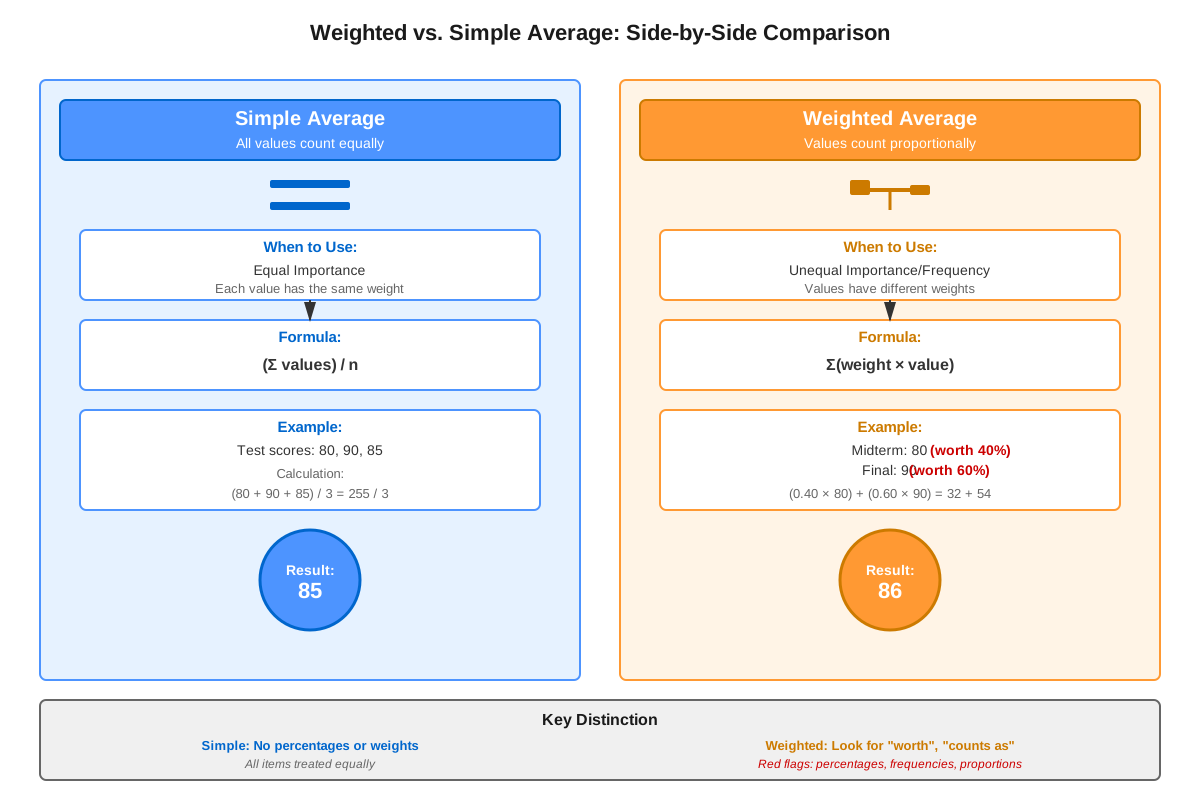
Weighted average problems represent a critical category of quantitative reasoning questions that appear consistently on the GRE. Unlike simple averages that treat all values equally, weighted averages account for the relative importance or frequency of different values in a dataset. This concept extends the fundamental notion of arithmetic mean by incorporating the principle that not all data points contribute equally to the final average. For instance, if a student scores 90 on a midterm worth 40% of the grade and 80 on a final worth 60%, the course grade isn't simply 85 (the simple average), but rather 84 (the weighted average that reflects each exam's contribution).
The GRE tests weighted average problems through various contexts: mixing solutions with different concentrations, combining groups with different characteristics, calculating grade point averages, analyzing investment portfolios, and determining average speeds over different distances. These problems require students to move beyond memorized formulas and demonstrate genuine understanding of proportional reasoning and algebraic manipulation. The ability to recognize when a problem involves weighted rather than simple averages often determines whether a student can even begin solving the question correctly.
Mastery of gre weighted average problems connects directly to broader quantitative reasoning skills including ratio and proportion problems, percent calculations, algebraic equation setup, and data interpretation. This topic serves as a bridge between basic arithmetic operations and more complex multi-step word problems. Students who excel at weighted average problems demonstrate strong analytical skills that transfer to other GRE question types, particularly those involving data sufficiency and quantitative comparison formats.
Learning Objectives
- [ ] Identify when Weighted average problems is being tested
- [ ] Explain the core rule or strategy behind Weighted average problems
- [ ] Apply Weighted average problems to GRE-style questions accurately
- [ ] Distinguish between situations requiring weighted versus simple averages
- [ ] Set up and solve weighted average equations using multiple solution methods
- [ ] Estimate weighted averages to eliminate incorrect answer choices quickly
- [ ] Solve reverse weighted average problems where the weights must be determined
Prerequisites
- Basic arithmetic mean calculation: Understanding how to find simple averages is foundational, as weighted averages build directly on this concept by adding complexity through differential weighting
- Algebraic equation solving: Setting up and manipulating equations with variables is essential since most weighted average problems require translating word problems into algebraic expressions
- Ratio and proportion reasoning: Weighted averages inherently involve proportional relationships between different groups or quantities
- Percent calculations: Many weighted average problems involve percentages, whether as weights themselves or as part of the problem context
- Fraction operations: Weights are often expressed as fractions of the total, requiring comfort with fraction multiplication and addition
Why This Topic Matters
Weighted average problems appear in approximately 8-12% of GRE Quantitative Reasoning questions, making them one of the most frequently tested word problem types. The Educational Testing Service (ETS) favors these problems because they efficiently assess multiple skills simultaneously: reading comprehension, algebraic reasoning, proportional thinking, and computational accuracy. Students who master weighted averages gain a significant competitive advantage, as these questions often separate mid-range scorers from those achieving scores in the 160+ range.
Beyond the exam context, weighted averages have extensive real-world applications that make them genuinely useful knowledge. Financial analysts use weighted averages to calculate portfolio returns, where different investments represent different proportions of total capital. Educators compute grade point averages where courses carry different credit hours. Scientists determine average molecular weights in chemical mixtures. Business managers calculate weighted customer satisfaction scores where different customer segments have varying importance. This practical relevance means that time invested in mastering this topic yields benefits extending far beyond test day.
On the GRE, weighted average problems typically appear as word problems in the quantitative comparison format, multiple-choice questions with five answer choices, or numeric entry questions requiring calculated responses. Common scenarios include: mixing problems (combining solutions, alloys, or populations with different characteristics), academic performance (calculating GPAs or course grades), rate problems (average speed over different segments), and financial calculations (investment returns or cost averaging). The GRE often disguises weighted average problems within complex scenarios, testing whether students can identify the underlying mathematical structure.
Core Concepts
The Fundamental Weighted Average Formula
The weighted average of a set of values is calculated by multiplying each value by its corresponding weight, summing these products, and dividing by the sum of all weights. The general formula is:
Weighted Average = (w₁ × v₁ + w₂ × v₂ + ... + wₙ × vₙ) / (w₁ + w₂ + ... + wₙ)Where:
- v₁, v₂, ..., vₙ represent the individual values
- w₁, w₂, ..., wₙ represent the corresponding weights
- n is the number of distinct values
When weights sum to 1 (or 100%), the denominator simplifies, and the formula becomes:
Weighted Average = w₁ × v₁ + w₂ × v₂ + ... + wₙ × vₙThis simplified version appears frequently when weights are given as percentages or fractions that total 100% or 1.
Understanding Weights as Relative Importance
Weights represent the relative importance, frequency, or proportion of each value in the dataset. In practical terms, weights answer the question: "How much does this particular value contribute to the overall average?" Consider three common weight interpretations:
| Weight Type | Example Context | Interpretation |
|---|---|---|
| Frequency | 5 students scored 90, 10 students scored 80 | The weight is the count in each group |
| Proportion | 40% of grade from midterm, 60% from final | The weight is the fractional contribution |
| Quantity | 3 liters of 20% solution, 2 liters of 50% solution | The weight is the amount of each component |
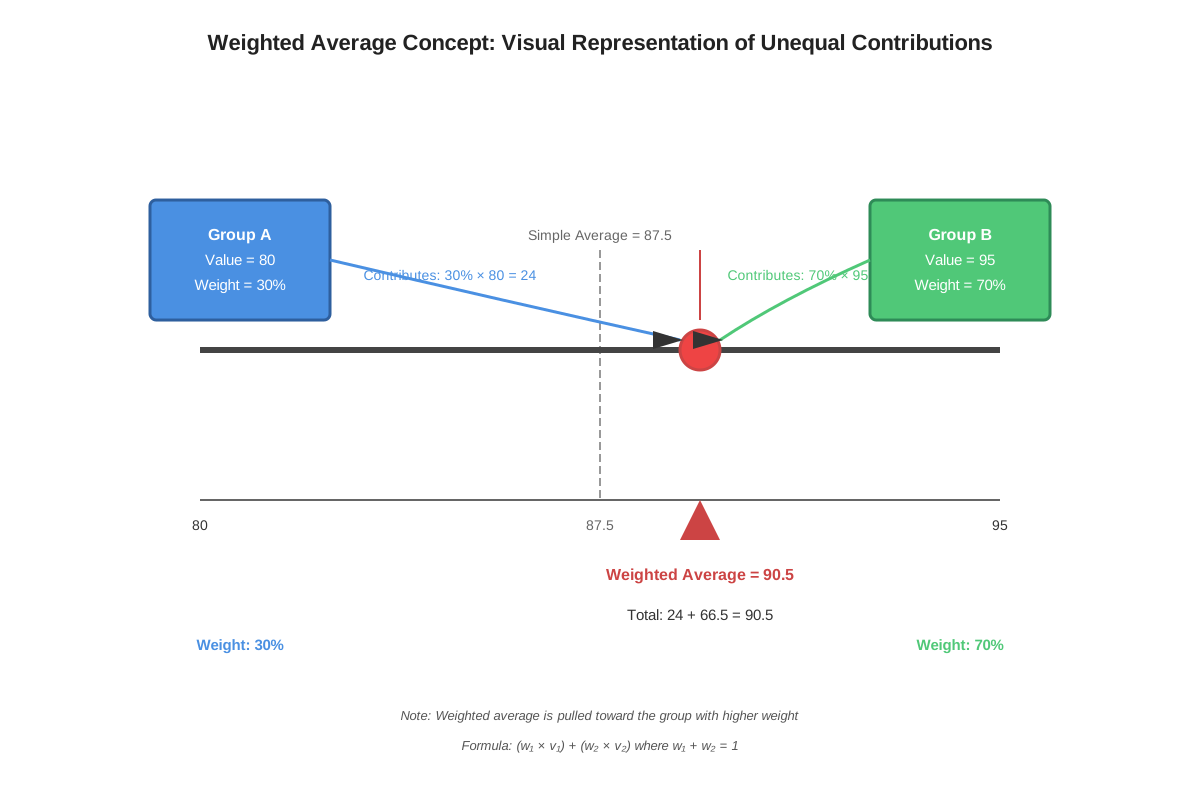
The key insight is that larger weights pull the weighted average closer to their associated values. If one value has a weight of 80% and another has 20%, the weighted average will be much closer to the first value than the second.
The Mixture Method for Two-Component Problems
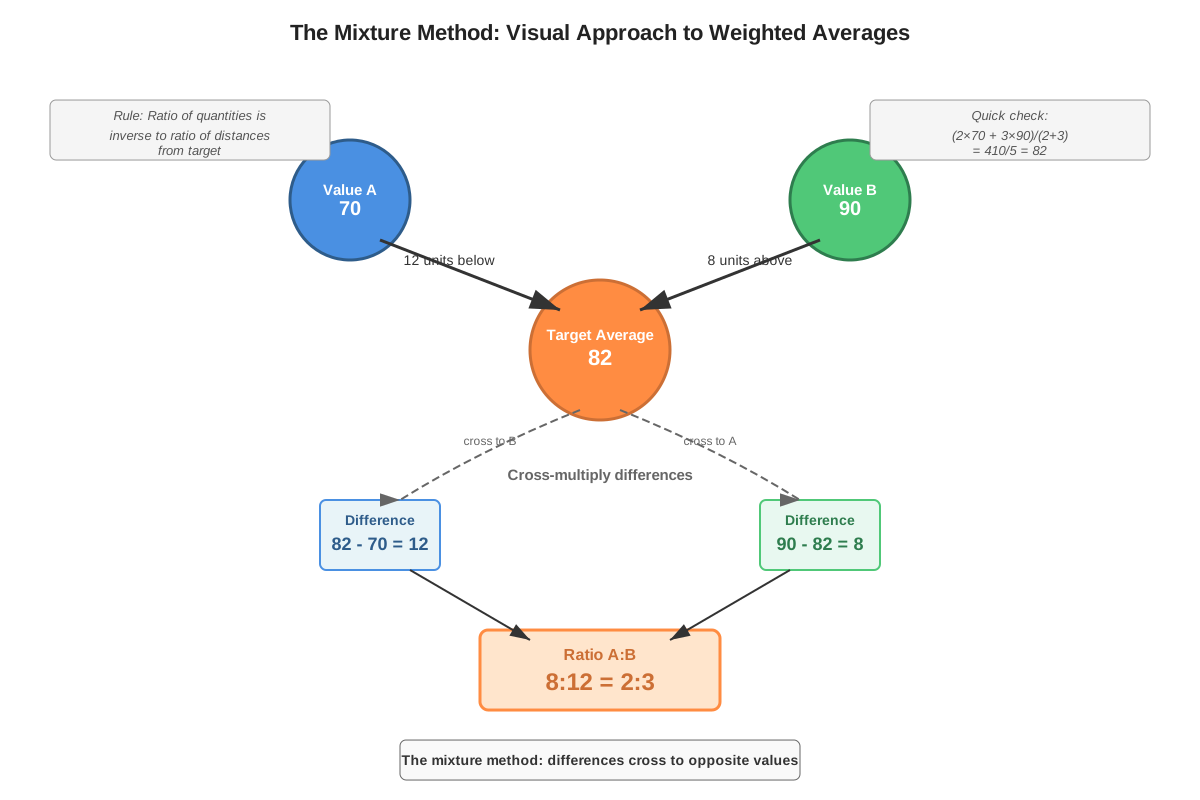
For problems involving exactly two groups or components, the mixture method provides an elegant alternative to the standard formula. This approach uses the principle that the weighted average must fall between the two individual values, and its position depends on the ratio of weights.
The deviation method states:
(Weight₁) × (Distance from Value₁ to Weighted Average) = (Weight₂) × (Distance from Value₂ to Weighted Average)This can be visualized as a balance point or fulcrum problem. The weighted average is the balance point where the "moments" on each side are equal. This method is particularly powerful for estimation and for solving problems where weights must be determined from a known weighted average.
Setting Up Weighted Average Equations
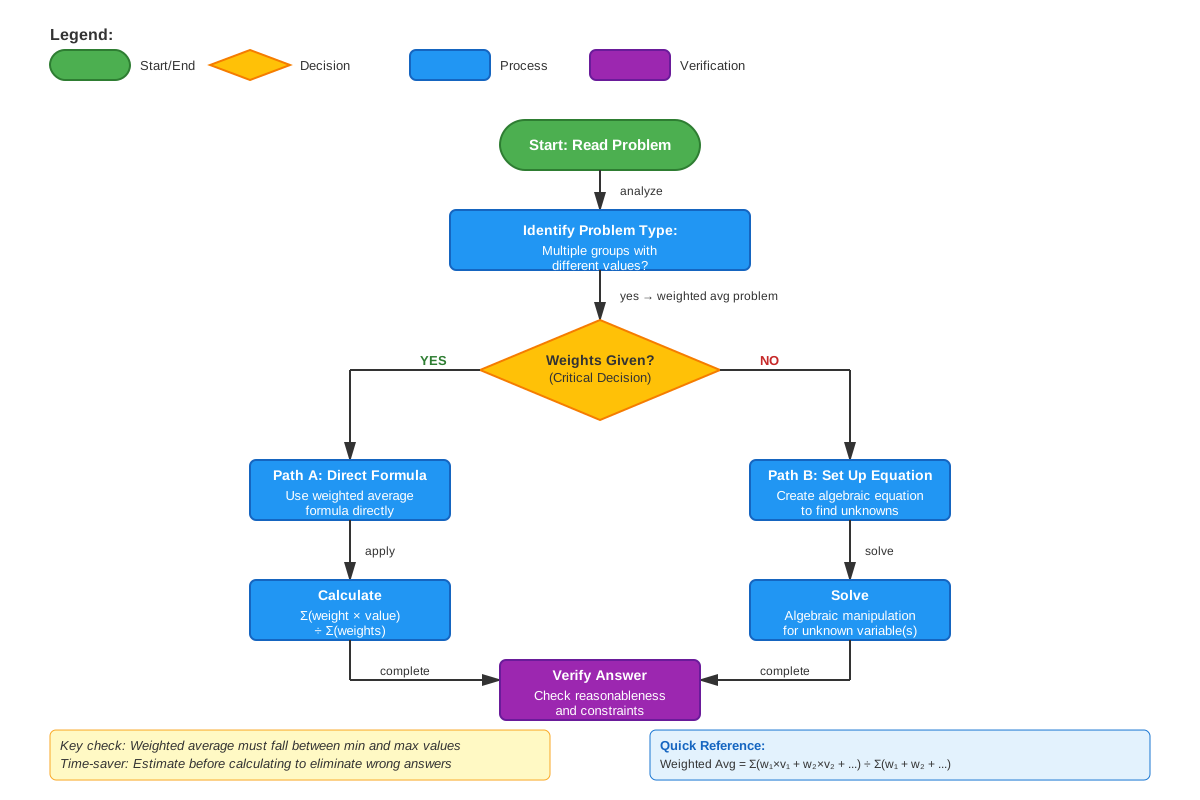
Translating word problems into weighted average equations requires systematic analysis:
- Identify the values: What quantities are being averaged? (test scores, concentrations, speeds, prices)
- Identify the weights: What determines each value's contribution? (number of items, time periods, volumes, percentages)
- Determine what's being asked: The weighted average itself, one of the values, or one of the weights?
- Set up the equation: Apply the weighted average formula with variables for unknowns
For complex problems involving multiple unknowns, students may need to create systems of equations by combining the weighted average equation with other constraints given in the problem.
Special Case: Average Speed Problems
Average speed over a journey with different segments is a weighted average problem where time (not distance) serves as the weight. This counterintuitive fact causes frequent errors. The correct formula is:
Average Speed = Total Distance / Total TimeWhich can be rewritten as a weighted average:
Average Speed = (t₁ × s₁ + t₂ × s₂) / (t₁ + t₂)Where t₁ and t₂ are the times spent at speeds s₁ and s₂. Students often incorrectly use distance as the weight or simply average the speeds, leading to wrong answers.
The Weighted Average Inequality Principle
A crucial property for estimation and elimination: the weighted average must always fall between the minimum and maximum values being averaged (assuming all weights are positive). Furthermore, the weighted average is closer to values with larger weights. This principle enables rapid answer elimination on multiple-choice questions and provides a sanity check for calculated answers.
For example, if combining groups with averages of 60 and 80, the overall weighted average must be between 60 and 80. If one group is three times larger than the other, the weighted average will be three times closer to that group's average.
Concept Relationships
The core concepts within weighted average problems form an interconnected system. The fundamental weighted average formula serves as the foundation, from which the mixture method emerges as a specialized technique for two-component scenarios. Both approaches rely on understanding weights as relative importance, which determines how much each value influences the final average. The equation setup process applies these formulas to word problems, while the weighted average inequality principle provides bounds and estimation capabilities that support both setup and verification.
These concepts connect to prerequisite knowledge in specific ways: algebraic equation solving enables manipulation of the weighted average formula when solving for unknowns; ratio and proportion reasoning underlies the mixture method and weight interpretation; percent calculations frequently appear in weight specifications. The relationship flows: Prerequisites → Formula Understanding → Application Methods → Verification Principles.
Weighted average problems also connect forward to more advanced topics. They provide foundation for probability calculations (expected value is a weighted average), statistics (weighted means in data analysis), and optimization problems (where weighted objectives must be balanced). The mixture method specifically connects to work rate problems and distance-rate-time problems, which use similar balance-point reasoning.
High-Yield Facts
⭐ The weighted average always falls between the minimum and maximum values being averaged (with positive weights)
⭐ When weights are equal, the weighted average equals the simple average
⭐ The weighted average is pulled toward values with larger weights
⭐ In average speed problems, time (not distance) is the weight
⭐ If weights sum to 1 or 100%, the denominator in the weighted average formula can be omitted
- The weighted average formula is: (w₁v₁ + w₂v₂ + ... + wₙvₙ) / (w₁ + w₂ + ... + wₙ)
- For two groups, if one group is k times larger than the other, the weighted average is k times closer to the larger group's average
- Weighted averages are commutative: the order of values and weights doesn't matter
- When combining groups, the total number of items equals the sum of items in each group (this provides a second equation for systems)
- In mixture problems, the final concentration must be between the initial concentrations
- Weighted averages can be calculated iteratively: first combine two groups, then combine that result with a third group
- The deviation of the weighted average from any individual value is inversely proportional to that value's weight
Quick check — test yourself on Weighted average problems so far.
Try Flashcards →Common Misconceptions
Misconception: Weighted average problems can be solved by simply averaging the given values without considering weights → Correction: This produces a simple average, which is only correct when all weights are equal. The weighted average explicitly accounts for different contributions from each value. For example, if 10 students average 80 and 5 students average 90, the overall average is not 85 but rather (10×80 + 5×90)/(10+5) = 83.33.
Misconception: In average speed problems, distance serves as the weight → Correction: Time is the correct weight for average speed calculations. Average speed equals total distance divided by total time, not a distance-weighted average of speeds. If you travel 60 mph for 1 hour and 40 mph for 2 hours, the average speed is (60×1 + 40×2)/(1+2) = 46.67 mph, not a distance-weighted calculation.
Misconception: The weighted average of two values must be exactly halfway between them → Correction: The weighted average is only at the midpoint when weights are equal. With unequal weights, the weighted average shifts toward the value with greater weight. If one value has 75% weight and another has 25% weight, the weighted average will be three times closer to the first value.
Misconception: Weights must always be given explicitly as numbers → Correction: Weights can be implicit in the problem structure. In a problem stating "a class of 20 students has an average of 75, and another class of 30 students has an average of 85," the weights are the class sizes (20 and 30), even though the problem doesn't use the word "weight."
Misconception: The weighted average formula changes depending on the context (grades vs. mixtures vs. speeds) → Correction: The fundamental weighted average formula remains the same across all contexts; only the interpretation of what constitutes a "value" and a "weight" changes. The mathematical structure is identical whether calculating a GPA, a chemical concentration, or a combined group average.
Misconception: If you know the weighted average and one of the values, you can determine the other value without knowing the weights → Correction: Without information about the weights (or the ability to derive them from other constraints), you cannot uniquely determine unknown values. The weighted average equation has multiple variables, and you need sufficient information to solve for unknowns.
Worked Examples
Example 1: Classic Group Combination Problem
Problem: In a biology class, 12 students scored an average of 85 on the midterm, while 8 students scored an average of 92. What was the average score for all students in the class?
Solution:
Step 1: Identify the values and weights
- Value 1 (v₁) = 85 (average for first group)
- Weight 1 (w₁) = 12 (number of students in first group)
- Value 2 (v₂) = 92 (average for second group)
- Weight 2 (w₂) = 8 (number of students in second group)
Step 2: Apply the weighted average formula
Weighted Average = (w₁ × v₁ + w₂ × v₂) / (w₁ + w₂)
Weighted Average = (12 × 85 + 8 × 92) / (12 + 8)
Step 3: Calculate
= (1020 + 736) / 20
= 1756 / 20
= 87.8
Step 4: Verify using the inequality principle
The answer should be between 85 and 92 ✓
Since the first group is larger (12 vs 8), the average should be closer to 85 than to 92 ✓
The difference from 85 is 2.8, while the difference from 92 is 4.2, confirming the answer is closer to 85 ✓
Answer: 87.8
This problem directly addresses the learning objective of applying weighted average problems to GRE-style questions, demonstrating the standard formula approach with verification.
Example 2: Reverse Weighted Average Problem
Problem: A chemistry student mixes a 30% acid solution with a 60% acid solution to create 10 liters of a 45% acid solution. How many liters of the 30% solution did she use?
Solution:
Step 1: Define variables and identify what's being asked
- Let x = liters of 30% solution
- Then (10 - x) = liters of 60% solution (since total is 10 liters)
- We need to find x
Step 2: Set up the weighted average equation
The final concentration (45%) is the weighted average of the two initial concentrations (30% and 60%), where the weights are the volumes:
45 = (x × 30 + (10-x) × 60) / 10Step 3: Solve algebraically
45 × 10 = x × 30 + (10-x) × 60
450 = 30x + 600 - 60x
450 = 600 - 30x
30x = 150
x = 5
Step 4: Verify using the mixture method
The final concentration (45%) is exactly halfway between 30% and 60%, so equal volumes of each solution should be used. Since we need 10 liters total, we should use 5 liters of each solution ✓
Alternative approach using the mixture method:
The distance from 30% to 45% is 15 percentage points.
The distance from 45% to 60% is 15 percentage points.
Since these distances are equal, the weights (volumes) must be equal.
Therefore, x = 5 liters.
Answer: 5 liters of the 30% solution
This example demonstrates both algebraic and conceptual approaches, addressing the learning objective of explaining core strategies and applying multiple solution methods.
Exam Strategy
When approaching weighted average problems on the GRE, begin by identifying trigger phrases that signal this question type: "average," "mean," "combined," "mixture," "overall," "total," "class of X students and class of Y students," "traveled at different speeds," or "solutions with different concentrations." The presence of multiple groups or components with different characteristics strongly suggests a weighted average problem.
Step-by-step approach:
- Read carefully to distinguish weighted from simple averages: If the problem mentions different group sizes, different time periods, different quantities, or different importance levels, it's likely a weighted average problem.
- Identify the three components: values being averaged, weights for each value, and what's being asked (the weighted average itself, one of the values, or one of the weights).
- Estimate before calculating: Use the inequality principle to determine the range where the answer must fall, then eliminate answer choices outside this range. If one weight is much larger than others, estimate how close the weighted average should be to that value.
- Choose your solution method: For two-component problems, consider whether the mixture method might be faster than the formula. For problems with three or more components, use the standard formula. For reverse problems (finding weights), set up an algebraic equation.
- Verify your answer: Check that your answer falls within the expected range and makes intuitive sense given the weights. If time permits, substitute your answer back into the original equation.
Time allocation: Allocate 1.5-2 minutes for straightforward weighted average problems and up to 2.5 minutes for complex problems involving multiple steps or reverse calculations. If a problem requires more than 3 minutes, mark it for review and move on.
Process of elimination tips: Immediately eliminate answer choices that fall outside the range between minimum and maximum values. For quantitative comparison questions, use estimation to determine which quantity is larger without calculating exact values. If one group is significantly larger than another, eliminate answers that don't reflect the weighted average being pulled toward the larger group's value.
Common trap answers: The GRE often includes the simple average (ignoring weights) as a distractor, so always verify that you've accounted for weights. Another common trap is using the wrong weights (e.g., using distance instead of time for average speed problems).
Memory Techniques
WAV mnemonic for the weighted average formula: Weights times Amounts (or Values), then divide by total weights.
"Heavy pulls harder" visualization: Imagine values as objects on a balance beam, with weights as their masses. The heavier object pulls the balance point (weighted average) closer to itself. This mental image helps remember that larger weights pull the average toward their associated values.
VWWA acronym for problem setup: Values, Weights, What's asked, Answer method. This provides a systematic checklist for approaching any weighted average problem.
The "between" rule: Create a mental habit of immediately identifying the minimum and maximum values and remembering "the weighted average must be between these values." This single principle prevents many calculation errors and enables rapid answer elimination.
Speed-Time connection: For average speed problems, remember "Speed needs Time" (not distance) as the weight. The alliteration helps cement this counterintuitive relationship.
Mixture visualization: For mixture problems, visualize pouring liquids of different colors into a container. The final color (concentration) depends on how much of each color you pour (the weights), not just what colors you're mixing (the values).
Summary
Weighted average problems constitute a high-yield GRE topic that tests the ability to calculate averages when different values contribute unequally to the final result. The fundamental concept involves multiplying each value by its corresponding weight, summing these products, and dividing by the total of all weights. Success requires distinguishing weighted from simple averages, correctly identifying values and weights from word problem contexts, and applying either the standard formula or the mixture method for two-component problems. Critical principles include the inequality rule (weighted averages fall between minimum and maximum values), the pull principle (larger weights pull the average toward their values), and the special case of average speed problems where time serves as the weight. Students must develop facility with both forward calculations (finding the weighted average) and reverse problems (finding unknown values or weights given the weighted average). Estimation skills and verification strategies are essential for efficient problem-solving and error prevention on test day.
Key Takeaways
- Weighted averages account for the relative importance or frequency of different values, unlike simple averages that treat all values equally
- The weighted average formula is (w₁v₁ + w₂v₂ + ... + wₙvₙ) / (w₁ + w₂ + ... + wₙ), where v represents values and w represents weights
- The weighted average always falls between the minimum and maximum values being averaged and is pulled toward values with larger weights
- In average speed problems, time (not distance) serves as the weight—a frequent source of errors
- The mixture method provides an elegant alternative for two-component problems, using the principle that deviations from the weighted average are inversely proportional to weights
- Estimation using the inequality principle enables rapid answer elimination and serves as a verification tool for calculated answers
- Identifying whether a problem requires a weighted versus simple average is often the key to solving it correctly
Related Topics
Ratio and Proportion Problems: Weighted averages are fundamentally about proportional relationships between different groups. Mastering weighted averages strengthens ratio reasoning skills and vice versa, as both involve understanding how quantities relate to each other in multiplicative ways.
Percent Problems: Many weighted average problems involve percentages, either as the values being averaged (like concentrations or grade weights) or as the weights themselves. Strong percent skills make weighted average problems more accessible.
Rate Problems (Distance-Rate-Time): Average speed problems are a special case of weighted averages, and the reasoning used in weighted average problems transfers directly to more complex rate problems involving multiple segments or varying speeds.
Statistics and Data Interpretation: Weighted averages appear in data analysis contexts on the GRE, particularly in questions involving weighted means, expected values, and interpreting tables or graphs where different categories have different frequencies.
Mixture and Solution Problems: These represent a specific application of weighted averages involving combining substances with different properties (concentrations, purities, prices per unit). Mastering weighted averages is prerequisite to handling complex mixture problems.
Practice CTA
Now that you've mastered the concepts, strategies, and common pitfalls of weighted average problems, it's time to solidify your understanding through practice. Attempt the practice questions designed specifically for this topic, starting with basic applications and progressing to GRE-level complexity. Use the flashcards to reinforce the key formulas, principles, and trigger words until they become automatic. Remember that weighted average problems reward both conceptual understanding and computational accuracy—practice will build both. Each problem you solve strengthens your pattern recognition and increases your speed for test day. You've built the foundation; now make it unshakeable through deliberate practice!
Sign up free to keep reading
Create a free AnvayaPrep account to finish this GRE guide on Weighted average problems — plus flashcards and practice questions.