Overview
Interest problems are a fundamental category of word problems that appear regularly on the GRE Quantitative Reasoning section. These problems involve calculating the growth of money over time through interest accumulation, whether in savings accounts, investments, loans, or other financial contexts. While the real-world applications are straightforward—understanding how money grows or debt accumulates—the GRE tests your ability to set up equations correctly, manipulate algebraic expressions, and work efficiently under time pressure.
On the GRE, gre interest problems typically involve two main types: simple interest and compound interest. Simple interest calculations are linear, where interest is calculated only on the principal amount throughout the entire period. Compound interest, conversely, involves exponential growth where interest is calculated on both the principal and previously accumulated interest. The GRE expects test-takers to distinguish between these types quickly, set up the appropriate formulas, and solve for various unknowns—whether that's the final amount, the interest rate, the time period, or the initial principal.
Understanding interest problems connects directly to broader Quantitative Reasoning skills including percent calculations, algebraic manipulation, exponential functions, and word problem translation. These problems test your ability to extract relevant information from word problems, identify what's being asked, select the appropriate formula, and execute calculations accurately. Mastery of interest problems also reinforces your understanding of growth rates, which appears in other GRE contexts such as population growth, depreciation, and data interpretation questions involving percentage changes over time.
Learning Objectives
- [ ] Identify when Interest problems is being tested
- [ ] Explain the core rule or strategy behind Interest problems
- [ ] Apply Interest problems to GRE-style questions accurately
- [ ] Distinguish between simple interest and compound interest scenarios within 10 seconds of reading a problem
- [ ] Solve for any variable in interest formulas (principal, rate, time, or final amount) using algebraic manipulation
- [ ] Calculate compound interest with different compounding frequencies (annually, semi-annually, quarterly, monthly)
- [ ] Compare investment scenarios using interest calculations to determine optimal financial decisions
Prerequisites
- Percent calculations and conversions: Interest rates are expressed as percentages that must be converted to decimals for calculations; understanding percent increase/decrease is fundamental to grasping how interest accumulates.
- Basic algebra and equation solving: Interest problems require setting up equations and solving for unknown variables, including isolating variables and working with exponential expressions.
- Exponent rules: Compound interest formulas involve exponential expressions; understanding how to evaluate and manipulate exponents is essential for accurate calculations.
- Word problem translation skills: Converting written scenarios into mathematical expressions is the critical first step in solving any interest problem on the GRE.
Why This Topic Matters
Interest problems have direct real-world applications in personal finance, investment decisions, loan comparisons, and business planning. Understanding how interest works enables informed decisions about savings accounts, mortgages, credit cards, student loans, and retirement planning. The mathematical principles underlying interest calculations also apply to population growth, radioactive decay, bacterial growth, and other exponential phenomena across multiple disciplines.
On the GRE, interest problems appear with moderate to high frequency, typically comprising 1-2 questions per Quantitative Reasoning section. These problems most commonly appear as standalone word problems in the Quantitative Comparison or Problem Solving formats. According to test analysis data, approximately 8-12% of word problems on the GRE involve interest calculations or related growth scenarios. The GRE particularly favors questions that require distinguishing between simple and compound interest, calculating compound interest with multiple compounding periods per year, or comparing two different investment scenarios.
Interest problems on the GRE often appear disguised within broader financial scenarios. You might encounter questions about comparing two investment options, determining how long it takes for an investment to reach a certain value, or calculating the effective interest rate when compounding occurs multiple times per year. The test writers frequently combine interest calculations with other concepts like ratios, percentages, or systems of equations to create medium-to-hard difficulty questions that test multiple skills simultaneously.
Core Concepts
Simple Interest
Simple interest is calculated only on the original principal amount throughout the entire investment or loan period. The interest earned or paid remains constant for each time period because it's always calculated on the same base amount. The formula for simple interest is:
I = P × r × tWhere:
- I = Interest earned or paid
- P = Principal (initial amount)
- r = Annual interest rate (expressed as a decimal)
- t = Time (in years)
The total amount (A) after time t is:
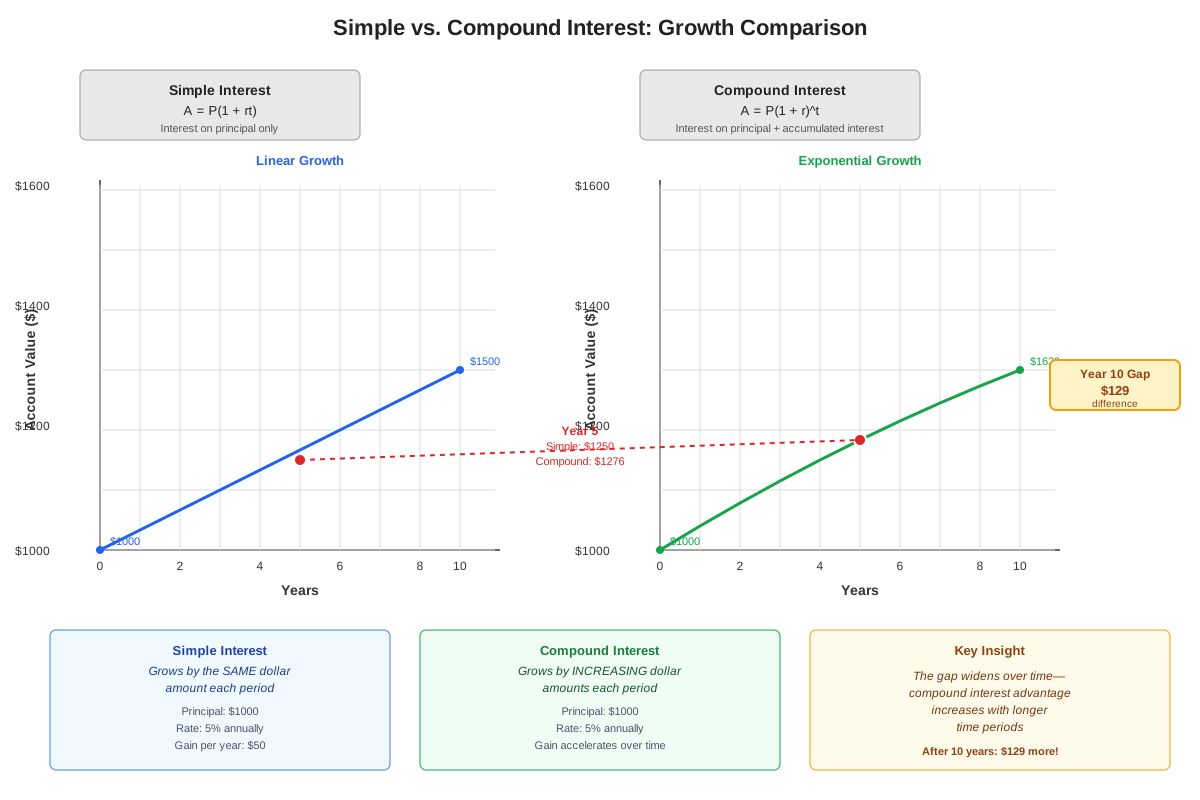
A = P + I = P + (P × r × t) = P(1 + rt)Simple interest creates a linear growth pattern. If you graph the total amount over time, you get a straight line. For example, if you invest $1,000 at 5% simple interest annually, you earn exactly $50 every year, regardless of how much total money has accumulated in the account.
Compound Interest
Compound interest is calculated on both the principal and the accumulated interest from previous periods. This creates exponential growth because each period's interest calculation includes the interest that was added in previous periods. The standard compound interest formula is:
A = P(1 + r/n)^(nt)Where:
- A = Final amount
- P = Principal (initial amount)
- r = Annual interest rate (as a decimal)
- n = Number of times interest is compounded per year
- t = Time in years
The compound interest earned is:
I = A - P = P(1 + r/n)^(nt) - PCompounding Frequency
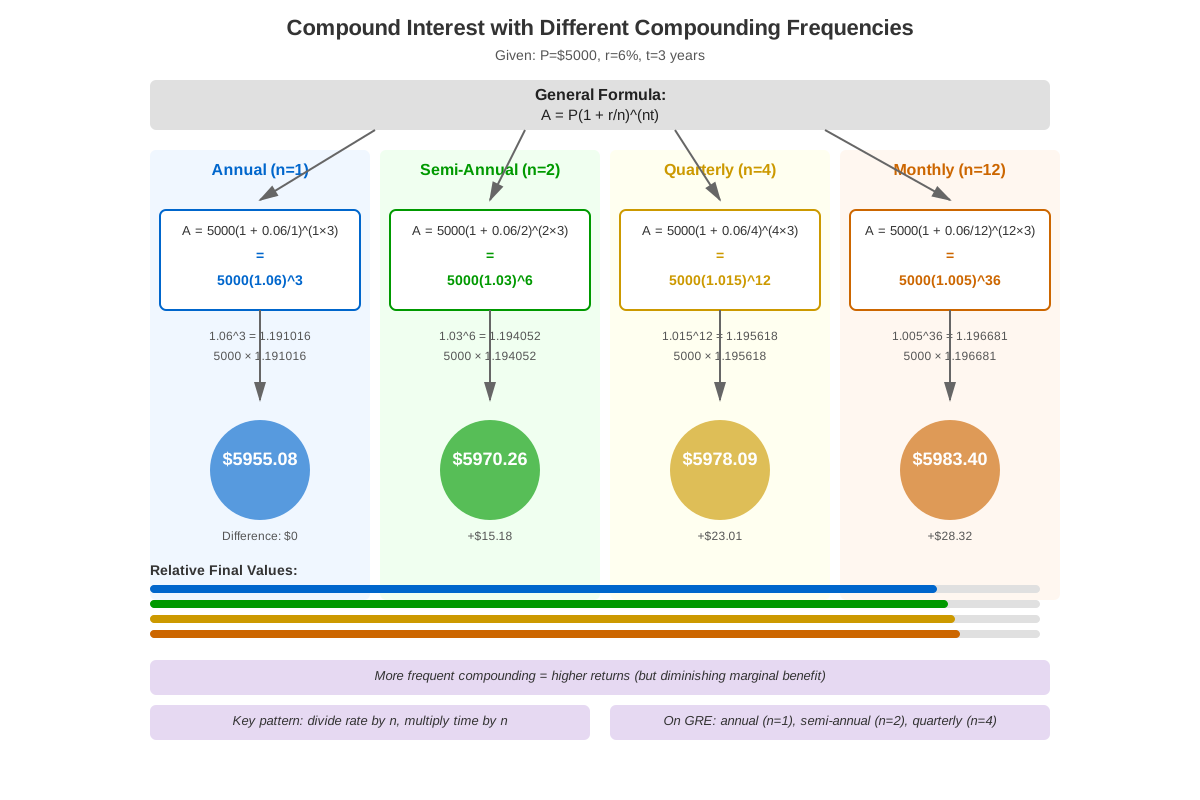
The frequency of compounding significantly affects the final amount. Common compounding frequencies include:
| Compounding Period | Value of n | Meaning |
|---|---|---|
| Annually | 1 | Interest calculated once per year |
| Semi-annually | 2 | Interest calculated twice per year |
| Quarterly | 4 | Interest calculated four times per year |
| Monthly | 12 | Interest calculated twelve times per year |
| Daily | 365 | Interest calculated every day |
The more frequently interest compounds, the more total interest accumulates. However, the difference becomes less dramatic as compounding frequency increases. For example, the difference between monthly and daily compounding is much smaller than the difference between annual and monthly compounding.
Continuous Compounding
For theoretical or advanced problems, interest can compound continuously, meaning at every possible instant. The formula for continuous compounding is:
A = Pe^(rt)Where e is Euler's number (approximately 2.71828). While less common on the GRE, understanding that continuous compounding represents the mathematical limit of increasingly frequent compounding can help with conceptual questions.
Effective Annual Rate
When interest compounds more than once per year, the effective annual rate (EAR) differs from the stated annual rate. The effective rate represents the actual annual return accounting for compounding effects:
EAR = (1 + r/n)^n - 1This concept helps compare investments with different compounding frequencies. An account offering 6% compounded monthly has a higher effective rate than one offering 6% compounded annually.
Solving for Different Variables
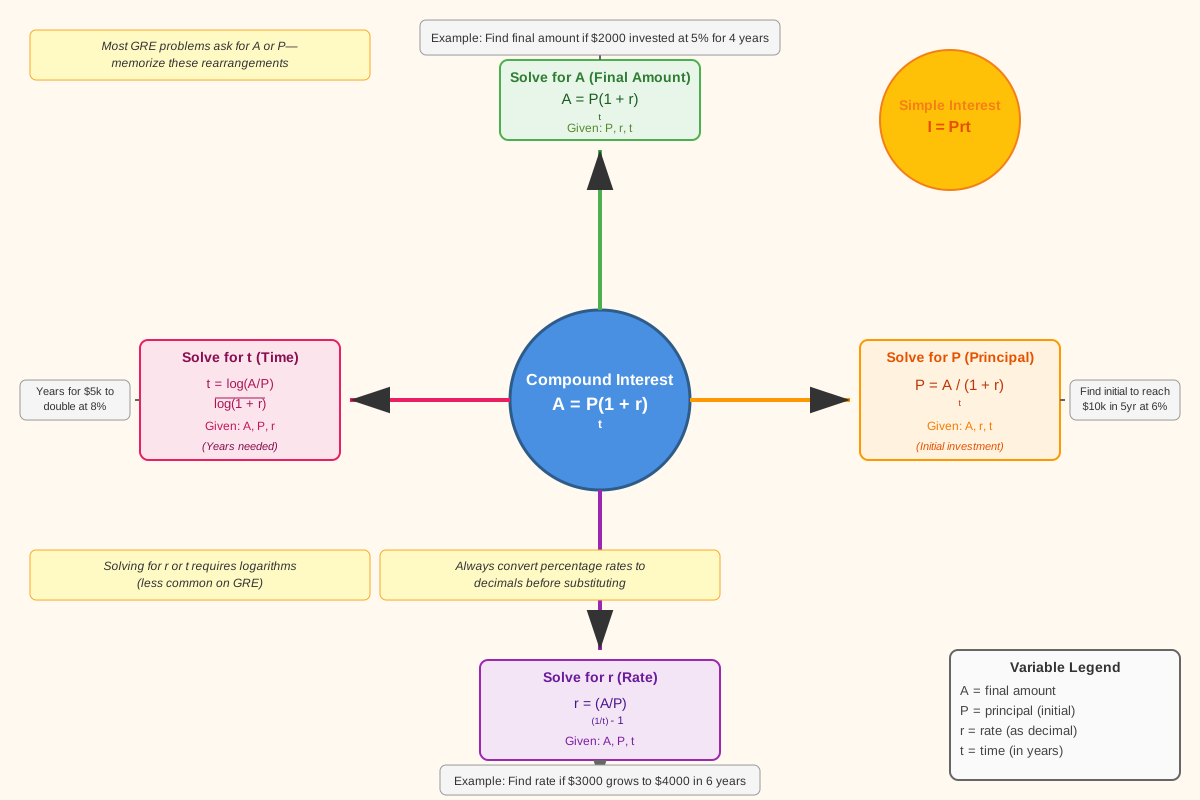
GRE interest problems don't always ask for the final amount. You might need to solve for:
- Principal (P): Given the final amount, rate, and time, work backward using algebra
- Rate (r): Isolate r by dividing and taking roots (for compound interest)
- Time (t): Use logarithms for compound interest problems or simple division for simple interest
- Interest earned (I): Subtract principal from final amount
The key skill is algebraic manipulation—being comfortable rearranging formulas to isolate the desired variable.
Comparing Simple vs. Compound Interest
For the same principal, rate, and time period, compound interest always yields more than simple interest (assuming compounding occurs at least once per year). The difference becomes more pronounced with:
- Higher interest rates
- Longer time periods
- More frequent compounding
For very short time periods or very low interest rates, the difference between simple and compound interest is minimal and sometimes negligible for GRE purposes.
Concept Relationships
The core relationship within interest problems flows from the fundamental distinction between simple interest → linear growth versus compound interest → exponential growth. This distinction determines which formula to apply and what type of growth pattern to expect.
Compounding frequency modifies the compound interest formula, creating a spectrum from annual compounding (n=1) through increasingly frequent compounding to the theoretical limit of continuous compounding. Understanding this relationship helps you recognize that more frequent compounding → higher effective returns → greater final amounts.
The effective annual rate concept bridges stated rates and actual returns, connecting to the broader GRE topic of percent calculations and allowing meaningful comparisons between different investment scenarios. This connects to prerequisite knowledge of percentages and percent change.
Interest problems connect to prerequisite topics through multiple pathways: percent calculations provide the foundation for understanding rates; algebraic manipulation enables solving for unknown variables; exponent rules are essential for evaluating compound interest formulas; and word problem translation skills determine whether you correctly identify the problem type and extract relevant information.
Interest calculations also relate to other Quantitative Reasoning topics including exponential functions (compound interest is an exponential function), sequences and series (simple interest creates arithmetic sequences), logarithms (needed when solving for time in compound interest problems), and data interpretation (interest rates appear in graphs and tables).
High-Yield Facts
⭐ Simple interest formula: I = Prt, where interest is calculated only on the principal throughout the entire period
⭐ Compound interest formula: A = P(1 + r/n)^(nt), where interest is calculated on principal plus accumulated interest
⭐ For the same rate and time, compound interest always exceeds simple interest (assuming at least annual compounding)
⭐ Doubling time approximation: Money doubles in approximately 72/r years at r% annual compound interest (Rule of 72)
⭐ More frequent compounding increases returns: quarterly > semi-annually > annually for the same stated rate
- Converting percentage rates to decimals is mandatory: 5% becomes 0.05 in all formulas
- Time must be expressed in years; convert months by dividing by 12, days by dividing by 365
- The interest earned equals final amount minus principal: I = A - P
- When comparing investments, calculate the final amount for each scenario using the appropriate formula
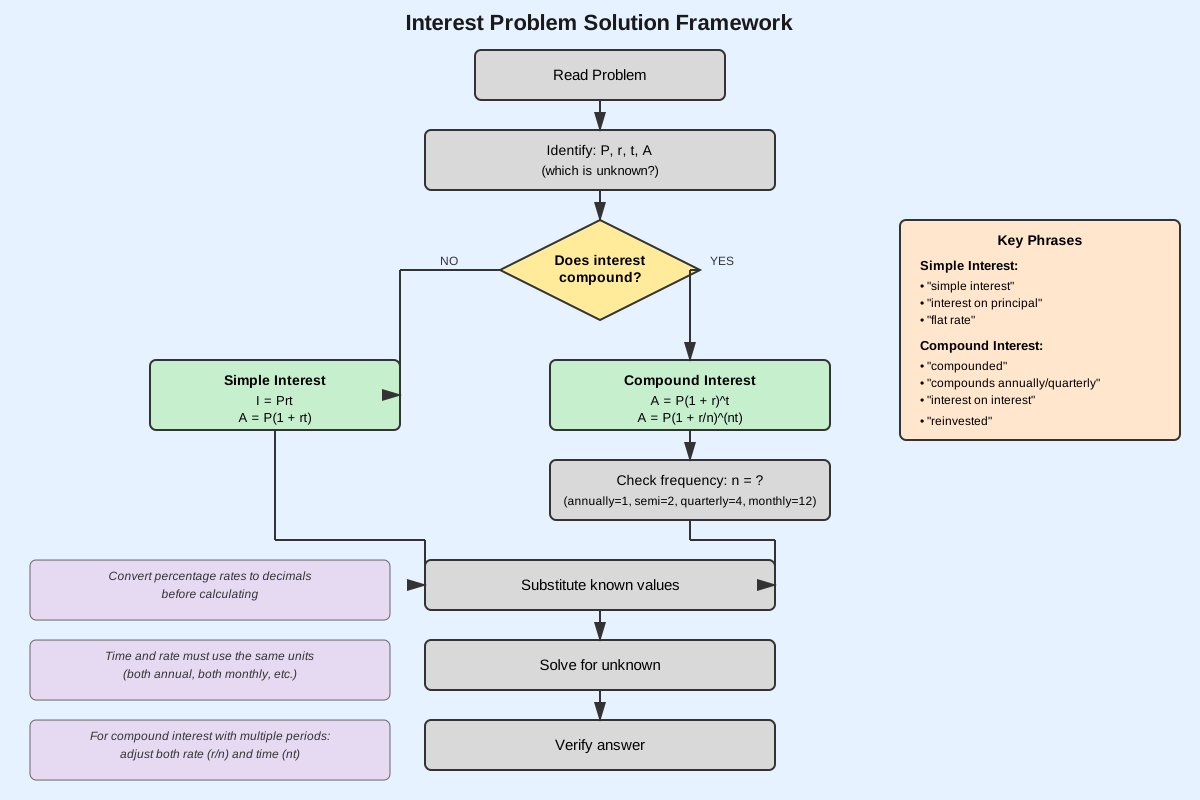
- If a problem mentions "interest compounded," use compound interest formulas; if it says "simple interest" or gives no specification for a basic problem, consider simple interest
Quick check — test yourself on Interest problems so far.
Try Flashcards →Common Misconceptions
Misconception: Simple interest and compound interest produce similar results for all time periods.
Correction: While the difference is small for very short periods (weeks or months), compound interest significantly outpaces simple interest over longer periods (years) due to exponential versus linear growth. The gap widens dramatically with time.
Misconception: The interest rate in formulas should be used as a percentage (e.g., 5 instead of 0.05).
Correction: Interest rates must always be converted to decimal form in calculations. A 5% rate becomes 0.05, a 12% rate becomes 0.12, and so forth. Using the percentage form will produce answers that are 100 times too large.
Misconception: In compound interest, n represents the number of years.
Correction: The variable n represents the number of compounding periods per year, not the total number of years. The variable t represents time in years. The exponent nt gives the total number of compounding periods over the entire investment duration.
Misconception: Doubling the interest rate doubles the final amount.
Correction: Doubling the rate does not double the final amount because the principal remains unchanged. If you invest $1,000 at 5% for one year, you get $1,050. At 10%, you get $1,100, not $2,100. The relationship between rate and final amount is linear for simple interest but not multiplicative with respect to the total.
Misconception: When solving for time in compound interest problems, simple division works.
Correction: Solving for time in compound interest requires logarithms because time appears as an exponent. You cannot simply divide both sides by the base; you must take the logarithm of both sides and use logarithm properties to bring the exponent down.
Misconception: Interest problems always provide all variables except one.
Correction: GRE interest problems sometimes require you to set up systems of equations or use given information to calculate intermediate values before applying interest formulas. You may need to find the principal from one piece of information before calculating the final amount.
Worked Examples
Example 1: Simple vs. Compound Interest Comparison
Problem: Sarah invests $5,000 in Account A, which pays 6% simple interest annually. She invests another $5,000 in Account B, which pays 6% interest compounded annually. After 3 years, how much more money does Account B have than Account A?
Solution:
Step 1: Calculate Account A (simple interest)
Using the formula A = P(1 + rt):
- P = $5,000
- r = 0.06
- t = 3 years
A = 5,000(1 + 0.06 × 3)
A = 5,000(1 + 0.18)
A = 5,000(1.18)
A = $5,900
Step 2: Calculate Account B (compound interest)
Using the formula A = P(1 + r/n)^(nt):
- P = $5,000
- r = 0.06
- n = 1 (compounded annually)
- t = 3 years
A = 5,000(1 + 0.06/1)^(1×3)
A = 5,000(1.06)^3
A = 5,000(1.191016)
A = $5,955.08
Step 3: Find the difference
Difference = $5,955.08 - $5,900 = $55.08
Answer: Account B has $55.08 more than Account A after 3 years.
Connection to Learning Objectives: This problem requires identifying the problem type (comparing simple and compound interest), applying both formulas accurately, and demonstrating the core principle that compound interest exceeds simple interest for the same rate and time period.
Example 2: Solving for Time with Compound Interest
Problem: Marcus invests $8,000 in an account that pays 8% interest compounded quarterly. How many years will it take for his investment to grow to $12,000?
Solution:
Step 1: Identify known and unknown variables
- A = $12,000 (final amount)
- P = $8,000 (principal)
- r = 0.08 (annual rate)
- n = 4 (quarterly compounding)
- t = ? (unknown, in years)
Step 2: Set up the compound interest equation
12,000 = 8,000(1 + 0.08/4)^(4t)
12,000 = 8,000(1.02)^(4t)
Step 3: Isolate the exponential term
12,000/8,000 = (1.02)^(4t)
1.5 = (1.02)^(4t)
Step 4: Apply logarithms to solve for t
log(1.5) = log[(1.02)^(4t)]
log(1.5) = 4t × log(1.02)
t = log(1.5) / [4 × log(1.02)]
Step 5: Calculate using logarithm values
log(1.5) ≈ 0.176
log(1.02) ≈ 0.0086
t = 0.176 / (4 × 0.0086)
t = 0.176 / 0.0344
t ≈ 5.12 years
Answer: It will take approximately 5.12 years (or about 5 years and 1.5 months) for the investment to grow to $12,000.
Connection to Learning Objectives: This problem demonstrates solving for an unknown variable (time) in a compound interest scenario, requiring algebraic manipulation and understanding of logarithms. It also shows how to work with quarterly compounding (n = 4).
Exam Strategy
When approaching gre interest problems, follow this systematic process:
Step 1: Identify the problem type immediately. Look for trigger words:
- "Simple interest" → use I = Prt or A = P(1 + rt)
- "Compounded," "compounds," "compounding" → use A = P(1 + r/n)^(nt)
- "Annually," "quarterly," "monthly" → determines n value
- No specification in a straightforward problem → likely simple interest
Step 2: Extract and organize information. Create a quick list:
- What is the principal (P)?
- What is the rate (r)? Convert percentages to decimals immediately.
- What is the time period (t)? Convert to years if given in months or days.
- How often does it compound (n)?
- What are you solving for?
Step 3: Watch for comparison questions. If the problem asks you to compare two scenarios, you'll need to calculate final amounts for both and find the difference. Set up both calculations before computing to avoid errors.
Step 4: Time management. Simple interest problems should take 60-90 seconds. Compound interest problems may take 90-120 seconds. If you're solving for time or rate in a compound interest problem, allow up to 2 minutes due to logarithm calculations.
Step 5: Use estimation strategically. For Quantitative Comparison questions, you often don't need exact values—just enough to determine which is larger. The Rule of 72 can provide quick estimates for doubling time.
Step 6: Process of elimination for multiple choice:
- Eliminate answers that are less than the principal (unless the problem involves debt or negative scenarios)
- For compound interest, eliminate answers equal to or less than what simple interest would produce
- Check if your answer makes intuitive sense: 6% annual interest for 2 years should increase the principal by roughly 12% (slightly more for compound interest)
Exam Tip: If you see a problem asking about "effective annual rate" or comparing investments with different compounding frequencies, the one with more frequent compounding will always have the higher effective rate for the same stated rate.
Memory Techniques
Mnemonic for Simple Interest Formula: "I PReTend" → I = P × r × t (Interest equals Principal times rate times time)
Mnemonic for Compound Interest Variables: "A PRINT" → A = P(1 + r/n)^(nt) - remember the variables in order: Amount, Principal, Rate, N (compounding frequency), Time
Visualization for Simple vs. Compound: Picture simple interest as a staircase (linear, equal steps) and compound interest as a snowball rolling downhill (exponential, accelerating growth). This mental image helps you remember that compound interest grows faster and faster over time.
Compounding Frequency Memory Aid: "All Students Quickly Master" → Annually (1), Semi-annually (2), Quarterly (4), Monthly (12) - the first letter reminds you of the period, and the sequence goes 1, 2, 4, 12.
Rule of 72: To estimate doubling time, divide 72 by the interest rate percentage. At 6% interest, money doubles in approximately 72/6 = 12 years. This works remarkably well for rates between 6% and 10% and provides quick estimates for comparison questions.
Converting Time Units: Remember "My Dog Yawns" → Months ÷ 12 = Years, Days ÷ 365 = Years. Always convert to years before plugging into formulas.
Summary
Interest problems on the GRE test your ability to distinguish between simple and compound interest scenarios, apply the appropriate formulas, and solve for various unknowns through algebraic manipulation. Simple interest (I = Prt) creates linear growth by calculating interest only on the principal, while compound interest [A = P(1 + r/n)^(nt)] creates exponential growth by calculating interest on both principal and accumulated interest. The frequency of compounding (n) significantly impacts returns, with more frequent compounding producing higher final amounts. Success on these problems requires immediate recognition of problem type through trigger words, accurate conversion of percentages to decimals and time periods to years, and systematic organization of given information. Understanding that compound interest always exceeds simple interest for the same parameters, knowing how to compare investment scenarios, and being comfortable solving for any variable in the formulas are essential skills. These problems typically appear 1-2 times per Quantitative Reasoning section and often combine with other concepts like percentages, ratios, or systems of equations to create medium-to-hard difficulty questions.
Key Takeaways
- Simple interest uses I = Prt and creates linear growth; compound interest uses A = P(1 + r/n)^(nt) and creates exponential growth
- Always convert percentage rates to decimals (5% → 0.05) and time periods to years before calculating
- Compound interest always produces more than simple interest for the same principal, rate, and time (assuming at least annual compounding)
- The variable n represents compounding frequency per year: annually (1), semi-annually (2), quarterly (4), monthly (12)
- More frequent compounding increases returns: the effective annual rate rises as n increases
- Trigger words like "compounded," "compounds," or "compounding" signal compound interest; "simple interest" or no specification in basic problems suggests simple interest
- When comparing investment scenarios, calculate the final amount for each using the appropriate formula, then find the difference
Related Topics
Exponential Growth and Decay: Compound interest is a specific application of exponential functions. Mastering interest problems provides the foundation for understanding population growth, radioactive decay, and bacterial growth problems that follow similar mathematical patterns.
Percent Change and Percent Increase/Decrease: Interest problems are fundamentally about percentage growth over time. Understanding these concepts deeply enhances your ability to work with percentage changes in data interpretation questions and other word problems.
Sequences and Series: Simple interest creates arithmetic sequences (constant addition each period), while compound interest relates to geometric sequences (constant multiplication each period). This connection helps with pattern recognition problems.
Logarithms: Solving for time or rate in compound interest problems requires logarithms. Strengthening your logarithm skills enables you to tackle more complex interest problems efficiently.
Systems of Equations: Advanced GRE problems may present scenarios with multiple accounts or investments, requiring you to set up and solve systems of equations involving interest formulas.
Practice CTA
Now that you've mastered the core concepts, formulas, and strategies for interest problems, it's time to reinforce your learning through active practice. Attempt the practice questions to apply these concepts to GRE-style problems, and use the flashcards to memorize key formulas and trigger words. Remember, the difference between understanding interest problems conceptually and scoring points on test day comes down to repeated, deliberate practice. Each problem you solve strengthens your pattern recognition and calculation speed. You've built a solid foundation—now make it automatic through practice!
Sign up free to keep reading
Create a free AnvayaPrep account to finish this GRE guide on Interest problems — plus flashcards and practice questions.