Overview
Profit and loss problems are among the most frequently tested word problem types on the GRE Quantitative Reasoning section. These questions assess a test-taker's ability to understand business transactions, calculate financial outcomes, and manipulate percentage relationships. At their core, profit and loss problems involve determining the financial gain or deficit when goods or services are bought and sold at different prices. The GRE tests this concept through various question formats, including multiple-choice questions, numeric entry problems, and quantitative comparison questions that require students to evaluate relationships between different pricing scenarios.
Understanding GRE profit and loss questions is essential because they integrate multiple mathematical skills simultaneously. Students must work with percentages, ratios, basic algebra, and sometimes even systems of equations—all while translating real-world business language into mathematical expressions. These problems frequently appear in the context of retail scenarios, manufacturing costs, discount pricing, and markup calculations. The ability to quickly identify the relationships between cost price, selling price, profit, and loss is crucial for achieving a competitive score on the GRE.
Beyond their direct application, profit and loss problems serve as a bridge between pure arithmetic and more complex quantitative reasoning. They require students to think critically about relationships between quantities, understand the difference between absolute and relative change (a key GRE concept), and apply logical reasoning to multi-step problems. Mastery of this topic strengthens overall problem-solving abilities and builds confidence in tackling the diverse word problems that constitute a significant portion of the Quantitative Reasoning section.
Learning Objectives
- [ ] Identify when profit and loss is being tested in GRE word problems
- [ ] Explain the core rule or strategy behind profit and loss calculations
- [ ] Apply profit and loss formulas to GRE-style questions accurately
- [ ] Convert between different representations of profit and loss (absolute values, percentages, and ratios)
- [ ] Solve multi-step problems involving successive discounts, markups, and combined transactions
- [ ] Analyze quantitative comparison questions involving profit and loss scenarios
- [ ] Recognize and avoid common calculation errors related to percentage bases
Prerequisites
- Percentage calculations: Essential for computing profit/loss percentages and understanding markup/discount relationships
- Basic algebra: Required for setting up equations when unknown values must be determined
- Ratio and proportion: Necessary for understanding relationships between cost, selling price, and profit
- Decimal and fraction operations: Needed for precise calculations and converting between different numerical representations
- Word problem translation skills: Critical for converting business language into mathematical expressions
Why This Topic Matters
Profit and loss problems appear in approximately 10-15% of GRE Quantitative Reasoning questions, making them one of the highest-yield word problem categories. These questions test practical mathematical reasoning that extends beyond academic mathematics into real-world business scenarios. The GRE uses profit and loss contexts to evaluate whether test-takers can apply mathematical concepts to authentic situations involving financial decision-making, pricing strategies, and economic analysis.
In real-world applications, profit and loss calculations form the foundation of business decision-making, from small retail operations to large corporate financial planning. Understanding these concepts enables professionals to evaluate pricing strategies, assess business viability, negotiate contracts, and make informed purchasing decisions. For graduate students in business, economics, or any field requiring quantitative analysis, these skills are fundamental.
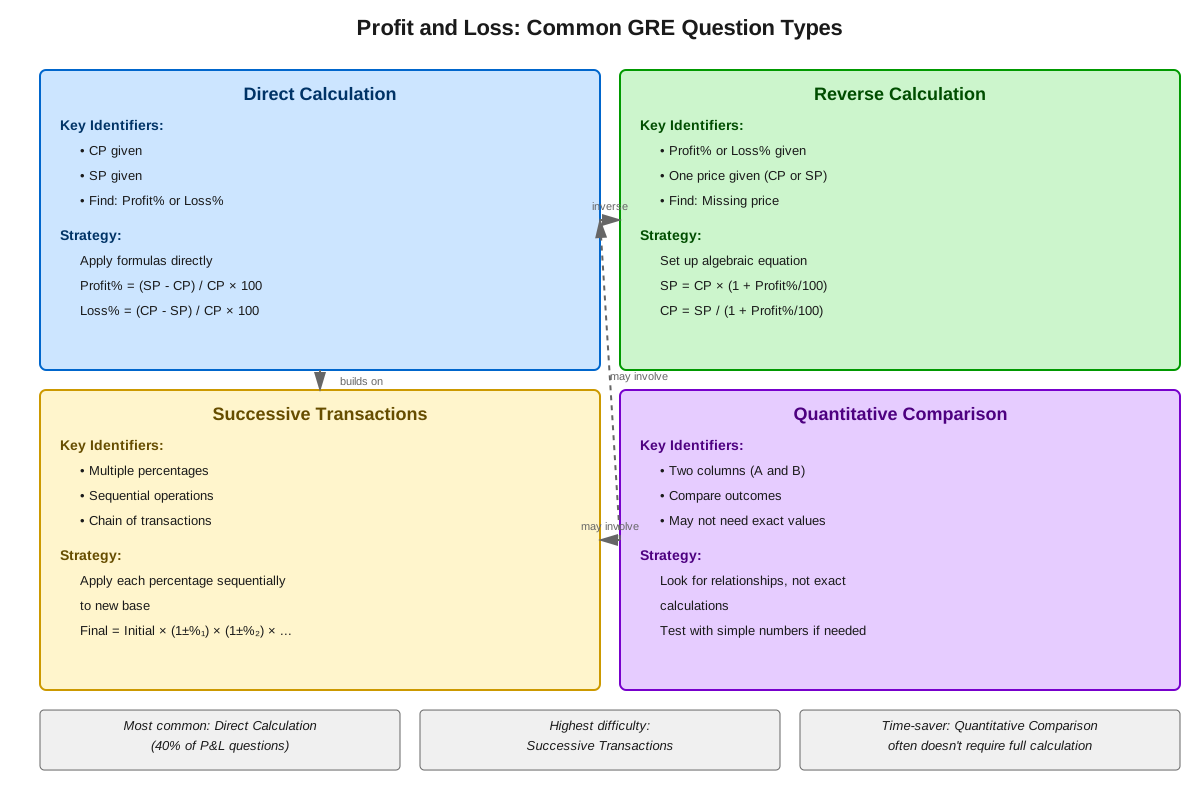
On the GRE, profit and loss questions commonly appear as: standalone word problems requiring calculation of specific values; quantitative comparison questions asking students to compare profit percentages under different scenarios; data interpretation questions embedded in tables or graphs showing sales and cost information; and multi-step problems combining profit/loss with other concepts like interest, ratios, or statistics. The topic frequently integrates with percentage problems, making it a compound test of multiple quantitative skills.
Core Concepts
Fundamental Definitions
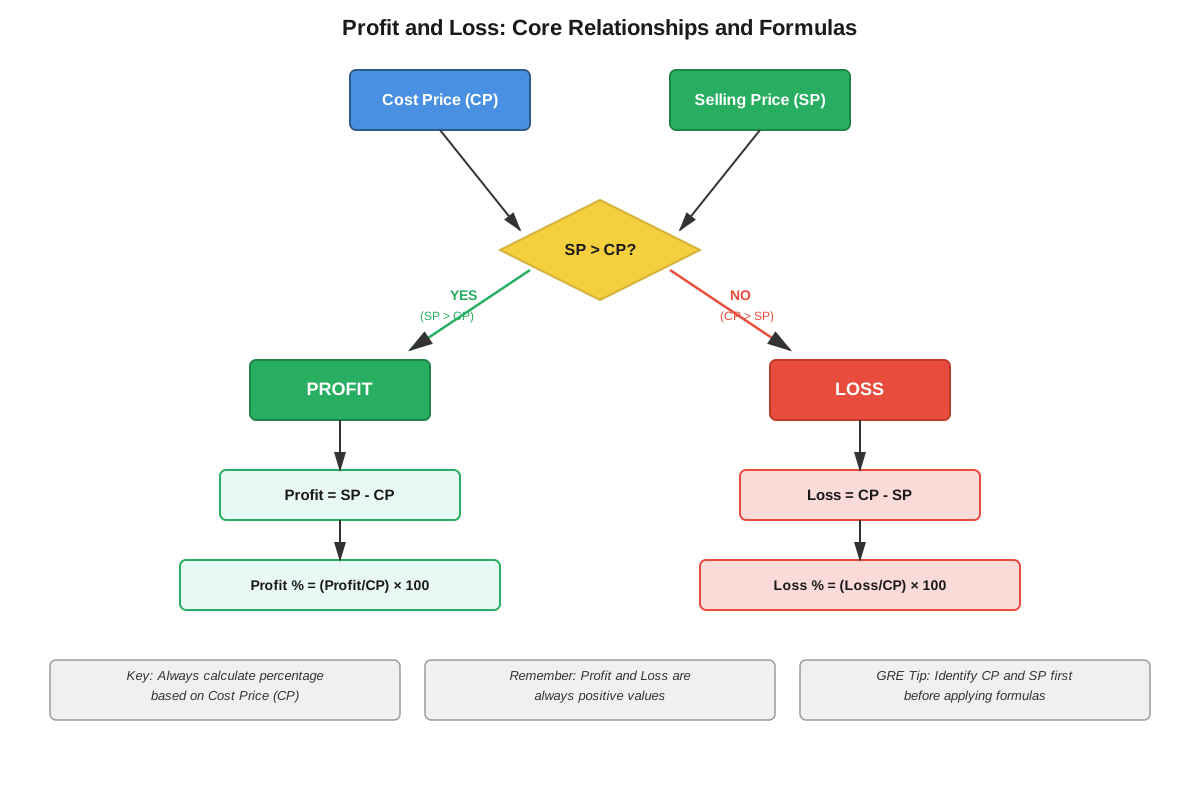
The foundation of all profit and loss problems rests on understanding three primary values: cost price (CP), selling price (SP), and the resulting profit or loss. The cost price represents the amount paid to acquire, produce, or obtain an item or service. The selling price is the amount received when the item is sold to a customer. When the selling price exceeds the cost price, the transaction generates a profit; when the cost price exceeds the selling price, the transaction results in a loss.
The basic relationships can be expressed as:
- Profit = Selling Price - Cost Price (when SP > CP)
- Loss = Cost Price - Selling Price (when CP > SP)
These absolute values tell only part of the story. The GRE frequently tests understanding of profit percentage and loss percentage, which express the gain or deficit relative to the cost price:
Profit Percentage = (Profit / Cost Price) × 100%
Loss Percentage = (Loss / Cost Price) × 100%
A critical point that distinguishes strong test-takers from average ones: profit and loss percentages are always calculated based on the cost price unless explicitly stated otherwise. This convention is fundamental to solving GRE problems correctly.
Markup and Marked Price
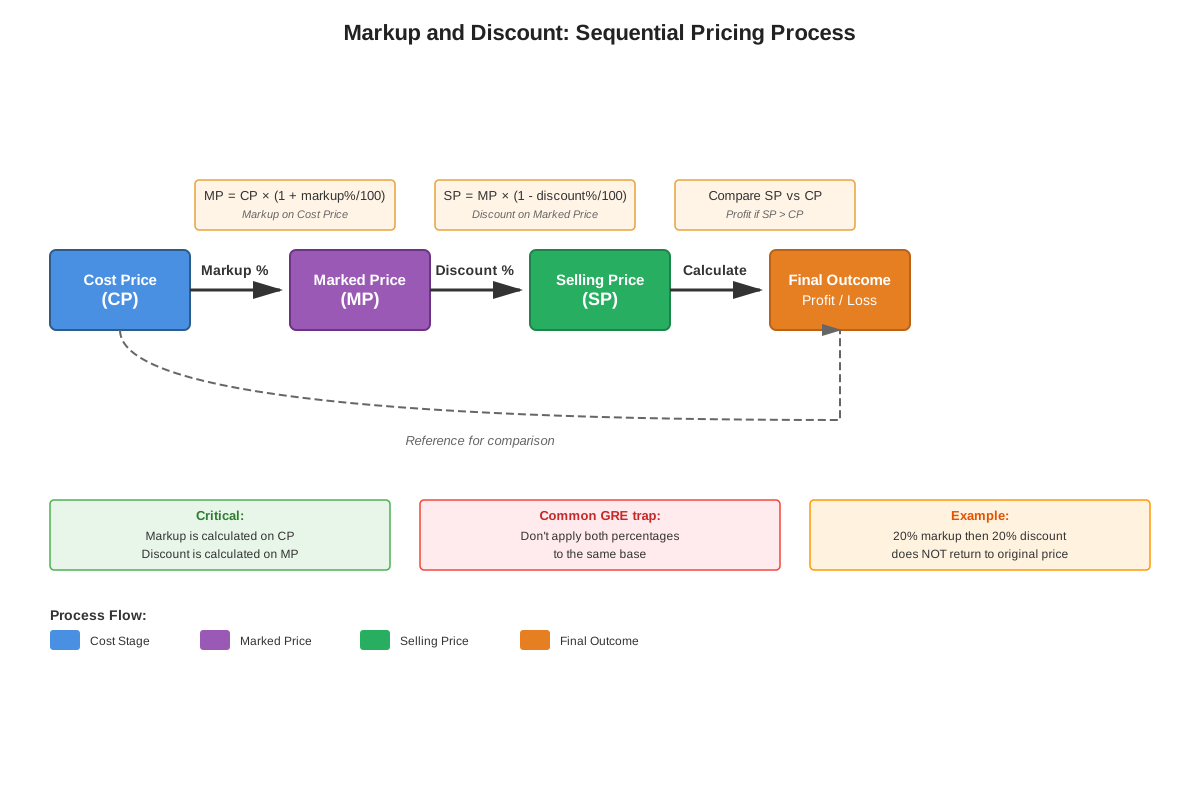
The markup represents the amount added to the cost price to arrive at a marked price (also called list price or tag price). The marked price is the initial price displayed to customers before any discounts are applied. Understanding the distinction between marked price and selling price is crucial for multi-step problems.
Marked Price = Cost Price + Markup
Markup Percentage = (Markup / Cost Price) × 100%
For example, if a retailer purchases an item for $80 and applies a 25% markup, the marked price becomes $80 + ($80 × 0.25) = $100. If the item then sells at this marked price, the selling price is $100, yielding a $20 profit (25% profit).
Discount Calculations
A discount is a reduction from the marked price, resulting in the final selling price. Discounts are typically expressed as percentages of the marked price:
Discount = Marked Price - Selling Price
Discount Percentage = (Discount / Marked Price) × 100%
Selling Price = Marked Price - Discount
The GRE often creates complexity by combining markup and discount in the same problem. A common scenario: an item is marked up by X% from cost price, then sold at a Y% discount from marked price. Students must carefully track which base (cost price or marked price) applies to each percentage calculation.
Successive Discounts and Markups
Successive discounts occur when multiple discounts are applied sequentially. A critical insight: two successive discounts of 20% and 10% do NOT equal a single 30% discount. Each discount applies to the remaining price after the previous discount.
For successive discounts of a% and b%, the equivalent single discount is:
Equivalent Discount = a + b - (a × b)/100For example, successive discounts of 20% and 10% equal: 20 + 10 - (20 × 10)/100 = 30 - 2 = 28% total discount.
Similarly, successive markups follow the same principle. A 20% markup followed by a 10% markup results in a 32% total markup, not 30%.
Break-Even and Loss Recovery
The break-even point occurs when selling price equals cost price (zero profit, zero loss). A sophisticated GRE question type involves determining what profit percentage is needed on one transaction to offset a loss on another transaction.
If an item is sold at an X% loss, the percentage profit needed on another identical item (sold at cost price) to break even overall is:
Required Profit % = [X / (100 - X)] × 100%For instance, if one item is sold at a 20% loss, a profit of 25% on another identical item is needed to break even: [20 / (100 - 20)] × 100% = 25%.
Relationship Between Profit/Loss and Selling Price
When profit or loss is given as a percentage, and the selling price is known, the cost price can be determined using:
Cost Price = Selling Price / (1 + Profit%/100)  [for profit]
Cost Price = Selling Price / (1 - Loss%/100)    [for loss]
Conversely, when cost price and profit/loss percentage are known:
Selling Price = Cost Price × (1 + Profit%/100)  [for profit]
Selling Price = Cost Price × (1 - Loss%/100)    [for loss]
These formulas enable quick calculation without intermediate steps, saving valuable time on the GRE.
Comparison Table of Key Formulas
| Scenario | Formula | Base for Percentage |
|---|---|---|
| Profit Percentage | (SP - CP)/CP × 100% | Cost Price |
| Loss Percentage | (CP - SP)/CP × 100% | Cost Price |
| Markup Percentage | (MP - CP)/CP × 100% | Cost Price |
| Discount Percentage | (MP - SP)/MP × 100% | Marked Price |
| SP from CP and Profit% | CP × (1 + P%/100) | Cost Price |
| CP from SP and Profit% | SP / (1 + P%/100) | Cost Price |
Concept Relationships
The profit and loss framework operates as an interconnected system where each component influences the others. At the foundation lies the cost price, which serves as the reference point for calculating profit percentages and markup percentages. The cost price → markup calculation → produces the marked price, which then serves as the base for discount calculations → resulting in the selling price. The relationship between cost price and selling price → determines whether a profit or loss occurs → which can be expressed as either an absolute value or a percentage.
Within multi-transaction problems, individual profit and loss calculations → combine to determine overall financial outcomes → requiring understanding of weighted averages and aggregate calculations. The concept of successive discounts → connects to exponential thinking → as each discount multiplies the remaining value by a factor less than one. Similarly, the break-even and loss recovery concepts → integrate algebraic thinking → requiring students to set up equations where total profit equals total loss.
Profit and loss problems connect to prerequisite topics through multiple pathways. Percentage knowledge → enables conversion between absolute and relative measures → which is essential for comparing transactions of different scales. Algebraic skills → allow formulation of equations when unknowns must be determined → particularly in problems involving relationships between multiple items or transactions. Ratio understanding → facilitates comparison of profit margins across different products → and helps in analyzing business efficiency.
The topic also bridges to more advanced GRE concepts. Profit and loss scenarios → often appear within data interpretation questions → requiring extraction of cost and revenue information from tables or graphs. They → integrate with interest problems → when considering time value of money or financing costs. Additionally, they → connect to optimization problems → where students must determine pricing strategies that maximize profit under given constraints.
High-Yield Facts
⭐ Profit percentage and loss percentage are always calculated based on cost price unless explicitly stated otherwise
⭐ Two successive discounts of a% and b% equal a single discount of [a + b - ab/100]%
⭐ If an item is sold at X% loss, the required profit percentage on another identical item to break even is [X/(100-X)] × 100%
⭐ When an item is marked up by X% and then discounted by X%, the result is always a net loss of (X²/100)%
⭐ Selling Price = Cost Price × (1 + Profit%/100) for profit scenarios
- If the cost price of X items equals the selling price of Y items, the profit percentage is [(X-Y)/Y] × 100%
- A discount of X% followed by a discount of Y% is NOT equal to a discount of (X+Y)%
- When comparing profit percentages, the transaction with higher absolute profit may have lower profit percentage if the cost prices differ significantly
- If selling price remains constant while cost price decreases by X%, profit increases but not by X percentage points
- The marked price can be calculated from selling price and discount percentage: MP = SP / (1 - Discount%/100)
Quick check — test yourself on Profit and loss so far.
Try Flashcards →Common Misconceptions
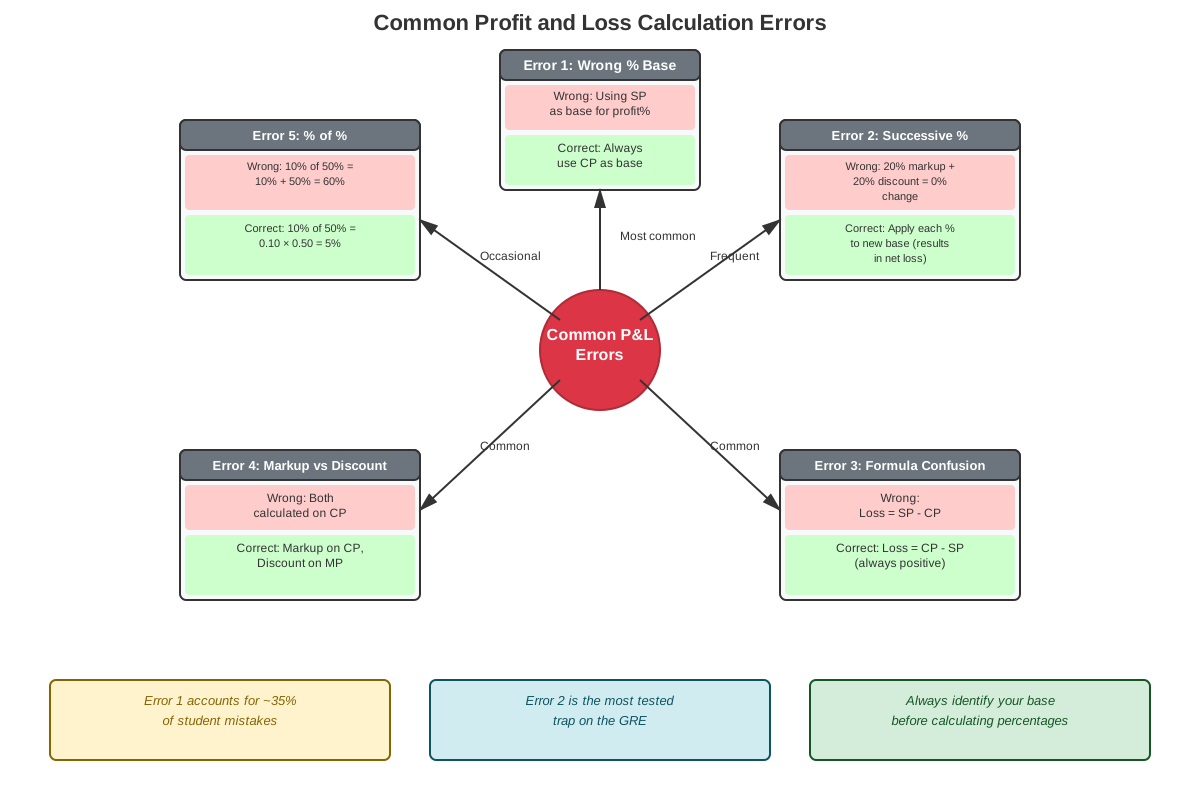
Misconception: Profit percentage is calculated based on selling price by default.
Correction: Unless explicitly stated otherwise, profit percentage is always calculated as (Profit/Cost Price) × 100%. Some problems may ask for profit as a percentage of selling price, but this must be clearly specified in the question.
Misconception: A 20% markup followed by a 20% discount returns to the original price.
Correction: These operations use different bases. If CP = $100, a 20% markup gives MP = $120. A 20% discount from $120 gives SP = $96, resulting in a 4% net loss. The net effect is always a loss of (X²/100)% when the markup and discount percentages are equal.
Misconception: Two discounts of 25% each equal a 50% total discount.
Correction: Successive discounts multiply the remaining value. Two 25% discounts result in: 100 × 0.75 × 0.75 = 56.25, which is a 43.75% total discount, not 50%. Use the formula: a + b - (ab/100).
Misconception: If an item is sold at a 20% loss, selling another item at a 20% profit will break even.
Correction: The loss and profit percentages apply to potentially different cost prices. Even if the cost prices are identical, a 20% loss requires a 25% profit on another item to break even because the bases differ after the first transaction.
Misconception: Increasing the selling price by X% increases profit by X%.
Correction: Increasing selling price by X% increases profit by more than X% because profit is the difference between selling price and cost price. If CP = $80 and SP = $100 (profit = $20), increasing SP by 10% to $110 increases profit to $30, which is a 50% increase in profit, not 10%.
Misconception: The discount percentage can be calculated as (Discount/Cost Price) × 100%.
Correction: Discount percentage is always calculated based on marked price, not cost price: (Discount/Marked Price) × 100%. Using cost price as the base will yield incorrect results.
Worked Examples
Example 1: Multi-Step Markup and Discount Problem
Problem: A retailer purchases an article for $240. She marks up the price by 25% and then offers a discount of 10% during a sale. What is her profit percentage?
Solution:
Step 1: Identify the given information
- Cost Price (CP) = $240
- Markup = 25%
- Discount = 10%
Step 2: Calculate the marked price
The markup is applied to the cost price:
Marked Price = CP × (1 + Markup%/100)
Marked Price = $240 × (1 + 25/100)
Marked Price = $240 × 1.25 = $300
Step 3: Calculate the selling price
The discount is applied to the marked price (not the cost price):
Selling Price = MP × (1 - Discount%/100)
Selling Price = $300 × (1 - 10/100)
Selling Price = $300 × 0.90 = $270
Step 4: Calculate profit
Profit = Selling Price - Cost Price
Profit = $270 - $240 = $30
Step 5: Calculate profit percentage
Profit Percentage = (Profit/Cost Price) × 100%
Profit Percentage = ($30/$240) × 100%
Profit Percentage = 0.125 × 100% = 12.5%
Answer: The retailer's profit percentage is 12.5%.
Connection to Learning Objectives: This problem demonstrates the application of profit and loss formulas to a GRE-style question involving both markup and discount, requiring careful attention to which base (cost price or marked price) applies to each calculation.
Example 2: Break-Even and Loss Recovery
Problem: A merchant sells two identical items. He sells the first item at a 15% loss. At what profit percentage must he sell the second item to achieve an overall break-even (no profit, no loss) on the two transactions?
Solution:
Step 1: Assign a convenient value to the cost price
Let CP of each item = $100 (using $100 simplifies percentage calculations)
Total Cost Price for both items = $200
Step 2: Calculate selling price of the first item
The first item is sold at 15% loss:
SP₁ = CP × (1 - Loss%/100)
SP₁ = $100 × (1 - 15/100)
SP₁ = $100 × 0.85 = $85
Step 3: Determine required total selling price for break-even
For break-even, Total SP must equal Total CP:
Total SP needed = $200
SP₂ = Total SP needed - SP₁
SP₂ = $200 - $85 = $115
Step 4: Calculate profit on the second item
Profit on second item = SP₂ - CP
Profit = $115 - $100 = $15
Step 5: Calculate profit percentage on the second item
Profit Percentage = (Profit/CP) × 100%
Profit Percentage = ($15/$100) × 100% = 15%
Alternative approach using the formula:
Required Profit % = [Loss% / (100 - Loss%)] × 100%
Required Profit % = [15 / (100 - 15)] × 100%
Required Profit % = [15 / 85] × 100% ≈ 17.65%
Wait—there's a discrepancy! Let's reconsider.
The formula [X/(100-X)] × 100% applies when we need to determine what profit percentage on the SAME cost price will offset the loss. But in this problem, we're breaking even across TWO items, each with cost price $100.
The correct answer is 15% profit on the second item to break even overall, because:
- Loss on first item: $15
- Profit needed on second item: $15
- Profit percentage: ($15/$100) × 100% = 15%
The formula [X/(100-X)] × 100% would apply if we were asking: "If an item is sold at 15% loss, at what profit percentage must the SAME item be resold to recover the loss?" In that case, the answer would be 17.65%.
Answer: The merchant must sell the second item at a 15% profit to break even overall.
Connection to Learning Objectives: This problem illustrates the importance of carefully reading what the question asks and understanding the difference between breaking even on multiple items versus recovering a loss on a single item through resale.
Exam Strategy
When approaching GRE profit and loss questions, begin by identifying the trigger words that signal this topic: "profit," "loss," "cost price," "selling price," "marked price," "discount," "markup," "gain," "revenue," and "break-even." These terms immediately indicate that the problem involves financial transactions requiring profit and loss analysis.
Step-by-step approach:
- Extract and label all given information: Clearly identify CP, SP, MP, profit%, loss%, markup%, and discount%. Write these down using abbreviations to avoid confusion.
- Determine what the question asks: Is it asking for a percentage or an absolute value? Is it asking for profit, loss, cost price, or selling price? Underline the specific question.
- Identify the base for percentage calculations: Remember that profit% and markup% use cost price as the base, while discount% uses marked price as the base.
- Choose strategic values: When no specific values are given, assign convenient numbers like $100 or $1000 to the cost price to simplify calculations.
- Work systematically through the transaction sequence: Follow the flow: CP → markup → MP → discount → SP → profit/loss calculation.
For quantitative comparison questions involving profit and loss:
- Calculate the actual values for both quantities rather than trying to reason abstractly
- Watch for scenarios where percentages are equal but bases differ
- Be alert to problems where one quantity involves successive operations while the other involves a single operation
Time-saving techniques:
- Recognize that when markup% equals discount%, there's always a net loss of (X²/100)%
- Use the formula SP = CP × (1 ± P%/100) for direct calculation
- For successive discounts, apply the formula a + b - (ab/100) rather than calculating step-by-step
Common trap answers to eliminate:
- Options that calculate profit% based on selling price instead of cost price
- Options that add successive discount percentages directly
- Options that confuse marked price with selling price
- Options that apply the wrong base for percentage calculations
Allocate approximately 1.5 to 2 minutes for straightforward profit and loss problems, and up to 2.5 minutes for complex multi-step problems involving successive operations or multiple items.
Memory Techniques
Mnemonic for the profit/loss formula sequence: "CP Makes SP" (Cost Price Makes Selling Price)
- When you have CP and profit%, multiply: CP × (1 + P%/100) = SP
- When you have SP and profit%, divide: SP / (1 + P%/100) = CP
Visualization for successive discounts: Picture a shrinking balloon. Each discount deflates it by a percentage of its CURRENT size, not the original size. This mental image reinforces that successive discounts don't simply add together.
Acronym for markup and discount bases: "CAMP-D"
- Cost price for Markup Percentage
- Marked price for Discount percentage
Memory aid for the net effect of equal markup and discount: "Square and divide by 100 for the loss"
- If markup% = discount% = X, net loss% = X²/100
- Example: 20% markup and 20% discount → 400/100 = 4% loss
Rhyme for profit percentage base: "Profit's base is what you paid, not the price for which it's trade"
- This reminds you that profit percentage uses cost price (what you paid), not selling price (the trade price)
Finger counting technique for successive discounts: Use your fingers to track the remaining percentage after each discount:
- Start with 10 fingers = 100%
- First discount of 20%: fold down 2 fingers, 8 remain = 80%
- Second discount of 10% of remaining: fold down 10% of 8 = 0.8 fingers, approximately 7 remain = 72%
- Total discount = 28%
Summary
Profit and loss problems on the GRE test the ability to navigate financial transactions involving cost prices, selling prices, markups, and discounts. The fundamental principle is that profit occurs when selling price exceeds cost price, while loss occurs when cost price exceeds selling price. Critical to success is understanding that profit and loss percentages are calculated based on cost price, while discount percentages are based on marked price. The GRE frequently tests multi-step problems where items are marked up from cost price and then discounted from marked price, requiring careful tracking of which base applies to each calculation. Successive discounts and markups do not simply add together; instead, they follow the formula a + b - (ab/100) for the equivalent single percentage. Advanced problems may involve break-even scenarios, loss recovery calculations, or comparisons between different pricing strategies. Mastery requires not only memorizing formulas but also developing the ability to translate business language into mathematical expressions, choose appropriate solution strategies, and avoid common calculation errors related to percentage bases.
Key Takeaways
- Profit percentage = (Profit/Cost Price) × 100% and Loss percentage = (Loss/Cost Price) × 100% — always use cost price as the base unless explicitly told otherwise
- Successive discounts of a% and b% equal [a + b - (ab/100)]%, not simply (a + b)%
- Markup percentage uses cost price as base; discount percentage uses marked price as base — mixing these up is a common error
- When markup% equals discount%, the net result is always a loss of (X²/100)%
- Use SP = CP × (1 ± P%/100) for quick calculations when you know cost price and profit/loss percentage
- Assign convenient values (like $100) to unknown cost prices to simplify calculations
- Read carefully to distinguish between questions asking for absolute profit versus profit percentage, and between single-item versus multi-item scenarios
Related Topics
Percentage Problems: Profit and loss problems are fundamentally percentage problems in a business context. Deepening percentage skills, particularly with percentage change and percentage point differences, directly enhances profit and loss problem-solving ability.
Ratio and Proportion: Understanding the ratio between cost price and selling price, or between profit and cost price, connects profit and loss to ratio problems. Some GRE questions explicitly frame profit and loss in ratio terms.
Simple and Compound Interest: Interest problems share structural similarities with profit and loss, particularly in understanding how percentages apply to different bases and how successive percentage changes compound.
Mixture Problems: Advanced GRE questions sometimes combine profit and loss with mixture concepts, such as determining overall profit when items with different cost prices and profit margins are sold together.
Data Interpretation: Profit and loss concepts frequently appear in data interpretation sets involving business data, requiring extraction of cost and revenue information from tables, graphs, or charts.
Practice CTA
Now that you've mastered the core concepts, formulas, and strategies for GRE profit and loss problems, it's time to solidify your understanding through practice. Attempt the practice questions designed specifically for this topic, focusing on applying the systematic approach outlined in the exam strategy section. Use the flashcards to reinforce key formulas and relationships until they become automatic. Remember, the difference between knowing the concepts and scoring points on test day lies in repeated, deliberate practice. Challenge yourself with increasingly complex problems, and review any mistakes carefully to identify gaps in understanding. Your investment in mastering this high-yield topic will pay dividends across multiple questions on the GRE Quantitative Reasoning section!
Sign up free to keep reading
Create a free AnvayaPrep account to finish this GRE guide on Profit and loss — plus flashcards and practice questions.