Overview
Causal reasoning is one of the most frequently tested critical reasoning skills on the GRE Verbal Reasoning section. This type of reasoning involves understanding, analyzing, and evaluating arguments that claim one event or factor causes another. On the GRE, students encounter causal arguments in Reading Comprehension passages, Text Completion questions that describe cause-and-effect relationships, and especially in analytical passages where they must identify logical flaws or strengthen/weaken arguments. Mastering causal reasoning is essential because approximately 20-30% of critical reasoning questions involve causal relationships, making it one of the highest-yield topics for score improvement.
GRE causal reasoning questions test the ability to distinguish between correlation and causation, identify alternative explanations for observed phenomena, and recognize common logical fallacies in causal arguments. The GRE presents these questions in various formats: some ask students to identify assumptions underlying a causal claim, others require finding evidence that would strengthen or weaken a causal argument, and still others test whether students can recognize when a causal relationship has been improperly inferred from correlational data. Understanding the mechanics of causal reasoning enables students to approach these questions systematically rather than relying on intuition alone.
Within the broader framework of Verbal Reasoning, causal reasoning connects intimately with argument structure analysis, logical fallacy identification, and evidence evaluation. It serves as a foundation for understanding how authors construct persuasive arguments and how those arguments can be critically examined. Students who master causal reasoning develop a transferable analytical skill that enhances performance across all question types requiring logical analysis, including those involving statistical reasoning, experimental design interpretation, and policy recommendation evaluation.
Learning Objectives
- [ ] Identify when Causal reasoning is being tested in GRE questions
- [ ] Explain the core rule or strategy behind Causal reasoning
- [ ] Apply Causal reasoning to GRE-style questions accurately
- [ ] Distinguish between correlation and causation in argument passages
- [ ] Recognize and name at least five common causal reasoning fallacies
- [ ] Generate alternative explanations for observed correlations
- [ ] Evaluate the strength of evidence supporting causal claims
Prerequisites
- Basic argument structure: Understanding premises, conclusions, and how evidence supports claims is necessary because causal reasoning questions always embed causal claims within larger arguments
- Logical connectors: Familiarity with words like "therefore," "because," "consequently," and "as a result" helps identify when causal relationships are being asserted
- Reading comprehension fundamentals: The ability to identify main ideas and supporting details enables students to locate causal claims within complex passages
Why This Topic Matters
Causal reasoning appears throughout academic, professional, and everyday contexts. Scientists use causal reasoning to design experiments and interpret results. Policy makers rely on causal analysis to predict the effects of proposed legislation. Business leaders employ causal thinking to understand market dynamics and make strategic decisions. The GRE tests this skill because graduate programs require students to evaluate research claims, assess evidence quality, and construct sound arguments—all of which depend on rigorous causal reasoning.
On the GRE specifically, causal reasoning questions appear in multiple formats across the Verbal Reasoning section. Approximately 25-35% of Reading Comprehension questions with an analytical focus involve causal relationships. These questions may ask students to identify an assumption, find a strengthening or weakening statement, explain a discrepancy, or evaluate a conclusion. Text Completion and Sentence Equivalence questions also frequently feature causal language, requiring students to select words that accurately reflect cause-and-effect relationships described in the passage.
The most common manifestations of causal reasoning on the GRE include: arguments claiming that one variable causes changes in another based on observational data; explanations for why a particular phenomenon occurs; predictions about future outcomes based on causal models; and policy recommendations justified by causal claims. Questions typically present a flawed causal argument and ask students to identify the flaw, or they present a causal claim and ask what would strengthen, weaken, or be assumed by that claim. Recognizing these patterns enables efficient question identification and strategic approach selection.
Core Concepts
The Fundamental Principle of Causal Reasoning
At its core, causal reasoning involves establishing that one event, condition, or factor (the cause) produces or brings about another event or condition (the effect). A valid causal claim requires more than mere temporal sequence or correlation; it demands a mechanism by which the cause produces the effect and the elimination of alternative explanations. The GRE tests whether students can distinguish between genuine causal relationships and spurious associations that merely appear causal.
The gold standard for establishing causation is the controlled experiment, where researchers manipulate the suspected cause while holding all other variables constant and observe whether the effect consistently follows. However, GRE passages often present observational data—situations where researchers observe naturally occurring correlations without experimental manipulation. This creates opportunities for logical errors that the GRE exploits in its questions.
Correlation vs. Causation
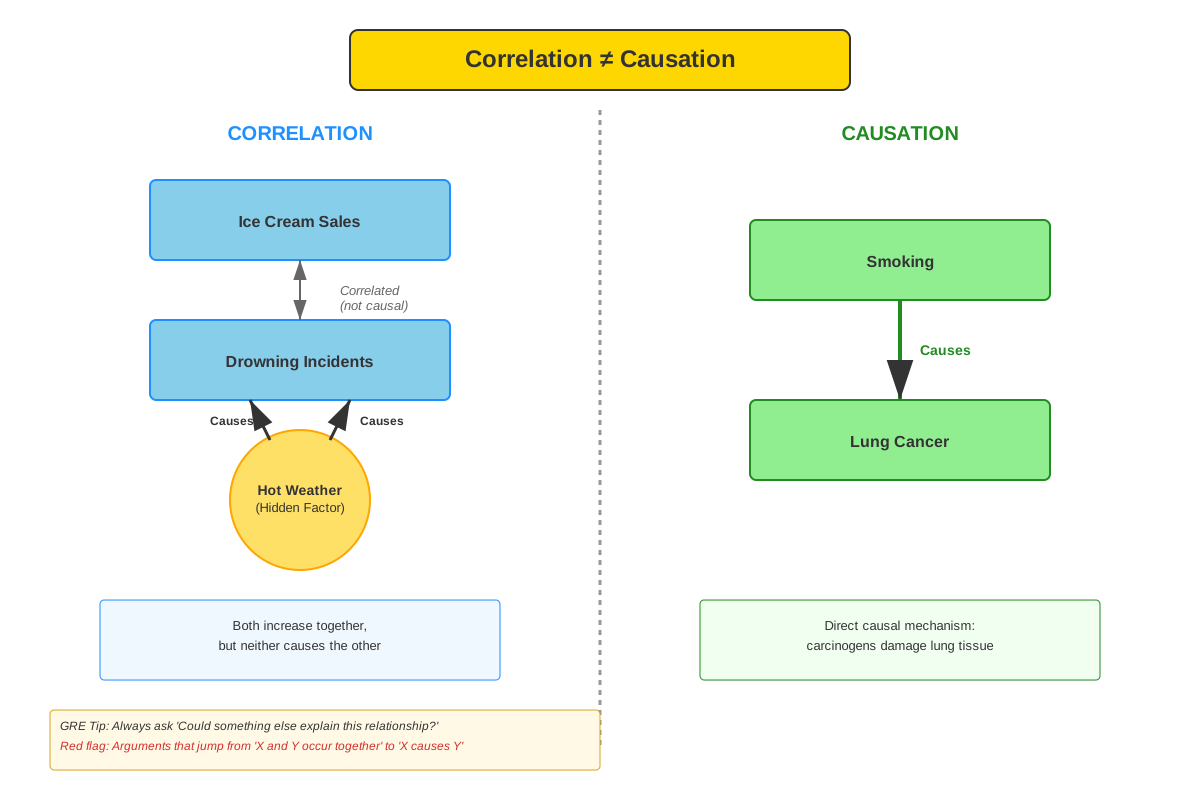
The most fundamental distinction in causal reasoning is between correlation (two variables changing together) and causation (one variable producing changes in another). When two variables are correlated, they exhibit a statistical relationship: as one increases, the other tends to increase (positive correlation) or decrease (negative correlation). However, correlation alone does not establish causation.
Consider this example: Ice cream sales and drowning deaths are positively correlated—both increase during the same months. However, ice cream consumption does not cause drowning. Instead, a third variable (warm weather) causes both increased ice cream sales and increased swimming, which leads to more drowning incidents. This illustrates the third variable problem, one of the most common causal reasoning errors on the GRE.
| Relationship Type | Definition | Example | Causal? |
|---|---|---|---|
| Correlation | Two variables change together | Height and weight tend to increase together | Not necessarily |
| Causation | One variable produces changes in another | Smoking causes lung cancer | Yes |
| Coincidence | Variables appear related by chance | Lottery numbers and birth dates | No |
| Common cause | Third variable causes both observed variables | Temperature causes both ice cream sales and drowning rates | No (between the two effects) |
The Five Major Causal Reasoning Fallacies
Understanding common errors in causal reasoning enables students to quickly identify flawed arguments on the GRE:
- Post hoc ergo propter hoc ("after this, therefore because of this"): Assuming that because Event B followed Event A, Event A must have caused Event B. Temporal sequence alone does not establish causation. Example: "The new mayor took office in January, and crime decreased in February; therefore, the new mayor's policies reduced crime." This ignores that crime naturally fluctuates and that February's decrease might have occurred regardless of the mayoral change.
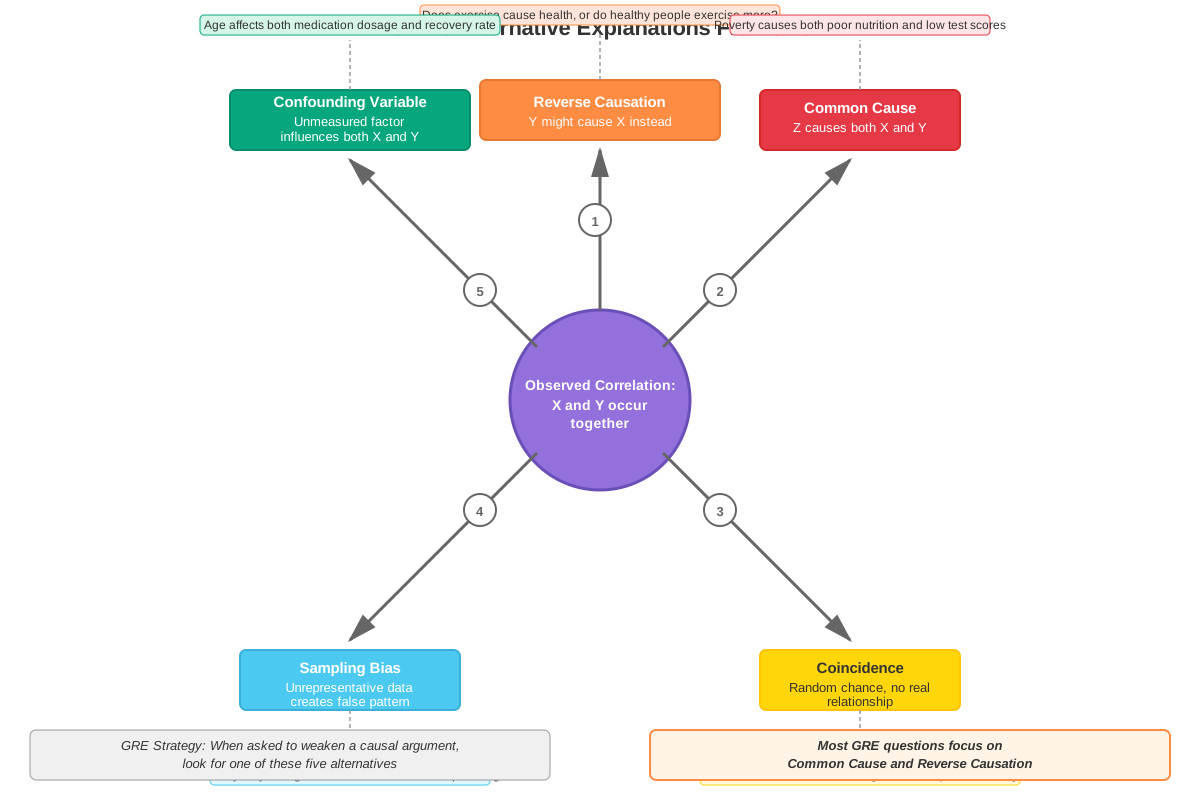
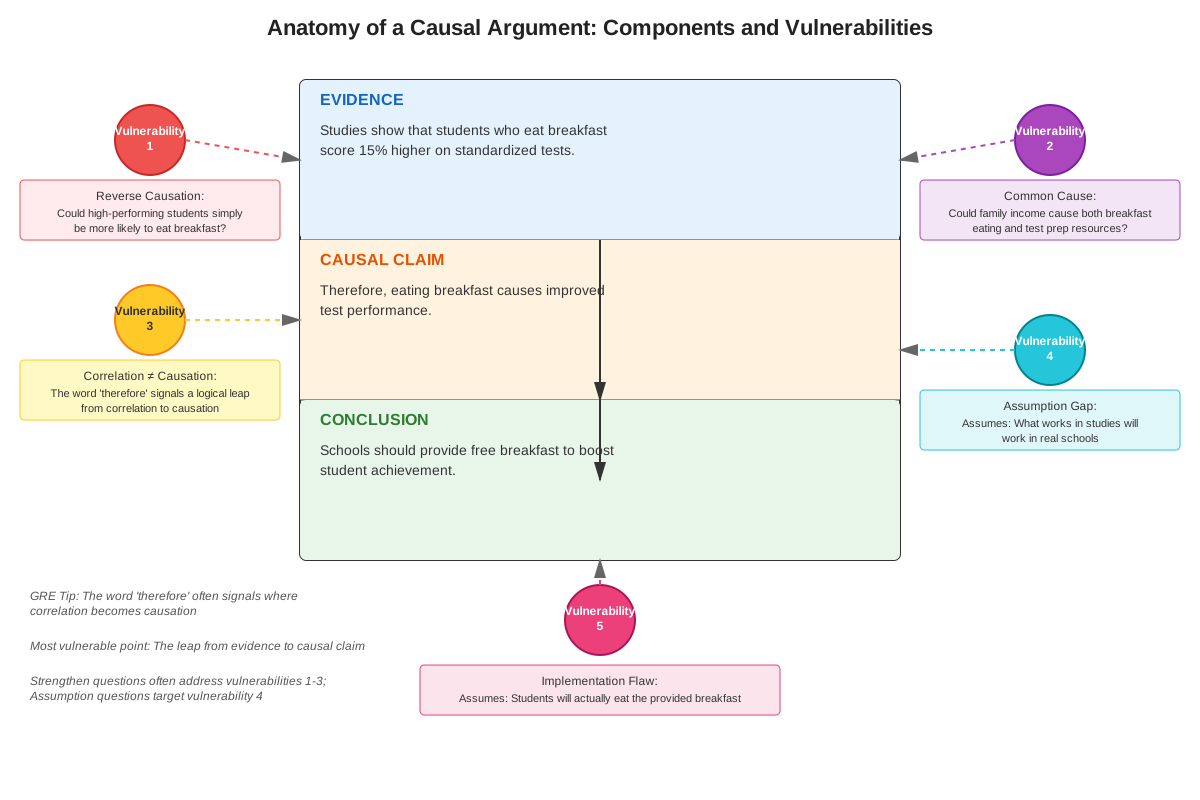
- Reverse causation: Mistaking which variable is the cause and which is the effect. Example: "Students who take notes on laptops perform worse on exams than students who handwrite notes; therefore, laptop use causes poor performance." However, students who struggle academically might choose laptops because they need to capture more information verbatim, meaning poor performance causes laptop use rather than vice versa.
- Third variable (confounding variable): Failing to consider that an unobserved variable might cause both observed variables. Example: "Countries with more television sets per capita have higher life expectancies; therefore, television ownership increases longevity." Wealth is the confounding variable—it enables both television purchases and access to quality healthcare.
- Oversimplification: Assuming a single cause when multiple factors contribute to an effect. Example: "Company profits increased after implementing the new marketing strategy; therefore, the marketing strategy caused the profit increase." This ignores other potential contributors like economic conditions, competitor actions, or product improvements.
- Causal chain errors: Failing to recognize that intermediate steps might break a causal chain. Example: "Education causes higher income; therefore, building more schools will increase average income." This assumes that building schools leads to more education (people must attend) and that education's effect on income remains constant across contexts.
Necessary vs. Sufficient Conditions
Understanding the distinction between necessary conditions (must be present for the effect to occur) and sufficient conditions (guarantee the effect will occur) is crucial for analyzing causal claims:
- A necessary condition must be present for an effect to occur, but its presence alone does not guarantee the effect. Example: Oxygen is necessary for fire, but oxygen alone does not cause fire.
- A sufficient condition guarantees an effect will occur, but the effect might occur through other means. Example: Decapitation is sufficient to cause death, but death can occur through many other causes.
Many GRE questions test whether students confuse these concepts. An argument might establish that X is necessary for Y and then incorrectly conclude that X is sufficient for Y, or vice versa.
Alternative Explanations
A critical skill in causal reasoning is generating alternative explanations for observed phenomena. When presented with a correlation or outcome, strong critical thinkers can identify multiple potential causes. The GRE frequently asks students to find answer choices that present alternative explanations that would weaken a causal argument.
For example, if a passage states "After the city installed speed cameras, traffic accidents decreased by 30%," alternative explanations might include:
- Improved road conditions during the same period
- A public awareness campaign about safe driving
- Reduced traffic volume due to economic factors
- Better weather conditions
- Natural regression to the mean after an unusually high accident period
Strengthening and Weakening Causal Arguments
GRE questions often ask what would strengthen or weaken a causal argument. Understanding what makes causal arguments stronger or weaker is essential:
Strengthening strategies:
- Eliminate alternative explanations
- Show the cause precedes the effect temporally
- Demonstrate a dose-response relationship (more cause → more effect)
- Identify a plausible mechanism linking cause and effect
- Show the effect disappears when the cause is removed
- Present experimental rather than observational evidence
Weakening strategies:
- Introduce alternative explanations
- Show the effect sometimes occurs without the cause
- Demonstrate the cause sometimes occurs without the effect
- Reveal a confounding variable
- Question the reliability of the data
- Show reverse causation is possible
Concept Relationships
The concepts within causal reasoning form an interconnected logical framework. The fundamental correlation vs. causation distinction serves as the foundation upon which all other concepts build. Understanding this distinction enables recognition of the five major causal fallacies, each of which represents a specific way that correlation might be mistaken for causation.
The relationship map flows as follows:
Correlation vs. Causation → enables identification of → Causal Fallacies (post hoc, reverse causation, third variable, oversimplification, causal chain errors)
Causal Fallacies → are avoided by considering → Alternative Explanations
Alternative Explanations → are evaluated using → Necessary vs. Sufficient Conditions
All of the above → inform strategies for → Strengthening and Weakening Arguments
These concepts connect to prerequisite knowledge of argument structure because causal claims always function as either premises or conclusions within larger arguments. They also relate to evidence evaluation skills, as students must assess whether presented evidence actually supports causal claims or merely establishes correlation.
Looking forward, mastery of causal reasoning enables progression to more advanced topics like statistical reasoning (understanding how sample size and study design affect causal inferences), experimental design analysis (evaluating whether studies can support causal conclusions), and complex argument evaluation (analyzing multi-step causal chains in policy arguments).
High-Yield Facts
⭐ Correlation does not imply causation—two variables can be associated without one causing the other
⭐ The post hoc fallacy (assuming temporal sequence implies causation) is the most frequently tested causal reasoning error on the GRE
⭐ Third variables (confounding factors) can cause both observed variables, creating a spurious correlation
⭐ Reverse causation occurs when the presumed effect actually causes the presumed cause
⭐ Alternative explanations weaken causal arguments by providing other potential causes for the observed effect
- Necessary conditions must be present for an effect but don't guarantee it; sufficient conditions guarantee an effect but aren't required
- Controlled experiments provide stronger evidence for causation than observational studies
- A dose-response relationship (more cause leads to more effect) strengthens causal claims
- Eliminating alternative explanations strengthens causal arguments
- Causal chains can break at any intermediate step, weakening the overall causal claim
- Oversimplification occurs when multiple causes are reduced to a single cause
- Temporal precedence (cause before effect) is necessary but not sufficient for establishing causation
- The absence of a plausible mechanism weakens causal claims
Quick check — test yourself on Causal reasoning so far.
Try Flashcards →Common Misconceptions
Misconception: If two events occur together frequently, one must cause the other.
Correction: Frequent co-occurrence establishes correlation, not causation. Both events might be caused by a third variable, or their association might be coincidental. Causation requires evidence beyond mere correlation, including temporal precedence, elimination of alternatives, and a plausible mechanism.
Misconception: If Event A always precedes Event B, then A causes B.
Correction: Temporal sequence is necessary for causation but not sufficient. Night always precedes day, but night does not cause day—both are caused by Earth's rotation. The post hoc fallacy specifically involves this error.
Misconception: Disproving one potential cause proves another cause must be responsible.
Correction: Multiple potential causes might exist. Eliminating one alternative explanation does not automatically validate a different causal claim. Each causal hypothesis requires its own positive evidence.
Misconception: If removing the suspected cause eliminates the effect, this proves causation.
Correction: While this evidence strengthens a causal claim, it doesn't definitively prove causation. Other factors that changed simultaneously with the removal might be responsible, or the effect might have disappeared for unrelated reasons (regression to the mean, natural cycles, etc.).
Misconception: Complex effects must have complex causes, and simple effects must have simple causes.
Correction: Causal relationships don't follow this pattern. Simple causes can produce complex effects (a single genetic mutation can cause multiple symptoms), and complex effects can result from simple causes (economic recessions can stem from interest rate changes). The GRE often exploits this misconception by presenting oversimplified causal claims for complex phenomena.
Misconception: Statistical significance proves causation.
Correction: Statistical significance indicates that an observed relationship is unlikely to be due to chance, but it doesn't distinguish between causal relationships and non-causal correlations. A statistically significant correlation between two variables might still result from confounding variables or reverse causation.
Misconception: Expert opinion or authority establishes causal relationships.
Correction: While expert analysis can be valuable, causation must be established through evidence and logical reasoning, not authority. The GRE tests critical thinking, which requires evaluating the evidence and logic behind claims regardless of who makes them.
Worked Examples
Example 1: Identifying a Causal Fallacy
Passage: "A recent study found that children who attend preschool score higher on standardized tests in elementary school than children who do not attend preschool. Therefore, preschool attendance causes improved academic performance. The city council should fund universal preschool to improve educational outcomes."
Question: Which of the following, if true, most weakens the argument?
A) Some children who attend preschool do not show improved test scores
B) Families who send children to preschool tend to have higher incomes and more educated parents than families who do not
C) Preschool teachers receive specialized training in early childhood education
D) The standardized tests measure skills that are taught in preschool
E) Universal preschool programs have been successful in other cities
Solution:
Step 1: Identify the causal claim. The argument claims that preschool attendance (cause) produces improved test scores (effect).
Step 2: Recognize the type of evidence. This is observational data showing a correlation between preschool attendance and test scores.
Step 3: Consider potential fallacies. The argument might suffer from a third variable problem—some other factor might cause both preschool attendance and higher test scores.
Step 4: Evaluate each answer choice:
- (A) Shows the cause doesn't always produce the effect, but this doesn't strongly weaken the argument because causal relationships can be probabilistic rather than deterministic. Some exceptions don't disprove a general causal trend.
- (B) Introduces confounding variables (family income and parental education) that could cause both preschool attendance and higher test scores. This directly addresses the third variable problem and suggests the correlation might not be causal. This is the strongest weakener.
- (C) Provides a mechanism that might explain how preschool could cause improved performance, which actually strengthens rather than weakens the argument.
- (D) Explains why preschool-attending children score higher but doesn't address whether preschool causes lasting academic improvement or merely teaches test-specific skills. This is somewhat relevant but doesn't weaken as strongly as (B).
- (E) Provides supporting evidence for the policy recommendation but doesn't address the causal claim's validity.
Answer: B
Connection to learning objectives: This example demonstrates how to identify when causal reasoning is being tested (the argument makes an explicit causal claim), apply the core strategy (look for alternative explanations and confounding variables), and accurately select the answer that weakens the causal argument.
Example 2: Strengthening a Causal Argument
Passage: "Researchers observed that office workers who take regular breaks to walk around the building report fewer headaches than workers who remain seated throughout the day. The researchers concluded that taking walking breaks reduces headache frequency."
Question: Which of the following, if true, most strengthens the researchers' conclusion?
A) Workers who take walking breaks also tend to drink more water throughout the day
B) The study included workers from multiple companies in different industries
C) When workers who previously remained seated began taking regular walking breaks, their headache frequency decreased
D) Headaches are a common complaint among office workers
E) Walking increases blood circulation and oxygen delivery to the brain
Solution:
Step 1: Identify the causal claim. Walking breaks (cause) reduce headache frequency (effect).
Step 2: Recognize the evidence type. The initial evidence is correlational—workers who walk have fewer headaches.
Step 3: Consider what would strengthen the causal claim. Strong evidence would eliminate alternative explanations, show temporal precedence, demonstrate a dose-response relationship, or provide experimental rather than observational data.
Step 4: Evaluate each answer choice:
- (A) Introduces an alternative explanation (water consumption might reduce headaches), which weakens rather than strengthens the argument.
- (B) Increases the generalizability of the findings but doesn't address whether the relationship is causal. A correlation that holds across multiple contexts is still just a correlation.
- (C) Provides quasi-experimental evidence showing that when the cause is introduced, the effect follows. This is much stronger than purely observational data because it demonstrates temporal precedence and suggests the walking breaks themselves (not some pre-existing difference between walkers and non-walkers) produce the effect. This is the strongest strengthener.
- (D) Establishes that the effect is common but doesn't address the causal relationship.
- (E) Provides a plausible mechanism, which strengthens the argument somewhat, but mechanism alone doesn't prove causation. The mechanism could be correct while the actual cause of reduced headaches is something else correlated with walking breaks.
Answer: C
Connection to learning objectives: This example shows how to identify causal reasoning questions, apply the strategy of looking for evidence that eliminates alternative explanations or provides experimental support, and select the answer that most strengthens the causal claim.
Exam Strategy
Recognizing Causal Reasoning Questions
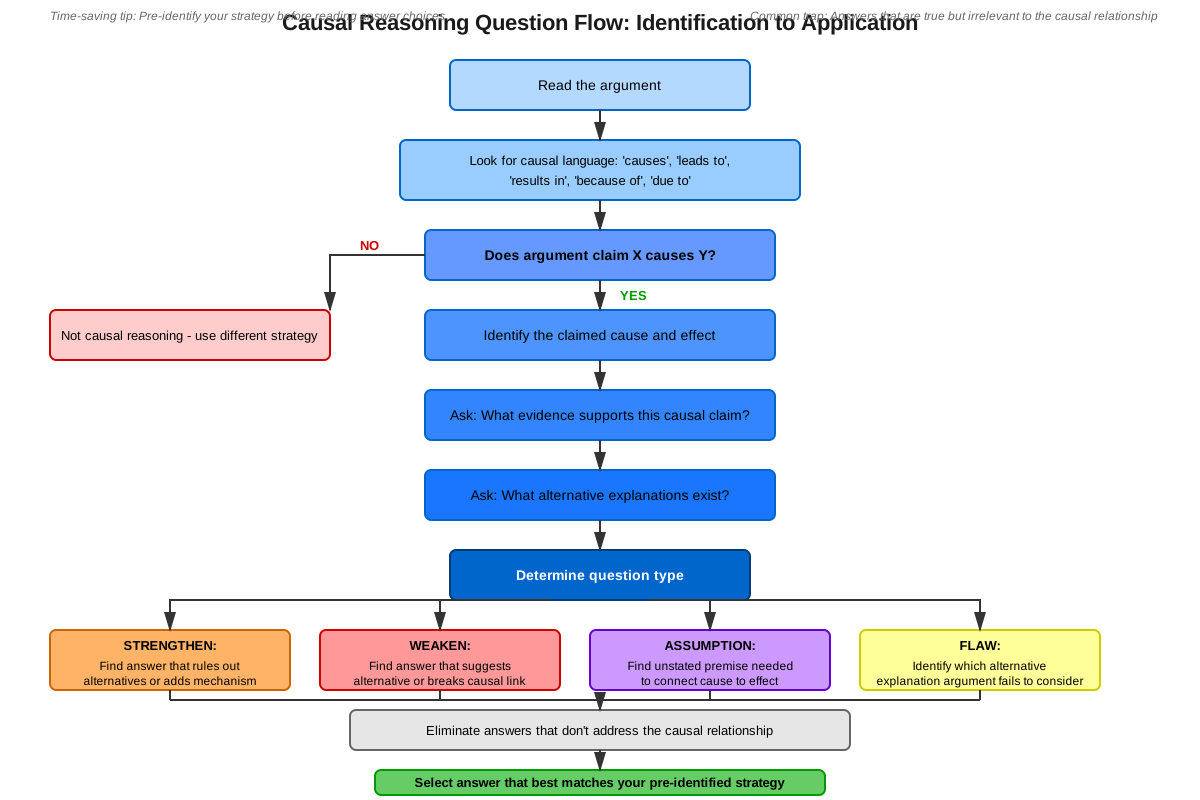
Watch for these trigger words and phrases that signal causal reasoning:
- "causes," "leads to," "results in," "produces," "brings about"
- "because of," "due to," "as a result of," "stems from"
- "therefore," "thus," "consequently," "accordingly"
- "explains why," "accounts for," "is responsible for"
- "if...then" constructions suggesting causal relationships
Questions explicitly testing causal reasoning often include phrases like:
- "Which of the following, if true, most weakens/strengthens the argument?"
- "The argument assumes which of the following?"
- "Which of the following provides an alternative explanation?"
- "The argument is most vulnerable to criticism on the grounds that..."
Systematic Approach to Causal Reasoning Questions
- Identify the causal claim: Clearly distinguish the proposed cause from the proposed effect. Underline or mentally note each component.
- Assess the evidence type: Is this experimental data (stronger for causal claims) or observational data (weaker, more susceptible to confounding)?
- Generate alternative explanations: Before looking at answer choices, brainstorm 2-3 alternative explanations for the observed correlation. This primes your mind to recognize relevant answer choices.
- Check for common fallacies: Quickly scan for post hoc reasoning, third variables, reverse causation, or oversimplification.
- Evaluate answer choices systematically: For weakening questions, look for alternatives that introduce confounding variables or alternative explanations. For strengthening questions, look for answers that eliminate alternatives or provide experimental evidence.
Process of Elimination Tips
For weakening questions, eliminate answers that:
- Strengthen the argument or are irrelevant
- Address minor points rather than the central causal claim
- Are too weak (e.g., "some exceptions exist" when the argument allows for exceptions)
For strengthening questions, eliminate answers that:
- Weaken the argument or introduce alternative explanations
- Merely restate the conclusion without providing new evidence
- Address tangential issues rather than the causal relationship
For assumption questions, eliminate answers that:
- Are explicitly stated in the passage (assumptions are unstated)
- Are irrelevant to the causal claim
- Are too extreme (assumptions should be necessary, not sufficient)
Time Allocation
Causal reasoning questions typically require 60-90 seconds. Allocate time as follows:
- 15-20 seconds: Read and identify the causal claim
- 10-15 seconds: Generate alternative explanations
- 30-45 seconds: Evaluate answer choices
- 5-10 seconds: Verify your selection
If you find yourself spending more than 90 seconds, you may be overthinking. Trust your systematic approach and make your best selection.
Exam Tip: When stuck between two answer choices on a weakening question, choose the one that introduces a more direct alternative explanation or confounding variable. When stuck on a strengthening question, choose the answer that provides experimental or quasi-experimental evidence over one that merely provides a plausible mechanism.
Memory Techniques
The CART Mnemonic for Causal Fallacies
Remember the most common causal fallacies with CART:
- Confounding variable (third variable problem)
- After-therefore-because (post hoc fallacy)
- Reverse causation
- Too simple (oversimplification)
The THREE-STEP Approach to Causal Questions
Type: Identify the causal claim (cause → effect)
Hypotheses: Generate alternative explanations
Review: Check for common fallacies
Evaluate: Assess each answer choice
Eliminate: Remove clearly wrong answers
Select: Choose the strongest remaining option
Test: Verify it addresses the causal claim
Ensure: Confirm it answers the specific question asked
Proceed: Move to the next question confidently
Visualization Strategy
Picture causal relationships as arrows: Cause → Effect
When you see a correlation, visualize three possible arrow configurations:
- A → B (A causes B)
- B → A (B causes A, reverse causation)
- C → A and C → B (C causes both, third variable)
This visual framework helps quickly generate alternative explanations.
The "But What Else?" Technique
After reading a causal claim, immediately ask "But what else could explain this?" This automatic questioning habit trains your mind to generate alternative explanations, which is the core skill tested in most causal reasoning questions.
Summary
Causal reasoning is a high-yield GRE topic that tests the ability to distinguish genuine cause-and-effect relationships from mere correlations. The fundamental principle is that correlation does not imply causation—two variables can be associated without one causing the other. The five major causal fallacies (post hoc reasoning, reverse causation, third variable problems, oversimplification, and causal chain errors) represent the most common ways arguments incorrectly infer causation from correlation. Strong causal arguments eliminate alternative explanations, demonstrate temporal precedence, show dose-response relationships, and ideally provide experimental rather than observational evidence. GRE questions test these concepts by presenting flawed causal arguments and asking students to identify assumptions, generate alternative explanations, or determine what would strengthen or weaken the argument. Success requires systematically identifying the causal claim, generating alternative explanations, checking for common fallacies, and evaluating answer choices based on whether they introduce confounding variables, provide experimental evidence, or address the central causal relationship. Mastering causal reasoning improves performance across multiple question types and develops critical thinking skills essential for graduate-level academic work.
Key Takeaways
- Correlation never automatically implies causation—always consider alternative explanations including third variables and reverse causation
- The post hoc fallacy (temporal sequence implies causation) is the most frequently tested error; remember that "after" does not mean "because of"
- Generate 2-3 alternative explanations before looking at answer choices to prime your mind for relevant options
- Experimental evidence strengthens causal claims more than observational evidence because it eliminates confounding variables
- Weakening questions typically require identifying alternative explanations or confounding variables
- Strengthening questions typically require eliminating alternatives or providing experimental/quasi-experimental evidence
- Use systematic approaches rather than intuition—identify the causal claim, check for fallacies, and evaluate each answer choice methodically
Related Topics
Statistical Reasoning: Understanding how sample size, study design, and statistical significance relate to causal claims builds on causal reasoning fundamentals. Mastering causal reasoning provides the logical foundation for evaluating whether statistical evidence supports causal conclusions.
Argument Structure Analysis: Causal claims function as premises or conclusions within larger arguments. Understanding how to diagram arguments and identify logical relationships enables more sophisticated analysis of how causal reasoning fits into complex argumentative passages.
Experimental Design Evaluation: Advanced causal reasoning involves assessing whether specific study designs (randomized controlled trials, longitudinal studies, case-control studies) can support causal inferences. This topic extends causal reasoning principles to scientific methodology.
Logical Fallacies: Beyond causal fallacies, understanding the full range of logical errors (false dichotomies, appeals to authority, ad hominem attacks) creates a comprehensive framework for critical reasoning. Causal reasoning mastery facilitates learning these related fallacy types.
Policy Analysis: Many GRE passages present policy recommendations based on causal claims. Understanding causal reasoning enables evaluation of whether proposed policies will achieve their intended effects or whether alternative factors might interfere with the causal chain.
Practice CTA
Now that you understand the principles of causal reasoning, it's time to apply these concepts to actual GRE-style questions. Attempt the practice questions to reinforce your ability to identify causal claims, recognize common fallacies, and systematically evaluate arguments. Use the flashcards to memorize the five major causal fallacies and strengthen your recall of key concepts. Remember: causal reasoning is a skill that improves with deliberate practice. Each question you work through builds your pattern recognition and strengthens your analytical abilities. You've learned the framework—now apply it consistently, and watch your performance on critical reasoning questions improve significantly!
Sign up free to keep reading
Create a free AnvayaPrep account to finish this GRE guide on Causal reasoning — plus flashcards and practice questions.