Overview
Common fallacies represent systematic errors in reasoning that appear valid on the surface but contain fundamental logical flaws. On the GRE Verbal Reasoning section, the ability to identify and analyze these flawed arguments is essential for success on Critical Reasoning questions, particularly in the "Analyze an Argument" essay task and in Reading Comprehension passages that require evaluating the strength of claims. Understanding GRE common fallacies enables test-takers to quickly spot weaknesses in arguments, predict correct answer choices, and avoid trap answers designed to exploit logical confusion.
The GRE frequently tests fallacy recognition because it measures a fundamental graduate-level skill: the ability to think critically about claims, evidence, and conclusions. Unlike simple reading comprehension, fallacy identification requires active analysis of the logical structure underlying an argument. Test-takers must distinguish between what an argument says and whether its reasoning is sound. This skill directly translates to graduate-level work, where students must evaluate research claims, assess the validity of theoretical frameworks, and construct their own logically sound arguments.
Within the broader Verbal Reasoning framework, fallacy recognition connects directly to argument structure analysis, assumption identification, and evidence evaluation. While Reading Comprehension tests understanding of explicit content, Critical Reasoning—where fallacies are most prominently featured—tests the ability to see beyond surface-level claims to the underlying logical machinery. Mastering common fallacies provides a systematic framework for approaching any argument-based question, transforming what might seem like subjective judgment into objective logical analysis.
Learning Objectives
- [ ] Identify when Common fallacies is being tested in GRE questions
- [ ] Explain the core rule or strategy behind Common fallacies
- [ ] Apply Common fallacies to GRE-style questions accurately
- [ ] Distinguish between different types of fallacies based on their logical structure
- [ ] Predict how arguments containing specific fallacies can be weakened or strengthened
- [ ] Recognize fallacies even when they appear in unfamiliar contexts or complex language
- [ ] Evaluate answer choices by identifying which ones correctly describe the flaw in reasoning
Prerequisites
- Basic argument structure: Understanding premises, conclusions, and assumptions is essential because fallacies represent flaws in how these components connect
- Logical reasoning fundamentals: Familiarity with valid inference patterns helps distinguish sound reasoning from fallacious reasoning
- Reading comprehension skills: The ability to parse complex sentences and identify main claims is necessary before analyzing logical structure
- Assumption identification: Recognizing unstated assumptions is crucial because many fallacies exploit gaps between stated premises and conclusions
Why This Topic Matters
In real-world contexts, fallacy recognition protects against manipulation, enables informed decision-making, and strengthens persuasive communication. Politicians, advertisers, and media sources frequently employ fallacious reasoning—sometimes deliberately, sometimes unconsciously. Graduate students must evaluate research methodologies, assess competing theoretical claims, and construct defensible arguments in their own work. The ability to spot logical flaws prevents accepting weak conclusions and helps build stronger arguments.
On the GRE, fallacy-related questions appear with high frequency across multiple question types. Approximately 30-40% of Critical Reasoning questions directly test fallacy identification, while many Reading Comprehension questions require recognizing flawed reasoning within passages. The "Analyze an Argument" essay explicitly requires identifying and explaining logical flaws in a provided argument. Question types include "weaken the argument," "identify the flaw," "strengthen the argument," and "identify the assumption"—all of which become significantly easier when test-takers can quickly categorize the fallacy present.
Common manifestations in GRE passages include arguments that confuse correlation with causation, make unwarranted generalizations from limited samples, attack the person making an argument rather than the argument itself, or present false dichotomies. The test writers deliberately craft arguments containing these fallacies, then create answer choices that either correctly identify the flaw or present tempting but incorrect characterizations. Students who systematically understand fallacies can eliminate wrong answers rapidly and select correct answers with confidence.
Core Concepts
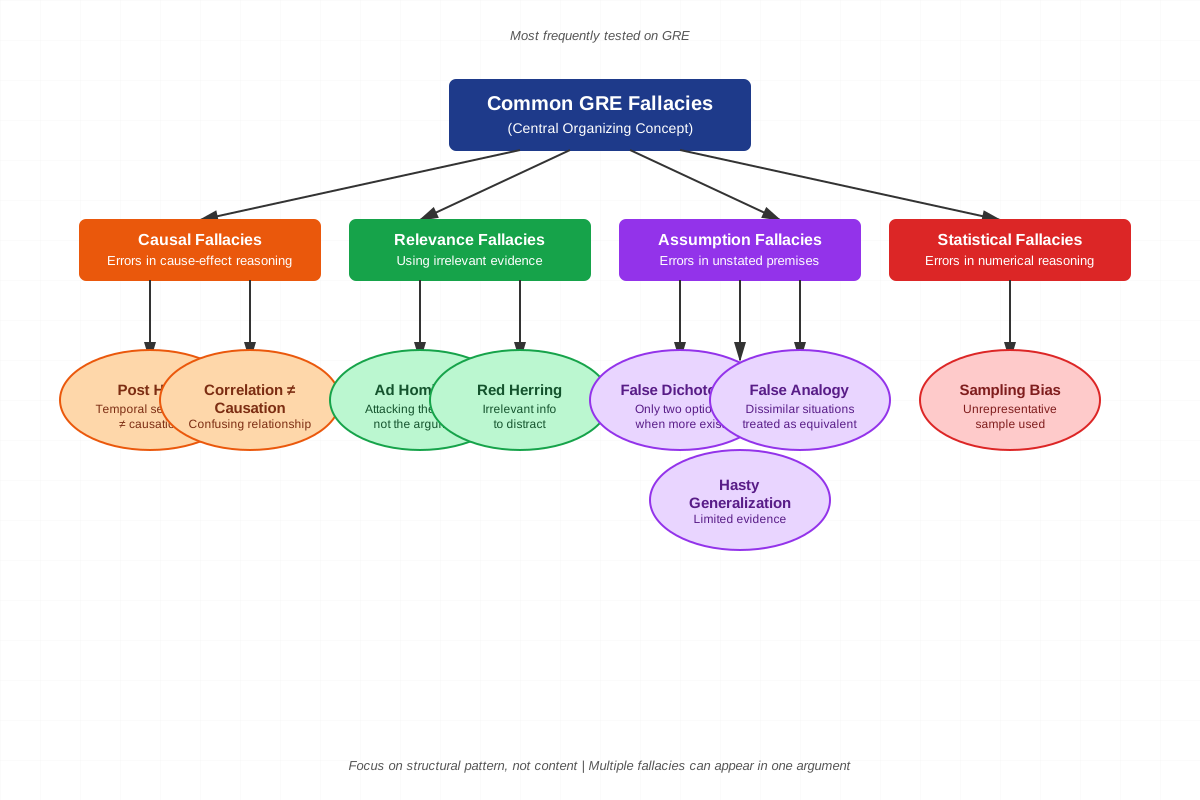
Causal Fallacies
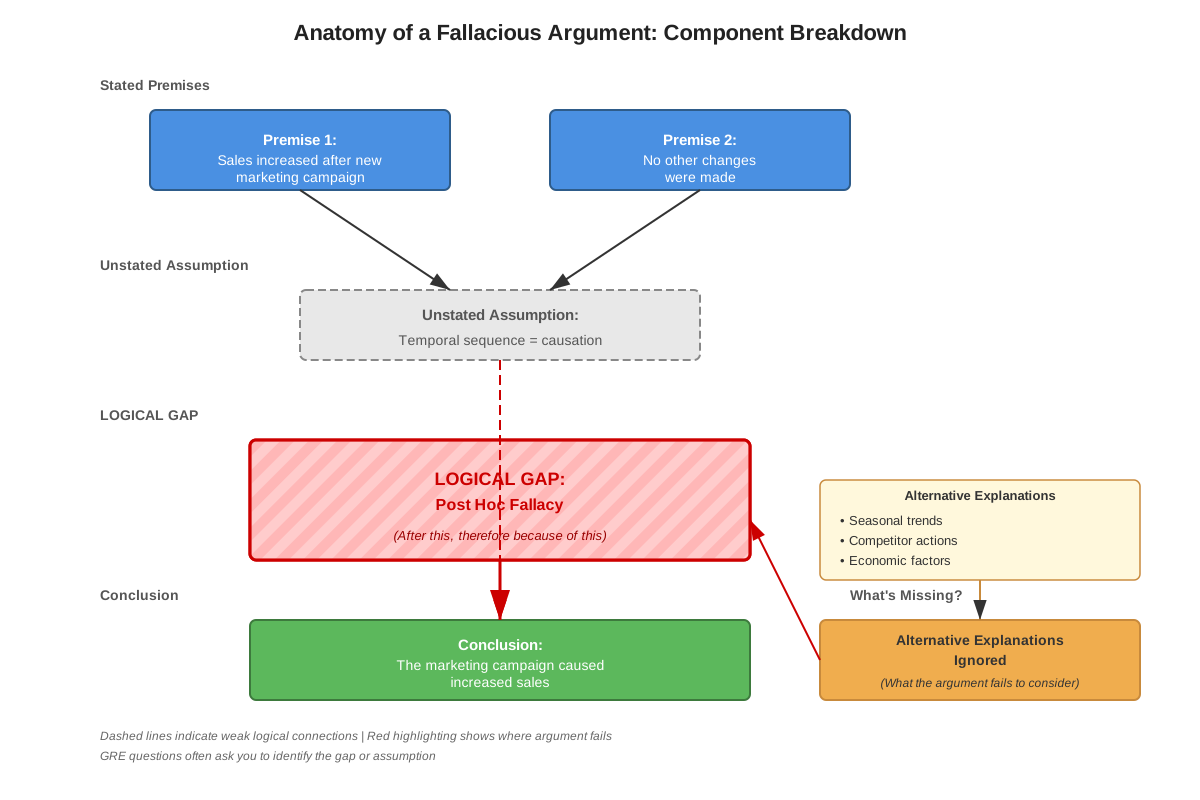
Causal fallacies occur when arguments incorrectly establish or assume cause-and-effect relationships. The most common variant is post hoc ergo propter hoc (Latin for "after this, therefore because of this"), which assumes that because Event B followed Event A, Event A must have caused Event B. This fallacy ignores alternative explanations: coincidence, reverse causation, or a third factor causing both events.
Example: "Crime rates dropped after the new mayor took office, so the mayor's policies reduced crime." This reasoning fails to consider that crime rates might have been declining already, that other factors (economic changes, demographic shifts) might be responsible, or that the timing might be coincidental.
Correlation-causation confusion represents a closely related error where the mere existence of a statistical relationship between two variables is treated as proof of causation. The GRE frequently presents survey data or observational studies, then asks test-takers to identify what would strengthen or weaken a causal claim. Correct answers often point to alternative explanations or confounding variables.
Reverse causation occurs when an argument assumes A causes B when actually B causes A, or when the causal relationship is bidirectional. Example: "Successful companies invest heavily in employee training, so investing in training causes success." Perhaps successful companies simply have more resources to invest in training.
Sampling and Generalization Fallacies
Hasty generalization involves drawing broad conclusions from insufficient or unrepresentative evidence. The GRE tests this by presenting arguments that extrapolate from small samples, biased samples, or exceptional cases to entire populations.
Example: "Three students from University X won prestigious fellowships this year, proving that University X provides superior education." This ignores the total number of students, whether these three are representative, and how other universities performed.
Biased sample fallacy occurs when the sample used to support a conclusion systematically differs from the population about which the conclusion is drawn. Voluntary response surveys, convenience samples, and self-selected groups frequently produce biased samples. GRE questions might present customer satisfaction surveys sent only to recent purchasers or polls conducted only among a specific demographic group.
Composition fallacy assumes what is true of parts must be true of the whole, while division fallacy assumes what is true of the whole must be true of each part. Example of composition: "Each musician in the orchestra is excellent, so the orchestra must be excellent" (ignoring coordination and chemistry). Example of division: "This university has an excellent reputation, so every department must be excellent."
False Dichotomy and False Dilemma
False dichotomy (also called false dilemma or either-or fallacy) presents only two options when additional alternatives exist. This fallacy artificially constrains the solution space, making one option appear necessary by eliminating only one alternative.
Example: "Either we implement this expensive security system or we accept that our data will be stolen." This ignores other security measures, combinations of approaches, or the possibility that the threat is overstated.
The GRE frequently uses this fallacy in policy arguments: "Either we raise taxes or cut essential services." Correct answers to "weaken" questions often introduce third options or point out that the dichotomy is false.
Ad Hominem and Genetic Fallacies
Ad hominem attacks ("to the person") reject an argument by attacking the character, circumstances, or motives of the person making it rather than addressing the argument's logical merit. Variants include:
- Abusive ad hominem: Attacking personal characteristics ("He's a known liar, so his economic theory must be wrong")
- Circumstantial ad hominem: Suggesting bias due to circumstances ("Of course the CEO supports the merger—she'll profit from it")
- Tu quoque ("you too"): Dismissing criticism by pointing out the critic's hypocrisy ("You can't criticize my carbon footprint when you drive an SUV")
Genetic fallacy rejects or accepts a claim based on its origin rather than its current merit. Example: "This theory originated in discredited research, so it must be false" (even if subsequent valid research supports it).
Appeal Fallacies
Appeal to authority (argumentum ad verecundiam) assumes a claim is true because an authority figure endorses it, without considering whether the authority is relevant, reliable, or whether authorities disagree. The GRE distinguishes between legitimate expert testimony (valid evidence) and inappropriate appeals to authority (fallacious).
Example: "A famous actor says this diet works, so it must be effective" (actor lacks relevant expertise). Contrast with: "Peer-reviewed studies by nutritionists show this diet works" (legitimate evidence).
Appeal to popularity (argumentum ad populum) assumes something is true or good because many people believe it or do it. Example: "Millions of people use this product, so it must be the best." This ignores that popularity might stem from marketing, price, or availability rather than quality.
Appeal to emotion substitutes emotional manipulation for logical reasoning. Variants include appeal to fear, pity, or flattery. The GRE presents these in arguments that use emotionally charged language to distract from weak logical connections.
Appeal to ignorance (argumentum ad ignorantiam) claims something is true because it hasn't been proven false, or false because it hasn't been proven true. Example: "No one has proven that this treatment doesn't work, so it must work."
Straw Man Fallacy
Straw man fallacy misrepresents an opponent's position to make it easier to attack, then refutes the distorted version rather than the actual argument. The arguer creates a weaker, exaggerated, or oversimplified version of the opposing view.
Example: Person A: "We should have some regulation of the financial industry." Person B: "Person A wants to destroy free enterprise and impose total government control of the economy." Person B attacks a position Person A never advocated.
On the GRE, this appears when arguments characterize opposing views in extreme or distorted terms, then claim victory by refuting the distortion.
Circular Reasoning and Begging the Question
Circular reasoning (also called begging the question in its classical sense) occurs when the conclusion is assumed in the premises, creating a logical circle rather than providing independent support.
Example: "This book is divinely inspired because it says so, and we can trust what it says because it's divinely inspired." The premise (the book is trustworthy) depends on the conclusion (divine inspiration), which depends on the premise.
Subtle forms include using different words to restate the same claim: "This policy is fair because it treats everyone equally" (if "fair" is defined as "treating everyone equally," this is circular).
Slippery Slope Fallacy
Slippery slope fallacy argues that a relatively small first step will inevitably lead to a chain of events resulting in a significant (usually negative) outcome, without providing evidence for the inevitability of this chain.
Example: "If we allow students to redo one assignment, soon they'll expect to redo everything, then they'll demand we eliminate deadlines entirely, and eventually the entire grading system will collapse." This assumes each step necessarily follows without justification.
Valid slippery slope arguments provide evidence for each link in the chain. Fallacious versions simply assert the chain without support.
Red Herring and Non Sequitur
Red herring introduces irrelevant information to distract from the actual issue under discussion. The term comes from the practice of using strong-smelling fish to distract hunting dogs from their quarry.
Example: "Why should we worry about the company's declining profits? Our CEO works harder than any CEO in the industry." The CEO's work ethic, while potentially admirable, doesn't address the profit issue.
Non sequitur (Latin for "it does not follow") is a broad category where the conclusion doesn't logically follow from the premises. While technically encompassing many specific fallacies, it's often used for arguments where the disconnect is particularly glaring.
Example: "The senator is a decorated war veteran, so her tax policy must be sound." Military service doesn't establish economic policy expertise.
Concept Relationships
The various fallacies form an interconnected system of logical errors, often overlapping in practice. Causal fallacies frequently combine with sampling fallacies—an argument might both generalize from a biased sample and incorrectly infer causation from correlation. Understanding this relationship helps test-takers recognize that arguments can contain multiple flaws.
Appeal fallacies share a common structure: they substitute an irrelevant consideration (authority, popularity, emotion) for logical evidence. Recognizing this pattern allows quick categorization even when encountering unfamiliar variants. Similarly, ad hominem and genetic fallacies both commit the error of judging claims by their source rather than their merit.
The relationship map flows as follows: Argument structure (premises + conclusion) → Assumption identification (unstated connections) → Fallacy recognition (flawed connections) → Argument evaluation (strength/weakness assessment). Each fallacy represents a specific way the connection between premises and conclusion can fail.
False dichotomy often combines with appeal to fear: "Either we adopt this extreme measure or disaster will strike" uses both the either-or structure and emotional manipulation. Slippery slope arguments frequently employ appeal to fear by emphasizing the dire final outcome.
Circular reasoning relates to assumption identification because circular arguments contain a hidden assumption that the conclusion is true. Straw man connects to reading comprehension because recognizing it requires accurately understanding the original position being distorted.
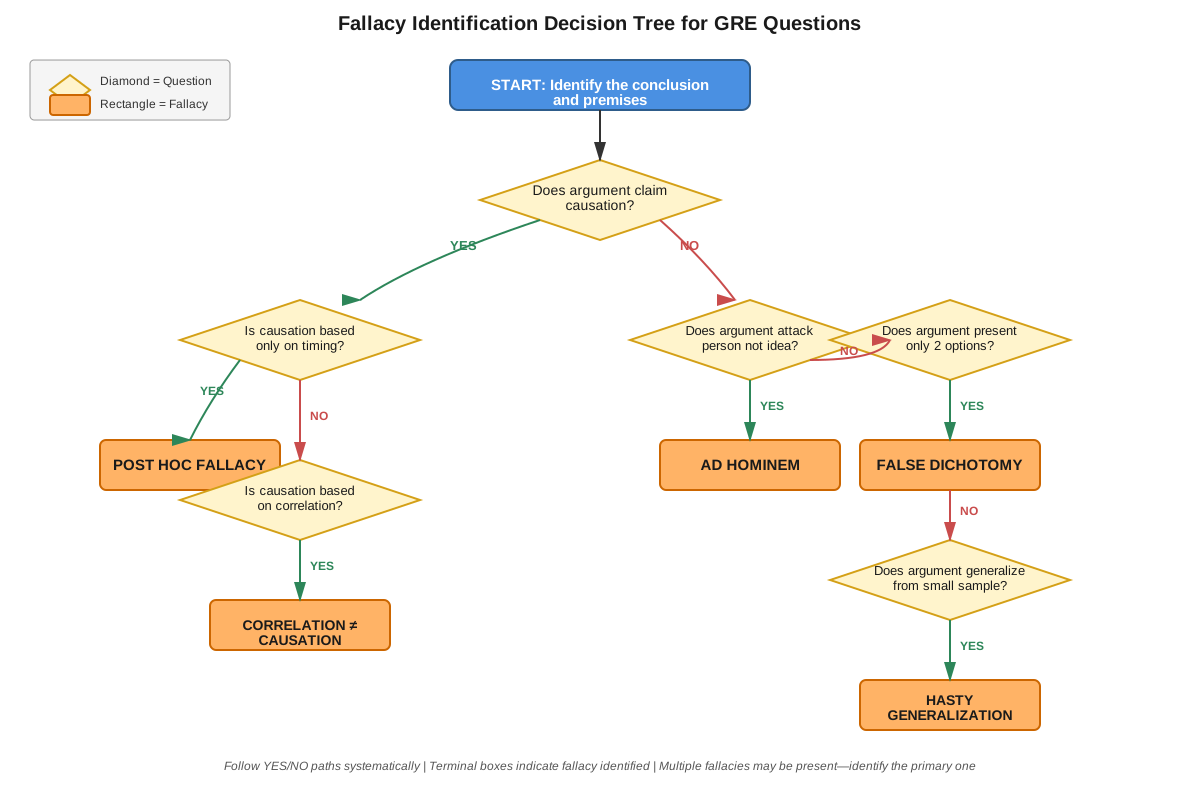
Understanding these relationships enables test-takers to approach unfamiliar arguments systematically: identify the conclusion, trace the logical path from premises to conclusion, spot where that path breaks down, and categorize the type of breakdown.
Quick check — test yourself on Common fallacies so far.
Try Flashcards →High-Yield Facts
⭐ Post hoc ergo propter hoc is the most frequently tested causal fallacy on the GRE, appearing in approximately 15-20% of Critical Reasoning questions
⭐ Arguments that confuse correlation with causation can be weakened by identifying alternative explanations, reverse causation, or confounding variables
⭐ Hasty generalization questions often involve surveys, studies, or examples that are presented as representative but are actually too small or biased
⭐ False dichotomy can be identified by asking "Are these really the only two options?" and can be weakened by introducing third alternatives
⭐ Ad hominem attacks the person rather than the argument; the correct answer will note that the argument fails to address the actual claim
- Appeal to authority is only fallacious when the authority lacks relevant expertise, has conflicts of interest, or when expert consensus doesn't exist
- Circular reasoning can be detected by checking whether the premises would be accepted by someone who doesn't already accept the conclusion
- Straw man requires comparing the characterized position with the actual position to identify distortion
- Slippery slope becomes fallacious when the chain of events is asserted without evidence for each link's necessity
- Sampling fallacies are particularly common in arguments about business decisions, policy effectiveness, and consumer preferences
- Appeal to ignorance reverses the burden of proof—absence of evidence is not evidence of absence
- Red herring can be identified by asking whether the introduced information actually addresses the original question or claim
Common Misconceptions
Misconception: Any argument that establishes causation from correlation is fallacious → Correction: Correlation can support causal claims when combined with other evidence (temporal precedence, mechanism, controlled studies, elimination of alternatives). The fallacy occurs when correlation alone is treated as sufficient proof of causation.
Misconception: Citing any expert opinion is an appeal to authority fallacy → Correction: Legitimate expert testimony from relevant, reliable authorities is valid evidence. The fallacy occurs only when the authority lacks relevant expertise, has undisclosed conflicts, or when the claim is presented as true solely because an authority said so, without considering the underlying evidence.
Misconception: All either-or statements are false dichotomies → Correction: Some situations genuinely involve binary choices (a light switch is on or off). False dichotomy is fallacious when additional options exist but are ignored. The key is whether the two options genuinely exhaust the possibilities.
Misconception: Pointing out someone's hypocrisy (tu quoque) proves their argument is wrong → Correction: Tu quoque is fallacious because a person's inconsistency doesn't affect the logical validity of their argument. A hypocrite can still make a sound argument; the hypocrisy is a separate issue from the argument's merit.
Misconception: Circular reasoning is easy to spot because it obviously repeats itself → Correction: Sophisticated circular arguments use different terminology or insert intermediate steps, making the circle less obvious. The test is whether the premises provide independent support or merely restate the conclusion in different words.
Misconception: Slippery slope arguments are always fallacious → Correction: Slippery slope reasoning is valid when evidence supports each step in the chain. It becomes fallacious when the chain is merely asserted without justification for why each step would necessarily follow.
Misconception: Emotional language automatically indicates an appeal to emotion fallacy → Correction: Emotional language is fallacious only when it substitutes for logical reasoning. Arguments can use emotional language while still providing valid logical support. The fallacy occurs when emotion replaces logic, not when it accompanies it.
Worked Examples
Example 1: Identifying Multiple Fallacies
Argument: "Last year, Smithville implemented a new traffic light system, and traffic accidents decreased by 15%. This proves the new system caused the reduction. Furthermore, three neighboring towns have already adopted similar systems, showing that this approach is clearly the best solution. Anyone who opposes implementing such systems in other cities obviously doesn't care about public safety."
Analysis:
Step 1: Identify the conclusion: The new traffic light system caused the accident reduction and should be adopted elsewhere.
Step 2: Identify the premises:
- Accidents decreased after implementation (temporal sequence)
- Three towns adopted similar systems (popularity)
- Opposition indicates lack of concern for safety (character attack)
Step 3: Identify fallacies:
Post hoc ergo propter hoc: The argument assumes causation from temporal sequence without ruling out alternative explanations. Perhaps accident rates were already declining, weather patterns changed, enforcement increased, or demographic shifts occurred. The 15% reduction might be within normal variation.
Appeal to popularity: The fact that three towns adopted the system doesn't establish its effectiveness. Perhaps they all responded to the same marketing, or they're copying each other without independent evaluation.
Ad hominem: The argument attacks opponents' character (claiming they don't care about safety) rather than addressing their reasons for opposition. Opponents might have legitimate concerns about cost, effectiveness, or alternative solutions.
Step 4: How to weaken: Correct answers might point out that (1) other factors could explain the reduction, (2) the sample of three towns is insufficient to establish effectiveness, or (3) the argument fails to address the actual objections of opponents.
Step 5: How to strengthen: Evidence that would strengthen includes (1) controlled studies showing the system reduces accidents, (2) data showing accident rates were stable before implementation and dropped after, or (3) evidence eliminating alternative explanations.
Connection to learning objectives: This example demonstrates identifying when fallacies are being tested (multiple fallacy types in one argument), explaining the core rules (temporal sequence ≠ causation, popularity ≠ validity, character ≠ argument quality), and applying these concepts to predict strengthen/weaken answers.
Example 2: Distinguishing Valid from Fallacious Reasoning
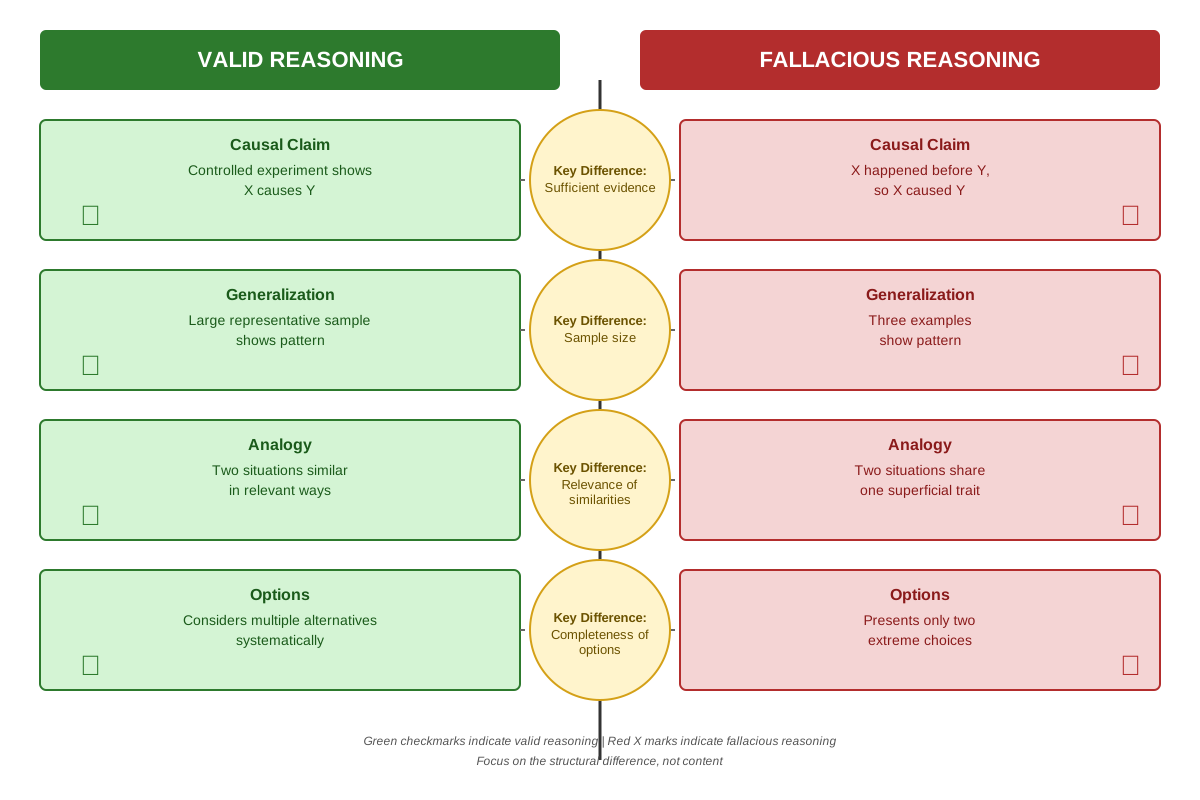
Argument A: "Studies show that students who eat breakfast score higher on tests than students who skip breakfast. Therefore, eating breakfast causes improved test performance."
Argument B: "A randomized controlled trial assigned students to either eat breakfast or skip it, controlling for prior academic performance, socioeconomic status, and sleep quality. Students assigned to eat breakfast scored significantly higher on tests. This suggests breakfast consumption contributes to improved test performance."
Analysis:
Argument A commits the correlation-causation fallacy. The observed correlation might result from:
- Reverse causation: Students who are more academically engaged both eat breakfast and study more
- Confounding variables: Family income affects both breakfast consumption and educational resources
- Third factor: Conscientiousness leads to both breakfast eating and test preparation
The argument treats correlation as sufficient evidence for causation without addressing these alternatives.
Argument B presents valid causal reasoning because:
- Randomization eliminates systematic differences between groups
- Control variables are explicitly addressed
- The conclusion is appropriately tentative ("suggests," "contributes") rather than absolute
- The study design (experimental rather than observational) supports causal inference
Key distinction: The difference isn't whether causation is claimed, but whether adequate evidence supports the causal claim. Argument A jumps from correlation to causation; Argument B provides methodological justification for the causal inference.
GRE application: When evaluating causal arguments, ask:
- Is this observational data or experimental data?
- Are alternative explanations addressed?
- Is the conclusion appropriately qualified?
- What additional evidence would strengthen or weaken the causal claim?
Connection to learning objectives: This example shows how to distinguish between fallacious and valid reasoning structures, apply critical analysis to similar-seeming arguments, and recognize that the same conclusion can be supported fallaciously or validly depending on the evidence and reasoning provided.
Exam Strategy
Trigger words for fallacy identification:
- Causal fallacies: "caused by," "resulted in," "led to," "because of," "therefore" (following temporal sequence)
- Generalization fallacies: "all," "every," "always," "proves that," "clearly shows" (with limited evidence)
- False dichotomy: "either...or," "the only options," "must choose between"
- Appeal to authority: "experts say," "according to," "leading authorities"
- Appeal to popularity: "most people," "widely accepted," "everyone knows"
- Circular reasoning: Repetition of key terms in both premises and conclusion
Systematic approach to "identify the flaw" questions:
- Read the conclusion first: Understanding what the argument is trying to prove helps identify the logical gap
- Map the logical structure: Identify premises → identify assumptions → identify conclusion
- Ask the critical questions:
- Does the conclusion necessarily follow from the premises?
- What is assumed but not stated?
- Are there alternative explanations?
- Is the evidence representative and sufficient?
- Predict the flaw category before reading answer choices
- Eliminate answers that describe valid reasoning or mischaracterize the argument
Process of elimination tips:
- Eliminate answers that describe flaws not present in the argument (even if they describe real fallacies)
- Eliminate answers that describe the argument's content rather than its logical structure
- Eliminate answers that are too extreme ("completely ignores," "totally fails") when the argument partially addresses something
- Eliminate answers that confuse necessary and sufficient conditions
- Keep answers that accurately describe the gap between premises and conclusion
Time allocation: Spend 30-40 seconds understanding the argument structure before reading answer choices. This upfront investment prevents re-reading and confusion. For "identify the flaw" questions, predicting the flaw type before reading choices saves 15-20 seconds by enabling rapid elimination.
Common trap answers:
- Describing a flaw the argument doesn't commit
- Attacking the conclusion rather than the reasoning
- Confusing what the argument says with what it assumes
- Describing valid reasoning as if it were flawed
For strengthen/weaken questions involving fallacies:
- Strengthen: Provide evidence that fills the logical gap or eliminates alternative explanations
- Weaken: Introduce alternative explanations, show the sample is biased, or demonstrate the causal relationship doesn't hold
Memory Techniques
CAPERS mnemonic for the six most common GRE fallacy categories:
- Causal (post hoc, correlation-causation)
- Appeal (authority, popularity, emotion, ignorance)
- Personal attack (ad hominem, genetic)
- Evidence problems (hasty generalization, biased sample)
- Reasoning structure (circular, non sequitur)
- Simplification (false dichotomy, straw man, slippery slope)
Visualization for causal fallacies: Picture a timeline with Event A and Event B. Ask: "Could anything else fit between them? Could the arrow point the other way? Could a third factor above the timeline point down to both?"
The "So What?" test for red herrings: After each piece of evidence, ask "So what? How does this connect to the conclusion?" If the answer is "It doesn't really," you've found a red herring.
The "Rewind" technique for circular reasoning: Try to trace the argument backward from conclusion to premises. If you end up back at the conclusion without gaining new information, the reasoning is circular.
The "Third Option" test for false dichotomy: Whenever you see "either...or," immediately brainstorm a third option. If you can easily think of one, the dichotomy is likely false.
The "Swap" test for ad hominem: Replace the person being attacked with someone you respect. If the argument about them would be equally strong or weak, the original argument is attacking the person rather than the logic.
Acronym for appeal fallacies - APIE:
- Authority
- Popularity
- Ignorance
- Emotion
Summary
Common fallacies represent systematic logical errors that appear frequently on the GRE Verbal Reasoning section, particularly in Critical Reasoning questions. Mastering fallacy identification requires understanding both the specific patterns of flawed reasoning and the general principle that conclusions must be supported by relevant, sufficient evidence through valid logical connections. The most high-yield fallacies for the GRE include causal fallacies (especially post hoc and correlation-causation confusion), sampling fallacies (hasty generalization and biased samples), false dichotomy, ad hominem attacks, and various appeal fallacies. Success requires moving beyond memorizing definitions to actively analyzing argument structure: identifying conclusions, tracing the logical path from premises to conclusions, spotting where that path breaks down, and recognizing how the argument could be strengthened or weakened. The key insight is that fallacies exploit gaps between what is stated and what is concluded—they appear persuasive because they mimic valid reasoning while containing subtle but critical flaws. Test-takers who systematically apply fallacy recognition frameworks can quickly eliminate wrong answers and confidently select correct ones, transforming Critical Reasoning from a subjective challenge into an objective, manageable task.
Key Takeaways
- Common fallacies are systematic logical errors that the GRE tests extensively in Critical Reasoning questions, appearing in 30-40% of such questions
- Causal fallacies (post hoc, correlation-causation) are the most frequently tested category and can be identified by checking whether alternative explanations have been eliminated
- Sampling fallacies involve generalizing from insufficient or unrepresentative evidence; always evaluate whether the sample matches the population
- False dichotomy presents only two options when more exist; the key question is "Are these really the only choices?"
- Ad hominem and appeal fallacies substitute irrelevant considerations (personal attacks, authority, popularity, emotion) for logical evidence
- Effective fallacy identification requires analyzing argument structure (premises → assumptions → conclusion) rather than just reading for content
- Strengthen and weaken questions become significantly easier when you can identify the specific fallacy present and predict what would address the logical gap
Related Topics
Argument Structure and Assumptions: Understanding how premises, assumptions, and conclusions connect provides the foundation for recognizing when those connections are flawed. Mastering fallacies deepens assumption identification skills.
Formal Logic and Valid Inference Patterns: Learning valid logical forms (modus ponens, modus tollens, contrapositive) helps distinguish sound reasoning from fallacious reasoning by providing positive examples of correct logical structure.
Evidence Evaluation: Assessing the quality, relevance, and sufficiency of evidence builds on fallacy recognition by examining not just whether reasoning is flawed but whether support is adequate.
Argument Analysis Essay: The "Analyze an Argument" writing task explicitly requires identifying and explaining logical flaws, making fallacy mastery directly applicable to essay scoring.
Reading Comprehension - Author's Reasoning: Many RC questions ask about the author's argumentative strategy or logical structure, requiring the same analytical skills developed through fallacy study.
Practice CTA
Now that you understand the systematic patterns of flawed reasoning, you're ready to apply these concepts to actual GRE-style questions. The practice questions and flashcards will reinforce your ability to quickly identify fallacies under timed conditions and distinguish between similar-seeming logical errors. Remember: fallacy recognition is a skill that improves dramatically with deliberate practice. Each practice question you analyze strengthens your pattern recognition and speeds your response time. Approach the practice materials actively—predict the flaw before reading answer choices, and review both correct and incorrect answers to understand why each choice succeeds or fails. Your investment in mastering common fallacies will pay dividends across multiple question types and significantly boost your Verbal Reasoning score. You've built the framework; now apply it with confidence!
Sign up free to keep reading
Create a free AnvayaPrep account to finish this GRE guide on Common fallacies — plus flashcards and practice questions.