Overview
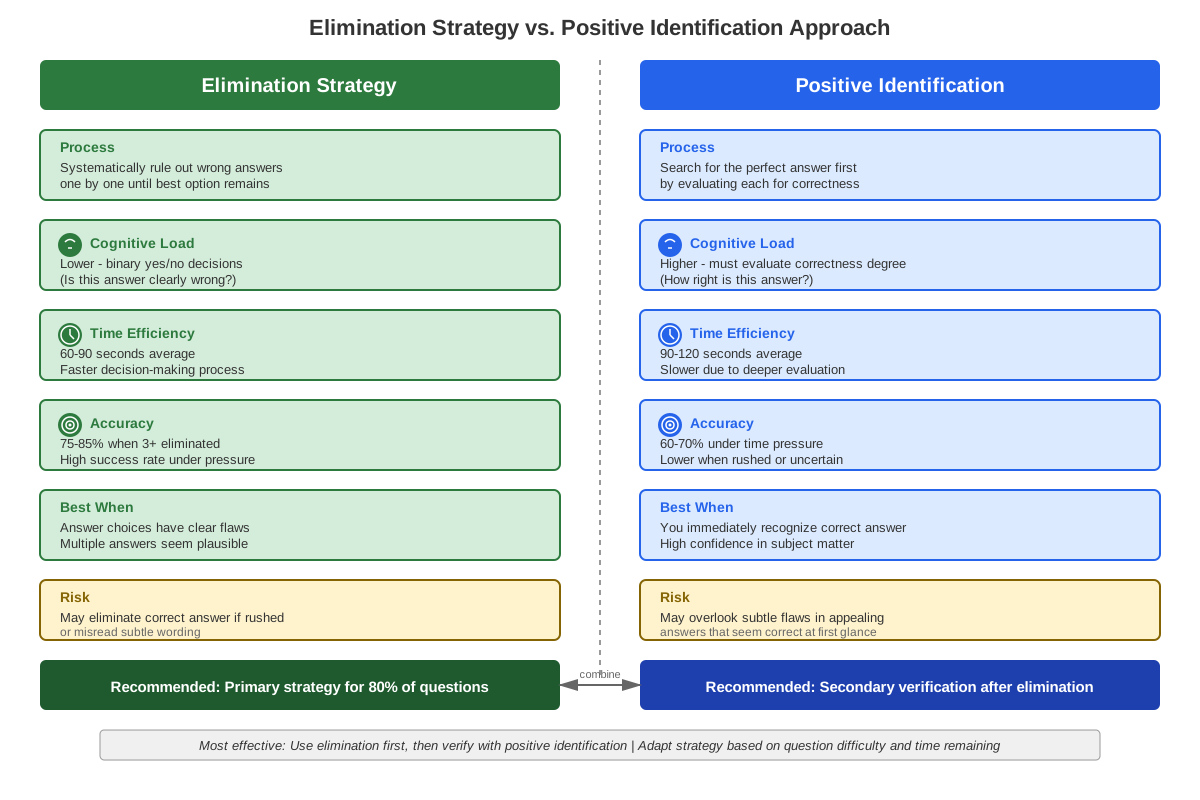
The critical reasoning elimination strategy is one of the most powerful and efficient approaches for tackling GRE Verbal Reasoning questions, particularly those involving arguments, assumptions, and logical structures. This systematic method involves strategically eliminating incorrect answer choices to increase the probability of selecting the correct response, even when the right answer isn't immediately obvious. Rather than searching for the "perfect" answer from the outset, skilled test-takers use elimination to narrow their options, reduce cognitive load, and maximize accuracy under time pressure.
On the GRE, critical reasoning questions appear throughout the Verbal Reasoning section, testing your ability to analyze arguments, identify logical flaws, strengthen or weaken conclusions, and recognize underlying assumptions. The GRE critical reasoning elimination strategy is essential because these questions rarely have answer choices that are clearly "right" or "wrong" at first glance. Instead, they present subtle distinctions that require careful analysis. By systematically eliminating choices that contain logical errors, irrelevant information, or scope mismatches, test-takers can dramatically improve their accuracy and speed.
This elimination approach connects directly to broader Verbal Reasoning skills including reading comprehension, argument analysis, and logical reasoning. It serves as a bridge between understanding the structure of arguments and executing correct answers under exam conditions. Mastering this strategy not only improves performance on explicit critical reasoning questions but also enhances overall analytical reading skills, making it a high-leverage investment of study time that pays dividends across multiple question types.
Learning Objectives
- [ ] Identify when Critical reasoning elimination strategy is being tested
- [ ] Explain the core rule or strategy behind Critical reasoning elimination strategy
- [ ] Apply Critical reasoning elimination strategy to GRE-style questions accurately
- [ ] Distinguish between answer choices that are out of scope versus those that are merely weak
- [ ] Recognize common trap patterns in incorrect answer choices
- [ ] Execute a systematic elimination process within 90 seconds per question
- [ ] Combine elimination strategy with positive identification of correct answer characteristics
Prerequisites
- Basic argument structure: Understanding premises, conclusions, and evidence is essential because elimination strategy requires identifying which answer choices address the argument's logical components
- Logical reasoning fundamentals: Familiarity with concepts like assumptions, inferences, and logical gaps enables recognition of why certain answer choices fail to address the question stem
- GRE question types: Knowledge of strengthen, weaken, assumption, and inference questions provides context for what makes an answer choice relevant or irrelevant
- Reading comprehension skills: The ability to extract main ideas and understand author's purpose ensures accurate interpretation of both passages and answer choices before elimination begins
Why This Topic Matters
Critical reasoning questions constitute approximately 30-40% of the Verbal Reasoning section on the GRE, making elimination strategy directly applicable to a substantial portion of your score. These questions appear in various formats: strengthen/weaken the argument, identify the assumption, draw a conclusion, identify the flaw, and evaluate the argument. Each format requires analyzing an argument and selecting from five answer choices, where typically 3-4 choices can be eliminated through systematic analysis.
In real-world applications, the analytical skills developed through elimination strategy transfer directly to graduate-level research, where evaluating competing hypotheses, identifying flawed reasoning, and distinguishing relevant from irrelevant evidence are daily requirements. Law schools, business programs, and research-intensive fields all value the precise thinking that elimination strategy cultivates.
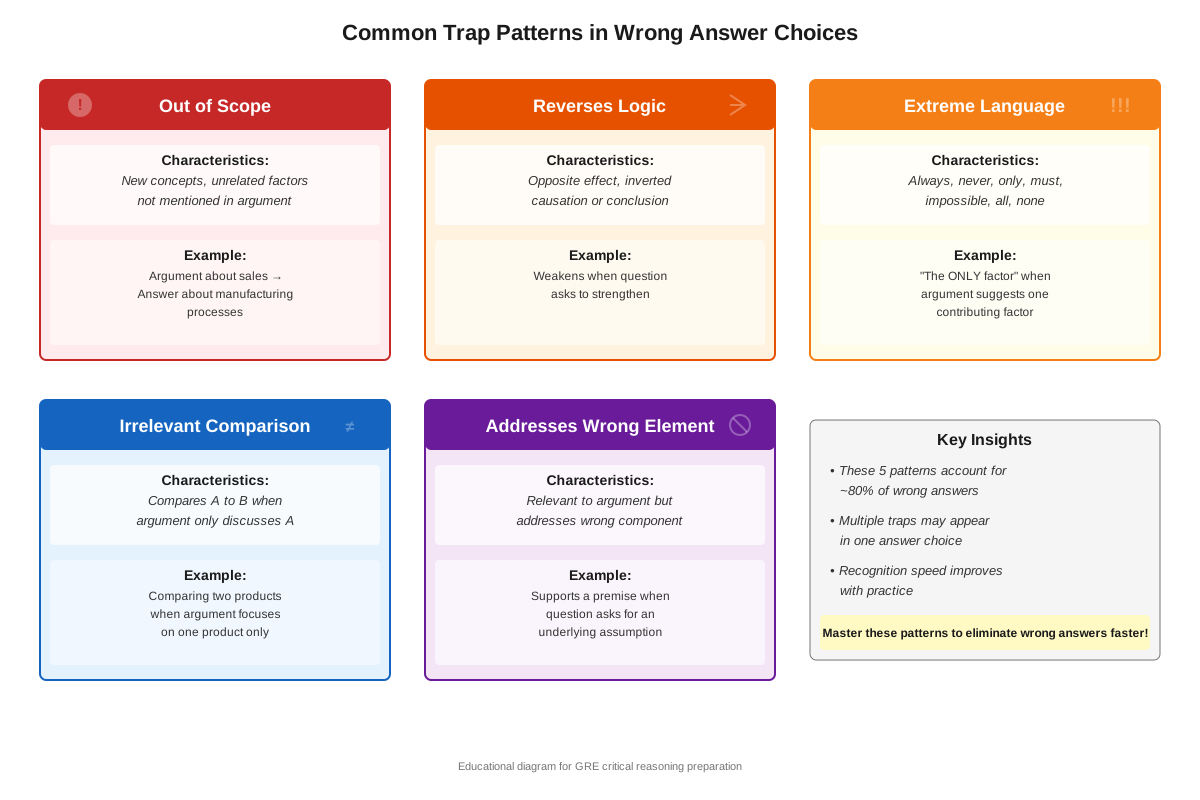
On the exam itself, critical reasoning questions commonly appear as short passages (2-5 sentences) followed by a question stem and five answer choices. The elimination strategy is particularly valuable because incorrect answers often contain predictable patterns: they may be out of scope, reverse the required logic, address the wrong component of the argument, or introduce irrelevant information. Recognizing these patterns allows for rapid, confident elimination, often reducing five choices to two or three within 30 seconds, leaving more time for careful analysis of remaining options.
Core Concepts
The Systematic Elimination Framework
The critical reasoning elimination strategy operates on a fundamental principle: it is often easier to identify what is definitely wrong than what is definitely right. This approach leverages the GRE's multiple-choice format, where four incorrect answers must accompany each correct answer. By developing expertise in recognizing the characteristics of wrong answers, test-takers can systematically narrow their options even when the correct answer's logic isn't immediately apparent.
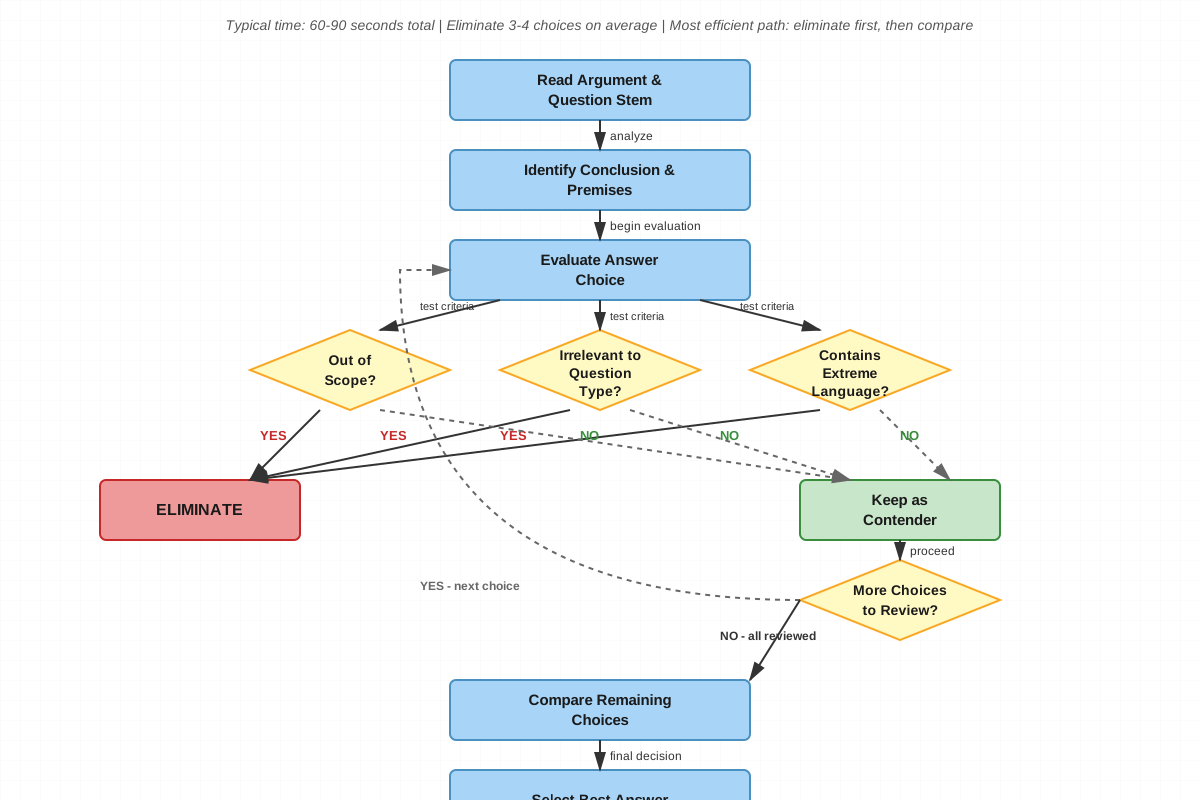
The framework consists of four sequential phases:
- Understand the argument structure - Identify the conclusion, premises, and any logical gaps
- Predict the answer type - Based on the question stem, anticipate what the correct answer must accomplish
- Eliminate systematically - Remove choices that fail specific criteria
- Verify the remaining choice - Confirm the last standing answer actually addresses the question
Primary Elimination Criteria
Scope Mismatches represent the most common and easily identifiable elimination criterion. An answer choice is out of scope when it discusses concepts, time periods, populations, or variables not addressed in the original argument. For example, if an argument discusses employee productivity in manufacturing, an answer choice about employee satisfaction in service industries would be out of scope. The GRE frequently includes these attractive distractors because they sound plausible and relate to the general topic, but they fail to address the specific logical structure of the argument presented.
Irrelevance to the Question Stem occurs when an answer choice might be true or even related to the argument's topic, but fails to accomplish what the question asks. If the question asks you to weaken an argument, an answer that strengthens it—no matter how logical—must be eliminated. Similarly, if asked to identify an assumption, an answer that states an explicit premise should be eliminated because assumptions are unstated.
Logical Direction Errors appear when answer choices move in the opposite direction required. For strengthen questions, choices that weaken must go. For weaken questions, choices that strengthen must be eliminated. This seems obvious, but the GRE crafts these choices to be subtle, often including information that seems relevant but actually supports the opposite conclusion.
Extreme Language and Absolutes often signal incorrect answers in critical reasoning questions. Words like "always," "never," "only," "must," "impossible," and "certainly" make claims that are too strong to be supported by the limited information in the argument. While not every answer with extreme language is wrong, such language should trigger careful scrutiny. The correct answer typically matches the scope and certainty level of the original argument.
The Two-Pass Elimination Technique
Efficient test-takers employ a two-pass approach to maximize both speed and accuracy:
First Pass (30-40 seconds): Quickly scan all five choices, eliminating obvious errors—primarily scope mismatches and clear irrelevancies. This pass should eliminate 2-3 choices, leaving 2-3 for deeper analysis. During this pass, mark choices with a mental or physical notation system: X for eliminated, ? for uncertain, ✓ for possible.
Second Pass (30-40 seconds): Carefully analyze remaining choices, comparing them directly to the argument structure and question requirements. Look for subtle flaws: Does this choice actually address the logical gap? Does it make the conclusion more or less likely? Is it making an assumption the argument doesn't support?
Common Wrong Answer Patterns
The GRE recycles certain wrong answer patterns across critical reasoning questions. Recognizing these patterns enables rapid elimination:
| Pattern | Description | Example Context |
|---|---|---|
| Out of Scope | Introduces new concepts not in argument | Argument about dogs; answer about cats |
| Reverse Logic | Strengthens when should weaken, or vice versa | Asked to weaken; answer supports conclusion |
| Premise Booster | Restates or supports a premise rather than conclusion | Repeats evidence already given |
| Irrelevant Comparison | Compares elements not relevant to the logic | Argument about cost; answer about popularity |
| Shell Game | Uses similar words but shifts meaning | Argument about "economic growth"; answer about "economic stability" |
The Assumption-Based Elimination Approach
For assumption questions specifically, elimination strategy employs the negation test: if negating an answer choice would destroy the argument, that choice is likely correct. Conversely, if negating a choice has no impact on the argument's validity, that choice can be eliminated. This technique transforms assumption questions from abstract reasoning exercises into systematic tests.
For example, if an argument concludes that "increasing advertising will boost sales" based on the premise that "competitors who advertise more have higher sales," an assumption might be "factors other than advertising don't fully explain the sales difference." Negating this—"factors other than advertising DO fully explain the difference"—would destroy the argument, confirming it as a necessary assumption.
Comparative Elimination for Final Choices
When elimination reduces options to two choices, employ comparative analysis: directly contrast the remaining choices against each other and the argument. Ask:
- Which choice more directly addresses the conclusion versus a premise?
- Which choice requires fewer additional assumptions?
- Which choice matches the scope and specificity of the argument?
- Which choice addresses the logical gap more precisely?
This head-to-head comparison often reveals subtle superiority in one choice, even when both seem plausible in isolation.
Concept Relationships
The critical reasoning elimination strategy builds directly upon argument structure analysis: one must first identify the conclusion, premises, and assumptions before determining which answer choices fail to address these components. This creates a dependency relationship: Argument Analysis → Elimination Criteria Application → Answer Selection.
Within the elimination strategy itself, concepts form a hierarchical relationship. Scope analysis serves as the foundation, as it's the fastest and most reliable elimination criterion. Once scope is confirmed, relevance to question stem becomes the next filter, followed by logical direction verification, and finally comparative analysis between remaining choices. This creates a funnel: Scope → Relevance → Direction → Comparison.
The elimination strategy also connects forward to time management skills. By eliminating 2-3 choices quickly, test-takers allocate their cognitive resources more efficiently, spending analytical energy only on viable options. This relationship can be expressed as: Efficient Elimination → Reduced Cognitive Load → Better Time Management → Higher Accuracy.
Additionally, elimination strategy interfaces with educated guessing techniques. When time pressure prevents complete analysis, having eliminated even 1-2 choices significantly improves guessing odds: Partial Elimination → Improved Probability → Strategic Guessing → Score Optimization.
High-Yield Facts
⭐ Approximately 60-80% of wrong answers in critical reasoning questions can be eliminated based on scope mismatches alone
⭐ The correct answer to a strengthen/weaken question must directly impact the likelihood of the conclusion being true, not merely relate to the topic
⭐ Answer choices that introduce entirely new concepts not mentioned or implied in the argument are almost always incorrect
⭐ For assumption questions, the correct answer must be something the argument depends upon but does not explicitly state
⭐ Extreme language (always, never, only, must) appears more frequently in incorrect answers than correct ones
- Wrong answers often address premises rather than conclusions in strengthen/weaken questions
- The "shell game" trap uses similar terminology from the argument but shifts the meaning subtly
- Correct answers typically match the specificity level of the argument—neither more general nor more specific
- Answer choices that are factually true but logically irrelevant to the argument must be eliminated
- In comparative elimination between two choices, the answer that requires fewer additional assumptions is typically correct
Quick check — test yourself on Critical reasoning elimination strategy so far.
Try Flashcards →Common Misconceptions
Misconception: Any answer choice that is factually true or sounds reasonable must be correct → Correction: Critical reasoning questions test logical relationships, not factual knowledge. An answer can be true in the real world but completely irrelevant to the argument's logic. Eliminate based on logical relevance, not real-world plausibility.
Misconception: Elimination strategy is only useful when you don't know the right answer → Correction: Even when you identify a likely correct answer immediately, systematic elimination serves as verification. Checking why the other four choices are wrong confirms your selection and prevents overconfidence errors.
Misconception: You should spend equal time considering each answer choice → Correction: Efficient elimination involves spending minimal time on obviously wrong choices (5-10 seconds) and more time on plausible options (20-30 seconds). The two-pass technique optimizes this time allocation.
Misconception: Out of scope means "not related to the topic" → Correction: Out of scope means not addressing the specific logical structure of the argument. An answer can discuss the same general topic but address different variables, populations, or time periods than those in the argument, making it out of scope.
Misconception: The longest or most complex answer choice is usually correct → Correction: The GRE deliberately crafts complex, detailed wrong answers to appear authoritative. Length and complexity are not indicators of correctness. Focus on logical relevance and precision instead.
Misconception: If you can't eliminate an answer, it must be correct → Correction: Difficulty eliminating a choice may indicate insufficient understanding of the argument or question stem. Return to the argument structure before concluding an answer is correct by default.
Worked Examples
Example 1: Weaken Question
Argument: "City planners propose building a new highway to reduce traffic congestion in downtown areas. Studies show that cities with more highway miles per capita experience less traffic congestion than cities with fewer highway miles per capita."
Question: Which of the following, if true, most weakens the city planners' proposal?
Answer Choices:
(A) Cities with less traffic congestion tend to invest more in highway construction
(B) The proposed highway would pass through several residential neighborhoods
(C) Traffic congestion in downtown areas has increased by 15% over the past decade
(D) Public transportation usage decreases when new highways are built
(E) Highway construction typically takes 3-5 years to complete
Elimination Process:
First Pass - Scope and Relevance Check:
- (B) discusses residential neighborhoods, which relates to construction impact but doesn't address whether the highway will reduce congestion. This is somewhat relevant but doesn't directly weaken the causal logic. Mark with "?" for second pass.
- (C) states a fact about current congestion but doesn't weaken the proposal that highways will reduce it. This is out of scope regarding the solution's effectiveness. Eliminate.
- (E) discusses timeline, which is irrelevant to whether the solution will work. Eliminate.
Second Pass - Logical Direction and Causation:
- (A) suggests reverse causation: less congestion leads to more highways, not the other way around. This directly weakens the planners' assumption that highways cause reduced congestion. Strong candidate.
- (B) might be a practical concern but doesn't address the logical connection between highways and congestion reduction. Eliminate - doesn't weaken the core logic.
- (D) mentions public transportation decrease, but doesn't directly connect to whether congestion will be reduced. This is tangentially related but doesn't attack the main argument. Weak candidate.
Final Comparison: Between (A) and (D), choice (A) directly challenges the causal relationship the argument assumes (highways → less congestion) by suggesting the correlation might be reversed (less congestion → more highways). Choice (D) introduces a side effect but doesn't directly weaken whether congestion will decrease.
Correct Answer: (A)
Learning Objective Connection: This example demonstrates applying elimination strategy by first removing scope mismatches (C, E), then eliminating choices that don't address the logical direction (B), and finally comparing remaining choices to select the one that most directly weakens the causal assumption.
Example 2: Assumption Question
Argument: "The Riverside Restaurant's profits have declined over the past year. The restaurant's owner plans to increase profits by reducing menu prices by 20%. This strategy will work because lower prices will attract more customers."
Question: The owner's plan assumes which of the following?
Answer Choices:
(A) The restaurant's food quality is comparable to that of competitors
(B) The increase in customer volume will compensate for the lower profit margin per meal
(C) Restaurant customers in the area are primarily motivated by price
(D) The restaurant's current prices are higher than those of nearby restaurants
(E) Reducing prices will not require reducing food quality
Elimination Process:
First Pass - Explicit vs. Implicit:
- The argument explicitly states that lower prices will attract more customers, so we need an assumption that bridges "more customers" to "increased profits."
- (A) discusses food quality comparison, which isn't mentioned in the argument. This seems out of scope. Tentative eliminate, but mark "?" since quality could relate to customer attraction.
- (C) states customers are motivated by price, but the argument already assumes this by claiming lower prices attract customers. This is too close to an explicit premise. Eliminate.
- (D) discusses current price levels relative to competitors, which isn't necessary for the logic. Even if prices are already low, reducing them further could still attract customers. Eliminate.
Second Pass - Negation Test:
- (B): If we negate this—"The increase in customer volume will NOT compensate for lower profit margin"—the plan falls apart. The owner could attract more customers but still lose money. This is necessary for the argument. Strong candidate.
- (E): If we negate this—"Reducing prices WILL require reducing food quality"—this could undermine the plan, but the argument doesn't depend on maintaining quality; it only depends on attracting customers and increasing profits. Weaker candidate.
- (A): Returning to this, if we negate—"Food quality is NOT comparable"—this might affect customer attraction, but the argument's logic doesn't require quality comparison, only that lower prices attract customers. Eliminate.
Final Analysis: Choice (B) identifies the critical gap between "more customers" and "increased profits." The argument jumps from attracting customers to increasing profits without addressing whether the volume increase will offset the per-meal profit decrease. This is the necessary assumption.
Correct Answer: (B)
Learning Objective Connection: This example shows identifying when elimination strategy is being tested (assumption question requiring gap analysis), explaining the strategy (using negation test and identifying logical gaps), and applying it accurately through systematic elimination.
Exam Strategy
When approaching critical reasoning questions on the GRE, begin by investing 20-30 seconds in understanding the argument structure before reading answer choices. Identify the conclusion (often signaled by words like "therefore," "thus," "consequently"), premises (evidence supporting the conclusion), and any logical gaps. This upfront investment prevents the common error of evaluating answer choices without a clear understanding of what you're looking for.
Trigger words in question stems signal which elimination criteria to prioritize:
- "Weaken" or "cast doubt": Eliminate choices that strengthen or are neutral; focus on scope of conclusion
- "Strengthen" or "support": Eliminate choices that weaken or are irrelevant; look for gap-fillers
- "Assumption": Eliminate explicit premises and irrelevant statements; use negation test
- "Inference" or "conclude": Eliminate choices that go beyond the scope or require additional assumptions
- "Flaw" or "vulnerable to criticism": Eliminate choices describing flaws not present in the argument
Process-of-elimination sequence for maximum efficiency:
- Scope check (10-15 seconds): Eliminate choices discussing concepts, populations, or variables not in the argument
- Relevance check (10-15 seconds): Eliminate choices that don't address what the question stem asks
- Direction check (10-15 seconds): Eliminate choices moving in the wrong logical direction
- Comparative analysis (20-30 seconds): Between remaining choices, select the one most directly addressing the logical gap
Time allocation: Aim for 90 seconds per critical reasoning question. If elimination reduces choices to two but you're uncertain after 90 seconds, make your best selection and move on. Spending an additional 60 seconds for marginal confidence gain is inefficient. Mark the question for review if time permits at the end.
Physical notation strategy: On scratch paper or using the on-screen elimination feature, mark choices as you evaluate them. Use a consistent system: X for eliminated, ? for uncertain, ✓ for strong candidates. This prevents re-reading eliminated choices and provides a visual map of your reasoning.
Memory Techniques
SCOPE Mnemonic for first-pass elimination criteria:
- Same concepts as argument?
- Conclusion addressed (not just premises)?
- Opposite direction eliminated?
- Precise match to question stem?
- Extreme language flagged?
The "Bridge Test" Visualization: Picture the argument as two islands—premises on one side, conclusion on the other. The correct answer must build a bridge between them. If an answer choice discusses a different island entirely (out of scope) or builds a bridge to the wrong destination (irrelevant), eliminate it.
WASA Acronym for common wrong answer types:
- Wrong scope
- Addresses wrong component
- Shifts meaning (shell game)
- Absolute language (extreme claims)
The Negation Flip for assumption questions: Imagine a light switch. If flipping the switch (negating the answer) turns off the argument (makes it fall apart), that's your assumption. If the argument stays lit, eliminate that choice.
Comparative Elimination Mantra: "Which answer requires fewer leaps?" When stuck between two choices, the one requiring fewer additional assumptions or logical steps is typically correct.
Summary
The critical reasoning elimination strategy is a systematic approach to GRE Verbal Reasoning questions that prioritizes identifying and removing incorrect answer choices rather than immediately searching for the correct answer. This strategy leverages the multiple-choice format by recognizing that wrong answers typically exhibit predictable patterns: scope mismatches, irrelevance to the question stem, logical direction errors, and extreme language. By employing a two-pass technique—first eliminating obvious errors based on scope and relevance, then carefully analyzing remaining choices through comparative analysis—test-takers can efficiently narrow five choices to two or three within 30-40 seconds. The strategy is particularly powerful for assumption questions (using the negation test), strengthen/weaken questions (checking logical direction), and inference questions (verifying scope boundaries). Mastering this approach requires understanding argument structure, recognizing common wrong answer patterns, and practicing systematic evaluation under time pressure. The elimination strategy not only improves accuracy but also enhances time management by focusing analytical energy on viable options rather than exhaustively analyzing all five choices equally.
Key Takeaways
- Elimination is often easier than selection: Identifying what's definitely wrong is more reliable than identifying what's definitely right, especially under time pressure
- Scope mismatches eliminate 60-80% of wrong answers: Always check whether answer choices discuss the same concepts, populations, and variables as the argument
- Match elimination criteria to question type: Strengthen questions require eliminating weakeners; assumption questions require eliminating explicit premises; inference questions require eliminating scope violations
- Use the two-pass technique: First pass eliminates obvious errors (30-40 seconds); second pass analyzes remaining choices (30-40 seconds)
- The negation test is essential for assumptions: If negating an answer choice destroys the argument, it's likely the correct assumption
- Logical relevance trumps factual truth: An answer can be true in reality but logically irrelevant to the argument's structure
- Comparative analysis resolves close calls: When stuck between two choices, select the one that more directly addresses the logical gap and requires fewer additional assumptions
Related Topics
Argument Structure Analysis: Understanding how to identify conclusions, premises, and assumptions forms the foundation for effective elimination strategy. Mastering argument structure enables faster recognition of which answer choices address relevant components versus irrelevant ones.
Logical Fallacies: Familiarity with common reasoning errors (correlation vs. causation, false dichotomy, ad hominem, etc.) enhances elimination strategy by helping identify flawed answer choices and recognize argument weaknesses more quickly.
Reading Comprehension Inference Questions: The elimination techniques used in critical reasoning transfer directly to inference questions in longer passages, where identifying scope boundaries and avoiding extreme language are equally important.
Quantitative Reasoning Problem-Solving: The systematic elimination approach applies beyond Verbal Reasoning; in Quantitative Reasoning, eliminating impossible answer choices through estimation and boundary checking employs similar logical principles.
Advanced Argument Evaluation: After mastering basic elimination, students can progress to more sophisticated techniques like identifying sufficient versus necessary conditions, recognizing conditional logic patterns, and evaluating complex causal chains.
Practice CTA
Now that you understand the critical reasoning elimination strategy, it's time to put these techniques into practice. The concepts you've learned—scope analysis, the two-pass technique, negation testing, and comparative elimination—will become automatic only through deliberate practice. Attempt the practice questions associated with this topic, focusing not just on getting the right answer but on executing the systematic elimination process. Use the flashcards to reinforce recognition of common wrong answer patterns and trigger words. Remember: every expert test-taker once struggled with these questions, but systematic strategy and consistent practice transform uncertainty into confidence. Your investment in mastering elimination strategy will pay dividends across the entire Verbal Reasoning section!
Sign up free to keep reading
Create a free AnvayaPrep account to finish this GRE guide on Critical reasoning elimination strategy — plus flashcards and practice questions.