Overview
Conclusion strength is a critical reasoning skill tested extensively on the GRE Verbal Reasoning section. This concept evaluates a test-taker's ability to assess how well evidence supports a given conclusion, identify logical gaps, and determine what additional information would strengthen or weaken an argument. Unlike simple reading comprehension, GRE conclusion strength questions require active analysis of the logical relationship between premises and conclusions, demanding that students think like critical evaluators rather than passive readers.
Mastering conclusion strength is essential for the GRE because these questions appear frequently in both the Reading Comprehension and Analytical Writing sections. They test the fundamental skill of argument analysis—the ability to distinguish between strong, well-supported conclusions and weak, poorly-justified ones. Students who excel at evaluating conclusion strength can quickly identify logical vulnerabilities, recognize unstated assumptions, and predict what evidence would make an argument more or less convincing. This skill directly impacts performance on strengthen/weaken questions, assumption questions, and evaluate-the-argument tasks.
Within the broader landscape of Verbal Reasoning, conclusion strength serves as a foundational skill that connects to nearly every aspect of critical reasoning. It builds upon basic argument structure recognition (identifying premises and conclusions) while providing the analytical framework needed for more advanced tasks like identifying logical fallacies, evaluating evidence quality, and constructing sound arguments in the Analytical Writing section. Understanding conclusion strength transforms students from readers who simply understand what an argument says into critical thinkers who can assess whether an argument actually proves its point.
Learning Objectives
- [ ] Identify when conclusion strength is being tested in GRE questions
- [ ] Explain the core rule or strategy behind evaluating conclusion strength
- [ ] Apply conclusion strength analysis to GRE-style questions accurately
- [ ] Distinguish between strong and weak conclusions based on evidence quality
- [ ] Recognize the role of assumptions in determining conclusion strength
- [ ] Predict what types of evidence would strengthen or weaken a given conclusion
- [ ] Evaluate the logical gap between premises and conclusions in complex arguments
Prerequisites
- Basic argument structure: Understanding the difference between premises (evidence) and conclusions (claims) is essential because conclusion strength analysis requires identifying what is being claimed versus what supports that claim.
- Logical reasoning fundamentals: Familiarity with cause-and-effect relationships and basic inference patterns enables students to trace how evidence connects to conclusions.
- Reading comprehension skills: The ability to accurately understand passage content ensures students can correctly identify the argument components before evaluating their strength.
- Assumption recognition: Knowing that arguments contain unstated assumptions helps students identify the logical gaps that determine conclusion strength.
Why This Topic Matters
In real-world contexts, evaluating conclusion strength is fundamental to critical thinking in professional, academic, and personal decision-making. Business leaders assess whether market data supports strategic conclusions, researchers evaluate whether experimental results justify scientific claims, and informed citizens determine whether political arguments are well-founded. The ability to distinguish between strongly-supported and weakly-supported conclusions protects against manipulation, enables sound decision-making, and forms the basis of analytical thinking across all disciplines.
On the GRE specifically, conclusion strength appears in approximately 30-40% of Verbal Reasoning questions, making it one of the highest-yield topics for score improvement. These questions manifest in multiple formats: strengthen/weaken questions that ask what evidence would affect an argument's persuasiveness, assumption questions that test understanding of what must be true for a conclusion to follow, and evaluation questions that ask what information would help determine an argument's validity. Additionally, the Analytical Writing section's "Analyze an Argument" task explicitly requires students to evaluate conclusion strength by identifying logical flaws and assessing evidence quality.
Common manifestations in GRE passages include: arguments with statistical evidence that may or may not support broad generalizations, causal claims based on correlational data, predictions about future outcomes based on past trends, comparisons between groups that may overlook important differences, and recommendations based on limited evidence. Recognizing these patterns enables rapid identification of conclusion strength questions and efficient application of analytical strategies.
Core Concepts
What Is Conclusion Strength?
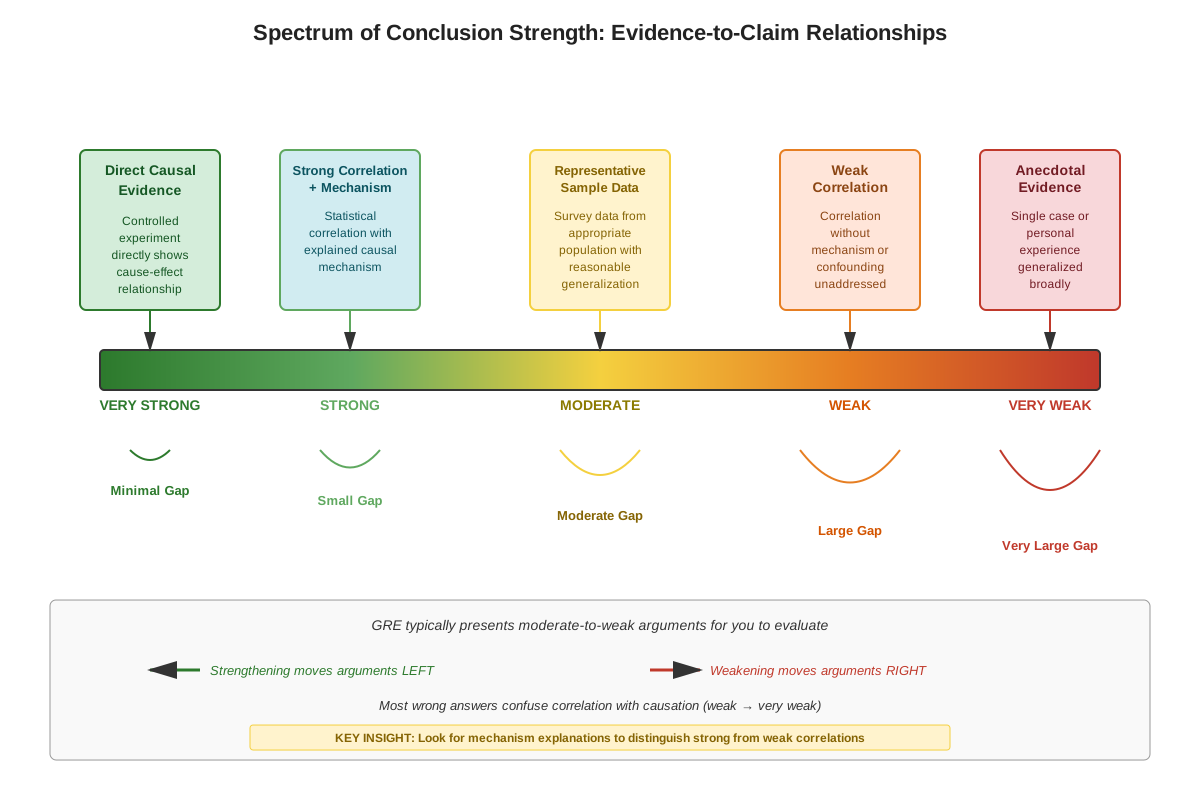
Conclusion strength refers to the degree to which premises (evidence, facts, data) logically support a conclusion (claim, assertion, recommendation). A strong conclusion follows necessarily or very probably from its premises, with minimal logical gaps. A weak conclusion has significant gaps between evidence and claim, relying on questionable assumptions or insufficient support. The strength exists on a spectrum rather than as a binary—conclusions can be very strong, moderately strong, weak, or completely unsupported.
The evaluation of conclusion strength requires examining three key elements: the quality of the evidence presented, the logical connection between that evidence and the conclusion, and the unstated assumptions that bridge any gaps. Even high-quality evidence can lead to a weak conclusion if the logical connection is poor, and even a seemingly tight logical connection can be weak if it relies on dubious assumptions.
The Anatomy of Argument Strength
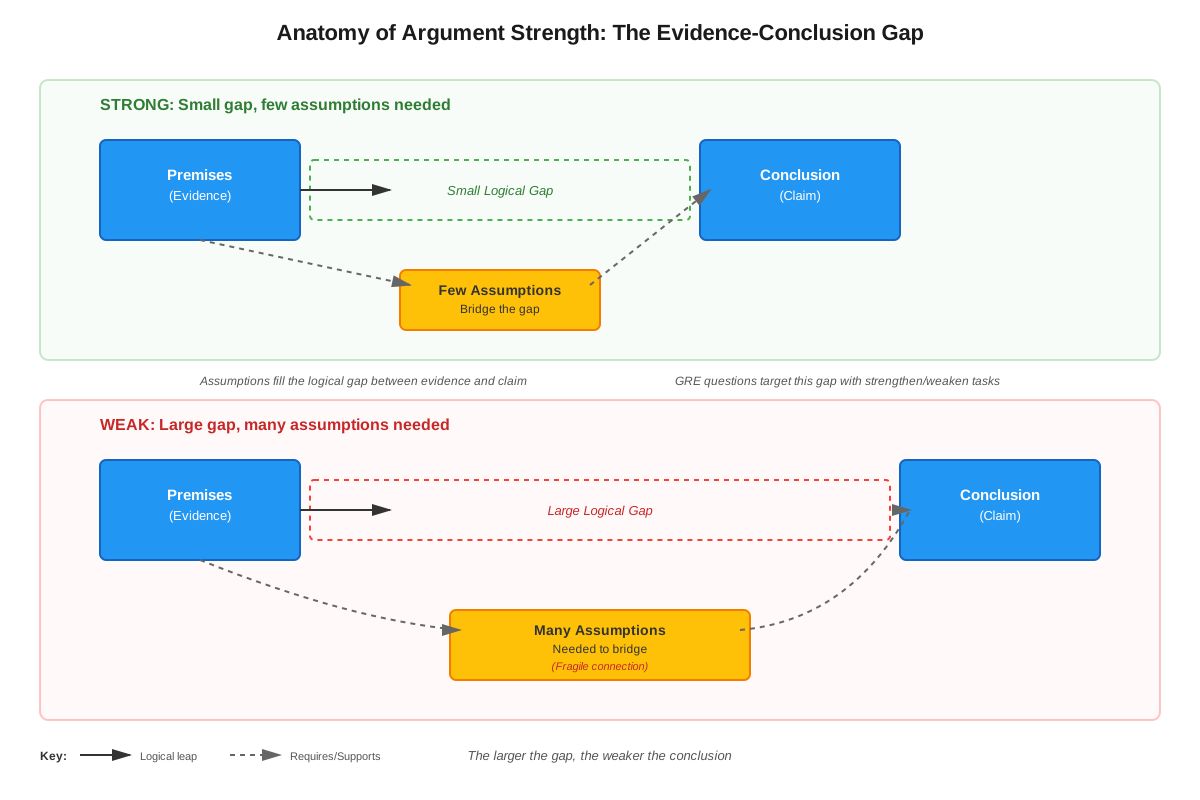
Every argument contains explicit components (stated premises and conclusion) and implicit components (unstated assumptions). The strength of a conclusion depends on:
- Evidence sufficiency: Is there enough evidence to support the scope of the conclusion?
- Evidence relevance: Does the evidence actually relate to the conclusion being drawn?
- Assumption validity: Are the unstated assumptions reasonable and likely to be true?
- Alternative explanations: Could the evidence be explained by factors other than what the conclusion claims?
- Scope matching: Does the conclusion claim more than the evidence can support?
Consider this framework for evaluating strength:
| Strength Level | Characteristics | Example |
|---|---|---|
| Very Strong | Evidence directly proves conclusion; minimal assumptions; no plausible alternatives | "All observed swans in this lake are white; therefore, this swan from the lake is white" |
| Moderately Strong | Evidence strongly suggests conclusion; reasonable assumptions; few alternatives | "95% of customers rated the product 5 stars; therefore, most customers are satisfied" |
| Weak | Evidence provides limited support; questionable assumptions; multiple alternatives | "Sales increased after the ad campaign; therefore, the ad campaign caused the increase" |
| Very Weak | Evidence barely relates to conclusion; unreasonable assumptions; many alternatives | "The CEO is tall; therefore, the company will be profitable" |
Identifying Logical Gaps
The logical gap is the space between what the evidence actually shows and what the conclusion claims. Identifying this gap is crucial for evaluating conclusion strength. Common types of logical gaps include:
Causal gaps: Evidence shows correlation, but conclusion claims causation. Example: "Ice cream sales and drowning deaths both increase in summer; therefore, ice cream causes drowning." The gap is the failure to consider that a third factor (warm weather) causes both.
Scope gaps: Evidence is limited, but conclusion is broad. Example: "In our survey of 50 college students, 80% preferred online learning; therefore, online learning is superior for all educational contexts." The gap is the leap from a small, specific sample to a universal claim.
Temporal gaps: Evidence from the past, but conclusion about the future. Example: "This investment strategy worked for the past five years; therefore, it will work for the next five years." The gap is the assumption that past conditions will continue.
Comparison gaps: Evidence about one group, but conclusion compares groups. Example: "Company A's profits increased 10%; therefore, Company A outperformed Company B." The gap is the lack of information about Company B's performance.
Assumptions as Bridges
Assumptions are unstated premises that must be true for a conclusion to follow from its stated evidence. They function as bridges across logical gaps. A conclusion's strength depends heavily on whether its assumptions are reasonable. Strong conclusions rest on assumptions that are obviously true or highly likely; weak conclusions depend on questionable or unlikely assumptions.
To identify assumptions, ask: "What must be true for this evidence to support this conclusion?" or "What is the author taking for granted?"
Example argument: "The new highway reduced commute times by 15 minutes. Therefore, worker productivity will increase."
Key assumptions:
- Shorter commutes lead to increased productivity (not just more leisure time)
- Workers will use the saved time productively
- The 15-minute reduction is significant enough to affect productivity
- Other factors affecting productivity remain constant
Each assumption represents a potential weakness. If any assumption is false, the conclusion's strength diminishes.
Strengthening vs. Weakening
Understanding what would strengthen or weaken a conclusion is central to GRE conclusion strength questions.
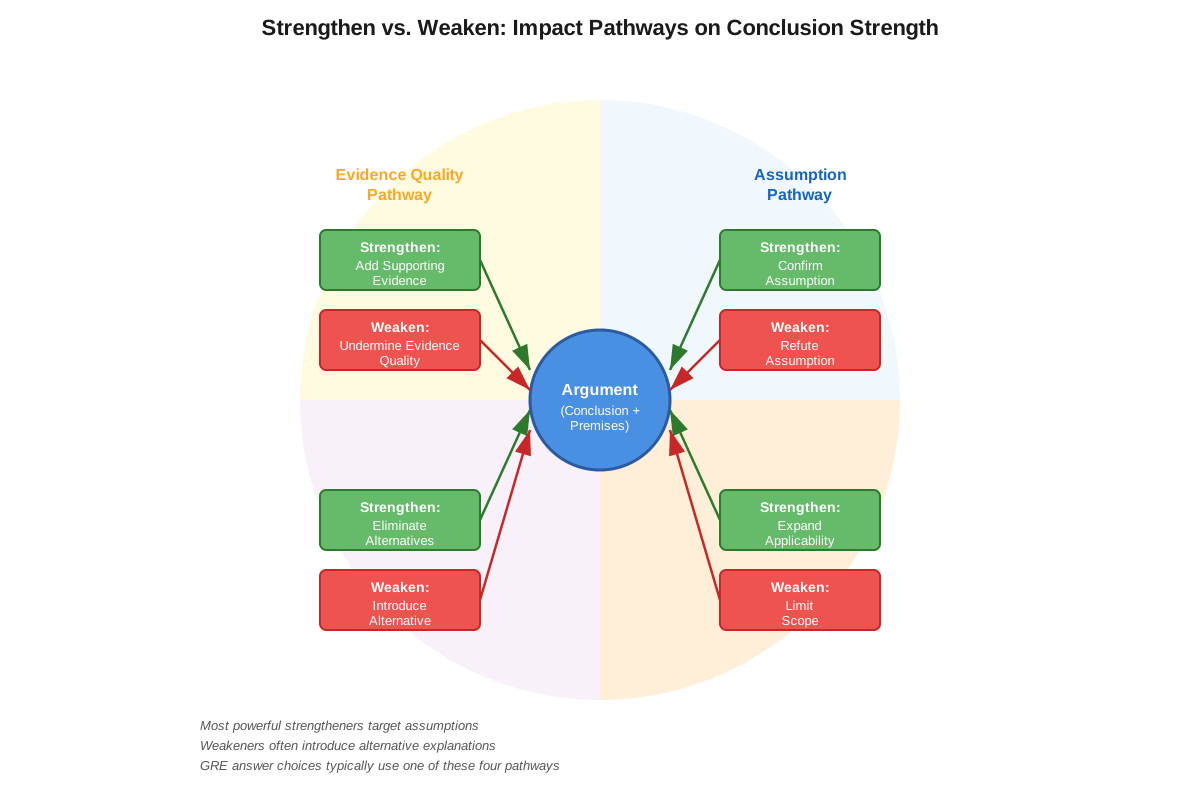
Strengthening evidence:
- Eliminates alternative explanations
- Validates key assumptions
- Provides additional supporting examples
- Shows the relationship is consistent across contexts
- Addresses potential objections
Weakening evidence:
- Introduces plausible alternative explanations
- Challenges key assumptions
- Provides counterexamples
- Shows the relationship doesn't hold in similar contexts
- Reveals relevant information that was omitted
GRE Tip: The correct answer to a strengthen/weaken question doesn't need to make the argument perfect or completely destroy it—it just needs to make the conclusion somewhat more or less likely to be true.
Evaluating Evidence Quality
Not all evidence equally supports conclusions. High-quality evidence is:
- Representative: Samples reflect the population being discussed
- Sufficient: Adequate quantity to support the scope of the conclusion
- Relevant: Directly relates to the claim being made
- Recent: Current enough to apply to the situation
- Objective: Free from obvious bias or conflicts of interest
- Precise: Specific rather than vague
Low-quality evidence includes anecdotes presented as proof, small or biased samples, outdated information, or irrelevant facts that create an illusion of support.
Concept Relationships
The concepts within conclusion strength form an interconnected analytical framework. Logical gaps exist between premises and conclusions, and assumptions serve as the bridges across these gaps. The strength of a conclusion depends on both the quality of explicit evidence and the reasonableness of implicit assumptions. When evaluating whether information would strengthen or weaken an argument, the analysis focuses on whether that information validates or challenges key assumptions or provides evidence that narrows or widens logical gaps.
This topic connects directly to prerequisite knowledge of argument structure—students must first identify premises and conclusions before evaluating how well they connect. It also relates to assumption identification, as recognizing unstated premises is essential for spotting logical gaps. The skill builds toward more advanced topics like logical fallacies (which are specific patterns of weak reasoning) and argument construction in the Analytical Writing section.
The relationship map flows as follows:
Argument Structure Recognition → enables → Premise/Conclusion Identification → enables → Logical Gap Detection → reveals → Assumptions → determines → Conclusion Strength → guides → Strengthen/Weaken Analysis → applies to → GRE Question Types
High-Yield Facts
⭐ Conclusion strength questions appear in multiple formats: strengthen, weaken, assumption, evaluate, and flaw questions all test this skill.
⭐ A strong conclusion requires both good evidence AND valid assumptions—excellent evidence with questionable assumptions still yields a weak conclusion.
⭐ Correlation does not imply causation—this is the most common logical gap on the GRE; always consider alternative explanations for observed relationships.
⭐ Scope mismatches are frequent weaknesses—conclusions that claim more than the evidence supports (generalizing from limited samples, extending past trends to future predictions).
⭐ The correct strengthen/weaken answer doesn't need to be definitive—it only needs to make the conclusion somewhat more or less likely.
- Assumptions are always unstated—if it's explicitly mentioned in the passage, it's not an assumption.
- Representative samples are crucial—evidence from unrepresentative groups weakens conclusions about broader populations.
- Temporal assumptions are common—arguments often assume past conditions will continue or that timing doesn't affect relationships.
- Alternative explanations weaken arguments—showing that evidence could be explained by something other than what the conclusion claims reduces strength.
- Strengthening evidence often eliminates alternatives—the best strengtheners rule out other possible explanations for the observed evidence.
- Analogies and comparisons assume relevant similarity—arguments comparing situations assume the situations are similar in ways that matter to the conclusion.
Quick check — test yourself on Conclusion strength so far.
Try Flashcards →Common Misconceptions
Misconception: A conclusion is strong if the evidence is true.
Correction: True evidence can still lead to weak conclusions if the logical connection is poor. The truth of premises doesn't automatically make a conclusion follow—the relationship between evidence and claim determines strength.
Misconception: Strengthen/weaken questions ask for information that proves or disproves the conclusion.
Correction: These questions ask for information that makes the conclusion more or less likely, not certain or impossible. The correct answer shifts probability, not establishes certainty.
Misconception: More evidence always strengthens a conclusion.
Correction: Only relevant evidence that addresses logical gaps or validates assumptions strengthens conclusions. Irrelevant evidence, even if abundant, doesn't increase strength.
Misconception: If an argument has any weakness, it's completely invalid.
Correction: Arguments exist on a strength spectrum. Most real-world arguments have some weaknesses but can still be reasonably persuasive. The GRE tests the ability to recognize degrees of strength, not just perfect versus flawed.
Misconception: Personal agreement with a conclusion means it's strong.
Correction: Conclusion strength is about logical support, not personal belief. A conclusion you disagree with can be logically strong if well-supported, and one you agree with can be logically weak if poorly supported.
Misconception: Complex or technical-sounding evidence automatically makes a conclusion stronger.
Correction: The sophistication of evidence matters less than its relevance and sufficiency. Simple, directly relevant evidence can support a conclusion better than impressive-sounding but tangential information.
Misconception: Assumptions are flaws in arguments.
Correction: All arguments contain assumptions—they're necessary bridges between evidence and conclusions. Assumptions only weaken arguments when they're unreasonable or unlikely to be true.
Worked Examples
Example 1: Evaluating a Causal Argument
Passage: "After the city installed brighter streetlights in the downtown area, reported crimes decreased by 25% over the following six months. Therefore, installing brighter streetlights reduces crime."
Question: Which of the following, if true, would most weaken the argument?
A) Brighter streetlights were also installed in residential areas with no change in crime rates.
B) The cost of installing brighter streetlights was higher than initially projected.
C) During the same six-month period, the city also increased police patrols in the downtown area.
D) Some residents complained that the brighter lights disrupted their sleep.
E) The streetlights use energy-efficient LED technology.
Analysis:
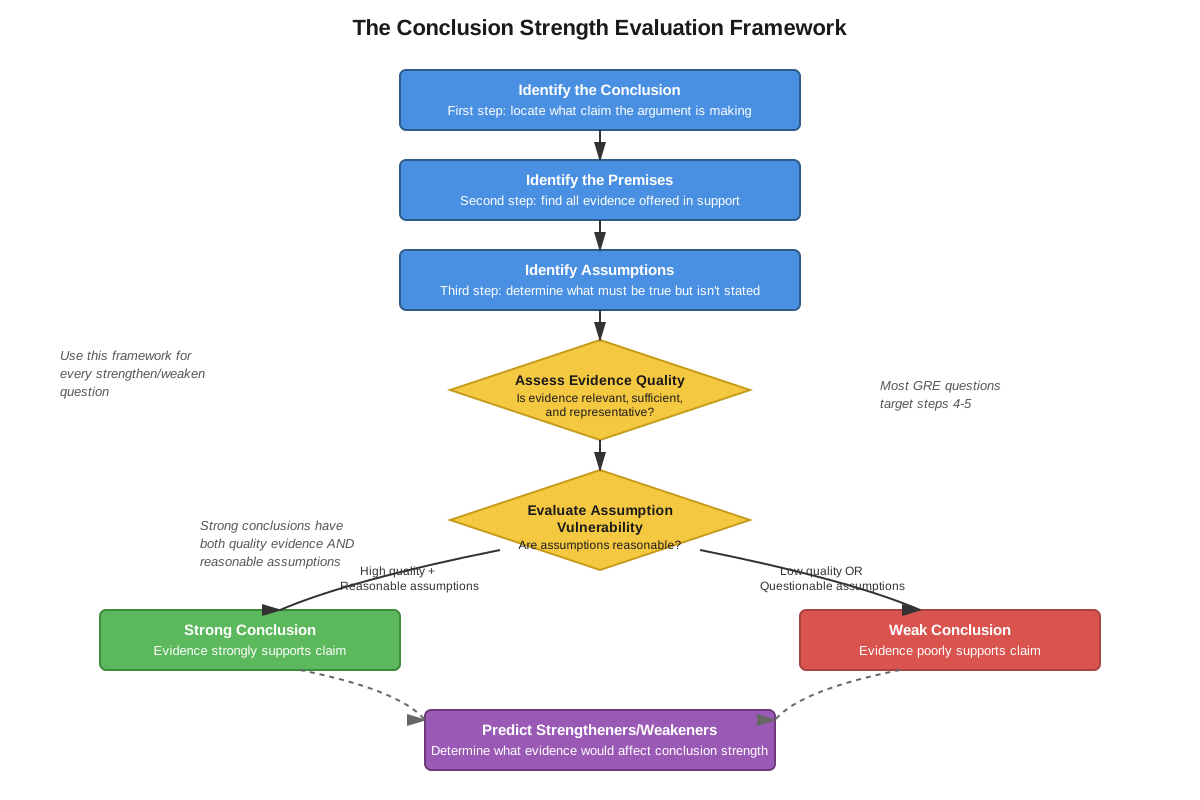
Step 1: Identify the conclusion and evidence.
- Conclusion: Installing brighter streetlights reduces crime
- Evidence: After installation, reported crimes decreased 25%
Step 2: Identify the logical gap and key assumptions.
- Gap: Correlation between streetlights and crime reduction
- Key assumption: The streetlights caused the reduction (not some other factor)
- Additional assumption: The timing wasn't coincidental
Step 3: Evaluate each answer choice.
Choice A strengthens slightly by showing the effect is specific to downtown, but doesn't provide an alternative explanation for downtown's decrease.
Choice B is irrelevant to whether streetlights reduce crime—cost doesn't affect the causal relationship.
Choice C directly challenges the key assumption by providing an alternative explanation. If police patrols increased simultaneously, we cannot determine whether streetlights, patrols, or both caused the crime reduction. This creates significant doubt about the causal claim.
Choice D is irrelevant to the crime reduction claim.
Choice E is irrelevant to the causal relationship between lighting and crime.
Answer: C
Connection to learning objectives: This example demonstrates identifying when conclusion strength is tested (a causal claim based on correlation), explaining the strategy (finding alternative explanations that challenge causal assumptions), and applying the analysis to select the answer that most weakens the argument.
Example 2: Evaluating a Predictive Argument
Passage: "TechCorp's stock price has increased by an average of 12% annually for the past decade. Financial analyst Maria Rodriguez predicts that TechCorp's stock will continue to increase by approximately 12% annually for the next decade."
Question: The prediction would be most strengthened by which of the following?
A) TechCorp has consistently maintained the same business model and market position throughout the past decade.
B) Other technology companies have experienced similar growth rates over the past decade.
C) The factors that drove TechCorp's growth over the past decade—expanding markets, innovative products, and strong management—are expected to continue.
D) TechCorp's stock price has never decreased on a year-over-year basis during the past decade.
E) Maria Rodriguez has correctly predicted stock performance for other companies in the past.
Analysis:
Step 1: Identify the conclusion and evidence.
- Conclusion: TechCorp's stock will continue 12% annual growth for the next decade
- Evidence: Stock has grown 12% annually for the past decade
Step 2: Identify the logical gap and key assumptions.
- Gap: Past performance to future prediction
- Key assumption: Conditions that caused past growth will continue
- Additional assumption: No new factors will disrupt the pattern
Step 3: Evaluate each answer choice.
Choice A provides some support by suggesting stability, but doesn't address whether the conditions that drove growth will continue.
Choice B is somewhat irrelevant—other companies' past performance doesn't predict TechCorp's future.
Choice C directly validates the key assumption by confirming that the causal factors behind past growth are expected to persist. This is the strongest support because it bridges the temporal gap by connecting past causes to future conditions.
Choice D adds detail about past performance but doesn't strengthen the future prediction—it's just more evidence about the past.
Choice E addresses the analyst's credibility but doesn't provide information about TechCorp specifically or the factors affecting its future performance.
Answer: C
Connection to learning objectives: This example shows how to identify temporal logical gaps (past to future), recognize that strengthening requires validating key assumptions (continuity of causal factors), and apply this understanding to select the answer that most directly addresses the argument's weakness.
Exam Strategy
Recognizing Conclusion Strength Questions
Trigger phrases that indicate conclusion strength is being tested:
- "Which of the following, if true, would most strengthen/weaken..."
- "The argument depends on which of the following assumptions..."
- "Which of the following would be most useful to know in evaluating the argument..."
- "The argument is flawed because it..."
- "Which of the following most undermines/supports..."
When you see these phrases, immediately shift into conclusion strength analysis mode: identify the conclusion, map the evidence, spot the logical gap, and recognize key assumptions.
Systematic Approach
Step 1: Identify the conclusion (usually signaled by "therefore," "thus," "consequently," or appears as a recommendation/prediction)
Step 2: Identify the premises (facts, data, observations that support the conclusion)
Step 3: Find the gap (What's the leap from evidence to conclusion? What's assumed but not stated?)
Step 4: Predict what would strengthen/weaken (Before looking at choices, anticipate what type of information would affect the argument)
Step 5: Evaluate choices (Eliminate irrelevant options first, then select the choice that most directly addresses the logical gap)
Time Management Tip: Spend 15-20 seconds on Steps 1-3 before looking at answer choices. This upfront investment prevents wasting time on attractive but irrelevant options.
Process of Elimination Strategies
Eliminate immediately:
- Choices that are factually irrelevant to the conclusion (even if related to the topic)
- Choices that affect a different conclusion than the one in the passage
- Choices that go in the wrong direction (strengthen when you need weaken, or vice versa)
- Choices that are too weak to significantly affect the argument
Be cautious of:
- Choices that seem to strengthen/weaken but actually don't address the key assumption
- Choices that affect a premise rather than the conclusion
- Choices that introduce new topics rather than addressing the logical gap
Favor choices that:
- Directly address the identified logical gap
- Validate or challenge the key assumption
- Provide alternative explanations (for weaken questions)
- Eliminate alternative explanations (for strengthen questions)
Common Traps
The "Interesting but Irrelevant" trap: Answer choices that provide fascinating information related to the topic but don't affect the logical relationship between premises and conclusion.
The "Opposite Direction" trap: On strengthen questions, choices that actually weaken (and vice versa)—always double-check which direction the question asks for.
The "Premise Booster" trap: Choices that make a premise more convincing but don't address the gap between premises and conclusion.
Memory Techniques
CASA Mnemonic for Identifying Logical Gaps:
- Causation (Does the argument claim cause from correlation?)
- Assumptions (What unstated premises bridge evidence to conclusion?)
- Scope (Does the conclusion claim more than evidence supports?)
- Alternatives (Are there other explanations for the evidence?)
The "Bridge" Visualization: Picture the evidence as one side of a river and the conclusion as the other side. Assumptions are the bridge connecting them. A strong argument has a solid, well-supported bridge; a weak argument has a rickety bridge with missing planks. Strengthening adds support to the bridge; weakening removes planks.
RSVP for Evidence Quality:
- Representative (Does the sample reflect the population?)
- Sufficient (Is there enough evidence?)
- Valid (Are the assumptions reasonable?)
- Pertinent (Is the evidence relevant?)
The "Alternative Explanation" Test: For any causal claim, automatically ask "Could something else explain this?" This habit quickly identifies the most common logical gap on the GRE.
Summary
Conclusion strength is the degree to which evidence logically supports a claim, determined by evidence quality, logical connections, and assumption validity. Mastering this concept requires identifying the gap between what evidence shows and what conclusions claim, recognizing the assumptions that bridge this gap, and evaluating whether those assumptions are reasonable. Strong conclusions follow necessarily or very probably from their premises with minimal logical leaps, while weak conclusions rely on questionable assumptions, insufficient evidence, or poor logical connections. The GRE tests this skill through strengthen/weaken questions, assumption questions, and evaluation questions, all requiring the same core analytical process: identify the conclusion, map the evidence, spot the logical gap, recognize key assumptions, and determine what information would make the conclusion more or less likely to be true. Success depends on systematic analysis rather than intuition, focusing on logical relationships rather than personal agreement, and recognizing that most arguments exist on a strength spectrum rather than being simply valid or invalid.
Key Takeaways
- Conclusion strength depends on both evidence quality and the validity of assumptions connecting evidence to conclusions
- The most common logical gaps involve causation (claiming cause from correlation), scope (generalizing beyond evidence), and temporal reasoning (predicting future from past)
- Strengthen/weaken questions ask for information that makes conclusions more or less likely, not certain or impossible
- Always identify the conclusion first, then map evidence, then spot the logical gap before evaluating answer choices
- Alternative explanations weaken arguments; eliminating alternatives strengthens them
- Assumptions are necessary bridges in all arguments—they only weaken arguments when unreasonable
- Systematic analysis beats intuition: use the CASA framework to identify gaps and predict what would affect argument strength
Related Topics
Logical Fallacies: Building on conclusion strength, this topic categorizes specific patterns of weak reasoning (ad hominem, false dichotomy, slippery slope, etc.). Mastering conclusion strength provides the foundation for recognizing why these patterns fail.
Argument Structure and Diagramming: This advanced skill involves visually mapping complex arguments with multiple premises and sub-conclusions, enabling analysis of sophisticated reasoning chains.
Evidence Evaluation: A deeper dive into assessing the quality of different evidence types (statistical, anecdotal, expert testimony, experimental) and understanding how evidence quality affects conclusion strength.
Analytical Writing - Analyze an Argument: The essay task directly applies conclusion strength skills, requiring written analysis of logical gaps, assumptions, and evidence quality in extended arguments.
Inference and Implication: Related to but distinct from conclusion strength, this topic focuses on what must be true or is strongly suggested by given information, rather than evaluating how well evidence supports explicit conclusions.
Practice CTA
Now that you understand the principles of evaluating conclusion strength, it's time to apply these skills to actual GRE-style questions. The practice questions and flashcards will reinforce your ability to quickly identify logical gaps, recognize key assumptions, and determine what information strengthens or weakens arguments. Remember: conclusion strength analysis is a systematic skill that improves with deliberate practice. Each question you work through builds your pattern recognition and analytical speed. Approach the practice with the same strategic process outlined in this guide, and you'll develop the confident, efficient reasoning that leads to top GRE Verbal scores. You've built the foundation—now strengthen it through application!
Sign up free to keep reading
Create a free AnvayaPrep account to finish this GRE guide on Conclusion strength — plus flashcards and practice questions.