Overview
Argument scope refers to the boundaries and limitations of a claim or conclusion within a logical argument. On the GRE Verbal Reasoning section, understanding argument scope is crucial for success in Critical Reasoning questions, particularly those that ask test-takers to identify assumptions, strengthen or weaken arguments, or evaluate logical flaws. The scope defines what an argument does and does not claim, what evidence it relies upon, and what conclusions can legitimately be drawn from the premises provided. Many students struggle with GRE questions not because they lack reading comprehension skills, but because they fail to recognize the precise boundaries of what an argument is actually asserting.
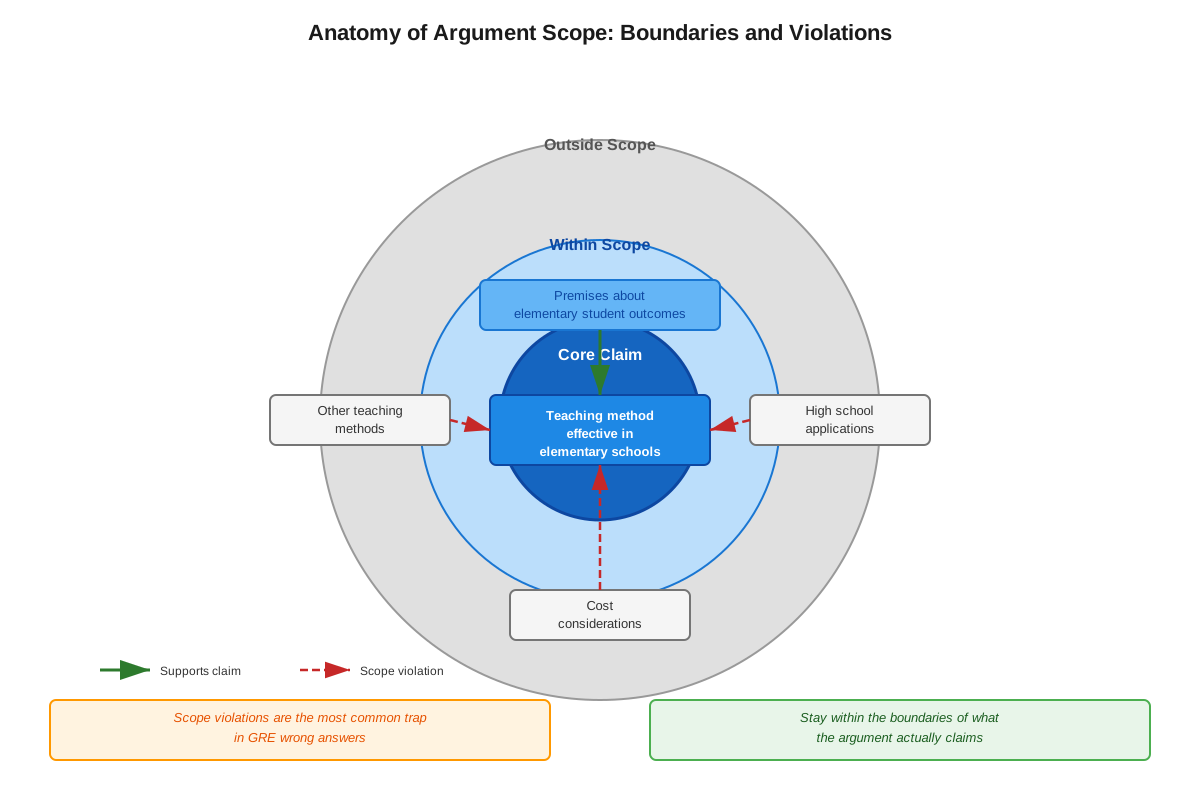
GRE argument scope questions test the ability to distinguish between what an argument explicitly states, what it implies, and what falls outside its boundaries entirely. For instance, an argument about the effectiveness of a new teaching method in elementary schools has a limited scope—it does not necessarily apply to high school students, college students, or other educational contexts. Recognizing these boundaries prevents test-takers from making unwarranted logical leaps and helps them identify answer choices that introduce irrelevant information or overgeneralize the argument's claims.
This topic sits at the heart of Critical Reasoning within Verbal Reasoning, connecting directly to skills like identifying assumptions, evaluating evidence, and recognizing logical fallacies. Mastering argument scope provides the foundation for understanding how arguments can be strengthened, weakened, or evaluated. It also relates closely to Reading Comprehension, where understanding the scope of an author's claims helps distinguish between main ideas, supporting details, and information that falls outside the passage's focus. Students who develop strong scope-recognition skills gain a significant advantage across multiple question types on the GRE.
Learning Objectives
- [ ] Identify when Argument scope is being tested in GRE questions
- [ ] Explain the core rule or strategy behind Argument scope
- [ ] Apply Argument scope to GRE-style questions accurately
- [ ] Distinguish between information that falls within and outside an argument's scope
- [ ] Recognize common scope violations in incorrect answer choices
- [ ] Evaluate whether evidence or objections are relevant to an argument's specific claims
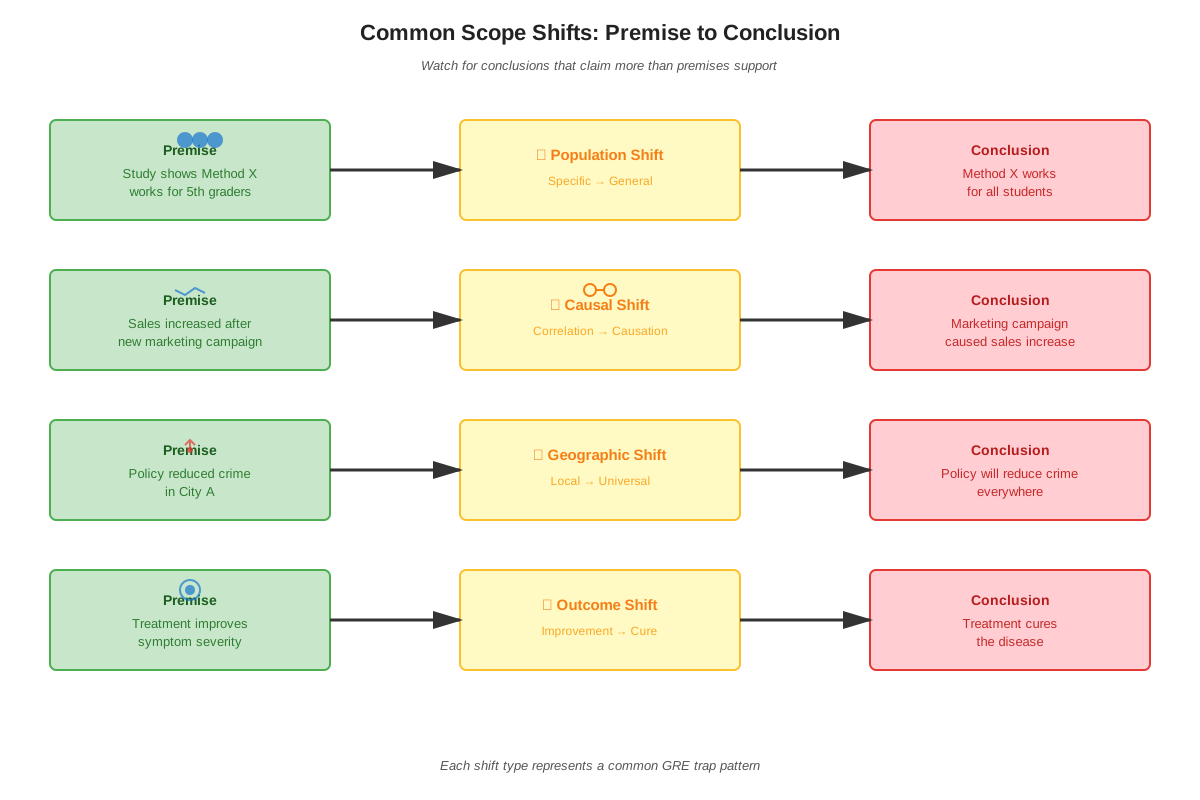
- [ ] Identify scope shifts between premises and conclusions
Prerequisites
- Basic logical reasoning: Understanding the structure of arguments (premises, conclusions, and evidence) is essential because scope analysis requires identifying what claims are actually being made.
- Reading comprehension fundamentals: The ability to parse complex sentences and identify main ideas enables students to determine the boundaries of an argument's claims.
- Familiarity with argument structure: Recognizing how premises support conclusions helps students see where scope limitations exist and where arguments might overreach.
Why This Topic Matters
Understanding argument scope has practical applications far beyond standardized testing. In professional settings, evaluating the scope of research findings, business proposals, and policy recommendations prevents costly errors in judgment. Legal professionals must constantly assess whether precedents apply to new cases based on scope similarities. Medical professionals evaluate whether research findings from one population apply to their specific patients. Academic researchers must carefully define the scope of their claims to maintain intellectual integrity.
On the GRE, argument scope appears in approximately 40-50% of Critical Reasoning questions, making it one of the highest-yield topics for test preparation. Questions testing scope understanding include Assumption questions (which often hinge on unstated scope limitations), Strengthen/Weaken questions (where wrong answers frequently introduce out-of-scope information), Evaluate questions (which require identifying what additional information would be relevant within the argument's scope), and Flaw questions (where scope shifts between premises and conclusions represent common logical errors).
This topic commonly appears in passages discussing research studies, policy proposals, business decisions, and causal explanations. The GRE frequently tests whether students can recognize when an argument about one specific context (e.g., a particular time period, location, or population) is being inappropriately extended to a different context. Additionally, scope issues arise when arguments shift from discussing correlation to causation, from describing what is true to prescribing what should be done, or from addressing one aspect of a complex issue to making claims about the entire issue.
Core Concepts
Defining Argument Scope
The argument scope encompasses the specific boundaries of what an argument claims, including the particular subjects, time frames, contexts, and conditions to which the argument applies. Every well-constructed argument has inherent limitations—it addresses certain questions while leaving others untouched, applies to specific situations while excluding others, and draws conclusions that are appropriately constrained by the evidence provided.
Consider this example: "Studies show that meditation reduces stress in corporate employees. Therefore, companies should implement meditation programs." The scope of the evidence concerns corporate employees specifically, not all workers. The scope also addresses stress reduction, not other potential benefits or drawbacks. A scope-aware analysis recognizes that this argument does not address whether meditation works for factory workers, whether it improves productivity, or whether the costs of implementation are justified.
Components of Scope
Understanding scope requires analyzing several key dimensions:
| Scope Dimension | Definition | Example |
|---|---|---|
| Subject Matter | What specific topic or entity the argument addresses | An argument about electric cars does not necessarily apply to hybrid vehicles |
| Population | Which group of people or things the argument concerns | Research on college students may not apply to elderly populations |
| Time Frame | When the argument's claims are meant to apply | Historical data may not predict future trends |
| Geographic Scope | Where the argument's claims are relevant | A policy effective in urban areas may not work in rural settings |
| Conditional Scope | Under what circumstances the argument holds | A strategy that works in economic booms may fail in recessions |
Scope Violations in Arguments
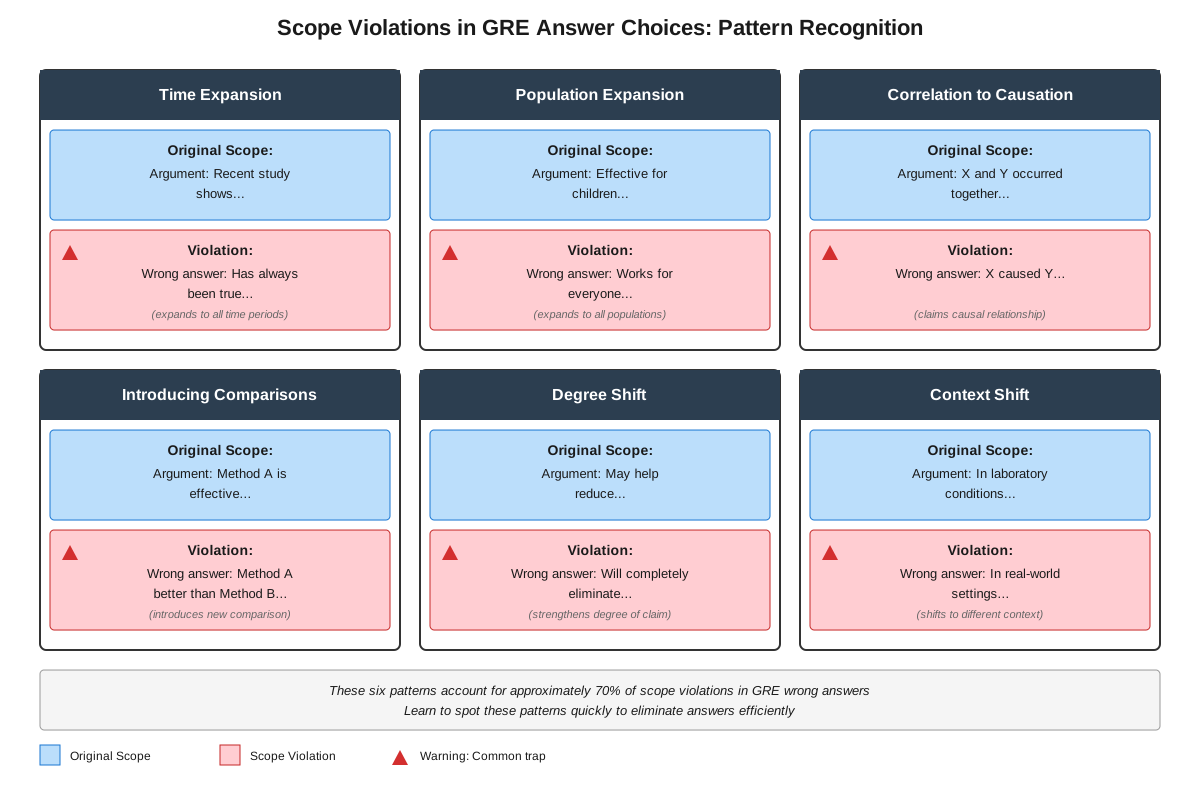
A scope violation occurs when an argument's conclusion extends beyond what the premises can legitimately support. These violations take several common forms:
- Overgeneralization: Extending a claim from a specific case to a broader category without justification
- Category shift: Moving from one type of subject to a related but distinct type
- Temporal shift: Applying evidence from one time period to draw conclusions about a different period
- Contextual shift: Assuming what works in one setting will work in another without establishing similarity
For example: "The new traffic light reduced accidents at the Main Street intersection by 30%. Therefore, installing similar lights throughout the city will reduce overall accidents by 30%." This argument violates scope by assuming that what worked at one specific intersection (which may have unique characteristics) will produce identical results city-wide.
Recognizing Scope in Premises vs. Conclusions
Critical scope analysis requires examining the relationship between premises and conclusions. The conclusion's scope must not exceed the scope established by the premises. When premises discuss a limited case but the conclusion makes a broader claim, a scope gap exists that requires an assumption to bridge.
Premise scope: "In a six-month trial, patients taking Drug X showed improved symptoms."
Conclusion scope: "Drug X is an effective long-term treatment."
The scope gap here involves the time dimension—the premise addresses six months, while the conclusion claims long-term effectiveness. This argument assumes that short-term results predict long-term outcomes, an assumption that may or may not be valid.
Scope and Assumptions
Many GRE Assumption questions test scope understanding because assumptions often serve to bridge scope gaps between premises and conclusions. When an argument shifts scope, it implicitly assumes that the shift is justified. Identifying these scope shifts reveals the argument's hidden assumptions.
Consider: "City A implemented a recycling program and saw waste reduction. City B should implement the same program." This argument assumes that City B is sufficiently similar to City A in relevant ways—that the scope of what worked in City A can legitimately extend to City B. The assumption bridges the geographic and contextual scope gap.
Scope and Relevance
Understanding scope is essential for evaluating relevance. Information is relevant to an argument only if it falls within the argument's scope. On the GRE, many incorrect answer choices introduce information that seems related to the topic but actually falls outside the argument's specific boundaries.
If an argument discusses whether a policy will reduce crime, information about whether the policy is popular is likely outside the scope (unless the argument specifically connects popularity to effectiveness). If an argument concerns environmental benefits, information about economic costs may be out of scope (unless the argument makes claims about overall benefits that would include economic considerations).
Identifying Scope Indicators
Certain words and phrases signal scope limitations:
- Limiting terms: "some," "many," "often," "in certain cases," "under these conditions"
- Specific references: "this study," "these participants," "during this period," "in this region"
- Qualifying phrases: "with respect to," "in terms of," "regarding," "concerning"
- Conditional language: "if," "when," "provided that," "assuming"
Conversely, broad language may signal scope expansion:
- Universal terms: "all," "every," "always," "never," "in general"
- Unqualified claims: statements without limiting conditions
- Categorical language: "must," "will," "cannot," "proves"
Concept Relationships
The concepts within argument scope form an interconnected system. Defining argument scope provides the foundation for all other scope-related skills. Once the boundaries of an argument are identified, students can recognize scope violations where conclusions exceed what premises support. Understanding scope violations naturally leads to identifying scope gaps between premises and conclusions, which in turn reveals the assumptions an argument requires. These assumptions often involve claims that scope shifts are justified—that what applies in one context, time, or population applies in another.
The relationship flows as follows:
Identify Argument Scope → Compare Premise Scope to Conclusion Scope → Detect Scope Gaps → Recognize Required Assumptions → Evaluate Relevance of New Information
This topic connects to prerequisite knowledge of basic logical reasoning by building on the foundation of identifying premises and conclusions. While basic logical reasoning teaches what arguments are, scope analysis teaches what arguments are specifically claiming and what they are not claiming. The connection to argument structure is direct: scope analysis requires first identifying the argument's components before evaluating their boundaries.
Argument scope also connects forward to more advanced Critical Reasoning topics. Understanding scope is prerequisite for effectively analyzing Strengthen/Weaken questions (where relevant information must fall within scope), Evaluate questions (where useful additional information must address the argument's specific claims), and Flaw questions (where scope violations represent common logical errors). Additionally, scope awareness enhances Reading Comprehension by helping students distinguish between what a passage explicitly argues and what it merely mentions or implies.
High-Yield Facts
⭐ Argument scope defines the specific boundaries of what an argument claims, including subject matter, population, time frame, and conditions.
⭐ A scope violation occurs when a conclusion extends beyond what the premises can legitimately support.
⭐ Many incorrect GRE answer choices introduce information that falls outside the argument's scope, even if topically related.
⭐ Scope gaps between premises and conclusions reveal an argument's assumptions.
⭐ Information is relevant to an argument only if it falls within the argument's established scope.
- Limiting language ("some," "many," "often") narrows scope, while universal language ("all," "always," "never") broadens it.
- Overgeneralization—extending a specific case to a broader category—is one of the most common scope violations on the GRE.
- Arguments that shift from one population to another without justification contain a scope gap requiring an assumption.
- Temporal scope violations occur when evidence from one time period is used to draw conclusions about a different period without establishing continuity.
- Geographic and contextual scope shifts assume that what works in one setting will work in another without proving similarity.
⭐ When evaluating answer choices, always ask: "Does this information address what the argument is specifically claiming?"
- Scope analysis prevents the common error of bringing in outside knowledge or assumptions not present in the argument.
- Arguments about correlation have narrower scope than arguments about causation—they claim less and therefore require less support.
- Prescriptive conclusions ("should," "must," "ought to") often have broader scope than descriptive premises, creating scope gaps.
- Recognizing scope limitations helps eliminate answer choices that are factually true but logically irrelevant to the specific argument.
Quick check — test yourself on Argument scope so far.
Try Flashcards →Common Misconceptions
Misconception: If information is related to the argument's topic, it must be relevant to the argument.
Correction: Information is relevant only if it addresses the specific claims within the argument's scope. An argument about whether a policy reduces crime is not necessarily concerned with whether the policy is expensive, even though cost is related to policy discussions generally.
Misconception: Broader conclusions are stronger because they claim more.
Correction: Broader conclusions are actually more vulnerable because they require more support. An argument with a carefully limited scope is often more logically sound than one making sweeping claims.
Misconception: All assumptions involve scope gaps.
Correction: While many assumptions do bridge scope gaps, some assumptions involve other logical connections, such as assuming that evidence is reliable or that no counteracting factors exist. However, scope-related assumptions are particularly common on the GRE.
Misconception: If an argument doesn't explicitly limit its scope, the conclusion can be interpreted broadly.
Correction: The scope of the conclusion is constrained by the scope of the premises, whether or not limitations are explicitly stated. If premises discuss only one specific case, the conclusion cannot legitimately extend to all cases without additional support.
Misconception: Identifying scope violations requires specialized knowledge about the argument's subject matter.
Correction: Scope analysis is a logical skill, not a content knowledge test. The GRE provides all necessary information within the argument itself. Students should focus on the logical relationship between premises and conclusions, not on outside knowledge.
Misconception: Scope is only relevant for Assumption questions.
Correction: Scope understanding is crucial for multiple question types, including Strengthen/Weaken (where out-of-scope information is irrelevant), Evaluate (where useful information must fall within scope), Flaw (where scope violations are common errors), and even some Inference questions (where valid inferences must respect scope limitations).
Misconception: An argument with limited scope is weak or incomplete.
Correction: Appropriately limited scope is a sign of logical rigor. Arguments that carefully define their boundaries and draw proportionate conclusions are more logically sound than those that overreach. The GRE rewards recognition of appropriate scope limitations.
Worked Examples
Example 1: Identifying Scope Violations
Argument: "A recent study found that high school students who eat breakfast before school perform better on morning tests than students who skip breakfast. Therefore, all students should eat breakfast to improve their academic performance."
Question: Which of the following identifies a scope problem in this argument?
Analysis:
Step 1: Identify the premise scope. The premise discusses high school students specifically, performance on morning tests specifically, and compares breakfast-eaters to breakfast-skippers.
Step 2: Identify the conclusion scope. The conclusion claims "all students" (broader population than just high school students) should eat breakfast to improve "academic performance" (broader than just morning test performance).
Step 3: Identify scope gaps. The argument shifts from:
- High school students → all students (population scope expansion)
- Morning test performance → overall academic performance (outcome scope expansion)
- Correlation (breakfast-eaters perform better) → causation (eating breakfast causes improvement)
Step 4: Evaluate the scope violation. The conclusion extends far beyond what the premise supports. The evidence doesn't address elementary students, college students, or graduate students. It doesn't address afternoon performance, homework quality, or long-term learning. It doesn't establish that breakfast causes the improvement (perhaps motivated students both eat breakfast and study more).
Answer: The argument inappropriately generalizes from a specific population and limited outcome measure to make a universal recommendation. The scope violation involves multiple dimensions: population, outcome measure, and causal inference.
Connection to Learning Objectives: This example demonstrates how to identify when scope is being tested (the shift from specific to universal claims), explains the core strategy (comparing premise scope to conclusion scope), and applies scope analysis to reach the correct answer.
Example 2: Evaluating Scope-Relevant Information
Argument: "TechCorp's new software increased productivity by 25% in its marketing department. The company should implement this software company-wide to boost overall productivity."
Question: Which of the following, if true, would be most relevant to evaluating this argument?
(A) The software is more expensive than competing products.
(B) The marketing department has unique workflow requirements not shared by other departments.
(C) TechCorp's competitors are also developing productivity software.
(D) The marketing department employees received extensive training on the software.
(E) Productivity improvements generally lead to higher profits.
Analysis:
Step 1: Identify the argument's scope. The premise concerns the marketing department specifically. The conclusion extends to company-wide implementation.
Step 2: Identify the scope gap. The argument assumes that what worked in the marketing department will work in other departments—that the scope can legitimately expand from one department to all departments.
Step 3: Evaluate each answer choice for scope relevance.
(A) Cost information is outside the scope. The argument concerns whether the software will boost productivity, not whether it's cost-effective. This would be relevant to a different argument about whether the company should implement the software from a financial perspective, but that's not what this argument claims.
(B) This is scope-relevant. If the marketing department has unique requirements, this directly addresses whether the scope can expand from marketing to other departments. It challenges the assumption that marketing's results will generalize.
(C) Competitor actions are outside the scope. The argument is about whether this software will work company-wide, not about competitive positioning.
(D) Training is somewhat relevant but doesn't directly address the scope gap. Even if training was provided, this doesn't tell us whether other departments are similar enough to marketing for the results to transfer.
(E) The connection between productivity and profits is outside the scope. The argument concludes that productivity will increase, not that profits will increase.
Step 4: Select the answer that most directly addresses the scope gap. Choice (B) is correct because it directly questions whether the scope expansion from one department to all departments is justified.
Connection to Learning Objectives: This example shows how to identify scope testing in evaluation questions, demonstrates the strategy of identifying scope gaps, and illustrates how to eliminate out-of-scope answer choices while selecting scope-relevant information.
Exam Strategy
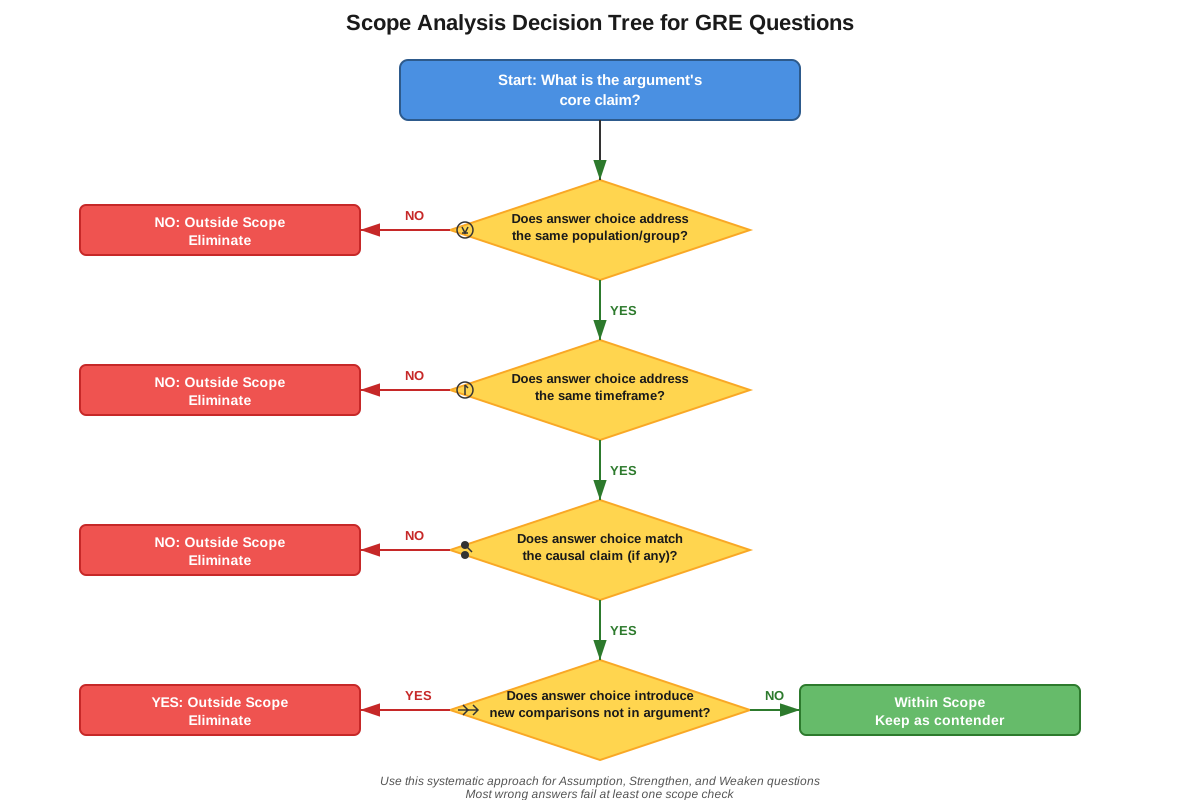
When approaching GRE questions testing argument scope, follow this systematic process:
Step 1: Read actively for scope markers. As you read the argument, note any limiting language, specific references, or qualifying conditions. Mentally flag words like "this study," "these participants," "in this case," or "under these conditions" that signal scope boundaries.
Step 2: Identify premise scope separately from conclusion scope. Before looking at answer choices, explicitly note what the premises discuss (specific population, time, context) and what the conclusion claims. Ask: "Is the conclusion claiming more than the premises support?"
Step 3: Predict the scope gap. For Assumption questions, predict what assumption would bridge any scope gap. For Strengthen/Weaken questions, predict what information would be relevant given the argument's specific scope. This prediction helps you quickly eliminate out-of-scope answer choices.
Step 4: Eliminate out-of-scope answer choices first. Many incorrect answers introduce information that seems topically related but falls outside the argument's boundaries. Ask of each choice: "Does this address what the argument is specifically claiming, or is it about something related but different?"
Exam Tip: The GRE frequently includes answer choices that would be correct for a different argument about the same general topic. These choices are designed to trap students who don't carefully track scope.
Trigger words and phrases to watch for:
- Scope expansion signals: "all," "always," "in general," "overall," "therefore," "thus," "consequently"
- Scope limitation signals: "some," "many," "in this case," "under these conditions," "this study"
- Scope shift signals: Changes in subject (from X to Y), time (from past to future), or population (from one group to another)
Process-of-elimination strategy:
- Eliminate answers that introduce new topics not mentioned in the argument
- Eliminate answers that address a different aspect of the general topic than what the argument discusses
- Eliminate answers that would be relevant to a broader or narrower version of the argument but not to the actual argument presented
- Among remaining choices, select the one that most directly addresses the specific scope gap or stays within established boundaries
Time allocation advice:
Scope analysis should take 15-20 seconds of your initial argument reading. This upfront investment saves time by allowing rapid elimination of out-of-scope answer choices. For a typical Critical Reasoning question, allocate:
- 30-40 seconds: Reading and scope analysis
- 40-60 seconds: Evaluating answer choices
- 10-20 seconds: Final verification
If you find yourself spending more than 90 seconds total on a question, you may be bringing in outside knowledge or considering information beyond the argument's scope. Refocus on what the argument specifically claims.
Memory Techniques
SCOPE Acronym for Analysis:
- Subject: What specific topic or entity?
- Context: What setting, conditions, or circumstances?
- Outcome: What specific result or effect?
- Population: What group of people or things?
- Era: What time period or duration?
Visualization Strategy: Picture the argument as a spotlight illuminating a specific area on a stage. Everything within the spotlight is in scope; everything in the shadows is out of scope. When the conclusion tries to illuminate a larger area than the premises support, you've found a scope violation.
The Boundary Test: When evaluating whether information is relevant, visualize drawing a boundary around the argument's specific claims. Ask: "Does this information fall inside or outside the boundary?" This mental image helps maintain focus on scope.
Mnemonic for Common Scope Violations: "POPTART"
- Population shift (from one group to another)
- Overgeneralization (from specific to universal)
- Past to future (temporal shift)
- Topic drift (from one subject to related subject)
- Assumption of similarity (from one context to another)
- Result expansion (from limited outcome to broader outcome)
- Type confusion (from correlation to causation, description to prescription)
The "Specifically" Technique: When reading conclusions, mentally insert the word "specifically" to maintain scope awareness. "The company should implement this software" becomes "The company should specifically implement this software company-wide based specifically on marketing department results." This makes scope gaps more obvious.
Summary
Argument scope represents the boundaries and limitations of what an argument claims, encompassing the specific subjects, populations, contexts, time frames, and conditions to which the argument applies. Mastering scope analysis is essential for GRE success because it enables test-takers to distinguish between what an argument actually asserts and what falls outside its boundaries. The core strategy involves identifying the scope of premises separately from the scope of conclusions, recognizing when conclusions extend beyond what premises support, and evaluating whether new information falls within the argument's established boundaries. Scope violations—particularly overgeneralization, population shifts, and temporal shifts—represent common logical flaws that the GRE frequently tests. Understanding scope is crucial for multiple question types, including Assumption questions (where scope gaps reveal hidden assumptions), Strengthen/Weaken questions (where only scope-relevant information affects the argument), and Evaluate questions (where useful information must address the argument's specific claims). Success requires careful attention to limiting language, systematic comparison of premise and conclusion scope, and disciplined elimination of answer choices that introduce out-of-scope information, even when that information seems topically related.
Key Takeaways
- Argument scope defines the specific boundaries of what an argument claims—always identify what the argument is specifically addressing versus what it leaves unaddressed
- Compare premise scope to conclusion scope systematically—scope violations occur when conclusions extend beyond what premises support
- Information is relevant only if it falls within the argument's scope—topically related information may still be logically irrelevant
- Scope gaps reveal assumptions—when an argument shifts scope, it assumes the shift is justified
- Eliminate out-of-scope answer choices first—this is often the fastest way to narrow options on Critical Reasoning questions
- Watch for common scope violations: overgeneralization, population shifts, temporal shifts, and contextual shifts
- Limited scope indicates logical rigor, not weakness—appropriately constrained arguments are more logically sound than those that overreach
Related Topics
Assumptions in Arguments: Understanding scope provides the foundation for identifying assumptions, as many assumptions serve to bridge scope gaps between premises and conclusions. Mastering scope analysis makes assumption questions significantly more manageable.
Strengthen and Weaken Questions: These questions require determining what information would make an argument more or less convincing, which depends entirely on understanding the argument's scope. Out-of-scope information cannot strengthen or weaken an argument.
Logical Fallacies: Many common fallacies involve scope violations, including hasty generalization (scope expansion), false analogy (unjustified scope transfer), and equivocation (scope shift in terminology). Scope mastery enables recognition of these flaws.
Causal Reasoning: Arguments about causation have specific scope requirements—evidence of correlation has narrower scope than claims of causation. Understanding this scope distinction is crucial for evaluating causal arguments.
Inference Questions: While primarily a Reading Comprehension question type, inference questions require understanding the scope of what a passage supports. Valid inferences must respect the scope limitations of the passage's claims.
Practice CTA
Now that you understand argument scope, it's time to apply these concepts to actual GRE-style questions. The practice questions and flashcards will help you internalize scope recognition, making it an automatic part of your Critical Reasoning approach. Remember: scope analysis is a skill that improves dramatically with deliberate practice. Each question you analyze strengthens your ability to quickly identify boundaries, spot scope violations, and eliminate out-of-scope answer choices. You're building one of the most valuable skills for GRE Verbal Reasoning success—approach your practice with confidence and attention to the specific strategies outlined in this guide!
Sign up free to keep reading
Create a free AnvayaPrep account to finish this GRE guide on Argument scope — plus flashcards and practice questions.