Overview
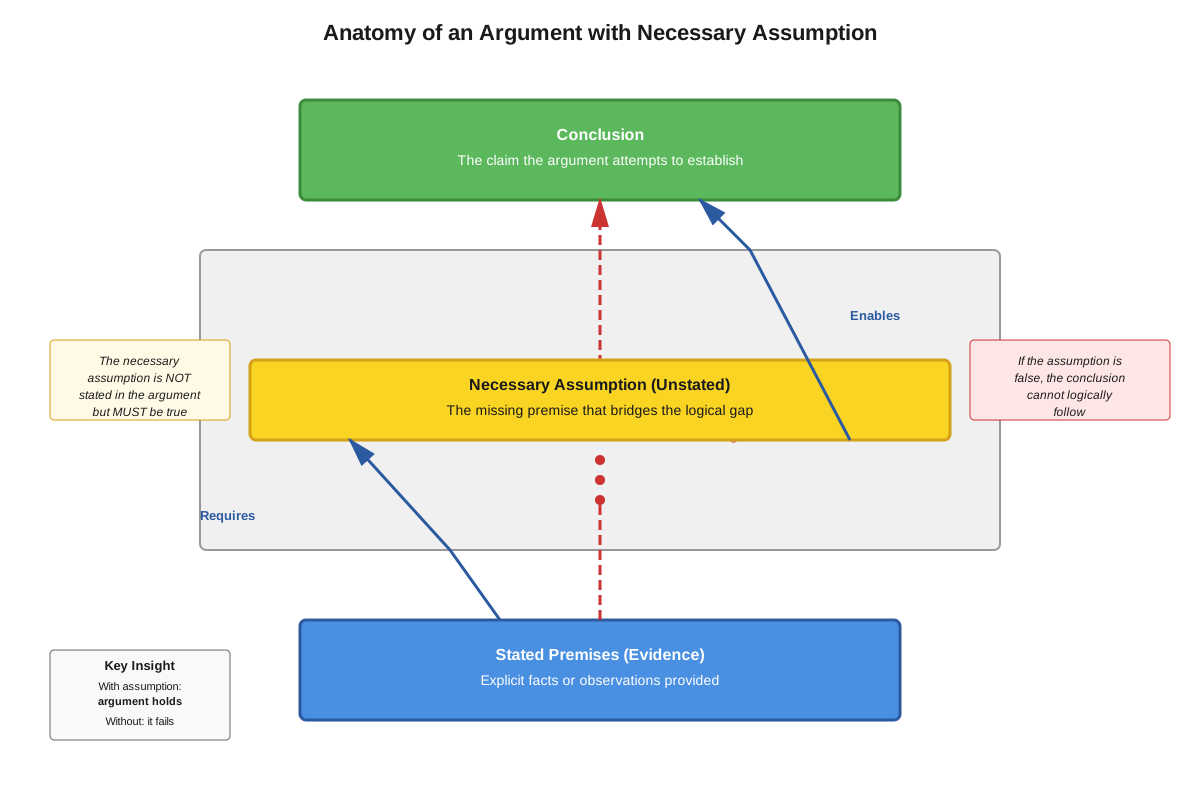
Necessary assumptions represent one of the most frequently tested concepts in GRE Verbal Reasoning, particularly within Critical Reasoning questions. A necessary assumption is an unstated premise that must be true for an argument's conclusion to logically follow from its evidence. Unlike sufficient assumptions (which guarantee the conclusion), necessary assumptions are the minimum requirements—the foundational building blocks without which the entire argument collapses. Understanding GRE necessary assumptions requires developing the ability to identify logical gaps between evidence and conclusion, then determining what unstated belief the author must hold for the argument to remain valid.
Mastering necessary assumptions is essential for the GRE because these questions appear regularly in both standalone Critical Reasoning items and within Reading Comprehension passages where students must evaluate argumentative structure. The GRE tests this concept because it measures critical thinking skills valued in graduate education: the ability to analyze reasoning, identify logical dependencies, and evaluate whether conclusions are properly supported. Students who excel at necessary assumption questions demonstrate they can think beyond surface-level content to examine the underlying logical architecture of arguments.
Within the broader landscape of Verbal Reasoning, necessary assumptions connect intimately with other critical reasoning skills including strengthening/weakening arguments, identifying flaws, and drawing inferences. These question types all require understanding how premises relate to conclusions, but necessary assumption questions specifically test whether students can identify what's missing—the unstated links that hold arguments together. This skill transfers directly to evaluating the logical soundness of complex academic arguments students will encounter throughout graduate study.
Learning Objectives
- [ ] Identify when Necessary assumptions is being tested
- [ ] Explain the core rule or strategy behind Necessary assumptions
- [ ] Apply Necessary assumptions to GRE-style questions accurately
- [ ] Distinguish necessary assumptions from sufficient assumptions and background information
- [ ] Use the negation test to verify whether an assumption is truly necessary
- [ ] Recognize common logical gaps that create the need for assumptions in GRE arguments
Prerequisites
- Basic argument structure: Understanding the distinction between premises (evidence) and conclusions is fundamental, as necessary assumptions bridge gaps between these components
- Conditional reasoning: Familiarity with "if-then" logic helps recognize when arguments depend on unstated conditional relationships
- Causal reasoning: Many necessary assumptions involve unstated beliefs about cause-and-effect relationships that arguments take for granted
- Inference skills: The ability to read between the lines and understand what's implied but not stated directly
Why This Topic Matters
In real-world contexts, identifying necessary assumptions is crucial for evaluating business proposals, scientific claims, policy arguments, and academic research. Professionals must constantly assess whether conclusions are properly supported or whether they rest on questionable unstated premises. A marketing executive evaluating a campaign proposal needs to identify what assumptions underlie projected success rates. A researcher reviewing a study must recognize what unstated beliefs about methodology or causation the authors are taking for granted.
On the GRE, necessary assumption questions appear with high frequency, typically comprising 15-20% of Critical Reasoning questions in the Verbal section. These questions appear in multiple formats: direct "assumption" questions asking what the argument depends upon, "flaw" questions where the flaw is a missing assumption, and "weaken" questions where the correct answer undermines a necessary assumption. The GRE favors these questions because they efficiently test multiple reasoning skills simultaneously: argument analysis, logical gap identification, and critical evaluation.
Common manifestations in GRE passages include arguments about causation (assuming no alternative causes), arguments about plans or predictions (assuming no obstacles or changed conditions), arguments by analogy (assuming relevant similarity), and arguments from authority or evidence (assuming reliability or representativeness). Recognizing these patterns allows students to anticipate what types of assumptions the test is likely to target.
Core Concepts
Definition and Characteristics of Necessary Assumptions
A necessary assumption is an unstated premise that must be true for an argument's conclusion to be logically valid. The defining characteristic is that if the assumption were false, the argument would completely fall apart—the conclusion could no longer be drawn from the given premises. Necessary assumptions are distinguished by three key properties:
- They are unstated: The author never explicitly mentions them in the argument
- They are required: The argument cannot work without them
- They are minimal: They represent the least that must be true, not everything that would help
Consider this simple argument: "Sarah scored in the 95th percentile on the GRE. Therefore, she will be admitted to her top-choice graduate program." The necessary assumption here is that scoring in the 95th percentile is sufficient for admission (or at least a major factor), and that no other disqualifying factors exist. Without this assumption, the conclusion doesn't follow from the premise.
The Logical Gap Concept
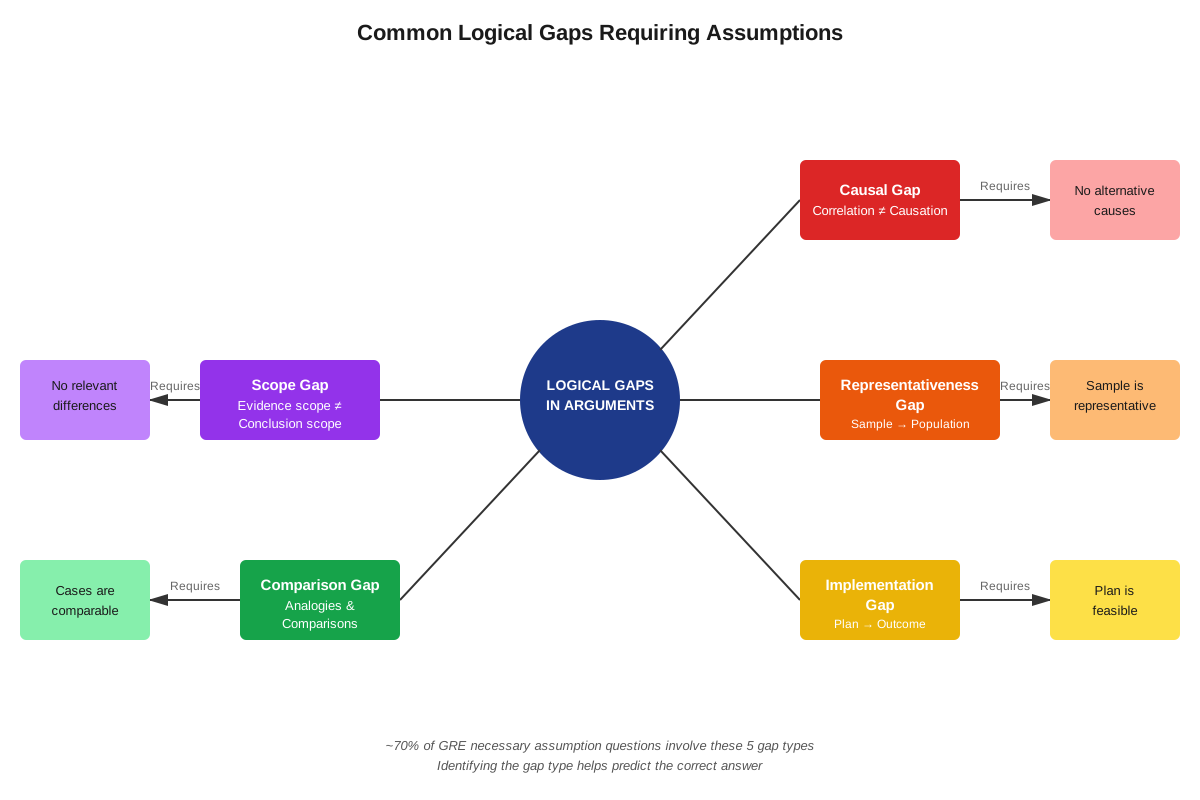
Every argument with a necessary assumption contains a logical gap—a disconnect between what the evidence actually proves and what the conclusion claims. Identifying this gap is the first step in finding necessary assumptions. The gap typically involves one of these patterns:
- Scope shift: The evidence discusses one thing, but the conclusion discusses something related but different
- Causal leap: The evidence shows correlation or sequence, but the conclusion assumes causation
- Comparison assumption: The conclusion compares two things, but the evidence only discusses one
- Feasibility assumption: The conclusion proposes a plan, but the evidence doesn't address whether it's possible
For example: "Company X's profits increased after implementing flexible work schedules. Therefore, flexible schedules caused the profit increase." The gap here is the leap from correlation (profits increased after the change) to causation (the change caused the increase). The necessary assumption is that no other factors were responsible for the profit increase.
The Negation Test
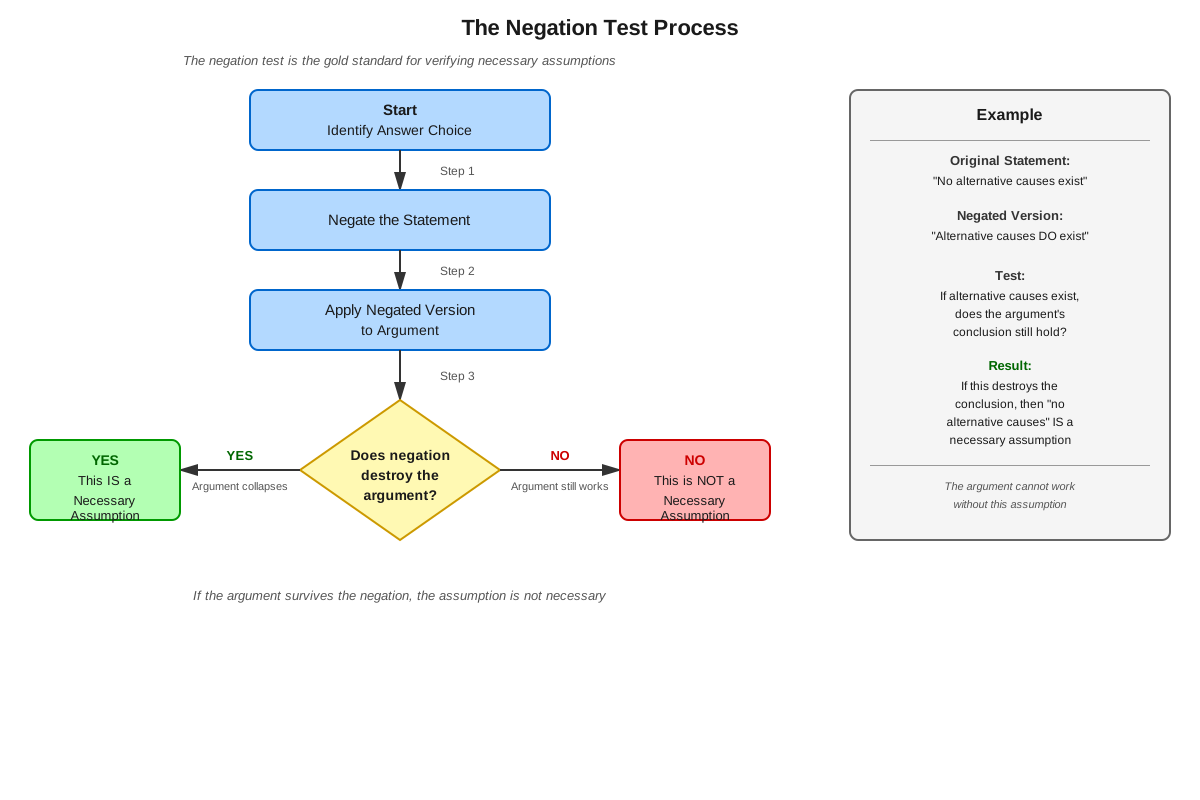
The negation test is the most reliable method for verifying whether an answer choice is truly a necessary assumption. The process works as follows:
- Take the answer choice being tested
- Negate it (make it false or opposite)
- Ask: "If this negated statement were true, would the argument fall apart?"
- If yes, the original statement is a necessary assumption
- If no, it's not necessary (though it might strengthen the argument)
Example application: Argument: "This medication reduced symptoms in clinical trials. Therefore, it will help patients in general practice."
Potential assumption: "The clinical trial participants were representative of the general patient population."
Negation: "The clinical trial participants were NOT representative of the general patient population."
Result: If the trial participants weren't representative, we have no reason to believe the medication will work for general patients. The argument collapses. Therefore, this IS a necessary assumption.
Types of Necessary Assumptions
| Type | Description | Example Pattern |
|---|---|---|
| Causal Assumptions | Assume no alternative causes or confounding factors | "X happened, then Y happened, so X caused Y" assumes no other cause of Y |
| Representativeness Assumptions | Assume a sample or example is typical | "This study of college students shows..." assumes students represent broader population |
| Feasibility Assumptions | Assume a plan or prediction is possible | "We should implement policy X" assumes X is implementable |
| Comparison Assumptions | Assume relevant similarity or difference | "City A's solution will work in City B" assumes relevant similarity |
| Definitional Assumptions | Assume terms mean what the argument requires | "This is the best solution" assumes a particular definition of "best" |
| Absence of Obstacles | Assume nothing will prevent the conclusion | "This will increase revenue" assumes no countervailing factors |
Necessary vs. Sufficient Assumptions
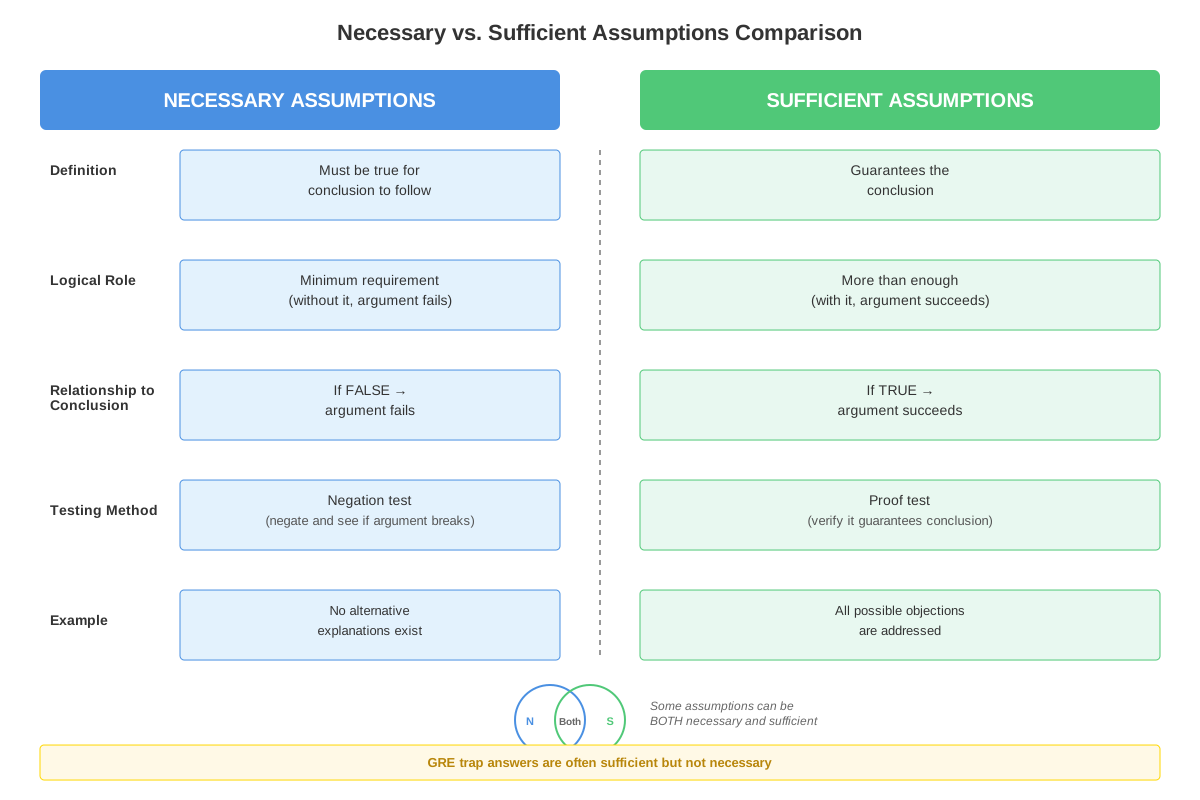
Understanding the distinction between necessary and sufficient assumptions is crucial for GRE success:
Necessary assumptions are the minimum required—what must be true. They are like the foundation of a building: without them, everything collapses, but having them doesn't guarantee the building is complete.
Sufficient assumptions are enough to guarantee the conclusion—what would make the argument airtight. They are like having a complete, finished building: they ensure the conclusion follows, but they often include more than the minimum required.
On the GRE, when a question asks "Which of the following is an assumption on which the argument depends?" or "The argument requires which assumption?", it's asking for a necessary assumption. The correct answer will be the minimum needed, not the maximum that would help.
Common Logical Structures Requiring Assumptions
Certain argument structures reliably create the need for assumptions:
Evidence-to-Plan Arguments: When evidence about the past or present is used to support a future plan, the argument assumes conditions won't change and no obstacles will emerge.
Analogy Arguments: When the author argues "X worked in situation A, so X will work in situation B," the necessary assumption is that A and B are similar in relevant ways.
Causal Arguments: When concluding that X causes Y, the argument assumes no alternative explanations exist and that the relationship isn't merely coincidental.
Authority Arguments: When citing expert opinion or study results, the argument assumes the source is reliable and relevant to the conclusion.
Concept Relationships
The concepts within necessary assumptions form an interconnected logical framework. The logical gap is the fundamental problem that creates the need for assumptions—without gaps, arguments would be complete and require no unstated premises. The negation test serves as the verification tool for identifying which potential assumptions actually fill these gaps in necessary ways. The various types of assumptions (causal, representativeness, feasibility, etc.) represent common patterns of logical gaps that appear repeatedly on the GRE.
This relationship flows as: Argument structure → Logical gap identification → Assumption type recognition → Negation test verification → Correct answer selection.
Necessary assumptions connect to prerequisite topics in essential ways. Basic argument structure knowledge enables students to separate premises from conclusions, which is required before identifying what's missing between them. Conditional reasoning helps recognize when arguments depend on unstated "if-then" relationships. Causal reasoning is particularly important because causal assumptions represent one of the most common assumption types on the GRE.
Necessary assumptions also connect forward to related Critical Reasoning topics. Strengthening questions often require identifying what would make an assumption more likely to be true. Weakening questions frequently target necessary assumptions by suggesting they're false. Flaw questions often describe the problem created by a missing necessary assumption. Understanding necessary assumptions thus provides a foundation for mastering multiple question types.
High-Yield Facts
⭐ A necessary assumption, when negated, must destroy the argument—this is the definitive test
⭐ Necessary assumptions are always unstated; if it's explicitly mentioned in the passage, it cannot be the answer
⭐ The correct answer to a necessary assumption question is often narrower and more specific than tempting wrong answers
⭐ Causal arguments almost always require the assumption that no alternative causes exist
⭐ Arguments proposing plans or predictions require assumptions about feasibility and absence of obstacles
- Necessary assumptions bridge logical gaps between evidence and conclusion
- Sufficient assumptions guarantee the conclusion; necessary assumptions are merely required for it
- Scope shifts between premises and conclusion create the need for assumptions
- Arguments by analogy require assumptions about relevant similarity
- Statistical or study-based arguments require representativeness assumptions
- The phrase "depends on which assumption" signals a necessary assumption question
- Wrong answers often strengthen the argument without being necessary for it
- Extreme language in answer choices (all, none, only) is often incorrect for necessary assumptions
- The correct assumption often addresses the most obvious gap in reasoning
- Time-based arguments (past to future) require assumptions about consistency of conditions
Quick check — test yourself on Necessary assumptions so far.
Try Flashcards →Common Misconceptions
Misconception: Any statement that would help the argument is a necessary assumption → Correction: Many statements strengthen arguments without being necessary. A necessary assumption must be something the argument cannot function without. Use the negation test: only if negating the statement destroys the argument is it truly necessary.
Misconception: Necessary assumptions must be obviously true or reasonable → Correction: Necessary assumptions can be questionable or even unlikely; they simply must be what the author is taking for granted. The GRE often tests your ability to identify dubious assumptions that arguments rest upon.
Misconception: The correct answer will make the argument perfect or airtight → Correction: Necessary assumptions are minimal requirements, not sufficient conditions. The argument may still have weaknesses even with the necessary assumption in place; it just can't work at all without it.
Misconception: Longer, more detailed answer choices are more likely to be correct → Correction: Correct necessary assumptions are often more limited in scope than wrong answers. Wrong answers frequently go too far, claiming more than is minimally necessary.
Misconception: If an assumption is stated in the passage, it might still be the answer → Correction: By definition, assumptions are unstated. If the passage explicitly mentions something, it's a premise, not an assumption. The correct answer will always introduce new information that bridges a gap.
Misconception: Background information or context that would be helpful is a necessary assumption → Correction: Necessary assumptions specifically connect the given premises to the stated conclusion. General background information, even if relevant to the topic, isn't a necessary assumption unless the argument logically requires it.
Worked Examples
Example 1: Causal Argument
Argument: "After the city installed brighter streetlights in the downtown area, vandalism decreased by 40%. Therefore, the brighter lighting caused the reduction in vandalism."
Question: Which of the following is an assumption required by the argument?
Answer Choices:
A) Brighter lighting makes it easier for police to patrol the area
B) No other factors that could reduce vandalism were introduced during the same period
C) The 40% reduction represents a statistically significant decrease
D) Vandalism is more likely to occur in poorly lit areas
E) The cost of installing brighter lights was justified by the reduction in vandalism
Step 1 - Identify the conclusion: The brighter lighting caused the reduction in vandalism.
Step 2 - Identify the evidence: Vandalism decreased after lights were installed.
Step 3 - Identify the logical gap: The evidence shows correlation (timing), but the conclusion claims causation. The gap is the leap from "happened after" to "caused by."
Step 4 - Predict the assumption: The argument must assume no other factors caused the decrease.
Step 5 - Evaluate answer choices using negation test:
(A) Negated: Brighter lighting does NOT make it easier for police to patrol. Does this destroy the argument? No—the lighting could still deter vandalism through other mechanisms. Not necessary.
(B) Negated: Other factors that could reduce vandalism WERE introduced during the same period. Does this destroy the argument? Yes—if other factors were introduced, we can't conclude the lighting caused the decrease. This IS necessary.
(C) Negated: The reduction is NOT statistically significant. Does this destroy the argument? No—the argument could still claim causation even with a smaller effect. Not necessary.
(D) Negated: Vandalism is NOT more likely in poorly lit areas. Does this destroy the argument? No—this is background information that would strengthen the argument but isn't required for the specific causal claim. Not necessary.
(E) Negated: The cost was NOT justified. Does this destroy the argument? No—this addresses whether the action was worthwhile, not whether it caused the effect. Not necessary.
Correct Answer: B
Connection to Learning Objectives: This example demonstrates identifying when necessary assumptions are tested (causal argument structure), explaining the core strategy (negation test), and applying it accurately to select the correct answer.
Example 2: Plan/Prediction Argument
Argument: "The university should require all students to take a course in data literacy. A recent survey showed that 78% of employers value data analysis skills in new hires. Therefore, adding this requirement will improve our graduates' employment prospects."
Question: The argument depends on which of the following assumptions?
Answer Choices:
A) Data literacy courses are currently available but underenrolled at the university
B) Students who take data literacy courses perform better academically overall
C) The skills taught in a data literacy course are the type of data analysis skills employers value
D) Most students graduating from the university seek employment rather than further education
E) Data analysis skills will continue to be valued by employers in the future
Step 1 - Identify the conclusion: Adding a data literacy requirement will improve graduates' employment prospects.
Step 2 - Identify the evidence: Employers value data analysis skills.
Step 3 - Identify the logical gap: The evidence is about "data analysis skills" (general), but the solution is a "data literacy course" (specific). There's a scope shift—the argument assumes the course teaches what employers want.
Step 4 - Predict the assumption: The course must teach the relevant skills.
Step 5 - Evaluate answer choices:
(A) Negated: Data literacy courses are NOT currently available or are well-enrolled. Does this destroy the argument? No—the argument is about whether to require them, not about current availability. Not necessary.
(B) Negated: Students who take these courses do NOT perform better academically overall. Does this destroy the argument? No—the conclusion is specifically about employment prospects, not general academic performance. Not necessary.
(C) Negated: The skills taught in a data literacy course are NOT the type of data analysis skills employers value. Does this destroy the argument? Yes—if the course doesn't teach what employers want, it won't improve employment prospects. This IS necessary.
(D) Negated: Most students do NOT seek employment. Does this destroy the argument? Partially—but the argument says "graduates' employment prospects," which could apply to those who do seek employment even if they're not the majority. This is tempting but not strictly necessary.
(E) Negated: Data analysis skills will NOT continue to be valued. Does this destroy the argument? This would weaken the argument, but the argument could still work for current graduates. Not strictly necessary.
Correct Answer: C
Connection to Learning Objectives: This example shows how to identify scope shifts between evidence and conclusion, apply the negation test to distinguish necessary from merely helpful assumptions, and recognize the pattern of plan arguments requiring feasibility/relevance assumptions.
Exam Strategy
When approaching GRE necessary assumption questions, follow this systematic process:
Step 1 - Identify the question type: Look for trigger phrases like "depends on which assumption," "requires the assumption that," "assumes which of the following," or "presupposes that." These signal necessary assumption questions.
Step 2 - Deconstruct the argument: Clearly separate the conclusion (what the author is trying to prove) from the premises (the evidence given). Often, the conclusion comes first or last, marked by words like "therefore," "thus," or "consequently."
Step 3 - Find the logical gap: Ask yourself: "What's missing? What leap in logic does the author make?" Look for scope shifts, causal leaps, or unstated connections between premises and conclusion.
Step 4 - Predict before looking at answers: Based on the gap you identified, predict what assumption would be necessary. This prevents you from being swayed by attractive wrong answers.
Step 5 - Use process of elimination: Eliminate answers that:
- Restate information already in the passage
- Go beyond what's necessary (too strong or broad)
- Address irrelevant issues
- Would strengthen the argument but aren't required
Step 6 - Apply the negation test to remaining choices: For each remaining answer, negate it and ask if the argument falls apart. The correct answer will destroy the argument when negated.
Exam Tip: If you're stuck between two answers, the correct necessary assumption is usually the more limited, specific one. Wrong answers often claim too much.
Time allocation: Spend approximately 1.5-2 minutes per necessary assumption question. If you're taking longer, make your best prediction, mark the question for review, and move on. These questions reward systematic thinking more than extended contemplation.
Trigger words to watch for in answer choices: Be cautious of extreme language like "only," "all," "never," or "must" in answer choices—necessary assumptions are often more moderate. However, don't automatically eliminate these; sometimes they're correct if the argument truly requires such a strong claim.
Memory Techniques
NEGATION Mnemonic for applying the negation test:
- Note the answer choice
- Express its opposite
- Gauge the argument's survival
- Argument destroyed? It's necessary
- Too strong? Probably wrong
- Ignore helpful but unnecessary
- Only one answer works
- Narrow scope often correct
The BRIDGE Acronym for identifying logical gaps:
- Background vs. necessary distinction
- Representativeness issues
- Implementation feasibility
- Different scope (evidence vs. conclusion)
- Gap in causation
- Evidence-to-prediction leaps
Visualization Strategy: Picture the argument as a bridge spanning a river. The premises are one side, the conclusion is the other side. The necessary assumption is the critical support beam—remove it, and the bridge collapses into the river. This helps you focus on what's structurally essential rather than what would merely make the bridge prettier or stronger.
The "Must Be True" Test: Before selecting an answer, ask yourself: "Must the author believe this for the argument to work?" If the answer is anything less than "absolutely yes," keep looking.
Summary
Necessary assumptions are unstated premises that arguments require to be logically valid—without them, the conclusion cannot follow from the evidence. Mastering GRE necessary assumptions requires three core skills: identifying logical gaps between premises and conclusions, recognizing common assumption patterns (causal, representativeness, feasibility, comparison), and applying the negation test to verify which answer choices are truly necessary. The negation test is the most reliable strategy: negate an answer choice, and if the argument falls apart, that choice is a necessary assumption. Common logical gaps include scope shifts between evidence and conclusion, causal leaps from correlation to causation, and unstated beliefs about feasibility or representativeness. Successful students distinguish necessary assumptions (minimum requirements) from sufficient assumptions (guarantees) and from statements that merely strengthen arguments without being required. This skill appears frequently on the GRE and connects to multiple other question types including strengthening, weakening, and flaw questions.
Key Takeaways
- Necessary assumptions are unstated premises that must be true for an argument to work; negating them destroys the argument
- The negation test is the most reliable method: flip the answer choice to its opposite and see if the argument collapses
- Look for logical gaps—scope shifts, causal leaps, or unstated connections between evidence and conclusion
- Correct answers are often narrower and more specific than tempting wrong answers that go too far
- Common assumption types include causal (no alternative causes), representativeness (sample is typical), and feasibility (plan is possible)
- If it's stated in the passage, it cannot be the assumption—assumptions are always unstated
- Necessary assumptions are minimum requirements, not sufficient conditions; the argument may still be weak even with them
Related Topics
Strengthening Arguments: Once you understand necessary assumptions, strengthening questions become clearer—they often ask what would make a necessary assumption more likely to be true or add additional support beyond the minimum required.
Weakening Arguments: These questions frequently work by attacking necessary assumptions, suggesting they might be false or providing evidence against them. Mastering necessary assumptions makes weakening questions significantly easier.
Logical Flaws: Many argument flaws involve missing necessary assumptions. Understanding what assumptions are required helps you articulate what's wrong with flawed reasoning.
Sufficient Assumptions: After mastering necessary assumptions, learning sufficient assumptions involves understanding what would guarantee rather than merely enable a conclusion—a natural progression in logical reasoning skills.
Inference Questions: While different from assumption questions, inference skills complement assumption identification by developing your ability to understand what follows from stated information versus what must be true for stated information to work.
Practice CTA
Now that you understand the core concepts and strategies for necessary assumptions, it's time to put your knowledge into practice. Attempt the practice questions to reinforce these skills and build the pattern recognition that leads to quick, accurate performance on test day. Remember: necessary assumption questions reward systematic thinking and the disciplined application of the negation test. Each practice question you work through strengthens your ability to spot logical gaps and identify what arguments truly depend upon. You've learned the framework—now make it automatic through deliberate practice. Review the flashcards to cement the key concepts, then challenge yourself with full-length practice sets. Mastery of necessary assumptions will not only improve your Critical Reasoning performance but will enhance your ability to evaluate arguments throughout the Verbal section and beyond.
Sign up free to keep reading
Create a free AnvayaPrep account to finish this GRE guide on Necessary assumptions — plus flashcards and practice questions.