Overview
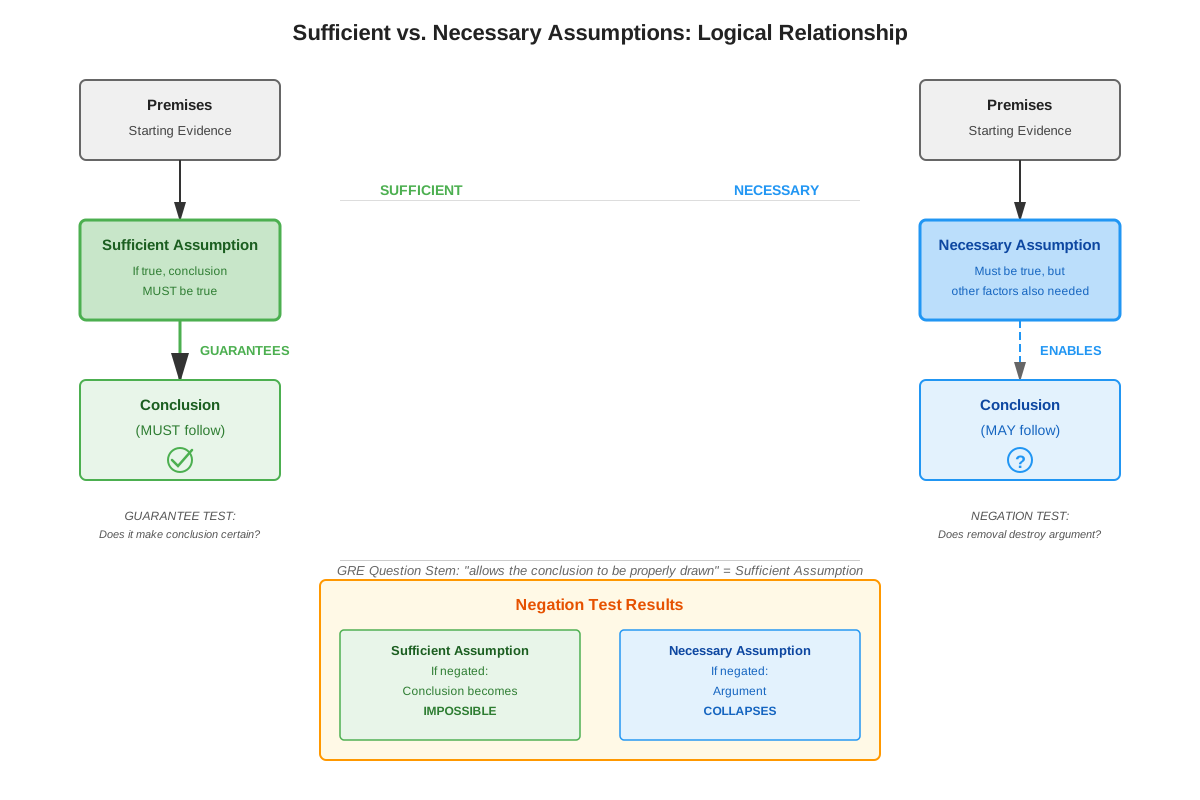
Sufficient assumptions represent one of the most critical question types in GRE Verbal Reasoning's Critical Reasoning section. These questions test the ability to identify unstated premises that, when added to an argument, guarantee the conclusion's validity. Unlike necessary assumptions (which are required but may not be enough alone), a sufficient assumption completes the logical chain so thoroughly that the conclusion must follow with certainty.
Understanding GRE sufficient assumptions is essential because these questions appear regularly on the exam and directly assess logical reasoning skills that graduate programs value. Students who master sufficient assumptions demonstrate the ability to analyze complex arguments, identify logical gaps, and understand what evidence would definitively prove a claim—skills fundamental to academic research and professional decision-making.
Within the broader landscape of Verbal Reasoning, sufficient assumptions bridge argument structure analysis and formal logic. They require understanding how premises connect to conclusions, recognizing unstated logical leaps, and evaluating what additional information would make an argument airtight. This topic builds upon foundational skills in identifying conclusions and premises while preparing students for more advanced tasks like strengthening arguments and evaluating evidence.
Learning Objectives
- [ ] Identify when Sufficient assumptions is being tested
- [ ] Explain the core rule or strategy behind Sufficient assumptions
- [ ] Apply Sufficient assumptions to GRE-style questions accurately
- [ ] Distinguish between sufficient and necessary assumptions in argument analysis
- [ ] Evaluate answer choices using the "negation test" and "guarantee test"
- [ ] Recognize common logical gap patterns that sufficient assumptions fill
- [ ] Construct valid logical chains from premises through assumptions to conclusions
Prerequisites
- Argument structure identification: Understanding how to locate conclusions, premises, and evidence is fundamental because sufficient assumptions bridge gaps between these components.
- Basic formal logic: Familiarity with conditional statements (if-then relationships) is relevant because sufficient assumptions often establish conditional connections that guarantee conclusions.
- Necessary assumptions: Knowledge of what an argument requires helps distinguish what merely supports an argument from what definitively proves it.
- Premise and conclusion indicators: Recognizing signal words helps identify where logical gaps exist that sufficient assumptions must fill.
Why This Topic Matters
Sufficient assumption questions test the highest level of logical reasoning on the GRE. They require not just understanding what an argument says, but precisely what unstated premise would make that argument logically bulletproof. This skill translates directly to graduate-level work, where students must evaluate research claims, identify what evidence would prove hypotheses, and construct airtight logical arguments in their own writing.
On the GRE, sufficient assumption questions typically appear 2-4 times per Verbal Reasoning section, making them high-frequency question types. They're often presented with stems like "Which of the following, if assumed, allows the conclusion to be properly drawn?" or "The conclusion follows logically if which one of the following is assumed?" These questions carry significant weight because they're typically more challenging than basic comprehension questions and effectively differentiate high-scoring test-takers from average performers.
In exam passages, sufficient assumptions most commonly appear in arguments about causal relationships, comparative claims, recommendations or predictions, and categorical statements. The GRE frequently tests whether students can identify what additional premise would bridge the gap between evidence about one group and a conclusion about another, or what assumption would connect observed correlations to claimed causal relationships.
Core Concepts
Definition and Fundamental Nature
A sufficient assumption is an unstated premise that, when added to an argument, guarantees the conclusion follows logically and necessarily from the premises. The term "sufficient" means "enough"—this assumption is enough, by itself, to make the argument valid. If a sufficient assumption is true, the conclusion must be true given the stated premises.
The critical distinction lies in understanding that sufficient assumptions do more than support an argument—they complete it. While many statements might strengthen an argument or make it more plausible, a sufficient assumption creates an ironclad logical connection where the conclusion becomes inescapable. This represents the highest standard of logical proof.
The Logical Gap Concept
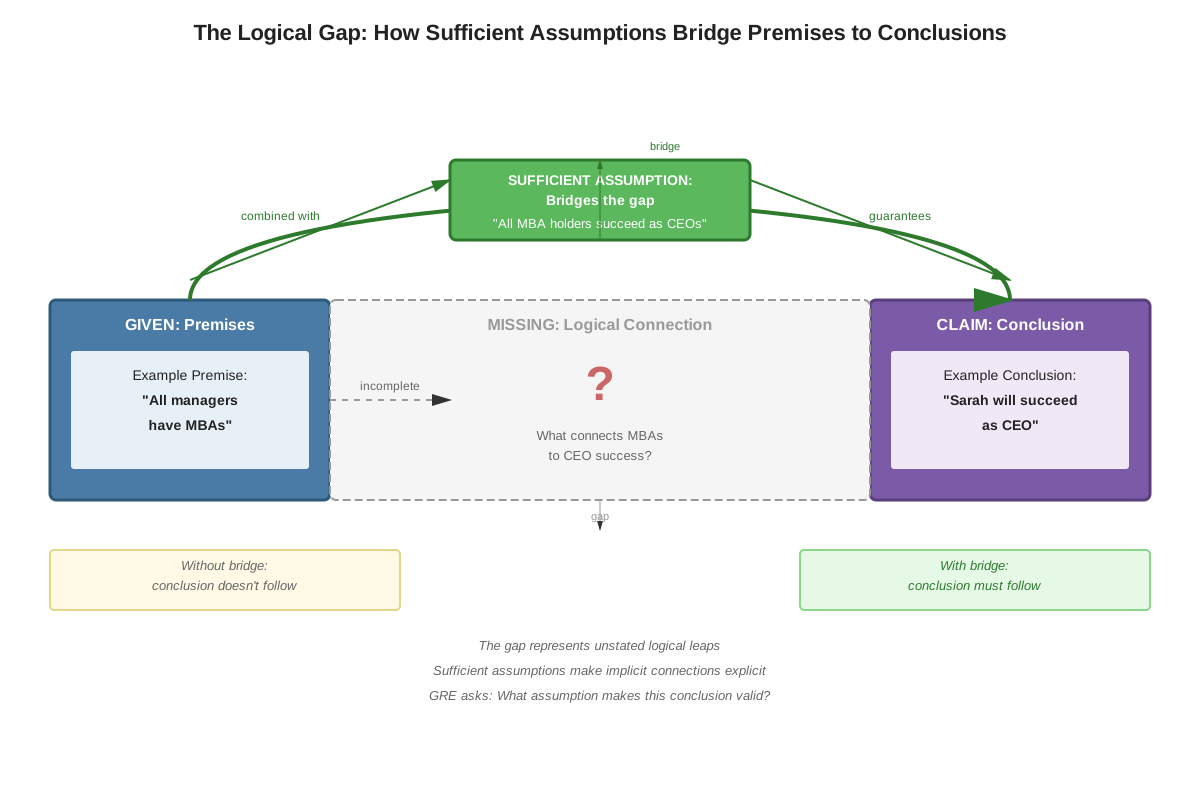
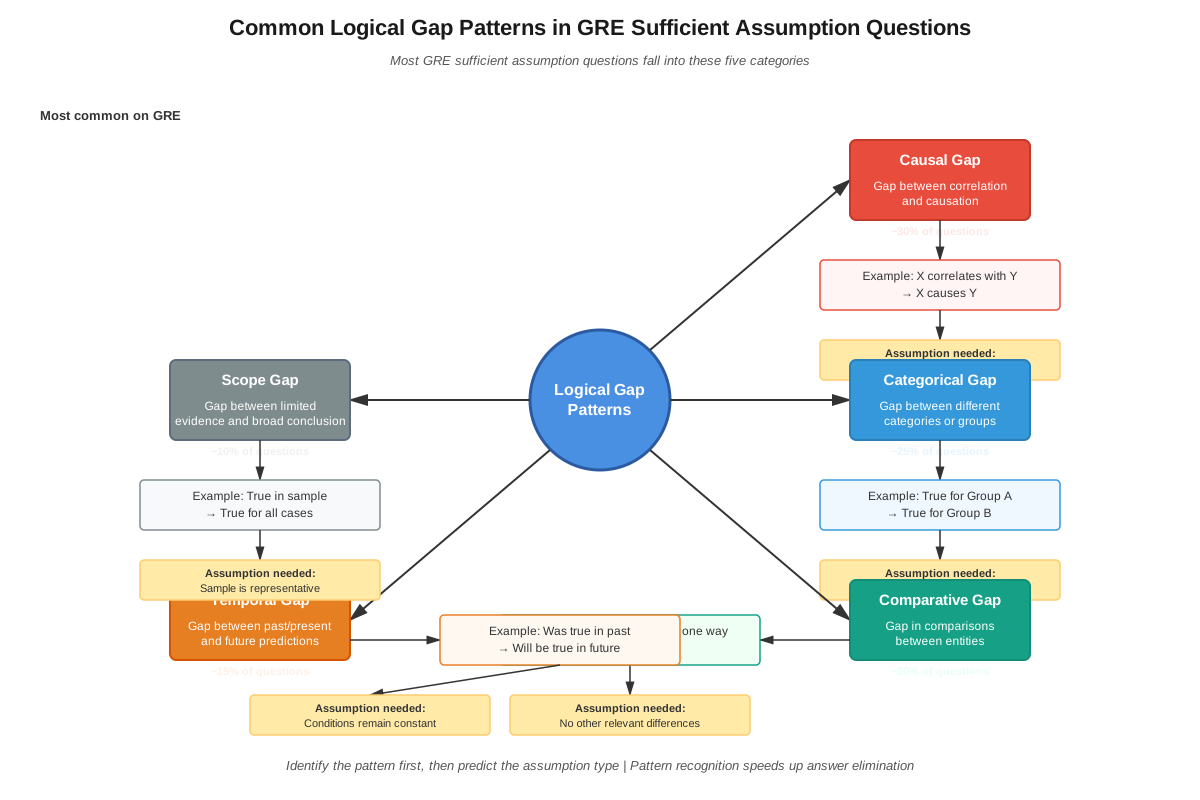
Every argument requiring a sufficient assumption contains a logical gap—a disconnect between what the premises establish and what the conclusion claims. Identifying this gap is the first step in finding the sufficient assumption. The gap typically involves:
- Scope shifts: The premises discuss one group/concept while the conclusion addresses another
- Temporal jumps: Evidence from the past used to conclude something about the future
- Causal leaps: Moving from correlation or sequence to causation
- Categorical extensions: Applying characteristics of some members to all members
The Guarantee Test
The most reliable method for evaluating sufficient assumptions is the guarantee test: Add the answer choice to the argument as a new premise, then ask whether the conclusion must now be true. If yes, you've found the sufficient assumption. If the conclusion merely becomes more likely or plausible but isn't guaranteed, the answer choice isn't sufficient.
This test distinguishes sufficient assumptions from strengtheners. A strengthener makes the conclusion more probable; a sufficient assumption makes it certain. For example:
- Premise: All students in the honors program scored above 90%.
- Conclusion: Maria scored above 90%.
- Strengthener: Maria is a strong student (makes conclusion more likely).
- Sufficient assumption: Maria is in the honors program (guarantees conclusion).
Common Logical Patterns
| Pattern Type | Premise Structure | Conclusion Structure | Required Assumption |
|---|---|---|---|
| Categorical Bridge | Some/Most X are Y | All X are Y | The remaining X are also Y |
| Scope Shift | Evidence about Group A | Claim about Group B | A and B are relevantly similar |
| Causal Claim | X correlates with Y | X causes Y | No alternative explanations exist |
| Conditional Chain | If A, then B | If A, then C | If B, then C (connecting link) |
| Representativeness | Sample has property P | Population has property P | Sample is representative |
The Sufficiency vs. Necessity Distinction
Understanding the difference between sufficient and necessary assumptions is crucial:
- Necessary assumptions are required for the argument to work at all. Without them, the argument falls apart. They're minimal requirements.
- Sufficient assumptions are enough to make the argument work perfectly. With them, the argument becomes airtight. They're complete solutions.
A necessary assumption might be "The sample wasn't contaminated," while a sufficient assumption might be "The sample was perfectly representative of the entire population in every relevant way." The first is required; the second guarantees the conclusion.
Formal Logic Structure
Sufficient assumptions often involve completing conditional chains. In formal logic terms:
- Given: If A → B (premise)
- Conclusion: If A → C
- Sufficient assumption needed: If B → C
This creates a complete chain: A → B → C, making the conclusion logically necessary. Recognizing these conditional structures helps identify what logical link is missing.
The Prephrase Strategy
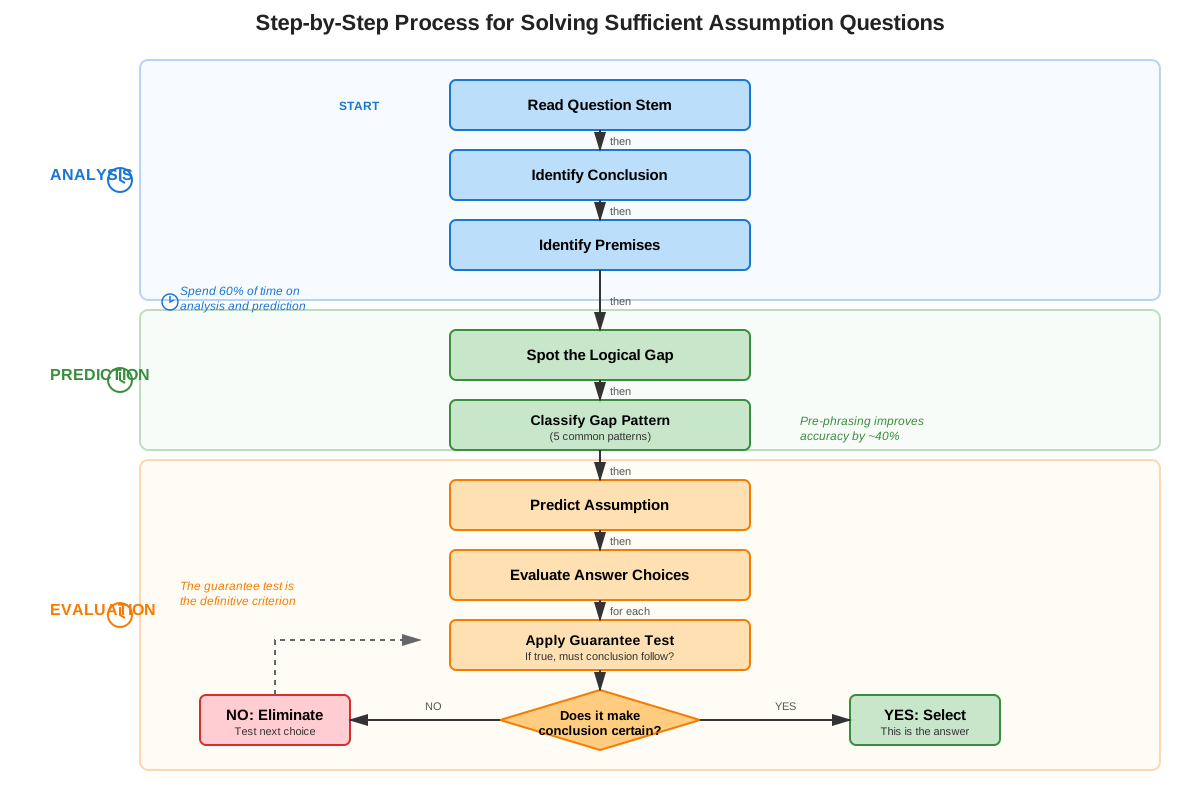
Before examining answer choices, effective test-takers prephrase—predict what the sufficient assumption should accomplish. This involves:
- Identifying the conclusion
- Identifying the premises
- Spotting the logical gap between them
- Articulating what statement would bridge that gap
- Looking for answer choices that match this prediction
Prephrasing prevents falling for attractive wrong answers that strengthen the argument without making it airtight.
Concept Relationships
The concepts within sufficient assumptions form an interconnected logical framework. The logical gap concept serves as the foundation—recognizing that a gap exists is prerequisite to filling it. This gap identification leads directly to applying the guarantee test, which determines whether a proposed assumption actually bridges the gap completely.
The sufficiency vs. necessity distinction operates as a quality control mechanism, helping distinguish sufficient assumptions from necessary assumptions and mere strengtheners. This distinction connects to the formal logic structure, which provides the mathematical framework for understanding why certain assumptions guarantee conclusions while others don't.
Common logical patterns represent practical applications of these theoretical concepts, showing how abstract principles manifest in actual GRE questions. The prephrase strategy integrates all other concepts, requiring gap identification, pattern recognition, and understanding of what would be sufficient.
Regarding prerequisite topics, sufficient assumptions build directly on argument structure identification—you cannot identify what's missing until you understand what's present. The connection to necessary assumptions is complementary: necessary assumptions represent the minimum required, while sufficient assumptions represent the complete solution. Both require understanding basic formal logic, particularly conditional reasoning.
Relationship map: Argument Structure → Logical Gap Identification → Pattern Recognition → Prephrase Development → Guarantee Test Application → Answer Selection
High-Yield Facts
⭐ A sufficient assumption, when added to the argument, guarantees the conclusion must be true—not just probably true or more likely true.
⭐ The most common logical gap involves scope shifts where premises discuss one group and the conclusion addresses a different group.
⭐ The guarantee test is the definitive method: add the answer choice as a premise and check if the conclusion must now follow.
⭐ Sufficient assumptions are typically stronger and more absolute than necessary assumptions—they often contain words like "all," "only," "every," or "always."
⭐ Wrong answers in sufficient assumption questions often strengthen the argument without making it airtight—they're tempting but insufficient.
- Sufficient assumption questions frequently use stems containing "if assumed," "allows the conclusion to be properly drawn," or "enables the conclusion to be properly inferred."
- The correct sufficient assumption directly addresses the specific gap between premises and conclusion—it doesn't introduce irrelevant new information.
- Causal arguments typically require sufficient assumptions that eliminate alternative explanations or establish that correlation indicates causation.
- Conditional logic chains require sufficient assumptions that connect the final term in the premise to the final term in the conclusion.
- Sufficient assumptions for comparative arguments must establish that the compared items are relevantly similar in ways that matter to the conclusion.
Quick check — test yourself on Sufficient assumptions so far.
Try Flashcards →Common Misconceptions
Misconception: Any statement that supports the argument is a sufficient assumption. → Correction: A sufficient assumption must guarantee the conclusion, not merely support it. Many statements strengthen arguments without making them logically airtight. The sufficient assumption creates certainty, not just increased probability.
Misconception: The sufficient assumption should be the most realistic or plausible statement. → Correction: The GRE tests logical sufficiency, not real-world plausibility. The correct answer might seem extreme or unlikely in reality, but if it logically guarantees the conclusion, it's correct. Don't reject answers because they seem too strong.
Misconception: Sufficient and necessary assumptions are interchangeable terms. → Correction: These are fundamentally different. A necessary assumption is required (without it, the argument fails), while a sufficient assumption is enough (with it, the argument succeeds completely). An assumption can be sufficient without being necessary, and vice versa.
Misconception: The sufficient assumption should introduce new evidence or facts. → Correction: Sufficient assumptions bridge logical gaps between existing premises and conclusions. They connect what's already stated rather than adding new factual claims. They're about logical relationships, not new information.
Misconception: If an answer choice makes the conclusion more likely, it's the sufficient assumption. → Correction: "More likely" indicates a strengthener, not a sufficient assumption. The sufficient assumption makes the conclusion certain and necessary, not just more probable. This is the most common trap in sufficient assumption questions.
Misconception: The longest or most complex answer choice is usually correct. → Correction: Sufficient assumptions can be stated simply or complexly. Length doesn't indicate correctness. Focus on whether the statement logically guarantees the conclusion, regardless of how many words it uses.
Worked Examples
Example 1: Causal Argument
Argument: "A recent study found that employees who work from home three days per week report 30% higher job satisfaction than those who work in the office full-time. Therefore, allowing employees to work from home three days per week will increase their job satisfaction."
Question: Which of the following, if assumed, allows the conclusion to be properly drawn?
Step 1 - Identify the conclusion: "Allowing employees to work from home three days per week will increase their job satisfaction."
Step 2 - Identify the premises: Employees currently working from home three days per week report higher satisfaction.
Step 3 - Identify the logical gap: The premise describes people who already work from home (possibly by choice or circumstance), while the conclusion is about what will happen if we allow employees generally to work from home. The gap involves whether the observed correlation will hold when applied as a policy to all employees.
Step 4 - Prephrase the assumption: We need something guaranteeing that employees who are allowed to work from home will experience the same satisfaction increase as those currently doing so. This requires assuming no relevant differences exist between current remote workers and employees who would be newly allowed to work remotely.
Step 5 - Evaluate answer choices:
- (A) "Employees who currently work from home chose this arrangement because they already had high job satisfaction." → This actually weakens the argument by suggesting reverse causation. Not sufficient.
- (B) "The employees studied are representative of all employees in terms of factors affecting job satisfaction." → This guarantees that what's true for the studied group will be true for all employees, making the conclusion certain. This is sufficient.
- (C) "Job satisfaction is an important factor in employee retention." → Irrelevant to whether remote work causes satisfaction. Not sufficient.
- (D) "Most employees prefer working from home to working in the office." → This strengthens but doesn't guarantee the conclusion—preference doesn't ensure satisfaction increase. Not sufficient.
- (E) "Working from home reduces commute stress." → This provides a mechanism but doesn't guarantee the conclusion will hold for all employees. Not sufficient.
Answer: (B) - When we add this assumption, the conclusion must follow: if the studied employees are representative, then what's true for them (remote work correlates with higher satisfaction) will be true for all employees.
Example 2: Categorical Reasoning
Argument: "Every member of the debate team has scored above the 90th percentile on the verbal reasoning section of standardized tests. Jamal is an excellent public speaker with strong analytical skills. Therefore, Jamal has scored above the 90th percentile on the verbal reasoning section."
Question: The conclusion follows logically if which one of the following is assumed?
Step 1 - Identify the conclusion: "Jamal has scored above the 90th percentile on the verbal reasoning section."
Step 2 - Identify the premises: (1) All debate team members scored above 90th percentile; (2) Jamal is an excellent public speaker with strong analytical skills.
Step 3 - Identify the logical gap: The premises establish a rule about debate team members and describe Jamal's skills, but never connect Jamal to the debate team. The conclusion claims Jamal has the characteristic (high score) that all debate team members have, but we don't know if Jamal is on the debate team.
Step 4 - Prephrase the assumption: To guarantee the conclusion, we need to establish that Jamal is a member of the debate team. If Jamal is on the debate team, and all debate team members scored above the 90th percentile, then Jamal must have scored above the 90th percentile.
Step 5 - Evaluate answer choices:
- (A) "Jamal is a member of the debate team." → This creates a complete logical chain: All debate team members scored high → Jamal is a debate team member → Therefore, Jamal scored high. This is sufficient.
- (B) "Most excellent public speakers score above the 90th percentile." → "Most" doesn't guarantee Jamal does. Not sufficient.
- (C) "Strong analytical skills correlate with high verbal reasoning scores." → Correlation doesn't guarantee Jamal's score. Not sufficient.
- (D) "The debate team only accepts members with excellent public speaking skills." → This tells us about debate team requirements but doesn't establish that Jamal is on the team. Not sufficient.
- (E) "Jamal has applied to join the debate team." → Application doesn't mean membership. Not sufficient.
Answer: (A) - This assumption bridges the gap perfectly, creating a syllogism where the conclusion must follow from the premises.
Exam Strategy
When approaching sufficient assumption questions on the GRE, follow this systematic process:
Recognition triggers: Watch for question stems containing "if assumed, allows the conclusion to be properly drawn," "the conclusion follows logically if," "which one of the following, if assumed, enables the conclusion," or "the argument's conclusion is properly inferred if." These phrases signal sufficient assumption questions.
Four-step approach:
- Identify and isolate the conclusion - Underline or mentally note the exact claim being made
- Map the premises - Note what evidence is actually provided
- Spot the gap - Articulate what logical leap occurs between premises and conclusion
- Prephrase before looking - Predict what would bridge this gap completely
Process of elimination strategy:
Eliminate answer choices that:
- Introduce irrelevant new topics not connected to the premise-conclusion gap
- Use weak language ("some," "might," "could") when the gap requires certainty
- Strengthen the argument without guaranteeing the conclusion
- Address necessary conditions without being sufficient
- Reverse the required logical relationship
The guarantee test in practice: For remaining answer choices, mentally insert each into the argument as a new premise. Ask: "If this is true, must the conclusion be true?" If you can imagine any scenario where the assumption is true but the conclusion false, eliminate that choice.
Time allocation: Spend 60-90 seconds on sufficient assumption questions. They're worth the investment because they're high-value questions, but don't exceed two minutes. If stuck between two choices, apply the guarantee test to each systematically.
Common trap avoidance: The GRE frequently includes answer choices that are necessary assumptions or strengtheners. These are tempting because they support the argument. Remember: sufficient assumptions don't just support—they guarantee. When in doubt, ask whether the conclusion could still be false even if the answer choice is true.
Memory Techniques
SUFFICIENT acronym for the evaluation process:
- Spot the conclusion first
- Understand the premises completely
- Find the logical gap
- Formulate a prephrase
- Insert each answer as a premise
- Check if conclusion must follow
- Ignore strengtheners and necessities
- Eliminate anything less than guarantee
- Narrow to the choice that bridges completely
- Test with the guarantee test
Visual technique: Picture the argument as a bridge with the premises on one side and the conclusion on the other. The logical gap is the missing section of bridge. The sufficient assumption is the exact piece that completes the bridge, making it possible to walk directly from premises to conclusion with no leaps.
The "Must Be True" mantra: Before selecting an answer, say "If this is true, the conclusion MUST be true—not might be, not probably is, but MUST be." This reinforces the certainty standard.
Scope matching memory aid: "Sufficient assumptions match scopes"—if the premise discusses "some students" and the conclusion claims "all students," the sufficient assumption must bridge from "some" to "all."
Summary
Sufficient assumptions represent complete logical bridges that guarantee an argument's conclusion follows necessarily from its premises. Unlike necessary assumptions (which are required) or strengtheners (which increase probability), sufficient assumptions create certainty—when added to an argument, they make the conclusion inescapable. The key to mastering this question type lies in identifying the logical gap between premises and conclusion, then finding the answer choice that bridges this gap completely. The guarantee test—adding the assumption and checking whether the conclusion must follow—serves as the definitive evaluation method. Common patterns include scope shifts, causal leaps, categorical extensions, and conditional chains. Success requires distinguishing between statements that merely support arguments and those that make them airtight, avoiding the temptation of plausible strengtheners that fall short of logical sufficiency.
Key Takeaways
- Sufficient assumptions guarantee conclusions with certainty, not just probability—they create airtight logical connections
- The guarantee test is your most reliable tool: add the assumption and verify the conclusion must follow
- Identify the logical gap first by comparing what premises establish versus what the conclusion claims
- Prephrase your answer before examining choices to avoid attractive wrong answers
- Common gaps involve scope shifts (premises about one group, conclusion about another) and causal leaps (correlation to causation)
- Sufficient assumptions are typically stronger and more absolute than necessary assumptions—don't reject answers for being "too strong"
- Wrong answers often strengthen arguments without guaranteeing conclusions—this is the most common trap
Related Topics
Necessary Assumptions: Understanding what an argument requires (but may not be sufficient alone) complements sufficient assumption skills and helps distinguish between minimal requirements and complete solutions.
Strengthen/Weaken Questions: These build on sufficient assumption skills by asking what makes arguments more or less likely true, representing a spectrum where sufficient assumptions occupy the "strongest possible support" position.
Formal Logic and Conditional Reasoning: Mastering if-then statements, contrapositives, and logical chains enables more sophisticated analysis of sufficient assumptions, particularly in complex arguments.
Argument Evaluation: Identifying flaws and gaps in reasoning directly applies sufficient assumption skills, as recognizing what's missing helps determine what would fix the argument.
Inference Questions: These require determining what must be true based on given information, using similar logical reasoning to sufficient assumptions but in reverse—deriving conclusions rather than supplying missing premises.
Practice CTA
Now that you understand the mechanics and strategy behind sufficient assumptions, it's time to apply these concepts to actual GRE-style questions. The practice questions and flashcards will reinforce your ability to identify logical gaps, distinguish sufficient from necessary assumptions, and apply the guarantee test under timed conditions. Remember: sufficient assumption questions reward systematic thinking and careful analysis. Each practice question you complete strengthens your pattern recognition and builds the confidence needed to tackle these high-value questions efficiently on test day. Start practicing now to transform these concepts from theoretical knowledge into automatic skills.
Sign up free to keep reading
Create a free AnvayaPrep account to finish this GRE guide on Sufficient assumptions — plus flashcards and practice questions.