Overview
Evidence relevance is a critical reasoning skill tested extensively on the GRE Verbal Reasoning section. This concept requires test-takers to evaluate whether a piece of information actually supports, weakens, or relates to an argument's conclusion. On the GRE, gre evidence relevance questions assess your ability to distinguish between information that genuinely impacts an argument and information that merely seems related but doesn't actually affect the logical structure or validity of the reasoning presented.
Understanding evidence relevance is essential because the GRE frequently presents arguments with multiple pieces of information, only some of which are truly pertinent to the conclusion. Test-takers must quickly identify which evidence matters and which serves as a distractor. This skill appears across multiple question types, including strengthen/weaken questions, assumption questions, and evaluation questions. Mastering evidence relevance directly improves performance on approximately 30-40% of all Critical Reasoning questions on the exam.
Within the broader Verbal Reasoning framework, evidence relevance connects intimately with argument structure analysis, assumption identification, and logical reasoning patterns. It serves as a foundational skill that enables more advanced critical reasoning tasks. When you can accurately assess whether evidence is relevant, you can better identify gaps in reasoning, evaluate the strength of conclusions, and predict what additional information would be necessary to complete an argument. This topic bridges the gap between simply understanding what an argument says and critically evaluating whether the reasoning actually works.
Learning Objectives
- [ ] Identify when Evidence relevance is being tested
- [ ] Explain the core rule or strategy behind Evidence relevance
- [ ] Apply Evidence relevance to GRE-style questions accurately
- [ ] Distinguish between relevant and irrelevant evidence in complex arguments
- [ ] Evaluate the degree of relevance for evidence that has partial connections to conclusions
- [ ] Recognize common patterns of irrelevant evidence used as distractors on the GRE
- [ ] Construct clear explanations for why specific evidence does or does not impact an argument
Prerequisites
- Basic argument structure: Understanding premises, conclusions, and how they connect is essential because evidence relevance requires identifying what the argument is actually trying to prove
- Logical reasoning fundamentals: Familiarity with cause-and-effect relationships and conditional logic helps determine whether evidence actually impacts the conclusion
- Reading comprehension skills: The ability to parse complex sentences and identify main ideas enables accurate assessment of what evidence addresses
- Scope recognition: Understanding the boundaries of an argument's claims is necessary to determine whether evidence falls within or outside those boundaries
Why This Topic Matters
Evidence relevance skills extend far beyond standardized testing into professional and academic contexts. In research, business analysis, legal reasoning, and scientific inquiry, the ability to distinguish relevant from irrelevant information determines the quality of decision-making. Professionals who can quickly identify which data points matter and which are distractions make more efficient and accurate judgments.
On the GRE specifically, evidence relevance appears in approximately 8-12 questions per Verbal Reasoning section. These questions manifest as strengthen/weaken questions (most common), assumption questions, evaluation questions, and occasionally as inference questions. The GRE tests this skill because graduate programs require students to evaluate research, assess arguments in academic literature, and construct well-supported positions in their own work.
Common manifestations in GRE passages include: arguments about causation where evidence addresses correlation instead; business scenarios where evidence about one product is presented when the conclusion concerns a different product; scientific arguments where evidence addresses a related but distinct phenomenon; and policy arguments where evidence addresses outcomes different from those in the conclusion. The test writers deliberately craft answer choices that seem topically related but don't actually impact the logical connection between premises and conclusion.
Core Concepts
Defining Evidence Relevance
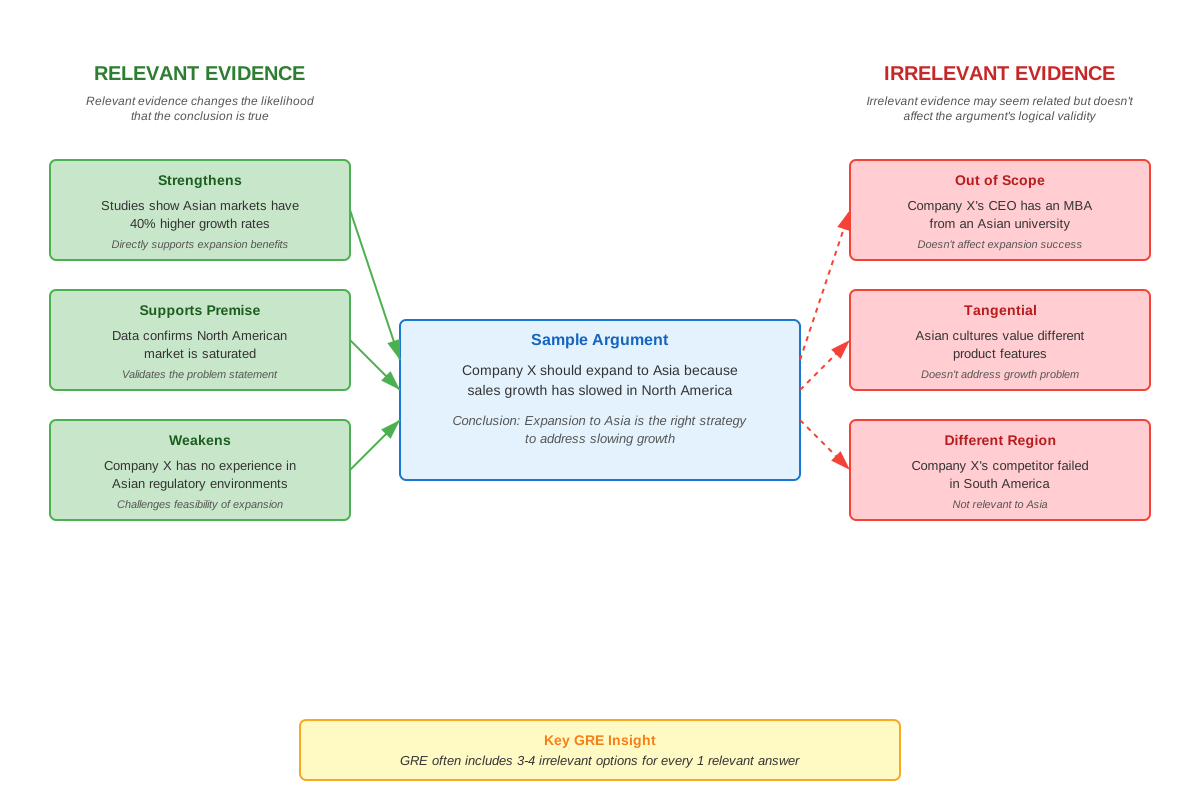
Evidence relevance refers to the degree to which a piece of information actually affects the logical relationship between an argument's premises and its conclusion. Relevant evidence either strengthens the argument (making the conclusion more likely to be true), weakens it (making the conclusion less likely to be true), or is necessary for the argument to work (fills a logical gap). Irrelevant evidence, regardless of how interesting or topically related it might be, does not change the probability that the conclusion follows from the premises.
The key distinction lies in impact versus association. Evidence can be associated with the topic of an argument without being relevant to its logical structure. For example, if an argument concludes that "increasing teacher salaries will improve student test scores," evidence about teacher job satisfaction is only relevant if it connects to the causal chain between salaries and test scores. Information about teacher satisfaction might seem related to teaching quality, but unless it demonstrates a mechanism linking salary increases to improved instruction, it doesn't impact the argument's validity.
The Scope Principle
The scope principle states that relevant evidence must address the same subject, timeframe, population, and conditions as the conclusion. This is perhaps the most frequently tested aspect of evidence relevance on the GRE. Test writers create distractors by presenting evidence that shifts one or more of these dimensions.
Consider these scope shifts:
| Scope Dimension | Conclusion Focus | Irrelevant Evidence Shift |
|---|---|---|
| Subject | Product X sales | Product Y sales |
| Timeframe | Future predictions | Past data from different era |
| Population | Adults aged 25-40 | Teenagers |
| Conditions | Urban environments | Rural environments |
| Measurement | Total revenue | Profit margins |
When evaluating evidence relevance, always ask: "Does this evidence address exactly what the conclusion claims, or has something shifted?" Even subtle scope changes render evidence irrelevant.
The Mechanism Test
For causal arguments, relevant evidence must address the proposed causal mechanism or an alternative mechanism. The mechanism test asks: "Does this evidence make the proposed cause-and-effect relationship more or less likely to be true?"
Evidence passes the mechanism test when it:
- Demonstrates the cause can produce the effect
- Shows the cause was present when the effect occurred
- Rules out alternative causes
- Establishes a correlation between cause and effect across multiple instances
- Explains the process by which the cause produces the effect
Evidence fails the mechanism test when it:
- Addresses a different cause or effect
- Discusses correlation without addressing causation when causation is claimed
- Provides information about related but distinct phenomena
- Describes outcomes that would occur regardless of whether the cause is present
Necessary versus Sufficient Conditions
Understanding the difference between necessary and sufficient conditions is crucial for evaluating evidence relevance in conditional arguments. Necessary conditions must be present for the conclusion to be true, while sufficient conditions guarantee the conclusion if present.
Relevant evidence for necessary conditions shows whether the condition is actually present or absent. Relevant evidence for sufficient conditions demonstrates whether the condition alone can produce the outcome or whether additional factors are required. Irrelevant evidence often confuses these categories—for instance, showing that a necessary condition is present doesn't strengthen an argument if the argument requires proving sufficiency.
Degree of Relevance
Not all relevant evidence has equal impact. The GRE sometimes tests whether students can recognize that evidence is relevant but weak versus relevant and strong. Degree of relevance depends on:
- Directness: Does the evidence directly address the conclusion or require multiple inferential steps?
- Completeness: Does the evidence address all aspects of the conclusion or only part?
- Representativeness: Does the evidence come from a sample that matches the conclusion's scope?
- Recency: For predictive arguments, is the evidence current enough to be applicable?
Strong relevant evidence directly addresses the conclusion's main claim with complete, representative, and current information. Weak relevant evidence might address only a peripheral aspect of the conclusion or require significant assumptions to connect to the main claim.
Common Irrelevance Patterns
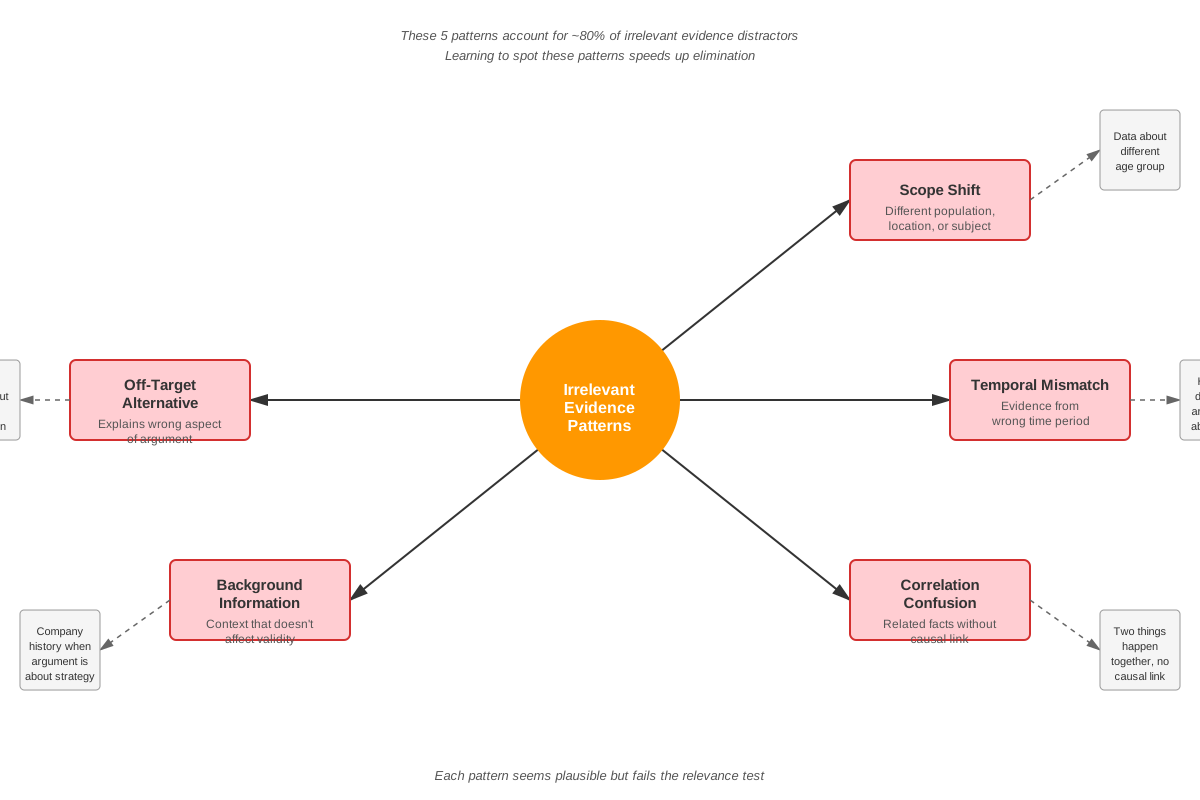
The GRE employs predictable patterns of irrelevant evidence:
- Topic association without logical connection: Evidence discusses the same general subject but doesn't impact the specific claim
- Reversed causation: Evidence shows B causes A when the argument claims A causes B
- Different comparison groups: Evidence compares X to Y when the conclusion compares X to Z
- Intermediate steps without endpoint: Evidence shows an early step in a causal chain but doesn't address whether the final outcome occurs
- Motivation versus outcome: Evidence addresses why people do something rather than what results from their actions
Concept Relationships
Evidence relevance serves as the foundation for multiple critical reasoning skills. The relationship flows as follows:
Argument Structure Recognition → Evidence Relevance Assessment → Assumption Identification → Argument Evaluation
Understanding argument structure enables you to identify what the conclusion claims, which is prerequisite to determining what evidence would be relevant. Once you can assess evidence relevance, you can identify assumptions (the unstated relevant evidence the argument requires). This then enables comprehensive argument evaluation.
Within evidence relevance itself, concepts connect hierarchically:
Scope Principle (most fundamental) → Mechanism Test (for causal arguments) → Degree of Relevance (for comparative evaluation)
The scope principle must be satisfied first—evidence outside the argument's scope cannot be relevant regardless of other factors. For evidence within scope, the mechanism test determines whether it actually impacts the logical connection. Finally, degree of relevance distinguishes between multiple pieces of relevant evidence.
Evidence relevance also connects to logical fallacies: many fallacies involve treating irrelevant evidence as relevant (red herrings, appeals to emotion, ad hominem attacks). Recognizing these fallacies requires first recognizing that the evidence presented doesn't actually impact the argument's validity.
High-Yield Facts
⭐ Evidence is relevant only if it affects the probability that the conclusion is true, not merely if it relates to the topic
⭐ Scope shifts in subject, timeframe, population, or conditions render evidence irrelevant even if topically related
⭐ For causal arguments, relevant evidence must address the proposed causal mechanism or rule out alternatives
⭐ Evidence about necessary conditions doesn't strengthen arguments that require proving sufficiency
⭐ The GRE frequently uses evidence about related but distinct phenomena as incorrect answer choices
- Evidence that would occur regardless of whether the conclusion is true or false is irrelevant
- Relevant evidence for strengthen questions makes the conclusion more likely; for weaken questions, less likely
- Evidence addressing motivations is irrelevant to arguments about outcomes unless motivation affects the outcome
- Analogies are only relevant if the compared situations share the characteristics essential to the argument
- Statistical evidence is irrelevant if the sample doesn't represent the population in the conclusion
- Historical evidence is irrelevant to predictive arguments if conditions have changed significantly
- Evidence about one member of a category is irrelevant to conclusions about a different member unless the argument establishes they're similar in relevant ways
- Intermediate effects are irrelevant unless the argument claims those specific effects occur
- Expert opinion is only relevant if the expert has expertise in the specific domain of the conclusion
Quick check — test yourself on Evidence relevance so far.
Try Flashcards →Common Misconceptions
Misconception: If evidence relates to the topic of the argument, it must be relevant to the conclusion.
Correction: Topical association doesn't guarantee logical relevance. Evidence must specifically impact whether the conclusion follows from the premises, not just discuss related subjects. The GRE exploits this misconception by creating answer choices that sound related but don't affect the argument's validity.
Misconception: Evidence that supports one premise automatically strengthens the entire argument.
Correction: An argument can have true premises but still reach an invalid conclusion. Relevant evidence must address the gap between premises and conclusion, not just confirm that premises are true. Supporting a premise only strengthens the argument if that premise was previously in doubt and is essential to the conclusion.
Misconception: More information is always better, so any additional evidence is relevant.
Correction: Additional information is only valuable if it impacts the argument's logical structure. Irrelevant information, no matter how abundant, doesn't strengthen or weaken an argument. The GRE tests whether you can resist the appeal of detailed but irrelevant evidence.
Misconception: If evidence weakens an argument, then evidence showing the opposite must strengthen it.
Correction: This is only true if the evidence addresses the same logical gap. Evidence can be irrelevant in both its positive and negative forms if it doesn't connect to the argument's reasoning. For example, if an argument's flaw is a scope problem, evidence within the wrong scope doesn't help even if it seems positive.
Misconception: Evidence is either completely relevant or completely irrelevant with no middle ground.
Correction: Evidence exists on a spectrum of relevance. Some evidence is highly relevant and directly impacts the conclusion, while other evidence is tangentially relevant, addressing only peripheral aspects of the argument. The GRE sometimes asks you to identify the most relevant evidence among multiple relevant options.
Misconception: Statistical evidence is always more relevant than anecdotal evidence.
Correction: Relevance depends on whether the evidence addresses the argument's scope and mechanism, not on the type of evidence. Statistics about the wrong population are less relevant than a case study of the right population. However, when both address the correct scope, statistical evidence generally provides stronger support.
Misconception: If an argument makes a causal claim, any evidence showing correlation is relevant.
Correction: Correlation evidence is only relevant if it addresses the specific cause and effect claimed in the argument and if the argument hasn't already established correlation. Many GRE arguments already assume correlation and argue for causation, making additional correlation evidence irrelevant.
Worked Examples
Example 1: Business Argument
Argument: "TechCorp should expand its customer service department because companies in the technology sector that invest heavily in customer service experience higher customer retention rates than those that don't."
Question: Which of the following, if true, most strengthens the argument?
Answer Choices:
A) TechCorp's competitors have recently expanded their customer service departments
B) Customer retention is strongly correlated with long-term profitability in the technology sector
C) TechCorp's current customer retention rate is below the industry average
D) Expanding customer service departments typically requires significant upfront investment
E) TechCorp's customers have expressed high satisfaction with current service levels
Analysis:
First, identify the conclusion: TechCorp should expand its customer service department.
Next, identify the premise: Companies in the tech sector with heavy customer service investment have higher retention rates.
Now, identify the logical gap: The argument assumes that (1) higher retention rates are desirable for TechCorp, (2) TechCorp would achieve similar results, and (3) the benefits outweigh the costs.
Evaluate each answer choice for relevance:
Choice A: This addresses what competitors are doing, but the argument's logic doesn't depend on competitive positioning—it depends on whether expansion would improve TechCorp's retention. This is topically related but logically irrelevant. Irrelevant.
Choice B: This is highly relevant because it addresses whether the outcome mentioned in the premise (higher retention) actually matters for the conclusion (should expand). If retention doesn't connect to desirable outcomes, the premise doesn't support the conclusion. This fills a logical gap. Relevant and strengthening.
Choice C: This suggests TechCorp has room for improvement, which makes expansion more potentially beneficial. However, the argument's logic works regardless of current retention rates—the premise claims expansion improves retention for any company. This is weakly relevant but doesn't address the main logical gap. Weakly relevant.
Choice D: This addresses costs, which is relevant to a "should" recommendation. However, it weakens rather than strengthens by suggesting a downside. Relevant but wrong direction.
Choice E: This actually weakens the argument by suggesting expansion might not be necessary. Relevant but wrong direction.
Correct Answer: B
Key Lesson: The most relevant evidence addresses the logical gap between premises and conclusion. Choice B is relevant because it establishes that the outcome in the premise (retention) connects to what matters for the conclusion (whether TechCorp should take this action).
Example 2: Scientific Argument
Argument: "The recent decline in bee populations is primarily caused by increased use of neonicotinoid pesticides. Studies show that bee populations have declined by 30% in regions where neonicotinoid use has increased, while populations in regions without these pesticides have remained stable."
Question: Which of the following, if true, most seriously weakens the argument?
Answer Choices:
A) Neonicotinoid pesticides are also harmful to other insect species
B) Regions with increased neonicotinoid use also experienced significant habitat loss during the same period
C) Some bee species are more sensitive to neonicotinoids than others
D) Neonicotinoid pesticides were introduced to improve crop yields
E) Bee populations naturally fluctuate by up to 15% annually
Analysis:
Conclusion: Neonicotinoid pesticides primarily cause bee decline.
Premise: Correlation between pesticide use and bee decline; no decline where pesticides absent.
The argument makes a causal claim based on correlation. Relevant weakening evidence would either (1) suggest an alternative cause, (2) break the causal mechanism, or (3) show the correlation doesn't hold more broadly.
Choice A: This addresses effects on other species, but the argument is specifically about bees. The conclusion doesn't depend on whether other species are affected. This is a scope shift. Irrelevant.
Choice B: This is highly relevant because it presents an alternative cause (habitat loss) that occurred in the same regions and timeframe. This directly challenges the "primarily caused by" claim by suggesting another factor could be responsible. Relevant and weakening.
Choice C: This addresses variation within bee species, but the argument is about overall bee populations. Whether some species are more sensitive doesn't affect whether neonicotinoids are the primary cause of overall decline. Weakly relevant at best.
Choice D: This addresses why pesticides were introduced, which is about motivation, not about whether they cause bee decline. This is irrelevant to the causal claim. Irrelevant.
Choice E: This provides context about natural variation, but 15% natural fluctuation doesn't explain a 30% decline. This doesn't meaningfully impact the argument. Weakly relevant.
Correct Answer: B
Key Lesson: For causal arguments, the most relevant weakening evidence presents alternative causes or breaks the causal mechanism. Choice B is relevant because it directly challenges the "primarily caused by" claim with an alternative explanation that fits the same pattern of evidence.
Exam Strategy
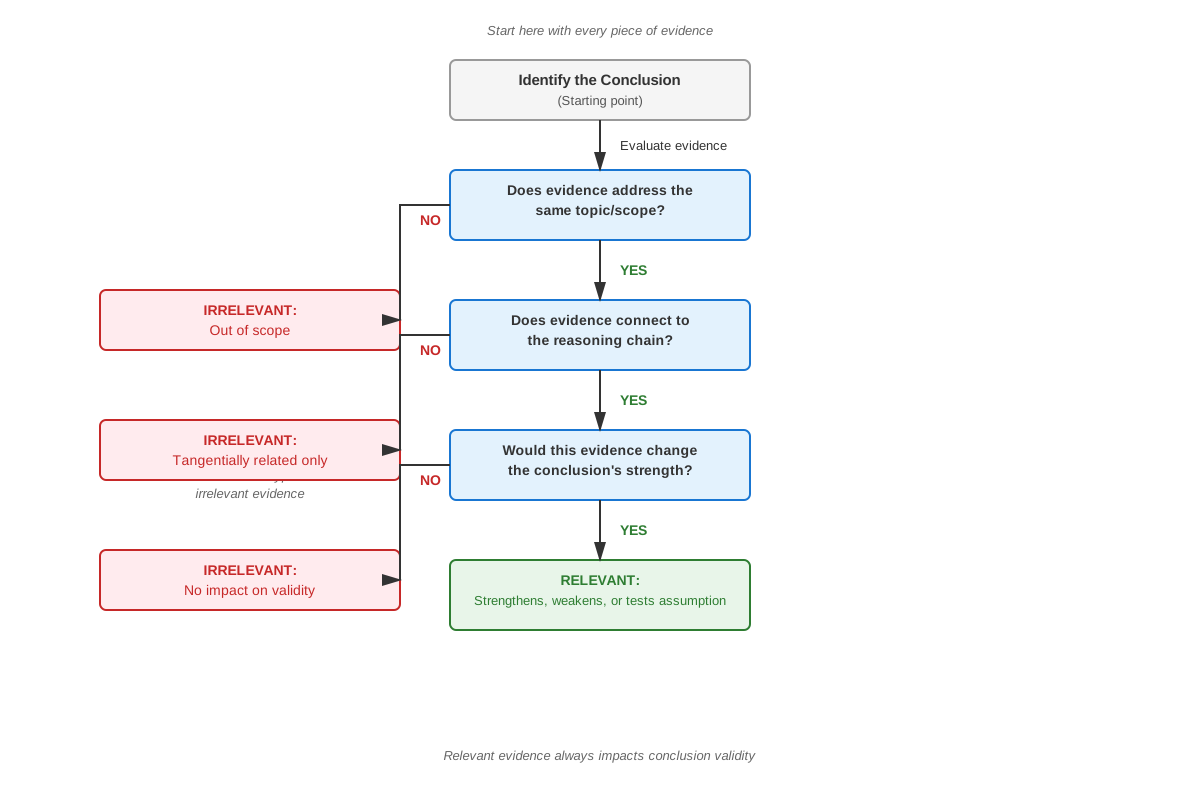
When approaching GRE questions testing evidence relevance, follow this systematic process:
Step 1: Identify the conclusion precisely (5-10 seconds). Underline or mentally note the exact claim being made. Pay attention to scope words like "all," "some," "primarily," "will," "should," etc.
Step 2: Identify the reasoning structure (5-10 seconds). Is this a causal argument? A prediction? A recommendation? A comparison? Different argument types require different types of relevant evidence.
Step 3: Identify the logical gap (10-15 seconds). What assumption connects the premises to the conclusion? What's missing? Relevant evidence will address this gap.
Step 4: Predict what would be relevant (5-10 seconds). Before looking at answer choices, briefly think: "What information would make this conclusion more or less likely to be true?"
Step 5: Evaluate each answer choice (30-40 seconds total). For each choice, ask: "Does this affect whether the conclusion follows from the premises?" Eliminate choices that shift scope, address different subjects, or discuss related but distinct issues.
Exam Tip: If an answer choice makes you think "that's interesting" rather than "that affects the argument," it's probably irrelevant. The GRE includes fascinating but irrelevant information as distractors.
Trigger words indicating evidence relevance questions:
- "Which of the following, if true, most strengthens/weakens..."
- "Which of the following is most relevant to evaluating..."
- "The argument depends on which of the following assumptions..."
- "Which of the following, if true, most helps to explain..."
- "Additional evidence is needed to evaluate..."
Process-of-elimination tips:
- Eliminate answer choices that shift the subject, population, timeframe, or conditions
- Eliminate choices that address outcomes or effects not mentioned in the conclusion
- Eliminate choices that would be true regardless of whether the conclusion is true
- For strengthen/weaken questions, eliminate choices that go in the wrong direction
- Between two relevant choices, select the one that more directly addresses the logical gap
Time allocation: Spend 60-90 seconds per evidence relevance question. If you're spending more than 90 seconds, make your best guess and move on. These questions reward quick, systematic analysis rather than prolonged deliberation.
Memory Techniques
SCOPE Acronym for checking evidence relevance:
- Subject: Same topic as conclusion?
- Conditions: Same circumstances?
- Outcome: Addresses the claimed result?
- Population: Same group of people/things?
- Era: Same timeframe?
The "So What?" Test: After reading a piece of evidence, ask "So what? How does this make the conclusion more or less likely?" If you can't answer clearly, the evidence is probably irrelevant.
The Substitution Technique: Mentally substitute the opposite of the evidence. If the argument works equally well with the opposite, the original evidence was irrelevant. For example, if evidence says "The program costs $1 million" and the argument works the same if it cost $2 million, then the specific cost is irrelevant to that argument.
Visualization Strategy: Picture the argument as a bridge from premises to conclusion. Relevant evidence either strengthens the bridge, weakens it, or fills a gap in its construction. Irrelevant evidence is material lying beside the bridge that isn't part of the structure.
The Mechanism Chain: For causal arguments, visualize: Cause → [Mechanism] → Effect. Relevant evidence addresses the cause, the mechanism, or the effect as stated. Evidence about different causes, mechanisms, or effects is irrelevant.
Summary
Evidence relevance is the critical skill of determining whether information actually impacts an argument's logical validity or merely relates to its topic. On the GRE, this concept appears across multiple question types and requires distinguishing between topical association and logical connection. The core principle is that relevant evidence must affect the probability that the conclusion follows from the premises, which requires addressing the argument's scope, mechanism, and logical gaps. The GRE systematically tests this skill by presenting answer choices that seem related but shift the subject, population, timeframe, or conditions, or that address different points in a causal chain than the conclusion claims. Mastering evidence relevance requires understanding the scope principle, applying the mechanism test for causal arguments, recognizing common irrelevance patterns, and systematically evaluating whether each piece of information strengthens, weakens, or is necessary for the argument's reasoning. Success on these questions comes from disciplined analysis that focuses on logical impact rather than topical interest.
Key Takeaways
- Evidence is relevant only if it affects whether the conclusion logically follows from the premises, not merely if it discusses related topics
- Always check for scope shifts in subject, population, timeframe, or conditions—these are the most common ways the GRE creates irrelevant distractors
- For causal arguments, relevant evidence must address the proposed mechanism or present alternative causes
- Apply the "So What?" test: if you can't explain how evidence impacts the conclusion, it's likely irrelevant
- Distinguish between evidence that supports premises and evidence that connects premises to conclusions—only the latter is always relevant
- Use systematic evaluation (SCOPE acronym) rather than intuition to assess relevance
- The most relevant evidence directly addresses the logical gap between premises and conclusion
Related Topics
Assumption Identification: Once you master evidence relevance, you can identify assumptions by recognizing what relevant evidence is missing from an argument. Assumptions are the unstated relevant evidence that arguments require.
Argument Structure Analysis: Understanding how premises, conclusions, and intermediate claims connect provides the foundation for assessing what evidence would be relevant to each component.
Strengthen and Weaken Questions: These question types directly test evidence relevance by asking you to identify information that makes conclusions more or less likely to be true.
Logical Fallacies: Many fallacies involve treating irrelevant evidence as relevant (red herrings) or failing to provide relevant evidence (hasty generalizations). Recognizing these patterns deepens your understanding of evidence relevance.
Evaluation Questions: These questions ask what additional information would be most useful for assessing an argument—essentially asking what relevant evidence is missing.
Practice CTA
Now that you understand the principles of evidence relevance, it's time to apply these concepts to actual GRE-style questions. The practice questions and flashcards will help you internalize the systematic approach to evaluating whether evidence truly impacts an argument. Remember, this skill improves dramatically with deliberate practice—each question you analyze strengthens your ability to quickly distinguish relevant from irrelevant information. Approach the practice materials with the strategies and techniques from this guide, and you'll see measurable improvement in your critical reasoning performance. You've built the foundation; now build the skill through application!
Sign up free to keep reading
Create a free AnvayaPrep account to finish this GRE guide on Evidence relevance — plus flashcards and practice questions.