Overview
Avoiding unsupported claims is a fundamental skill in GRE Analytical Writing that distinguishes high-scoring essays from mediocre ones. An unsupported claim is an assertion, conclusion, or statement presented as fact without adequate evidence, reasoning, or logical justification. In the context of the GRE's "Analyze an Issue" task, test-takers must develop well-reasoned arguments where every major point is substantiated with relevant examples, logical reasoning, or credible evidence. The ability to recognize and eliminate unsupported claims from one's own writing—while simultaneously identifying them in prompts—is essential for achieving scores in the 5.0-6.0 range.
The GRE Analytical Writing section evaluates critical thinking and persuasive writing abilities that extend far beyond test day. Graders specifically assess whether arguments are "cogently developed" and "well supported," making this topic one of the highest-yield areas for score improvement. Many test-takers lose points not because their ideas lack merit, but because they fail to provide sufficient justification for their positions. A brilliant thesis statement means nothing if the supporting paragraphs consist of bare assertions without elaboration.
This topic connects intimately with other Analytical Writing concepts including logical reasoning, evidence selection, and argument development. While related skills like identifying logical fallacies focus on flaws in reasoning structure, GRE avoiding unsupported claims emphasizes the completeness and adequacy of justification. Together, these skills form the foundation of persuasive academic writing that the GRE seeks to measure.
Learning Objectives
- [ ] Identify when avoiding unsupported claims is being tested in GRE prompts and scoring criteria
- [ ] Explain the core rule or strategy behind avoiding unsupported claims in analytical writing
- [ ] Apply avoiding unsupported claims to GRE-style questions accurately
- [ ] Distinguish between adequately supported and inadequately supported assertions in sample essays
- [ ] Generate appropriate types of support (examples, reasoning, evidence) for various claim types
- [ ] Evaluate the strength and relevance of supporting evidence in timed writing conditions
- [ ] Revise draft paragraphs to eliminate unsupported claims within time constraints
Prerequisites
- Basic essay structure: Understanding of thesis statements, topic sentences, and paragraph organization is necessary because unsupported claims typically occur when structural elements lack development
- Fundamental logic: Familiarity with basic cause-and-effect relationships and reasoning patterns helps distinguish between claims and their justifications
- Academic writing conventions: Knowledge of formal writing standards ensures appropriate evidence types and citation approaches
- GRE Issue task format: Understanding the prompt structure and scoring rubric provides context for why claim support matters
Why This Topic Matters
In professional and academic contexts, unsupported claims undermine credibility and weaken arguments. Graduate programs require students to defend positions with evidence, analyze complex issues critically, and communicate persuasively—all skills that depend on proper claim substantiation. Whether writing research papers, policy recommendations, or analytical reports, the ability to support assertions with appropriate evidence is indispensable.
On the GRE specifically, avoiding unsupported claims appears in approximately 100% of Issue task scoring decisions. The official scoring rubric for scores 5-6 explicitly requires "cogent, well-developed" arguments with "relevant reasons and/or examples." Essays scoring 3-4 typically contain "limited development and support" or "inadequate reasons or examples." This topic directly impacts 2-3 points on the 0-6 scale, making it one of the highest-leverage areas for improvement.
Common manifestations in GRE essays include: sweeping generalizations without qualification ("Technology always improves education"), personal opinions stated as universal truths ("Everyone knows that competition drives innovation"), statistical claims without sources ("Most people prefer"), and causal assertions without explanation ("This policy will solve the problem"). Graders specifically look for these weaknesses, making recognition and correction essential skills.
Core Concepts
What Constitutes an Unsupported Claim
An unsupported claim is any assertion that requires justification but receives none or insufficient backing. Not all statements require support—definitions, widely accepted facts, and logical truisms stand on their own. However, any statement that could reasonably be questioned, challenged, or doubted needs substantiation. The key question is: "Would a skeptical but reasonable reader accept this statement without further explanation?"
Claims requiring support typically fall into several categories:
- Causal claims: Assertions about cause-and-effect relationships ("Social media causes depression")
- Evaluative claims: Judgments about quality, importance, or value ("This approach is better")
- Predictive claims: Statements about future outcomes ("This policy will reduce crime")
- Empirical claims: Assertions about facts or data ("Most students struggle with math")
- Interpretive claims: Explanations of meaning or significance ("This trend indicates societal decline")
Types of Adequate Support
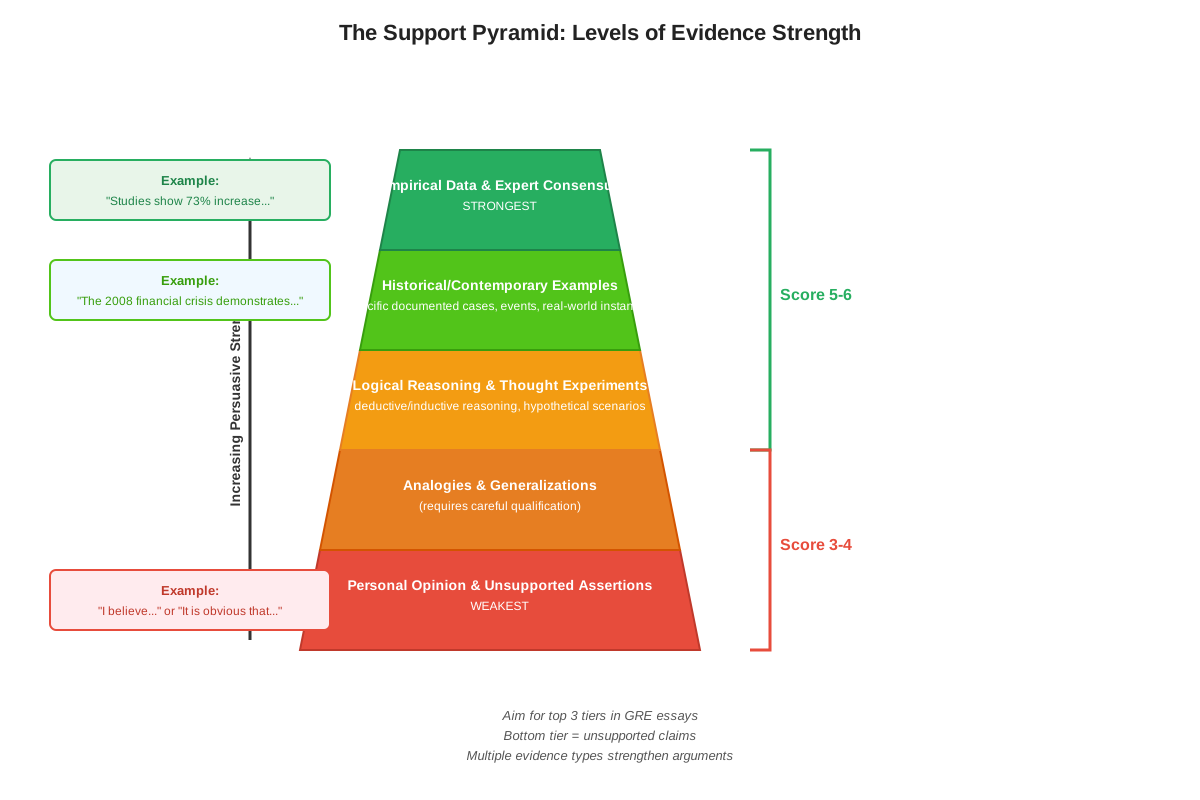
Effective claim support comes in multiple forms, and strong GRE essays typically employ several types:
| Support Type | Description | Example Application |
|---|---|---|
| Specific examples | Concrete instances that illustrate the claim | Historical events, personal experiences, case studies |
| Logical reasoning | Step-by-step explanation connecting claim to evidence | If-then chains, deductive arguments, analogies |
| Statistical evidence | Quantitative data supporting the assertion | Percentages, trends, comparative figures |
| Expert testimony | References to authoritative sources | Research findings, established theories |
| Hypothetical scenarios | Thought experiments demonstrating consequences | "Consider what would happen if..." |
| Counterexample analysis | Addressing opposing cases to strengthen position | "While some might point to X, this differs because..." |
The GRE does not require formal citations or specific data points. Instead, graders evaluate whether the support is relevant (directly relates to the claim), sufficient (adequate in quantity and depth), and logical (reasonably connects to the conclusion).
The Support-to-Claim Ratio
High-scoring GRE essays maintain an appropriate balance between claims and support. A useful guideline is the 3:1 support ratio: for every sentence making a claim, provide approximately three sentences of elaboration, examples, or reasoning. This doesn't mean mechanical counting, but rather ensuring that assertions never stand alone.
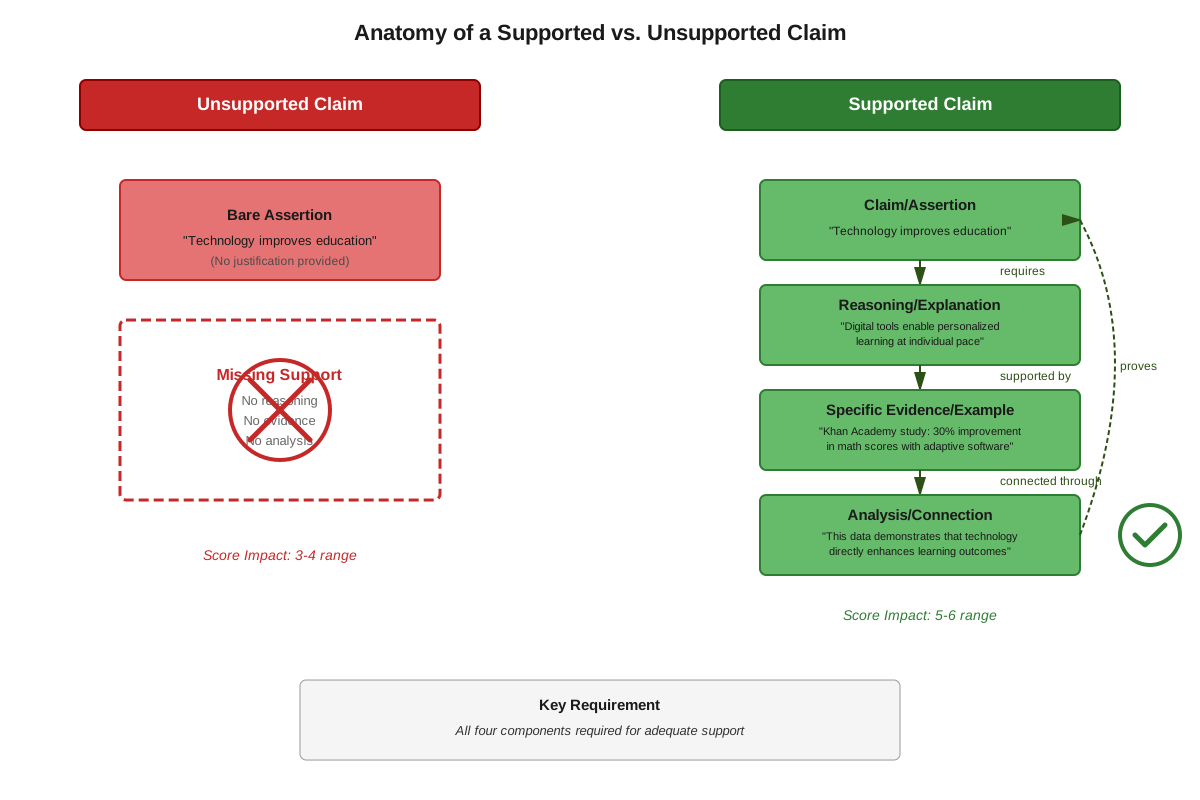
Consider this inadequate paragraph:
"Technology has revolutionized education. Students learn better with computers. Schools should invest more in technology."
Each sentence makes a claim, but none receives development. A properly supported version:
"Technology has revolutionized education by providing unprecedented access to information and personalized learning experiences. For instance, students in rural areas can now access the same educational resources as those in major cities through online platforms like Khan Academy and Coursera. Additionally, adaptive learning software adjusts difficulty levels based on individual performance, ensuring that each student progresses at an optimal pace. This personalization was impossible in traditional classroom settings where one teacher managed thirty diverse learners simultaneously."
Connecting Claims to Evidence
The most common error isn't missing evidence entirely—it's failing to explicitly connect evidence to claims. Test-takers often present an example and assume the relevance is obvious. Strong essays make connections explicit through transitional phrases and explanatory sentences.
Weak connection: "Competition drives innovation. Apple and Samsung constantly release new phones."
Strong connection: "Competition drives innovation by creating market pressure to differentiate products. This dynamic is evident in the smartphone industry, where Apple and Samsung's rivalry has accelerated technological advancement. Each company's new release forces the competitor to innovate or lose market share, resulting in rapid improvements in camera technology, processing power, and user interface design that might have taken decades without competitive pressure."
Qualifying Claims Appropriately
Another aspect of avoiding unsupported claims involves appropriate qualification—using language that matches the strength of available support. Absolute statements ("always," "never," "all," "none") require absolute proof, which is rarely available. Qualified language ("often," "typically," "many," "tends to") makes claims more defensible.
| Unqualified (Risky) | Qualified (Defensible) |
|---|---|
| Technology always improves education | Technology often improves educational outcomes when implemented thoughtfully |
| Competition never benefits consumers | Competition does not always benefit consumers, particularly in markets with high barriers to entry |
| All students learn better with hands-on activities | Many students, particularly kinesthetic learners, benefit from hands-on activities |
Anticipating Counterarguments
Sophisticated claim support includes acknowledgment of limitations and counterexamples. This demonstrates critical thinking and actually strengthens arguments by showing the writer has considered alternative perspectives. The pattern typically follows: Claim → Support → Counterargument → Rebuttal.
"While technology generally enhances educational access [claim], as demonstrated by online learning platforms reaching underserved populations [support], critics correctly note that digital divides can exacerbate inequality when students lack reliable internet access [counterargument]. However, this concern argues for expanding infrastructure rather than abandoning technological integration, as the long-term benefits of digital literacy outweigh the short-term implementation challenges [rebuttal]."
Concept Relationships
The skill of avoiding unsupported claims serves as the foundation for multiple interconnected writing competencies. At its core, this skill requires critical thinking → which enables argument development → which manifests through evidence selection → which requires logical reasoning → which circles back to strengthen claim support.
This topic directly builds upon prerequisite knowledge of essay structure: thesis statements make claims that body paragraphs must support, while topic sentences make claims that subsequent sentences must justify. Without understanding this hierarchical relationship, writers cannot identify which statements require support.
The concept connects forward to more advanced skills like analyzing arguments (identifying unsupported claims in others' reasoning) and addressing counterarguments (supporting claims against objections). It also relates laterally to logical fallacy recognition—while fallacies involve flawed reasoning structures, unsupported claims involve absent or inadequate reasoning.
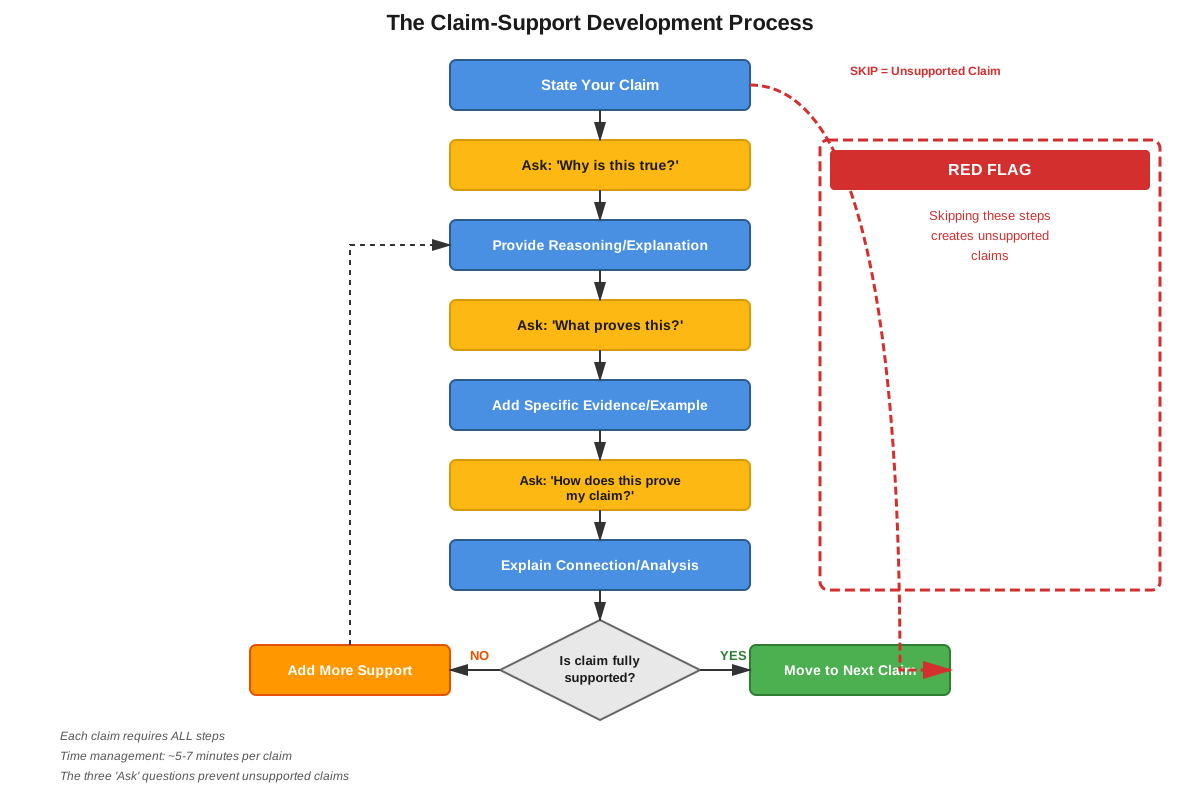
The relationship can be mapped as: Claim Identification → Support Type Selection → Evidence Development → Connection Articulation → Qualification and Refinement → Counterargument Integration. Each step depends on the previous one, and weakness at any stage results in unsupported claims appearing in the final essay.
High-Yield Facts
⭐ The GRE scoring rubric explicitly penalizes "limited development and support" in essays scoring 4 or below
⭐ Every major claim in a GRE essay should be followed by at least one specific example or detailed explanation
⭐ Absolute language ("always," "never," "all") creates unsupported claims unless absolute proof is provided
⭐ Personal opinion phrases ("I believe," "I think") do not constitute support for claims
⭐ The most common location for unsupported claims is the first sentence after a topic sentence
- Hypothetical examples are acceptable support on the GRE when developed with sufficient detail and logical connection
- Graders spend approximately 2-3 minutes per essay, making obvious unsupported claims highly visible
- Statistical claims without specific numbers are generally acceptable if qualified appropriately ("many," "most")
- Supporting one claim thoroughly is better than partially supporting multiple claims
- The conclusion paragraph should not introduce new unsupported claims requiring development
- Transitional phrases like "for example" and "specifically" signal incoming support and improve clarity
- Counterargument acknowledgment counts as sophisticated support when properly integrated
Quick check — test yourself on Avoiding unsupported claims so far.
Try Flashcards →Common Misconceptions
Misconception: Length equals support—longer essays automatically have better claim support.
Correction: Length without substance creates verbose unsupported claims. A 400-word essay with thorough support outscores a 600-word essay filled with unsupported assertions. Quality of development matters more than quantity of words.
Misconception: Personal experience cannot serve as valid support for claims.
Correction: Personal examples are acceptable and often effective on the GRE when specific, relevant, and logically connected to claims. The key is developing the example sufficiently rather than merely mentioning it.
Misconception: Every single sentence requires explicit support.
Correction: Only claims requiring justification need support. Transitional sentences, restatements, and logical inferences from already-supported claims can stand without additional evidence. The skill involves distinguishing which statements need support.
Misconception: Stating something confidently makes it supported.
Correction: Confidence in tone or absolute language does not constitute support. "It is undeniable that technology improves education" is still an unsupported claim despite the confident phrasing. Support comes from evidence and reasoning, not rhetorical emphasis.
Misconception: Common knowledge never requires support.
Correction: What constitutes "common knowledge" varies by audience and context. On the GRE, if a claim is central to your argument, provide at least brief support even if it seems obvious. This demonstrates thorough reasoning and prevents graders from questioning assumptions.
Misconception: Citing specific studies or statistics is required for strong support.
Correction: The GRE does not require or expect formal citations, specific data points, or memorized statistics. Logical reasoning, detailed hypothetical scenarios, and well-developed examples provide adequate support without numerical precision.
Worked Examples
Example 1: Revising an Unsupported Paragraph
Original paragraph (contains multiple unsupported claims):
"Schools should eliminate standardized testing because it harms students. These tests create stress and don't measure real learning. Teachers spend too much time preparing students for tests instead of teaching important skills. Countries without standardized testing have better education systems. Therefore, removing these tests would improve education quality."
Analysis of problems:
- "Harms students" - unsupported claim requiring explanation of harm
- "Don't measure real learning" - unsupported claim needing definition and justification
- "Too much time" - vague, unsupported quantitative claim
- "Countries without standardized testing have better education systems" - empirical claim without examples or explanation
- "Would improve education quality" - predictive claim without logical connection
Revised paragraph (with adequate support):
"Schools should reconsider their reliance on standardized testing because these assessments often measure test-taking skills rather than deep understanding. For instance, a student might memorize formulas to pass a mathematics exam but lack the conceptual understanding to apply those formulas to novel problems—a limitation that becomes apparent when such students struggle in higher-level courses despite strong test scores. Furthermore, the pressure to improve test scores incentivizes teachers to narrow curriculum focus, a phenomenon documented in schools where arts, social studies, and project-based learning receive reduced time as test dates approach. While standardized tests provide some useful data for comparing student performance across schools, this benefit must be weighed against the opportunity cost of instructional time spent on test preparation rather than developing critical thinking, creativity, and collaborative skills that standardized formats cannot easily assess. Finland's education system, which minimizes standardized testing while achieving strong international rankings, demonstrates that alternative assessment approaches can successfully measure student learning without the drawbacks of high-stakes testing environments."
Key improvements:
- Specific example of formula memorization illustrates the "real learning" claim
- "Narrowing curriculum" claim supported with concrete examples (arts, social studies)
- Qualification added ("often," "some useful data") to avoid absolute claims
- Finland example provides concrete case study
- Logical connections explicitly stated throughout
Example 2: Building Support for a Complex Claim
Claim to support: "Collaboration often produces better outcomes than individual work in professional settings."
Step 1 - Identify what requires support: This evaluative claim requires evidence that collaborative outcomes exceed individual outcomes, plus qualification about when this applies.
Step 2 - Select support types: Specific example + logical reasoning + counterargument acknowledgment
Step 3 - Develop full paragraph:
"Collaboration often produces better outcomes than individual work in professional settings because diverse perspectives identify solutions that single viewpoints miss. Consider software development, where code review processes—in which multiple programmers examine each other's work—consistently catch errors that individual developers overlook, even when those developers are highly skilled. This occurs because each reviewer brings different experiences and mental models to the evaluation, noticing issues that fall outside the original programmer's awareness. Beyond error detection, collaborative environments foster innovation through the combination of complementary skills; a product team including engineers, designers, and marketers generates more comprehensive solutions than any single specialist working alone, as each member contributes domain expertise the others lack. Admittedly, collaboration introduces coordination costs and can slow decision-making when consensus-building becomes cumbersome. However, for complex problems requiring diverse expertise—which characterize most professional challenges—these costs are typically offset by the quality improvements and reduced rework that collaboration enables. Individual work remains appropriate for routine tasks with clear parameters, but professional environments increasingly involve ambiguous, multifaceted challenges where collaborative approaches demonstrate clear advantages."
Support elements present:
- Specific example: software code review
- Logical reasoning: diverse perspectives catch different errors
- Additional example: cross-functional product teams
- Counterargument: coordination costs acknowledged
- Rebuttal: costs offset by quality improvements
- Qualification: "often," "typically," specifying when collaboration works best
Exam Strategy
Identifying When This Skill Is Being Tested
The GRE tests avoiding unsupported claims in every Issue task essay, but certain prompt types make this skill especially critical:
Trigger phrases in prompts:
- "Discuss the extent to which you agree or disagree" (requires supported position)
- "Explain your reasoning" (explicitly demands justification)
- "Provide reasons and/or examples" (directly tests support provision)
- "Discuss the implications" (requires logical development)
Pre-Writing Strategy
Before writing, spend 2-3 minutes creating a support map:
- Write your thesis (main claim)
- List 2-3 supporting points
- For EACH supporting point, jot down at least one specific example or reasoning chain
- If you cannot think of support for a point, replace it with one you can support
This planning prevents the common error of discovering mid-paragraph that you lack support for a claim you've already stated.
During-Writing Strategy
Apply the "So what? Prove it!" test to each paragraph:
- After writing a topic sentence, ask "Prove it!"—then write the proof
- After providing an example, ask "So what?"—then explain the connection
- If you cannot immediately answer either question, the claim is likely unsupported
Time Allocation
In the 30-minute Issue task:
- 3-4 minutes: Planning (including support identification)
- 20-22 minutes: Writing (spending more time developing support than stating claims)
- 3-4 minutes: Revision (specifically checking for unsupported claims)
During revision, scan for danger words that often signal unsupported claims: "obviously," "clearly," "everyone knows," "always," "never," "must," "will definitely." These words either need deletion or the claims they modify need additional support.
Process of Elimination for Self-Editing
When reviewing your essay, use this checklist for each body paragraph:
- Identify the main claim (usually the topic sentence)
- Count sentences of support (aim for 3-5)
- Verify at least one specific example or detailed reasoning chain
- Check that connections between evidence and claim are explicit
- Confirm appropriate qualification (avoid absolutes unless absolutely supported)
If any paragraph fails these checks, add support rather than adding new claims.
Memory Techniques
The SPECS Acronym for Support Types
Specific examples
Personal experiences
Expert reasoning (logical chains)
Comparative analysis (contrasts)
Scenarios (hypotheticals)
When developing any claim, mentally run through SPECS to identify which support type fits best.
The "Three-Sentence Rule" Visualization
Imagine each claim as a table that needs three legs to stand: one leg is insufficient (the table tips), two legs are unstable (the table wobbles), three or more legs provide stability. Visualize adding "legs" of support to each claim-table.
The "Skeptical Reader" Technique
Before writing each paragraph, imagine a skeptical professor reading your essay and saying "Prove it!" after each claim. This mental model helps identify which statements require support.
The Traffic Light System
- Red statements (STOP and support): Claims about causation, evaluation, prediction, or empirical facts
- Yellow statements (CAUTION): Generalizations that might need qualification
- Green statements (GO ahead): Transitions, restatements, and logical inferences from already-supported claims
Mentally color-code sentences as you write to identify which need support.
Summary
Avoiding unsupported claims is the cornerstone of effective GRE Analytical Writing, directly determining whether essays score in the 3-4 range or the 5-6 range. An unsupported claim is any assertion requiring justification that receives inadequate or absent support through examples, reasoning, or evidence. The GRE scoring rubric explicitly evaluates whether arguments are "well supported" and "cogently developed," making this skill essential for test success. Effective support involves selecting appropriate evidence types (specific examples, logical reasoning, hypothetical scenarios), maintaining adequate support-to-claim ratios (approximately three sentences of development per claim), explicitly connecting evidence to claims through explanatory language, and appropriately qualifying assertions to match the strength of available support. Common errors include stating claims without elaboration, presenting examples without explaining their relevance, using absolute language without absolute proof, and assuming connections are obvious when they require articulation. Success requires planning support before writing, applying the "Prove it!" test during composition, and systematically checking for unsupported claims during revision.
Key Takeaways
- Every major claim in a GRE essay requires at least one specific example or detailed logical explanation—bare assertions receive low scores regardless of their validity
- The most common error is not missing evidence entirely but failing to explicitly connect evidence to claims through explanatory sentences
- Absolute language ("always," "never," "all") creates unsupported claims unless absolute proof is provided; qualified language ("often," "typically," "many") makes claims more defensible
- Planning support during the pre-writing phase prevents discovering mid-paragraph that you lack justification for claims already stated
- Strong support includes specific examples, logical reasoning chains, hypothetical scenarios, and counterargument acknowledgment—variety demonstrates sophisticated thinking
- The GRE does not require formal citations or memorized statistics; well-developed hypothetical examples and logical reasoning provide adequate support
- Revision time should focus specifically on identifying and eliminating unsupported claims using the "Prove it!" test for each paragraph's main assertion
Related Topics
Logical Fallacies in Argument Analysis: While avoiding unsupported claims focuses on absent justification, identifying logical fallacies addresses flawed reasoning structures. Mastering claim support enables recognition of when arguments fail due to inadequate evidence versus faulty logic.
Developing Complex Thesis Statements: Strong thesis statements make claims that require sophisticated support throughout the essay. Understanding support requirements helps craft thesis statements that are ambitious yet defensible within time constraints.
Counterargument Integration: Addressing opposing viewpoints requires supporting both the counterargument presentation and the rebuttal. This advanced skill builds directly on fundamental claim support abilities.
Evidence Selection and Relevance: Once comfortable avoiding unsupported claims, the next level involves choosing the most effective support from multiple options and evaluating evidence strength—skills essential for score improvement from 5.0 to 6.0.
Practice CTA
Now that you understand the principles of avoiding unsupported claims, apply these concepts through targeted practice. Complete the practice questions to test your ability to identify unsupported claims in sample essays and revise paragraphs to include adequate support. Use the flashcards to reinforce the types of support, common trigger words, and revision strategies. Remember: recognizing unsupported claims in examples is easier than catching them in your own writing under time pressure, so practice both identification and real-time application. Every practice essay you write with conscious attention to claim support builds the habits that will become automatic on test day. Your ability to support claims thoroughly and explicitly is one of the most controllable factors in your Analytical Writing score—invest the practice time to master this high-yield skill.
Sign up free to keep reading
Create a free AnvayaPrep account to finish this GRE guide on Avoiding unsupported claims — plus flashcards and practice questions.