Overview
Using personal examples is a strategic writing technique that can significantly strengthen an Analyze an Issue essay on the GRE. This approach involves drawing from personal experiences, observations, or knowledge to support arguments and illustrate abstract concepts with concrete, relatable details. When executed effectively, personal examples demonstrate critical thinking, add authenticity to arguments, and help writers develop ideas more fully within the 30-minute time constraint.
The GRE Analytical Writing section evaluates a test-taker's ability to articulate and support complex ideas, and GRE using personal examples serves as one of several evidence types available to accomplish this goal. While some test-takers mistakenly believe that academic essays must rely exclusively on historical events, scientific studies, or literary references, the GRE scoring rubric explicitly values well-developed reasoning regardless of the evidence source. Personal examples, when relevant and thoughtfully integrated, can be just as persuasive as other forms of support—and often more accessible under timed conditions.
Within the broader Analytical Writing framework, using personal examples connects to fundamental essay-writing principles including evidence selection, paragraph development, and persuasive reasoning. This technique complements other support strategies such as hypothetical scenarios, logical reasoning, and general knowledge examples. Understanding when and how to deploy personal examples effectively enables test-takers to write more compelling, detailed essays that demonstrate the sophisticated thinking the GRE rewards with scores of 5.0 and 6.0.
Learning Objectives
- [ ] Identify when Using personal examples is being tested
- [ ] Explain the core rule or strategy behind Using personal examples
- [ ] Apply Using personal examples to GRE-style questions accurately
- [ ] Distinguish between effective and ineffective personal examples in essay contexts
- [ ] Evaluate the appropriateness of personal examples for different argument types
- [ ] Construct well-integrated personal examples that advance thesis statements
- [ ] Balance personal examples with other forms of evidence for maximum persuasive impact
Prerequisites
- Basic essay structure: Understanding introduction, body paragraphs, and conclusion organization is essential because personal examples function as supporting evidence within this framework
- Thesis development: Ability to craft clear position statements is necessary because personal examples must directly support the essay's central claim
- Paragraph unity: Knowledge of topic sentences and supporting details ensures personal examples contribute to coherent paragraph development rather than digressing
- Time management fundamentals: Basic awareness of the 30-minute time limit helps determine when personal examples offer the most efficient path to well-developed support
Why This Topic Matters
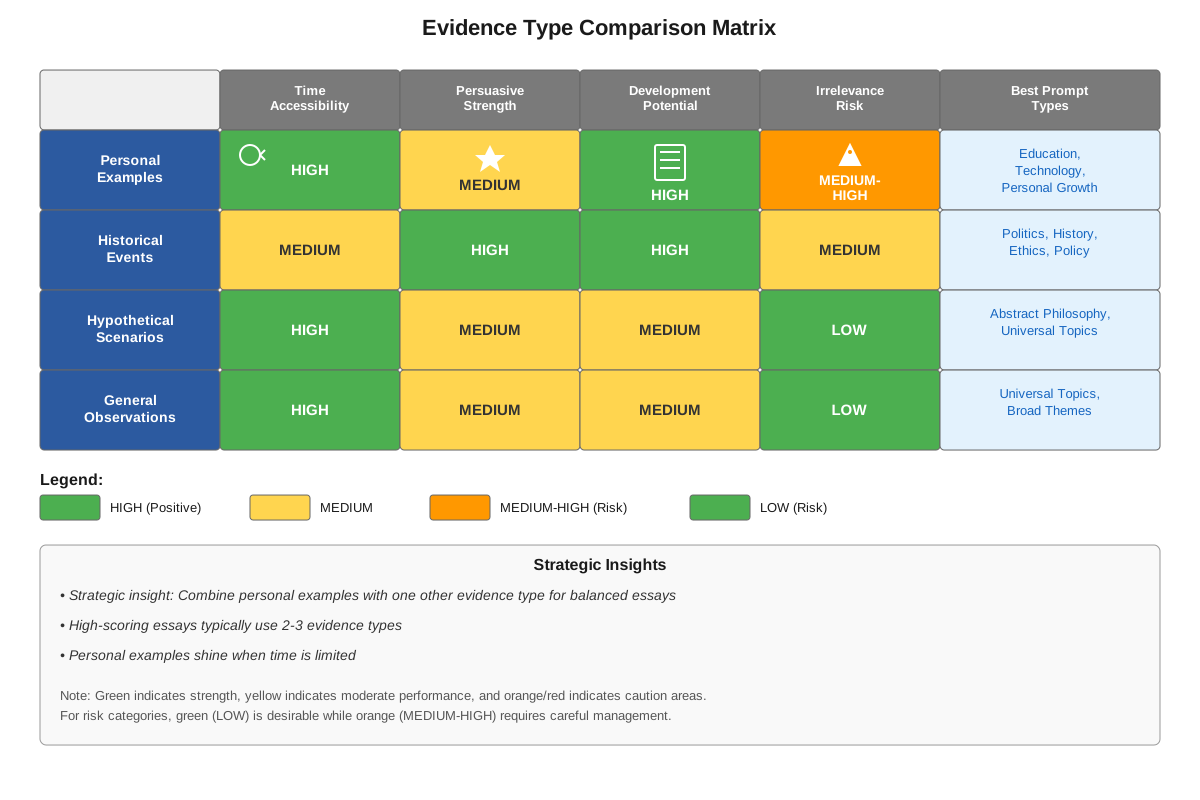
Personal examples represent one of the most accessible and time-efficient evidence types available during the GRE Analytical Writing section. Under exam pressure, test-takers may struggle to recall specific historical events, scientific studies, or literary references, but personal experiences remain readily available. This accessibility makes using personal examples a high-value skill that can prevent writer's block and enable continuous essay development even when other evidence sources prove elusive.
On the GRE, approximately 60-70% of high-scoring essays (5.0-6.0 range) incorporate at least one personal example or observation, according to analysis of published sample essays. The Analyze an Issue task appears as the first writing prompt, and the ability to quickly generate relevant personal examples can establish positive momentum for the entire Analytical Writing section. Personal examples appear most frequently in essays addressing topics related to education, technology, social behavior, leadership, and personal development—themes that constitute roughly 40% of the GRE issue pool.
The scoring rubric explicitly rewards "relevant reasons and/or examples" without specifying that evidence must be academic or impersonal. Graders evaluate whether examples effectively support the argument, demonstrate critical thinking, and are developed with sufficient detail—criteria that well-crafted personal examples can absolutely satisfy. Understanding this reality empowers test-takers to leverage their own experiences strategically rather than limiting themselves to potentially less familiar or less detailed alternative evidence.
Core Concepts
Definition and Scope of Personal Examples
Using personal examples refers to the strategic incorporation of one's own experiences, observations, or direct knowledge into argumentative writing to support claims and illustrate abstract concepts. On the GRE, personal examples can range from specific incidents ("During my internship at a marketing firm, I observed how...") to general patterns observed over time ("Throughout my education, I have consistently noticed that..."). The key distinguishing feature is that the writer draws from their own life rather than from external sources like history, literature, or science.
Personal examples exist on a spectrum of specificity. Highly specific examples describe particular events with concrete details: names (anonymized if appropriate), locations, timeframes, and outcomes. General personal observations describe patterns noticed across multiple experiences without focusing on a single incident. Both types can be effective, but specific examples typically provide more vivid, memorable support that demonstrates sophisticated thinking through detailed analysis.
When Personal Examples Are Appropriate
Personal examples work best when the issue prompt addresses topics within the realm of common human experience. Education-related prompts ("Universities should require students to take courses outside their major field of study") naturally invite personal examples from one's academic journey. Technology prompts ("Technology has made people less creative") can be supported by personal observations about how one uses technology. Leadership, collaboration, ethics, and personal development topics similarly align well with personal evidence.
Conversely, personal examples may be less appropriate for prompts requiring specialized knowledge or broad societal analysis. A prompt about government policy ("Nations should suspend government funding for the arts when significant numbers of their citizens are hungry or homeless") might be better served by logical reasoning and hypothetical scenarios than by personal anecdotes, unless the writer has direct relevant experience with arts funding or poverty programs. The key criterion is relevance: does the personal example genuinely illuminate the issue, or does it merely demonstrate that the writer has had an experience?
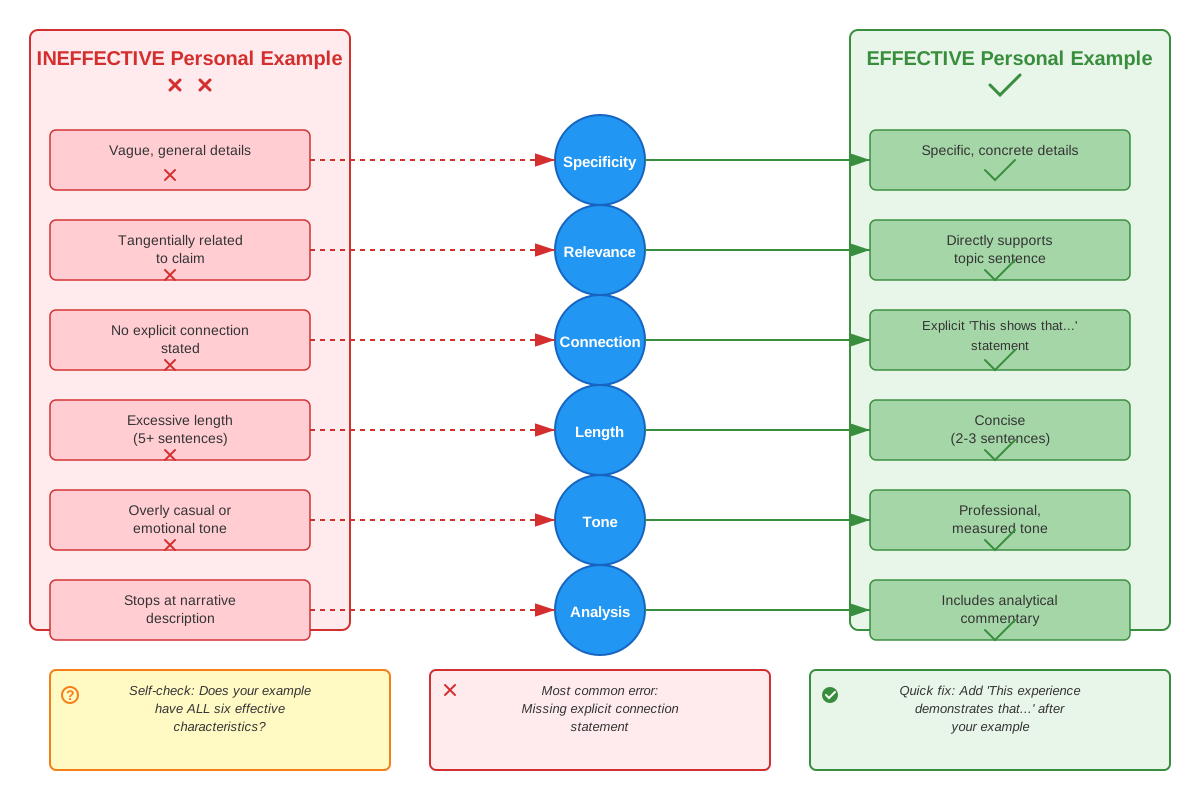
Characteristics of Effective Personal Examples
Effective personal examples share several critical characteristics that distinguish them from weak or counterproductive ones:
| Characteristic | Description | Example |
|---|---|---|
| Relevance | Directly supports the specific claim being made | Using a group project experience to support claims about collaboration, not just to mention school |
| Specificity | Includes concrete details that make the example vivid and credible | "In my sophomore biology course" rather than "once in school" |
| Analysis | Explains how the example supports the argument rather than simply narrating | "This experience demonstrates that..." followed by explicit connection to thesis |
| Appropriate scope | Neither too narrow (trivial) nor too broad (vague) | A semester-long experience rather than a single conversation or "my entire life" |
| Professional tone | Maintains academic register despite personal content | Avoids overly casual language or irrelevant emotional details |
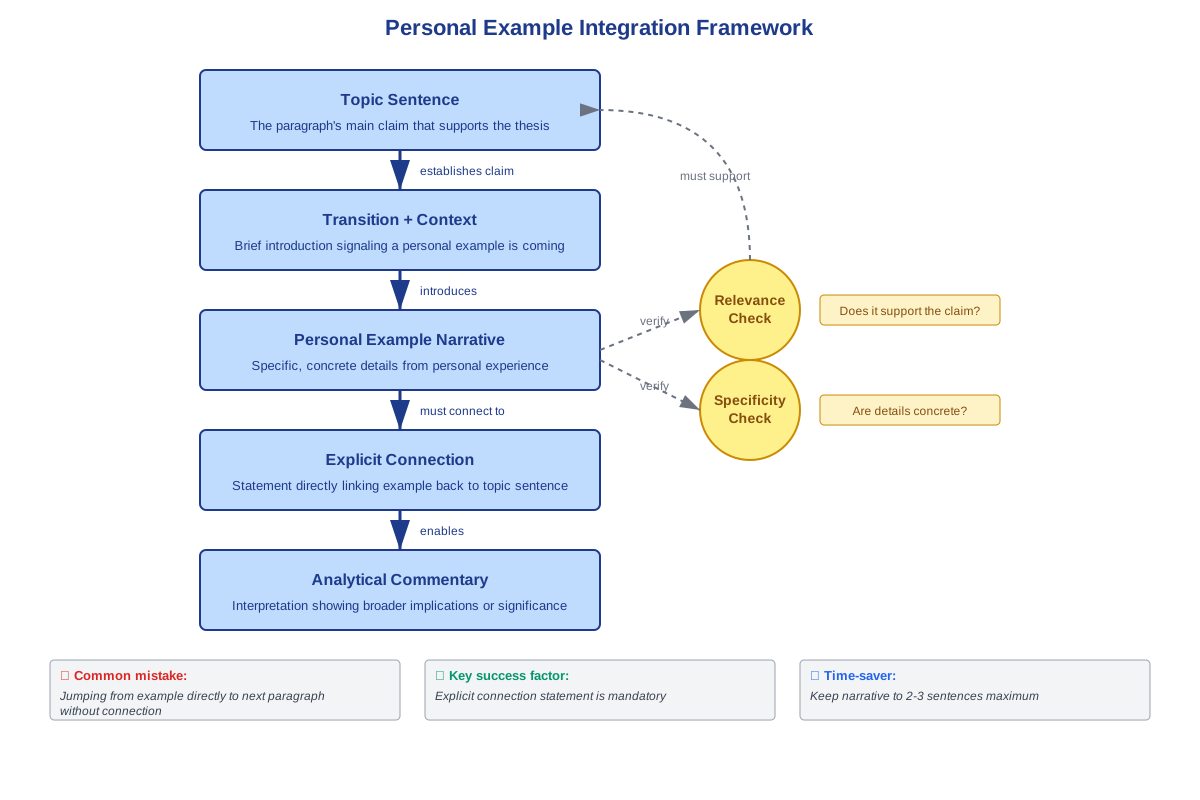
The most crucial element is the analytical connection between example and argument. Simply narrating a personal experience without explaining its significance creates a descriptive rather than argumentative essay. High-scoring essays consistently include explicit phrases like "This experience illustrates that...", "This observation supports the view that...", or "From this, one can see that..." to ensure the example's relevance is unmistakable.
Integration Strategies
Personal examples should be seamlessly integrated into the essay's argumentative structure rather than appearing as isolated anecdotes. The most effective integration follows a three-part pattern: claim-example-analysis. First, state the point being argued. Second, introduce the personal example with appropriate context. Third, explicitly analyze how the example supports the claim and connects to the thesis.
Transitional phrases help signal that a personal example is being introduced: "My own experience confirms this view," "I have observed this phenomenon firsthand," "A relevant example from my background illustrates this point," or "This principle became clear to me when..." These phrases prepare readers for the shift to personal evidence while maintaining the essay's argumentative focus.
Personal examples work best when balanced with other evidence types. An essay relying exclusively on personal examples may appear limited in perspective, while an essay that includes one or two personal examples alongside logical reasoning, hypothetical scenarios, or general knowledge demonstrates versatility and depth. The typical high-scoring essay includes 2-3 distinct pieces of evidence per body paragraph, with personal examples comprising one of these pieces.
Common Pitfalls to Avoid
Several common mistakes undermine the effectiveness of personal examples. Over-narration occurs when writers provide excessive story details that don't serve the argument: describing every step of an experience rather than focusing on the relevant aspects. The GRE rewards analysis, not storytelling, so personal examples should be concise enough to leave room for interpretation and connection to the thesis.
Irrelevant tangents happen when personal examples drift away from the specific claim being supported. A writer might begin with a relevant example but then include details about other aspects of the experience that don't advance the argument. Maintaining tight focus on the argumentative purpose prevents this problem.
Insufficient generalization occurs when writers fail to explain why their personal experience has broader significance. An effective personal example must be presented as illustrative of a larger pattern or principle, not as an isolated incident. Phrases like "This experience is representative of..." or "This pattern appears frequently in..." help establish broader relevance.
Concept Relationships
The effectiveness of using personal examples depends on their relationship to other essay components. Personal examples serve the thesis statement—they exist to support the essay's central argument, not as ends in themselves. This means the thesis must be developed first, and personal examples selected or constructed to advance that specific position.
Personal examples connect to paragraph development by functioning as supporting evidence within body paragraphs. Each body paragraph typically begins with a topic sentence stating a reason that supports the thesis. Personal examples then illustrate or prove that reason, followed by analysis that explicitly connects the example back to both the topic sentence and the thesis. This creates a clear logical chain: thesis → reason (topic sentence) → evidence (personal example) → analysis → connection back to thesis.
The relationship between personal examples and other evidence types is complementary rather than competitive. Logical reasoning establishes why something should be true; personal examples demonstrate that it is true in practice. Hypothetical scenarios explore what could happen; personal examples show what has happened. This complementary relationship means effective essays often combine personal examples with other support types within the same paragraph or across different paragraphs.
Textual relationship map: Thesis statement → Body paragraph topic sentence → Personal example (evidence) → Analysis of example → Connection to topic sentence → Reinforcement of thesis. This linear progression ensures every element serves the argumentative purpose, with personal examples occupying the crucial evidence position that transforms abstract claims into concrete, credible arguments.
Quick check — test yourself on Using personal examples so far.
Try Flashcards →High-Yield Facts
- ⭐ Personal examples are explicitly acceptable on the GRE; the scoring rubric evaluates relevance and development, not evidence source
- ⭐ High-scoring essays (5.0-6.0) frequently include at least one personal example or observation
- ⭐ Effective personal examples require explicit analysis connecting the example to the argument, not just narration
- ⭐ Personal examples work best for topics related to education, technology, personal development, leadership, and social behavior
- ⭐ The claim-example-analysis structure ensures personal examples support rather than distract from arguments
- Personal examples should be specific enough to be credible but concise enough to leave room for analysis
- Balancing personal examples with other evidence types demonstrates versatility and depth of thinking
- Transitional phrases like "My own experience confirms" or "I have observed" signal personal examples effectively
- Personal examples from academic, professional, or community experiences typically carry more weight than purely social anecdotes
- Over-narration is a common pitfall; personal examples should be detailed but focused on argumentatively relevant aspects
- Personal examples must be generalized to show broader significance beyond the individual experience
- The 30-minute time limit makes personal examples strategically valuable because they're readily accessible
- Personal examples should maintain academic tone despite personal content, avoiding overly casual language
- A single well-developed personal example is more effective than multiple superficial ones
Common Misconceptions
Misconception: Personal examples are inappropriate for academic writing and will lower GRE scores.
Correction: The GRE scoring rubric explicitly values "relevant reasons and/or examples" without requiring impersonal evidence. Well-developed personal examples that support the argument effectively are completely acceptable and appear in many high-scoring sample essays.
Misconception: Personal examples must be extraordinary or impressive experiences to be valuable.
Correction: Ordinary experiences can be highly effective if analyzed thoughtfully. The quality of analysis and relevance to the argument matter far more than the impressiveness of the experience itself. A common classroom observation analyzed insightfully outperforms an exotic experience narrated without clear connection to the thesis.
Misconception: Longer, more detailed personal examples are always better.
Correction: Concise, focused personal examples that leave room for analysis are more effective than lengthy narratives. Over-narration consumes valuable time and word count that should be devoted to explaining how the example supports the argument. The ideal personal example provides just enough detail to be credible and vivid, then moves quickly to analysis.
Misconception: Personal examples can stand alone without explicit connection to the argument.
Correction: Personal examples must be accompanied by analysis that explicitly explains their relevance to the claim being supported. Simply narrating an experience and assuming readers will infer its significance is insufficient. High-scoring essays consistently include phrases like "This demonstrates that..." or "This experience illustrates..." to make connections explicit.
Misconception: Essays should rely exclusively on personal examples to demonstrate authenticity.
Correction: While personal examples are valuable, essays that rely solely on personal evidence may appear limited in perspective. The most effective essays balance personal examples with logical reasoning, hypothetical scenarios, or general knowledge to demonstrate versatility and comprehensive thinking about the issue.
Misconception: Personal examples must be completely true and factually accurate.
Correction: While personal examples should be plausible and realistic, the GRE does not fact-check personal anecdotes. The key is that examples must be believable and relevant. Test-takers may reasonably construct or composite personal examples that effectively illustrate their arguments, provided they maintain credibility and avoid obvious fabrication.
Worked Examples
Worked Example 1: Education Prompt
Prompt: "Universities should require every student to take a variety of courses outside the student's field of study."
Sample body paragraph using a personal example:
Exposure to diverse disciplines enhances problem-solving abilities by providing multiple analytical frameworks. My own experience confirms this principle. During my undergraduate studies in computer science, I was required to take a philosophy course on logic and argumentation. Initially, I viewed this requirement as an unwelcome distraction from my technical coursework. However, the logical structures I learned—identifying premises, evaluating argument validity, recognizing fallacies—proved directly applicable to programming. When debugging complex code, I began systematically analyzing the logical flow of my programs using the same techniques I had learned for evaluating philosophical arguments. This cross-disciplinary connection improved my technical work in ways that additional computer science courses alone could not have achieved. This experience illustrates a broader principle: diverse coursework creates unexpected synergies that strengthen thinking within one's primary field.
Analysis of effectiveness:
- Claim stated first: "Exposure to diverse disciplines enhances problem-solving abilities"
- Specific details: Names the major (computer science), the required course (philosophy on logic), and the specific skills learned
- Concrete application: Explains exactly how philosophy improved programming (debugging through logical analysis)
- Explicit connection: "This experience illustrates a broader principle" generalizes beyond the individual case
- Appropriate scope: Focuses on one semester-long course rather than vague references to "my education"
- Balanced with analysis: Roughly equal space devoted to narrating the example and explaining its significance
Worked Example 2: Technology Prompt
Prompt: "As people rely more and more on technology to solve problems, the ability of humans to think for themselves will surely deteriorate."
Sample body paragraph using a personal example:
However, technology often serves as a tool that augments rather than replaces human thinking. I have observed this pattern in my own use of GPS navigation systems. When I first began using GPS, I admittedly paid less attention to routes and landmarks, simply following turn-by-turn directions. Yet over time, I noticed that the GPS actually enhanced my spatial understanding of my city. By showing me alternative routes during traffic, the system revealed connections between neighborhoods I had never recognized. I began mentally mapping these alternatives, understanding the city's layout more comprehensively than when I relied solely on memorized routes to familiar destinations. Rather than deteriorating my navigational thinking, the technology expanded it by providing information I could synthesize into a more sophisticated mental model. This suggests that technology's impact on thinking depends on how users engage with it—as a replacement for thought or as a catalyst for deeper understanding.
Analysis of effectiveness:
- Addresses counterargument: Uses personal example to challenge the prompt's assumption
- Shows development over time: Describes initial passive use, then active engagement
- Specific technology: Focuses on GPS rather than vague "technology"
- Explicit analysis: "This suggests that technology's impact depends on..." connects to broader principle
- Maintains argumentative focus: Every detail serves the point about technology augmenting rather than replacing thinking
- Professional tone: Discusses personal experience without becoming overly casual or emotional
Exam Strategy
When approaching an Analyze an Issue prompt, quickly assess whether personal examples would be appropriate by asking: "Do I have relevant personal experience with this topic?" and "Would a personal example effectively illustrate my argument?" If both answers are yes, plan to include one or two personal examples in your essay outline.
Trigger words and phrases that suggest personal examples might be effective include: "education," "learning," "students," "teachers," "technology use," "social media," "collaboration," "leadership," "work," "creativity," "decision-making," and "personal development." These topics typically fall within common experience, making personal examples accessible and relevant.
Time allocation strategy: Reserve approximately 3-4 minutes per body paragraph. Within this time, spend roughly 1 minute introducing the claim, 1-1.5 minutes presenting the personal example with sufficient detail, and 1-1.5 minutes analyzing how the example supports the argument. This balance ensures personal examples enhance rather than dominate the essay.
Process-of-elimination approach: If you're struggling to develop a body paragraph, ask yourself: "Have I experienced something related to this point?" Personal examples can break through writer's block because they require less external knowledge than historical or scientific evidence. However, if no relevant personal experience comes to mind within 30 seconds, move to logical reasoning or hypothetical scenarios rather than forcing an irrelevant personal example.
Integration checklist: Before moving to the next paragraph, verify that your personal example includes: (1) a clear claim stated before the example, (2) specific details that make the example credible, (3) explicit analysis connecting the example to the claim, and (4) a generalization showing broader significance. If any element is missing, add 1-2 sentences to complete the integration.
Exam Tip: Personal examples are particularly valuable in the first body paragraph because they're quick to generate and can establish momentum. Once you've successfully developed one paragraph, subsequent paragraphs often flow more easily, even if they use different evidence types.
Memory Techniques
C-E-A Acronym: Remember Claim-Example-Analysis as the structure for integrating personal examples. Every personal example should follow this sequence to ensure proper integration.
STAR Adaptation: Borrow from the interview technique STAR (Situation, Task, Action, Result) but add Significance. When constructing a personal example: briefly describe the Situation, explain the Task or challenge, describe your Action or observation, note the Result, and most importantly, explain the Significance for your argument.
The "So What?" Test: After writing a personal example, mentally ask "So what?" If you can't immediately answer how the example supports your argument, you need to add analysis. This self-check prevents narration without argumentation.
Balance Visualization: Picture a scale with "narration" on one side and "analysis" on the other. Effective personal examples keep these balanced or tip slightly toward analysis. If you're spending more than 60% of the paragraph narrating the example, you're likely over-narrating.
The Three-Sentence Minimum: Remember that effective personal example integration requires at least three sentences: one introducing the claim, one (or more) presenting the example, and one explicitly analyzing its significance. This minimum ensures you don't just drop in an anecdote without context or analysis.
Summary
Using personal examples effectively on the GRE Analytical Writing section requires understanding that personal evidence is fully acceptable when relevant, specific, and properly analyzed. The key to success lies not in the impressiveness of personal experiences but in the quality of analysis connecting those experiences to the essay's argument. Effective personal examples follow the claim-example-analysis structure, providing specific details that establish credibility while maintaining focus on argumentatively relevant aspects. They work best for topics related to education, technology, personal development, and social behavior—areas within common human experience. Personal examples should be balanced with other evidence types to demonstrate versatility, and they must be explicitly connected to the thesis through analytical phrases that generalize beyond individual experience. Under the time pressure of the 30-minute Analyze an Issue task, personal examples offer strategic value because they're readily accessible, helping test-takers develop well-supported arguments even when other evidence sources prove elusive. The scoring rubric rewards relevant, well-developed reasoning regardless of evidence source, making thoughtfully integrated personal examples a legitimate and often effective path to high scores.
Key Takeaways
- Personal examples are explicitly acceptable on the GRE when relevant and well-developed; the rubric evaluates quality of reasoning, not evidence source
- Effective personal examples require the claim-example-analysis structure: state the point, present the example with specific details, then explicitly analyze its significance
- Personal examples work best for topics within common experience (education, technology, leadership, personal development) and should be balanced with other evidence types
- Analysis matters more than narration; spend equal or greater time explaining how the example supports your argument than describing the experience itself
- Specific, focused personal examples outperform vague or overly detailed ones; include just enough detail to be credible, then move to analysis
- Personal examples offer strategic value under time pressure because they're readily accessible and can prevent writer's block
- Generalize personal examples to show broader significance beyond individual experience, using phrases like "This illustrates a broader principle" or "This pattern appears frequently"
Related Topics
Developing logical reasoning: While personal examples provide concrete evidence, logical reasoning offers abstract support for arguments. Mastering both techniques enables test-takers to select the most effective evidence type for each claim, with logical reasoning particularly valuable for prompts requiring theoretical analysis or addressing topics beyond personal experience.
Using hypothetical examples: Hypothetical scenarios complement personal examples by exploring possibilities rather than actual experiences. Understanding when to use "what if" scenarios versus personal anecdotes helps test-takers adapt their evidence selection to different argument types and prompt requirements.
Balancing multiple evidence types: Advanced essay development involves strategically combining personal examples, logical reasoning, hypothetical scenarios, and general knowledge within single essays or paragraphs. This skill demonstrates sophisticated thinking and versatility, characteristics of 6.0-level essays.
Analyzing argument structure: The Analyze an Argument task (the second Analytical Writing prompt) requires different skills than the Analyze an Issue task. Understanding how personal examples function in issue essays provides foundation for recognizing how evidence functions in argument analysis, though personal examples are generally not used in argument essays.
Practice CTA
Now that you understand the strategic value and proper integration of personal examples, it's time to apply these concepts. Work through the practice questions to identify effective versus ineffective personal examples, then attempt the flashcards to reinforce key principles. Remember: the difference between a good essay and a great essay often lies not in having impressive experiences, but in analyzing ordinary experiences with insight and connecting them clearly to your argument. Your personal experiences are valuable evidence—learn to leverage them effectively, and you'll have a powerful tool for the Analytical Writing section.
Sign up free to keep reading
Create a free AnvayaPrep account to finish this GRE guide on Using personal examples — plus flashcards and practice questions.