Overview
Using historical examples is one of the most powerful and persuasive techniques available to test-takers on the GRE Analytical Writing section, particularly for the Analyze an Issue task. This approach involves drawing upon events, figures, movements, and developments from history to support arguments, illustrate principles, and demonstrate the complexity of issues. When executed effectively, historical examples transform abstract claims into concrete, credible arguments that resonate with evaluators and demonstrate intellectual depth.
The GRE Analytical Writing section assesses the ability to articulate and support complex ideas, and historical examples serve as evidence that grounds theoretical positions in real-world contexts. Unlike personal anecdotes or hypothetical scenarios, historical examples carry inherent authority because they represent documented events that have been analyzed and interpreted by scholars. The effective use of historical examples signals to graders that a test-taker possesses broad knowledge, critical thinking skills, and the ability to synthesize information across domains—all qualities that graduate programs value highly.
Within the broader framework of Analytical Writing, GRE using historical examples connects directly to evidence-based argumentation, persuasive writing techniques, and the development of nuanced perspectives. Historical examples work synergistically with other forms of support such as contemporary examples, logical reasoning, and hypothetical scenarios to create multi-layered arguments. Mastering this technique enables test-takers to achieve scores in the upper ranges (5.0-6.0) by demonstrating the sophisticated thinking and comprehensive support that distinguishes exceptional essays from merely competent ones.
Learning Objectives
- [ ] Identify when Using historical examples is being tested
- [ ] Explain the core rule or strategy behind Using historical examples
- [ ] Apply Using historical examples to GRE-style questions accurately
- [ ] Evaluate the relevance and appropriateness of specific historical examples for different argument types
- [ ] Construct well-integrated historical examples that include sufficient context and clear connections to thesis statements
- [ ] Distinguish between effective and ineffective uses of historical examples in sample essays
- [ ] Synthesize multiple historical examples to support complex, nuanced arguments
Prerequisites
- Basic essay structure: Understanding introduction, body paragraphs, and conclusion organization is essential because historical examples must be integrated into coherent argumentative frameworks
- Thesis development: The ability to craft clear position statements is necessary because historical examples serve to support specific claims rather than standing alone
- Paragraph organization: Knowledge of topic sentences and supporting evidence structure enables proper placement and integration of historical examples
- Basic world history knowledge: Familiarity with major historical periods, events, and figures provides the raw material from which to draw examples
Why This Topic Matters
Historical examples represent one of the most frequently rewarded elements in high-scoring GRE Analytical Writing essays. According to ETS scoring guidelines, essays that demonstrate "insightful development" and "compelling reasons and/or persuasive examples" consistently receive scores of 5.0 or higher. Historical examples fulfill both criteria by providing concrete evidence that has been tested through time and scholarly analysis.
In real-world academic and professional contexts, the ability to reference historical precedents demonstrates intellectual breadth and analytical sophistication. Graduate programs across disciplines value students who can contextualize contemporary issues within historical frameworks, recognize patterns across time periods, and apply lessons from the past to present challenges. This skill proves essential in fields ranging from public policy and law to business strategy and education.
On the GRE specifically, historical examples appear as opportunities in virtually every Analyze an Issue prompt. Whether the topic concerns education, technology, government, leadership, or social progress, historical precedents exist that can illuminate the discussion. Test-takers who have prepared a mental repository of versatile historical examples gain a significant advantage in both planning time and essay development. The most common manifestations include prompts about the role of leaders, the pace of social change, the relationship between innovation and tradition, and the balance between individual rights and collective welfare—all areas rich with historical illustration.
Core Concepts
The Nature and Function of Historical Examples
Using historical examples involves referencing specific events, figures, movements, policies, or developments from the past to support argumentative claims in analytical writing. Unlike vague historical allusions, effective historical examples include sufficient detail to establish credibility while remaining focused on the argument's purpose. These examples function as evidence that demonstrates patterns, illustrates principles, provides counterexamples, or reveals consequences of particular approaches or beliefs.
Historical examples serve multiple rhetorical functions simultaneously. They provide concrete evidence that grounds abstract arguments in reality, they establish credibility by demonstrating knowledge and research, they create emotional resonance by connecting to shared cultural memory, and they enable comparative analysis by showing how similar situations have unfolded across different contexts. The most sophisticated uses of historical examples do not simply cite events but analyze them, drawing explicit connections between historical circumstances and the issue under examination.
Criteria for Effective Historical Examples
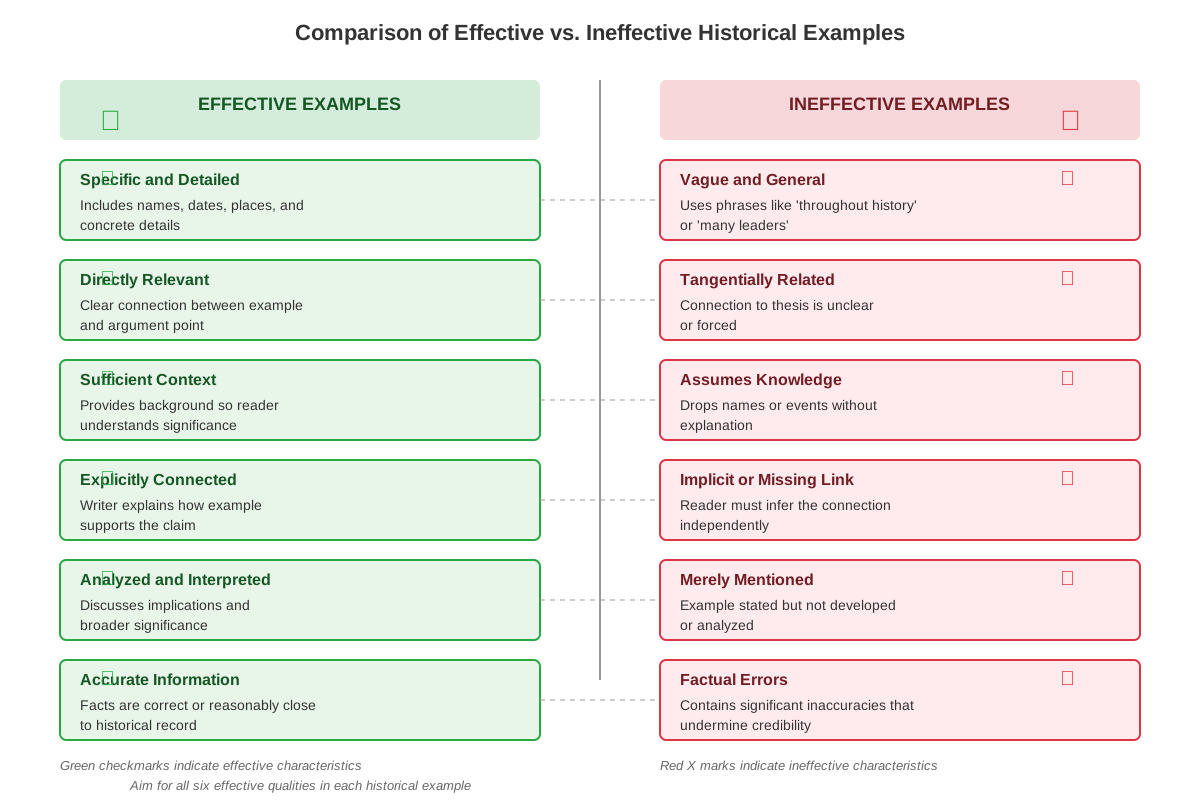
Not all historical references strengthen an argument equally. Effective historical examples meet several key criteria:
| Criterion | Description | Example |
|---|---|---|
| Relevance | Direct connection to the specific claim being supported | Using the Industrial Revolution to discuss technological disruption's effects on employment |
| Specificity | Sufficient detail to establish credibility and enable analysis | Mentioning specific dates, names, or outcomes rather than vague references |
| Accuracy | Factually correct information that withstands scrutiny | Correctly identifying causes and effects of historical events |
| Integration | Seamless incorporation into the argument's logical flow | Transitioning naturally from claim to example to analysis |
| Analysis | Explicit explanation of how the example supports the argument | Not assuming the connection is obvious to readers |
The relevance criterion proves particularly crucial on the GRE because time constraints prevent extensive historical exposition. Each historical example must directly illuminate the specific aspect of the issue being discussed. An example about the Roman Empire's fall might be relevant to arguments about political corruption, military overextension, or economic inequality, but the writer must explicitly connect the historical circumstances to the contemporary principle being illustrated.
Types of Historical Examples
Historical examples can be categorized by their scope and function:
- Event-based examples: Specific occurrences such as the French Revolution, the Moon landing, or the fall of the Berlin Wall
- Figure-based examples: Individual leaders, innovators, or influential people such as Abraham Lincoln, Marie Curie, or Mahatma Gandhi
- Movement-based examples: Sustained social, political, or cultural phenomena such as the Renaissance, the Civil Rights Movement, or the Scientific Revolution
- Policy-based examples: Specific governmental or institutional decisions such as the New Deal, the Marshall Plan, or the Meiji Restoration
- Comparative examples: Parallel situations from different time periods or cultures that reveal patterns or contrasts
Each type offers distinct advantages. Event-based examples provide clear narratives with identifiable causes and effects. Figure-based examples enable discussion of leadership qualities, decision-making, and individual impact. Movement-based examples illustrate how ideas spread and societies transform over time. Policy-based examples demonstrate the consequences of specific approaches to problems. Comparative examples showcase analytical sophistication by revealing patterns across contexts.
Integrating Historical Examples into Arguments
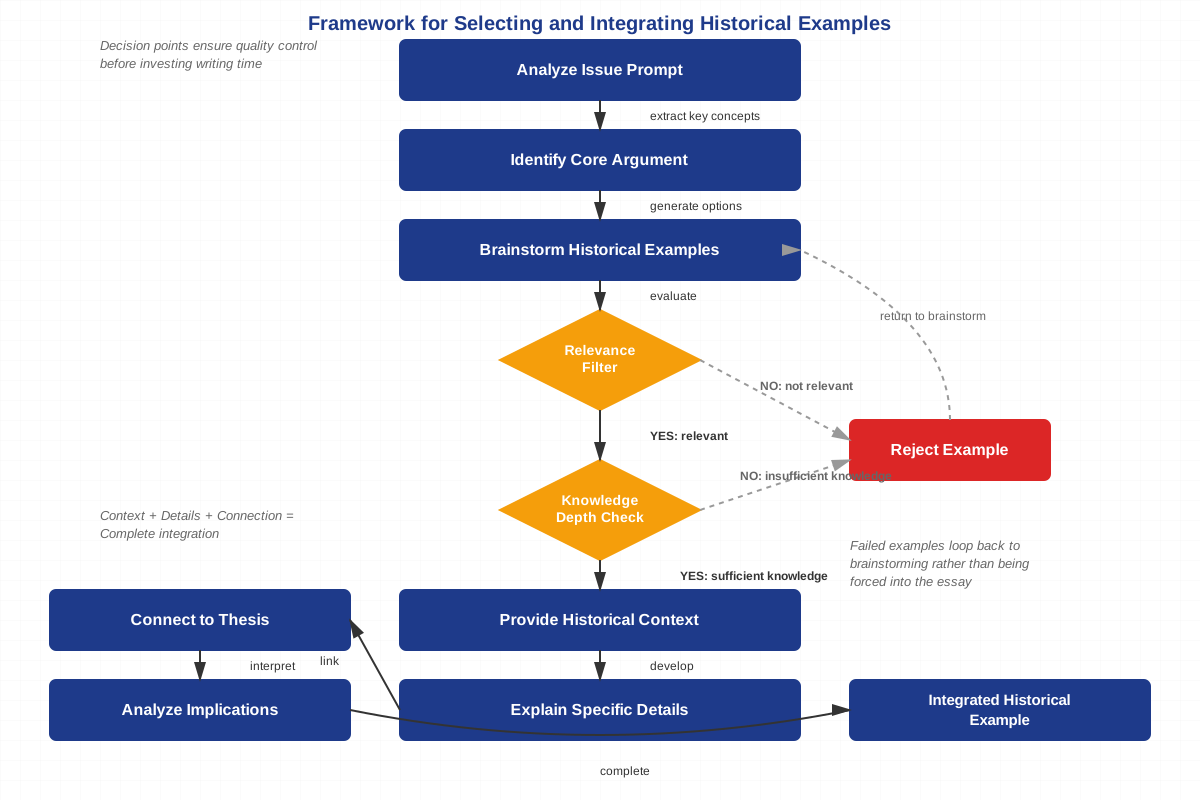
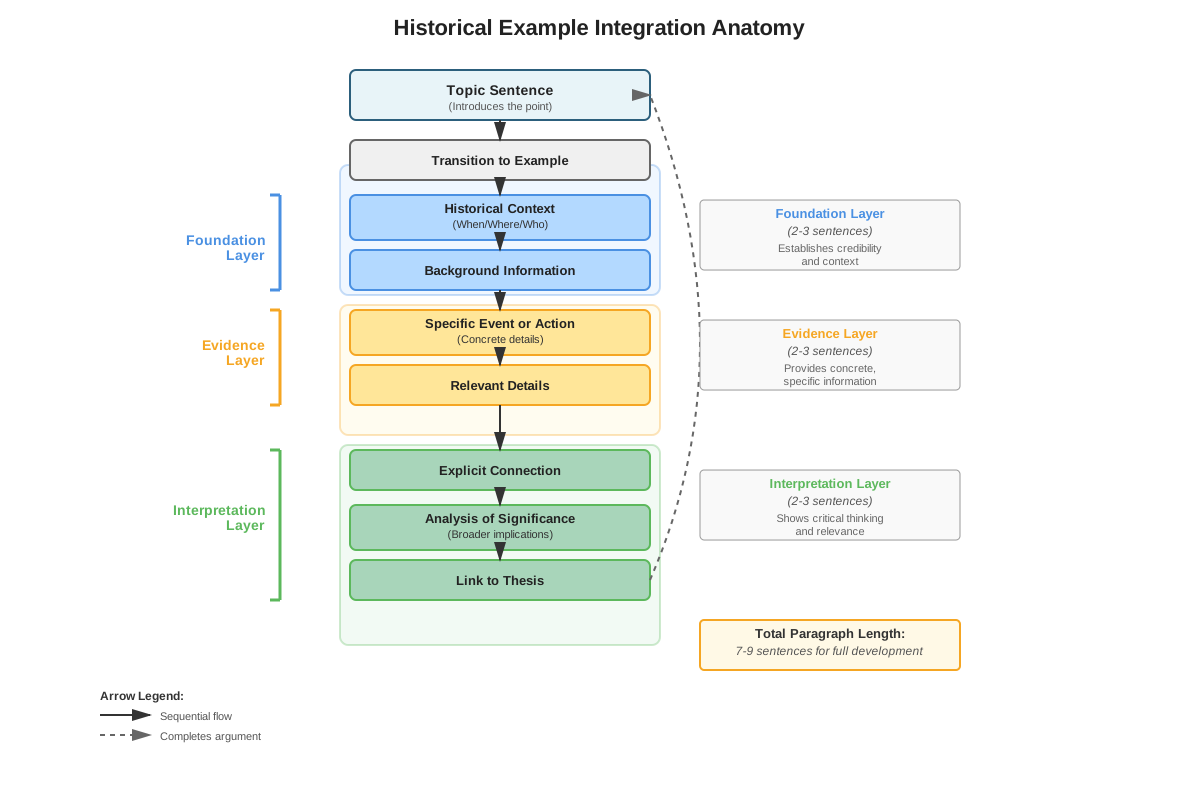
The integration process follows a consistent pattern that ensures historical examples enhance rather than distract from arguments:
- Establish the claim: State the specific point the historical example will support
- Introduce the example: Provide necessary context (when, where, who, what)
- Describe relevant details: Include specific information that connects to the claim
- Analyze the connection: Explicitly explain how the example supports the argument
- Transition forward: Link back to the thesis or forward to the next point
This five-step process prevents the common error of "example dumping," where writers list historical events without explaining their relevance. The analysis step proves most critical—it transforms a historical reference from mere decoration into genuine evidence. For instance, mentioning that "the printing press revolutionized communication" provides less value than explaining: "Gutenberg's printing press, introduced in 1440, demonstrates how technological innovation can democratize information access; by reducing the cost of book production by over 90%, it enabled widespread literacy and ultimately challenged institutional authorities who had controlled knowledge distribution."
Balancing Breadth and Depth
Test-takers face a strategic decision about whether to use multiple brief historical examples or fewer detailed ones. Both approaches can succeed, but they serve different purposes:
Breadth approach: Using 3-4 concise historical examples from different periods or cultures demonstrates wide-ranging knowledge and reveals patterns across contexts. This approach works well for arguments about universal principles or recurring human tendencies.
Depth approach: Developing 1-2 historical examples with substantial detail and nuanced analysis demonstrates sophisticated understanding and critical thinking. This approach suits arguments requiring careful examination of causes, effects, and complexities.
The most effective essays often combine both strategies, using one detailed example as a primary illustration and supplementing it with briefer references that reinforce the pattern or address counterarguments.
Concept Relationships
The effective use of historical examples exists within a network of interconnected writing skills and strategies. Thesis development serves as the foundation—historical examples must support specific claims rather than existing independently. The thesis determines which historical examples are relevant and how they should be framed.
Evidence-based argumentation represents the broader category within which historical examples function alongside contemporary examples, statistical data, logical reasoning, and expert testimony. Historical examples often work most powerfully when combined with other evidence types: a historical precedent might establish a pattern, while contemporary examples demonstrate its continued relevance, and logical reasoning explains the underlying mechanism.
The relationship flows as follows: Thesis statement → determines relevant → Historical examples → which require → Contextual explanation → leading to → Analytical connection → strengthening → Overall argument → supporting → Thesis statement.
Paragraph organization skills enable proper integration of historical examples. Each body paragraph typically advances one aspect of the thesis, and historical examples serve as the concrete evidence within topic sentence → evidence → analysis → transition structures. Without strong organizational skills, historical examples become disconnected facts rather than integrated support.
Critical thinking and analytical reasoning transform historical references from mere citations into genuine argumentation. These skills enable writers to identify relevant parallels, recognize important differences, and draw meaningful conclusions from historical patterns. The connection between historical knowledge and analytical ability proves synergistic—broader historical knowledge provides more material for analysis, while stronger analytical skills enable more sophisticated use of historical information.
High-Yield Facts
⭐ Historical examples should always include specific details (dates, names, or outcomes) rather than vague references to establish credibility and enable analysis.
⭐ The analysis of how an example supports the argument matters more than the example itself—never assume the connection is obvious to readers.
⭐ Accuracy is essential but perfection is not required—minor date errors rarely affect scores if the overall understanding is correct and the analysis is sound.
⭐ Historical examples from diverse time periods and cultures demonstrate broader knowledge than multiple examples from the same era or region.
⭐ One well-developed historical example typically strengthens an argument more effectively than three superficially mentioned events.
- Historical examples work most powerfully when explicitly connected to the specific aspect of the issue being discussed rather than the general topic.
- Counterexamples from history (events that challenge the argument) can strengthen essays when acknowledged and addressed rather than ignored.
- The most versatile historical examples involve major transformative events or figures that can illustrate multiple principles depending on how they are framed.
- Historical examples should be integrated into the logical flow of the argument rather than segregated into "example paragraphs" separate from analysis.
- Recent history (past 50 years) can serve as historical examples on the GRE, though older examples often carry more authority as "tested by time."
- Historical examples from non-Western cultures demonstrate intellectual breadth and help avoid Eurocentric perspectives that may limit argument scope.
- The introduction and conclusion should reference historical examples sparingly, reserving detailed development for body paragraphs where space allows proper analysis.
Quick check — test yourself on Using historical examples so far.
Try Flashcards →Common Misconceptions
Misconception: Historical examples must be perfectly accurate with exact dates and details to be valuable.
Correction: While accuracy matters, minor errors in dates or details rarely affect GRE scores if the overall understanding is correct and the analysis is sound. Graders evaluate the quality of reasoning and argument development rather than testing historical knowledge. Being approximately correct about when the Industrial Revolution occurred (early-to-mid 1800s rather than precisely 1760-1840) does not undermine an argument about technological change's social effects.
Misconception: More historical examples always create stronger arguments than fewer examples.
Correction: Quality and depth of analysis matter far more than quantity. An essay with one thoroughly developed historical example that includes context, specific details, and explicit analytical connection to the thesis typically outperforms an essay that lists five historical events without explaining their relevance. The GRE rewards insightful development, not encyclopedic listing.
Misconception: Historical examples should only come from ancient or classical history to seem more scholarly.
Correction: Historical examples from any period can be effective, including recent history from the past few decades. What matters is relevance to the argument and quality of analysis. The Civil Rights Movement of the 1960s, the fall of the Berlin Wall in 1989, or the development of the internet in the 1990s can serve as powerful historical examples despite their relative recency.
Misconception: Simply mentioning a historical event or figure provides sufficient support for an argument.
Correction: Historical references become evidence only when explicitly connected to the claim through analysis. Stating "Like Abraham Lincoln, leaders must make difficult decisions" provides minimal support. Effective use requires explaining: "Lincoln's decision to issue the Emancipation Proclamation in 1863, despite political risks and constitutional questions, illustrates how effective leaders must sometimes prioritize moral imperatives over short-term political calculations."
Misconception: Historical examples must be obscure or sophisticated to impress graders.
Correction: Well-known historical examples can be highly effective when analyzed insightfully. The French Revolution, World War II, or the American Civil Rights Movement remain powerful examples not despite but because of their familiarity—they provide common reference points that enable deeper analysis. Obscure examples risk confusing readers or requiring excessive explanation that consumes valuable time and space.
Misconception: Historical examples from non-Western cultures are too risky because graders might not recognize them.
Correction: GRE graders are trained to evaluate argumentation quality across diverse cultural references. Examples from Chinese, Indian, African, or Latin American history can be highly effective and demonstrate intellectual breadth. What matters is providing sufficient context for readers unfamiliar with the specific example and clearly explaining its relevance to the argument.
Worked Examples
Worked Example 1: Technology and Social Change
Prompt: "The rapid pace of technological change makes it difficult for society to adapt, often creating more problems than it solves."
Claim to Support: While technological change does create adaptation challenges, history demonstrates that societies successfully integrate transformative technologies when given sufficient time and institutional support.
Historical Example Development:
Step 1 - Establish the claim: "Historical precedent suggests that initial disruption from technological change often gives way to successful adaptation when societies develop appropriate institutional responses."
Step 2 - Introduce the example: "The Industrial Revolution of the late 18th and early 19th centuries provides a compelling illustration of this pattern."
Step 3 - Describe relevant details: "The mechanization of textile production and other industries initially created severe social disruption in Britain and other industrializing nations. Factory systems displaced skilled artisans, created dangerous working conditions, and concentrated workers in overcrowded urban areas lacking adequate sanitation or housing. Child labor became widespread, and the gap between industrial owners and workers widened dramatically. These problems seemed to validate concerns that industrialization created more harm than benefit."
Step 4 - Analyze the connection: "However, over subsequent decades, societies developed institutional responses that enabled successful adaptation to industrial technology. Labor unions emerged to advocate for workers' rights, governments enacted factory safety regulations and child labor laws, urban planning improved sanitation and housing, and public education systems prepared populations for industrial employment. By the late 19th century, the same technologies that initially caused disruption had raised living standards, increased life expectancy, and expanded opportunities for social mobility. This historical trajectory demonstrates that technological change's problems often reflect inadequate institutional adaptation rather than inherent flaws in the technology itself."
Step 5 - Transition forward: "This pattern of initial disruption followed by successful institutional adaptation appears repeatedly throughout history, suggesting that contemporary technological challenges may similarly yield to thoughtful social responses."
Analysis of Effectiveness: This example succeeds because it provides specific details (textile mechanization, child labor, urban overcrowding), acknowledges the complexity of the issue (initial problems were real and severe), and explicitly connects the historical pattern to the argument (societies can adapt when they develop institutional responses). The example doesn't simply assert that the Industrial Revolution was important—it analyzes how the historical process illuminates the principle being argued.
Worked Example 2: Individual vs. Collective Action
Prompt: "Significant social progress requires the coordinated efforts of many people rather than the actions of exceptional individuals."
Claim to Support: While collective action provides essential support, exceptional individuals often catalyze and direct social movements that would not otherwise coalesce.
Historical Example Development:
Step 1 - Establish the claim: "History reveals that exceptional individuals frequently serve as catalysts who transform diffuse dissatisfaction into organized movements for change."
Step 2 - Introduce the example: "Mahatma Gandhi's leadership of the Indian independence movement from the 1920s through 1947 illustrates this catalytic role."
Step 3 - Describe relevant details: "When Gandhi returned to India in 1915, opposition to British colonial rule existed but lacked unified direction or effective strategy. Gandhi introduced the philosophy of satyagraha—nonviolent resistance—and organized specific campaigns such as the Salt March of 1930, in which he led thousands on a 240-mile march to the sea to produce salt in defiance of British monopoly laws. This single act of civil disobedience, conceived and initiated by Gandhi, galvanized millions of Indians who had previously remained passive or engaged in isolated protests."
Step 4 - Analyze the connection: "Gandhi's individual contribution was not simply participating in a movement that would have occurred regardless—he provided the strategic vision, moral framework, and symbolic actions that transformed scattered resistance into a coordinated national movement. Without his specific innovations in nonviolent resistance and his ability to communicate across India's diverse religious and linguistic communities, the independence movement would likely have taken a different form, possibly involving more violence and achieving less unified support. The collective action of millions proved essential to independence, but Gandhi's individual leadership determined when, how, and under what principles that collective action occurred."
Step 5 - Transition forward: "This pattern—exceptional individuals providing vision and strategy that enables effective collective action—appears throughout movements for social change, suggesting that individual and collective contributions are complementary rather than contradictory."
Analysis of Effectiveness: This example demonstrates sophisticated argumentation by acknowledging both sides of the issue (collective action was necessary, but individual leadership was catalytic). It provides specific details (the Salt March, satyagraha philosophy, the 240-mile distance) that establish credibility. Most importantly, it analyzes rather than merely describes, explaining precisely how Gandhi's individual contribution shaped the collective movement. The example also anticipates counterarguments by explicitly addressing what might have happened without Gandhi's leadership.
Exam Strategy
When approaching GRE Analyze an Issue prompts, implement a systematic strategy for identifying opportunities to use historical examples and executing them effectively under time pressure.
During the 30-second prompt analysis: Immediately identify the prompt's core issue and brainstorm 2-3 historical examples that might be relevant. Don't commit to using all of them—simply note possibilities. Look for prompts involving leadership, social change, technological innovation, education, government policy, or conflict resolution, as these areas offer rich historical material.
Trigger words and phrases that signal opportunities for historical examples include: "throughout history," "has always been," "traditionally," "in the past," "over time," "progress," "change," "leadership," "innovation," and "society." These phrases invite historical contextualization and comparison.
During the 5-minute planning phase: Select 1-2 historical examples that most directly support your thesis. For each, jot down 3-4 specific details you'll include (dates, names, outcomes, or statistics). Plan where in your essay structure each example will appear—typically one major example per body paragraph, with the most compelling example in your first or second body paragraph.
Process-of-elimination for example selection: When choosing between multiple possible historical examples, eliminate those that:
- Require extensive background explanation that will consume too much time
- You cannot remember with sufficient specificity to establish credibility
- Only tangentially relate to your specific argument rather than directly supporting it
- Come from the same time period or culture as your other examples (diversity strengthens arguments)
Time allocation: Budget approximately 3-4 minutes per body paragraph. Within that time, allocate roughly 1 minute to introducing and describing your historical example and 1-2 minutes to analyzing its connection to your argument. If you find yourself spending more than 2 minutes on historical description, you're likely providing excessive detail at the expense of analysis.
Integration technique: Use transitional phrases that explicitly signal the relationship between your claim and historical example: "Historical precedent supports this view," "This principle is illustrated by," "A compelling example of this pattern appears in," or "The consequences of this approach are evident in." These transitions help graders follow your logical flow.
Backup strategy: If you cannot remember sufficient details about a historical example during the exam, either (1) acknowledge the limitation explicitly ("While I cannot recall the exact date, the general pattern of...") and proceed with your analysis, or (2) pivot to a different type of example (contemporary, hypothetical, or logical reasoning). Never fabricate historical facts, as inaccuracies undermine credibility.
Balancing historical and other examples: Aim to use at least one historical example in your essay, but don't force historical examples into every paragraph. A strong essay might include one detailed historical example, one contemporary example, and one paragraph of logical reasoning. This variety demonstrates versatility while preventing the essay from becoming a history lecture.
Memory Techniques
The CREAM mnemonic helps remember the five essential elements of effective historical examples:
- Context: When and where did this occur?
- Relevance: How does this connect to my specific claim?
- Evidence: What specific details establish credibility?
- Analysis: What does this example prove or illustrate?
- Meaning: What broader principle does this reveal?
Versatile Example Repository: Prepare 8-10 historical examples before the exam that can be adapted to multiple argument types. Organize them by theme:
- Leadership/Decision-making: Lincoln and the Emancipation Proclamation, Churchill during WWII, Mandela and reconciliation
- Technological change: Industrial Revolution, printing press, Green Revolution in agriculture
- Social movements: Civil Rights Movement, women's suffrage, labor movement
- Innovation/Progress: Scientific Revolution, Renaissance, Space Race
- Government/Policy: New Deal, Marshall Plan, decolonization movements
- Conflict/Cooperation: World War I origins, United Nations formation, European Union development
The "Three-Detail Rule": For each historical example in your repository, memorize three specific details (a date, a name, and an outcome). This provides sufficient specificity to establish credibility without requiring encyclopedic knowledge. For example, for the Civil Rights Movement: (1) 1963 March on Washington, (2) Martin Luther King Jr.'s leadership, (3) Civil Rights Act of 1964.
Visualization technique: Create mental images linking historical examples to argument types. Picture a printing press when thinking about democratization of information, visualize Gandhi's Salt March when considering nonviolent resistance, or imagine the Berlin Wall falling when discussing the end of ideological divisions. These visual associations enable faster recall under exam pressure.
Chronological anchoring: Organize historical examples along a mental timeline with major periods (Ancient, Medieval, Early Modern, Industrial Age, 20th Century, Contemporary). This prevents confusion about temporal relationships and helps you select examples from diverse periods to demonstrate breadth.
Summary
Using historical examples effectively on the GRE Analytical Writing section requires more than simply knowing historical facts—it demands the ability to select relevant examples, provide sufficient context and detail, and explicitly analyze how historical patterns illuminate contemporary arguments. The most successful test-takers prepare a repository of versatile historical examples spanning different time periods and cultures, ensuring they can adapt these examples to various prompt types. Effective integration follows a consistent pattern: establish the claim, introduce the example with necessary context, describe relevant specific details, analyze the connection to the argument, and transition forward. Quality matters far more than quantity; one thoroughly developed historical example with insightful analysis strengthens an argument more than multiple superficially mentioned events. Historical examples work synergistically with other evidence types and demonstrate the intellectual breadth and analytical sophistication that distinguish high-scoring essays. Success requires balancing historical knowledge with time management, ensuring that examples enhance rather than overwhelm arguments, and always prioritizing explicit analysis over mere description.
Key Takeaways
- Historical examples must be explicitly connected to arguments through analysis—never assume the relevance is obvious to readers
- Specific details (dates, names, outcomes) establish credibility and distinguish genuine knowledge from vague references
- One well-developed historical example typically outperforms multiple superficial references because depth of analysis matters more than breadth of citation
- Effective historical examples include context, relevant details, analytical connection, and transition to the next point in the argument
- Prepare 8-10 versatile historical examples before the exam that can be adapted to multiple argument types and prompt categories
- Historical examples from diverse time periods and cultures demonstrate intellectual breadth and help avoid limited perspectives
- Balance historical examples with contemporary examples and logical reasoning to create multi-layered, sophisticated arguments that showcase versatility
Related Topics
Contemporary Examples: While historical examples provide time-tested evidence, contemporary examples demonstrate awareness of current events and issues. Mastering both types enables flexible argumentation that can adapt to any prompt. Contemporary examples often work best when paired with historical precedents to show patterns across time.
Logical Reasoning and Argumentation: Historical examples serve as evidence within larger logical structures. Understanding formal logic, causal reasoning, and argument construction enables more sophisticated use of historical material by clarifying what each example proves and what it cannot prove.
Counterargument and Concession: Advanced use of historical examples involves acknowledging historical cases that challenge your position and explaining why they don't undermine your overall argument. This demonstrates intellectual honesty and sophisticated thinking.
Comparative Analysis: Drawing parallels and contrasts between multiple historical examples from different contexts reveals patterns and demonstrates analytical sophistication. This skill builds on basic historical example usage to create more nuanced arguments.
Practice CTA
Now that you understand the principles and strategies for using historical examples effectively, it's time to apply this knowledge through deliberate practice. Attempt the practice questions that follow this guide, focusing on selecting relevant historical examples, providing specific details, and explicitly analyzing connections to your arguments. Use the flashcards to reinforce key concepts and test your recall of versatile historical examples. Remember that mastery comes through repeated application—each practice essay you write strengthens your ability to integrate historical evidence smoothly and persuasively. Your investment in practicing this high-yield skill will pay dividends not only on test day but throughout your graduate studies and professional career.
Sign up free to keep reading
Create a free AnvayaPrep account to finish this GRE guide on Using historical examples — plus flashcards and practice questions.