Overview
Evaluating conclusion strength is a fundamental analytical skill tested extensively in the GRE Analytical Writing section, particularly in the Argument Essay (also known as the "Analyze an Argument" task). This skill requires test-takers to critically assess whether the evidence presented in a passage adequately supports the conclusion drawn by the author. Rather than agreeing or disagreeing with the argument's position, students must examine the logical connection between premises and conclusion, identifying gaps, unstated assumptions, and weaknesses in reasoning.
The GRE Argument Essay presents a brief passage containing a conclusion supported by various pieces of evidence, and test-takers must write a response that evaluates how well the evidence supports that conclusion. Success on this task depends on the ability to recognize that even seemingly persuasive arguments may rest on questionable assumptions, insufficient data, or logical fallacies. GRE evaluating conclusion strength questions assess whether students can think like critical analysts rather than passive readers, distinguishing between what an argument claims and what it actually proves.
This topic sits at the heart of the Analytical Writing section's purpose: measuring the ability to articulate complex ideas, examine claims and evidence, and sustain a focused, coherent discussion. Mastering conclusion evaluation connects directly to identifying assumptions, recognizing logical fallacies, and constructing well-reasoned critiques—all essential components of the Argument Essay. Strong performance in evaluating conclusion strength typically correlates with scores in the 5.0–6.0 range on the Analytical Writing scale.
Learning Objectives
- [ ] Identify when Evaluating conclusion strength is being tested
- [ ] Explain the core rule or strategy behind Evaluating conclusion strength
- [ ] Apply Evaluating conclusion strength to GRE-style questions accurately
- [ ] Distinguish between strong and weak evidential support for conclusions
- [ ] Recognize the most common types of logical gaps that weaken conclusions
- [ ] Generate specific questions that would help evaluate an argument's conclusion
- [ ] Construct a well-organized essay response that systematically addresses conclusion strength
Prerequisites
- Basic logical reasoning: Understanding the difference between premises and conclusions is essential for identifying what needs evaluation
- Familiarity with argument structure: Recognizing how arguments are constructed allows students to deconstruct them effectively
- Reading comprehension skills: The ability to extract main ideas and supporting details enables accurate identification of the conclusion and its evidence
- Basic writing proficiency: Expressing analytical thoughts clearly is necessary for communicating the evaluation in essay form
Why This Topic Matters
In academic and professional contexts, the ability to evaluate whether conclusions are justified by evidence is crucial for making sound decisions, conducting research, and avoiding costly errors based on faulty reasoning. Professionals in law, business, medicine, and policy analysis regularly assess whether recommendations, diagnoses, or strategies are supported by adequate evidence. Graduate-level coursework demands this critical thinking skill across disciplines.
On the GRE, evaluating conclusion strength appears in 100% of Argument Essay prompts, making it the single most important skill for this section. The Argument Essay accounts for half of the Analytical Writing score, which many graduate programs consider carefully during admissions. Test-takers have 30 minutes to analyze an argument and compose a response, and those who can quickly identify conclusion weaknesses gain a significant advantage.
Common manifestations in GRE passages include arguments about business decisions (e.g., "Company X should adopt Policy Y because..."), public policy recommendations, causal claims about social trends, and predictions based on limited data. The passages typically range from 100-150 words and contain multiple logical vulnerabilities that test-takers must identify and explain. Questions explicitly instruct students to "discuss how well reasoned you find this argument" or to "examine the stated and/or unstated assumptions" that affect conclusion strength.
Core Concepts
Understanding Conclusions vs. Evidence
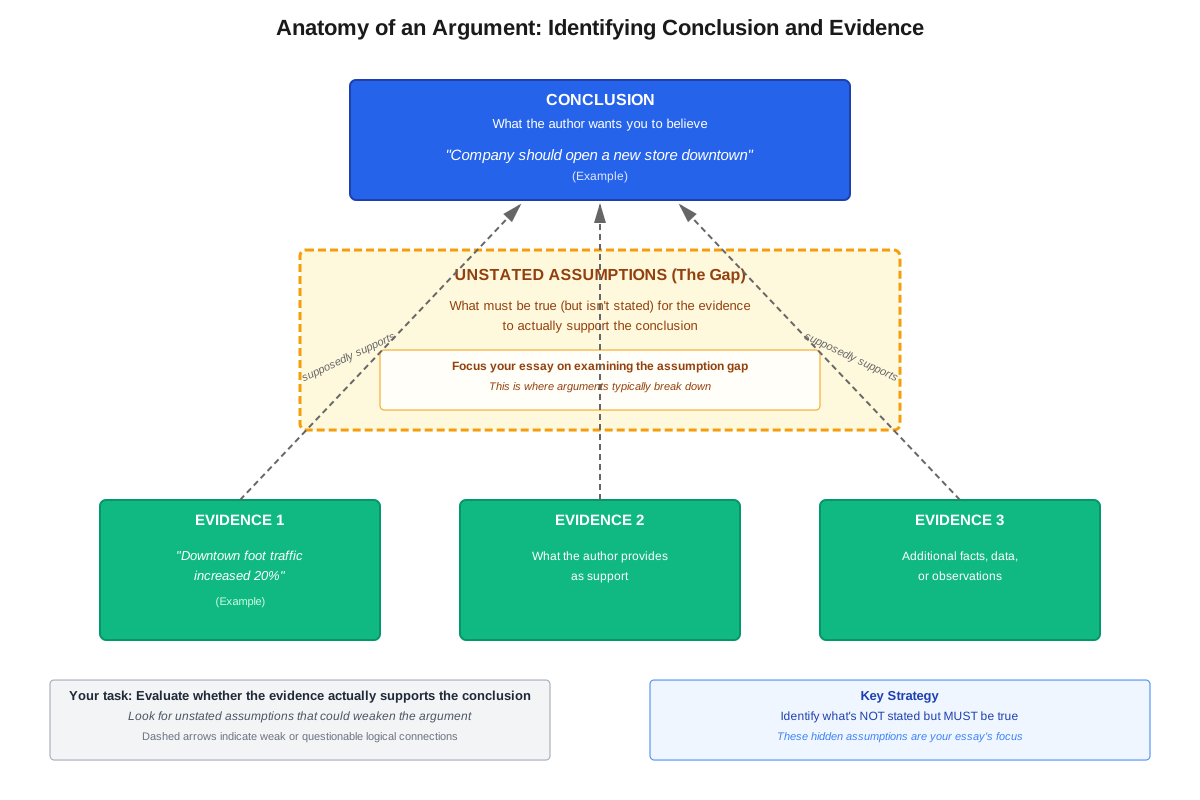
The conclusion is the main claim or recommendation that an argument attempts to establish—the "so what" or "therefore" statement that the author wants readers to accept. Evidence consists of the facts, data, examples, or reasoning offered to support that conclusion. In GRE arguments, the conclusion is often (but not always) stated in the first or last sentence and frequently contains indicator words like "therefore," "thus," "consequently," "should," or "must."
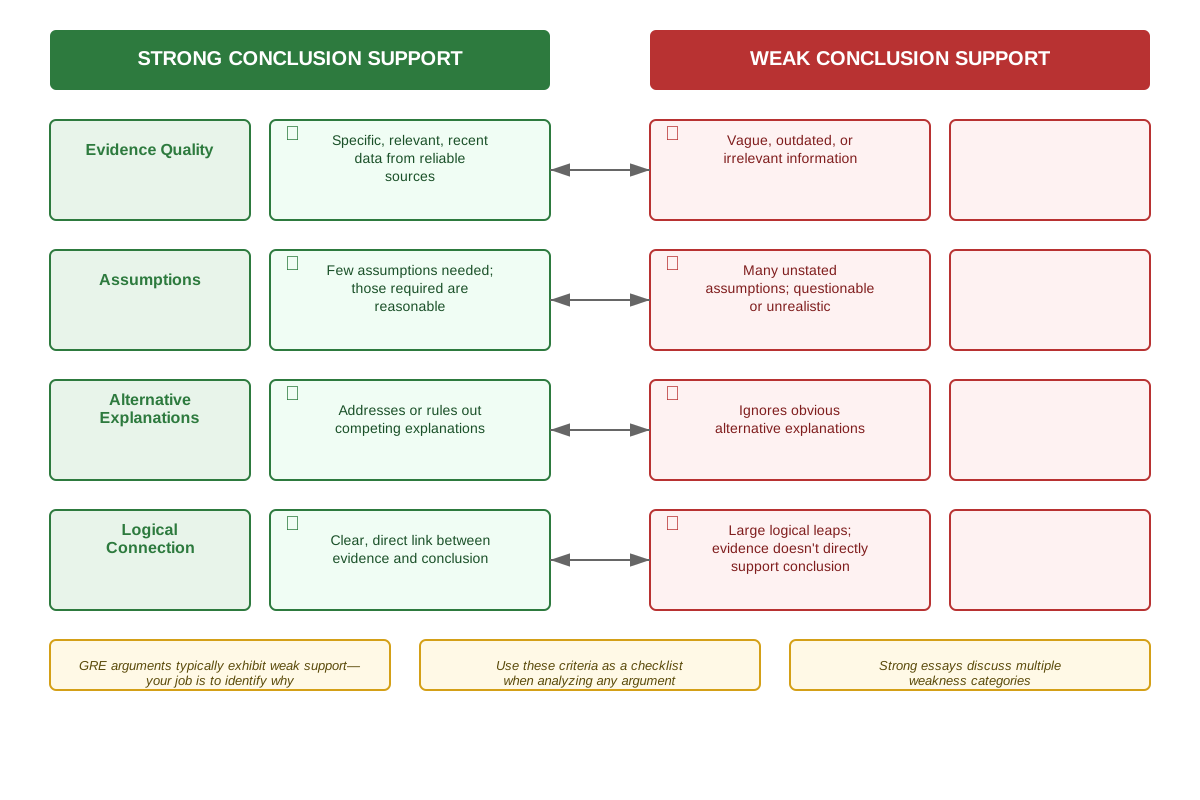
A strong conclusion is one where the evidence provided makes the conclusion highly probable or logically necessary. A weak conclusion is one where significant gaps exist between what the evidence shows and what the conclusion claims. The GRE specifically designs arguments with weak conclusions to test whether students can identify these gaps.
The Gap Between Evidence and Conclusion
The central concept in evaluating conclusion strength is recognizing that evidence can be true while still failing to adequately support a conclusion. This gap typically arises from:
- Unstated assumptions: The argument relies on beliefs or facts that are assumed but not proven
- Insufficient scope: The evidence covers only a narrow case but the conclusion generalizes broadly
- Alternative explanations: Other factors could account for the observed evidence
- Temporal issues: Past evidence may not predict future outcomes
- Sampling problems: The data comes from an unrepresentative group
For example, an argument might conclude "All residents of Smithville should exercise daily" based on evidence that "A study of 50 Smithville residents who exercised daily showed improved health." The evidence is specific and limited, while the conclusion is universal and prescriptive—a significant gap exists.
Types of Logical Weaknesses
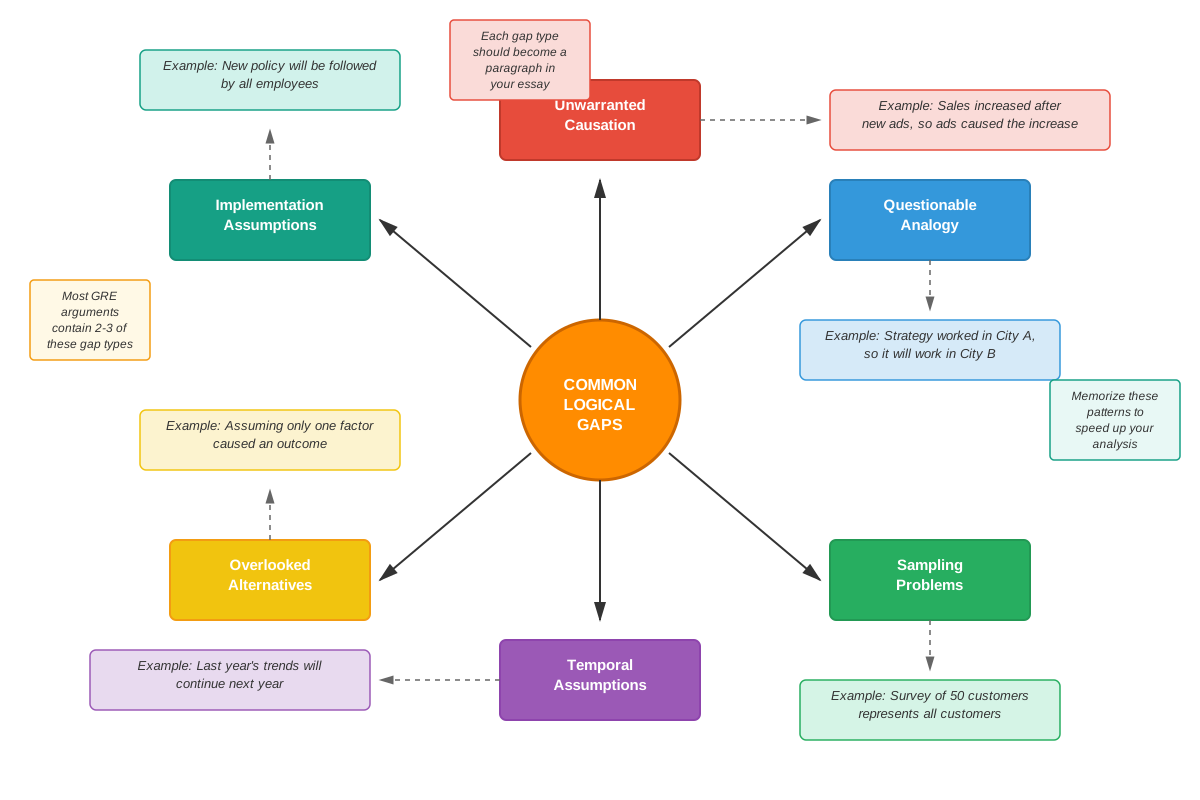
| Weakness Type | Description | Example |
|---|---|---|
| Hasty Generalization | Drawing broad conclusions from limited examples | "Three customers complained, so our entire customer base is dissatisfied" |
| False Causation | Assuming correlation proves causation | "Sales increased after we hired a new manager, so the manager caused the increase" |
| Questionable Analogy | Assuming two situations are comparable without justification | "This marketing strategy worked in City A, so it will work in City B" |
| Unrepresentative Sample | Using data from an atypical group | "Our survey of website visitors shows high satisfaction" (ignoring dissatisfied people who stopped visiting) |
| Temporal Assumption | Assuming past/present conditions will continue | "Profits have grown for five years, so they will continue growing" |
The Evaluation Framework
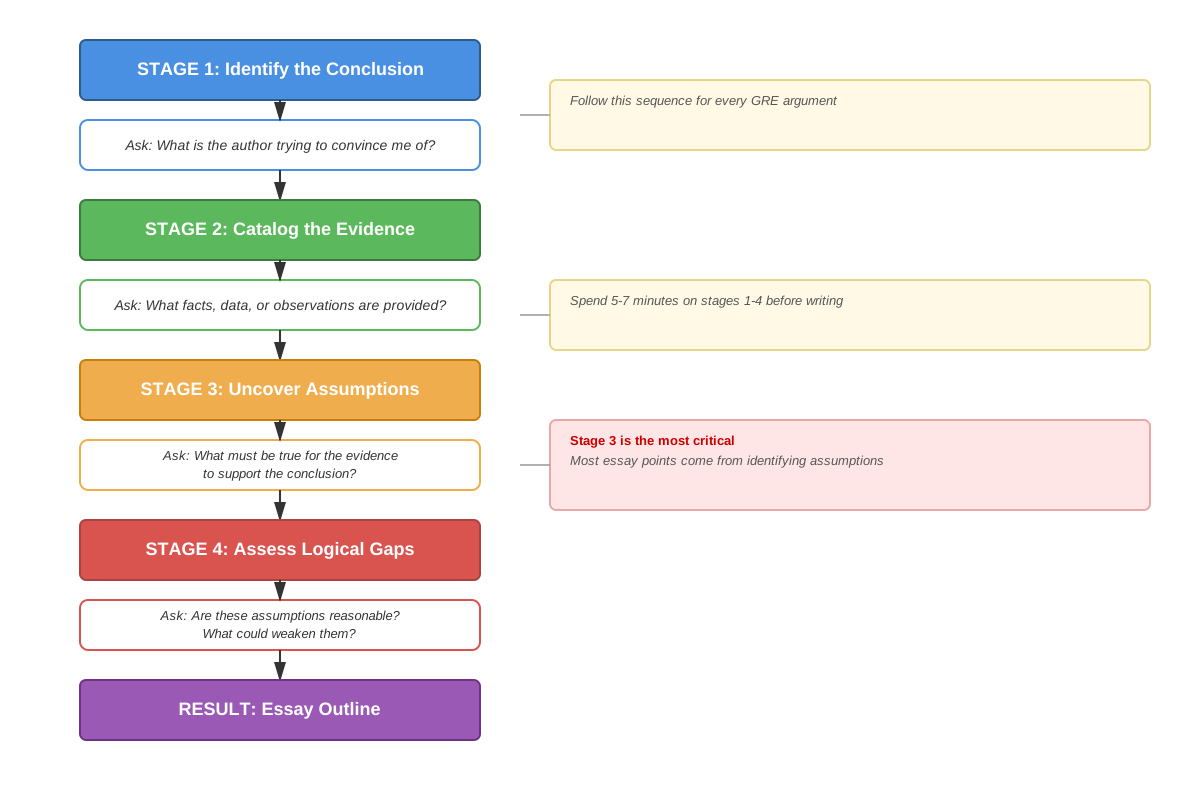
When evaluating conclusion strength, apply this systematic approach:
- Identify the conclusion: What is the author trying to prove or recommend?
- Identify the evidence: What facts, data, or reasoning support this conclusion?
- Identify the assumptions: What must be true for the evidence to support the conclusion?
- Assess each assumption: How reasonable is each assumption? What could undermine it?
- Consider alternatives: What other explanations or outcomes are possible?
- Determine overall strength: How much does the evidence actually support the conclusion?
Questions That Reveal Weaknesses
Strong evaluation involves asking specific questions that expose logical gaps. For any GRE argument, consider:
- Representativeness: Is the sample/example typical of the larger group?
- Causation: Could other factors explain the observed relationship?
- Comparability: Are the compared situations truly similar in relevant ways?
- Completeness: What relevant information is missing?
- Temporal validity: Will past patterns continue into the future?
- Implementation: Will the recommended action produce the expected result?
These questions transform vague skepticism into specific, articulate critique—exactly what the GRE rewards.
Degrees of Conclusion Strength
Not all weak arguments are equally weak. Conclusions exist on a spectrum:
- Very Strong: Evidence directly proves the conclusion with minimal assumptions
- Moderately Strong: Evidence supports the conclusion but requires some reasonable assumptions
- Weak: Evidence provides limited support; multiple questionable assumptions required
- Very Weak: Evidence is largely irrelevant or contradicts the conclusion
GRE arguments typically fall in the "weak" to "very weak" range, deliberately designed with multiple vulnerabilities. Recognizing the degree of weakness helps prioritize which issues to discuss in the essay response.
Concept Relationships
The concepts within evaluating conclusion strength form an interconnected analytical framework. The process begins with distinguishing conclusions from evidence, which enables identification of the gap between them. This gap exists because of unstated assumptions that connect evidence to conclusion. These assumptions often contain logical weaknesses of various types (hasty generalization, false causation, etc.).
Applying the evaluation framework systematically reveals these weaknesses, which can be articulated through specific questions that expose vulnerabilities. Understanding degrees of conclusion strength helps prioritize which weaknesses to emphasize in a written response.
This topic connects to prerequisite knowledge of argument structure (which helps identify conclusions and premises) and logical reasoning (which provides the foundation for recognizing valid vs. invalid inferences). It also relates to other Analytical Writing topics including identifying assumptions (a specific application of evaluating conclusion strength), recognizing logical fallacies (common patterns of weak reasoning), and constructing counterarguments (using identified weaknesses to challenge conclusions).
The relationship map: Argument Structure → Conclusion Identification → Evidence Assessment → Gap Recognition → Assumption Identification → Weakness Classification → Systematic Evaluation → Written Critique
High-Yield Facts
⭐ The GRE Argument Essay never asks whether you agree with the conclusion; it asks how well the evidence supports it
⭐ Every GRE argument contains multiple logical weaknesses by design—your task is to identify and explain them
⭐ The most common weaknesses involve unstated assumptions about causation, representativeness, and comparability
⭐ Strong responses identify 3-4 specific weaknesses and explain what additional information would help evaluate the argument
⭐ Conclusions that recommend actions or predict future outcomes are particularly vulnerable to evaluation
- Evidence can be factually accurate yet still fail to support the conclusion adequately
- The strength of a conclusion depends on the reasonableness of its underlying assumptions, not just the truth of its evidence
- Correlation between two factors never proves causation without ruling out alternative explanations
- Past trends do not guarantee future results without evidence that conditions will remain similar
- Small or self-selected samples may not represent larger populations
- Analogies between different situations require evidence that relevant factors are comparable
- Missing information is often as important as provided information when evaluating arguments
- The scope of evidence must match the scope of the conclusion for strong support
- Multiple weak pieces of evidence do not necessarily combine to create strong support
- Identifying what would strengthen or weaken an argument demonstrates deep understanding of its logical structure
Quick check — test yourself on Evaluating conclusion strength so far.
Try Flashcards →Common Misconceptions
Misconception: The goal is to disagree with the argument's conclusion
Correction: The task is to evaluate whether the evidence adequately supports the conclusion, regardless of whether the conclusion might be true in reality. An argument can reach a true conclusion through faulty reasoning, and that faulty reasoning is what the essay should address.
Misconception: Pointing out that the argument "lacks evidence" is sufficient critique
Correction: Effective evaluation requires specifying exactly what type of evidence is missing and explaining why that missing information matters for the conclusion. Generic statements about "needing more evidence" earn minimal credit.
Misconception: Longer arguments with more evidence are necessarily stronger
Correction: Quantity of evidence does not equal quality of support. An argument with extensive evidence can still be weak if that evidence doesn't address the right questions or rests on questionable assumptions.
Misconception: If any part of the evidence is questionable, the entire conclusion is worthless
Correction: Evaluation should be proportional and nuanced. Some arguments have stronger support than others, and effective analysis acknowledges degrees of strength rather than treating all arguments as equally flawed.
Misconception: Personal experience or outside knowledge should be used to evaluate the argument
Correction: Evaluation should focus on the logical relationship between the provided evidence and conclusion, not on whether the conclusion matches real-world knowledge. The GRE tests analytical reasoning, not subject-matter expertise.
Misconception: Identifying logical fallacies by name (e.g., "ad hominem," "straw man") is required
Correction: While recognizing fallacy patterns is helpful, the GRE rewards clear explanation of why the reasoning is flawed, not memorization of Latin terms. Explaining the logical gap in plain language is more valuable than labeling it.
Worked Examples
Example 1: Business Recommendation Argument
Argument: "The Riverside Café should start serving breakfast to increase profits. A survey of 50 customers who visited during lunch hours showed that 60% would be interested in breakfast options. Additionally, the Downtown Diner, which added breakfast service last year, reported a 15% increase in annual revenue. Therefore, Riverside Café should implement breakfast service immediately."
Worked Analysis:
Step 1 - Identify the conclusion: The café should start serving breakfast to increase profits.
Step 2 - Identify the evidence: (1) Survey showing 60% of lunch customers interested in breakfast; (2) Downtown Diner's revenue increased 15% after adding breakfast.
Step 3 - Identify assumptions:
- The lunch customers surveyed represent all potential breakfast customers
- Customer interest translates to actual breakfast purchases
- Riverside Café and Downtown Diner are comparable situations
- The Diner's revenue increase was caused by breakfast service
- Increased revenue means increased profits (not just sales)
- No significant costs or obstacles would prevent successful implementation
Step 4 - Assess each assumption:
Survey representativeness: The survey only captured lunch customers, who may differ significantly from potential breakfast customers. People who eat lunch at the café might not be available for breakfast due to work schedules or location. The survey also measured interest, not commitment to purchase.
Comparability: The argument assumes Riverside Café and Downtown Diner face similar circumstances, but critical differences might exist. The Diner might be in a location with more morning foot traffic, have a different customer base, or possess kitchen facilities better suited to breakfast preparation. Without evidence that relevant factors are similar, the analogy is weak.
Causation: The Diner's 15% revenue increase might result from factors other than breakfast service—improved management, marketing campaigns, competitor closures, or general economic growth. The temporal relationship (breakfast service followed by revenue increase) doesn't prove causation.
Revenue vs. Profit: Even if breakfast increases revenue, it might not increase profits if breakfast service requires significant investment in equipment, ingredients, and staff, or if breakfast items have lower profit margins than lunch items.
Step 5 - Overall evaluation: The conclusion is weakly supported. While the evidence suggests some potential for breakfast service, multiple unstated assumptions remain unexamined. The argument would be stronger with evidence that: (1) breakfast-time customers were surveyed, (2) Riverside and Downtown locations/clientele are comparable, (3) the Diner's revenue increase was specifically attributable to breakfast, and (4) projected breakfast profits exceed implementation costs.
Example 2: Public Policy Argument
Argument: "The city of Parkville should ban the use of leaf blowers to reduce noise pollution. A recent study found that leaf blower noise levels exceed 75 decibels, which can cause hearing damage with prolonged exposure. Furthermore, 200 residents signed a petition complaining about leaf blower noise. Implementing this ban would significantly improve quality of life for Parkville residents."
Worked Analysis:
Conclusion: Banning leaf blowers would significantly improve quality of life.
Evidence: (1) Leaf blowers exceed 75 decibels; (2) 200 residents signed a complaint petition.
Key Weaknesses:
Scope of the problem: The argument doesn't establish how widespread leaf blower use is in Parkville, how many residents are actually affected, or how frequently the noise occurs. If leaf blowers are used infrequently or in limited areas, the impact on overall quality of life might be minimal.
Representativeness of petition: 200 signatures might represent a tiny fraction of Parkville's population. Without knowing the city's size, we cannot assess whether this represents significant concern or a vocal minority. Additionally, people satisfied with current conditions rarely sign petitions, so the sample is self-selected and potentially unrepresentative.
Hearing damage threshold: While 75 decibels can cause damage with "prolonged exposure," the argument doesn't establish that typical exposure to leaf blowers meets this threshold. Residents might experience brief, intermittent exposure rather than prolonged exposure, making the health concern less relevant.
Alternative solutions: The argument jumps to a complete ban without considering less restrictive alternatives like time restrictions, decibel limits, or requirements for quieter equipment. These alternatives might address the noise concern while preserving the benefits of leaf blowers.
Unintended consequences: Banning leaf blowers might increase costs for landscaping services, reduce property maintenance quality, or create enforcement challenges. These factors could negatively affect quality of life, potentially offsetting any noise reduction benefits.
Strengthening questions: What percentage of Parkville residents are regularly exposed to leaf blower noise? What is the city's total population? How do residents who use landscaping services view the proposed ban? What are the costs and benefits of alternative noise reduction measures?
Exam Strategy
Approaching Argument Essay Prompts
When the 30-minute timer starts, invest the first 3-4 minutes in careful analysis before writing. Read the argument twice: first for overall understanding, second to identify the conclusion and evidence. Physically mark or mentally note the conclusion, each piece of evidence, and the assumptions connecting them.
Trigger Words for Conclusion Identification
Watch for these indicators of conclusions:
- Recommendation language: "should," "must," "ought to," "needs to"
- Prediction language: "will," "is likely to," "can expect"
- Causal claims: "therefore," "thus," "consequently," "as a result"
- Evaluative judgments: "best," "most effective," "optimal"
Trigger Words for Weak Support
These phrases often signal logical vulnerabilities:
- "A recent study/survey": Question sample size, representativeness, methodology
- "Similar to" or "like": Question whether the analogy is valid
- "After" or temporal sequences: Question whether correlation implies causation
- "Many" or "most": Question the basis for these quantitative claims
- "Will" or future predictions: Question whether past patterns will continue
Process of Elimination for Weakness Identification
Systematically check each common weakness type:
- Is there a causal claim? → Check for alternative explanations
- Is there a comparison/analogy? → Check for relevant differences
- Is there survey/sample data? → Check for representativeness
- Is there a prediction? → Check for changed conditions
- Is there a recommendation? → Check for implementation obstacles
Time Allocation
- Minutes 0-4: Read and analyze the argument, identify 3-4 major weaknesses
- Minutes 4-6: Outline the essay structure (intro, 3 body paragraphs, conclusion)
- Minutes 6-24: Write the essay (roughly 6 minutes per major section)
- Minutes 24-30: Review and revise for clarity and completeness
Exam Tip: Don't try to identify every possible weakness. Focus on 3-4 substantial issues that you can explain clearly and thoroughly. Depth matters more than breadth.
Essay Organization Strategy
Structure responses using this proven template:
- Introduction: Briefly state that the argument is flawed due to questionable assumptions
- Body Paragraph 1: First major weakness + explanation + what information would help evaluate it
- Body Paragraph 2: Second major weakness + explanation + what information would help evaluate it
- Body Paragraph 3: Third major weakness + explanation + what information would help evaluate it
- Conclusion: Summarize that the argument requires additional evidence to be persuasive
This structure ensures comprehensive coverage while maintaining clear organization—both factors in the scoring rubric.
Memory Techniques
The CREST Mnemonic for Common Weaknesses
Causation: Does correlation really prove cause-and-effect?
Representativeness: Is the sample typical of the larger group?
Evidence scope: Does the evidence match the conclusion's breadth?
Similarity: Are compared situations truly comparable?
Temporal validity: Will past patterns continue into the future?
The "Three Questions" Visualization
Picture yourself as a skeptical investor evaluating a business proposal. Before committing resources, you always ask:
- "Is this information reliable?" (representativeness, sample quality)
- "Are you sure this caused that?" (causation vs. correlation)
- "Will this work in our situation?" (comparability, implementation)
This mental model helps generate specific critiques rather than vague objections.
The Assumption Bridge Metaphor
Visualize the evidence and conclusion as two cliffs with a gap between them. Assumptions are the bridge connecting them. Your task is to examine whether each plank in that bridge is sturdy (reasonable assumption) or rotten (questionable assumption). A conclusion is only as strong as its weakest plank.
The "So What?" Chain
For each piece of evidence, repeatedly ask "So what?" until you reach the conclusion:
- "Sales increased after the new policy" → So what?
- "So the policy caused the increase" → So what?
- "So the policy will work elsewhere" → So what?
- "So we should adopt it"
Each "so what?" step represents an assumption that needs evaluation. This technique quickly reveals logical gaps.
Summary
Evaluating conclusion strength is the cornerstone skill for the GRE Argument Essay, requiring test-takers to assess whether evidence adequately supports a conclusion rather than simply agreeing or disagreeing with it. Strong evaluation recognizes that arguments contain gaps between evidence and conclusions, gaps bridged by unstated assumptions that may be questionable. The most common weaknesses involve hasty generalizations, false causation, questionable analogies, unrepresentative samples, and temporal assumptions. Effective evaluation applies a systematic framework: identify the conclusion and evidence, recognize the connecting assumptions, assess each assumption's reasonableness, consider alternative explanations, and determine overall support strength. Success on the GRE requires identifying 3-4 specific weaknesses and explaining what additional information would help evaluate the argument, all within a clear, well-organized essay structure. The ability to ask targeted questions that expose logical vulnerabilities—about representativeness, causation, comparability, and completeness—distinguishes high-scoring responses from mediocre ones.
Key Takeaways
- Evaluating conclusion strength means assessing the logical connection between evidence and conclusion, not judging whether the conclusion is true or agreeable
- Every GRE argument contains deliberate logical weaknesses; identifying and explaining 3-4 major weaknesses is the path to high scores
- The most frequently tested weaknesses involve causation assumptions, sample representativeness, questionable analogies, and predictions based on past trends
- Strong responses specify what additional information would help evaluate the argument, demonstrating understanding of what's missing
- Systematic application of the CREST framework (Causation, Representativeness, Evidence scope, Similarity, Temporal validity) ensures comprehensive analysis
- Effective essays balance breadth (covering multiple weaknesses) with depth (thoroughly explaining why each weakness matters)
- Time management is crucial: spend 3-4 minutes analyzing before writing, leaving time for revision at the end
Related Topics
Identifying Unstated Assumptions: This topic deepens the skill of recognizing what arguments take for granted, providing more sophisticated techniques for uncovering hidden premises that affect conclusion strength.
Logical Fallacies in Arguments: Understanding common patterns of flawed reasoning (false dilemma, slippery slope, appeal to authority) provides additional tools for evaluating conclusion strength and articulating specific weaknesses.
Strengthening and Weakening Arguments: This complementary skill involves determining what additional evidence would make conclusions more or less persuasive, directly building on conclusion evaluation abilities.
Argument Essay Writing Strategies: Mastering the mechanics of organizing and composing the essay response ensures that analytical insights about conclusion strength translate into high scores.
Mastering evaluating conclusion strength provides the analytical foundation for all these related topics, as recognizing weak reasoning is prerequisite to understanding how to strengthen it or avoid fallacies.
Practice CTA
Now that you understand the principles of evaluating conclusion strength, it's time to apply these concepts to actual GRE-style arguments. The practice questions and flashcards will reinforce your ability to quickly identify conclusions, spot logical gaps, and articulate specific weaknesses—skills that improve dramatically with deliberate practice. Each practice argument you analyze strengthens your pattern recognition and builds the confidence needed to excel on test day. Approach the practice materials with the same systematic framework you've learned here, and you'll see measurable improvement in both speed and accuracy. Your investment in mastering this high-yield topic will pay dividends across the entire Analytical Writing section!
Sign up free to keep reading
Create a free AnvayaPrep account to finish this GRE guide on Evaluating conclusion strength — plus flashcards and practice questions.