Overview
Suggesting improvements is a critical component of the GRE Analytical Writing Argument Essay, representing one of the most sophisticated analytical skills tested on the exam. When the GRE presents an argument essay prompt, test-takers must not only identify logical flaws and questionable assumptions but also propose concrete, actionable recommendations that would strengthen the argument's validity. This skill demonstrates advanced critical thinking—the ability to move beyond mere criticism toward constructive problem-solving. The GRE suggesting improvements task requires students to think like consultants or researchers, identifying what additional evidence, clarifications, or methodological changes would make an argument more persuasive and logically sound.
Understanding how to effectively suggest improvements is essential because it directly impacts scoring on the Analytical Writing section. According to ETS scoring guidelines, essays that earn scores of 5 or 6 consistently demonstrate the ability to "develop ideas cogently" and "convey ideas fluently and precisely." Simply pointing out flaws yields a mediocre essay; the highest-scoring responses distinguish themselves by offering thoughtful, specific suggestions that address the argument's weaknesses. This skill accounts for approximately 30-40% of the evaluation criteria in a well-balanced Argument Essay response.
Within the broader Analytical Writing framework, suggesting improvements represents the constructive counterpart to critical analysis. While identifying assumptions and logical fallacies reveals what's wrong with an argument, suggesting improvements demonstrates what could make it right. This topic builds upon foundational skills in recognizing evidence quality, understanding causal reasoning, and evaluating statistical claims. It also connects forward to real-world applications in business analysis, academic research, and policy evaluation—contexts where stakeholders expect not just criticism but actionable recommendations.
Learning Objectives
- [ ] Identify when Suggesting improvements is being tested in GRE Argument Essay prompts
- [ ] Explain the core rule or strategy behind Suggesting improvements in analytical writing
- [ ] Apply Suggesting improvements to GRE-style questions accurately and effectively
- [ ] Distinguish between vague and specific improvement suggestions
- [ ] Generate multiple improvement categories for a single flawed argument
- [ ] Connect each suggested improvement directly to an identified logical weakness
- [ ] Evaluate the feasibility and relevance of proposed improvements
Prerequisites
- Understanding of logical fallacies: Necessary because improvements must address specific reasoning errors such as hasty generalizations, false causality, or sampling bias
- Ability to identify assumptions: Required because the most effective improvements target unstated assumptions that weaken arguments
- Familiarity with evidence types: Essential for suggesting what kinds of data, studies, or information would strengthen an argument's foundation
- Basic essay structure knowledge: Important for organizing improvement suggestions within a coherent analytical essay framework
Why This Topic Matters
In real-world contexts, the ability to suggest improvements translates directly to professional competencies valued across industries. Business consultants must recommend specific actions to address organizational weaknesses. Academic researchers must propose methodological refinements to strengthen study designs. Policy analysts must suggest evidence-based modifications to improve program effectiveness. The GRE tests this skill because graduate programs seek students who can engage constructively with ideas rather than simply critique them.
On the GRE Analytical Writing section, suggesting improvements appears in virtually every Argument Essay prompt, making it a high-frequency, high-impact topic. The standard Argument Essay instructions explicitly direct test-takers to "discuss what questions would need to be answered in order to decide whether the recommendation is likely to have the predicted result" or "what evidence would strengthen or weaken the argument." Approximately 100% of Argument Essay prompts require some form of improvement suggestion, though the specific phrasing varies. Essays that fail to include substantive improvement suggestions rarely score above a 4, regardless of how well they identify flaws.
Common manifestations in exam passages include arguments with: insufficient survey data (suggesting larger sample sizes or demographic verification), correlation-causation confusion (suggesting controlled experiments or alternative explanation investigation), unrepresentative samples (suggesting broader sampling methods), temporal assumptions (suggesting longitudinal studies), and analogical reasoning flaws (suggesting direct comparative studies). Recognizing these patterns enables test-takers to quickly generate relevant improvement suggestions under time pressure.
Core Concepts
The Foundation: Moving from Critique to Construction
Suggesting improvements fundamentally means proposing specific actions, evidence, or clarifications that would address an argument's logical weaknesses and make its conclusion more convincing. Unlike simple criticism, which identifies what's wrong, improvement suggestions answer the question: "What would need to be true, known, or demonstrated for this argument to become stronger?" This constructive approach requires understanding both the argument's current flaws and the types of information or reasoning that could remedy those flaws.
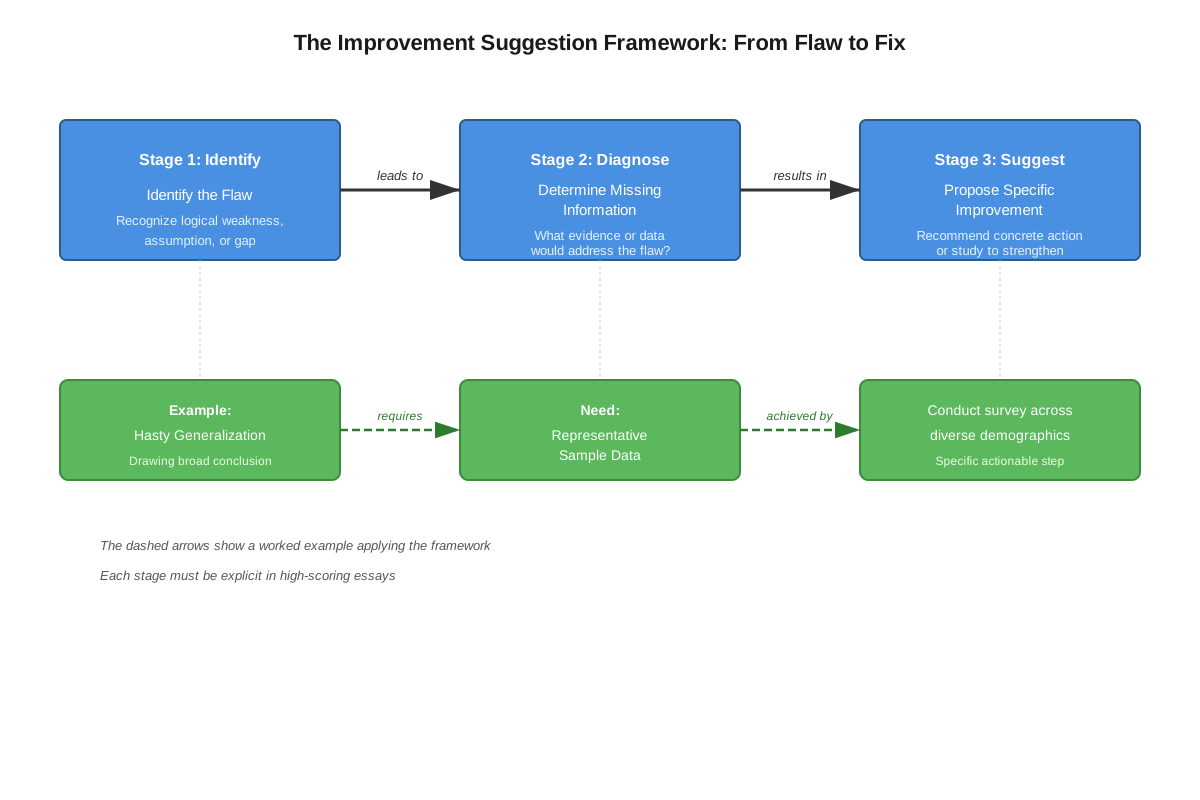
The core strategy involves a three-step process: (1) identify a specific logical weakness or questionable assumption, (2) determine what information or evidence is missing or unclear, and (3) propose a concrete way to obtain or clarify that information. For example, if an argument assumes that a correlation between ice cream sales and drowning deaths indicates causation, the improvement isn't merely stating "this is correlation, not causation." Instead, the improvement would be: "The argument would be strengthened by investigating whether a third variable, such as summer temperature, explains both increases, or by conducting a controlled study that manipulates ice cream availability while controlling for seasonal factors."
Categories of Improvement Suggestions
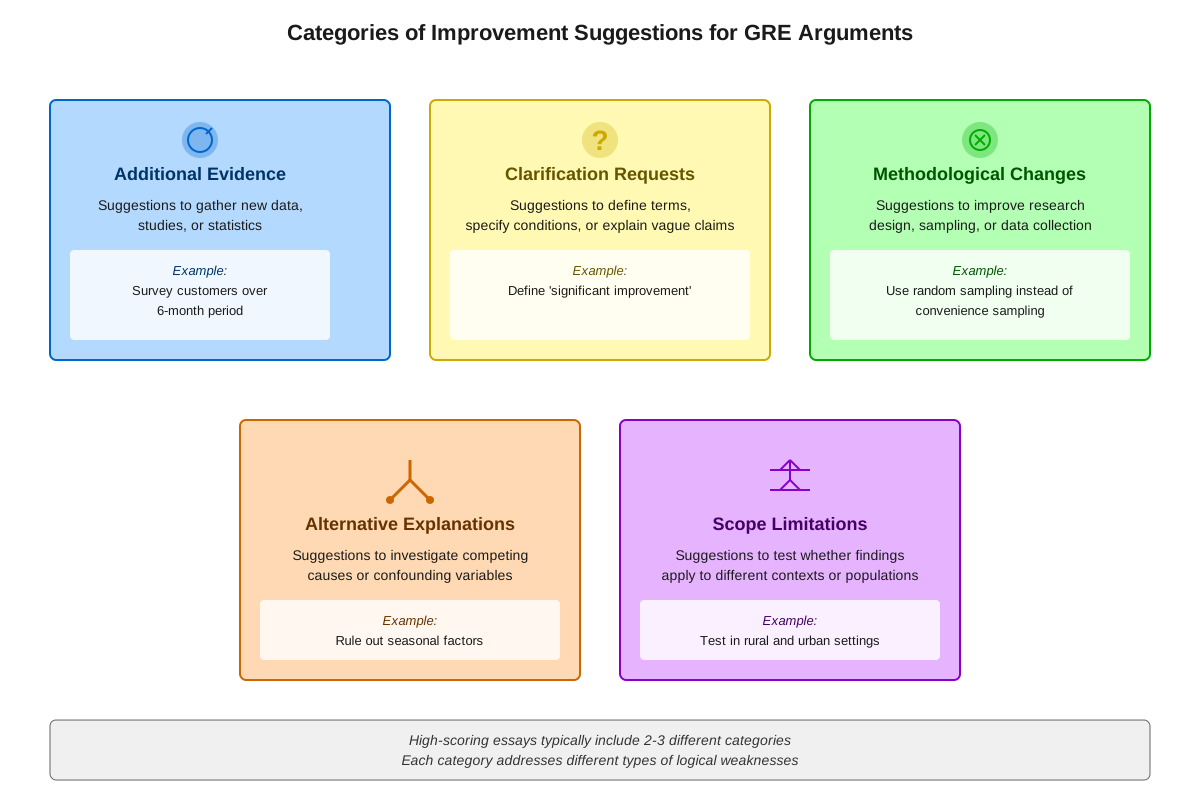
Effective improvement suggestions typically fall into several distinct categories, each addressing different types of logical weaknesses:
| Improvement Category | Purpose | Example Application |
|---|---|---|
| Additional Evidence | Provide missing data to support claims | "Survey data from neighboring cities would clarify whether the trend is local or regional" |
| Clarification Requests | Define ambiguous terms or scope | "Specifying what constitutes 'success' would enable evaluation of the program's effectiveness" |
| Methodological Refinements | Improve study design or data collection | "A randomized controlled trial would establish causation rather than mere correlation" |
| Alternative Explanations | Investigate competing hypotheses | "Research into economic factors during the same period would determine if they better explain the outcome" |
| Temporal Extensions | Examine longer time frames | "Five-year follow-up data would reveal whether initial improvements were sustained" |
| Comparative Analysis | Add control groups or benchmarks | "Comparing results with similar cities that didn't implement the policy would isolate its effects" |
Specificity: The Hallmark of Strong Suggestions
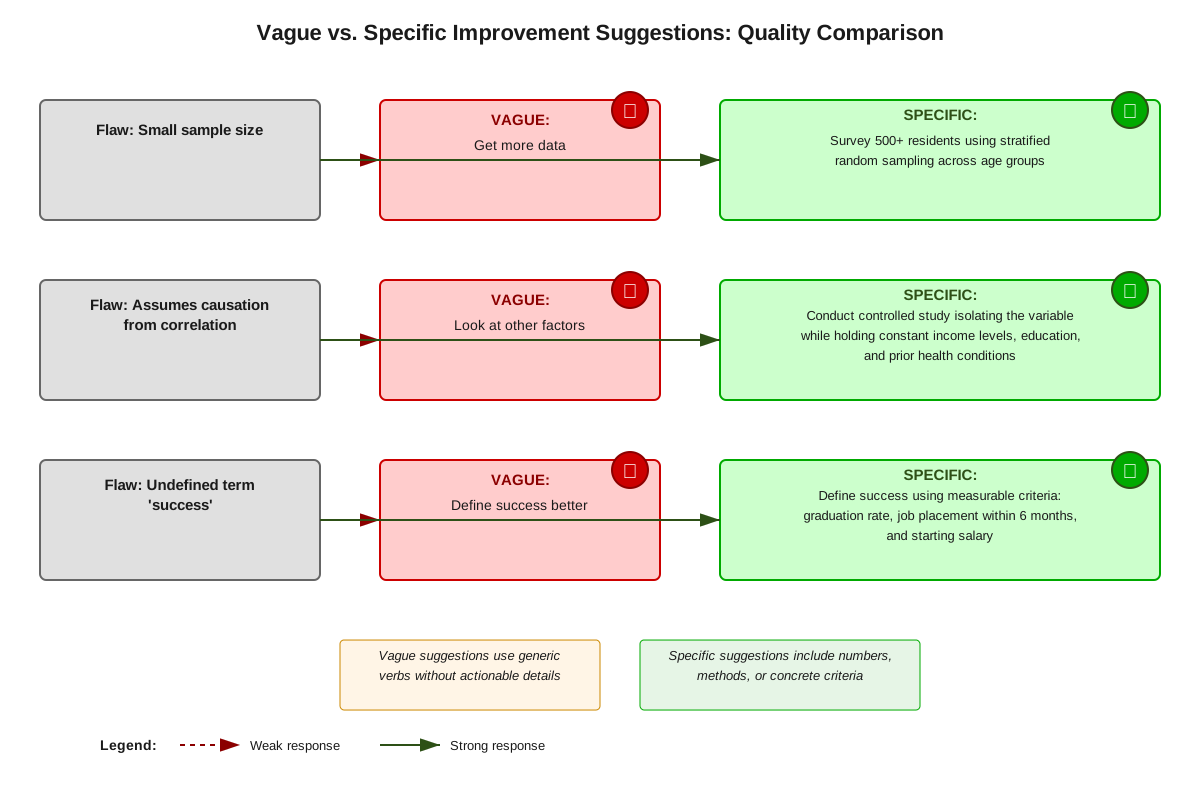
The difference between mediocre and excellent improvement suggestions lies in specificity. Vague suggestions like "more research is needed" or "better data would help" add minimal value and suggest superficial analysis. Strong suggestions specify exactly what should be researched, what data should be collected, how it should be gathered, and why it would address the particular weakness identified.
Consider this weak versus strong comparison:
Weak: "The argument needs more information about the survey."
Strong: "The argument would be strengthened by providing the survey's sample size, demographic breakdown, response rate, and question wording to assess whether the results represent the broader population and whether leading questions might have biased responses."
The strong version demonstrates analytical depth by identifying multiple specific aspects of survey methodology that could affect validity.
Connecting Improvements to Identified Flaws
Each improvement suggestion must explicitly connect to a previously identified logical weakness. This connection demonstrates analytical coherence and ensures that suggestions are relevant rather than tangential. The typical structure follows this pattern:
- Identify the flaw: "The argument assumes that the 20% increase in gym memberships directly caused the 15% decrease in healthcare costs."
- Explain why it's problematic: "This assumption is questionable because numerous other factors could explain reduced healthcare costs, including changes in insurance coverage, demographic shifts, or preventive care initiatives."
- Suggest the improvement: "To strengthen this causal claim, the argument would benefit from a longitudinal study tracking individual gym members' healthcare utilization compared to a matched control group of non-members, controlling for variables such as age, income, and pre-existing conditions."
This three-part structure ensures that improvements aren't arbitrary but directly address the argument's logical vulnerabilities.
The "Questions to Answer" Framework
Many GRE Argument Essay prompts explicitly ask test-takers to discuss "what questions would need to be answered" to evaluate the argument. This framework provides an excellent structure for suggesting improvements. Each question should:
- Address a specific assumption or gap in the argument
- Be answerable through concrete evidence or research
- Have clear implications for the argument's validity
For example, if an argument claims that a new traffic light reduced accidents at an intersection, relevant questions include:
- What was the accident rate at this intersection during comparable periods in previous years?
- Were there other changes (road repairs, increased police presence, weather patterns) during the same timeframe?
- How does the accident reduction compare to citywide trends during this period?
- What types of accidents decreased—those the traffic light would logically prevent?
Each question, when answered, would provide evidence that either strengthens or weakens the argument's conclusion.
Feasibility and Relevance Considerations
While creativity in suggesting improvements is valuable, the most effective suggestions are both feasible (realistically obtainable) and relevant (directly addressing the argument's core weaknesses). Suggesting a nationwide longitudinal study spanning 20 years might be theoretically ideal but practically unrealistic. Similarly, suggesting improvements that address minor tangential issues rather than central logical flaws demonstrates poor prioritization.
The GRE rewards suggestions that demonstrate practical judgment: proposing surveys, comparative studies, clarifications of terms, investigation of alternative explanations, and examination of additional time periods—all realistic approaches that directly target the argument's most significant vulnerabilities.
Concept Relationships
The skill of suggesting improvements sits at the intersection of multiple analytical competencies. It directly builds upon assumption identification—one cannot suggest meaningful improvements without first recognizing what the argument takes for granted. When a test-taker identifies that an argument assumes survey respondents represent the general population, this recognition naturally leads to improvement suggestions about sampling methodology, demographic verification, or response rate analysis.
Evidence evaluation serves as another prerequisite relationship. Understanding what constitutes strong versus weak evidence enables test-takers to suggest specific types of evidence that would strengthen an argument. If an argument relies on anecdotal evidence, recognizing this weakness leads to suggestions for systematic data collection, controlled studies, or statistical analysis.
The relationship flows as follows: Logical Fallacy Recognition → Assumption Identification → Evidence Gap Analysis → Improvement Suggestion. Each step depends on the previous one, creating a analytical chain that culminates in constructive recommendations.
Within the suggesting improvements topic itself, the various improvement categories (additional evidence, methodological refinements, clarification requests) are not mutually exclusive but complementary. A single flawed argument typically requires multiple types of improvements, and the most comprehensive essays address weaknesses from several angles. For instance, an argument about a business recommendation might need both clarification of financial terms AND additional market research data AND investigation of alternative explanations for past trends.
Suggesting improvements also connects forward to essay organization and development. Each improvement suggestion can form the basis of a body paragraph, with the identified flaw serving as the topic sentence, the explanation of why it's problematic providing development, and the specific improvement suggestion offering the constructive conclusion. This structural relationship helps test-takers organize their essays coherently under time pressure.
High-Yield Facts
⭐ Every GRE Argument Essay prompt requires suggesting improvements in some form, making this a mandatory skill for achieving competitive scores.
⭐ Specific improvement suggestions (naming exact types of data, studies, or clarifications needed) score significantly higher than vague suggestions like "more research is needed."
⭐ The most effective improvements directly address the argument's central assumptions rather than peripheral details.
⭐ Improvement suggestions should be feasible and realistic, not requiring decades of research or impossible data collection.
⭐ Each improvement suggestion must explicitly connect to a previously identified logical flaw or questionable assumption.
- Improvement suggestions typically fall into six categories: additional evidence, clarification requests, methodological refinements, alternative explanation investigation, temporal extensions, and comparative analysis.
- The "questions to answer" framework provides an excellent structure for organizing improvement suggestions in essay responses.
- Strong essays typically include 3-5 substantive improvement suggestions, each developed in detail rather than listing many superficial suggestions.
- Improvements addressing sampling issues, causation claims, and representativeness concerns appear most frequently on actual GRE prompts.
- Test-takers should allocate approximately 8-10 minutes of their 30-minute essay time to developing improvement suggestions.
- Improvement suggestions demonstrate higher-order thinking (synthesis and evaluation) compared to mere identification of flaws (analysis).
- The best improvement suggestions specify not just what information is needed but also how it could be obtained or verified.
Quick check — test yourself on Suggesting improvements so far.
Try Flashcards →Common Misconceptions
Misconception: Suggesting improvements means proposing ways to fix the situation described in the argument (e.g., how to actually reduce traffic or improve business performance).
Correction: Suggesting improvements means proposing ways to strengthen the argument itself—what evidence, clarifications, or methodological changes would make the reasoning more logically sound, not how to solve the real-world problem the argument discusses.
Misconception: Any suggestion for "more research" or "additional data" constitutes an adequate improvement suggestion.
Correction: Vague calls for more information demonstrate superficial analysis. Effective suggestions specify exactly what type of data, research design, sample characteristics, or clarifications would address the specific logical weakness identified.
Misconception: Improvement suggestions should only appear in the conclusion paragraph of the essay.
Correction: Improvement suggestions should be integrated throughout the essay, with each body paragraph typically identifying a flaw and then suggesting how to address it. The conclusion may synthesize these suggestions but shouldn't introduce them for the first time.
Misconception: The more improvement suggestions included, the higher the essay score.
Correction: Quality trumps quantity. Three well-developed, specific improvement suggestions that directly address central weaknesses will score higher than ten superficial or tangential suggestions. Depth of analysis matters more than breadth.
Misconception: Improvement suggestions should focus on making the argument's conclusion true.
Correction: Improvement suggestions should focus on making the argument's reasoning more valid and its evidence more reliable. Even if the conclusion happens to be true, the argument can still be logically flawed, and improvements address the reasoning process, not the truth of the conclusion.
Worked Examples
Example 1: Restaurant Recommendation Argument
Argument: "The Riverside Restaurant should start serving breakfast to increase profits. A survey of 50 customers who dined there for lunch or dinner showed that 70% would be interested in breakfast options. Additionally, the restaurant across the street recently added breakfast service and has seen a 25% increase in revenue. Therefore, adding breakfast will likely increase Riverside's profits."
Step 1: Identify Key Weaknesses
This argument contains several logical flaws:
- The survey sample (existing lunch/dinner customers) may not represent potential breakfast customers
- Interest expressed in a survey doesn't guarantee actual patronage
- The competitor's revenue increase may stem from factors other than breakfast service
- Increased revenue doesn't necessarily mean increased profits (costs aren't considered)
Step 2: Develop Specific Improvement Suggestions
Improvement Suggestion 1 (addressing survey representativeness):
"The argument would be strengthened by conducting a survey of people who live or work near the restaurant but don't currently patronize it, since breakfast customers may differ demographically and behaviorally from lunch and dinner customers. Additionally, the survey should ask not just about interest but about specific behavioral intentions, such as how frequently respondents would likely eat breakfast at Riverside and what price points would be acceptable."
Improvement Suggestion 2 (addressing the competitor comparison):
"To determine whether breakfast service actually caused the competitor's revenue increase, the argument needs information about other changes that restaurant might have implemented simultaneously (such as renovations, marketing campaigns, or menu changes) and whether similar restaurants in the area without breakfast service experienced comparable revenue growth during the same period. A controlled comparison would isolate the effect of breakfast service specifically."
Improvement Suggestion 3 (addressing the profit assumption):
"The argument would benefit from a detailed cost-benefit analysis showing the expenses associated with breakfast service—including additional staff wages, ingredient costs, utility expenses during morning hours, and equipment purchases—compared to projected breakfast revenue. Information about the restaurant's current profit margins and whether the kitchen and dining space can accommodate breakfast service without reducing lunch/dinner capacity would also strengthen the recommendation."
Connection to Learning Objectives: This example demonstrates how to identify when improvements are needed (multiple logical gaps), explains the strategy (connecting each improvement to a specific flaw), and applies the skill to a GRE-style argument with appropriate specificity.
Example 2: Educational Policy Argument
Argument: "Bellville should adopt a year-round school calendar to improve student academic performance. A study of three schools that switched to year-round calendars showed average test scores increased by 12% in the first year. Furthermore, year-round schooling reduces summer learning loss, which particularly affects students from low-income families. Therefore, implementing year-round schooling district-wide will raise academic achievement."
Step 1: Identify Key Weaknesses
Critical flaws include:
- Small sample size (three schools) may not be representative
- No control group to determine if test scores would have increased anyway
- Correlation between calendar change and score improvement doesn't establish causation
- Assumption that results from three schools will generalize to entire district
- No information about implementation costs or teacher/family preferences
Step 2: Develop Specific Improvement Suggestions
Improvement Suggestion 1 (addressing causation and controls):
"The argument would be significantly strengthened by comparing the test score changes at these three schools with score changes at similar schools that maintained traditional calendars during the same period. This comparison would help determine whether the year-round calendar specifically caused the improvement or whether district-wide trends, new curricula, or other factors better explain the results. Additionally, examining whether the improvement was sustained in subsequent years would indicate if the effect is durable or merely a temporary novelty effect."
Improvement Suggestion 2 (addressing generalizability):
"To evaluate whether results from three schools would apply district-wide, the argument needs information about how these schools compare to others in Bellville regarding student demographics, baseline academic performance, school size, and resource availability. If the three schools were atypical—for example, if they were smaller, better-funded, or served different populations than most district schools—the results might not generalize. A pilot program involving a more diverse and representative sample of schools would provide more reliable evidence."
Improvement Suggestion 3 (addressing implementation feasibility):
"The argument would benefit from research into the practical and financial implications of district-wide implementation, including costs for facility modifications, transportation schedule changes, and teacher compensation adjustments. Additionally, surveying families about childcare implications and teachers about professional development needs would reveal potential implementation barriers that could affect the policy's success. Evidence from districts similar to Bellville that have successfully implemented year-round calendars would also strengthen the recommendation."
Connection to Learning Objectives: This example shows how to generate multiple improvement categories (methodological refinements, comparative analysis, feasibility studies) for a single argument and how to make each suggestion specific and actionable rather than vague.
Exam Strategy
When approaching GRE Argument Essay prompts, implement this systematic strategy for suggesting improvements:
Time Allocation: Dedicate approximately 8-10 minutes of your 30-minute essay to developing improvement suggestions. Spend 2-3 minutes during your initial analysis identifying which flaws most need addressing, then integrate improvement suggestions as you write each body paragraph.
Trigger Words and Phrases: Watch for these prompt instructions that signal the need for improvement suggestions:
- "What questions would need to be answered..."
- "What evidence would strengthen or weaken..."
- "What additional information would be most useful..."
- "Discuss what questions would need to be addressed..."
- "Explain how the answers to these questions would help..."
These phrases explicitly direct you to suggest improvements, making this component mandatory for a complete response.
The Three-Part Paragraph Structure: Organize each body paragraph using this proven formula:
- Identify: State the logical flaw or questionable assumption (2-3 sentences)
- Explain: Explain why this weakens the argument (2-3 sentences)
- Improve: Suggest specific ways to address this weakness (3-4 sentences)
This structure ensures you don't merely criticize but also offer constructive solutions.
Prioritization Strategy: Not all flaws are equally important. Focus your improvement suggestions on:
- Assumptions central to the argument's main conclusion
- Evidence gaps that most significantly weaken the reasoning
- Issues affecting the argument's logical validity rather than peripheral details
If time runs short, one well-developed improvement addressing a central flaw outweighs three superficial suggestions about minor issues.
Specificity Checklist: Before finalizing each improvement suggestion, verify it includes:
- What specific information or evidence is needed
- How that information could be obtained or verified
- Why that information would address the identified weakness
- What the implications would be if the information supported or contradicted the argument
Process of Elimination for Self-Checking: Avoid these red flags that indicate weak improvement suggestions:
- ❌ Vague phrases like "more research" without specifying what kind
- ❌ Suggestions that would require impossible data collection
- ❌ Improvements addressing issues not actually present in the argument
- ❌ Suggestions about fixing the real-world problem rather than strengthening the argument's logic
- ❌ Improvements that don't connect to previously identified flaws
Template Phrases for Strong Suggestions: Use these sentence starters to ensure specificity:
- "The argument would be strengthened by [specific type of study/data] that examines..."
- "To evaluate this assumption, the author would need to provide information about..."
- "A comparison between [specific groups] would clarify whether..."
- "Longitudinal data tracking [specific variables] over [timeframe] would reveal..."
- "Clarifying the definition of [ambiguous term] and specifying [measurement criteria] would enable..."
Memory Techniques
IMPROVE Acronym for remembering improvement categories:
- Investigate alternative explanations
- Methodology refinements (better study designs)
- Provide additional evidence
- Refine definitions and clarify terms
- Obtain comparative data (control groups, benchmarks)
- Verify representativeness (sampling, generalizability)
- Extend timeframes (longitudinal data)
The "Three Whats" Mnemonic: Every improvement suggestion should answer:
- What information is missing?
- What method would obtain it?
- What would it reveal about the argument?
Visualization Strategy: Picture yourself as a consultant hired to strengthen the argument. Your job isn't to defend the conclusion but to identify what the argument's author should have included to make their case more convincing. This mental frame naturally generates constructive improvement suggestions rather than mere criticism.
The Specificity Test: Remember "SWAN" to ensure suggestions aren't too vague:
- Specific type of data/study
- Why it addresses the flaw
- Action to obtain it
- Next steps or implications
If your suggestion doesn't include all four SWAN elements, it needs more development.
Connection Chain: Visualize this sequence for each body paragraph:
Flaw → Gap → Bridge → Stronger Argument
The "bridge" is your improvement suggestion that connects the gap to a potentially stronger argument.
Summary
Suggesting improvements represents a critical analytical skill for GRE Argument Essay success, requiring test-takers to move beyond identifying flaws toward proposing specific, actionable ways to strengthen an argument's logical foundation. This skill appears in virtually every Argument Essay prompt and significantly influences scoring, with essays earning 5-6 scores consistently demonstrating well-developed, specific improvement suggestions. Effective improvements fall into several categories—additional evidence, methodological refinements, clarification requests, alternative explanation investigation, temporal extensions, and comparative analysis—and must directly address identified logical weaknesses rather than offering vague calls for "more research." The key to excellence lies in specificity: naming exact types of studies, data, or clarifications needed and explaining how each would address particular flaws. By connecting each improvement suggestion to a previously identified assumption or evidence gap, test-takers demonstrate analytical coherence and depth. Mastering this skill requires understanding not just what's wrong with an argument but what would make it right—a constructive, solution-oriented approach that mirrors real-world analytical demands in graduate study and professional contexts.
Key Takeaways
- Suggesting improvements is mandatory for competitive GRE Argument Essay scores, appearing in 100% of prompts through various phrasings about "questions to answer" or "evidence needed"
- Specificity distinguishes excellent from mediocre suggestions—always name exact types of data, studies, or clarifications rather than vague calls for "more information"
- Each improvement must connect directly to an identified flaw, following the structure: identify weakness → explain why it's problematic → suggest specific remedy
- Focus on the argument's logic, not the real-world problem—improvements should strengthen reasoning and evidence, not solve the situation described
- Feasibility and relevance matter—suggest realistic, obtainable information that addresses central weaknesses rather than peripheral issues
- Use the three-part paragraph structure (identify-explain-improve) to ensure balanced development throughout your essay
- Quality trumps quantity—three well-developed improvement suggestions addressing major flaws outperform many superficial suggestions
Related Topics
Identifying Assumptions in Arguments: Mastering assumption identification directly enables more effective improvement suggestions, since the strongest improvements address unstated assumptions that weaken arguments. This foundational skill precedes suggesting improvements in the analytical sequence.
Evaluating Evidence Quality: Understanding what constitutes strong versus weak evidence allows test-takers to suggest specific types of evidence that would strengthen arguments. This topic provides the knowledge base for evidence-focused improvement suggestions.
Causal Reasoning and Correlation-Causation Fallacies: Many improvement suggestions involve proposing controlled studies or investigations of alternative explanations to address causation claims. Mastering causal reasoning enables more sophisticated methodological improvement suggestions.
Survey and Sampling Methodology: Since many GRE arguments rely on survey data or samples, understanding sampling principles enables specific improvement suggestions about sample size, representativeness, response rates, and question design.
Essay Organization and Development: The skill of suggesting improvements integrates into overall essay structure, with each body paragraph typically including an improvement suggestion. Mastering this topic enhances the ability to organize coherent, well-developed Argument Essays.
Practice CTA
Now that you've mastered the principles of suggesting improvements, it's time to apply these strategies to actual GRE-style arguments. The practice questions and flashcards will help you internalize the patterns of effective improvement suggestions and develop the automaticity needed to generate specific, relevant recommendations under time pressure. Remember: every practice essay is an opportunity to refine your ability to think constructively about logical weaknesses. Approach each practice argument as a consultant would—identifying not just what's wrong but exactly what would make it right. Your ability to suggest concrete, feasible improvements will distinguish your essays and demonstrate the analytical sophistication graduate programs seek. Start practicing now to build the confidence and skill that lead to top scores!
Sign up free to keep reading
Create a free AnvayaPrep account to finish this GRE guide on Suggesting improvements — plus flashcards and practice questions.