Overview
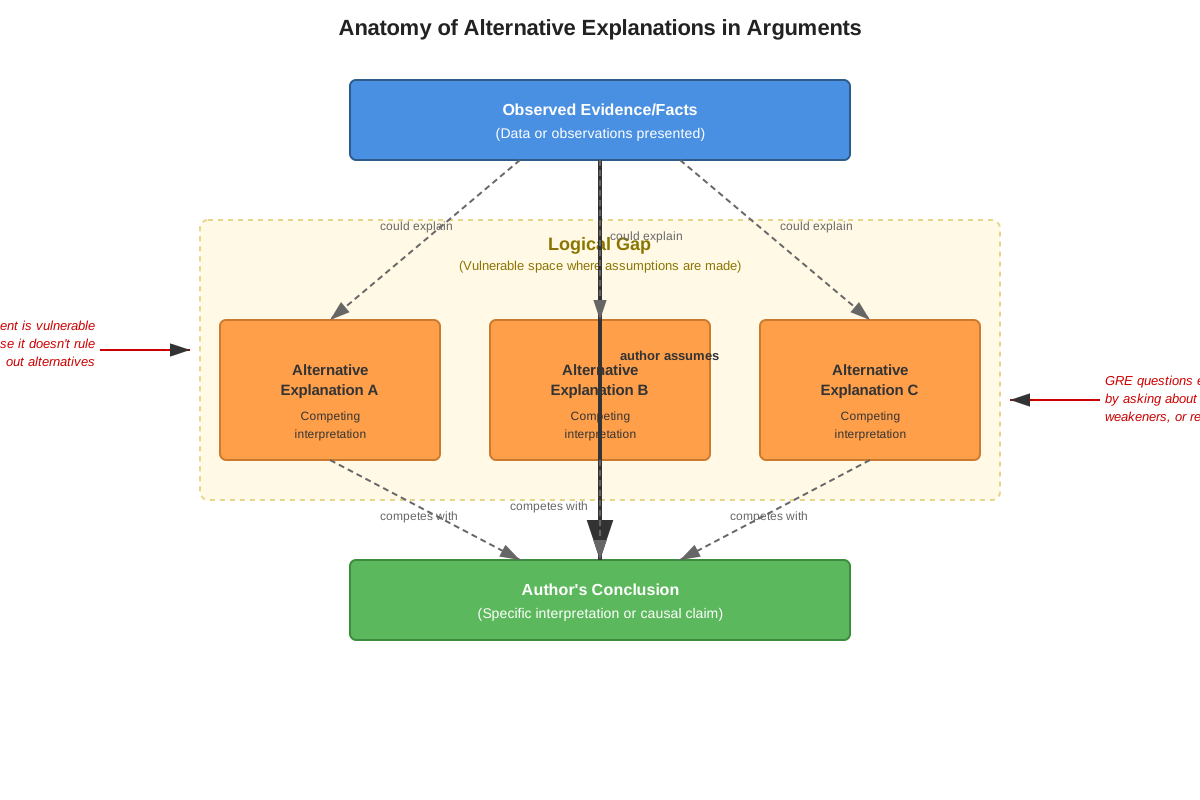
Alternative explanations represent one of the most frequently tested critical reasoning skills on the GRE Verbal Reasoning section. This concept requires test-takers to recognize that when presented with a set of facts or observations, multiple interpretations or causes may account for the same phenomenon. Rather than accepting the first or most obvious explanation, skilled critical thinkers must consider whether other plausible scenarios could equally well explain the evidence presented. On the GRE, questions testing gre alternative explanations typically present an argument that draws a specific conclusion from certain evidence, then ask test-takers to identify assumptions, weaken the argument, or recognize what additional information would be relevant—all of which hinge on understanding that alternative causal pathways or interpretations exist.
The ability to generate and evaluate alternative explanations is fundamental to critical reasoning because it directly challenges the logical leap between evidence and conclusion. Many GRE arguments commit the fallacy of assuming that correlation implies causation, or that one particular explanation is the only possible account of observed facts. Test-takers who master this skill can quickly identify the gap in reasoning and select answer choices that either expose this gap or provide information that would help distinguish between competing explanations.
Within the broader landscape of GRE Verbal Reasoning, alternative explanations connect intimately with other critical reasoning skills including assumption identification, argument weakening and strengthening, and evaluation of evidence. This topic serves as a foundation for understanding how arguments can be vulnerable to challenge and how additional evidence can shift the persuasiveness of competing claims. Mastering alternative explanations enhances performance not only on dedicated critical reasoning questions but also improves reading comprehension by fostering a more analytical, questioning approach to any argumentative text.
Learning Objectives
- [ ] Identify when Alternative explanations is being tested
- [ ] Explain the core rule or strategy behind Alternative explanations
- [ ] Apply Alternative explanations to GRE-style questions accurately
- [ ] Generate at least two plausible alternative explanations for any given set of observations
- [ ] Distinguish between alternative explanations that genuinely compete with a conclusion versus those that are irrelevant
- [ ] Evaluate which types of additional evidence would help discriminate between competing explanations
- [ ] Recognize the relationship between alternative explanations and common logical fallacies (especially correlation/causation errors)
Prerequisites
- Basic argument structure: Understanding premises, conclusions, and how evidence supports claims is essential because alternative explanations specifically target the connection between evidence and conclusion
- Causal reasoning fundamentals: Recognizing the difference between correlation and causation provides the foundation for understanding why alternative explanations matter
- Logical fallacies overview: Familiarity with common reasoning errors helps identify when an argument is vulnerable to alternative explanations
- Reading comprehension skills: The ability to extract main ideas and supporting details from passages enables accurate identification of what needs to be explained
Why This Topic Matters
Alternative explanations represent a cornerstone of scientific thinking, legal reasoning, and everyday decision-making. In real-world contexts, professionals across fields—from medical diagnostics to business analytics to policy evaluation—must constantly consider whether their initial interpretation of data is the only viable explanation or whether other factors could account for observed patterns. A doctor observing that patients taking a certain medication show improvement must consider whether the medication caused the improvement or whether other factors (natural recovery, placebo effect, lifestyle changes) provide alternative explanations. Similarly, a business analyst noting increased sales after a marketing campaign must evaluate whether the campaign caused the increase or whether seasonal trends, competitor actions, or economic conditions offer alternative accounts.
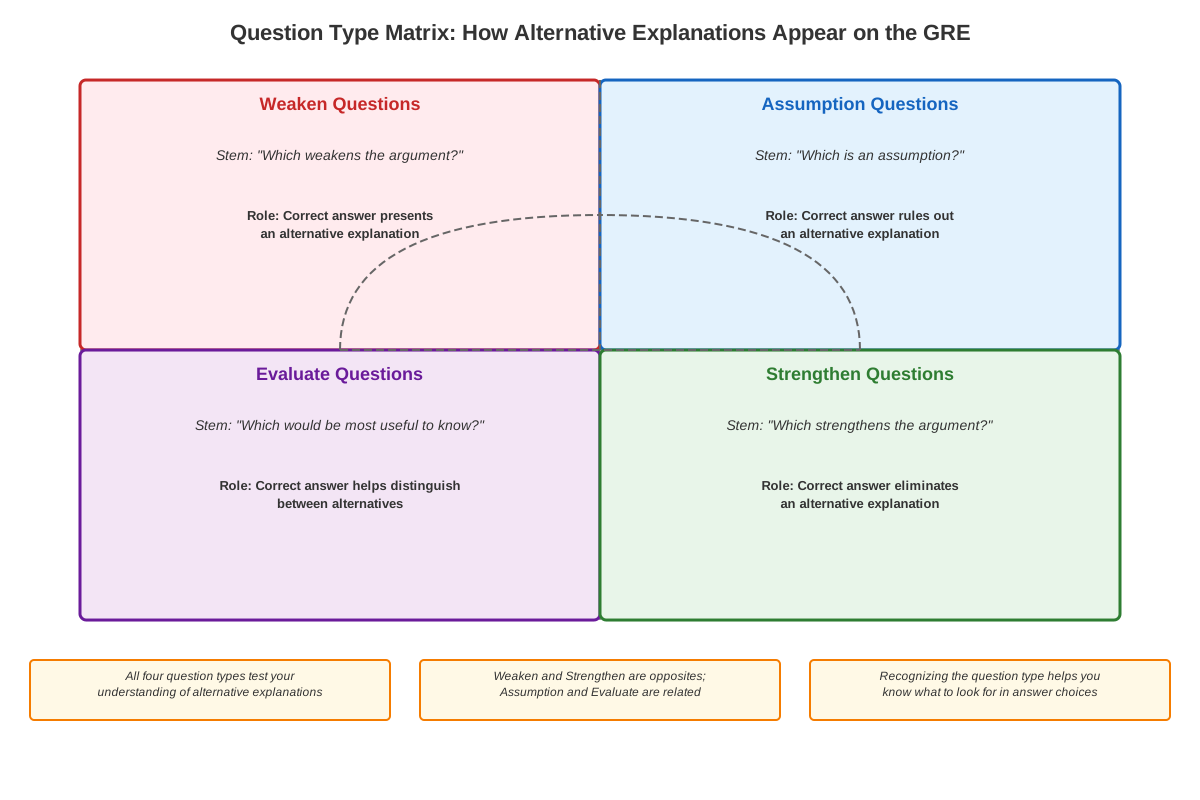
On the GRE specifically, alternative explanations appear with high frequency across multiple question types. Approximately 20-30% of critical reasoning questions directly or indirectly test this skill. The most common question types include:
- Weaken questions: Often require identifying an alternative explanation that undermines the argument's conclusion
- Assumption questions: Frequently hinge on recognizing that the argument assumes no alternative explanation exists
- Evaluate questions: Ask what additional information would help determine whether the stated explanation or an alternative is correct
- Explain the discrepancy questions: Require finding an explanation that accounts for seemingly contradictory facts
These questions typically appear in both discrete critical reasoning items and within reading comprehension passages where test-takers must evaluate the author's reasoning. The ability to quickly generate and assess alternative explanations directly impacts both accuracy and speed on these high-value question types.
Core Concepts
The Fundamental Principle of Alternative Explanations
The core principle underlying alternative explanations is that observed facts or correlations can often be explained by multiple different causal mechanisms or interpretations. When an argument presents evidence and draws a conclusion, it implicitly assumes that the explanation offered is the correct or only reasonable one. However, if another explanation could equally well account for the same evidence, the argument's conclusion becomes less certain.
Consider this structure:
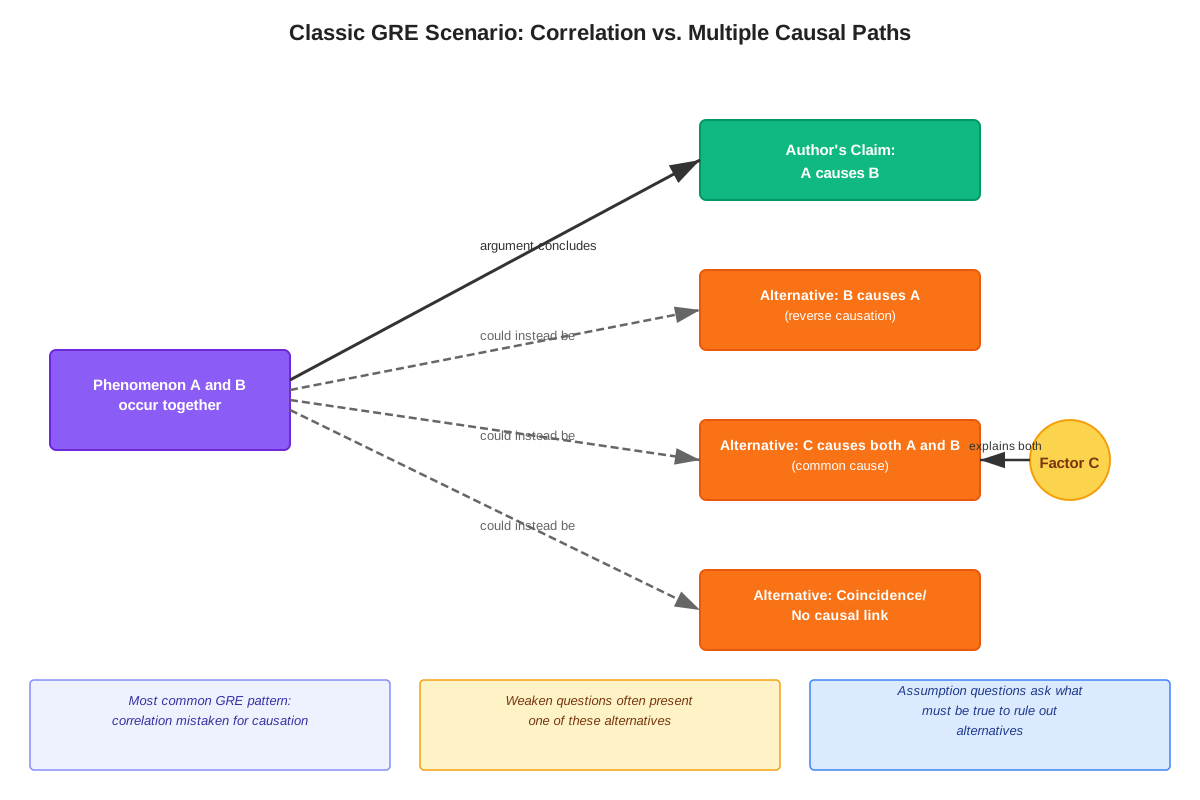
- Observation: X and Y occur together
- Conclusion: X causes Y
- Alternative explanation: Z causes both X and Y, or Y causes X, or coincidence
The existence of plausible alternative explanations doesn't necessarily prove an argument wrong, but it does reveal that the argument is incomplete or assumes more than the evidence warrants. This gap between evidence and conclusion represents the logical vulnerability that GRE questions exploit.
Types of Alternative Explanations
Several distinct categories of alternative explanations appear regularly on the GRE:
| Type | Description | Example |
|---|---|---|
| Reverse causation | The effect is actually the cause | Sales increased after hiring more staff → Perhaps increased sales necessitated hiring more staff |
| Common cause | A third factor causes both observed phenomena | Ice cream sales and drowning both increase in summer → Heat causes both |
| Coincidence | No causal relationship exists; timing is accidental | Company profits rose after CEO wore lucky tie → Unrelated events |
| Multiple contributing factors | Several causes work together | Test scores improved after new curriculum → Could be new curriculum, better teachers, more motivated students, or all three |
| Selection bias | The sample observed is not representative | Survey shows product users are satisfied → Perhaps only satisfied customers responded |
| Pre-existing differences | Groups differed before the intervention | Drug trial shows improvement → Perhaps treatment group was healthier initially |
Identifying When Alternative Explanations Are Being Tested
Several trigger phrases and question structures signal that alternative explanations are being tested:
Question stem indicators:
- "Which of the following, if true, most weakens the argument?"
- "The argument assumes which of the following?"
- "Which of the following would be most useful to know in evaluating the argument?"
- "Which of the following, if true, best explains the discrepancy?"
- "The argument is vulnerable to criticism on the grounds that it..."
Argument structure indicators:
- Arguments that move from correlation to causation
- Arguments that attribute a change to a single factor without ruling out others
- Arguments that compare two groups without establishing their initial similarity
- Arguments that observe a pattern and conclude a specific mechanism
When an argument presents temporal sequence (A happened, then B happened, therefore A caused B), alternative explanations are almost certainly relevant. Similarly, when an argument presents comparative data (Group X did better than Group Y after treatment Z), considering whether pre-existing differences or other factors might explain the difference is crucial.
The Strategy for Applying Alternative Explanations
To effectively apply alternative explanations on GRE questions, follow this systematic approach:
- Identify the conclusion: What specific claim is the argument making?
- Identify the evidence: What facts or observations support this conclusion?
- Locate the logical gap: What assumption connects the evidence to the conclusion?
- Generate alternatives: What other explanations could account for the same evidence?
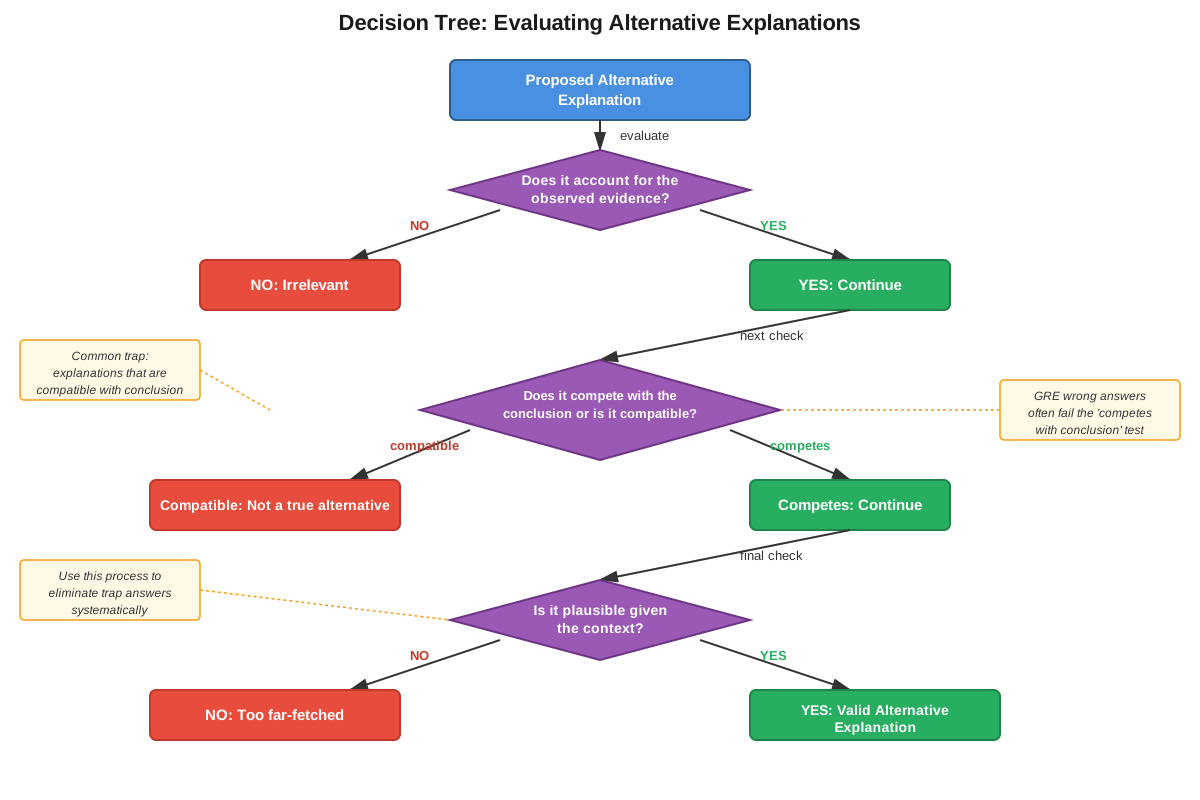
- Evaluate relevance: Which alternative explanations directly compete with the argument's conclusion?
- Match to answer choices: Which answer choice introduces, eliminates, or tests an alternative explanation?
The key insight is that the argument's conclusion is only as strong as its ability to rule out alternative explanations. When an argument fails to address obvious alternatives, it remains vulnerable to challenge.
Distinguishing Relevant from Irrelevant Alternatives
Not every alternative explanation weakens an argument equally. The most powerful alternative explanations are those that:
- Directly account for the same evidence using a different causal mechanism
- Are plausible given common knowledge and the context provided
- Compete with the conclusion rather than merely adding additional factors
- Cannot coexist with the argument's explanation (or make it unnecessary)
For example, if an argument concludes that a new teaching method improved test scores, an alternative explanation that students were simply older and more mature is relevant because it provides a competing account. However, an alternative that the students also ate healthier lunches is less relevant unless there's reason to believe nutrition significantly affects the specific outcome measured.
Concept Relationships
The concept of alternative explanations serves as a hub connecting multiple critical reasoning skills. Understanding these relationships enhances both comprehension and application:
Alternative Explanations → Assumptions: Every alternative explanation that an argument fails to address represents an implicit assumption. When an argument assumes no alternative explanation exists, identifying that alternative reveals the assumption. This relationship means that assumption questions and alternative explanation questions often test the same underlying logical gap from different angles.
Causal Reasoning → Alternative Explanations → Weaken/Strengthen: Causal arguments are particularly vulnerable to alternative explanations because establishing causation requires ruling out other possibilities. Weaken questions often introduce alternative explanations, while strengthen questions often eliminate them. This creates a direct pathway: understanding causal reasoning enables recognition of alternative explanations, which enables effective analysis of weaken/strengthen questions.
Evidence Evaluation → Alternative Explanations → Evaluate Questions: When determining what additional information would help evaluate an argument, the key is often identifying what evidence would distinguish between the stated explanation and alternatives. This relationship makes alternative explanations central to "evaluate" question types.
Alternative Explanations ↔ Scope Issues: Sometimes what appears to be an alternative explanation is actually outside the argument's scope. Conversely, recognizing scope helps determine which alternatives are genuinely relevant. These concepts mutually inform each other.
The textual relationship map:
Correlation observed → Causal claim made → Alternative explanations possible →
Assumptions revealed → Argument vulnerable to weakening →
Additional evidence needed to evaluate → Strengthen by eliminating alternatives
High-Yield Facts
⭐ Most GRE arguments that move from correlation to causation are vulnerable to alternative explanations—this is the single most common pattern tested.
⭐ Temporal sequence (A before B) does not establish causation—alternative explanations include reverse causation, common cause, or coincidence.
⭐ When an argument attributes an outcome to a single factor, alternative explanations involving multiple contributing factors are highly relevant.
⭐ Comparison arguments (Group A vs. Group B) are vulnerable to alternative explanations involving pre-existing differences between groups.
⭐ The existence of a plausible alternative explanation weakens an argument even if that alternative isn't proven true—mere plausibility creates doubt.
- Alternative explanations that involve common causes (third factors) are especially powerful because they account for correlation without causation.
- Selection bias represents a category of alternative explanation where the sample observed is not representative of the broader population.
- Reverse causation is often overlooked but represents a complete inversion of the argument's causal claim.
- Arguments that fail to establish a mechanism for their causal claim are more vulnerable to alternative explanations.
- Strengthen questions often work by eliminating the most plausible alternative explanations, thereby making the original conclusion more likely.
- When evaluating alternative explanations, consider whether they are mutually exclusive with the original explanation or could coexist.
- The phrase "other factors being equal" or "all else being equal" in an argument signals that the argument assumes no alternative explanations exist.
Quick check — test yourself on Alternative explanations so far.
Try Flashcards →Common Misconceptions
Misconception: An alternative explanation must be proven true to weaken an argument. → Correction: An alternative explanation only needs to be plausible and relevant. The mere possibility of another explanation reduces confidence in the original conclusion because it shows the evidence doesn't uniquely support that conclusion.
Misconception: Any factor that could possibly be involved represents a relevant alternative explanation. → Correction: Alternative explanations must directly compete with or replace the argument's explanation. Additional contributing factors that could work alongside the stated cause are less relevant than competing explanations that would make the stated cause unnecessary.
Misconception: If the argument's explanation is possible, alternative explanations don't matter. → Correction: Critical reasoning evaluates whether the evidence adequately supports the conclusion. Even if the conclusion could be true, the existence of equally plausible alternatives means the evidence doesn't establish it as the most likely explanation.
Misconception: Alternative explanations are only relevant for weaken questions. → Correction: Alternative explanations are central to assumption questions (the argument assumes no alternative exists), evaluate questions (we need information to distinguish between alternatives), and strengthen questions (eliminating alternatives strengthens the argument).
Misconception: The most complex or sophisticated alternative explanation is the best answer. → Correction: GRE correct answers typically involve straightforward, common-sense alternative explanations. Overly complex alternatives are often incorrect because they introduce too many additional assumptions.
Misconception: If an argument acknowledges one alternative explanation, it's protected against all alternatives. → Correction: Arguments must address all plausible alternatives. Ruling out one alternative while ignoring others still leaves the argument vulnerable.
Worked Examples
Example 1: Classic Correlation-to-Causation Argument
Argument:
"A recent study found that employees who work from home three or more days per week report higher job satisfaction than those who work exclusively in the office. Therefore, allowing employees to work from home increases job satisfaction."
Question: Which of the following, if true, most weakens the argument?
Analysis:
- Conclusion: Working from home causes increased job satisfaction
- Evidence: Correlation between working from home and higher reported satisfaction
- Logical gap: Assumes the work arrangement causes the satisfaction rather than other factors
- Alternative explanations to consider:
- Reverse causation: Perhaps more satisfied employees are granted work-from-home privileges
- Pre-existing differences: Perhaps employees who choose/are allowed to work from home differ in other ways
- Common cause: Perhaps a third factor (like seniority, job type, or personality) causes both work-from-home status and satisfaction
- Selection bias: Perhaps only certain types of employees were surveyed
Strong answer choice: "Employees who are granted work-from-home privileges tend to have more autonomy in their roles, and previous research has shown that job autonomy is a primary driver of job satisfaction."
Why this works: This introduces a common cause alternative explanation. It suggests that autonomy causes both the work-from-home arrangement and the job satisfaction, meaning the work arrangement itself might not be causal. This directly competes with the argument's conclusion.
Weaker answer choice: "Some employees who work from home report feeling isolated from their colleagues."
Why this is weaker: While this provides a potential downside to working from home, it doesn't offer an alternative explanation for why work-from-home employees report higher satisfaction. It could coexist with the argument's conclusion.
Example 2: Comparative Study with Multiple Interpretations
Argument:
"City A implemented a new traffic management system in January, and by June, average commute times had decreased by 15%. City B, which did not implement the system, saw no change in commute times during the same period. This demonstrates that the new traffic management system effectively reduces commute times."
Question: The argument's reasoning is most vulnerable to criticism on the grounds that it fails to consider which of the following?
Analysis:
- Conclusion: The traffic management system caused the reduction in commute times
- Evidence: City A (with system) saw improvement; City B (without system) saw no change
- Logical gap: Assumes no other differences between the cities or time periods explain the outcome
- Alternative explanations to consider:
- Seasonal factors: Perhaps commute times naturally vary by season
- Other interventions: Perhaps City A made other changes during this period
- Pre-existing trends: Perhaps City A's commute times were already improving
- City differences: Perhaps the cities differ in ways that affect commute times
- External factors: Perhaps economic changes affected City A differently
Strong answer choice: "Whether City A experienced a significant decrease in population or employment during the period studied, which would naturally reduce traffic volume."
Why this works: This provides a powerful alternative explanation—the improvement might result from fewer commuters rather than better traffic management. This completely accounts for the observed decrease without requiring the traffic system to have any effect.
Analysis of learning objective connection: This example demonstrates how to identify when alternative explanations are being tested (the question stem "fails to consider"), explain the core strategy (systematically generating competing explanations), and apply the concept accurately (selecting the explanation that most directly competes with the conclusion).
Exam Strategy
Approaching Alternative Explanation Questions
When facing GRE questions involving alternative explanations, employ this systematic approach:
Step 1: Identify the question type
- Weaken questions: Look for answer choices that introduce alternative explanations
- Assumption questions: The correct answer often rules out an alternative explanation
- Evaluate questions: Look for information that would distinguish between alternatives
- Strengthen questions: The correct answer often eliminates alternative explanations
Step 2: Map the argument structure
Before reading answer choices, spend 15-20 seconds identifying:
- The specific conclusion (often signaled by "therefore," "thus," "consequently")
- The evidence provided
- The type of reasoning (causal claim, comparison, prediction)
Step 3: Predict the vulnerability
Ask yourself: "What else could explain this evidence?" Generate 1-2 alternative explanations before looking at answer choices. This prediction strategy dramatically improves accuracy.
Step 4: Evaluate answer choices strategically
Exam Tip: Eliminate answer choices that are irrelevant to the conclusion, even if they're true. The correct answer must directly address the logical gap between evidence and conclusion.
Trigger Words and Phrases
In question stems:
- "Weakens" / "casts doubt" / "calls into question" → Often requires alternative explanation
- "Assumes" / "presupposes" / "takes for granted" → Often involves assuming no alternative exists
- "Evaluate" / "useful to know" → Often requires distinguishing between alternatives
- "Explains" / "accounts for" / "resolves the discrepancy" → Requires finding the correct explanation among alternatives
In arguments:
- "Because of" / "due to" / "resulted from" → Signals causal claim vulnerable to alternatives
- "After" / "following" / "subsequently" → Temporal sequence often confused with causation
- "Compared to" / "in contrast to" → Comparison vulnerable to pre-existing differences
- "The reason for" / "explains why" → Explicit causal claim
Process of Elimination Tips
Eliminate answer choices that:
- Address a different conclusion than the one stated in the argument
- Strengthen rather than weaken (or vice versa, depending on question type)
- Are outside the scope of the argument's subject matter
- Could coexist with the argument's conclusion without affecting its validity (for weaken questions)
- Introduce implausible scenarios that require too many additional assumptions
Favor answer choices that:
- Directly compete with the argument's explanation
- Involve common patterns (reverse causation, common cause, pre-existing differences)
- Are straightforward and don't require complex reasoning chains
- Address the specific mechanism the argument proposes
Time Allocation
For critical reasoning questions involving alternative explanations:
- 30-45 seconds: Read and understand the argument
- 15-20 seconds: Identify conclusion, evidence, and predict vulnerability
- 45-60 seconds: Evaluate answer choices
- Total: 90-120 seconds per question
If you find yourself spending more than 2 minutes, make your best educated guess and move on. Alternative explanation questions reward quick pattern recognition more than extended deliberation.
Memory Techniques
The RACE Acronym for Alternative Explanations
Reverse causation - Could the effect actually be the cause?
Alternative causes - What other factors might explain the evidence?
Common cause - Could a third factor cause both observations?
Existing differences - Did groups differ before the intervention?
When analyzing any causal argument, mentally run through RACE to generate alternative explanations quickly.
The "What Else?" Question
Train yourself to automatically ask "What else could explain this?" whenever you see:
- Correlation presented as causation
- Temporal sequence (A then B)
- Comparison between groups
- Attribution of an outcome to a single factor
This simple habit transforms passive reading into active critical analysis.
Visualization Strategy: The Explanation Tree
Mentally visualize the evidence as a trunk and possible explanations as branches:
                    [Evidence/Observation]
                            |
        _____________________|_____________________
        |                    |                    |
   [Argument's         [Alternative 1]      [Alternative 2]
   Explanation]        (reverse cause)      (common cause)
This visualization helps recognize that evidence can support multiple explanations simultaneously, making it easier to identify when an argument fails to rule out alternatives.
The "Third Factor" Mnemonic
For common cause alternatives, remember: "When two things correlate, think THREE" (the third factor that might cause both). This reminds you to consider whether an unstated variable explains the correlation.
Summary
Alternative explanations represent a critical reasoning skill that tests whether arguments adequately support their conclusions or whether other interpretations could equally account for the evidence presented. The fundamental principle is that observed correlations, temporal sequences, or comparative outcomes can often be explained by multiple causal mechanisms—including reverse causation, common causes, pre-existing differences, or coincidence. GRE questions test this concept primarily through weaken, assumption, and evaluate question types, requiring test-takers to recognize when arguments move from evidence to conclusion without adequately ruling out competing explanations. Mastery requires the ability to quickly identify argument structure, generate plausible alternative explanations, and evaluate which alternatives genuinely compete with the stated conclusion. The most commonly tested patterns involve correlation-causation errors, comparison studies that ignore pre-existing differences, and temporal sequences mistaken for causal relationships. Success on these questions depends on systematic analysis: identifying the conclusion and evidence, recognizing the logical gap, predicting vulnerabilities, and matching predictions to answer choices that introduce, eliminate, or test alternative explanations.
Key Takeaways
- Alternative explanations challenge the logical connection between evidence and conclusion by showing that other interpretations could account for the same facts
- Correlation does not establish causation—temporal sequence, comparison, and co-occurrence all require ruling out alternatives like reverse causation, common causes, and pre-existing differences
- Plausibility, not proof, is sufficient—an alternative explanation weakens an argument simply by being reasonable, even without evidence proving it true
- The RACE framework (Reverse causation, Alternative causes, Common cause, Existing differences) provides a systematic method for generating alternative explanations
- Question type determines strategy: weaken questions introduce alternatives, assumption questions reveal that arguments assume no alternatives exist, evaluate questions ask what would distinguish between alternatives
- Relevant alternatives must directly compete with the argument's conclusion rather than merely adding additional factors that could coexist
- Pattern recognition is key—most GRE alternative explanation questions follow predictable structures involving causal claims, comparisons, or temporal sequences
Related Topics
Assumption Identification: Understanding alternative explanations directly enhances the ability to identify assumptions, since arguments often assume that no alternative explanation exists. Mastering alternative explanations provides the foundation for recognizing unstated premises.
Strengthen and Weaken Questions: These question types frequently involve alternative explanations—weaken questions introduce them, while strengthen questions eliminate them. The skills developed here transfer directly to these high-frequency question types.
Causal Reasoning: Alternative explanations represent a specific application of broader causal reasoning principles. Deeper study of causation, including necessary and sufficient conditions, builds on the foundation established here.
Argument Evaluation: The ability to assess what additional information would help evaluate an argument depends heavily on recognizing what evidence would distinguish between competing explanations. This topic extends the alternative explanations framework.
Logical Fallacies: Many formal fallacies (post hoc ergo propter hoc, false cause, hasty generalization) involve failures to consider alternative explanations. Studying fallacies provides additional frameworks for recognizing vulnerable reasoning.
Practice CTA
Now that you've mastered the core concepts of alternative explanations, it's time to cement your understanding through active practice. The practice questions and flashcards designed for this topic will challenge you to apply the RACE framework, identify vulnerable arguments, and distinguish between relevant and irrelevant alternatives under timed conditions. Remember that pattern recognition improves with repetition—each practice question you complete strengthens your ability to quickly spot when alternative explanations are being tested and how to approach them strategically. Your investment in deliberate practice now will translate directly into points on test day. Begin with the practice questions to test your mastery and use the flashcards to reinforce high-yield facts and trigger words. You've built the foundation; now build the speed and confidence that come from application.
Sign up free to keep reading
Create a free AnvayaPrep account to finish this GRE guide on Alternative explanations — plus flashcards and practice questions.