Overview
Quadratic equations represent one of the most frequently tested algebraic concepts on the GRE Quantitative Reasoning section. These polynomial equations of degree two appear in various forms throughout the exam, from straightforward computational problems to complex word problems involving optimization, geometry, and data interpretation. A quadratic equation takes the standard form ax² + bx + c = 0, where a, b, and c are constants and a ≠ 0. Mastering quadratic equations is not merely about memorizing formulas—it requires understanding multiple solution methods, recognizing when to apply each technique, and developing the algebraic intuition to manipulate these expressions efficiently under timed conditions.
The importance of gre quadratic equations extends beyond isolated algebra problems. Quadratic relationships appear in coordinate geometry when analyzing parabolas, in word problems involving area and optimization, in quantitative comparison questions requiring strategic reasoning rather than complete solutions, and in data interpretation scenarios where quadratic models describe real-world phenomena. Students who develop fluency with quadratic equations gain a significant advantage because these problems often serve as gatekeepers—questions that separate high scorers from average performers.
Within the broader landscape of GRE Quantitative Reasoning, quadratic equations bridge foundational algebra and advanced problem-solving. They build upon linear equations, factoring skills, and basic arithmetic while connecting forward to functions, coordinate geometry, inequalities, and systems of equations. The ability to quickly identify quadratic structures, select appropriate solution strategies, and verify answers efficiently represents a critical competency that influences performance across multiple question types and difficulty levels throughout the exam.
Learning Objectives
- [ ] Identify when Quadratic equations is being tested
- [ ] Explain the core rule or strategy behind Quadratic equations
- [ ] Apply Quadratic equations to GRE-style questions accurately
- [ ] Determine the most efficient solution method for a given quadratic equation based on its form and the question requirements
- [ ] Recognize and exploit the relationship between roots, coefficients, and factored forms without complete calculation
- [ ] Solve quadratic inequalities and interpret solutions in context
- [ ] Apply the discriminant to determine the nature and number of solutions without solving completely
Prerequisites
- Linear equations and algebraic manipulation: Essential for rearranging quadratic equations into standard form and performing algebraic operations during solution processes
- Factoring techniques: Required for the factoring method of solving quadratics and for recognizing special products like difference of squares
- Basic arithmetic with fractions and radicals: Necessary for applying the quadratic formula and simplifying radical expressions in solutions
- Understanding of the coordinate plane: Helpful for visualizing parabolas and understanding the geometric interpretation of quadratic solutions
- Properties of exponents: Needed for manipulating squared terms and understanding why quadratic equations can have two solutions
Why This Topic Matters
Quadratic equations appear with remarkable frequency on the GRE, showing up in approximately 10-15% of Quantitative Reasoning questions across both the multiple-choice and quantitative comparison formats. This high frequency makes quadratic equations one of the most important algebra topics to master for exam success. Beyond their direct appearance, quadratic concepts underlie many geometry problems (areas of rectangles, properties of parabolas), word problems (projectile motion, profit optimization, number relationships), and even some data interpretation questions involving polynomial trends.
In real-world applications, quadratic equations model countless phenomena: the trajectory of projectiles under gravity, the relationship between price and revenue in economics, the optimization of areas and volumes in engineering and design, and the behavior of certain physical systems in science. This practical relevance means that GRE questions often embed quadratic equations within realistic scenarios, testing not just computational ability but also the capacity to translate word problems into mathematical expressions.
On the GRE specifically, quadratic equations appear in multiple question formats: Problem Solving questions may ask for specific solutions or properties of solutions; Quantitative Comparison questions frequently test understanding of relationships between roots and coefficients without requiring complete solutions; and Data Interpretation questions occasionally involve quadratic models. The exam particularly favors questions that reward strategic thinking—recognizing when you can use the sum or product of roots, when factoring is faster than the quadratic formula, or when you can eliminate answer choices without solving completely. Students who develop this strategic flexibility consistently outperform those who rely on a single mechanical approach.
Core Concepts
Standard Form and Components
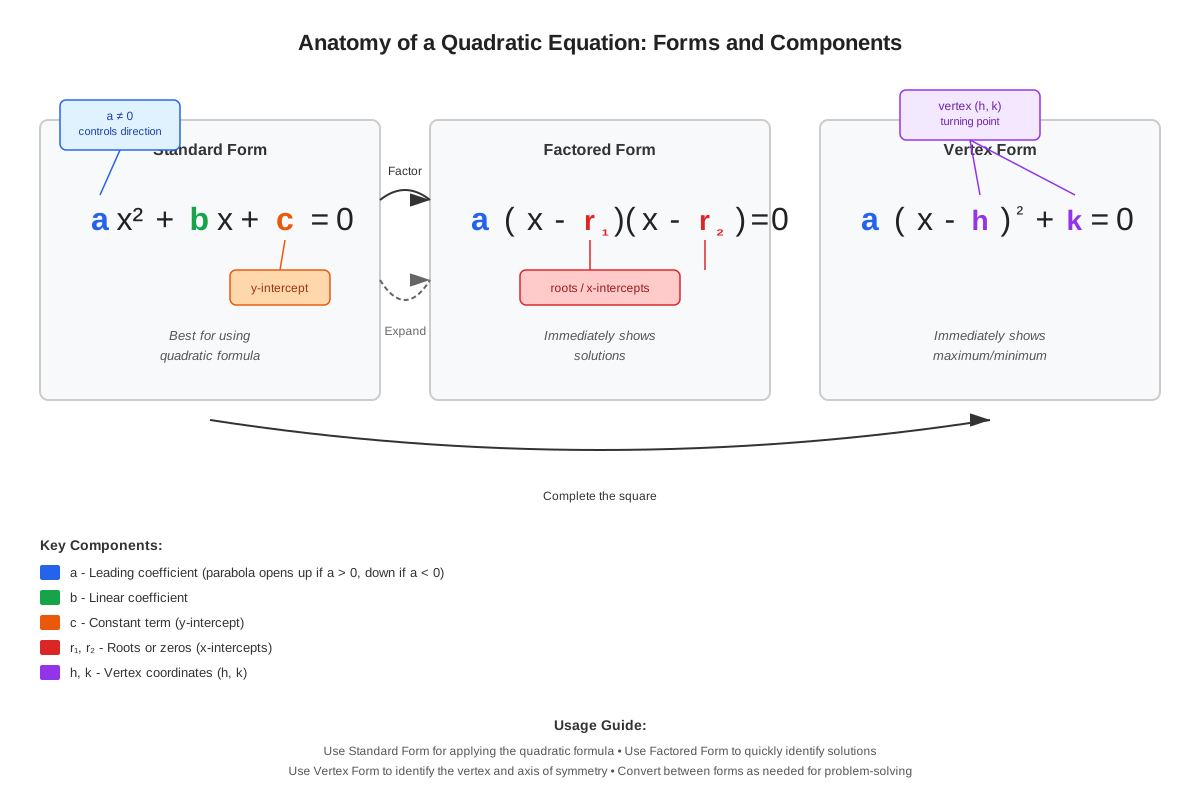
A quadratic equation is any equation that can be written in the form ax² + bx + c = 0, where a, b, and c are real numbers and a ≠ 0. This is called standard form. The coefficient a is called the leading coefficient, b is the linear coefficient, and c is the constant term. The requirement that a ≠ 0 is crucial—if a equals zero, the equation becomes linear rather than quadratic.
Understanding the structure of standard form enables quick identification of quadratic equations even when they appear in disguised forms. For example, 3x² = 5x - 2 is quadratic but not in standard form; rearranging gives 3x² - 5x + 2 = 0. Similarly, (x + 3)(x - 2) = 7 is quadratic but requires expansion and rearrangement: x² + x - 6 = 7 becomes x² + x - 13 = 0.
Solution Methods
Factoring Method
The factoring method relies on the zero product property: if the product of two factors equals zero, at least one factor must equal zero. When a quadratic can be expressed as (px + q)(rx + s) = 0, the solutions are found by setting each factor equal to zero.
Steps for factoring:
- Ensure the equation is in standard form with zero on one side
- Factor the quadratic expression into two binomials
- Set each factor equal to zero
- Solve each resulting linear equation
For example, to solve x² + 5x + 6 = 0:
- Factor: (x + 2)(x + 3) = 0
- Set each factor to zero: x + 2 = 0 or x + 3 = 0
- Solutions: x = -2 or x = -3
The factoring method is fastest when the quadratic factors easily with integer coefficients. Common factoring patterns include:
- Difference of squares: a² - b² = (a + b)(a - b)
- Perfect square trinomials: a² + 2ab + b² = (a + b)²
- Simple trinomials: x² + (a+b)x + ab = (x + a)(x + b)
Quadratic Formula
The quadratic formula provides solutions for any quadratic equation and is derived by completing the square on the general form. For ax² + bx + c = 0:
x = [-b ± √(b² - 4ac)] / (2a)This formula always works regardless of whether the quadratic factors nicely. The expression under the square root, b² - 4ac, is called the discriminant and provides crucial information about the solutions.
Steps for using the quadratic formula:
- Identify coefficients a, b, and c from standard form
- Calculate the discriminant: b² - 4ac
- Substitute values into the formula
- Simplify, being careful with signs and the ± symbol
- Express solutions in simplest form
For example, to solve 2x² + 3x - 5 = 0:
- a = 2, b = 3, c = -5
- Discriminant: 3² - 4(2)(-5) = 9 + 40 = 49
- x = [-3 ± √49] / (2·2) = [-3 ± 7] / 4
- Solutions: x = 4/4 = 1 or x = -10/4 = -5/2
Completing the Square
Completing the square transforms a quadratic into perfect square form: (x + p)² = q. This method is particularly useful for understanding the vertex form of parabolas and for deriving the quadratic formula itself.
Steps for completing the square:
- Ensure the coefficient of x² is 1 (divide through if necessary)
- Move the constant term to the right side
- Take half the coefficient of x, square it, and add to both sides
- Factor the left side as a perfect square
- Solve by taking square roots of both sides
For example, to solve x² + 6x + 2 = 0:
- Move constant: x² + 6x = -2
- Complete the square: x² + 6x + 9 = -2 + 9
- Factor: (x + 3)² = 7
- Take square roots: x + 3 = ±√7
- Solutions: x = -3 ± √7
The Discriminant
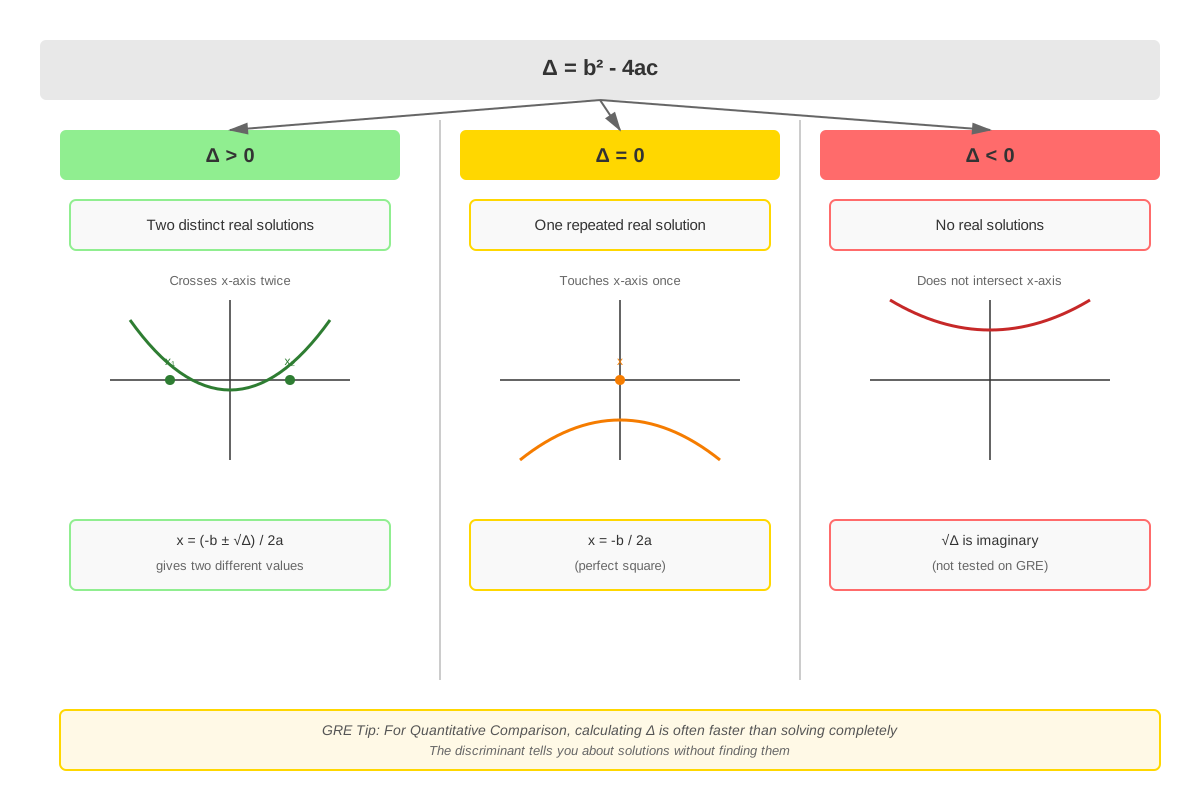
The discriminant, Δ = b² - 4ac, determines the nature and number of solutions without requiring complete calculation:
| Discriminant Value | Number of Real Solutions | Nature of Solutions |
|---|---|---|
| Δ > 0 | Two distinct real solutions | Rational if Δ is a perfect square; irrational otherwise |
| Δ = 0 | One real solution (repeated root) | Always rational |
| Δ < 0 | No real solutions | Two complex conjugate solutions |
This information is invaluable for GRE quantitative comparison questions and for eliminating answer choices efficiently.
Relationships Between Roots and Coefficients
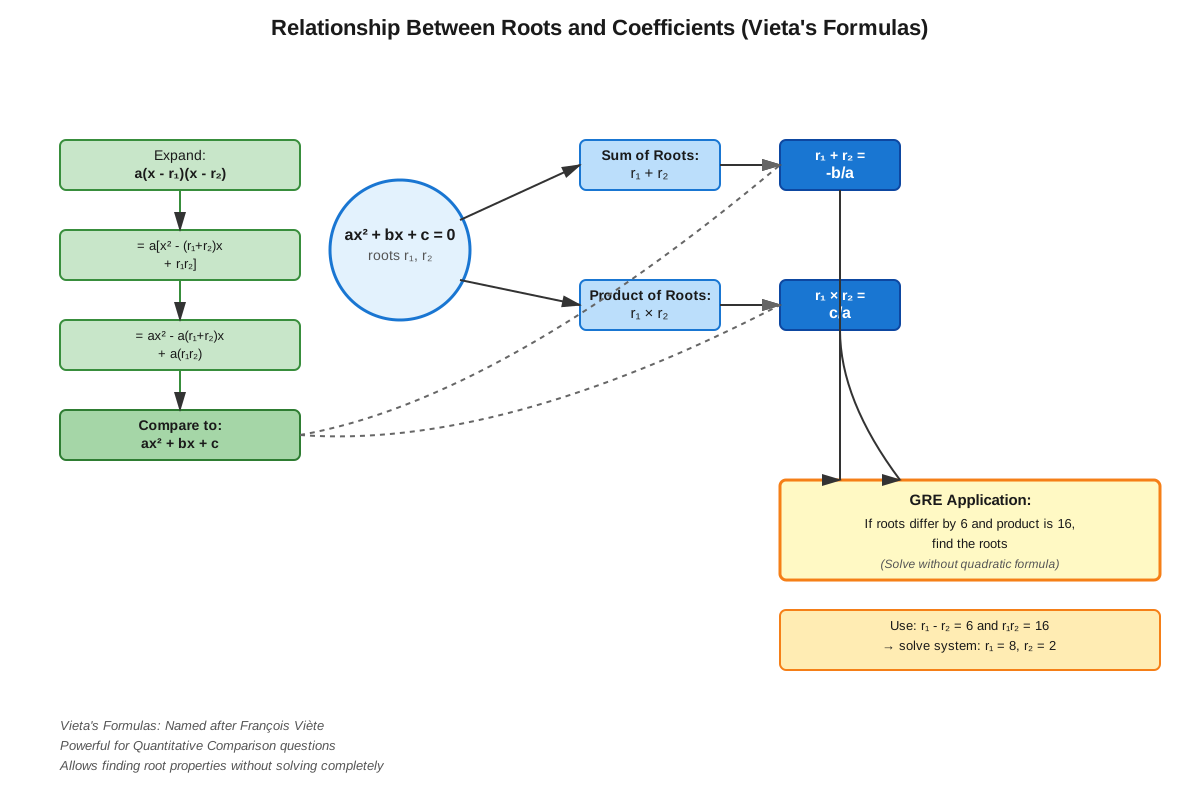
For a quadratic equation ax² + bx + c = 0 with roots r and s, Vieta's formulas establish:
- Sum of roots: r + s = -b/a
- Product of roots: r · s = c/a
These relationships allow strategic problem-solving without finding individual roots. For example, if asked whether the sum of roots of 3x² - 12x + 7 = 0 is positive or negative, calculate -(-12)/3 = 4 without solving completely.
Special Cases and Forms
Incomplete quadratics lack one or more terms:
- Pure quadratic (b = 0): ax² + c = 0, solved by isolating x² and taking square roots
- No constant term (c = 0): ax² + bx = 0, solved by factoring out x
For example:
- 4x² - 25 = 0 → x² = 25/4 → x = ±5/2
- 3x² - 6x = 0 → 3x(x - 2) = 0 → x = 0 or x = 2
Concept Relationships
The core concepts of quadratic equations form an interconnected system where understanding one element enhances comprehension of others. The standard form (ax² + bx + c = 0) serves as the foundation from which all other concepts derive. This form directly determines the coefficients that appear in both the quadratic formula and Vieta's formulas, creating a direct pathway from equation structure to solution properties.
The three primary solution methods—factoring, quadratic formula, and completing the square—represent different approaches to the same goal, each with strategic advantages. Factoring works most efficiently when integer factors exist and connects backward to prerequisite factoring skills. The quadratic formula provides universal applicability and connects forward through the discriminant, which reveals solution characteristics without complete calculation. Completing the square bridges to coordinate geometry by revealing vertex form and demonstrates why the quadratic formula works.
The discriminant (b² - 4ac) acts as a diagnostic tool that connects the equation's coefficients to the nature of its solutions, enabling strategic decision-making on quantitative comparison questions. This same discriminant appears within the quadratic formula, showing how solution existence and solution calculation interrelate.
Vieta's formulas create a direct connection between roots and coefficients, allowing calculation of root relationships (sum and product) without finding individual roots. This concept particularly connects to factored form: if (x - r)(x - s) = 0 expands to x² - (r+s)x + rs = 0, the relationships between coefficients and roots become geometrically evident.
Relationship map: Standard Form → Coefficients (a, b, c) → Discriminant (determines solution nature) → Solution Methods (factoring, formula, completing square) → Roots → Vieta's Formulas (connect roots back to coefficients) → Strategic Problem Solving
Quick check — test yourself on Quadratic equations so far.
Try Flashcards →High-Yield Facts
⭐ The discriminant b² - 4ac determines solution types: positive gives two real solutions, zero gives one repeated solution, negative gives no real solutions
⭐ Sum of roots equals -b/a and product of roots equals c/a (Vieta's formulas)—use these for quantitative comparisons without solving completely
⭐ A quadratic equation always has exactly two solutions (counting multiplicity and including complex solutions), never more
⭐ If a quadratic factors as (x - r)(x - s) = 0, the solutions are x = r and x = s directly from the zero product property
⭐ The quadratic formula x = [-b ± √(b² - 4ac)] / (2a) works for every quadratic equation regardless of whether it factors nicely
- When c = 0, one solution is always x = 0; factor out x to find the other solution
- Perfect square trinomials (discriminant = 0) have one repeated root: x = -b/(2a)
- For pure quadratics (ax² + c = 0), solutions are x = ±√(-c/a) if -c/a > 0
- If the discriminant is a perfect square, the quadratic factors with rational coefficients
- The axis of symmetry of a parabola occurs at x = -b/(2a), which is also the average of the two roots
- When a > 0, the parabola opens upward; when a < 0, it opens downward
- Multiplying an entire quadratic equation by a nonzero constant doesn't change the solutions
- If both roots are positive, then -b/a > 0 and c/a > 0 (sum and product both positive)
- The vertex of the parabola y = ax² + bx + c occurs at x = -b/(2a)
- Completing the square reveals the vertex form: a(x - h)² + k where (h, k) is the vertex
Common Misconceptions
Misconception: The quadratic formula only works when the equation doesn't factor.
Correction: The quadratic formula works for all quadratic equations, whether they factor or not. Factoring is simply faster when it's easy to identify factors, but the formula is universal.
Misconception: If the discriminant is negative, there are no solutions.
Correction: If the discriminant is negative, there are no real solutions, but there are two complex solutions. On the GRE, which focuses on real numbers, this typically means "no solution" in the context of the problem, but the mathematical distinction matters.
Misconception: When using the quadratic formula, the ± symbol means you can choose either + or - based on which gives a nicer answer.
Correction: The ± symbol indicates two separate solutions—you must calculate both x = [-b + √(b² - 4ac)] / (2a) and x = [-b - √(b² - 4ac)] / (2a) to find both roots.
Misconception: In the quadratic formula, -b means "negative b," so if b is already negative, it becomes positive.
Correction: The -b in the formula means the opposite of b. If b = -3, then -b = -(-3) = 3. If b = 5, then -b = -5. Always substitute the actual value of b, then apply the negative sign.
Misconception: A quadratic equation can have one, two, or three solutions depending on the problem.
Correction: A quadratic equation always has exactly two solutions when counting multiplicity (a repeated root counts as two identical solutions) and including complex solutions. It never has one, three, or any other number of solutions.
Misconception: To solve x² = 9, the only solution is x = 3.
Correction: When taking the square root of both sides, you must include both positive and negative roots: x = ±3, giving solutions x = 3 and x = -3. Forgetting the negative solution is one of the most common errors.
Misconception: The sum of roots formula is b/a.
Correction: The sum of roots is -b/a (negative b divided by a). The negative sign is crucial and frequently forgotten, leading to sign errors in quantitative comparison questions.
Misconception: If a quadratic equation has no real solutions, something is wrong with the problem.
Correction: Quadratic equations can legitimately have no real solutions, which often has meaningful interpretations (e.g., no real intersection points, no feasible solution to a word problem). This is mathematically valid.
Worked Examples
Example 1: Multi-Method Problem Solving
Problem: Solve 2x² - 7x + 3 = 0 using two different methods and verify the relationship between roots and coefficients.
Solution:
Method 1: Factoring
First, identify that we need two numbers that multiply to (2)(3) = 6 and add to -7. These numbers are -6 and -1.
Rewrite the middle term: 2x² - 6x - x + 3 = 0
Factor by grouping:
- 2x(x - 3) - 1(x - 3) = 0
- (2x - 1)(x - 3) = 0
Apply zero product property:
- 2x - 1 = 0 → x = 1/2
- x - 3 = 0 → x = 3
Method 2: Quadratic Formula
Identify coefficients: a = 2, b = -7, c = 3
Calculate discriminant: b² - 4ac = (-7)² - 4(2)(3) = 49 - 24 = 25
Apply formula:
x = [7 ± √25] / (2·2) = [7 ± 5] / 4Two solutions:
- x = (7 + 5)/4 = 12/4 = 3
- x = (7 - 5)/4 = 2/4 = 1/2
Verification using Vieta's formulas:
Sum of roots: 1/2 + 3 = 7/2
Check: -b/a = -(-7)/2 = 7/2 ✓
Product of roots: (1/2)(3) = 3/2
Check: c/a = 3/2 ✓
Key insights: This problem demonstrates that multiple methods yield identical solutions and that Vieta's formulas provide an independent verification method. The discriminant being a perfect square (25) indicated that factoring would work with rational coefficients, making it the faster method for this particular equation.
Example 2: Strategic Quantitative Comparison
Problem:
Column A: The sum of the solutions to x² - 5x + 2 = 0
Column B: 5
Solution:
Strategic approach (without solving completely):
This is a quantitative comparison question where finding exact solutions would waste time. Instead, use Vieta's formulas directly.
For the equation x² - 5x + 2 = 0:
- a = 1, b = -5, c = 2
Sum of roots = -b/a = -(-5)/1 = 5
Therefore, Column A = 5
Comparison: Column A = Column B
Answer: The two columns are equal (C)
Alternative verification (to build confidence):
Check the discriminant to ensure two real solutions exist:
Δ = b² - 4ac = (-5)² - 4(1)(2) = 25 - 8 = 17 > 0 ✓
Since Δ > 0, two distinct real solutions exist, and their sum is indeed 5.
Key insights: This problem rewards strategic thinking over computation. Recognizing that the sum of roots equals -b/a allows immediate comparison without using the quadratic formula. This approach saves 60-90 seconds compared to solving completely—critical time savings on the GRE. The discriminant check, while not strictly necessary, provides confidence that the solutions are real numbers, making the comparison valid.
Exam Strategy
Primary trigger phrases: "solve for x," "find the value(s)," "roots of the equation," "solutions to," "where the graph crosses the x-axis," "when the expression equals zero"
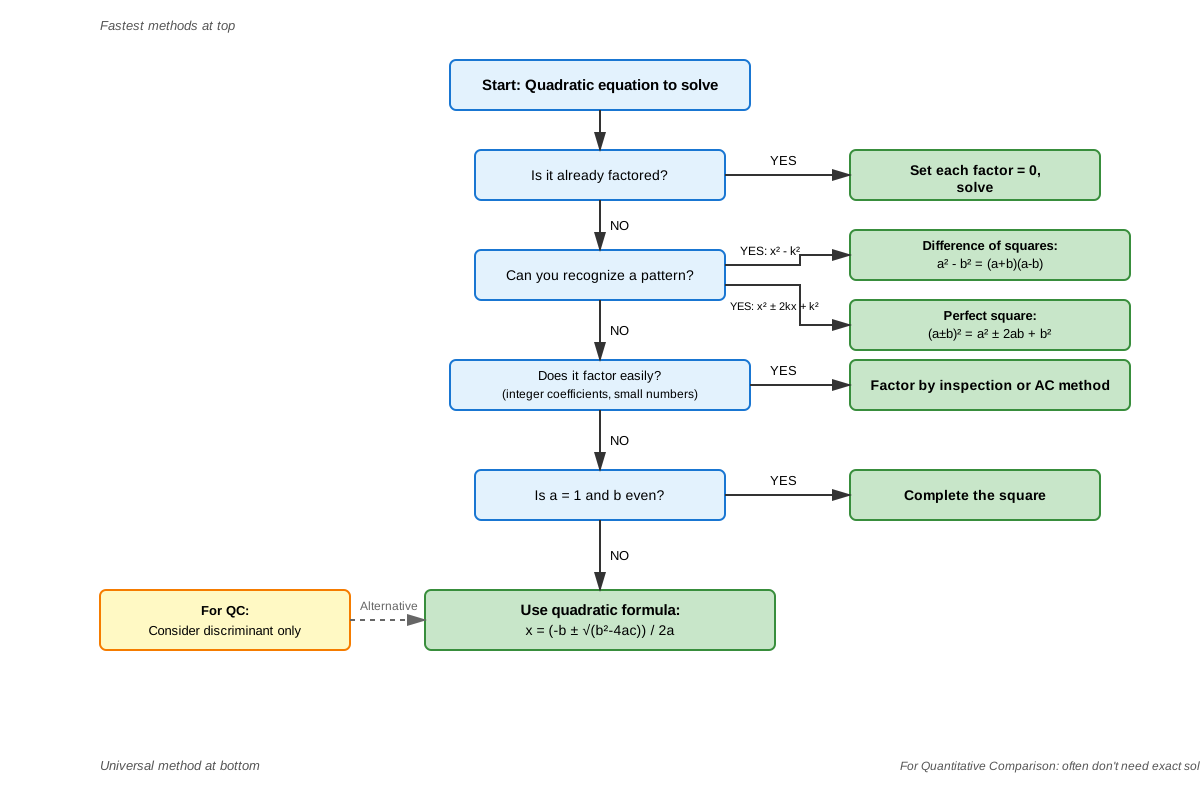
When approaching GRE quadratic equation questions, begin with a strategic decision tree:
- Identify the question type: Does it ask for exact solutions, properties of solutions (sum/product), or just whether solutions exist?
- For quantitative comparisons: Check if Vieta's formulas or the discriminant provide sufficient information without solving. Calculate -b/a for sum of roots or c/a for product of roots before attempting complete solutions.
- For exact solutions, assess the form:
- If c = 0, factor out x immediately
- If b = 0, isolate x² and take square roots
- If the equation factors obviously (small integers), use factoring
- Otherwise, use the quadratic formula
- Time allocation: Spend no more than 90-120 seconds on a quadratic equation problem. If factoring isn't apparent within 15-20 seconds, switch to the quadratic formula rather than continuing to search for factors.
Process of elimination strategies:
- If answer choices are given and you've found one solution, substitute it back to verify before spending time finding the second solution
- For "which of the following could be a solution" questions, substitute answer choices rather than solving—often faster
- If asked about the number of solutions, calculate only the discriminant
- When answer choices include both positive and negative versions of the same number (±k), the equation likely has symmetric solutions
Common trap patterns:
- Questions that give (x - a)(x - b) = k where k ≠ 0—students incorrectly conclude x = a or x = b without first expanding and rearranging
- Problems requiring solutions to x² = k where students forget the negative root
- Word problems where one mathematical solution doesn't make contextual sense (negative time, negative length)—always check reasonableness
Calculator usage: The GRE calculator helps with discriminant calculations and quadratic formula arithmetic, but don't rely on it for factoring recognition—that requires pattern recognition developed through practice.
Memory Techniques
Quadratic Formula Mnemonic: "Negative Boy, Plus or Minus Square Root, Boy Squared Minus Four Alfred Charlie, All Over Two Alfred"
This encodes: x = [-b ± √(b² - 4ac)] / (2a)
Discriminant Decision Tree (visualize a branching path):
- Discriminant Positive → Pair of solutions (two distinct)
- Discriminant Zero → Zingle solution (one repeated)
- Discriminant Negative → No real solutions
Vieta's Formulas: "Sum Needs Attention" and "Product Creates Answers"
- Sum = Negative b / A → -b/a
- Product = C / A → c/a
Factoring Pattern Visualization: Picture a rectangle with area c and sides that add to b. For x² + bx + c, you're finding two numbers that multiply to c and add to b. Visualizing this geometric relationship helps identify factors quickly.
Standard Form Reminder: "Always Bring Cookies" to remember the order a, b, c in ax² + bx + c = 0
Zero Product Property: "Zero Kills Everything" → if a product equals zero, at least one factor must be zero (the zero "kills" the entire product)
Summary
Quadratic equations represent a cornerstone of GRE Quantitative Reasoning, appearing frequently across multiple question formats and difficulty levels. Mastery requires understanding the standard form ax² + bx + c = 0 and developing fluency with three solution methods: factoring (fastest when applicable), the quadratic formula (universal but more time-intensive), and completing the square (useful for vertex form and theoretical understanding). The discriminant b² - 4ac serves as a powerful diagnostic tool, revealing whether solutions are real and distinct, repeated, or non-existent without requiring complete calculation. Vieta's formulas connecting the sum of roots (-b/a) and product of roots (c/a) to coefficients enable strategic problem-solving on quantitative comparison questions. Success on GRE quadratic problems demands not just computational ability but strategic thinking—recognizing which method suits each problem, when partial information suffices, and how to verify solutions efficiently. The ability to move fluidly between factored form, standard form, and solution properties while maintaining accuracy under time pressure distinguishes high scorers from average performers on this high-yield topic.
Key Takeaways
- Quadratic equations always have exactly two solutions (counting multiplicity), which may be real and distinct, real and repeated, or complex conjugates depending on the discriminant
- The discriminant b² - 4ac determines solution nature without solving: positive (two real), zero (one repeated), negative (no real solutions)
- Three solution methods each have strategic advantages: factoring is fastest when obvious, the quadratic formula always works, and completing the square reveals vertex form
- Vieta's formulas (sum = -b/a, product = c/a) enable quantitative comparisons and solution verification without finding individual roots
- Strategic method selection based on equation form and question requirements saves critical time—use Vieta's formulas for comparisons, factor when obvious, otherwise apply the quadratic formula
- Always include both positive and negative roots when taking square roots, and verify that mathematical solutions make contextual sense in word problems
- The zero product property underlies factoring: if (x - r)(x - s) = 0, then x = r or x = s, but this only applies when one side equals zero
Related Topics
Quadratic Functions and Parabolas: Building on quadratic equations, this topic explores the graphical representation y = ax² + bx + c, vertex form, axis of symmetry, and optimization problems—essential for coordinate geometry questions.
Quadratic Inequalities: Extends equation-solving to inequalities like ax² + bx + c > 0, requiring understanding of sign analysis and interval notation for solution sets.
Systems of Equations with Quadratics: Combines linear and quadratic equations, testing ability to solve systems using substitution or elimination—frequently appears in challenging GRE problems.
Polynomial Factoring: Generalizes factoring techniques beyond quadratics to higher-degree polynomials, building on the same principles of the zero product property.
Complex Numbers: For quadratics with negative discriminants, complex number solutions provide complete understanding, though less commonly tested on the GRE.
Optimization Problems: Many real-world GRE word problems involve maximizing or minimizing quadratic expressions, connecting algebra to practical reasoning.
Practice CTA
Now that you've mastered the core concepts, solution methods, and strategic approaches for quadratic equations, it's time to solidify your understanding through active practice. Attempt the practice questions designed specifically for this topic, focusing on applying the decision tree for method selection and using Vieta's formulas strategically on quantitative comparisons. Use the flashcards to reinforce the quadratic formula, discriminant interpretations, and common factoring patterns until they become automatic. Remember: the difference between understanding quadratic equations and achieving mastery lies in timed practice under exam-like conditions. Each problem you solve builds the pattern recognition and strategic intuition that will serve you throughout the Quantitative Reasoning section. You've built a strong foundation—now transform that knowledge into test-day confidence through deliberate practice!
Sign up free to keep reading
Create a free AnvayaPrep account to finish this GRE guide on Quadratic equations — plus flashcards and practice questions.