Overview
The elimination method is a fundamental algebraic technique used to solve systems of linear equations by strategically removing one variable at a time. This approach involves adding or subtracting equations to cancel out a variable, thereby reducing a system of multiple equations into a single equation with one unknown. Once one variable is determined, back-substitution reveals the remaining variable values. On the GRE Quantitative Reasoning section, the elimination method appears frequently in algebra problems, particularly those involving two or more equations with two or more unknowns.
Mastering the GRE elimination method is essential because it provides a systematic, reliable approach to solving systems of equations—a skill tested directly through problem-solving questions and indirectly through word problems involving multiple constraints. Unlike substitution, which can become algebraically messy with complex coefficients or fractions, elimination often offers a cleaner computational path. The GRE rewards test-takers who can quickly identify when elimination is the optimal strategy and execute it efficiently under time pressure.
This topic sits at the intersection of several core Quantitative Reasoning concepts. It builds upon foundational equation-solving skills and connects to coordinate geometry (finding intersection points of lines), optimization problems, and real-world scenarios involving multiple conditions. Understanding elimination strengthens overall algebraic fluency and provides a powerful tool for tackling medium to high-difficulty questions that combine multiple mathematical concepts. The method's versatility makes it indispensable for achieving competitive scores on the quantitative section.
Learning Objectives
- [ ] Identify when Elimination method is being tested
- [ ] Explain the core rule or strategy behind Elimination method
- [ ] Apply Elimination method to GRE-style questions accurately
- [ ] Determine the optimal coefficient multipliers to eliminate a chosen variable efficiently
- [ ] Recognize when a system has no solution, infinite solutions, or a unique solution using elimination
- [ ] Combine elimination with other algebraic techniques to solve complex multi-step problems
Prerequisites
- Basic equation solving: Understanding how to isolate variables and perform inverse operations is fundamental to executing elimination steps correctly
- Operations with integers and fractions: Elimination requires adding, subtracting, and multiplying equations, often involving negative numbers and fractional coefficients
- Understanding of linear equations: Recognizing the standard form (ax + by = c) helps identify coefficients that can be manipulated for elimination
- Distributive property and combining like terms: These skills are essential when multiplying equations by constants and adding equations together
Why This Topic Matters
The elimination method represents one of the most practical problem-solving techniques in algebra, with applications extending far beyond standardized testing. In real-world contexts, systems of equations model scenarios involving multiple constraints—from business optimization (balancing production costs and revenue targets) to physics (analyzing forces in equilibrium) to economics (finding market equilibrium points). The ability to systematically reduce complex multi-variable problems into manageable single-variable equations is a transferable analytical skill.
On the GRE specifically, elimination method questions appear in approximately 10-15% of Quantitative Reasoning sections, making it a high-yield topic for focused study. These questions typically manifest in three formats: direct "solve for x and y" problems, word problems requiring equation setup followed by elimination, and Quantitative Comparison questions where understanding the relationship between variables matters more than finding exact values. The GRE particularly favors problems where elimination reveals elegant shortcuts—for instance, questions asking for x + y when you can add equations directly without solving for individual variables.
Test-makers frequently embed elimination method problems within more complex scenarios to assess multi-step reasoning. A typical GRE question might present a word problem about ticket sales or mixture problems, requiring students to first translate the scenario into equations, then recognize that elimination provides the most efficient solution path. Questions may also test whether students can identify inconsistent systems (no solution) or dependent systems (infinite solutions), adding conceptual depth beyond mechanical computation.
Core Concepts
The Fundamental Principle of Elimination
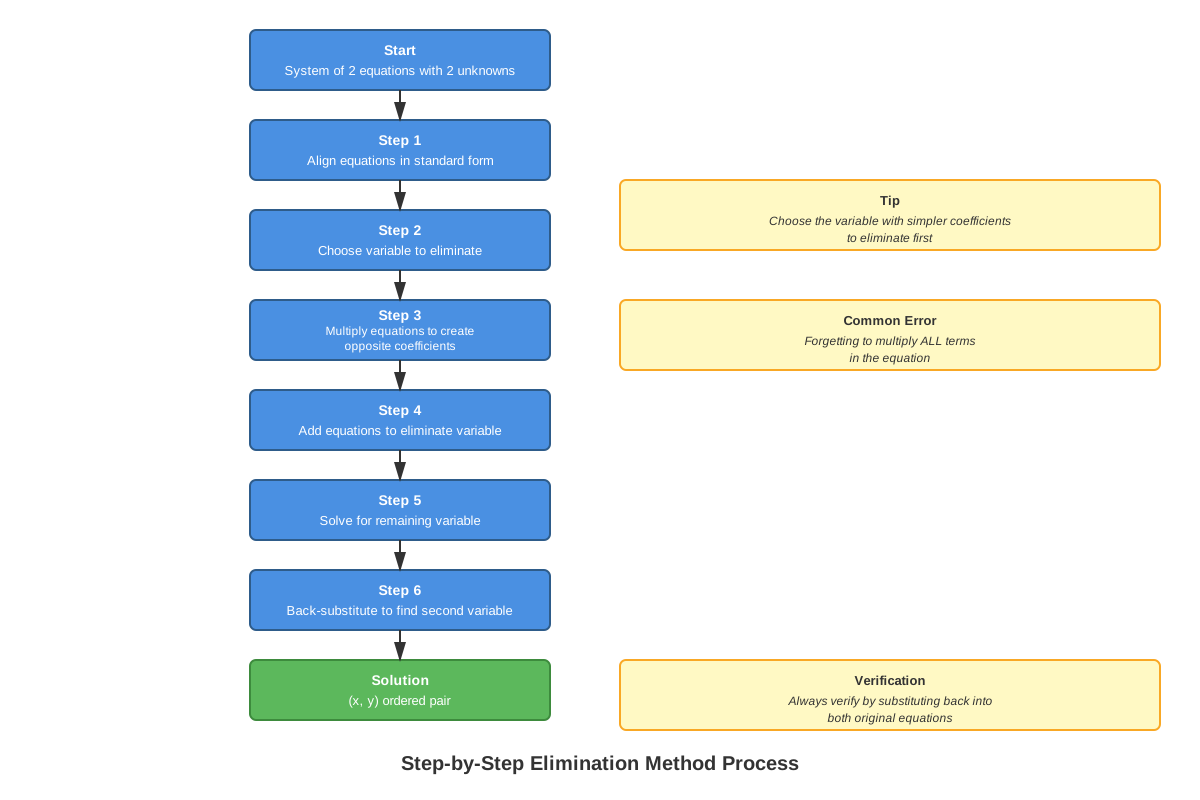
The elimination method operates on a simple but powerful principle: when two equations are added or subtracted, the resulting equation remains valid and can be used to solve the system. This works because equations represent balanced statements—whatever appears on the left side equals what appears on the right side. When equations are combined, this balance is preserved. The strategic goal is to manipulate the equations so that when combined, one variable's coefficients cancel out (sum to zero), leaving an equation with only one unknown.
Consider the basic system:
3x + 2y = 16
5x - 2y = 8
Notice that the y-coefficients are opposites (+2 and -2). Adding these equations directly eliminates y:
(3x + 2y) + (5x - 2y) = 16 + 8
8x = 24
x = 3
This exemplifies the ideal elimination scenario where coefficients naturally oppose each other. However, most GRE problems require preliminary manipulation to create this condition.
Creating Opposite Coefficients Through Multiplication
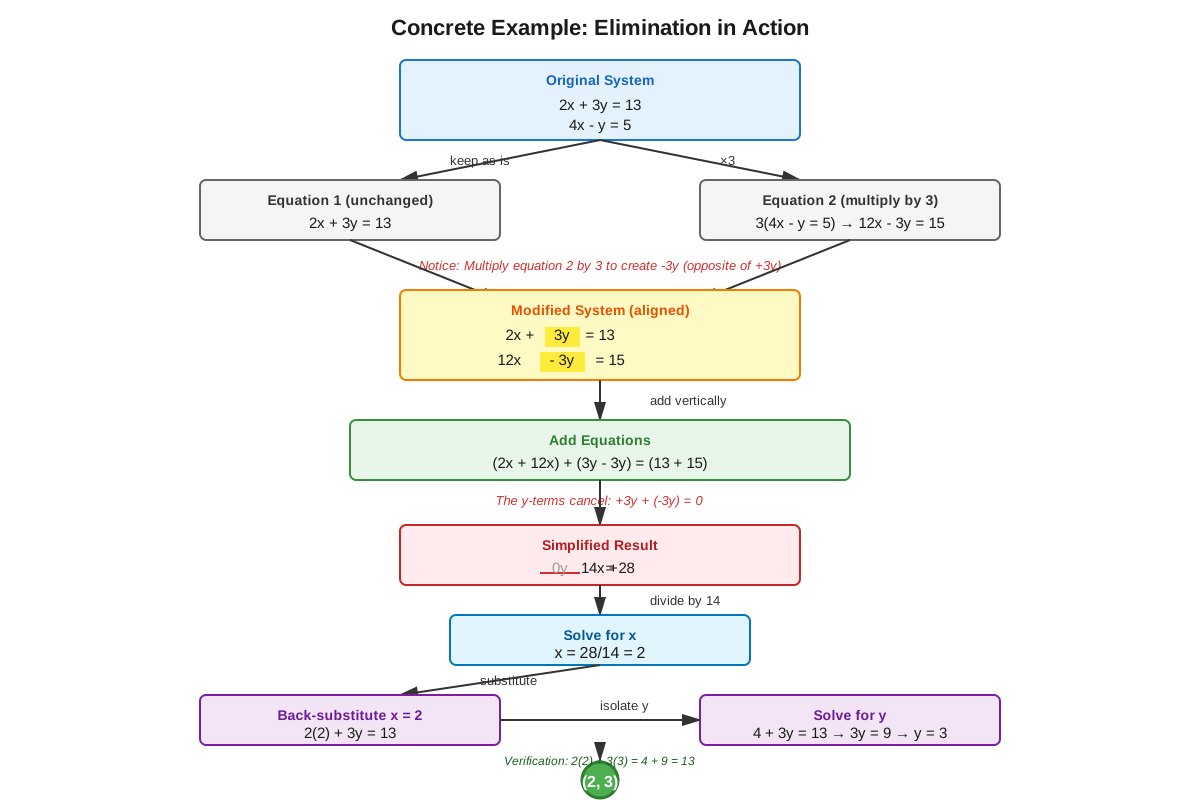
When coefficients don't naturally cancel, the elimination method requires multiplying one or both equations by strategic constants. The goal is to make the coefficients of one variable equal in magnitude but opposite in sign. This process involves identifying the least common multiple (LCM) of the coefficients or simply cross-multiplying.
For the system:
2x + 3y = 13
4x + 5y = 23
To eliminate x, multiply the first equation by 2:
2(2x + 3y) = 2(13)  →  4x + 6y = 26
4x + 5y = 23
Now subtract the second equation from the modified first:
(4x + 6y) - (4x + 5y) = 26 - 23
y = 3
Alternatively, to eliminate y, multiply the first equation by 5 and the second by -3:
5(2x + 3y) = 5(13)  →  10x + 15y = 65
-3(4x + 5y) = -3(23)  →  -12x - 15y = -69
Adding these eliminates y:
10x + 15y - 12x - 15y = 65 - 69
-2x = -4
x = 2
Back-Substitution to Find Remaining Variables
After elimination yields the value of one variable, back-substitution determines the remaining variable(s). This involves substituting the known value into either original equation and solving for the unknown. While either equation works theoretically, choosing the simpler equation (fewer terms, smaller coefficients) reduces calculation errors.
Using our previous example where we found y = 3, substitute into the first original equation:
2x + 3(3) = 13
2x + 9 = 13
2x = 4
x = 2
Always verify the solution by substituting both values into the second original equation:
4(2) + 5(3) = 8 + 15 = 23 ✓This verification step catches arithmetic errors and confirms the solution satisfies both constraints.
Special Cases: No Solution and Infinite Solutions
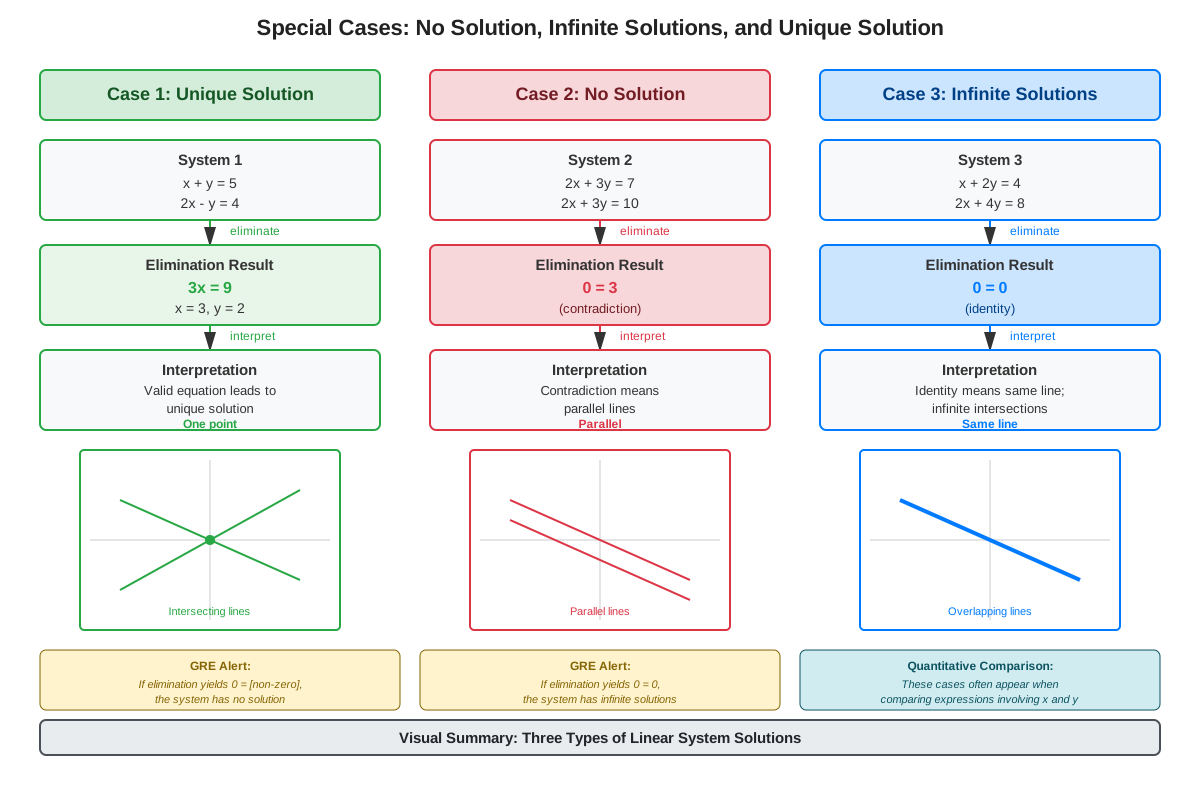
Not all systems have a unique solution. The elimination method reveals two special cases that frequently appear on the GRE:
Inconsistent Systems (No Solution): When elimination produces a false statement (like 0 = 5), the system has no solution. The equations represent parallel lines that never intersect.
Example:
2x + 3y = 7
4x + 6y = 20
Multiplying the first equation by -2:
-4x - 6y = -14
4x + 6y = 20
Adding yields: 0 = 6 (false statement → no solution)
Dependent Systems (Infinite Solutions): When elimination produces a true identity (like 0 = 0), the equations are equivalent—they represent the same line. Every point on the line is a solution.
Example:
3x - 2y = 6
6x - 4y = 12
The second equation is simply the first multiplied by 2. Elimination yields 0 = 0, indicating infinite solutions.
Strategic Variable Selection
Choosing which variable to eliminate first can significantly impact calculation efficiency. Consider these factors:
| Factor | Optimal Choice |
|---|---|
| Coefficients are already opposites | Eliminate that variable immediately |
| One variable has coefficient of 1 | Eliminate the other variable (simpler multiplication) |
| Question asks for sum/difference | Eliminate to create the desired combination |
| Fractional coefficients present | Eliminate to avoid fraction multiplication |
For GRE questions asking for x + y or 2x - y, sometimes adding or subtracting equations directly yields the answer without finding individual values—a significant time-saver.
Three-Variable Systems
While less common on the GRE, three-variable systems follow the same principle: eliminate one variable from two pairs of equations, creating two equations with two unknowns, then proceed with standard elimination.
Given:
x + y + z = 6
2x - y + z = 3
x + 2y - z = 5
Eliminate z from equations 1 and 2:
(x + y + z) + (2x - y + z) = 6 + 3
3x = 9  →  x = 3
Then eliminate z from equations 1 and 3:
(x + y + z) + (x + 2y - z) = 6 + 5
2x + 3y = 11
Substitute x = 3: 6 + 3y = 11, so y = 5/3, and back-substitution yields z.
Concept Relationships
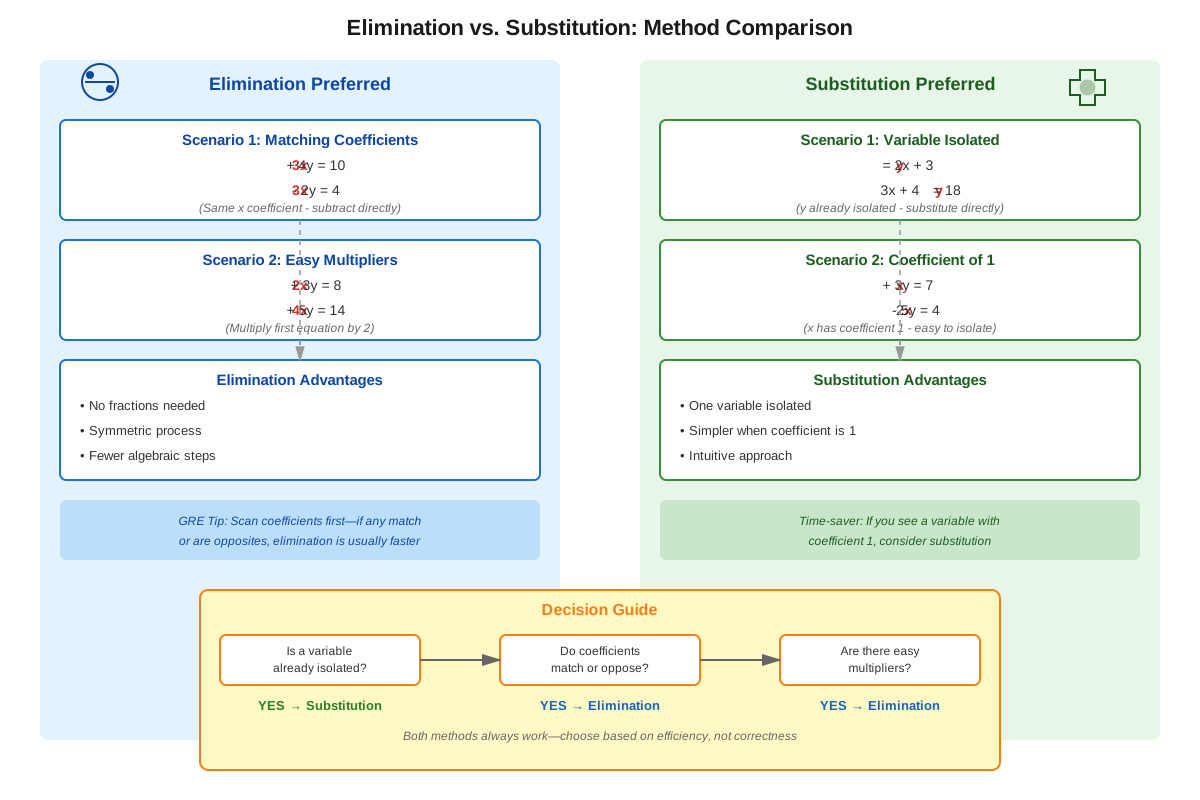
The elimination method connects intimately with several algebraic concepts, forming a web of problem-solving strategies. At its foundation, elimination relies on equation properties (addition property of equality) and inverse operations, which are prerequisite skills. The method serves as an alternative to the substitution method—while substitution isolates one variable and replaces it in another equation, elimination combines equations to remove variables. Each approach has optimal use cases: substitution works well when one variable has a coefficient of 1, while elimination excels with matching or easily manipulated coefficients.
The relationship map flows as follows:
Basic Equation Solving → enables → Elimination Method → solves → Systems of Linear Equations → represents → Line Intersections in Coordinate Geometry
Additionally, elimination connects to matrix operations (though beyond GRE scope, the method mirrors row reduction) and provides the algebraic foundation for linear programming and optimization problems. When combined with word problem translation skills, elimination becomes a powerful tool for modeling real-world constraints.
The special cases (no solution, infinite solutions) directly relate to parallel and coincident lines in coordinate geometry. Understanding that inconsistent systems represent parallel lines (same slope, different y-intercepts) and dependent systems represent identical lines deepens conceptual mastery beyond mechanical computation.
Quick check — test yourself on Elimination method so far.
Try Flashcards →High-Yield Facts
⭐ The elimination method works by adding or subtracting equations to cancel one variable, creating an equation with fewer unknowns
⭐ Multiply equations by strategic constants to create opposite coefficients before adding (or equal coefficients before subtracting)
⭐ When elimination yields 0 = [non-zero number], the system has no solution (inconsistent/parallel lines)
⭐ When elimination yields 0 = 0, the system has infinite solutions (dependent/coincident lines)
⭐ Always verify solutions by substituting both values into both original equations
- Choose to eliminate the variable with coefficients that are easiest to manipulate (already opposites, or one is 1)
- If a question asks for x + y or another combination, sometimes adding/subtracting equations directly gives the answer without solving for individual variables
- Multiplying an equation by a negative number changes the signs of all terms—a common source of errors
- The elimination method and substitution method always yield the same solution for consistent systems
- For three-variable systems, eliminate the same variable from two different equation pairs to reduce to a two-variable system
Common Misconceptions
Misconception: When multiplying an equation by a constant, only the left side needs to be multiplied → Correction: Both sides of the equation must be multiplied by the same constant to maintain equality. If 2x + y = 5 is multiplied by 3, the result is 6x + 3y = 15, not 6x + 3y = 5.
Misconception: Elimination only works when you add equations together → Correction: Elimination works through both addition and subtraction. When coefficients have the same sign, subtraction eliminates the variable. The key is making coefficients opposites (for addition) or equal (for subtraction).
Misconception: If elimination produces 0 = 0, there is no solution → Correction: The identity 0 = 0 indicates infinite solutions (dependent system), not no solution. No solution occurs when elimination produces a false statement like 0 = 5.
Misconception: You must always eliminate x first → Correction: Either variable can be eliminated first. Strategic selection based on coefficient simplicity improves efficiency, but the final answer is identical regardless of which variable is eliminated first.
Misconception: Back-substitution must use the first original equation → Correction: After finding one variable's value, substitute it into either original equation—whichever is simpler. Both equations must be satisfied by the solution, so either works for back-substitution.
Misconception: Multiplying both equations by the same number helps elimination → Correction: Multiplying both equations by the same constant doesn't create opposite coefficients. Each equation typically needs a different multiplier, or one equation is multiplied while the other remains unchanged.
Worked Examples
Example 1: Standard Two-Variable System
Problem: Solve the system:
3x + 4y = 18
5x - 2y = 4Solution:
Step 1: Analyze coefficients
The y-coefficients are 4 and -2. The x-coefficients are 3 and 5. Eliminating y appears simpler since 4 and -2 have a smaller LCM.
Step 2: Create opposite coefficients for y
Multiply the second equation by 2:
2(5x - 2y) = 2(4)
10x - 4y = 8
Now we have:
3x + 4y = 18
10x - 4y = 8
Step 3: Add equations to eliminate y
(3x + 4y) + (10x - 4y) = 18 + 8
13x = 26
x = 2
Step 4: Back-substitute to find y
Using the first original equation:
3(2) + 4y = 18
6 + 4y = 18
4y = 12
y = 3
Step 5: Verify in second original equation
5(2) - 2(3) = 10 - 6 = 4 ✓Answer: x = 2, y = 3
Connection to Learning Objectives: This example demonstrates applying the elimination method to a standard GRE-style problem, showing the complete process from coefficient analysis through verification.
Example 2: GRE Shortcut Strategy
Problem: If 2x + 3y = 17 and 4x + 3y = 25, what is the value of x + y?
Solution:
Step 1: Recognize the shortcut opportunity
The question asks for x + y, not individual values. Look for a way to create this combination directly.
Step 2: Eliminate y to find x
Subtract the first equation from the second:
(4x + 3y) - (2x + 3y) = 25 - 17
2x = 8
x = 4
Step 3: Find y through back-substitution
Using the first equation:
2(4) + 3y = 17
8 + 3y = 17
3y = 9
y = 3
Step 4: Calculate the requested value
x + y = 4 + 3 = 7Alternative Shortcut Approach:
Notice that if we add both original equations:
(2x + 3y) + (4x + 3y) = 17 + 25
6x + 6y = 42
6(x + y) = 42
x + y = 7
This approach finds x + y directly without determining individual values—a significant time-saver on the GRE.
Answer: 7
Connection to Learning Objectives: This example illustrates identifying when elimination is being tested and applying strategic thinking to maximize efficiency, a crucial skill for GRE success.
Exam Strategy
When approaching elimination method questions on the GRE, begin by quickly scanning the problem to identify trigger phrases that signal systems of equations: "two equations," "if x and y satisfy," "given that," or word problems with multiple constraints (e.g., "the sum of two numbers is 15 and their difference is 3"). These phrases indicate that elimination may be the optimal approach.
Exam Tip: Before diving into calculations, spend 5-10 seconds analyzing coefficients. If one variable already has opposite coefficients or coefficients of 1, you've identified the easiest elimination path.
Time allocation strategy: Standard two-variable elimination problems should take 60-90 seconds. If you're exceeding two minutes, consider whether substitution might be faster or if you've made an arithmetic error. For Quantitative Comparison questions involving systems, sometimes you don't need exact values—determining whether a variable is positive or negative may suffice.
Process-of-elimination tips specific to elimination method:
- If answer choices are given for both variables (like "x = 2, y = 3"), plug them into both equations rather than solving completely—this can be faster
- For "which of the following could be true" questions, eliminate choices that would create inconsistent systems
- When answer choices are expressions like "x + y" or "2x - 3y," look for ways to combine equations to create these expressions directly
Common trap patterns: The GRE often presents systems where hasty addition/subtraction leads to errors. Watch for:
- Negative signs when subtracting equations (subtracting -2y means adding 2y)
- Questions asking for 2x or x/2 rather than x itself—students solve for x then forget to transform it
- Special cases disguised as standard problems—always check if your elimination produces 0 = 0 or 0 = [number]
Strategic decision-making: If a problem offers both elimination and substitution as viable approaches, choose elimination when:
- Coefficients are already aligned or easily manipulated
- The question asks for a sum or difference of variables
- Substitution would create complex fractions or nested parentheses
Memory Techniques
Mnemonic for the elimination process: "MACE"
- Multiply equations to align coefficients
- Add or subtract to eliminate one variable
- Calculate the remaining variable
- Evaluate through back-substitution and verify
Visualization strategy: Picture equations as balanced scales. When you add two balanced scales together, the result remains balanced. Elimination is like stacking scales so that equal weights on opposite sides cancel out, leaving only the difference visible.
Acronym for special cases: "FIND"
- False statement (0 = 5) → Inconsistent → No solution → Different parallel lines
- True identity (0 = 0) → Infinite solutions → Dependent → Exact same line
Sign management mnemonic: When subtracting equations, remember "SOAP" - Subtraction Opposites All Parts. Subtracting means changing the sign of every term in the equation being subtracted, not just the first term.
Coefficient selection memory aid: "LOSE" - Look for Opposites or Simple (coefficient of 1) to Eliminate first. This reminds you to scan for the easiest elimination path before calculating.
Summary
The elimination method provides a systematic, powerful approach to solving systems of linear equations by strategically combining equations to cancel variables. This technique, essential for GRE Quantitative Reasoning success, operates on the principle that adding or subtracting valid equations produces valid results. The method requires multiplying equations by strategic constants to create opposite coefficients, then adding (or subtracting) to eliminate one variable. After finding one variable's value, back-substitution determines remaining variables, with verification confirming accuracy. Special cases—inconsistent systems yielding false statements and dependent systems yielding identities—test conceptual understanding beyond mechanical computation. The GRE rewards students who can quickly identify when elimination is optimal, execute it efficiently, and recognize shortcuts like directly creating requested variable combinations. Mastery requires understanding coefficient manipulation, sign management during subtraction, and strategic variable selection based on coefficient simplicity.
Key Takeaways
- The elimination method solves systems by adding or subtracting equations to cancel one variable at a time
- Multiply equations by strategic constants to create opposite coefficients (for addition) or equal coefficients (for subtraction)
- False statements (0 = 5) indicate no solution; true identities (0 = 0) indicate infinite solutions
- Always verify solutions by substituting into both original equations to catch arithmetic errors
- Choose to eliminate the variable with the simplest coefficient relationships to maximize efficiency
- For questions asking for variable combinations (x + y), look for shortcuts that avoid finding individual values
- Back-substitution into either original equation works—select the simpler one to reduce calculation errors
Related Topics
Substitution Method: An alternative approach to solving systems where one variable is isolated and substituted into another equation. Mastering elimination enables better strategic decisions about when substitution might be more efficient.
Systems of Inequalities: Extends elimination concepts to inequality systems, requiring understanding of how operations affect inequality directions. Elimination method mastery provides the algebraic foundation for this more complex topic.
Coordinate Geometry and Line Intersections: Systems of equations represent intersection points of lines. Understanding elimination deepens geometric intuition about when lines intersect, are parallel, or coincide.
Word Problem Translation: Many GRE problems require translating verbal descriptions into equation systems before applying elimination. This topic combines language interpretation with algebraic technique.
Matrix Operations: Though beyond GRE scope, elimination method mirrors row reduction in matrices, providing a conceptual bridge to more advanced linear algebra.
Practice CTA
Now that you've mastered the elimination method's core concepts and strategies, it's time to solidify your understanding through active practice. The practice questions and flashcards designed for this topic will challenge you to apply elimination in various GRE-style contexts, from straightforward systems to complex word problems requiring strategic thinking. Remember, proficiency comes from deliberate practice—work through each problem methodically, focusing on coefficient analysis and verification. Each practice question you complete strengthens your pattern recognition and calculation speed, bringing you closer to your target GRE score. Start practicing now to transform this knowledge into test-day confidence!
Sign up free to keep reading
Create a free AnvayaPrep account to finish this GRE guide on Elimination method — plus flashcards and practice questions.