Overview
The substitution method is a fundamental algebraic technique that allows test-takers to solve systems of equations by expressing one variable in terms of another and replacing it throughout the problem. On the GRE Quantitative Reasoning section, this method appears frequently in both discrete quantitative comparison questions and problem-solving items, making it an essential skill for achieving competitive scores. The technique involves isolating a variable in one equation and substituting that expression into another equation, thereby reducing the number of unknowns and simplifying the path to a solution.
Understanding the GRE substitution method extends beyond mechanical equation manipulation—it represents a strategic approach to breaking down complex algebraic relationships into manageable steps. This method proves particularly valuable when dealing with linear systems, word problems that generate multiple equations, and questions involving algebraic expressions where direct calculation would be cumbersome. The GRE frequently tests whether students can recognize when substitution offers the most efficient solution path compared to alternative methods like elimination or graphing.
The substitution method connects deeply to broader Quantitative Reasoning concepts including linear equations, coordinate geometry, functions, and algebraic manipulation. Mastery of this technique enables students to tackle more advanced topics such as optimization problems, inequality systems, and abstract algebraic reasoning questions. Since the GRE emphasizes problem-solving efficiency and strategic thinking, knowing when and how to apply substitution can save precious time and reduce computational errors during the exam.
Learning Objectives
- [ ] Identify when Substitution method is being tested
- [ ] Explain the core rule or strategy behind Substitution method
- [ ] Apply Substitution method to GRE-style questions accurately
- [ ] Determine when substitution is more efficient than alternative methods (elimination, graphing)
- [ ] Recognize and avoid common algebraic errors during the substitution process
- [ ] Solve systems with three or more variables using sequential substitution
- [ ] Apply substitution to word problems by translating verbal statements into equations
Prerequisites
- Linear equations and solving for variables: Essential for isolating variables before substitution can occur
- Order of operations and algebraic simplification: Required to correctly simplify expressions after substitution
- Combining like terms: Necessary to consolidate the resulting equation into solvable form
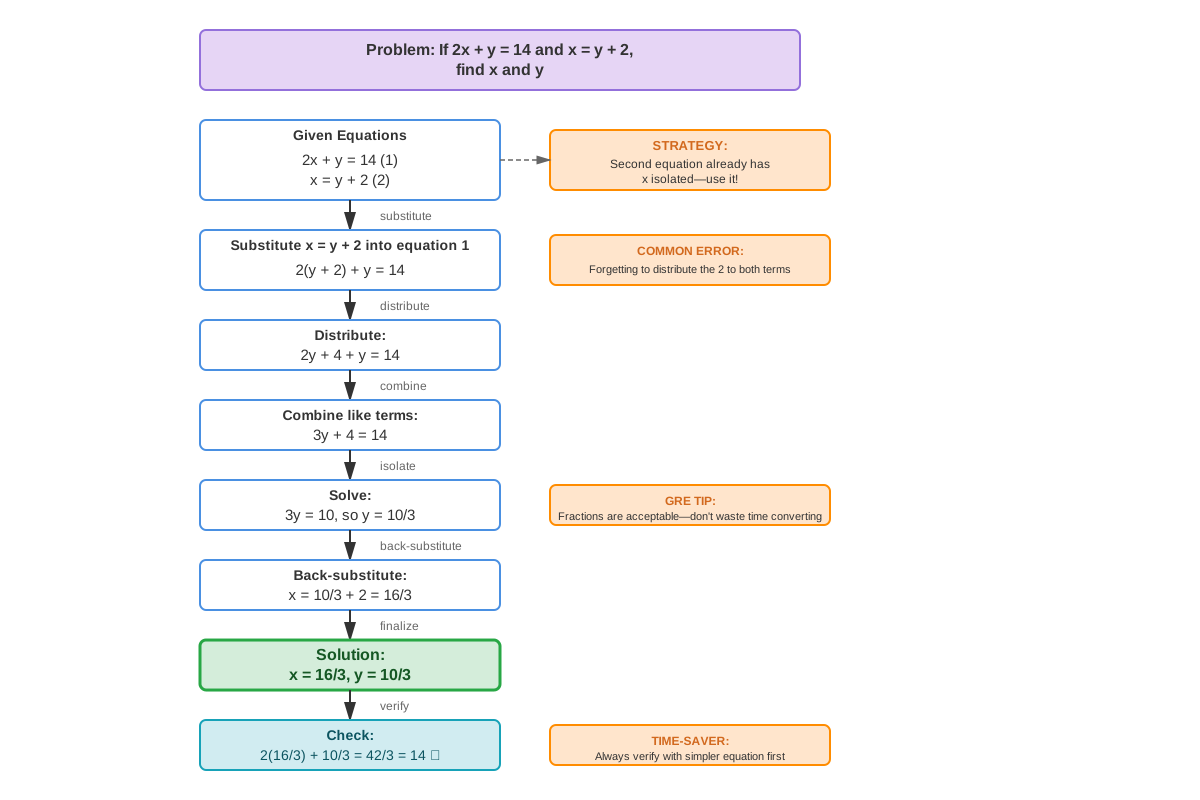
- Distributive property: Critical when substituting expressions that contain multiple terms
- Basic equation-solving techniques: Foundation for finding final solutions after substitution reduces the system
Why This Topic Matters
The substitution method appears in approximately 15-20% of GRE Quantitative Reasoning questions, either directly or as part of a multi-step problem-solving process. This technique proves invaluable in real-world applications including economics (supply-demand equilibrium), physics (motion problems with multiple constraints), business analytics (break-even analysis), and engineering (system optimization). The ability to manipulate and solve systems of equations demonstrates logical reasoning and analytical thinking—core competencies that graduate programs value highly.
On the GRE, substitution method questions typically appear in several formats: quantitative comparison questions asking students to compare expressions involving multiple variables, problem-solving questions presenting word problems that generate systems of equations, and data interpretation questions requiring algebraic manipulation of given relationships. The exam frequently embeds substitution within more complex scenarios rather than presenting straightforward "solve this system" questions, testing whether students can recognize the underlying algebraic structure.
Common question types include age problems (relating current and future ages), mixture problems (combining solutions with different concentrations), distance-rate-time scenarios (involving multiple travelers), and abstract algebraic relationships (where variables represent unknown quantities without real-world context). The GRE particularly favors questions where substitution reveals elegant shortcuts or where recognizing the substitution opportunity distinguishes efficient test-takers from those who attempt more laborious approaches.
Core Concepts
The Fundamental Substitution Process
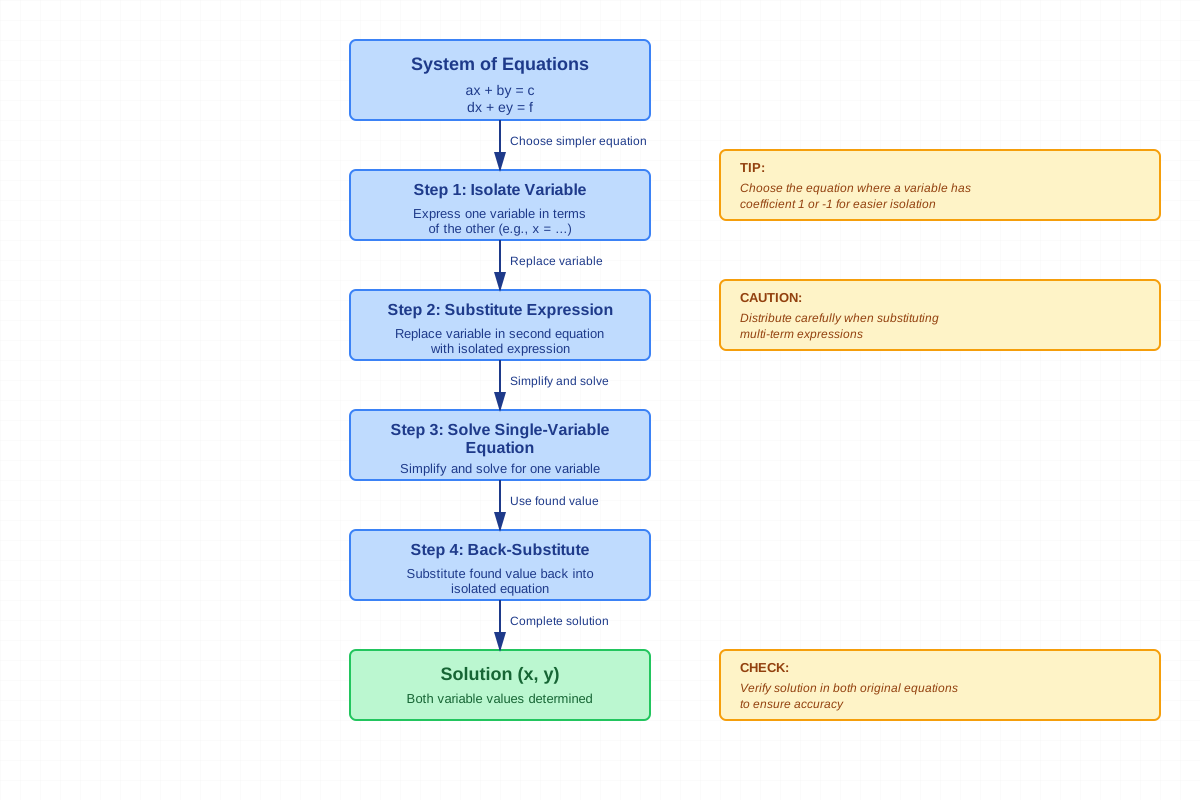
The substitution method operates on a straightforward principle: when facing multiple equations with multiple unknowns, solve one equation for one variable, then replace every occurrence of that variable in the other equations with the expression obtained. This process transforms a system of equations into a single equation with one unknown, which can then be solved using standard algebraic techniques.
The systematic approach involves four distinct steps:
- Select an equation and variable: Choose the equation and variable that will yield the simplest expression when isolated
- Isolate the chosen variable: Solve the selected equation for the chosen variable
- Substitute the expression: Replace all instances of that variable in the remaining equations with the derived expression
- Solve and back-substitute: Solve the resulting equation, then substitute back to find remaining variables
Choosing the Optimal Variable for Substitution
Strategic selection of which variable to isolate significantly impacts computational efficiency. The ideal candidate for substitution exhibits these characteristics:
- Coefficient of 1 or -1: Variables with unit coefficients require no division, reducing fraction complexity
- Already isolated or nearly isolated: Equations where a variable appears alone on one side minimize manipulation
- Appears in simpler form: Variables without exponents or complex coefficients simplify subsequent substitution
- Leads to easier arithmetic: Consider which choice produces the most manageable numbers in later steps
Single-Step vs. Multi-Step Substitution
Single-step substitution applies when dealing with two equations and two unknowns. After one substitution, the problem reduces to a single-variable equation. For example, given:
Equation 1: y = 2x + 3
Equation 2: 3x + 4y = 26
Substituting Equation 1 into Equation 2 immediately yields a solvable equation in x alone.
Multi-step substitution becomes necessary with three or more variables, requiring sequential substitutions. The process involves solving for one variable, substituting to eliminate it from all other equations, then repeating the process with the reduced system. This technique demands careful organization to track which variables have been eliminated and which equations remain active.
Substitution in Non-Linear Systems
While most GRE substitution problems involve linear equations, the method extends to systems containing quadratic or other non-linear equations. When one equation is linear and another is quadratic, substitution often proves more efficient than elimination. The linear equation provides an expression for one variable that can be substituted into the quadratic equation, yielding a single-variable quadratic that can be solved by factoring, completing the square, or the quadratic formula.
Substitution with Inequalities
The substitution method adapts to systems involving inequalities, though additional care is required. When substituting into an inequality, the direction of the inequality sign must be preserved unless multiplying or dividing by a negative number. The solution often represents a region rather than discrete points, and graphical interpretation may complement algebraic work.
Verification and Solution Checking
After obtaining solutions through substitution, verification proves essential—particularly on the GRE where answer choices may include common error results. Substitute the found values back into all original equations to confirm they satisfy every constraint. This step catches sign errors, arithmetic mistakes, and cases where extraneous solutions arise from algebraic manipulation.
Concept Relationships
The substitution method builds directly on prerequisite skills in solving linear equations and algebraic manipulation. The ability to isolate variables (prerequisite) → enables the substitution process (core concept) → which leads to solving systems of equations (application). Within the topic itself, choosing the optimal variable for substitution → determines computational efficiency → which affects accuracy under time pressure.
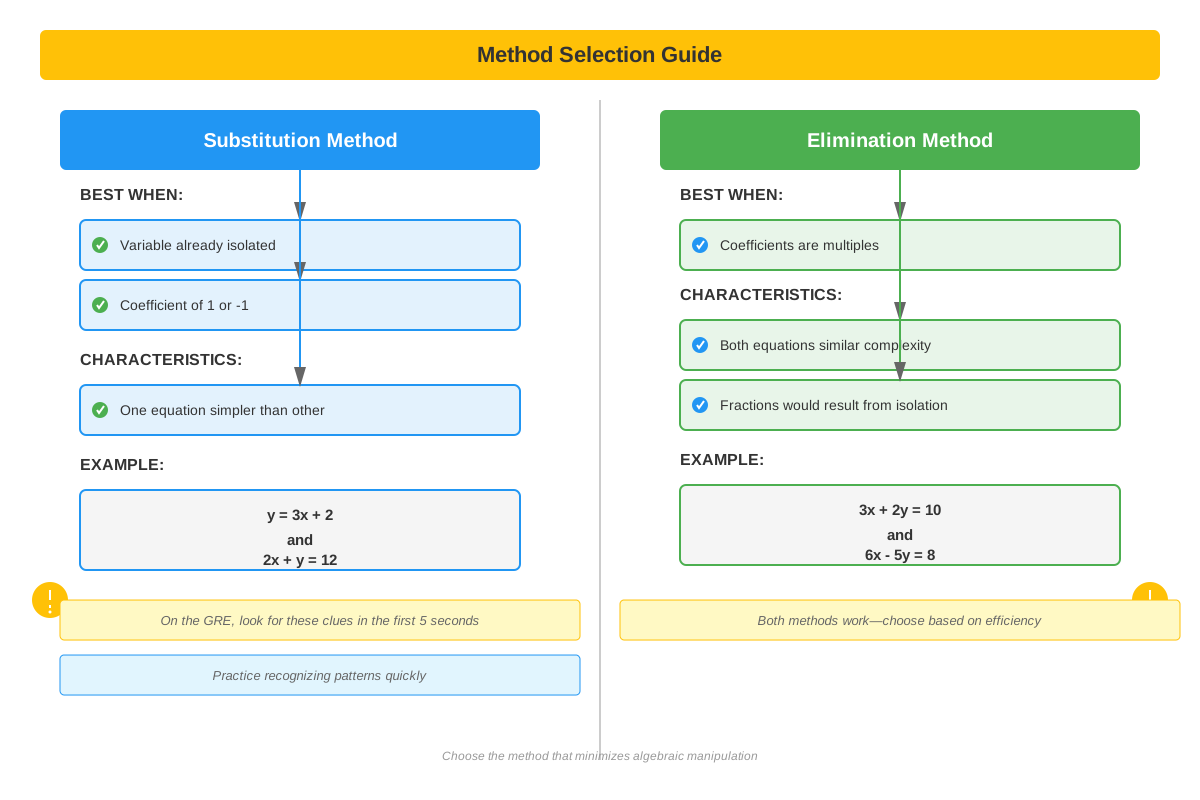
Substitution connects to the elimination method as an alternative approach to systems of equations. Both methods aim to reduce the number of variables, but substitution replaces variables with expressions while elimination combines equations to cancel variables. Understanding both methods → allows strategic selection based on problem structure → leading to optimal time management on the exam.
The technique also relates to function composition in algebra, where substituting one function into another parallels substituting one equation into another. This connection extends to coordinate geometry, where substitution helps find intersection points of lines and curves. Additionally, substitution underlies more advanced topics like Lagrange multipliers in optimization and parametric equations in calculus, though these exceed GRE scope.
High-Yield Facts
⭐ The substitution method works most efficiently when one equation already has a variable isolated or has a coefficient of 1 or -1
⭐ Always substitute the entire expression, including any negative signs or parentheses, to avoid sign errors
⭐ After finding one variable's value, you must back-substitute to find the remaining variables
⭐ Substitution typically proves faster than elimination when one equation is already solved for a variable
⭐ Verify solutions by substituting back into all original equations, not just one
- Systems with no solution produce contradictions (like 0 = 5) during the substitution process
- Systems with infinitely many solutions reduce to identities (like 0 = 0) after substitution
- When substituting into quadratic equations, expect up to two solution pairs
- Substitution can be applied iteratively in systems with three or more variables
- The method works equally well with equations involving fractions, decimals, or radicals, though arithmetic becomes more complex
Quick check — test yourself on Substitution method so far.
Try Flashcards →Common Misconceptions
Misconception: Only the expression on one side of the equation needs to be substituted → Correction: The entire expression that equals the isolated variable must be substituted, maintaining proper use of parentheses to preserve the complete relationship
Misconception: After finding one variable, the problem is complete → Correction: Both variables (or all variables in larger systems) must be found unless the question specifically asks for only one; back-substitution is required to find remaining values
Misconception: Substitution and elimination always yield different answers → Correction: Both methods solve the same system and must produce identical solutions when applied correctly; different answers indicate an error in execution
Misconception: The variable with the largest coefficient should be isolated first → Correction: Variables with coefficients of 1 or -1 should be prioritized because they avoid introducing fractions during isolation
Misconception: Substitution only works for linear equations → Correction: The method applies to systems mixing linear and non-linear equations, though the resulting equation may require quadratic or other advanced solving techniques
Misconception: When substituting into an inequality, the same rules apply as with equations → Correction: While substitution mechanics are similar, inequality direction must be carefully maintained, and multiplying/dividing by negative values requires reversing the inequality sign
Misconception: If substitution seems complicated, the problem was set up incorrectly → Correction: Some problems naturally involve complex substitution; however, this may signal that elimination or another method would be more efficient for that particular system
Worked Examples
Example 1: Classic Two-Variable System
Problem: Solve the system of equations:
x + y = 10
2x - y = 5Solution:
Step 1: Identify the optimal equation and variable
The first equation has both variables with coefficient 1, making either variable easy to isolate. Choose to solve for y in the first equation.
Step 2: Isolate the variable
x + y = 10
y = 10 - x
Step 3: Substitute into the second equation
Replace y in the second equation with (10 - x):
2x - y = 5
2x - (10 - x) = 5
Note the parentheses around (10 - x) to ensure the negative sign distributes correctly.
Step 4: Solve for x
2x - 10 + x = 5
3x - 10 = 5
3x = 15
x = 5
Step 5: Back-substitute to find y
y = 10 - x
y = 10 - 5
y = 5
Step 6: Verify the solution
Check in both original equations:
- Equation 1: 5 + 5 = 10 ✓
- Equation 2: 2(5) - 5 = 10 - 5 = 5 ✓
Answer: x = 5, y = 5
This example demonstrates the core substitution process and emphasizes the importance of using parentheses during substitution to maintain correct signs.
Example 2: GRE-Style Word Problem
Problem: Concert tickets cost $15 for adults and $8 for children. A family purchases 7 tickets for a total of $82. How many adult tickets did they purchase?
Solution:
Step 1: Translate to equations
Let a = number of adult tickets, c = number of child tickets
a + c = 7        (total tickets)
15a + 8c = 82    (total cost)
Step 2: Choose variable to isolate
The first equation has coefficients of 1, making it ideal. Solve for c:
c = 7 - aStep 3: Substitute into the cost equation
15a + 8c = 82
15a + 8(7 - a) = 82
Step 4: Solve for a
15a + 56 - 8a = 82
7a + 56 = 82
7a = 26
a = 26/7
Wait—this produces a non-integer answer, which is impossible for ticket purchases. Rechecking the arithmetic:
15a + 56 - 8a = 82
7a = 26
This suggests an error in the problem statement or our setup. Let's verify by testing integer values. If a = 4:
- Total tickets: 4 + 3 = 7 ✓
- Total cost: 15(4) + 8(3) = 60 + 24 = 84 ✗
If a = 3:
- Total tickets: 3 + 4 = 7 ✓
- Total cost: 15(3) + 8(4) = 45 + 32 = 77 ✗
Actually, let's recalculate more carefully:
15a + 8(7 - a) = 82
15a + 56 - 8a = 82
7a = 26
Since 26/7 is not an integer, this problem as stated has no integer solution. However, if the total were $83 instead:
7a = 27
a = 27/7 (still not integer)
For a = 4: 15(4) + 8(3) = 84
For a = 3: 15(3) + 8(4) = 77
The closest integer solution would be a = 4, c = 3 for $84 total.
Key Learning Point: This example illustrates that substitution reveals when a system has no solution or when problem parameters need adjustment. On the GRE, if calculations yield impossible results, recheck the problem statement or consider that "cannot be determined" may be the correct answer.
Exam Strategy
When approaching GRE questions involving the substitution method, begin by scanning for trigger phrases that indicate systems of equations: "two numbers," "sum and difference," "combined total," "relationship between," or any scenario presenting multiple constraints on unknown quantities. These phrases signal that translating the problem into equations and applying substitution may be necessary.
Time allocation strategy: Spend 15-20 seconds identifying whether substitution or elimination will be more efficient before beginning calculations. If one equation already has an isolated variable or a coefficient of 1, substitution typically saves time. If both equations have similar coefficient patterns, elimination may be faster. For quantitative comparison questions, sometimes substitution reveals relationships without requiring complete solutions—look for opportunities to compare expressions directly.
Process-of-elimination tips: When answer choices are provided, consider working backward by substituting answer choices into the original equations. This "plug-in" strategy can be faster than algebraic solution, especially when answers are simple integers. Additionally, eliminate answers that violate basic constraints (negative values when only positive make sense, non-integers for counting problems, etc.).
Common GRE variations: Watch for questions that provide the sum and product of two numbers, requiring substitution into the quadratic formula framework. Also recognize "hidden systems" where a single complex sentence contains multiple constraints that must be separated into distinct equations. The exam may present three equations with three unknowns, but often only two equations are needed to answer the specific question asked—identify what you actually need to find before solving everything.
Efficiency techniques: When the question asks for an expression like "x + y" rather than individual values, look for ways to manipulate equations to find the desired expression directly without solving for each variable separately. Similarly, if asked for "2x - 3y," consider whether combining or manipulating the original equations yields this expression without full substitution.
Memory Techniques
SISS Mnemonic for the substitution process:
- Select the equation and variable
- Isolate the chosen variable
- Substitute into remaining equations
- Solve and back-substitute
Parentheses Protection Rule: Visualize wrapping the substituted expression in a protective bubble (parentheses) to remember that the entire expression must be treated as a unit, especially when preceded by a negative sign or coefficient.
The "One Less" Principle: Each successful substitution reduces the number of variables by one. With two variables, one substitution yields a single-variable equation. With three variables, two substitutions are needed. This mental model helps track progress through complex systems.
Verification Visualization: Picture a checkpoint at the end of every problem where solutions must "pass through" all original equations. This mental image reinforces the habit of checking answers in every equation, not just the one used for back-substitution.
Coefficient Hierarchy: Remember "1 is #1" to prioritize isolating variables with coefficient 1 or -1, as these produce the cleanest substitutions without introducing fractions.
Summary
The substitution method represents a cornerstone algebraic technique for solving systems of equations on the GRE Quantitative Reasoning section. By isolating one variable in terms of others and systematically replacing it throughout the system, test-takers transform multi-variable problems into single-variable equations that can be solved through standard techniques. Success with this method requires strategic selection of which variable to isolate (prioritizing coefficients of 1 or -1), meticulous attention to algebraic detail (especially sign preservation and parentheses use), and consistent verification of solutions in all original equations. The GRE tests substitution both directly through systems of equations and indirectly through word problems requiring translation into algebraic form. Recognizing when substitution offers advantages over alternative methods like elimination, and executing the four-step process efficiently, enables students to handle 15-20% of quantitative questions with confidence while managing time effectively under exam conditions.
Key Takeaways
- The substitution method solves systems by isolating one variable and replacing it in other equations, reducing the number of unknowns systematically
- Always choose to isolate variables with coefficients of 1 or -1 first to minimize fraction arithmetic and computational complexity
- Parentheses are essential when substituting expressions to preserve correct signs and maintain proper order of operations
- Back-substitution is required to find all variable values; finding one variable does not complete the problem unless specifically asked
- Verify solutions by substituting into all original equations to catch arithmetic errors and confirm the solution satisfies every constraint
- Substitution proves most efficient when one equation already has an isolated variable or when mixing linear and non-linear equations
- Recognize GRE word problems that generate systems of equations through phrases like "sum and difference," "combined total," or "relationship between"
Related Topics
Elimination Method: An alternative approach to solving systems of equations by adding or subtracting equations to cancel variables; mastering both substitution and elimination enables strategic method selection based on problem structure
Linear Inequalities and Systems: Extends substitution techniques to inequality systems, requiring attention to inequality direction and solution regions rather than discrete points
Quadratic Equations: Substitution into quadratic equations produces single-variable quadratics requiring factoring or the quadratic formula; this combination appears frequently on the GRE
Functions and Function Notation: Function composition parallels the substitution process, where f(g(x)) involves substituting one function into another
Coordinate Geometry: Finding intersection points of lines and curves requires solving systems through substitution, connecting algebra to geometric visualization
Word Problem Translation: Converting verbal descriptions into algebraic equations is the essential first step before substitution can be applied to real-world scenarios
Practice CTA
Now that you understand the substitution method's principles, strategies, and applications, reinforce your mastery through deliberate practice. Attempt the practice questions associated with this topic, focusing on recognizing when substitution offers the most efficient solution path and executing the four-step process with precision. Use the flashcards to internalize high-yield facts and common error patterns. Remember that the GRE rewards both accuracy and efficiency—practice will build the pattern recognition that enables you to identify substitution opportunities quickly and execute them confidently under time pressure. Each practice problem strengthens your algebraic intuition and brings you closer to your target score. Start practicing now to transform understanding into exam-day performance!
Sign up free to keep reading
Create a free AnvayaPrep account to finish this GRE guide on Substitution method — plus flashcards and practice questions.