Overview
Factoring quadratics represents one of the most fundamental and frequently tested algebraic skills on the GRE Quantitative Reasoning section. A quadratic expression takes the form ax² + bx + c, where a, b, and c are constants and a ≠ 0. The process of factoring transforms this expression into a product of two binomials, revealing the roots or zeros of the equation and enabling rapid problem-solving across multiple question types. Mastery of this technique allows test-takers to solve equations, simplify complex expressions, analyze functions, and tackle word problems with efficiency and confidence.
The importance of GRE factoring quadratics extends beyond isolated algebra questions. This skill serves as a gateway to understanding parabolas, optimization problems, coordinate geometry, and even data interpretation questions that involve quadratic relationships. On the GRE, factoring appears in approximately 15-20% of Quantitative Reasoning questions, either as the primary skill being tested or as an intermediate step toward solving more complex problems. Questions may directly ask for roots of equations, require simplification of rational expressions, or embed quadratic relationships within real-world scenarios involving area, projectile motion, or profit maximization.
Within the broader Quantitative Reasoning framework, factoring quadratics connects foundational arithmetic and algebraic manipulation to higher-level problem-solving. It builds upon basic multiplication and distribution (FOIL method) while serving as a prerequisite for understanding polynomial functions, inequalities, and systems of equations. Students who can quickly recognize factorable patterns and execute the factoring process accurately gain significant time advantages on the exam, allowing them to allocate more resources to challenging questions while maintaining accuracy on medium-difficulty items.
Learning Objectives
- [ ] Identify when Factoring quadratics is being tested in GRE questions
- [ ] Explain the core rule or strategy behind Factoring quadratics
- [ ] Apply Factoring quadratics to GRE-style questions accurately
- [ ] Recognize different forms of quadratic expressions and select the appropriate factoring method
- [ ] Factor quadratics with leading coefficients other than 1 efficiently
- [ ] Verify factored forms through expansion and identify factoring errors
- [ ] Connect factored forms to graphical representations and real-world contexts
Prerequisites
- Multiplication and division of integers: Essential for identifying factor pairs and performing the reverse FOIL process
- Distributive property and combining like terms: Required to expand binomials and verify factored forms
- Basic equation-solving techniques: Necessary to apply the zero-product property after factoring
- Understanding of variables and algebraic expressions: Fundamental to manipulating quadratic expressions
- FOIL method for multiplying binomials: The inverse operation of factoring; understanding multiplication aids factoring recognition
Why This Topic Matters
Factoring quadratics appears across diverse real-world applications, from physics (calculating projectile trajectories) to business (determining break-even points and profit maximization) to engineering (analyzing structural loads and optimization). The ability to factor enables professionals to find critical values where functions equal zero, which often represent meaningful transition points in practical scenarios. Architects use quadratic equations to design parabolic arches, economists model supply-demand equilibrium, and computer scientists optimize algorithms using quadratic complexity analysis.
On the GRE specifically, factoring quadratics appears in approximately 3-5 questions per Quantitative Reasoning section, manifesting in multiple question formats. Quantitative Comparison questions frequently test whether students can determine relationships between roots or coefficients. Problem Solving questions may require finding specific values that satisfy quadratic equations. Data Interpretation questions occasionally embed quadratic relationships within graphs or tables. The skill also appears as an intermediate step in questions about functions, coordinate geometry, and word problems involving area or consecutive integers.
Common exam presentations include: direct factoring requests ("Factor x² + 7x + 12"), solving equations ("Find all values of x such that x² - 5x - 14 = 0"), simplifying rational expressions with quadratic numerators or denominators, analyzing parabola properties, and word problems that translate to quadratic equations. The GRE particularly favors questions where factoring provides a faster solution path than alternative methods like the quadratic formula, rewarding students who recognize patterns quickly.
Core Concepts
Standard Form and Factored Form
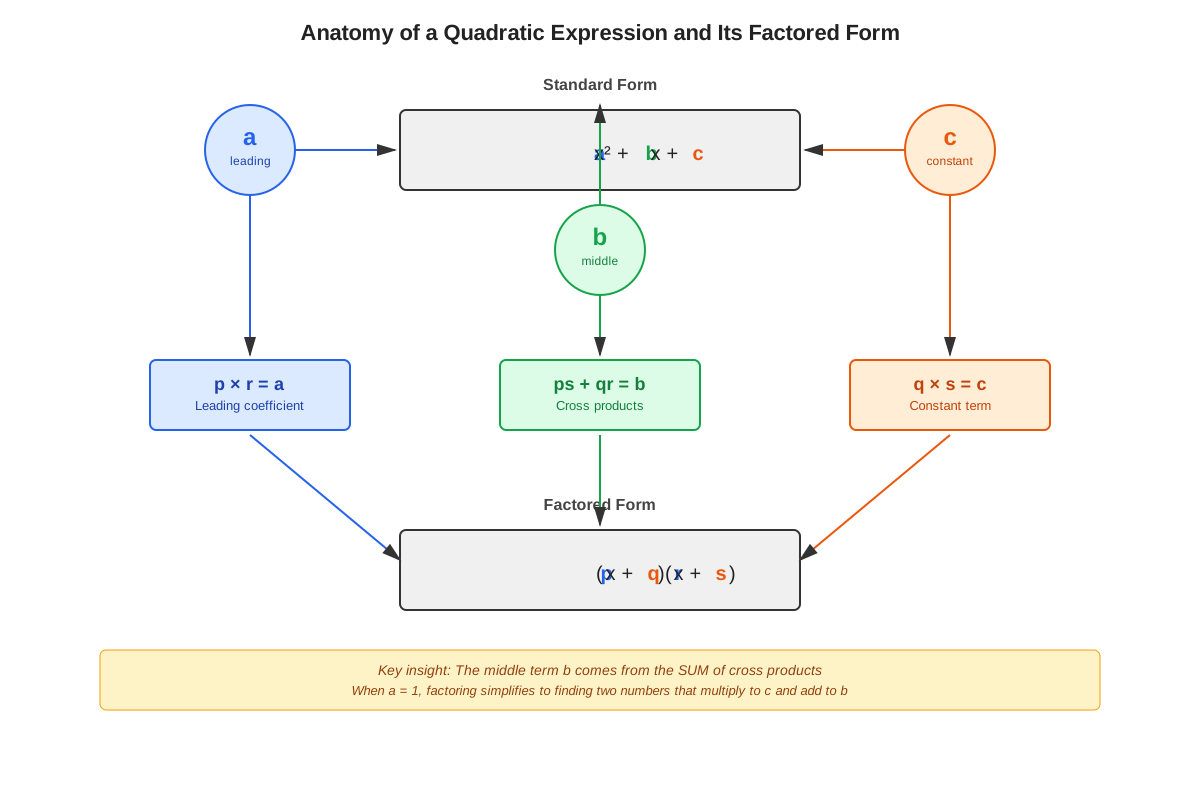
A quadratic expression in standard form appears as ax² + bx + c, where a, b, and c represent real number coefficients. The factored form expresses the same quadratic as a product of two binomials: (mx + p)(nx + q). When expanded using the distributive property, this factored form yields mnx² + (mq + np)x + pq. The fundamental goal of factoring is to reverse this expansion process, identifying values of m, n, p, and q that reproduce the original coefficients.
The relationship between forms reveals critical information: when a quadratic equals zero, the factored form immediately shows the solutions through the zero-product property. If (x - r)(x - s) = 0, then either x - r = 0 or x - s = 0, yielding solutions x = r and x = s. These solutions represent the x-intercepts of the parabola when the quadratic is graphed, connecting algebraic and geometric representations.
Simple Trinomial Factoring (a = 1)
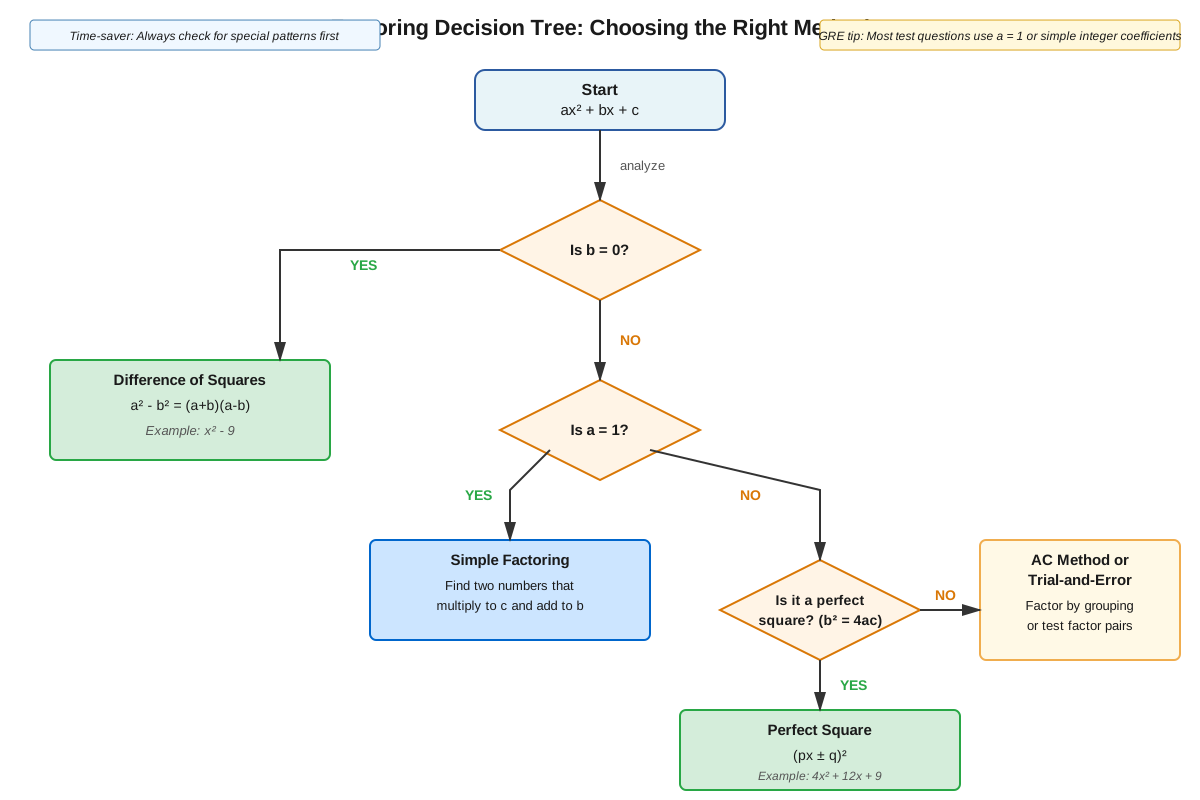
When the leading coefficient equals 1, the quadratic takes the form x² + bx + c. The factoring strategy involves finding two numbers that simultaneously multiply to c and add to b. These two numbers become the constant terms in the binomial factors: (x + m)(x + n), where m · n = c and m + n = b.
Step-by-step process:
- Write the quadratic in standard form and identify b and c
- List factor pairs of c (considering both positive and negative factors)
- Identify which pair adds to b
- Write the factored form as (x + m)(x + n)
- Verify by expanding using FOIL
For x² + 8x + 15, the factor pairs of 15 are (1, 15), (3, 5), (-1, -15), and (-3, -5). Since 3 + 5 = 8, the factored form is (x + 3)(x + 5). The signs of m and n follow specific patterns: when c is positive, both factors share the sign of b; when c is negative, factors have opposite signs with the larger absolute value matching b's sign.
Factoring with Leading Coefficients (a ≠ 1)
Quadratics where a ≠ 1, such as 3x² + 10x + 8, require modified approaches. The ac-method (also called grouping method) provides systematic factoring:
- Multiply a and c (the leading coefficient and constant term)
- Find two numbers that multiply to ac and add to b
- Rewrite the middle term using these two numbers
- Factor by grouping
For 3x² + 10x + 8: ac = 24, and 4 + 6 = 10 while 4 · 6 = 24. Rewrite as 3x² + 4x + 6x + 8, then group: (3x² + 4x) + (6x + 8) = x(3x + 4) + 2(3x + 4) = (x + 2)(3x + 4).
Alternatively, the trial-and-error method tests possible factor combinations. For 2x² + 7x + 3, possible forms include (2x + ?)(x + ?) or (x + ?)(2x + ?). Testing (2x + 1)(x + 3) yields 2x² + 7x + 3, confirming the correct factorization.
Special Factoring Patterns
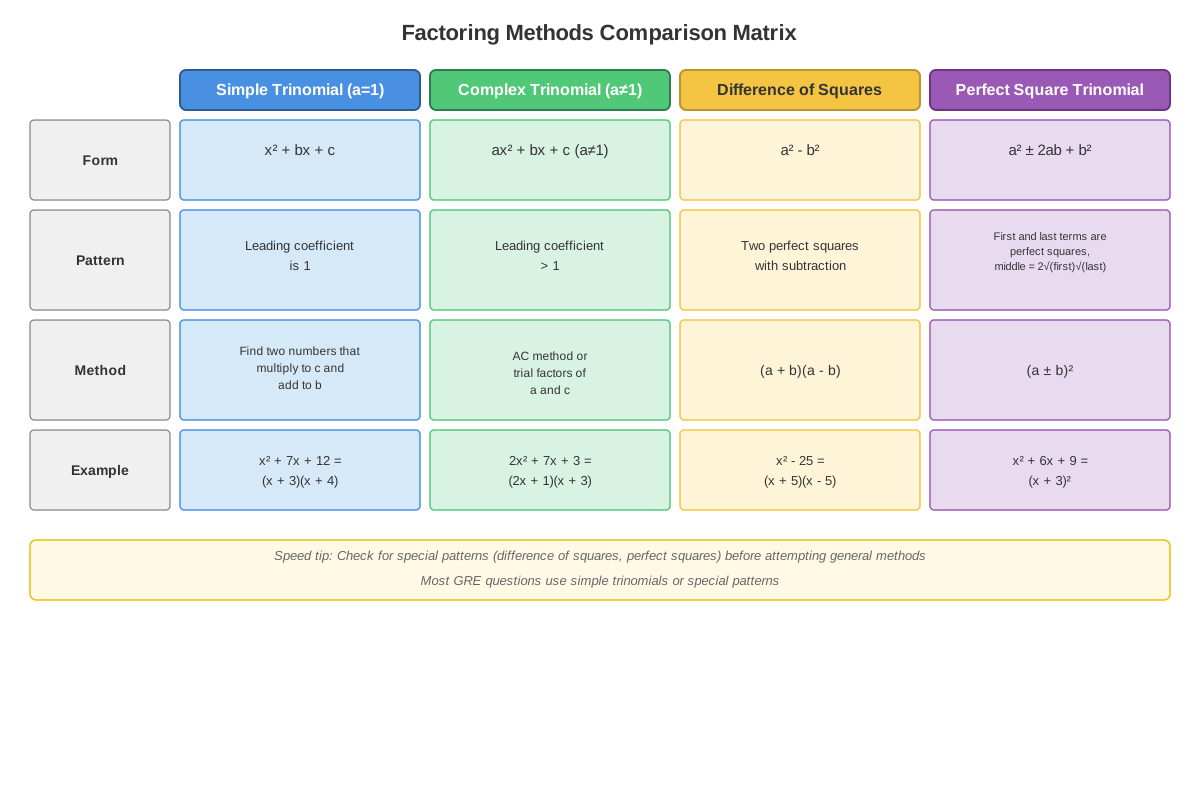
Certain quadratic forms follow predictable patterns that enable instant factoring:
| Pattern Name | Standard Form | Factored Form | Key Feature |
|---|---|---|---|
| Perfect Square Trinomial | a² + 2ab + b² | (a + b)² | Middle term is twice the product of roots |
| Perfect Square Trinomial | a² - 2ab + b² | (a - b)² | Middle term is twice the product of roots |
| Difference of Squares | a² - b² | (a + b)(a - b) | No middle term; subtraction only |
Recognizing these patterns accelerates factoring. For x² + 10x + 25, noting that 25 = 5² and 10 = 2(5) reveals the perfect square pattern: (x + 5)². The expression x² - 49 immediately factors as (x + 7)(x - 7) through difference of squares recognition.
The Zero-Product Property Application
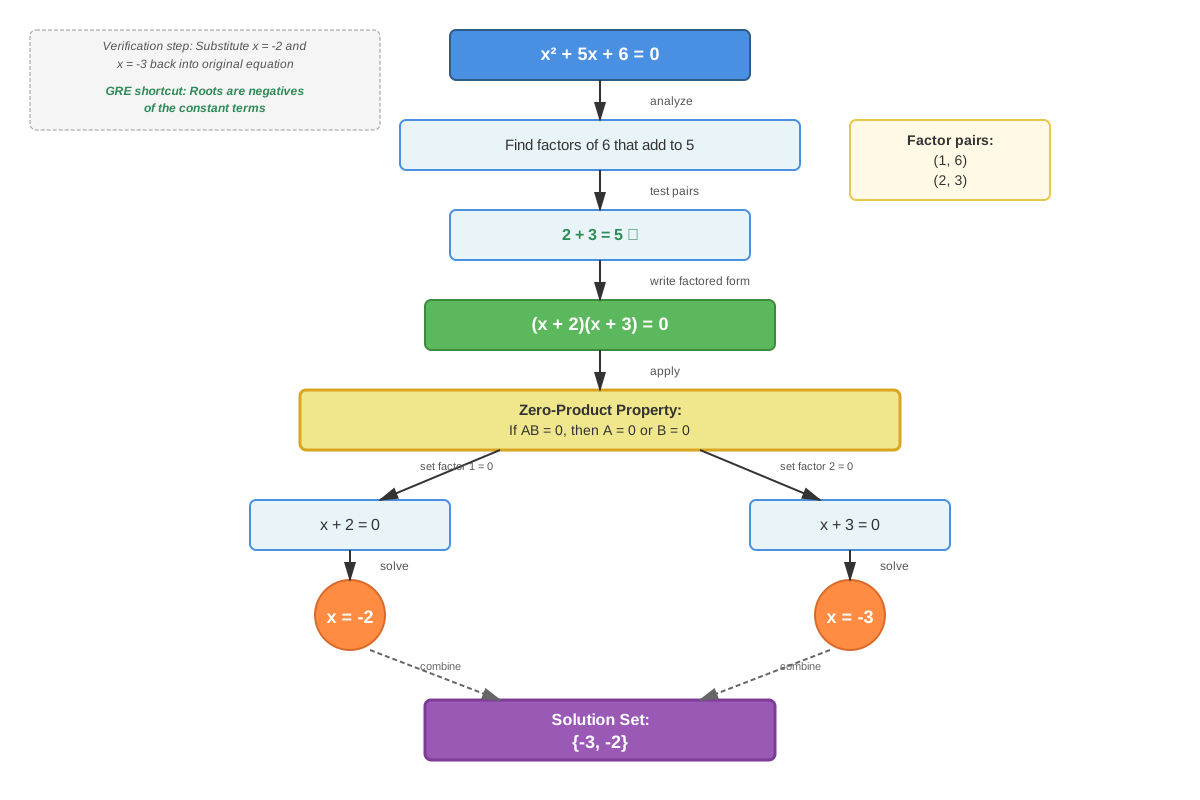
After factoring, solving quadratic equations requires applying the zero-product property: if the product of factors equals zero, at least one factor must equal zero. For (x - 3)(x + 5) = 0, either x - 3 = 0 (yielding x = 3) or x + 5 = 0 (yielding x = -5). This property transforms factoring from algebraic manipulation into equation-solving, connecting to coordinate geometry where these solutions represent x-intercepts.
Non-Factorable Quadratics
Not all quadratics factor using integer coefficients. When factor pairs of c cannot sum to b, the quadratic is prime over the integers. For example, x² + 2x + 5 has no integer factor pair of 5 that sums to 2. The discriminant (b² - 4ac) determines factorability: when b² - 4ac is a perfect square, the quadratic factors with rational numbers; otherwise, it requires the quadratic formula or remains in standard form.
Concept Relationships
The factoring process fundamentally reverses the FOIL multiplication method, creating a bidirectional relationship between expanded and factored forms. Mastery of multiplication patterns directly enhances factoring recognition—students who fluently expand (x + 3)(x + 5) immediately recognize x² + 8x + 15 as factorable into those binomials.
Within factoring itself, simple trinomial factoring (a = 1) serves as the foundation for more complex cases. Once students master finding factor pairs that multiply to c and add to b, they can extend this logic to the ac-method, which essentially reduces a ≠ 1 cases back to the simpler pattern through strategic regrouping. Special patterns (perfect squares and difference of squares) represent shortcuts that bypass standard factoring procedures when specific coefficient relationships exist.
Factoring connects forward to multiple advanced topics: solving quadratic equations (through the zero-product property), graphing parabolas (factored form reveals x-intercepts), simplifying rational expressions (factoring enables cancellation), and solving inequalities (factored form facilitates sign analysis). The relationship map flows: Basic multiplication → FOIL method → Recognizing patterns → Simple factoring → Complex factoring → Equation solving → Graphical analysis → Applied problem-solving.
Prerequisite knowledge of integer operations and the distributive property enables the mechanical execution of factoring, while understanding variables and expressions provides the conceptual framework for manipulating abstract quantities. Each concept builds incrementally, with earlier skills remaining essential as complexity increases.
Quick check — test yourself on Factoring quadratics so far.
Try Flashcards →High-Yield Facts
- ⭐ For x² + bx + c, find two numbers that multiply to c and add to b; these become the constants in (x + m)(x + n)
- ⭐ When c is positive, both factors share the same sign as b; when c is negative, factors have opposite signs
- ⭐ The difference of squares pattern a² - b² always factors as (a + b)(a - b) with no middle term
- ⭐ Perfect square trinomials follow the pattern a² ± 2ab + b² = (a ± b)²
- ⭐ After factoring to (x - r)(x - s) = 0, the solutions are x = r and x = s by the zero-product property
- For ax² + bx + c with a ≠ 1, multiply ac and find factors of ac that sum to b for the grouping method
- Always verify factoring by expanding the result using FOIL to check against the original expression
- The discriminant b² - 4ac determines factorability: perfect squares indicate rational factors exist
- Factored form (x - r)(x - s) reveals x-intercepts at r and s when the quadratic is graphed
- Common GRE trap: x² - 9 factors as (x + 3)(x - 3), not (x - 3)(x - 3)
- When factoring completely, always check for common factors first (greatest common factor)
- The sum of squares a² + b² does NOT factor over real numbers (no middle term with addition)
Common Misconceptions
Misconception: The expression x² + 25 factors as (x + 5)(x + 5) or (x + 5)².
Correction: This is a sum of squares, which does not factor over real numbers. Only difference of squares (x² - 25) factors as (x + 5)(x - 5). The sum of squares remains prime unless complex numbers are introduced.
Misconception: For x² - 7x + 12, the factors are (x - 3)(x - 4) because 3 + 4 = 7.
Correction: While 3 + 4 = 7, the middle term is -7x, requiring factors that add to -7. The correct factorization is (x - 3)(x - 4), where -3 + (-4) = -7. Sign attention is critical.
Misconception: All quadratics can be factored using integers.
Correction: Many quadratics are prime over the integers, such as x² + x + 1. When no integer factor pairs satisfy the required conditions, the quadratic formula or completing the square must be used instead.
Misconception: When solving (x - 4)(x + 2) = 6, the solutions are x = 4 and x = -2.
Correction: The zero-product property only applies when the product equals zero. This equation must first be expanded to x² - 2x - 8 = 6, then rearranged to x² - 2x - 14 = 0 before solving. The original solutions are incorrect.
Misconception: For 2x² + 8x + 6, factoring yields (2x + 2)(x + 3).
Correction: While this expansion is correct, the factoring is incomplete. First factor out the GCF of 2: 2(x² + 4x + 3) = 2(x + 1)(x + 3). Complete factoring requires extracting all common factors before applying trinomial factoring.
Misconception: The factored form of x² - 6x + 9 is (x - 3)(x + 3).
Correction: This is a perfect square trinomial, not a difference of squares. Since 9 = 3² and -6 = -2(3), the correct factorization is (x - 3)². Expanding (x - 3)(x + 3) yields x² - 9, not the original expression.
Worked Examples
Example 1: Standard Factoring and Equation Solving
Problem: Solve for all values of x: x² - 3x - 18 = 0
Solution:
Step 1: Identify the quadratic in standard form with a = 1, b = -3, c = -18.
Step 2: Find two numbers that multiply to -18 and add to -3. List factor pairs of -18:
- 1 and -18 (sum: -17)
- -1 and 18 (sum: 17)
- 2 and -9 (sum: -7)
- -2 and 9 (sum: 7)
- 3 and -6 (sum: -3) ✓
- -3 and 6 (sum: 3)
Step 3: The pair 3 and -6 satisfies both conditions. Write the factored form:
x² - 3x - 18 = (x + 3)(x - 6)
Step 4: Set the equation equal to zero: (x + 3)(x - 6) = 0
Step 5: Apply the zero-product property:
- x + 3 = 0 → x = -3
- x - 6 = 0 → x = 6
Step 6: Verify by substituting back:
- For x = -3: (-3)² - 3(-3) - 18 = 9 + 9 - 18 = 0 ✓
- For x = 6: (6)² - 3(6) - 18 = 36 - 18 - 18 = 0 ✓
Answer: x = -3 or x = 6
This example demonstrates the complete process from recognition through verification, addressing learning objectives about applying factoring to solve equations accurately.
Example 2: Factoring with Leading Coefficient Using AC-Method
Problem: Factor completely: 6x² + 13x + 6
Solution:
Step 1: Identify coefficients: a = 6, b = 13, c = 6
Step 2: Calculate ac = 6 × 6 = 36
Step 3: Find two numbers that multiply to 36 and add to 13:
- 1 and 36 (sum: 37)
- 2 and 18 (sum: 20)
- 3 and 12 (sum: 15)
- 4 and 9 (sum: 13) ✓
Step 4: Rewrite the middle term using 4 and 9:
6x² + 13x + 6 = 6x² + 4x + 9x + 6
Step 5: Factor by grouping:
= (6x² + 4x) + (9x + 6)
= 2x(3x + 2) + 3(3x + 2)
= (2x + 3)(3x + 2)
Step 6: Verify using FOIL:
(2x + 3)(3x + 2) = 6x² + 4x + 9x + 6 = 6x² + 13x + 6 ✓
Answer: (2x + 3)(3x + 2)
This example illustrates the systematic ac-method for handling leading coefficients other than 1, demonstrating the strategy behind GRE factoring quadratics when standard approaches don't immediately apply.
Exam Strategy
Trigger Recognition: Watch for phrases like "solve for x," "find the roots," "x-intercepts," "where the function equals zero," or "factor the expression." Questions asking for "all possible values" or "solutions" typically require factoring.
When approaching GRE factoring questions, first assess whether factoring is the most efficient method. For simple integer coefficients and recognizable patterns, factoring typically outpaces the quadratic formula. However, if coefficients are large or non-integer, alternative methods may prove faster. The GRE rewards strategic method selection, not just mechanical execution.
Time allocation strategy: Allocate 45-60 seconds for straightforward factoring questions (a = 1, small coefficients), 90-120 seconds for complex factoring (a ≠ 1, larger numbers), and up to 2 minutes for multi-step problems requiring factoring as an intermediate step. If factoring doesn't emerge within 30 seconds of analysis, consider whether the quadratic formula or answer-choice substitution might be more efficient.
Process-of-elimination techniques: When answer choices present factored forms, quickly expand one or two options using FOIL to eliminate incorrect answers. This reverse-checking often proves faster than factoring from scratch. For Quantitative Comparison questions involving roots, factor to find exact values rather than estimating, as small differences often determine the correct relationship.
Pattern recognition shortcuts: Immediately check for special patterns before attempting standard factoring. Scan for perfect square trinomials (is the constant term a perfect square? does 2√c equal the middle coefficient?), difference of squares (no middle term with subtraction?), or common factors (can all terms be divided by the same number?). These patterns save 20-30 seconds per question when recognized instantly.
Common GRE traps: The exam frequently presents quadratics that appear factorable but aren't, testing whether students waste time on impossible factoring attempts. If factor pairs don't emerge quickly, move to alternative methods. Also watch for equations where the product doesn't equal zero—students often incorrectly apply the zero-product property to expressions like (x - 2)(x + 3) = 5.
Memory Techniques
FOIL Reversal Mnemonic: "Multiply to Constant, Add to B" (MCAB) reminds students that factor pairs must multiply to c and add to b in standard trinomial factoring.
Sign Pattern Acronym: "Same Sign Positive" (SSP) and "Opposite Sign Negative" (OSN) encode the rule that when c is positive, both factors share b's sign, while negative c produces opposite-sign factors.
Difference of Squares Visualization: Picture a square with side length a, then remove a smaller square with side length b from one corner. The remaining area can be rearranged into a rectangle with dimensions (a + b) by (a - b), visualizing why a² - b² = (a + b)(a - b).
Perfect Square Recognition: Remember "Twice the Product" (TP) for the middle term. If the middle coefficient equals twice the product of the square roots of the first and last terms, the expression is a perfect square trinomial.
AC-Method Memory Aid: "Always Combine" reminds students to multiply the leading coefficient and constant term first, then find factors of this product that combine (add) to the middle coefficient.
Summary
Factoring quadratics transforms expressions from standard form (ax² + bx + c) into products of binomials, revealing roots and enabling efficient equation-solving. The fundamental strategy involves finding number pairs that satisfy specific multiplication and addition requirements, with the exact approach varying based on the leading coefficient. When a = 1, factors of c that sum to b directly provide the binomial constants. When a ≠ 1, the ac-method or trial-and-error extends this logic through grouping or systematic testing. Special patterns—perfect square trinomials and difference of squares—offer instant factorization shortcuts when recognized. After factoring, the zero-product property converts factored equations into simple linear equations, yielding the quadratic's roots. GRE success requires not just mechanical factoring ability but also pattern recognition, method selection, and strategic time management. Students must distinguish factorable from prime quadratics, verify results through expansion, and connect factored forms to graphical representations and real-world contexts. Mastery enables rapid problem-solving across diverse question types while avoiding common traps involving sign errors, incomplete factoring, and misapplied properties.
Key Takeaways
- For x² + bx + c, find two numbers that multiply to c and add to b; these become the constants in the factored binomials
- Sign patterns follow predictable rules: positive c means same-sign factors, negative c means opposite-sign factors
- Special patterns (difference of squares, perfect square trinomials) enable instant factoring when coefficient relationships are recognized
- The ac-method systematically handles leading coefficients other than 1 by converting complex cases into simpler factoring problems
- Always verify factored forms by expanding with FOIL to catch errors before finalizing answers
- The zero-product property applies only when the product equals zero; rearrange equations before applying this principle
- Not all quadratics factor with integers—recognize when to abandon factoring attempts and use alternative methods
Related Topics
Solving Quadratic Equations: Extends factoring by incorporating the quadratic formula, completing the square, and graphical methods for finding roots when factoring proves insufficient or impossible.
Graphing Parabolas: Connects factored form to visual representation, using x-intercepts from factoring to sketch parabolas and understand vertex, axis of symmetry, and direction of opening.
Rational Expressions: Applies factoring to simplify complex fractions by canceling common factors in numerators and denominators, essential for advanced algebraic manipulation.
Polynomial Functions: Generalizes quadratic factoring to higher-degree polynomials, building on the same principles of finding roots and expressing functions as products of factors.
Quadratic Inequalities: Uses factored form to analyze sign changes and determine solution intervals where quadratic expressions satisfy inequality conditions.
Practice CTA
Now that you've mastered the core concepts and strategies for factoring quadratics, reinforce your learning by attempting the practice questions designed specifically for this topic. These problems mirror actual GRE question formats and difficulty levels, providing essential experience with the patterns and traps you'll encounter on test day. Additionally, use the flashcards to drill factor pair recognition and special pattern identification until these skills become automatic. Consistent practice transforms conceptual understanding into the rapid, accurate execution that distinguishes top scorers. Your investment in deliberate practice now will yield significant time savings and confidence gains when you face these high-frequency questions under exam conditions!
Sign up free to keep reading
Create a free AnvayaPrep account to finish this GRE guide on Factoring quadratics — plus flashcards and practice questions.