Overview
Quantitative comparison algebra represents one of the most distinctive and strategically important question types on the GRE Quantitative Reasoning section. Unlike traditional problem-solving questions that ask for a specific numerical answer, quantitative comparison questions present two quantities—Quantity A and Quantity B—and require test-takers to determine the relationship between them. These questions demand a unique blend of algebraic manipulation, logical reasoning, and strategic thinking. Mastering GRE quantitative comparison algebra is essential because these questions constitute approximately one-third of all Quantitative Reasoning questions, making them a high-impact area for score improvement.
The power of quantitative comparison questions lies in their efficiency: students don't need to calculate exact values, only relationships. This creates opportunities for elegant shortcuts and strategic thinking, but also introduces pitfalls for those who rush to conclusions without considering all possibilities. Algebraic techniques become particularly valuable in these questions because they allow test-takers to manipulate expressions, test special cases, and identify when relationships hold universally versus when they depend on variable values.
Within the broader landscape of GRE Quantitative Reasoning, quantitative comparison algebra serves as a bridge between pure algebraic manipulation and critical reasoning. It requires fluency with fundamental algebraic operations—simplifying expressions, solving equations, working with inequalities—while simultaneously demanding the strategic judgment to know when to calculate, when to estimate, and when to test cases. This topic integrates concepts from linear equations, quadratic expressions, inequalities, absolute values, and exponents, making it a comprehensive test of algebraic proficiency.
Learning Objectives
- [ ] Identify when quantitative comparison algebra is being tested
- [ ] Explain the core rule or strategy behind quantitative comparison algebra
- [ ] Apply quantitative comparison algebra to GRE-style questions accurately
- [ ] Distinguish between relationships that are always true versus those that depend on variable constraints
- [ ] Execute strategic simplification techniques to compare algebraic expressions efficiently
- [ ] Recognize when to test special cases (positive, negative, zero, fractions) to determine relationships
- [ ] Avoid common traps such as illegal operations and premature conclusions
Prerequisites
- Basic algebraic manipulation: Ability to combine like terms, distribute, and factor expressions—essential for simplifying quantities before comparison
- Solving linear and quadratic equations: Understanding solution methods enables testing specific values and identifying variable constraints
- Properties of inequalities: Knowledge of how operations affect inequality direction is critical for valid comparisons
- Exponent rules: Necessary for comparing expressions involving powers and understanding when bases and exponents affect magnitude
- Number properties: Understanding positive/negative numbers, fractions, and zero behavior informs strategic case testing
Why This Topic Matters
Quantitative comparison questions appear in approximately 13-15 of the 40 questions across the two Quantitative Reasoning sections of the GRE, representing roughly one-third of the total quantitative score. This high frequency makes mastery of quantitative comparison algebra a high-leverage investment of study time. Students who develop strong skills in this area can often answer these questions more quickly than traditional problem-solving questions, creating valuable time for more complex problems.
In real-world applications, the skill of comparing quantities without calculating exact values mirrors decision-making processes in business, engineering, and research contexts. Professionals frequently need to determine which option is larger, better, or more efficient without performing exhaustive calculations—whether comparing investment returns, evaluating design parameters, or assessing experimental outcomes.
On the GRE, quantitative comparison algebra appears in several characteristic forms: comparing algebraic expressions with given constraints on variables, evaluating expressions involving absolute values or exponents, comparing solutions to equations or inequalities, and analyzing geometric relationships expressed algebraically. The questions test not just computational ability but strategic thinking—recognizing when relationships are determinable and when they depend on unknown variable values. This format rewards students who think flexibly and avoid unnecessary calculation.
Core Concepts
The Four Answer Choices
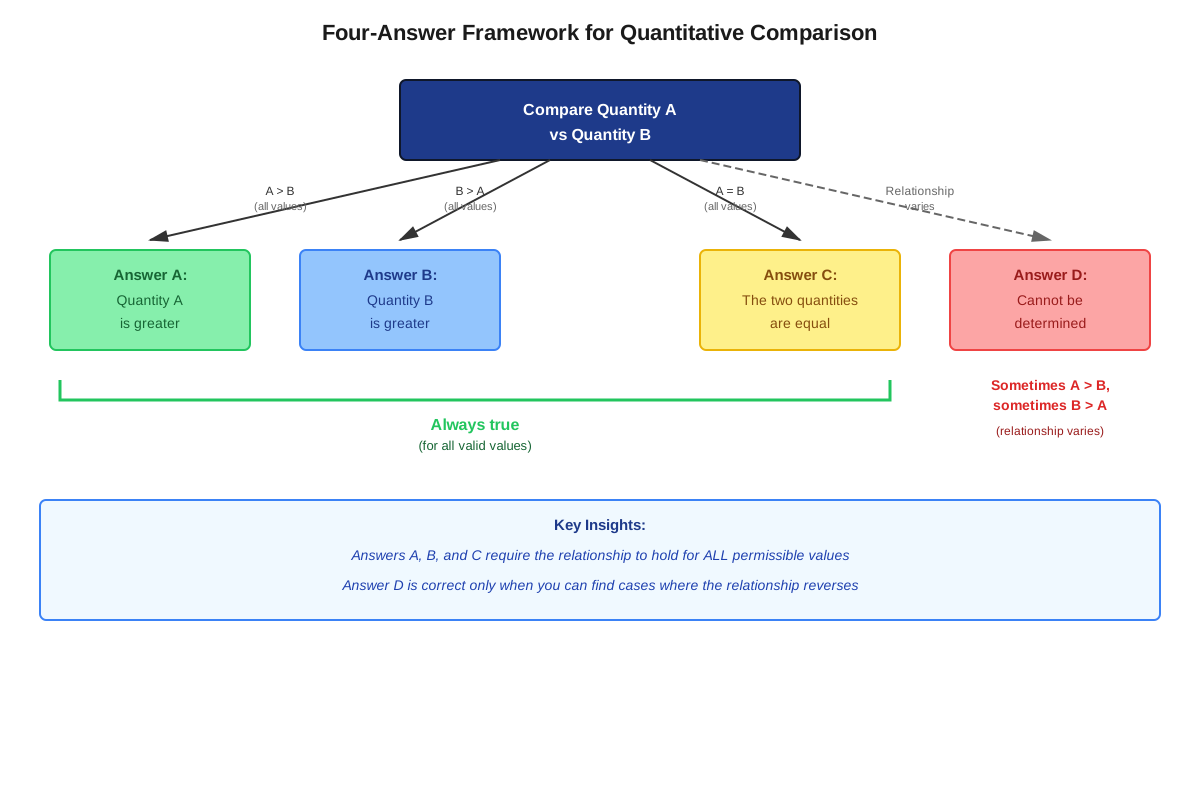
Every quantitative comparison question on the GRE presents exactly four answer choices, which remain constant across all questions:
- (A) Quantity A is greater
- (B) Quantity B is greater
- (C) The two quantities are equal
- (D) The relationship cannot be determined from the information given
Understanding when to select each answer is fundamental. Choice (D) is only available when variables are present and the relationship between quantities changes depending on the values those variables take. If no variables appear, or if the relationship holds for all permissible values of the variables, choice (D) is never correct.
Core Strategy: Simplification Through Valid Operations
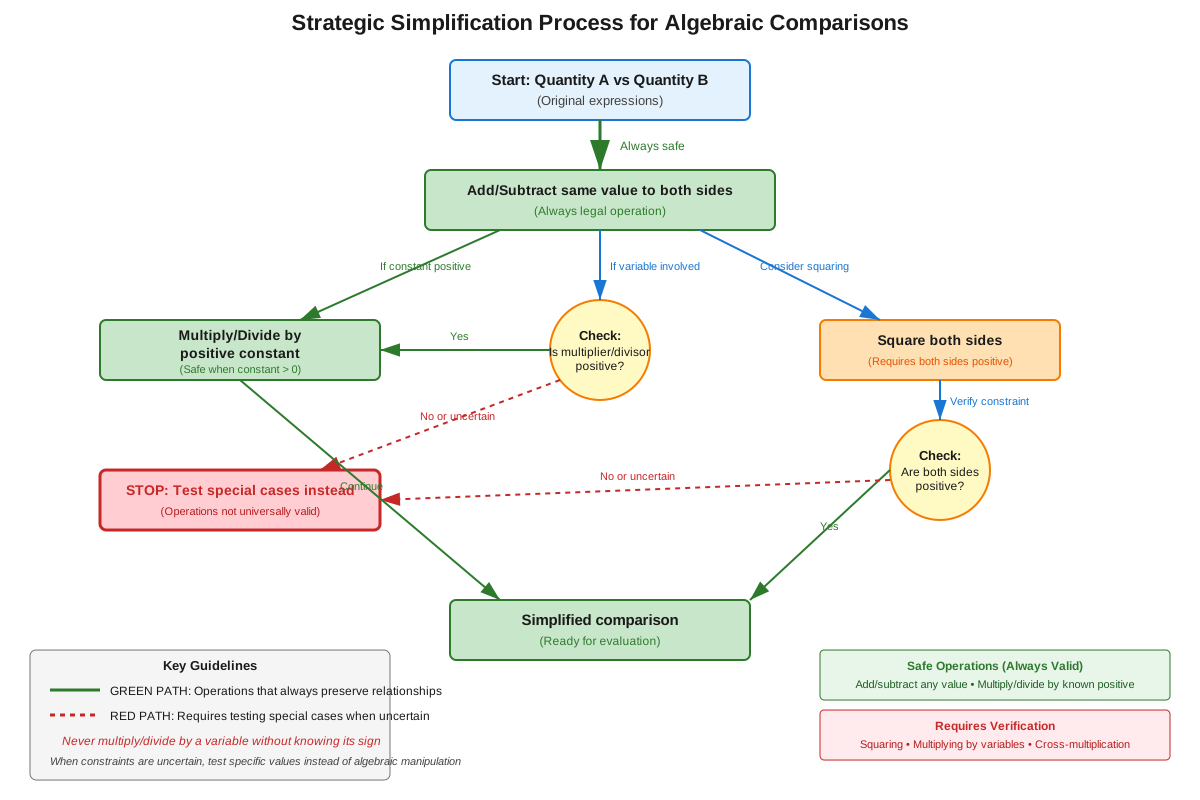
The fundamental approach to quantitative comparison algebra involves simplifying both quantities simultaneously using operations that preserve the relationship between them. Valid operations include:
- Adding or subtracting the same value from both quantities
- Multiplying or dividing both quantities by the same positive number
- Squaring both quantities when both are known to be positive (or both negative)
- Taking square roots when both quantities are non-negative
These operations transform the comparison into a simpler form while maintaining the truth of the relationship. The goal is to reduce the comparison to its simplest form where the answer becomes obvious.
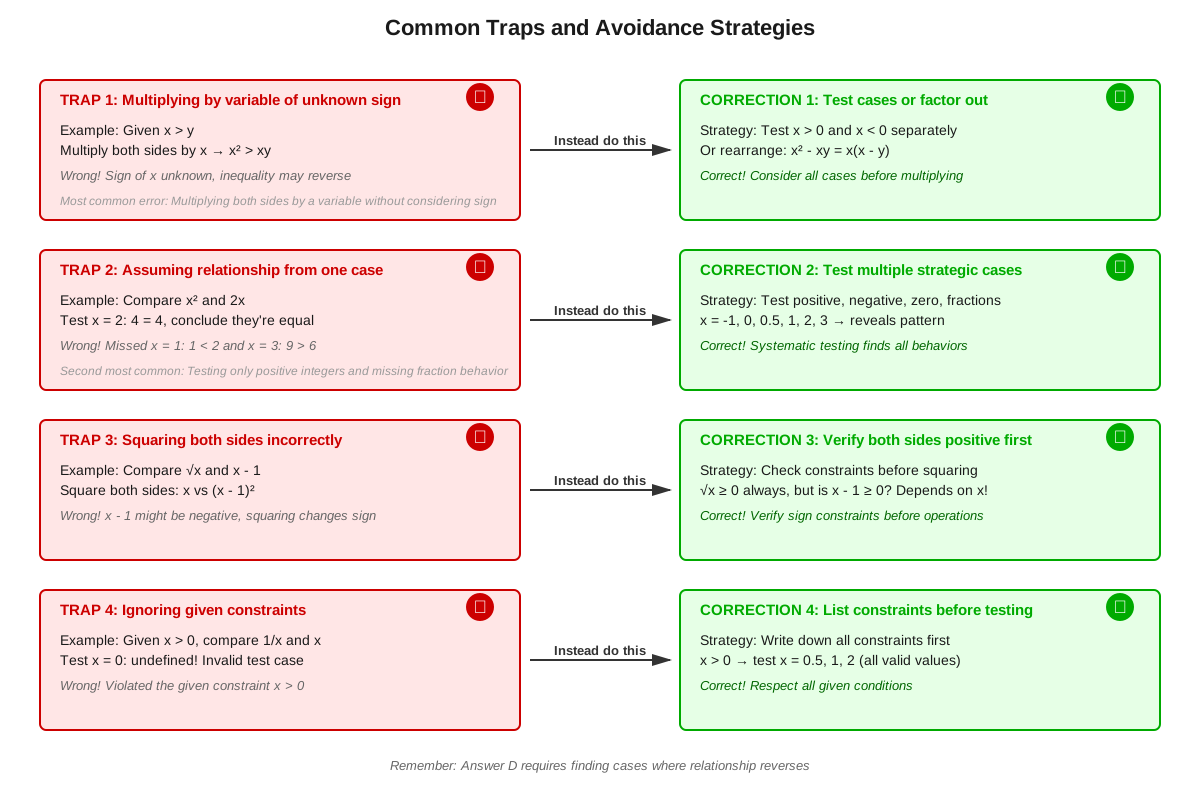
Critical restriction: Never multiply or divide both quantities by a variable expression unless you know its sign. If the expression could be negative, the inequality would reverse, potentially leading to an incorrect answer.
Testing Special Cases
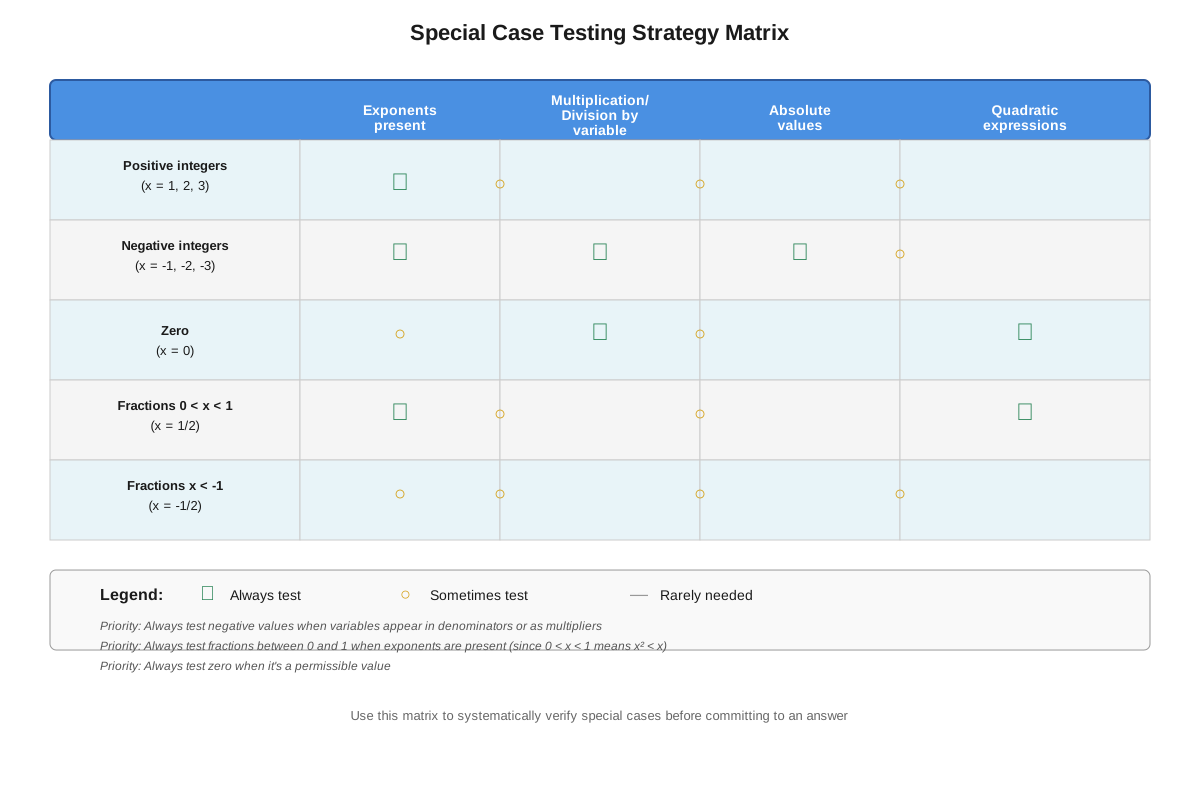
When variables appear in quantitative comparison questions, testing special cases becomes essential for determining whether the relationship is constant or variable. The most productive values to test include:
- Zero: Often reveals unexpected behavior
- One: Useful for expressions with exponents
- Negative one: Tests negative number behavior
- Large positive numbers: Reveals which terms dominate
- Fractions between 0 and 1: Shows different behavior than integers
- Negative fractions: Combines fraction and negative properties
If testing two different permissible values yields different relationships (A greater in one case, B greater in another), the answer must be (D). If all tested cases yield the same relationship, that suggests (but doesn't prove) a constant relationship—further algebraic analysis should confirm.
Comparing Algebraic Expressions
When comparing expressions like Quantity A: x² + 2x and Quantity B: x² + 3x, the strategic approach is:
- Subtract one quantity from the other (or subtract the same expression from both)
- Determine the sign of the resulting expression
- Use that sign to establish the relationship
For the example above:
- Subtract x² from both: Compare 2x versus 3x
- Subtract 2x from both: Compare 0 versus x
- The relationship depends on whether x is positive, negative, or zero
This reveals that the answer is (D) because when x > 0, Quantity B is greater; when x < 0, Quantity A is greater; when x = 0, they're equal.
Working with Constraints
Many quantitative comparison questions provide constraints on variables, such as "x > 0" or "a < b < 0." These constraints are crucial:
- They eliminate certain test cases
- They may determine the sign of expressions
- They often make choice (D) incorrect by ensuring a constant relationship
Always incorporate constraints into your analysis. If told x > 3, don't test x = 1. If told a < b, use this ordering in your algebraic manipulations.
The "Cannot Be Determined" Decision
Choice (D) appears when and only when:
- Variables are present in the quantities
- The relationship between quantities changes for different permissible values of those variables
To confirm (D), you must demonstrate that the relationship is not constant by finding specific values where different relationships hold. Conversely, to eliminate (D), you must show that the relationship is always the same, regardless of variable values (within any given constraints).
Comparison Table: Valid vs. Invalid Operations
| Operation | Valid When | Invalid When | Reason |
|---|---|---|---|
| Add/subtract same value | Always | Never | Preserves order |
| Multiply/divide by positive constant | Always | Never | Preserves order |
| Multiply/divide by negative constant | Never directly | Always | Reverses order |
| Multiply/divide by variable | Variable is positive | Sign unknown | May reverse order |
| Square both sides | Both quantities same sign | Opposite signs possible | Squaring reverses order for negatives |
| Cross-multiply | Denominator positive | Denominator sign unknown | May reverse inequality |
Concept Relationships
The concepts within quantitative comparison algebra form an interconnected strategic framework. Simplification through valid operations serves as the foundation, enabling transformation of complex comparisons into simpler ones. This leads directly to comparing algebraic expressions, where the goal is reducing the comparison to a simple inequality or equality.
Testing special cases functions as both a complement and a check on algebraic simplification. When algebraic manipulation becomes complex or when the relationship's constancy is unclear, testing cases provides empirical evidence. The results of case testing inform the "cannot be determined" decision, which represents the culmination of analysis—determining whether the relationship is constant or variable.
Working with constraints intersects with all other concepts, modifying which operations are valid (by determining signs of expressions) and which test cases are permissible (by restricting variable domains). Constraints often transform a seemingly variable relationship into a constant one, making choice (D) incorrect.
The relationship map flows as follows:
Problem presentation → Identify constraints → Attempt simplification → If simplified: determine relationship → Answer A, B, or C
Problem presentation → Identify constraints → Simplification unclear → Test special cases → If relationship varies: Answer D / If constant: Further simplification → Answer A, B, or C
This framework connects to prerequisite topics: algebraic manipulation enables simplification, inequality properties govern valid operations, number properties inform case selection, and equation solving helps identify critical values where relationships might change.
High-Yield Facts
⭐ Quantitative comparison questions always have exactly four answer choices, with choice (D) only valid when variables are present and the relationship varies.
⭐ Never multiply or divide both quantities by a variable expression unless you know its sign with certainty.
⭐ Testing x = 0, x = 1, and x = -1 reveals the relationship in most variable-based comparisons.
⭐ If you can find two different values that yield different relationships (A greater vs. B greater), the answer must be (D).
⭐ Subtracting the same expression from both quantities is always valid and often simplifies comparisons dramatically.
- Adding or subtracting the same value from both quantities preserves their relationship and is always a valid operation.
- When both quantities are guaranteed positive, squaring both sides is a valid operation that preserves the relationship.
- Constraints on variables (like x > 0 or a < b) often eliminate choice (D) by ensuring a constant relationship.
- If no variables appear in either quantity, choice (D) is never correct—the relationship is determinable.
- Cross-multiplying to compare fractions is only valid when denominators are known to be positive.
- For expressions with exponents, testing values between 0 and 1 often reveals different behavior than testing integers.
- When quantities involve absolute values, test both positive and negative cases for the expression inside the absolute value.
- Factoring expressions can reveal common terms that cancel, simplifying comparisons.
- If algebraic simplification leads to comparing 0 with an expression, determine the sign of that expression.
- The goal is not to calculate exact values but only to determine the relationship—this often allows shortcuts.
Quick check — test yourself on Quantitative comparison algebra so far.
Try Flashcards →Common Misconceptions
Misconception: If Quantity A contains more terms or looks more complex, it must be larger.
Correction: Complexity has no relationship to magnitude. The expression x² - 100x + 1 might be much smaller than the simple expression 5, depending on x's value. Always simplify or test cases rather than judging by appearance.
Misconception: You can multiply both quantities by a variable to clear denominators or simplify.
Correction: Multiplying by a variable is only valid if you know the variable is positive. If the variable could be negative, multiplication would reverse the inequality, leading to the wrong answer. When in doubt, test cases instead.
Misconception: If testing one value shows Quantity A is greater, then (A) is the answer.
Correction: Testing a single value only provides evidence, not proof. You must either test multiple strategic values to check consistency or use algebraic reasoning to prove the relationship holds for all permissible values. One test showing A > B doesn't rule out other values where B > A.
Misconception: Choice (D) means "I don't know" or "this is too hard to determine."
Correction: Choice (D) has a precise mathematical meaning: the relationship between the quantities changes depending on the values of the variables. It's not a guess or an admission of confusion—it's a definitive answer that requires proof (showing the relationship varies for different values).
Misconception: When quantities are equal for one tested value, the answer is (C).
Correction: Equality for one value doesn't establish equality for all values. You must verify that the quantities are equal for all permissible values of the variables. If they're equal for some values but not others, the answer is (D), not (C).
Misconception: Squaring both sides is always a valid operation for comparing quantities.
Correction: Squaring is only valid when both quantities have the same sign (both positive or both negative). If one quantity is positive and the other negative, squaring reverses the relationship because the negative quantity, though smaller, becomes positive and potentially larger when squared.
Misconception: Complex algebraic manipulation is always necessary to solve quantitative comparison questions.
Correction: Often, strategic thinking and testing cases is faster and more reliable than extensive algebra. The GRE rewards efficiency—if testing x = 0 and x = 1 quickly reveals the answer is (D), that's superior to five minutes of algebraic manipulation.
Worked Examples
Example 1: Simplification Strategy
Given: x > 0
Quantity A: x² + 5x + 6
Quantity B: x² + 3x + 8
Solution:
Step 1: Recognize that both quantities contain x² terms. Subtract x² from both quantities (valid operation):
- Quantity A becomes: 5x + 6
- Quantity B becomes: 3x + 8
Step 2: Subtract 3x from both quantities (valid operation):
- Quantity A becomes: 2x + 6
- Quantity B becomes: 8
Step 3: Subtract 6 from both quantities (valid operation):
- Quantity A becomes: 2x
- Quantity B becomes: 2
Step 4: Divide both quantities by 2 (valid—positive constant):
- Quantity A becomes: x
- Quantity B becomes: 1
Step 5: Apply the constraint. We're told x > 0, but we need to know if x > 1, x = 1, or 0 < x < 1.
Step 6: Test cases within the constraint:
- If x = 0.5: Quantity A = 0.5, Quantity B = 1, so B is greater
- If x = 2: Quantity A = 2, Quantity B = 1, so A is greater
Step 7: Since the relationship changes depending on x's value (even within the constraint x > 0), the answer is (D).
Learning objective addressed: This example demonstrates applying quantitative comparison algebra through systematic simplification and testing cases to determine that the relationship cannot be determined.
Example 2: Using Constraints Effectively
Given: a < b < 0 (both a and b are negative)
Quantity A: a²
Quantity B: b²
Solution:
Step 1: Recognize the constraint: both variables are negative, and a is more negative than b (further left on the number line).
Step 2: Consider what happens when negative numbers are squared—they become positive, and more negative numbers become larger positive numbers when squared.
Step 3: Test specific values:
- Let a = -3 and b = -1 (satisfies a < b < 0)
- Quantity A: (-3)² = 9
- Quantity B: (-1)² = 1
- So A > B in this case
Step 4: Test another case:
- Let a = -5 and b = -2 (satisfies a < b < 0)
- Quantity A: (-5)² = 25
- Quantity B: (-2)² = 4
- So A > B in this case too
Step 5: Algebraic reasoning: Since a < b < 0, we know a is more negative than b. When we square both sides of an inequality where both sides are negative, the inequality reverses. Since a < b (and both negative), we have a² > b² (both positive).
Step 6: The relationship is constant for all values satisfying the constraint: Quantity A is always greater.
Answer: (A)
Learning objective addressed: This example shows how to identify when quantitative comparison algebra is being tested with constraints, and how to apply the core strategy of considering number properties (negative numbers squared) to determine a constant relationship.
Exam Strategy
Approaching Quantitative Comparison Questions
Begin every quantitative comparison question by reading the centered information carefully—this contains crucial constraints on variables. Next, quickly assess whether variables are present: if not, choice (D) is impossible. Then decide between two strategic paths: algebraic simplification or case testing.
Choose algebraic simplification when:
- The expressions are similar and terms will cancel
- Simple operations will reduce complexity significantly
- No variables appear (making exact comparison possible)
Choose case testing when:
- Algebraic simplification seems complex or unclear
- Multiple variables interact in complicated ways
- You want to quickly check if (D) is possible
Trigger Words and Phrases
Watch for these indicators that quantitative comparison algebra is being tested:
- "Compare Quantity A and Quantity B"
- Centered information containing variable constraints: "x > 0," "a < b," "n is an integer"
- Expressions involving the same variables in both quantities
- Absolute value expressions in one or both quantities
- Exponents or roots with variable bases or exponents
- Fractions with variable numerators or denominators
Process of Elimination Tips
Eliminate (D) immediately when:
- No variables appear in either quantity
- The quantities are purely numerical (even if complex)
- You can prove algebraically that the relationship is constant
Eliminate (A) and (B) when:
- Testing one case shows A > B, but another case shows B > A
- This immediately confirms (D)
Eliminate (C) when:
- Testing any case shows the quantities are unequal
- Unless all tested cases show equality, (C) is wrong
Time Allocation
Quantitative comparison questions should typically take 1-1.5 minutes each, slightly less than the 1.75-minute average for all quantitative questions. The format allows for faster solving because you don't need exact values. If you're spending more than 2 minutes on a quantitative comparison question, you're likely over-calculating—step back and consider testing cases or making a strategic guess.
Time-saving principle: As soon as you find two cases that yield different relationships, select (D) and move on. Don't waste time testing additional cases or attempting to prove what you've already disproven.
Memory Techniques
The "SAND" Mnemonic for Valid Operations
Subtract the same value (always valid)
Add the same value (always valid)
Never multiply/divide by variables of unknown sign
Divide or multiply by positive constants only (always valid)
The "ZONE" Testing Strategy
When testing cases, remember ZONE:
Zero - Test first, often reveals unexpected behavior
One - Test second, especially for exponents
Negative - Test negative values, especially -1
Extremes - Test very large or very small values
Visualization for Squaring Negatives
Picture the number line: negative numbers are left of zero. When you square them, they "bounce" to the right side, and numbers further left bounce further right. So -5 squared (25) is further right than -2 squared (4). This helps remember that squaring reverses the inequality for negative numbers.
The "Two Different, Choose D" Rule
If you find two cases with different relationships, choose D. This rhyme helps remember that demonstrating variability requires showing the relationship changes.
Summary
Quantitative comparison algebra represents a high-impact question type on the GRE, comprising approximately one-third of Quantitative Reasoning questions. Success requires mastering two complementary approaches: systematic simplification through valid operations and strategic case testing. The core principle is that you can add, subtract, multiply by positive constants, or divide by positive constants to both quantities without changing their relationship, but you must never multiply or divide by variables of unknown sign. When variables are present, testing special cases—particularly zero, one, negative one, and fractions—reveals whether the relationship is constant or variable. Choice (D) is only correct when the relationship demonstrably changes for different permissible values of the variables. Constraints on variables are crucial: they restrict which test cases are valid and often ensure a constant relationship, eliminating choice (D). The goal is not to calculate exact values but to determine the relationship efficiently, making quantitative comparison questions potentially faster than traditional problem-solving questions for well-prepared test-takers.
Key Takeaways
- Quantitative comparison questions always present four answer choices, with (D) only valid when variables create a variable relationship
- Simplify by adding/subtracting the same value or multiplying/dividing by positive constants—never multiply/divide by variables of unknown sign
- Test strategic cases (zero, one, negative one, fractions) to determine if the relationship varies; two different relationships prove the answer is (D)
- Constraints on variables are critical—they restrict valid test cases and often eliminate choice (D) by ensuring constant relationships
- If no variables appear, choice (D) is impossible; the relationship is always determinable
- Focus on determining the relationship, not calculating exact values—this enables time-saving shortcuts
- When in doubt between algebra and testing, test cases first—it's often faster and reveals the answer clearly
Related Topics
Quantitative Comparison with Inequalities: Builds directly on this topic by focusing specifically on comparing expressions involving inequality statements and compound inequalities, requiring deeper understanding of inequality properties and solution sets.
Quantitative Comparison Geometry: Applies the same four-answer-choice format and strategic principles to geometric figures, requiring spatial reasoning combined with the algebraic comparison techniques mastered here.
Data Interpretation Quantitative Comparisons: Extends these skills to questions where quantities are derived from graphs, tables, or charts, combining data analysis with comparison strategies.
Algebraic Word Problems: Uses the algebraic manipulation skills developed here but in traditional problem-solving format, showing how the same underlying algebra applies across question types.
Exponents and Radicals in Quantitative Comparisons: Deepens the treatment of exponential expressions in comparison questions, building on the foundation established in this topic.
Practice CTA
Now that you've mastered the core concepts and strategies of quantitative comparison algebra, it's time to cement your understanding through active practice. Attempt the practice questions associated with this topic, focusing on applying the systematic simplification approach and strategic case testing you've learned. Use the flashcards to reinforce high-yield facts and common traps. Remember: quantitative comparison questions reward strategic thinking over brute-force calculation. Each practice question is an opportunity to refine your decision-making process—when to simplify, when to test cases, and when to confidently select choice (D). Your investment in mastering this high-frequency question type will pay dividends across the entire Quantitative Reasoning section. Start practicing now, and watch your efficiency and accuracy soar!
Sign up free to keep reading
Create a free AnvayaPrep account to finish this GRE guide on Quantitative comparison algebra — plus flashcards and practice questions.