Overview
Algebraic word problems represent one of the most frequently tested and high-yield areas on the GRE Quantitative Reasoning section. These problems require students to translate real-world scenarios into mathematical equations and then solve for unknown variables. Unlike straightforward computational questions, GRE algebraic word problems demand both linguistic comprehension and mathematical reasoning, making them a critical skill set that distinguishes high-scoring test-takers from average performers.
The essence of algebraic word problems lies in the translation process: converting verbal descriptions of relationships, rates, quantities, and constraints into symbolic mathematical language. This skill is fundamental because the GRE deliberately obscures mathematical relationships within narrative contexts, testing whether students can identify the underlying mathematical structure beneath layers of verbal description. Success with these problems requires systematic approaches to reading, variable assignment, equation setup, and solution verification.
Within the broader Quantitative Reasoning framework, algebraic word problems serve as an integration point for multiple mathematical concepts including linear equations, systems of equations, ratios, percentages, rates, and logical reasoning. They frequently appear alongside data interpretation questions and often incorporate elements from arithmetic, geometry, and number properties. Mastering this topic creates a foundation for tackling complex multi-step problems and builds the analytical thinking skills that permeate the entire GRE mathematics section.
Learning Objectives
- [ ] Identify when Algebraic word problems is being tested
- [ ] Explain the core rule or strategy behind Algebraic word problems
- [ ] Apply Algebraic word problems to GRE-style questions accurately
- [ ] Translate complex verbal descriptions into algebraic equations systematically
- [ ] Recognize common problem types (age, mixture, work rate, distance-rate-time) and their characteristic equation structures
- [ ] Verify solutions by substituting back into the original problem context
- [ ] Distinguish between problems requiring single equations versus systems of equations
Prerequisites
- Linear equations and solving for variables: Essential for manipulating equations once they're set up from word problems
- Basic arithmetic operations with fractions and decimals: Required for accurate computation within word problem contexts
- Ratio and proportion concepts: Many word problems involve proportional relationships that must be expressed algebraically
- Understanding of rate, time, and distance relationships: Forms the basis for a major category of word problems
- Systems of equations (substitution and elimination methods): Necessary when word problems involve multiple unknowns and constraints
Why This Topic Matters
Algebraic word problems appear in approximately 25-30% of GRE Quantitative Reasoning questions, making them one of the highest-frequency topics on the exam. They appear in both multiple-choice formats (single answer and multiple answer) and numeric entry questions, spanning all difficulty levels from easy to hard. The GRE uses word problems to assess mathematical maturity—the ability to apply mathematical tools to unfamiliar situations rather than simply executing memorized procedures.
In real-world applications, the skills developed through algebraic word problems translate directly to quantitative reasoning in business, science, and everyday decision-making. Whether calculating optimal pricing strategies, determining resource allocation, or analyzing experimental data, professionals constantly translate verbal descriptions into mathematical models. Graduate programs value this skill because it reflects the analytical thinking required for research and advanced coursework.
On the GRE specifically, algebraic word problems commonly appear as: consecutive integer problems, age-related problems, mixture and solution problems, work rate problems, distance-rate-time problems, profit and pricing problems, and problems involving geometric relationships expressed verbally. The test-makers deliberately embed these problems in realistic scenarios to assess whether students can identify mathematical structures in context rather than simply recognizing equation types in isolation.
Core Concepts
The Translation Process
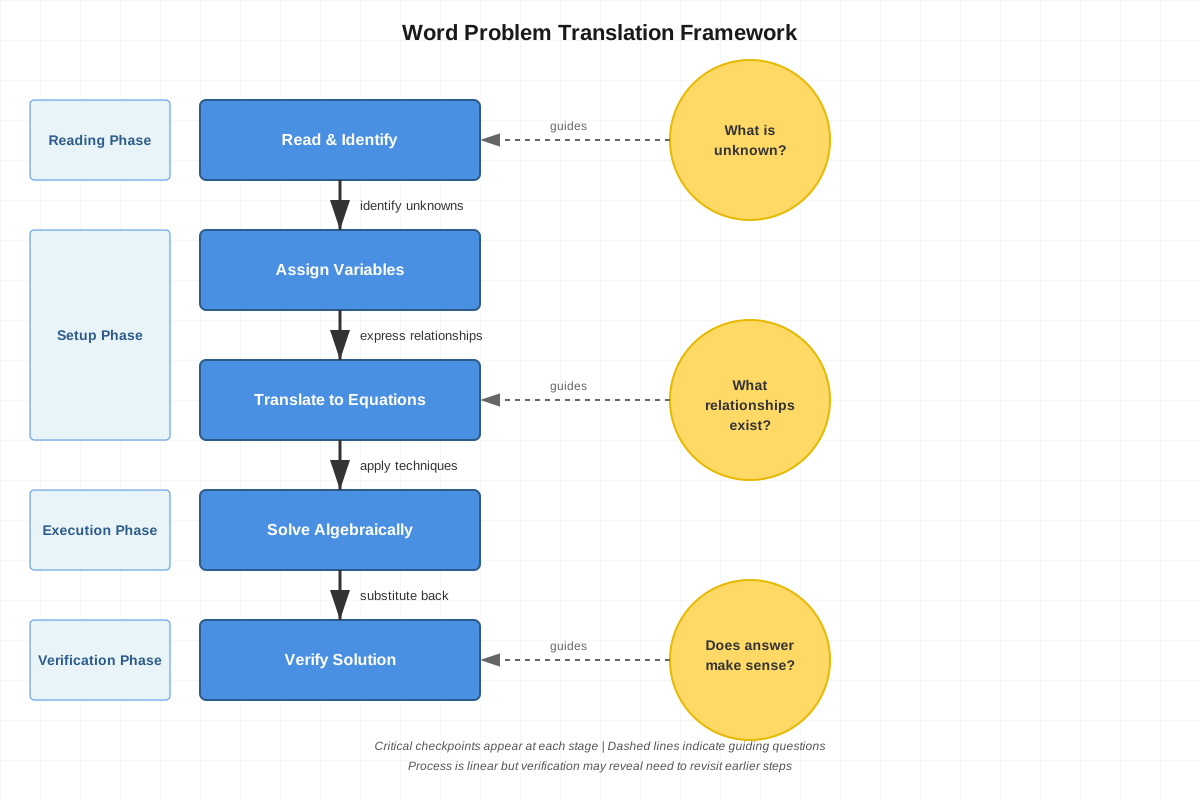
The foundation of solving algebraic word problems involves a systematic translation from English to algebra. This process requires identifying three key elements: what quantities are unknown (variables), what relationships exist between quantities (equations), and what the problem asks to find (the target). Successful translation depends on careful reading that distinguishes between given information and unknowns, recognizes mathematical operations embedded in verbal phrases, and identifies constraints that become equations.
Common verbal phrases translate to specific operations:
- "More than," "sum of," "increased by" → addition (+)
- "Less than," "difference," "decreased by" → subtraction (−)
- "Times," "product of," "of" (with fractions/percentages) → multiplication (×)
- "Per," "quotient," "ratio of" → division (÷)
- "Is," "equals," "results in" → equals sign (=)
Variable Assignment Strategy
Effective variable assignment dramatically simplifies problem-solving. The optimal approach assigns the variable to the quantity the problem asks to find, then expresses all other quantities in terms of this variable. For problems with multiple unknowns, assign variables to the most fundamental quantities and express derived quantities as expressions.
For example, in age problems, if the problem asks for John's current age and mentions Mary's age in relation to John's, assign x to John's current age and express Mary's age as an expression involving x. This strategy minimizes the number of variables and reduces algebraic complexity.
Common Problem Types and Their Structures
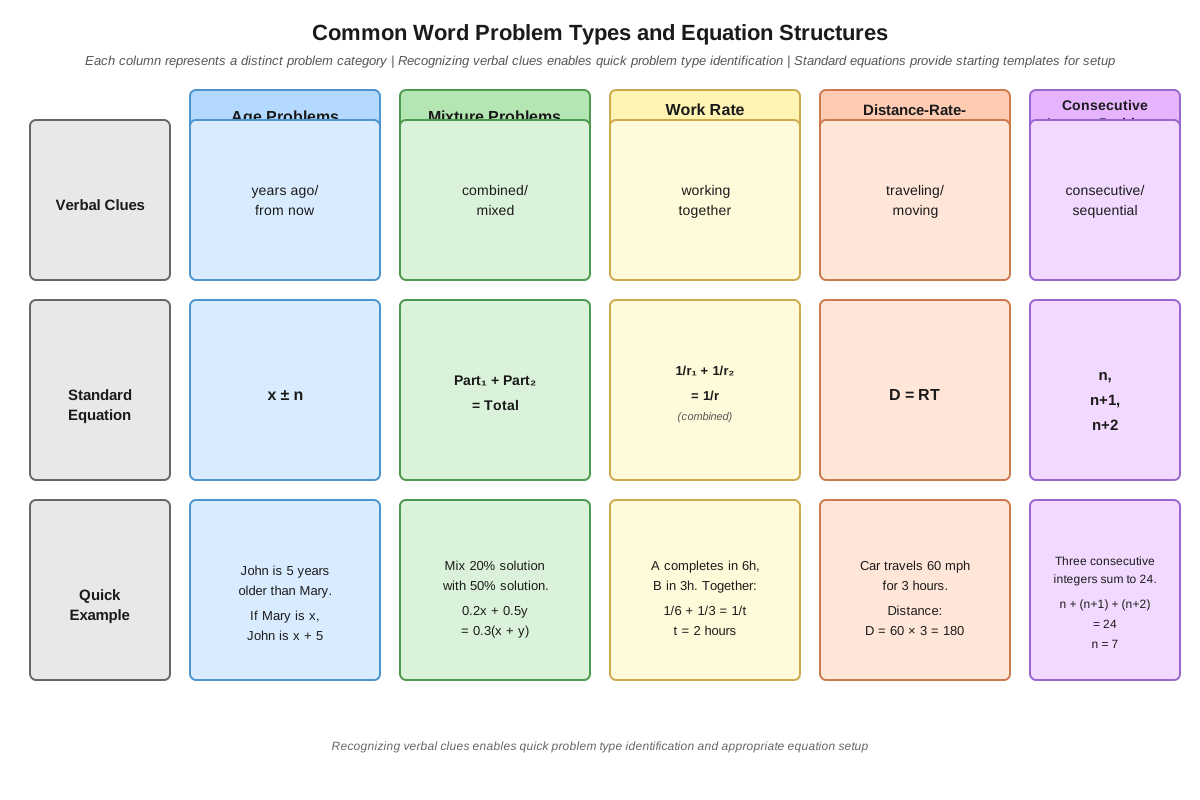
Age Problems involve relationships between people's ages at different times. The key principle: everyone ages at the same rate, so if 5 years pass, add 5 to everyone's age. These problems typically involve setting up equations that relate current ages to past or future ages.
Consecutive Integer Problems involve integers that follow in sequence (n, n+1, n+2 for consecutive integers; n, n+2, n+4 for consecutive even/odd integers). The sum, product, or other relationships between these integers form the equation.
Mixture Problems involve combining substances with different concentrations or values. The fundamental equation: (Amount₁)(Concentration₁) + (Amount₂)(Concentration₂) = (Total Amount)(Final Concentration). These problems require tracking both quantities and their characteristics.
Work Rate Problems follow the principle that Rate × Time = Work Done. When multiple workers collaborate, their rates add: Rate₁ + Rate₂ = Combined Rate. The key insight: if someone completes a job in n hours, their rate is 1/n jobs per hour.
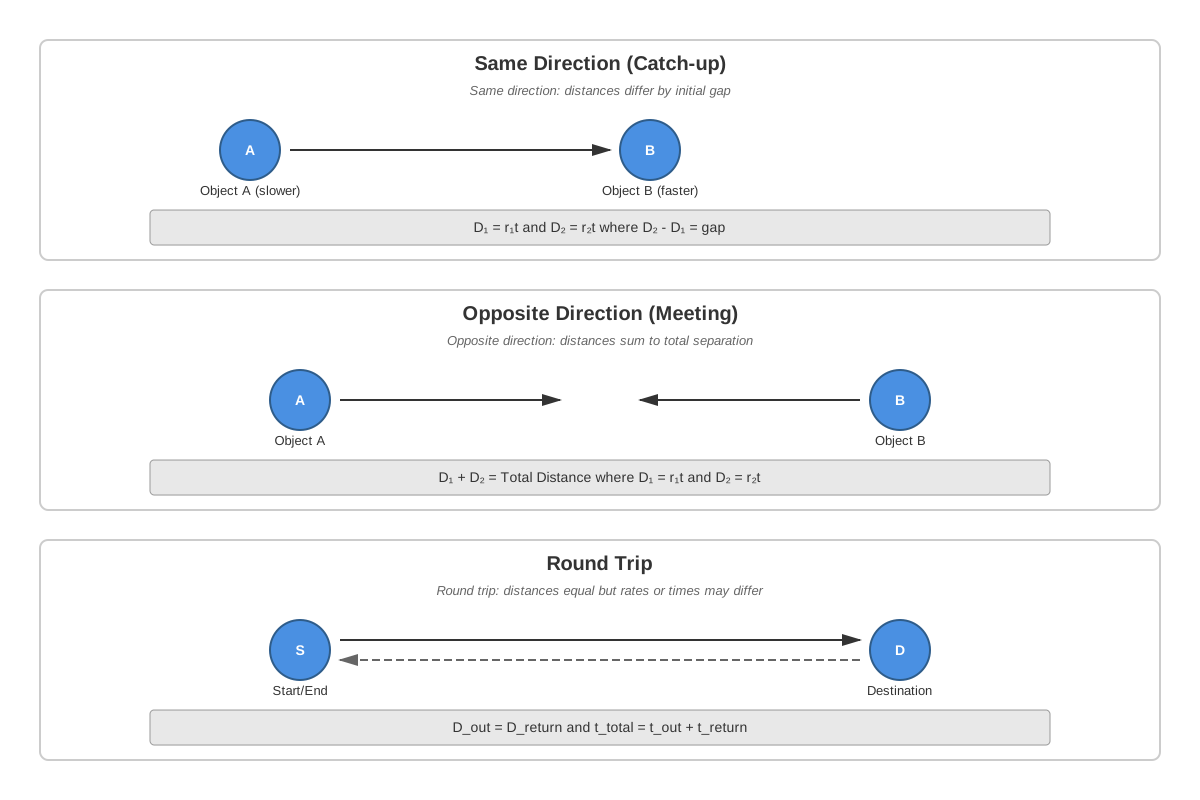
Distance-Rate-Time Problems use the fundamental relationship: Distance = Rate × Time. Problems often involve two objects moving toward or away from each other, requiring careful attention to whether distances add or subtract.
Setting Up Equations
Once variables are assigned and the problem type identified, equation setup follows a systematic process:
- Identify the constraint or relationship described in the problem
- Express both sides of the relationship using variables and given numbers
- Ensure units are consistent across the equation
- Verify the equation makes logical sense by checking extreme cases
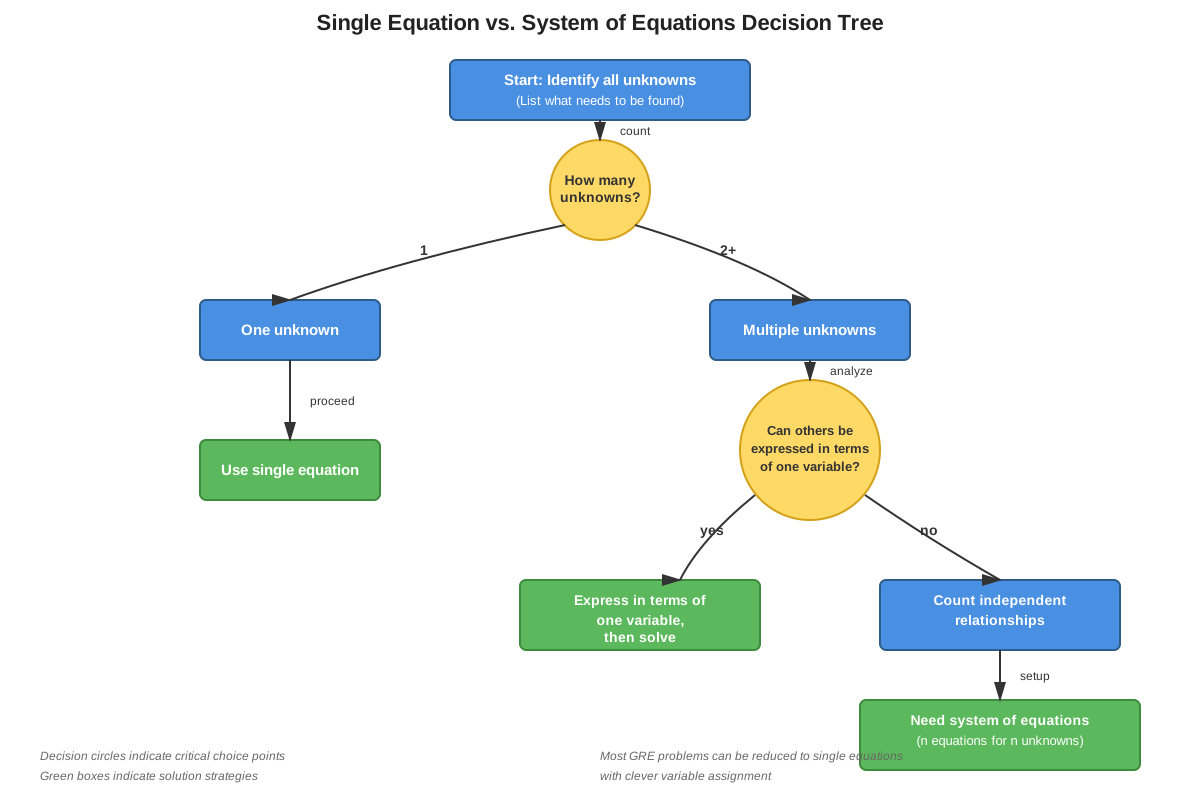
For problems with multiple constraints, each constraint becomes a separate equation, creating a system of equations. The number of independent equations must equal the number of unknowns for a unique solution.
Solution Verification
After solving algebraically, verification ensures the solution makes sense in the original context. Substitute the solution back into the problem's verbal description (not just the equation) to check:
- Does the answer have appropriate units?
- Is the answer reasonable in magnitude?
- Does it satisfy all stated conditions?
- Are there any implicit constraints (like positive quantities) that must be satisfied?
Concept Relationships
The translation process serves as the entry point for all algebraic word problems, leading directly to variable assignment strategy. The choice of variables then determines the complexity of equation setup. Variable assignment and problem type recognition work in parallel—identifying the problem type (age, mixture, work rate, etc.) informs optimal variable choices.
Problem type recognition → guides → equation structure selection → leads to → systematic equation setup. Once equations are established, the solution process connects to prerequisite knowledge of equation-solving techniques (linear equations for single-variable problems, systems of equations for multi-variable problems).
Solution verification closes the loop by connecting back to the original translation process, ensuring the algebraic solution corresponds to the verbal problem context. This creates a circular validation: verbal problem → algebraic model → numerical solution → verbal interpretation → verification against original problem.
The broader connection to GRE Quantitative Reasoning: algebraic word problems integrate arithmetic (for computation), algebra (for equation manipulation), and logical reasoning (for problem interpretation). They also connect forward to data interpretation questions, which often require setting up equations based on graphical or tabular information.
High-Yield Facts
⭐ The number of independent equations needed equals the number of unknown variables for a unique solution
⭐ In work rate problems, if a person completes a job in n units of time, their rate is 1/n jobs per unit time
⭐ For distance-rate-time problems, when two objects move toward each other, their relative speed is the sum of their individual speeds
⭐ In mixture problems, the amount of pure substance equals (total amount) × (concentration percentage)
⭐ Consecutive integers are represented as n, n+1, n+2; consecutive even or odd integers as n, n+2, n+4
- Age problems require recognizing that time changes equally for all people: if x years pass, add x to everyone's age
- The phrase "x is 5 more than twice y" translates to x = 2y + 5, not y = 2x + 5 (order matters)
- Percent problems often require converting percentages to decimals before setting up equations
- When objects move in opposite directions (away from each other), distances add; when moving in the same direction, distances subtract
- Investment/interest problems use the formula: Total Interest = (Principal₁)(Rate₁) + (Principal₂)(Rate₂)
Quick check — test yourself on Algebraic word problems so far.
Try Flashcards →Common Misconceptions
Misconception: In the phrase "5 less than x," the translation is 5 − x → Correction: The correct translation is x − 5. The phrase structure "A less than B" means B − A, not A − B. The quantity being diminished comes first in the algebraic expression.
Misconception: When two people work together, their combined time is the sum of their individual times → Correction: Rates add, not times. If Person A takes 3 hours and Person B takes 6 hours, their combined rate is 1/3 + 1/6 = 1/2 jobs per hour, so together they take 2 hours (not 9 hours).
Misconception: All word problems require setting up equations → Correction: Some GRE word problems are more efficiently solved through logical reasoning, number testing, or working backwards from answer choices. Always consider whether algebraic setup is the most efficient approach.
Misconception: The variable should always represent the smallest or first-mentioned quantity → Correction: The variable should represent what the problem asks to find, or the most fundamental quantity from which others can be easily expressed. This minimizes algebraic complexity.
Misconception: Once you solve the equation, you're done → Correction: Always verify that your answer makes sense in the original problem context and that you've answered the actual question asked. The GRE frequently asks for a related quantity rather than the variable you solved for.
Worked Examples
Example 1: Age Problem
Problem: Sarah is currently twice as old as Tom. In 6 years, Sarah will be 1.5 times as old as Tom. How old is Sarah now?
Solution Process:
Step 1 - Identify what to find: Sarah's current age
Step 2 - Assign variables: Let S = Sarah's current age, T = Tom's current age
Step 3 - Translate relationships into equations:
- "Sarah is currently twice as old as Tom": S = 2T
- "In 6 years, Sarah will be 1.5 times as old as Tom": S + 6 = 1.5(T + 6)
Step 4 - Solve the system:
From equation 1: S = 2T, so T = S/2
Substitute into equation 2:
S + 6 = 1.5(S/2 + 6)
S + 6 = 0.75S + 9
S − 0.75S = 9 − 6
0.25S = 3
S = 12
Step 5 - Verify: If Sarah is 12, then Tom is 6 (since 12 = 2 × 6 ✓). In 6 years, Sarah will be 18 and Tom will be 12. Is 18 = 1.5 × 12? Yes ✓
Answer: Sarah is currently 12 years old.
Connection to learning objectives: This example demonstrates translating verbal age relationships into equations (Objective 4), recognizing the age problem type (Objective 5), and verifying the solution (Objective 6).
Example 2: Work Rate Problem
Problem: Machine A can complete a job in 4 hours. Machine B can complete the same job in 6 hours. If both machines work together, how long will it take them to complete the job?
Solution Process:
Step 1 - Identify the problem type: Work rate problem requiring rate addition
Step 2 - Determine individual rates:
- Machine A's rate: 1 job / 4 hours = 1/4 job per hour
- Machine B's rate: 1 job / 6 hours = 1/6 job per hour
Step 3 - Calculate combined rate:
Combined rate = 1/4 + 1/6
Finding common denominator:
= 3/12 + 2/12 = 5/12 job per hour
Step 4 - Calculate time for combined work:
If rate = 5/12 job per hour, then time = 1 job ÷ (5/12 job per hour)
Time = 1 × 12/5 = 12/5 = 2.4 hours
Step 5 - Verify: In 2.4 hours, Machine A completes 2.4/4 = 0.6 of the job. Machine B completes 2.4/6 = 0.4 of the job. Total: 0.6 + 0.4 = 1.0 job ✓
Answer: Working together, the machines will complete the job in 2.4 hours (or 2 hours 24 minutes).
Connection to learning objectives: This demonstrates recognizing the work rate problem type (Objective 5), applying the rate formula systematically (Objective 3), and using verification to ensure accuracy (Objective 6).
Exam Strategy
When approaching GRE algebraic word problems, begin by reading the entire problem carefully to identify what is being asked. The GRE often places the question at the end, but understanding the target helps guide variable assignment. Underline or note the specific question to avoid solving for the wrong quantity.
Trigger words to watch for:
- "How many," "how much," "what is" → signals what to solve for
- "More than," "less than," "times as much" → indicates relationships between quantities
- "Together," "combined," "total" → suggests addition of quantities or rates
- "Difference," "exceeds by," "greater than" → indicates subtraction
- "Each," "per," "rate of" → signals rate or unit rate problems
Process-of-elimination strategies:
- Eliminate answers that violate implicit constraints (negative ages, speeds faster than light, percentages over 100% when inappropriate)
- Test extreme cases: if the problem involves variables, consider what happens when they equal 0 or 1
- Check units: eliminate answers with incorrect units or unreasonable magnitudes
- For numeric entry questions, verify your answer satisfies all stated conditions before entering
Time allocation advice: Allocate 1.5-2 minutes for straightforward word problems and up to 2.5 minutes for complex multi-step problems. If equation setup takes more than 45 seconds, consider whether working backwards from answer choices or using number testing might be more efficient. The GRE rewards strategic problem-solving, not just algebraic prowess.
Strategic approach sequence:
- Read and identify the question (15 seconds)
- Assign variables and note given information (20 seconds)
- Set up equations (30-45 seconds)
- Solve algebraically (30-45 seconds)
- Verify and check the question asked (15-20 seconds)
Memory Techniques
VIPER for the systematic approach to word problems:
- Variables: Assign variables to unknowns
- Identify: Recognize the problem type
- Phrase: Translate verbal phrases to equations
- Equations: Set up and solve
- Review: Verify the solution makes sense
DIRT for distance-rate-time problems:
- D = IRT (Distance = Rate × Time)
- Rearrange as needed: R = D/T or T = D/R
Rate Work Rhyme: "If the job takes hours of n, then the rate is one over n"
Age Problem Visualization: Draw a simple table with rows for each person and columns for different time periods (past, present, future). This visual organization prevents confusion about when relationships apply.
Mixture Problem Memory Aid: "Amount times concentration gives you the pure stuff in the solution" — helps remember that (Volume)(Concentration) = Amount of pure substance
Consecutive Integer Patterns:
- Regular: n, n+1, n+2 (differ by 1)
- Even/Odd: n, n+2, n+4 (differ by 2)
- Multiples of 3: n, n+3, n+6 (differ by 3)
Summary
Algebraic word problems constitute a critical high-yield area of the GRE Quantitative Reasoning section, requiring students to translate verbal descriptions into mathematical equations and solve for unknown quantities. Success depends on systematic approaches: careful reading to identify what is asked, strategic variable assignment, recognition of common problem types (age, work rate, distance-rate-time, mixture, consecutive integer), accurate translation of verbal phrases into algebraic expressions, and thorough verification of solutions. The key insight is that word problems test mathematical modeling—the ability to represent real-world situations mathematically—rather than just computational skill. Mastery requires understanding the characteristic equation structures for each problem type, recognizing trigger words that signal mathematical operations, and developing efficient solution strategies that balance algebraic rigor with time management. The most successful test-takers approach these problems methodically, always connecting their algebraic solutions back to the original problem context to ensure answers are reasonable and address the actual question asked.
Key Takeaways
- Systematic translation is essential: Carefully convert verbal phrases to algebraic expressions using consistent patterns (more than → +, less than → −, times → ×, per → ÷)
- Variable assignment strategy matters: Assign variables to what the problem asks for or to the most fundamental quantities, expressing other values as expressions
- Problem type recognition accelerates solving: Identifying whether a problem involves age, work rates, distance-rate-time, mixtures, or consecutive integers immediately suggests the appropriate equation structure
- Rates add, times don't: In work rate problems, when people or machines work together, add their rates (1/t₁ + 1/t₂), not their times
- Verification is non-negotiable: Always check that your solution makes sense in the original problem context and answers the specific question asked
- The number of equations must equal the number of unknowns: For problems with multiple variables, ensure you have enough independent constraints to solve uniquely
- Strategic flexibility improves efficiency: Sometimes working backwards from answer choices or testing numbers is faster than setting up complex equations
Related Topics
Systems of Equations: Many complex algebraic word problems require setting up and solving systems with multiple variables and constraints. Mastering substitution and elimination methods enables tackling more sophisticated word problems.
Ratios and Proportions: Word problems frequently involve proportional relationships that can be solved either through algebraic equations or proportion methods. Understanding both approaches provides strategic flexibility.
Percent and Percent Change: Many real-world word problems involve percentage increases, decreases, or comparisons. These often combine with algebraic techniques for problems involving pricing, discounts, or growth.
Functions and Function Notation: Advanced word problems may describe functional relationships verbally, requiring translation into function notation and evaluation.
Inequalities: Some word problems involve constraints expressed as inequalities rather than equations, requiring understanding of inequality properties and solution methods.
Practice CTA
Now that you've mastered the systematic approaches to algebraic word problems, it's time to solidify your understanding through practice. Attempt the practice questions to apply these strategies to GRE-style problems, and use the flashcards to reinforce key translation patterns and problem-type recognition. Remember: algebraic word problems reward systematic thinking and careful verification more than computational speed. Each practice problem you solve strengthens your pattern recognition and builds the confidence needed to tackle any word problem the GRE presents. Your ability to translate real-world scenarios into mathematical models is a skill that extends far beyond test day—invest the time now to master it thoroughly!
Sign up free to keep reading
Create a free AnvayaPrep account to finish this GRE guide on Algebraic word problems — plus flashcards and practice questions.