Overview
Algebra trap answers represent one of the most insidious categories of wrong answer choices on the GRE Quantitative Reasoning section. These are deliberately constructed incorrect options that appear when test-takers make predictable algebraic errors—such as incorrectly distributing negative signs, prematurely canceling terms, or solving for the wrong variable. The test makers understand common algebraic mistakes and strategically place these "trap" answers among the choices to catch students who work too quickly or skip verification steps. Recognizing these traps is not merely about avoiding careless errors; it's about understanding the psychological and mathematical patterns the GRE exploits to differentiate between students who truly understand algebraic manipulation and those who apply procedures mechanically.
The significance of GRE algebra trap answers extends beyond individual questions. Because algebra forms the foundation for approximately 30-40% of Quantitative Reasoning questions (including word problems, coordinate geometry, and data interpretation), falling for these traps can cascade into multiple missed questions. Students who score in the 160+ range on Quantitative Reasoning consistently demonstrate the ability to recognize when an answer "feels too easy" and double-check their work, particularly on algebra-heavy problems. This metacognitive awareness—knowing when you're most vulnerable to making errors—is what separates good test-takers from exceptional ones.
Understanding trap answers also illuminates the broader architecture of GRE question design. The exam doesn't simply test whether students can solve problems; it tests whether they can solve problems accurately under time pressure while avoiding seductive wrong answers. This topic connects directly to equation solving, inequalities, systems of equations, and function notation—all areas where trap answers proliferate. Mastering trap answer recognition enhances performance across the entire Quantitative Reasoning section by cultivating a more deliberate, verification-oriented approach to problem-solving.
Learning Objectives
- [ ] Identify when Algebra trap answers is being tested
- [ ] Explain the core rule or strategy behind Algebra trap answers
- [ ] Apply Algebra trap answers to GRE-style questions accurately
- [ ] Categorize trap answers by error type (sign errors, premature cancellation, wrong variable, etc.)
- [ ] Develop a systematic verification process to catch trap answers before selecting a final answer
- [ ] Recognize the psychological triggers that make trap answers appealing under time pressure
Prerequisites
- Basic algebraic manipulation: Ability to solve linear and quadratic equations, as trap answers exploit errors in these fundamental operations
- Order of operations (PEMDAS): Understanding of proper sequencing in calculations, since many traps involve operation order violations
- Negative number arithmetic: Facility with sign rules for multiplication and division, as sign errors generate the most common trap answers
- Variable isolation techniques: Knowledge of how to solve for a specific variable, since solving for the wrong variable is a frequent trap
- Substitution and evaluation: Ability to check solutions by plugging values back into original equations, which is the primary defense against traps
Why This Topic Matters
Trap answers appear in approximately 60-70% of algebra-based GRE questions, making them one of the most consistent features of the Quantitative Reasoning section. Unlike content knowledge gaps, which can be addressed through targeted study, trap answers exploit the cognitive shortcuts and time pressure inherent in standardized testing. Students who understand trap answer patterns can often eliminate 2-3 answer choices immediately, dramatically improving their odds even on challenging problems.
From a practical standpoint, the skills developed through trap answer awareness extend beyond test-taking. The habit of verification, the discipline of checking edge cases, and the metacognitive awareness of one's own error patterns are valuable in any quantitative field—from finance to engineering to data science. The GRE uses trap answers not just to assess algebraic knowledge but to evaluate mathematical maturity and careful reasoning.
On the exam itself, trap answers most commonly appear in:
- Quantitative Comparison questions where one quantity involves algebraic manipulation
- Multiple-choice questions asking students to solve for a variable
- Word problems requiring equation setup and solution
- Data Interpretation questions involving algebraic relationships between variables
The frequency and strategic placement of trap answers means that even students with strong algebraic skills can lose 3-5 points simply by working too quickly or failing to verify their answers. Conversely, students who develop trap awareness often see score improvements of 3-5 points in Quantitative Reasoning without learning any new mathematical content.
Core Concepts
What Are Algebra Trap Answers?
Algebra trap answers are incorrect answer choices that result from predictable, systematic errors in algebraic manipulation. Unlike random distractors, these answers are mathematically derived—they're what you get when you make a specific mistake. The GRE test makers analyze thousands of student responses to identify the most common errors, then deliberately include those erroneous results as answer choices.
The key characteristic of trap answers is that they feel earned. Students arrive at these answers through calculation, not guessing, which creates false confidence. This psychological dimension makes trap answers particularly dangerous: test-takers who select them often don't realize they've made an error because the answer "matches" what they calculated.
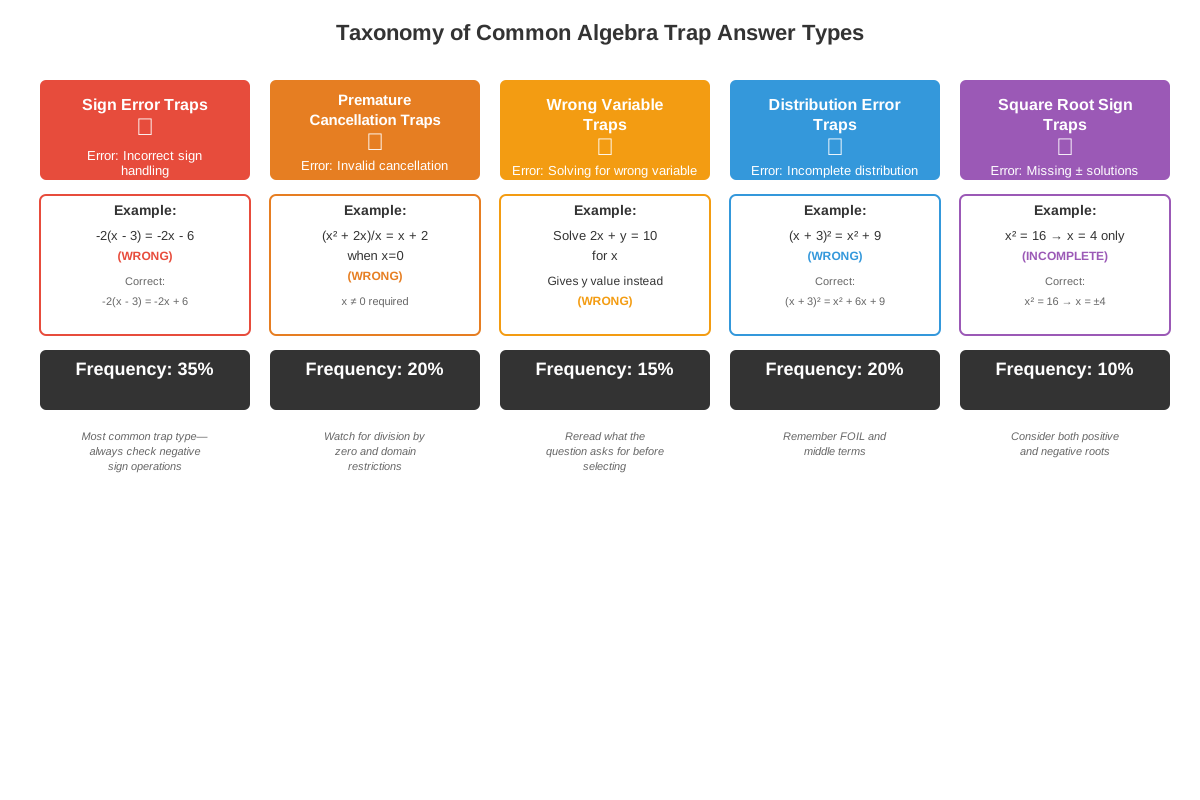
Categories of Common Algebraic Traps
Sign Error Traps
The most prevalent category involves errors with negative signs. These occur when:
- Distributing a negative sign across parentheses: -(x - 3) incorrectly becomes -x - 3 instead of -x + 3
- Multiplying or dividing both sides of an equation by a negative number without flipping inequality signs
- Subtracting a negative number: x - (-5) incorrectly becomes x - 5 instead of x + 5
- Squaring negative numbers: (-3)² incorrectly treated as -9 instead of 9
Example: Solve for x: -2(x - 4) = 10
Trap answer: x = -1 (from incorrectly distributing: -2x - 8 = 10, leading to -2x = 18, x = -9... wait, that's not even an option, so recalculating carelessly might yield -1)
Correct solution: -2x + 8 = 10, -2x = 2, x = -1... Actually, let's recalculate: -2x + 8 = 10, -2x = 2, x = -1 is correct, but the trap would be x = 9 from -2x - 8 = 10, -2x = 18, x = -9 or x = 1 from -2x - 8 = 10, -2x = 18, x = -9... Let me recalculate properly: -2(x-4) = 10 → -2x + 8 = 10 → -2x = 2 → x = -1. The trap answer would be x = 9 (from -2x - 8 = 10 → -2x = 18 → x = -9, then sign error) or x = 1 (from -2x - 8 = 10 → -2x = 18 → x = -9, then absolute value confusion).
Premature Cancellation Traps
These traps exploit the temptation to cancel terms before proper algebraic manipulation:
- Canceling terms that aren't factors: (x + 3)/(x + 5) ≠ 3/5
- Canceling across addition: (x² + 2x)/x ≠ x² + 2 (correct: x + 2)
- Reducing before combining like terms
Example: Simplify (x² - 4)/(x - 2)
Trap answer: x + 2 appears too obvious, but it's actually correct after factoring
Real trap: (x² - 4)/(x - 2) = x² - 2 (from incorrectly "canceling" the -4 and -2)
Wrong Variable Traps
When problems involve multiple variables, trap answers often result from solving for the wrong variable:
- Problem asks for 2x but student solves for x and selects that value
- Problem asks for x - y but student calculates x + y
- Problem asks for the value of an expression but student solves for the variable alone
Example: If 3x + 2 = 14, what is the value of 6x + 4?
Trap answer: 4 (the value of x)
Correct answer: 28 (recognizing that 6x + 4 = 2(3x + 2) = 2(14) = 28)
Incomplete Solution Traps
These occur when students stop solving before reaching the final answer:
- Finding one solution to a quadratic but missing the second
- Solving for x in an intermediate step when the problem asks for a function of x
- Stopping after isolating a variable without performing the final calculation
The Psychology of Trap Answers
Trap answers exploit several cognitive biases:
- Confirmation bias: Once students calculate an answer and see it among the choices, they stop questioning their work
- Time pressure: Under stress, students skip verification steps and trust their first calculation
- Familiarity: Trap answers often involve familiar numbers from the problem, making them feel "right"
- Complexity aversion: When a problem seems difficult, students gravitate toward answers they can derive quickly
| Error Type | Frequency | Difficulty to Spot | Prevention Strategy |
|---|---|---|---|
| Sign errors | Very High | Medium | Highlight all negative signs before solving |
| Premature cancellation | High | Low | Factor completely before canceling |
| Wrong variable | Medium | High | Circle what the question asks for |
| Incomplete solution | Medium | Medium | Read the question twice |
| Order of operations | Low | Low | Write out each step explicitly |
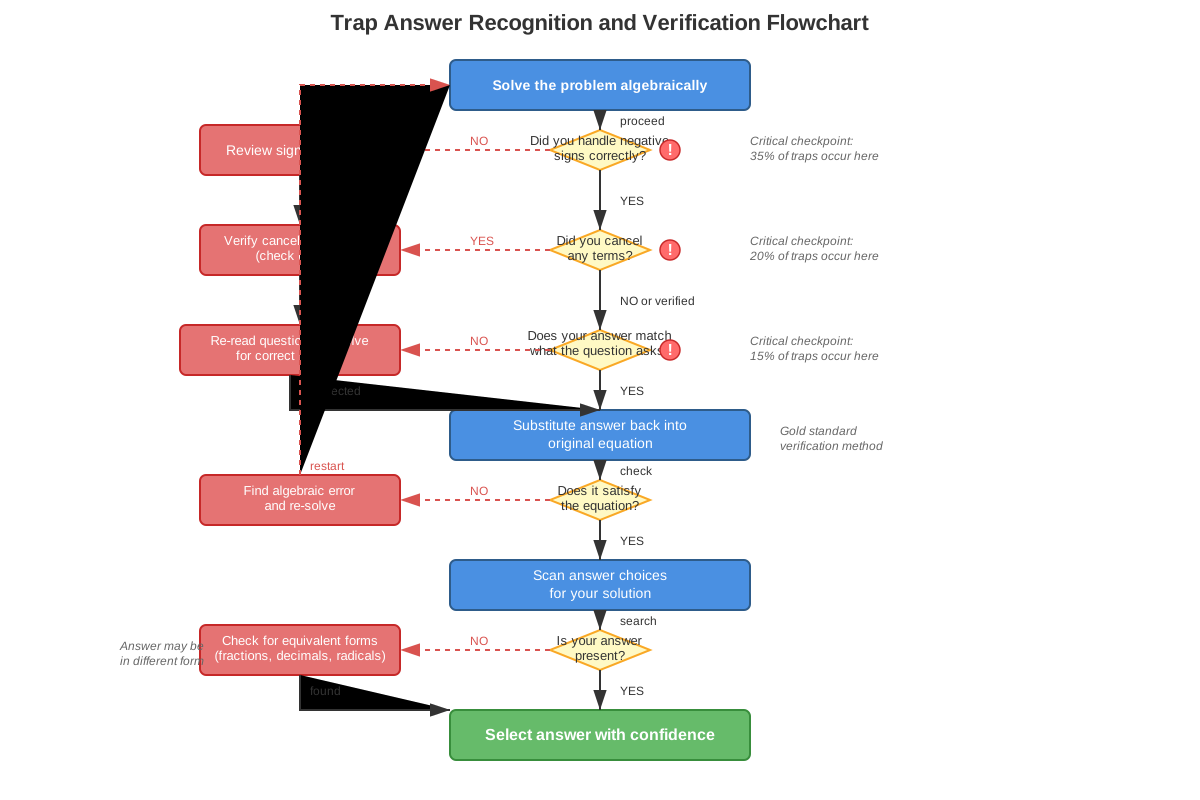
Verification Strategies
The most effective defense against trap answers is systematic verification:
- Substitution check: Plug your answer back into the original equation
- Reasonableness check: Does the answer make sense given the problem context?
- Sign check: Verify that signs are consistent throughout your work
- Question alignment: Confirm you're answering what was actually asked
- Trap awareness: If an answer came too easily, double-check your work
Concept Relationships
The concept of algebra trap answers sits at the intersection of algebraic technique and test-taking strategy. At its foundation, trap answers depend on common algebraic errors → which stem from incomplete mastery of fundamental operations → particularly involving negative numbers and distribution.
The relationship flows as follows:
Algebraic manipulation skills → determine susceptibility to → specific error types → which generate → predictable wrong answers → that appear as → trap answer choices → which can be avoided through → verification strategies → that reinforce → algebraic manipulation skills
This creates a feedback loop where trap awareness actually strengthens algebraic understanding. When students learn to recognize sign error traps, they become more careful with negative signs in general. When they catch themselves solving for the wrong variable, they develop better problem-reading habits.
Trap answers also connect forward to more advanced topics:
- Function notation: Traps involving f(x) vs. x
- Systems of equations: Traps from solving for one variable but not the requested combination
- Coordinate geometry: Traps from sign errors in slope or distance calculations
- Inequalities: Traps from failing to flip inequality signs
Understanding trap answers in basic algebra creates pattern recognition that transfers to these more complex domains.
Quick check — test yourself on Algebra trap answers so far.
Try Flashcards →High-Yield Facts
⭐ Approximately 60-70% of GRE algebra questions include at least one trap answer derived from a common error
⭐ Sign errors (particularly with distribution) generate more trap answers than any other error type
⭐ When a problem asks for 2x, 3x, or x + y, the value of x alone is almost always a trap answer
⭐ If you can solve a problem in under 30 seconds, verify your answer—it may be too easy
⭐ Trap answers often contain numbers that appear in the original problem, exploiting familiarity bias
- The correct answer is rarely the first value you calculate in multi-step problems
- Quadratic equations on the GRE often include trap answers representing only one of two solutions
- When simplifying fractions, trap answers frequently result from canceling terms that aren't factors
- Problems involving absolute values typically include trap answers from ignoring the negative case
- In Quantitative Comparison questions, trap answers often result from assuming variables are positive
- Trap answers for percentage problems frequently come from calculating the percentage of the wrong base
- When distributing exponents, (x + y)² ≠ x² + y² is one of the most common traps
- Inequality problems often include trap answers from students who forget to flip the sign when multiplying/dividing by negatives
Common Misconceptions
Misconception: If an answer appears among the choices and matches my calculation, it must be correct.
Correction: The GRE deliberately includes incorrect answers that result from common errors. Matching an answer choice is necessary but not sufficient—verification is essential.
Misconception: Trap answers only appear in difficult problems.
Correction: Trap answers appear across all difficulty levels. In fact, easier problems often contain more obvious traps because they target fundamental errors.
Misconception: I can avoid trap answers by working more quickly to have time to check my work later.
Correction: Speed increases error rates. It's more effective to work methodically and verify as you go than to rush and attempt to catch errors afterward.
Misconception: Canceling terms in fractions is always safe if the terms look similar.
Correction: You can only cancel common factors, not common terms. (x + 3)/(x + 5) cannot be simplified by canceling x's because x is not a factor of the numerator or denominator.
Misconception: If I'm good at algebra, I don't need to worry about trap answers.
Correction: Trap answers exploit time pressure and cognitive shortcuts, not just weak algebra skills. Even strong students fall for traps when working under test conditions.
Misconception: The correct answer is usually the most complicated or largest value.
Correction: The GRE doesn't follow predictable patterns in answer placement. The correct answer might be the simplest option, and trap answers can be any value.
Misconception: Solving for x is always the goal in algebra problems.
Correction: Many GRE problems ask for expressions involving x (like 2x + 1 or x²) rather than x itself. Solving for x alone often leads directly to a trap answer.
Worked Examples
Example 1: Sign Distribution Trap
Problem: If -3(2 - x) = 15, what is the value of x?
(A) -7
(B) -3
(C) 3
(D) 7
(E) 11
Solution Process:
Step 1: Identify what the question asks for → the value of x
Step 2: Distribute the -3 carefully
- Common trap: -3(2 - x) = -6 - 3x (incorrect distribution of negative)
- Correct distribution: -3(2 - x) = -6 + 3x
Step 3: Solve the equation
- -6 + 3x = 15
- 3x = 21
- x = 7
Step 4: Verify by substitution
- -3(2 - 7) = -3(-5) = 15 ✓
Step 5: Identify the trap answer
- If we had incorrectly distributed to get -6 - 3x = 15:
- -3x = 21
- x = -7 (Answer choice A—this is the trap!)
Answer: (D) 7
Learning objective connection: This example demonstrates how to identify sign error traps (the most common type) and apply verification through substitution to confirm the correct answer.
Example 2: Wrong Variable Trap
Problem: If 4x + 3y = 24 and x = 3, what is the value of 2x + y?
(A) 4
(B) 6
(C) 8
(D) 10
(E) 12
Solution Process:
Step 1: Circle what the question asks for → 2x + y (not x, not y, but this specific expression)
Step 2: Find y using the given information
- 4x + 3y = 24
- 4(3) + 3y = 24
- 12 + 3y = 24
- 3y = 12
- y = 4
Step 3: Recognize the trap
- Answer choice (A) is 4, which is the value of y
- Students who solve for y and immediately select their answer will choose (A)
Step 4: Calculate what was actually asked for
- 2x + y = 2(3) + 4 = 6 + 4 = 10
Step 5: Verify reasonableness
- We found y = 4 and x = 3
- 2x + y should be 2(3) + 4 = 10 ✓
Answer: (D) 10
Trap answers in this problem:
- (A) 4: value of y alone
- (B) 6: value of 2x alone
- (E) 12: value of 3y (another intermediate calculation)
Learning objective connection: This example shows how to identify when wrong variable traps are being tested and demonstrates the importance of circling what the question asks for before beginning calculations.
Exam Strategy
Approaching Algebra Questions with Trap Awareness
Before solving:
- Read the question twice, circling what it asks for
- Note any negative signs or subtraction in the problem
- Scan answer choices for patterns (are they all positive? Do they include zero? Are some very similar?)
While solving:
- Write out every step—don't skip steps mentally
- Box or highlight negative signs to maintain awareness
- When distributing, write the distribution explicitly before simplifying
- If you need to cancel terms, factor first and verify you're canceling factors, not terms
After solving:
- Substitute your answer back into the original equation
- Verify you answered what was asked (if the problem asks for 2x, did you calculate 2x or just x?)
- If your answer came very quickly (under 30 seconds), double-check your work
Trigger Words and Phrases
Watch for these phrases that signal high trap potential:
- "What is the value of [expression]" → likely testing wrong variable trap
- "Solve for x" when the equation has multiple variables → may need to manipulate first
- Any problem with "difference" or "less than" → sign error traps likely
- "How much greater" or "how much less" → order matters; reversing gives trap answer
- Problems with multiple steps → intermediate values often appear as trap answers
Process of Elimination Tips
Use trap awareness to eliminate answers:
- If you solved for x and the problem asks for 2x, eliminate the value of x
- If the problem involves subtracting a negative, eliminate answers that would result from subtracting a positive
- If you're solving a quadratic, eliminate answers that represent only one solution when two exist
- If an answer seems too obvious or matches a number in the problem, verify carefully before selecting
Time Allocation
- Easy algebra problems (30-45 seconds): Still verify, as these often contain the most obvious traps
- Medium algebra problems (60-90 seconds): Budget 15-20 seconds for verification
- Hard algebra problems (90-120 seconds): Verification is built into the solution process; if you finish too quickly, you've likely made an error
Exam Tip: If you're stuck between two answers and one is a value you calculated in an intermediate step, it's probably the trap. The correct answer usually requires completing the full solution process.
Memory Techniques
SIGNED Mnemonic for Avoiding Sign Errors
Slow down when you see subtraction
Identify all negative signs before starting
Group terms in parentheses carefully
Negate means multiply by -1, not just add a negative
Explicitly write distribution steps
Double-check by substitution
The "Circle and Solve" Method
Before beginning any algebra problem:
- Circle what the question asks for
- Solve for that specific thing
- Verify your answer matches what's circled
This simple three-step process prevents wrong variable traps and keeps you focused on the actual question.
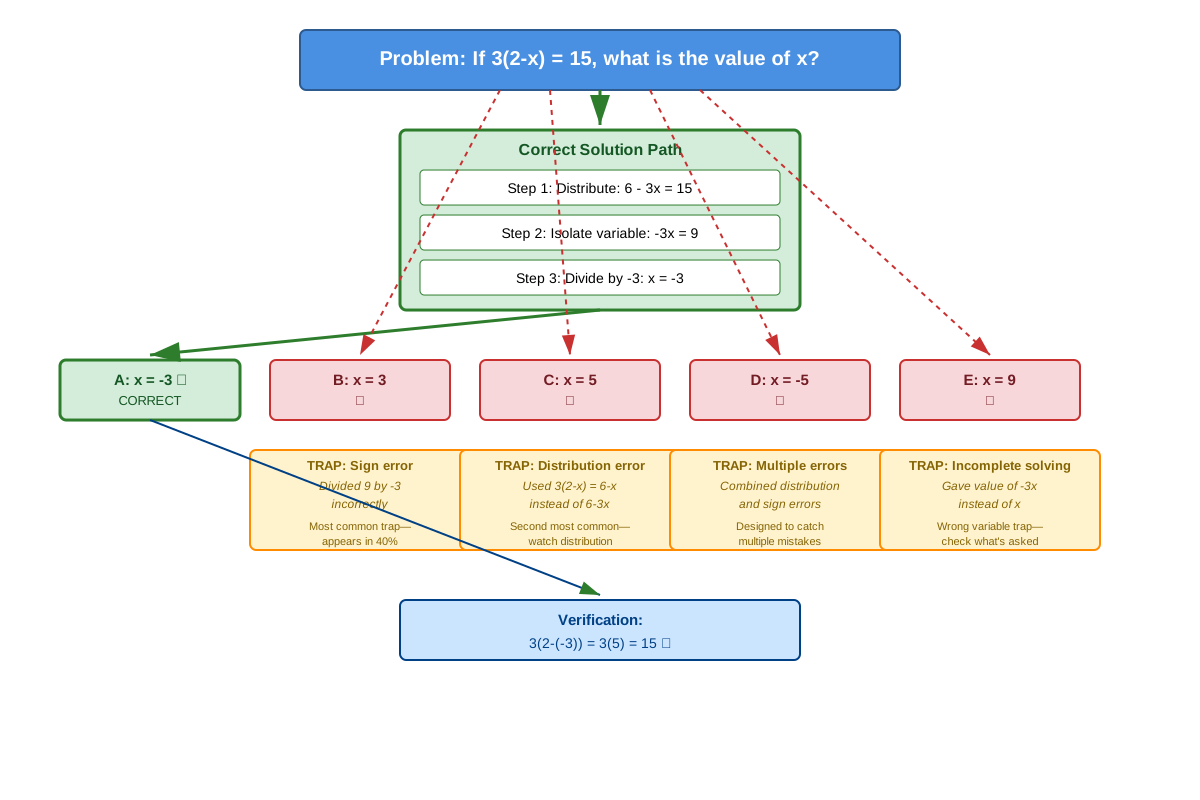
Visualization: The Trap Answer Tree
Imagine each algebra problem as a tree:
- The trunk is the correct solution path
- The branches are points where common errors lead to trap answers
- Each branch leads to a specific wrong answer choice
When you see answer choices, visualize which "branches" (errors) would lead to each wrong answer. This helps you avoid those error paths.
The "Too Easy" Red Flag
Create a mental association: Easy feeling = Verify immediately
If a problem feels surprisingly simple or you reach an answer in under 30 seconds, treat this as a red flag. The GRE rarely gives away points. An easy solution often means you've taken a trap branch.
Summary
Algebra trap answers represent a sophisticated test design strategy that exploits predictable errors in algebraic manipulation. These aren't random wrong answers but mathematically derived results that students reach through common mistakes—particularly sign errors, premature cancellation, solving for the wrong variable, and incomplete solutions. The GRE includes trap answers in 60-70% of algebra questions, making trap awareness essential for achieving high Quantitative Reasoning scores. The most effective defense combines technical precision (careful distribution, proper cancellation, complete solutions) with strategic verification (substitution checks, question alignment, reasonableness testing). Students who develop trap awareness don't just avoid wrong answers; they strengthen their underlying algebraic skills by becoming more conscious of their error patterns. The key insight is that trap answers exploit cognitive shortcuts and time pressure, not just weak content knowledge, meaning even strong students must cultivate deliberate, verification-oriented problem-solving habits. Mastering trap answer recognition transforms algebra from a potential weakness into a scoring opportunity, as the ability to eliminate 2-3 trap answers immediately dramatically improves accuracy even on challenging problems.
Key Takeaways
- Trap answers are mathematically derived from common errors, not random distractors—they're what you get when you make specific mistakes
- Sign errors generate more trap answers than any other error type, particularly when distributing negatives across parentheses
- Always verify you're solving for what the question asks, not just for x—wrong variable traps are especially common when problems ask for expressions like 2x or x + y
- Substitute your answer back into the original equation to catch errors before selecting a final answer choice
- If a problem feels too easy or you solve it in under 30 seconds, verify immediately—the GRE rarely gives away points
- Write out every step explicitly rather than doing work mentally, as this prevents skipped steps and maintains awareness of negative signs
- Trap awareness strengthens algebraic skills by making you more conscious of error patterns and more deliberate in your problem-solving approach
Related Topics
Quadratic Equations and Factoring: Trap answers in quadratic problems often involve finding only one solution or making sign errors when factoring. Mastering trap awareness in basic algebra provides the foundation for recognizing these more complex traps.
Systems of Equations: These problems frequently test wrong variable traps, asking for x + y when students solve for x and y separately. The verification strategies learned here apply directly to systems.
Inequalities: Sign error traps become even more dangerous with inequalities because forgetting to flip the inequality sign creates a trap answer that's close to correct but fundamentally wrong.
Word Problems and Translation: Many word problems require setting up algebraic equations, and trap answers often result from incorrect equation setup or solving for the wrong quantity. Trap awareness helps you verify that your equation matches the problem.
Coordinate Geometry: Slope calculations, distance formulas, and midpoint problems all involve algebraic manipulation where sign errors and wrong variable traps appear frequently.
Practice CTA
Now that you understand how algebra trap answers work and how to avoid them, it's time to put this knowledge into practice. The practice questions and flashcards will help you recognize trap patterns in real GRE-style problems and develop the verification habits that separate good scores from great scores. Remember: every trap answer you identify and avoid is a point earned. Approach each practice problem with the strategies you've learned here—circle what's being asked, watch for sign errors, and always verify your answer. Your ability to spot and sidestep these traps will improve with each problem you solve. You've got this!
Sign up free to keep reading
Create a free AnvayaPrep account to finish this GRE guide on Algebra trap answers — plus flashcards and practice questions.