Overview
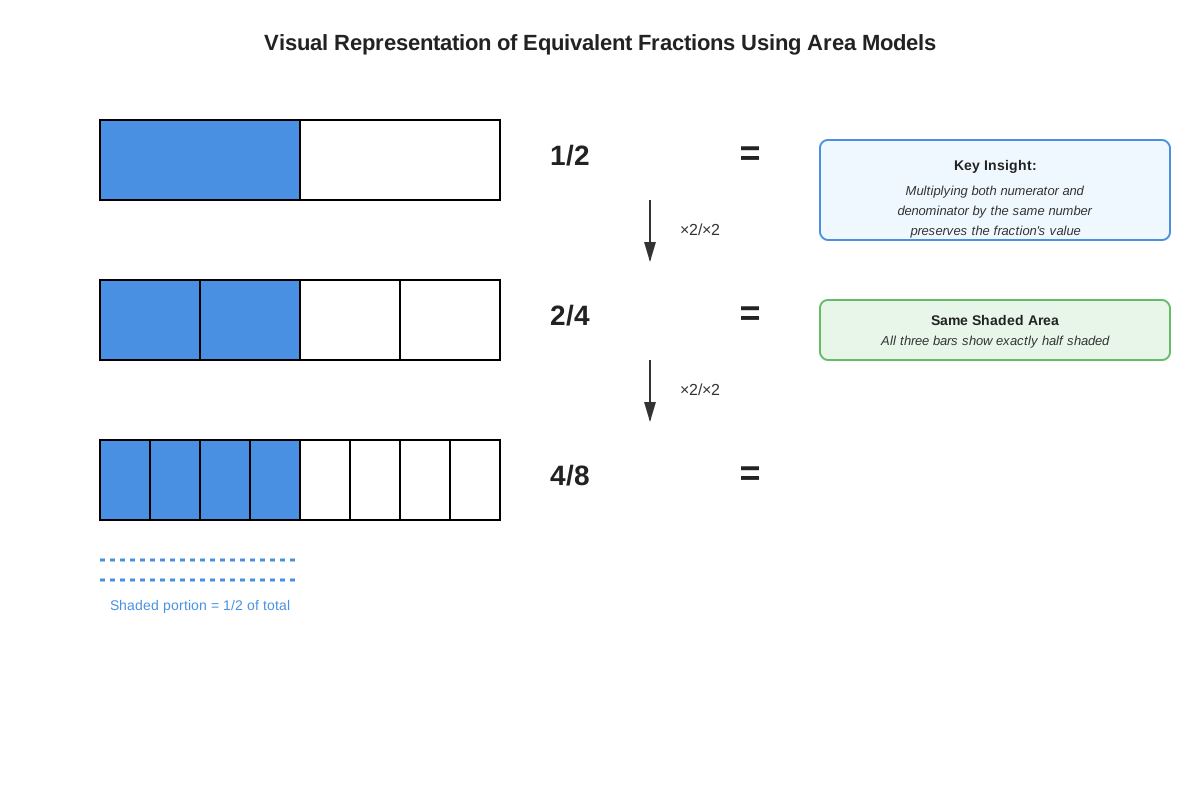
Equivalent fractions represent one of the most fundamental yet frequently tested concepts in GRE Quantitative Reasoning. At its core, this topic deals with the principle that different numerical expressions can represent the same fractional value—for instance, 1/2, 2/4, and 50/100 all represent identical quantities despite appearing different. While this may seem elementary, the GRE tests equivalent fractions in sophisticated ways that require both conceptual understanding and computational fluency. Questions may embed this concept within complex word problems, algebraic expressions, data interpretation scenarios, or quantitative comparison questions where recognizing equivalent forms becomes the key to efficient problem-solving.
The importance of mastering gre equivalent fractions extends far beyond simple fraction manipulation. This topic serves as a foundational skill that connects to numerous other Quantitative Reasoning areas including ratios, proportions, percentages, probability, and algebraic simplification. Test-makers frequently design problems where the most efficient solution path involves recognizing that two seemingly different fractions are actually equivalent, or where converting a fraction to an equivalent form reveals a pattern or simplifies a calculation. Students who can quickly identify and generate equivalent fractions gain significant time advantages on the exam, as they can bypass lengthy calculations and recognize answer choices more readily.
Understanding equivalent fractions also strengthens overall mathematical reasoning by reinforcing the concept that mathematical expressions can be transformed while preserving their underlying value. This principle appears throughout the GRE in various disguises: simplifying complex fractions, comparing quantities, solving equations, and interpreting data visualizations. The ability to fluidly move between different equivalent representations of the same value represents a hallmark of quantitative maturity that the GRE explicitly rewards.
Learning Objectives
- [ ] Identify when Equivalent fractions is being tested
- [ ] Explain the core rule or strategy behind Equivalent fractions
- [ ] Apply Equivalent fractions to GRE-style questions accurately
- [ ] Generate multiple equivalent forms of a given fraction using multiplication and division
- [ ] Determine whether two fractions are equivalent using cross-multiplication and simplification techniques
- [ ] Recognize equivalent fractions in algebraic expressions and variable-based problems
- [ ] Utilize equivalent fractions to simplify complex calculations and comparisons efficiently
Prerequisites
- Basic fraction notation and terminology: Understanding numerators, denominators, and proper/improper fractions is essential since equivalent fractions build directly on these foundational concepts
- Multiplication and division of whole numbers: These operations form the basis for generating equivalent fractions through scaling
- Greatest Common Factor (GCF) and Least Common Multiple (LCM): These concepts enable simplification to lowest terms and finding common denominators
- Basic algebraic manipulation: Many GRE questions present equivalent fractions with variables rather than just numbers
Why This Topic Matters
Equivalent fractions appear in approximately 15-20% of GRE Quantitative Reasoning questions, either as the primary concept being tested or as a necessary skill for solving more complex problems. This high frequency makes it one of the most valuable topics to master for score improvement. The concept appears across multiple question formats: quantitative comparison questions often require recognizing equivalent forms to determine relationships; multiple-choice questions may present answer choices as different equivalent fractions; and data interpretation questions frequently require converting fractions to compare values across different representations.
In real-world applications, equivalent fractions underpin financial literacy (comparing interest rates, understanding investment returns), cooking and recipe scaling, construction and engineering measurements, and data analysis. The ability to recognize that 3/4 of a project completed equals 75% or that a 1:2 ratio is equivalent to 50% demonstrates the practical utility of this mathematical skill beyond test-taking.
On the GRE specifically, equivalent fractions commonly appear in: comparison of fractional quantities where denominators differ; simplification of complex algebraic fractions; word problems involving rates, ratios, and proportions; probability questions requiring fraction manipulation; and geometry problems involving fractional relationships between areas or lengths. Test-makers particularly favor questions where the most efficient solution involves recognizing an equivalent form rather than performing extensive calculations, rewarding students who have internalized these patterns.
Core Concepts
Fundamental Definition and Principle
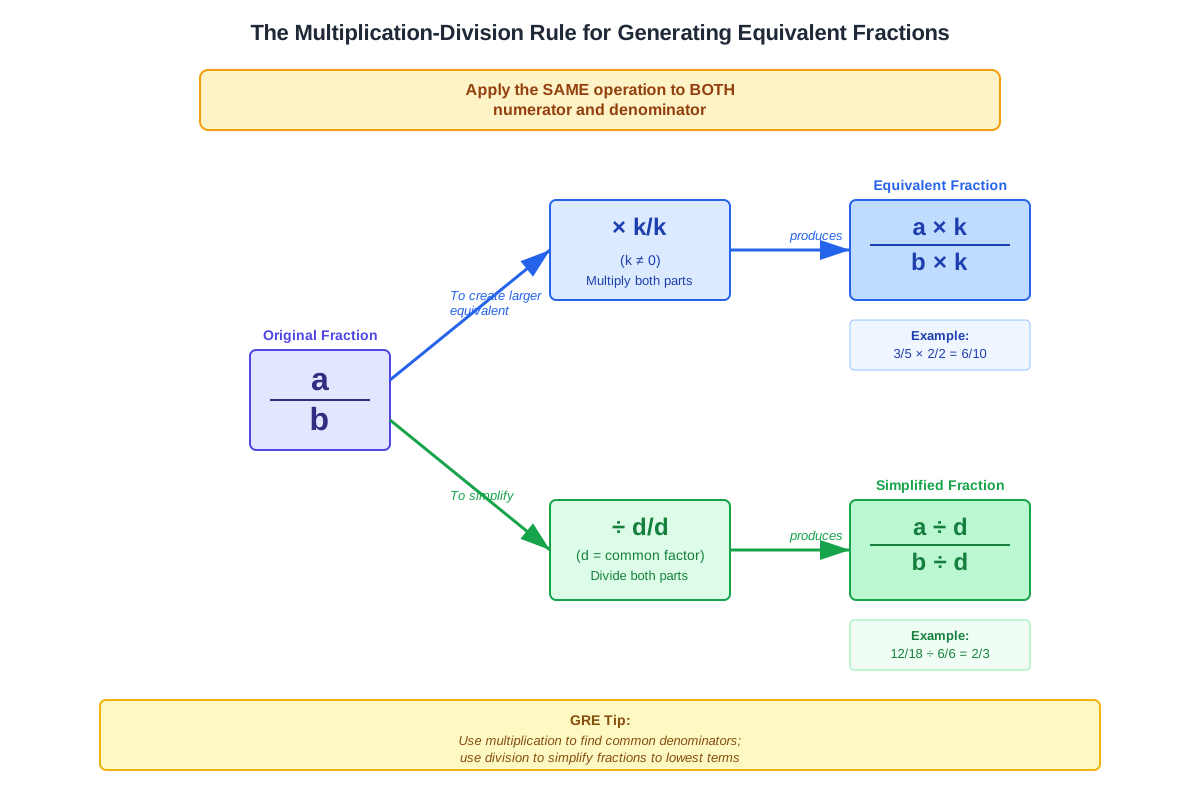
Equivalent fractions are fractions that represent the same numerical value or proportion, despite having different numerators and denominators. The fundamental principle states that multiplying or dividing both the numerator and denominator of a fraction by the same non-zero number produces an equivalent fraction. This principle derives from the multiplicative identity property: multiplying any number by 1 leaves it unchanged, and any fraction where the numerator equals the denominator (like 2/2, 5/5, or 100/100) equals 1.
Mathematically, if we have a fraction a/b, then:
a/b = (a × n)/(b × n) for any non-zero integer nSimilarly:
a/b = (a ÷ d)/(b ÷ d) for any common divisor d of both a and bThis principle ensures that the ratio between numerator and denominator remains constant, preserving the fractional value.
Generating Equivalent Fractions Through Multiplication
To create equivalent fractions by scaling up, multiply both the numerator and denominator by the same factor. For example, starting with 3/5:
- Multiply by 2/2: (3 × 2)/(5 × 2) = 6/10
- Multiply by 3/3: (3 × 3)/(5 × 3) = 9/15
- Multiply by 10/10: (3 × 10)/(5 × 10) = 30/50
All these fractions—3/5, 6/10, 9/15, and 30/50—are equivalent. This technique proves particularly useful when finding common denominators for addition or subtraction, or when converting fractions to match answer choice formats on the GRE.
Simplifying Fractions to Lowest Terms
The reverse process involves dividing both numerator and denominator by their common factors to reduce a fraction to its simplest form or lowest terms. A fraction is in lowest terms when the numerator and denominator share no common factors other than 1 (they are relatively prime).
Process for simplification:
- Identify the Greatest Common Factor (GCF) of the numerator and denominator
- Divide both numerator and denominator by the GCF
- Verify that no common factors remain
Example: Simplify 24/36
- Find GCF of 24 and 36: GCF = 12
- Divide both by 12: 24 ÷ 12 = 2, and 36 ÷ 12 = 3
- Result: 24/36 = 2/3 (in lowest terms)
Cross-Multiplication Method for Verification
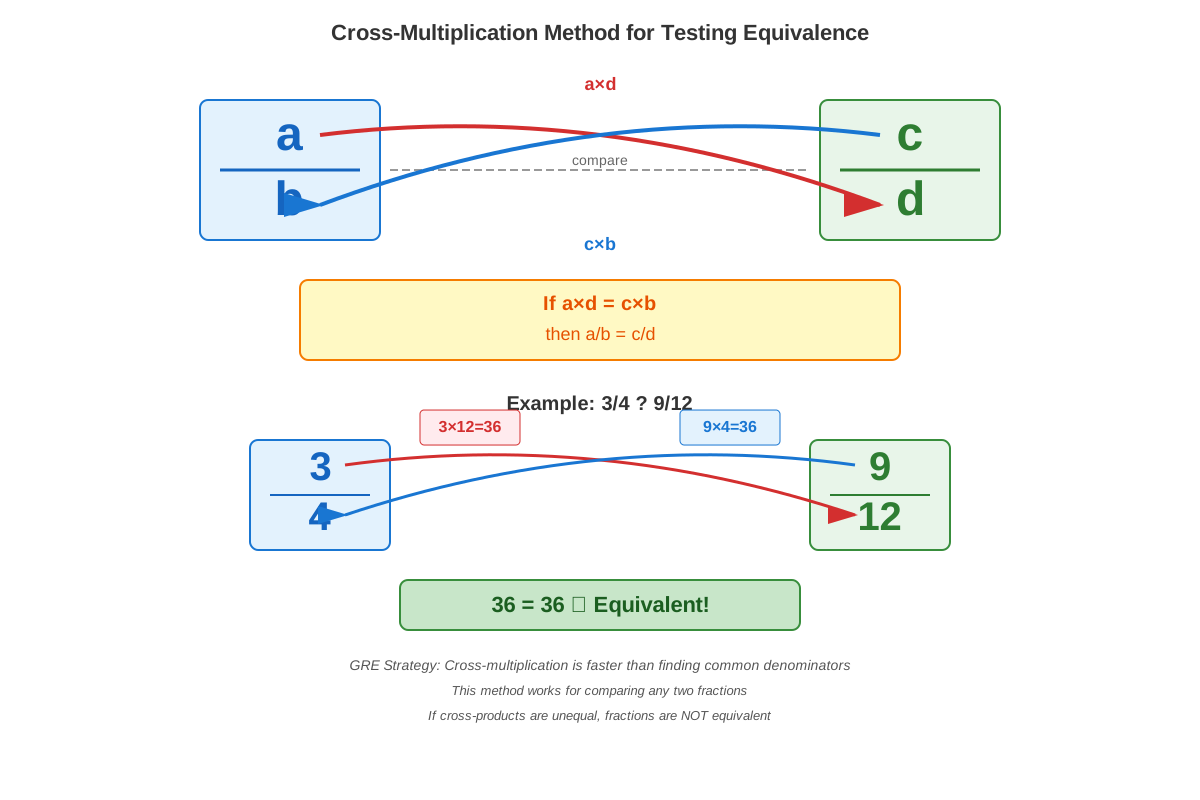
To determine whether two fractions are equivalent without simplifying both, use cross-multiplication. For fractions a/b and c/d:
If a × d = b × c, then a/b = c/d
Example: Are 3/7 and 12/28 equivalent?
- Cross-multiply: 3 × 28 = 84, and 7 × 12 = 84
- Since 84 = 84, the fractions are equivalent
This method provides a quick verification technique particularly valuable during timed GRE conditions.
Equivalent Fractions with Variables
GRE questions frequently present equivalent fractions containing algebraic expressions. The same principles apply, but require algebraic manipulation skills.
Example: For what value of x is 4/7 = x/21?
- Cross-multiply: 4 × 21 = 7 × x
- 84 = 7x
- x = 12
Alternatively, recognize that 21 = 7 × 3, so multiply numerator by 3: 4 × 3 = 12
Comparing Fractions Using Equivalent Forms
When comparing fractions with different denominators, converting to equivalent fractions with a common denominator enables direct comparison. The Least Common Denominator (LCD) provides the most efficient common denominator.
Example: Which is larger, 5/6 or 7/9?
- Find LCD of 6 and 9: LCD = 18
- Convert: 5/6 = 15/18 and 7/9 = 14/18
- Since 15/18 > 14/18, therefore 5/6 > 7/9
Decimal and Percentage Equivalents
Understanding that fractions, decimals, and percentages represent equivalent ways of expressing the same value proves crucial for GRE success. Common equivalents to memorize:
| Fraction | Decimal | Percentage |
|---|---|---|
| 1/2 | 0.5 | 50% |
| 1/4 | 0.25 | 25% |
| 3/4 | 0.75 | 75% |
| 1/5 | 0.2 | 20% |
| 1/3 | 0.333... | 33.33...% |
| 2/3 | 0.666... | 66.66...% |
| 1/8 | 0.125 | 12.5% |
Recognizing these equivalents allows rapid conversion between forms, often revealing the most efficient solution path.
Concept Relationships
The concept of equivalent fractions serves as a central hub connecting multiple arithmetic and algebraic topics. At the foundational level, equivalent fractions builds directly on basic fraction understanding (numerator/denominator relationships) and multiplication/division operations. The ability to generate equivalent fractions by multiplying or dividing both terms by the same value represents a direct application of the multiplicative identity property.
Moving upward in complexity, equivalent fractions enables fraction addition and subtraction through the process of finding common denominators—essentially converting fractions to equivalent forms that can be combined. Similarly, fraction comparison relies on converting to equivalent fractions with common denominators or recognizing relative sizes through cross-multiplication.
The relationship extends horizontally to ratios and proportions, which are conceptually equivalent to fractions. Solving proportions involves recognizing equivalent ratios, and simplifying ratios uses identical techniques to simplifying fractions. Percentages represent another equivalent form, where any fraction can be converted to a percentage by finding an equivalent fraction with denominator 100.
In algebraic contexts, equivalent fractions connects to rational expressions and equation solving. Simplifying algebraic fractions, solving fractional equations, and working with rational functions all require the same principles of generating and recognizing equivalent forms. The concept also appears in probability (where equivalent fractions represent the same probability) and geometry (where fractional relationships between measurements must be recognized as equivalent).
Conceptual flow: Basic Fractions → Equivalent Fractions → Common Denominators → Fraction Operations → Ratios/Proportions → Percentages → Algebraic Fractions → Advanced Problem Solving
High-Yield Facts
⭐ Multiplying or dividing both numerator and denominator by the same non-zero number always produces an equivalent fraction
⭐ A fraction is in lowest terms when the GCF of numerator and denominator equals 1
⭐ Cross-multiplication provides the fastest method to verify fraction equivalence: a/b = c/d if and only if a×d = b×c
⭐ Any fraction can be converted to an equivalent fraction with a specific denominator by multiplying both terms by the appropriate factor
⭐ Common benchmark fractions (1/2, 1/3, 1/4, 1/5, 1/8) have predictable decimal and percentage equivalents that should be memorized
- Fractions with the same numerator are inversely related to their denominators: larger denominator means smaller value
- The LCD of two denominators equals their LCM
- Improper fractions and mixed numbers represent equivalent values (e.g., 7/4 = 1¾)
- Negative fractions have equivalent forms: -a/b = a/(-b) = -(a/b)
- Multiplying a fraction by n/n (where n ≠ 0) is equivalent to multiplying by 1, preserving the value
- Complex fractions can be simplified by finding equivalent forms of the component fractions
- In quantitative comparisons, converting both quantities to equivalent forms with common denominators often reveals the relationship immediately
Quick check — test yourself on Equivalent fractions so far.
Try Flashcards →Common Misconceptions
Misconception: Adding the same number to both numerator and denominator produces an equivalent fraction → Correction: Only multiplication or division by the same non-zero value preserves equivalence. Adding 2 to both terms of 1/2 gives 3/4, which equals 0.75, not 0.5. The ratio between numerator and denominator changes with addition.
Misconception: A fraction with larger numbers is always greater in value → Correction: The fraction 2/100 is smaller than 1/2, despite having larger numerator and denominator values. The relationship between numerator and denominator determines value, not the absolute size of the numbers.
Misconception: Simplifying fractions changes their value → Correction: Simplification produces an equivalent fraction with identical value but smaller terms. The fraction 50/100 equals exactly 1/2; simplification reveals the same value in clearer form.
Misconception: Cross-multiplication only works for solving proportions, not for comparing fractions → Correction: Cross-multiplication serves multiple purposes: verifying equivalence, comparing fraction sizes, and solving proportions. For comparison, if a×d > b×c, then a/b > c/d.
Misconception: Equivalent fractions must have related denominators (one must be a multiple of the other) → Correction: Any two fractions can be equivalent regardless of their denominator relationship. For example, 2/3 and 14/21 are equivalent, and while 21 is a multiple of 3, the equivalence principle works for any pair of fractions with the same value.
Misconception: Dividing both numerator and denominator by any number produces an equivalent fraction → Correction: Both terms must be divided by a common factor (a number that divides evenly into both). Dividing 6/9 by 2 gives 3/4.5, which is not a proper fraction and not equivalent to 6/9 (which equals 2/3).
Misconception: The fraction with the smallest denominator is always in lowest terms → Correction: A fraction is in lowest terms only when numerator and denominator share no common factors. The fraction 4/6 has a smaller denominator than 2/3, but 2/3 is the lowest-terms form.
Worked Examples
Example 1: Multi-Step Fraction Comparison
Question: Which is greater: 7/12 or 11/18?
Solution Process:
Step 1: Identify that direct comparison is difficult with different denominators.
Step 2: Find the LCD of 12 and 18.
- Prime factorization: 12 = 2² × 3, and 18 = 2 × 3²
- LCD = 2² × 3² = 4 × 9 = 36
Step 3: Convert both fractions to equivalent fractions with denominator 36.
- For 7/12: Need to multiply by 3/3 (since 12 × 3 = 36)
- 7/12 = (7 × 3)/(12 × 3) = 21/36
- For 11/18: Need to multiply by 2/2 (since 18 × 2 = 36)
- 11/18 = (11 × 2)/(18 × 2) = 22/36
Step 4: Compare the equivalent fractions.
- 21/36 vs. 22/36
- Since 22 > 21, we have 22/36 > 21/36
Answer: 11/18 is greater than 7/12
Connection to Learning Objectives: This example demonstrates applying equivalent fractions to comparison problems, a common GRE question type. It shows the strategy of finding common denominators through LCD calculation and converting to equivalent forms.
Example 2: Algebraic Equivalent Fractions
Question: If 3/x = 9/15, what is the value of x?
Solution Process:
Method 1 (Cross-multiplication):
Step 1: Apply cross-multiplication principle.
- 3 × 15 = x × 9
- 45 = 9x
Step 2: Solve for x.
- x = 45 ÷ 9 = 5
Method 2 (Equivalent fraction recognition):
Step 1: Simplify the right side to lowest terms.
- 9/15: GCF of 9 and 15 is 3
- 9/15 = (9 ÷ 3)/(15 ÷ 3) = 3/5
Step 2: Recognize that 3/x must equal 3/5.
- Since numerators are equal, denominators must be equal
- x = 5
Verification: Check by substituting x = 5 into original equation.
- 3/5 = 9/15
- Cross-multiply: 3 × 15 = 45, and 5 × 9 = 45 ✓
Answer: x = 5
Connection to Learning Objectives: This example illustrates identifying when equivalent fractions is being tested (in an algebraic equation), explaining the core strategy (cross-multiplication or simplification), and applying the concept accurately to find a variable value.
Example 3: Complex GRE-Style Application
Question: A recipe calls for 2/3 cup of flour. If you want to make 2½ times the recipe, how many cups of flour are needed? Express your answer as a fraction in lowest terms.
Solution Process:
Step 1: Convert the mixed number to an improper fraction.
- 2½ = 5/2
Step 2: Multiply the original amount by the scaling factor.
- (2/3) × (5/2) = (2 × 5)/(3 × 2) = 10/6
Step 3: Simplify to lowest terms.
- GCF of 10 and 6 is 2
- 10/6 = (10 ÷ 2)/(6 ÷ 2) = 5/3
Step 4: Convert to mixed number if needed (for practical interpretation).
- 5/3 = 1⅔ cups
Answer: 5/3 cups (or 1⅔ cups)
Connection to Learning Objectives: This problem requires recognizing equivalent fractions in a word problem context, applying multiplication of fractions, and simplifying the result to lowest terms—demonstrating comprehensive mastery of the topic.
Exam Strategy
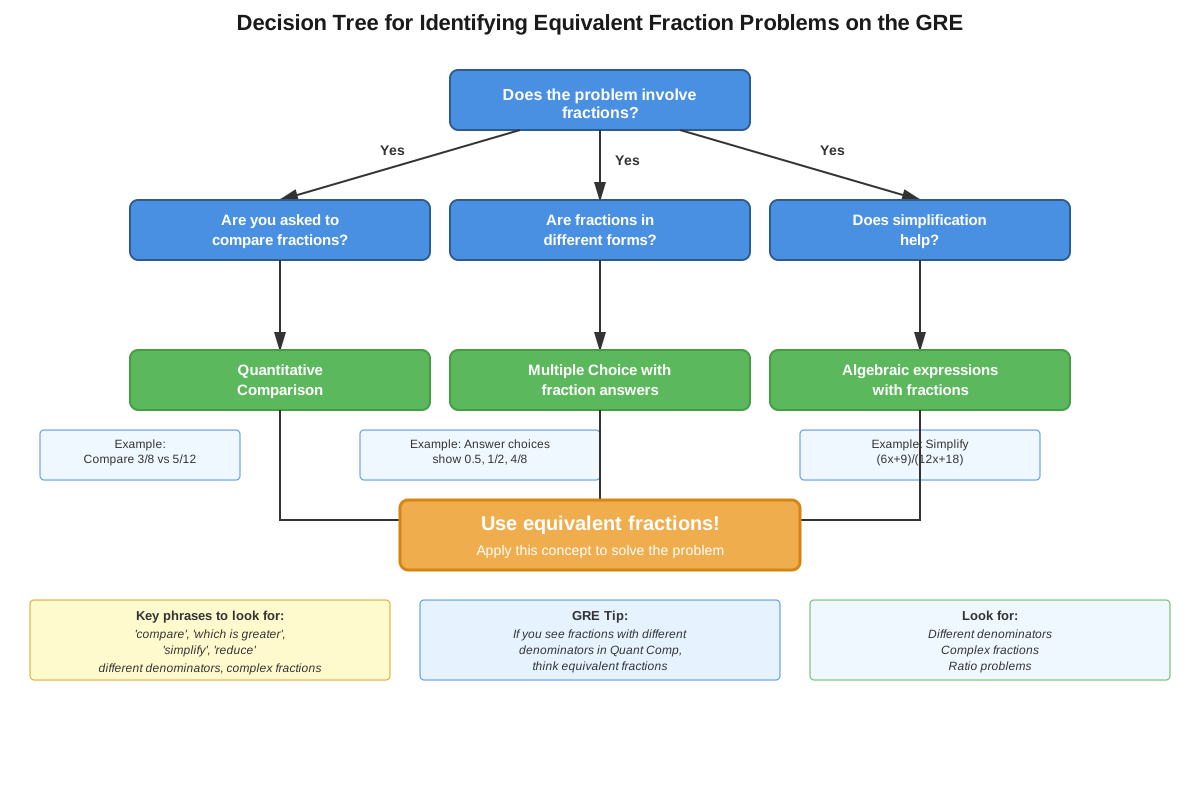
When approaching GRE questions involving equivalent fractions, begin by identifying trigger phrases that signal this concept: "express in lowest terms," "which of the following equals," "simplify," "what fraction is equivalent to," or comparison questions with fractions having different denominators. These phrases indicate that recognizing or generating equivalent forms will be central to the solution.
Time-saving approach: Before performing calculations, scan answer choices to determine their format. If answers are in lowest terms, simplify your work as you go. If answers have a common denominator, convert to that denominator immediately rather than finding the LCD. If answers are decimals or percentages, consider converting the given fractions rather than working in fractional form.
Process-of-elimination strategy: In multiple-choice questions, use cross-multiplication to quickly eliminate non-equivalent options. This often proves faster than converting all fractions to common denominators. For quantitative comparison questions, if both quantities are fractions, immediately convert to common denominators or cross-multiply to establish the relationship—don't waste time calculating decimal values unless absolutely necessary.
Common trap awareness: GRE test-makers frequently include answer choices that result from common errors: adding the same number to numerator and denominator, incorrectly simplifying, or confusing numerator and denominator positions. Always verify your final answer by checking that it maintains the correct value relationship.
Efficient calculation techniques: Memorize common fraction-decimal-percentage equivalents to avoid calculation time. When comparing fractions, use the "cross-comparison" shortcut: for a/b vs. c/d, calculate a×d and b×c mentally—whichever product is larger indicates the larger fraction. For complex fractions, simplify component parts before attempting to simplify the entire expression.
Time allocation: Simple equivalent fraction problems should take 30-45 seconds. Problems requiring multiple steps (finding LCD, converting, then performing operations) warrant 60-90 seconds. If a problem requires more time, mark it for review and move forward—these concepts often appear in multiple questions, so maintaining momentum matters more than perfecting any single problem.
Memory Techniques
Mnemonic for generating equivalent fractions: "Multiply Matches Maintains" (MMM) - Multiplying Matching numbers (same number for numerator and denominator) Maintains the fraction's value.
Visualization strategy: Picture fractions as pizza slices. If you have 1/2 of a pizza and cut each half into 3 pieces, you now have 3/6 of the pizza—the same amount, just in smaller pieces. This mental image reinforces that equivalent fractions represent the same quantity in different forms.
Acronym for simplification steps: "GCD" - Greatest Common factor, Divide both terms. This reminds you of the two-step process for reducing to lowest terms.
Finger technique for cross-multiplication: Visualize drawing an "X" between two fractions. Your fingers trace from top-left to bottom-right (first product) and bottom-left to top-right (second product). This physical memory aid helps recall the cross-multiplication pattern during test pressure.
Benchmark fraction memory palace: Associate common fractions with familiar objects: 1/2 = half-dollar coin, 1/4 = quarter, 1/3 = one slice of a three-slice pizza, 1/5 = one weekday of a work week, 1/8 = one slice of a typical pizza. These concrete associations make recall automatic.
Rhyme for equivalence principle: "Times the top, times the bottom too, keeps the fraction's value true." This simple rhyme reinforces the fundamental rule.
Summary
Equivalent fractions represent identical values expressed with different numerators and denominators, forming a cornerstone concept for GRE Quantitative Reasoning success. The fundamental principle—that multiplying or dividing both terms of a fraction by the same non-zero number preserves its value—enables conversion between forms, simplification to lowest terms, and comparison of fractions with different denominators. Mastery requires fluency in generating equivalent fractions through scaling, reducing fractions by identifying the GCF, verifying equivalence through cross-multiplication, and recognizing equivalent forms across fractions, decimals, and percentages. The GRE tests this concept both directly and as an embedded skill within more complex problems involving ratios, proportions, algebraic expressions, and quantitative comparisons. Success demands not just procedural knowledge but strategic thinking: recognizing when converting to equivalent forms provides the most efficient solution path, avoiding common errors like adding to both terms, and leveraging memorized benchmark equivalents to save calculation time. Students who internalize these principles and practice applying them across varied question formats gain significant advantages in both accuracy and speed.
Key Takeaways
- Equivalent fractions have identical values but different numerators and denominators, generated by multiplying or dividing both terms by the same non-zero number
- Cross-multiplication (a×d = b×c) provides the fastest method to verify whether a/b and c/d are equivalent
- Simplifying to lowest terms requires dividing both numerator and denominator by their GCF, producing the clearest equivalent form
- Converting fractions to common denominators (preferably the LCD) enables direct comparison and addition/subtraction operations
- Memorizing common fraction-decimal-percentage equivalents (1/2 = 0.5 = 50%, 1/4 = 0.25 = 25%, etc.) accelerates problem-solving
- The GRE frequently embeds equivalent fractions within algebraic expressions, word problems, and quantitative comparisons rather than testing it in isolation
- Strategic recognition of when to convert to equivalent forms—rather than performing lengthy calculations—distinguishes high-scoring test-takers
Related Topics
Fraction Operations (Addition, Subtraction, Multiplication, Division): Mastering equivalent fractions directly enables these operations, particularly addition and subtraction which require common denominators. Understanding equivalence makes fraction arithmetic more intuitive and efficient.
Ratios and Proportions: These concepts represent equivalent fractions in applied contexts. The techniques for solving proportions mirror those for finding equivalent fractions, making this a natural progression.
Percentages and Decimal Conversions: Percentages are equivalent fractions with denominator 100, and decimals represent another equivalent form. Fluency with equivalent fractions accelerates work with these related representations.
Rational Expressions and Algebraic Fractions: The principles of equivalent fractions extend to algebraic contexts, where variables replace numbers but the same rules apply for simplification and equivalence.
Greatest Common Factor (GCF) and Least Common Multiple (LCM): These number theory concepts provide the computational foundation for simplifying fractions and finding common denominators, making them essential companion topics.
Practice CTA
Now that you've mastered the core concepts of equivalent fractions, it's time to solidify your understanding through active practice. Attempt the practice questions designed specifically for this topic—they'll challenge you to apply these principles in varied GRE-style contexts and reveal any remaining gaps in your knowledge. Use the flashcards to drill the high-yield facts and common equivalents until they become automatic. Remember: understanding the concept is just the first step; achieving test-day fluency requires repeated application under timed conditions. Your investment in deliberate practice now will pay dividends in both speed and accuracy when you face these questions on the actual GRE. You've got this!
Sign up free to keep reading
Create a free AnvayaPrep account to finish this GRE guide on Equivalent fractions — plus flashcards and practice questions.