Overview
Fractions represent one of the most fundamental and frequently tested concepts in GRE Quantitative Reasoning. A fraction expresses a part-to-whole relationship using two integers: a numerator (top number) and a denominator (bottom number). While fractions may seem elementary, the GRE tests them in sophisticated ways that require both computational fluency and conceptual understanding. Questions involving fractions appear across multiple question types—from straightforward arithmetic problems to complex word problems, data interpretation questions, and quantitative comparisons.
Mastery of GRE fractions is non-negotiable for achieving a competitive Quantitative score. The test makers deliberately design problems that combine fractions with other arithmetic operations, algebraic expressions, ratios, percentages, and probability. Students who struggle with fraction manipulation often find themselves unable to solve seemingly unrelated problems because fractions serve as a foundational building block for more advanced mathematical concepts. The ability to quickly simplify, compare, add, subtract, multiply, and divide fractions—often without a calculator—separates high scorers from average performers.
Understanding fractions connects directly to multiple areas within Quantitative Reasoning. Fractions form the basis for understanding ratios and proportions, converting between fractions and decimals or percentages, working with rates, and solving algebraic equations. They appear in geometry problems involving area and perimeter, in statistics questions about probability, and in data interpretation questions requiring percentage calculations. The conceptual framework students develop while mastering fractions transfers directly to these related topics, making this one of the highest-yield study areas for GRE preparation.
Learning Objectives
- [ ] Identify when Fractions is being tested
- [ ] Explain the core rule or strategy behind Fractions
- [ ] Apply Fractions to GRE-style questions accurately
- [ ] Convert between improper fractions, mixed numbers, decimals, and percentages fluently
- [ ] Simplify complex fractions and perform operations with multiple fractions efficiently
- [ ] Compare fractions with different denominators using multiple strategies
- [ ] Solve word problems that embed fractions within real-world contexts
Prerequisites
- Basic arithmetic operations: Addition, subtraction, multiplication, and division form the foundation for all fraction operations
- Understanding of factors and multiples: Essential for finding common denominators and simplifying fractions to lowest terms
- Concept of division: Fractions are fundamentally division expressions, so understanding what division represents is crucial
- Number sense: Estimating whether answers are reasonable requires intuition about relative sizes of numbers
Why This Topic Matters
Fractions appear in approximately 15-20% of all GRE Quantitative Reasoning questions, either as the primary focus or as a necessary component of solving more complex problems. This frequency makes fractions one of the most tested arithmetic concepts on the exam. Beyond pure arithmetic questions, fractions emerge in algebra (solving equations with fractional coefficients), geometry (calculating fractional parts of shapes), data interpretation (understanding fractional relationships in charts), and word problems (dividing quantities, calculating portions).
In real-world applications, fractions represent essential quantitative reasoning skills used in finance (interest rates, investment returns), cooking (recipe scaling), construction (measurements), medicine (dosage calculations), and data analysis (proportional relationships). The GRE tests fractions because they assess fundamental numerical literacy that graduate programs expect from incoming students.
Common question formats include: quantitative comparison questions asking students to compare two fractional expressions; multiple-choice questions requiring fraction arithmetic; numeric entry questions where students must calculate exact fractional values; and word problems where fractions represent portions of groups, time periods, or quantities. The test frequently combines fractions with variables, requiring algebraic manipulation alongside arithmetic operations. Questions may also present fractions in disguised forms—as ratios, rates, or verbal descriptions—testing whether students can recognize fractional relationships in various contexts.
Core Concepts
Understanding Fraction Structure
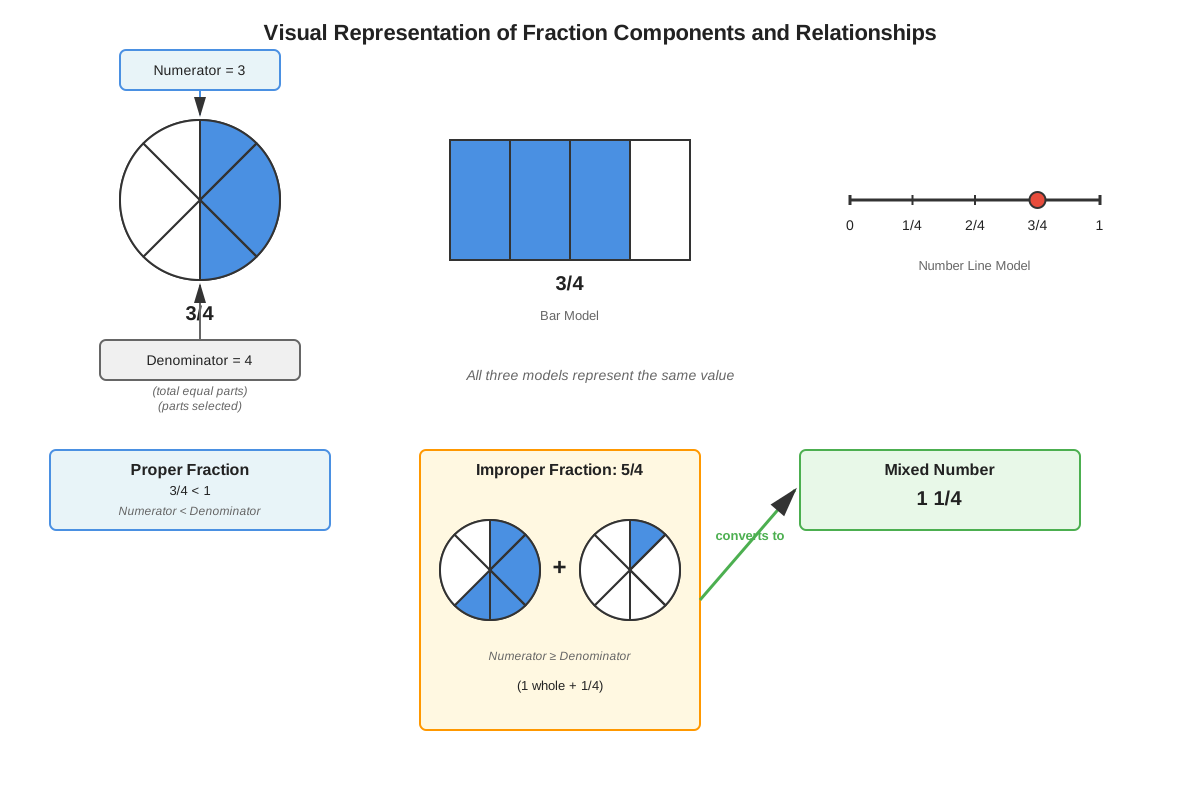
A fraction consists of two components: the numerator (the number above the fraction bar) and the denominator (the number below the fraction bar). The denominator indicates how many equal parts the whole is divided into, while the numerator indicates how many of those parts are being considered. For example, in the fraction 3/4, the whole is divided into 4 equal parts, and we're considering 3 of them.
Fractions can be classified into several categories:
- Proper fractions: Numerator is less than denominator (e.g., 2/5, 7/9)
- Improper fractions: Numerator is greater than or equal to denominator (e.g., 9/4, 5/5)
- Mixed numbers: A whole number combined with a proper fraction (e.g., 2 1/3, 5 3/8)
- Unit fractions: Fractions with a numerator of 1 (e.g., 1/2, 1/7)
Simplifying Fractions
Simplifying (or reducing) a fraction means expressing it in lowest terms by dividing both numerator and denominator by their greatest common factor (GCF). A fraction is in lowest terms when the numerator and denominator share no common factors other than 1.
Process for simplifying:
- Find the GCF of the numerator and denominator
- Divide both numerator and denominator by the GCF
- Verify that no common factors remain
Example: Simplify 24/36
- GCF of 24 and 36 is 12
- 24 ÷ 12 = 2 and 36 ÷ 12 = 3
- Simplified form: 2/3
Converting Between Forms
Converting improper fractions to mixed numbers:
- Divide the numerator by the denominator
- The quotient becomes the whole number
- The remainder becomes the new numerator
- Keep the same denominator
Example: Convert 17/5 to a mixed number
- 17 ÷ 5 = 3 remainder 2
- Result: 3 2/5
Converting mixed numbers to improper fractions:
- Multiply the whole number by the denominator
- Add the numerator to this product
- Place the result over the original denominator
Example: Convert 4 3/7 to an improper fraction
- (4 × 7) + 3 = 28 + 3 = 31
- Result: 31/7
Adding and Subtracting Fractions
To add or subtract fractions, they must have a common denominator. The least common denominator (LCD) is the smallest number that is a multiple of all denominators involved.
Steps for addition/subtraction:
- Find the LCD of all denominators
- Convert each fraction to an equivalent fraction with the LCD
- Add or subtract the numerators
- Keep the common denominator
- Simplify if possible
Example: 2/3 + 5/6
- LCD of 3 and 6 is 6
- 2/3 = 4/6
- 4/6 + 5/6 = 9/6 = 3/2 or 1 1/2
For mixed numbers, students can either convert to improper fractions first or add/subtract the whole numbers and fractions separately.
Multiplying Fractions
Multiplying fractions is more straightforward than addition or subtraction because no common denominator is needed.
Steps for multiplication:
- Multiply the numerators together
- Multiply the denominators together
- Simplify the result
Example: 3/4 × 2/5 = (3 × 2)/(4 × 5) = 6/20 = 3/10
Cross-canceling is an efficient technique that simplifies before multiplying:
- Cancel common factors between any numerator and any denominator before multiplying
- This reduces the size of numbers and minimizes simplification at the end
Example: 4/9 × 3/8
- Cancel 4 and 8 (both divisible by 4): 1/9 × 3/2
- Cancel 3 and 9 (both divisible by 3): 1/3 × 1/2
- Result: 1/6
Dividing Fractions
Division of fractions uses the reciprocal (or multiplicative inverse) of the divisor. The reciprocal of a fraction is obtained by swapping the numerator and denominator.
Steps for division:
- Keep the first fraction (dividend) unchanged
- Change division to multiplication
- Replace the second fraction (divisor) with its reciprocal
- Multiply as usual
Example: 2/3 ÷ 4/5
- Keep 2/3, change to multiplication, flip 4/5 to 5/4
- 2/3 × 5/4 = 10/12 = 5/6
Comparing Fractions
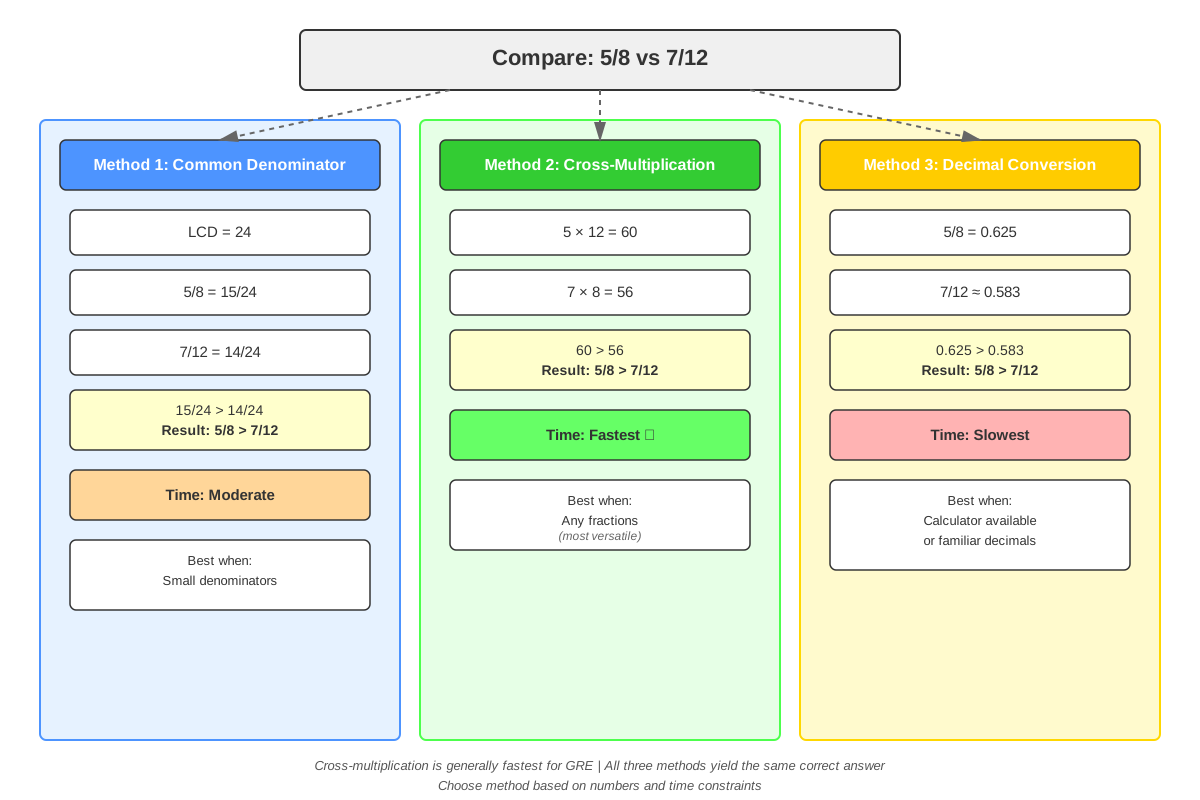
The GRE frequently asks students to compare fractions, especially in quantitative comparison questions. Several strategies exist:
| Strategy | When to Use | Method |
|---|---|---|
| Common denominator | Small denominators | Convert both fractions to same denominator and compare numerators |
| Cross-multiplication | Two fractions only | Multiply each numerator by the opposite denominator |
| Decimal conversion | Calculator available | Convert to decimals and compare |
| Benchmark comparison | Quick estimation needed | Compare both to 1/2 or another benchmark |
Example: Which is larger, 5/8 or 7/11?
- Cross-multiply: 5 × 11 = 55 and 7 × 8 = 56
- Since 56 > 55, we have 7/11 > 5/8
Complex Fractions
A complex fraction contains a fraction in the numerator, denominator, or both. To simplify complex fractions:
Method 1: Multiply both numerator and denominator by the LCD of all fractions involved
Method 2: Treat the fraction bar as division and use the division rule
Example: Simplify (2/3)/(5/6)
- Method 2: 2/3 ÷ 5/6 = 2/3 × 6/5 = 12/15 = 4/5
Quick check — test yourself on Fractions so far.
Try Flashcards →Concept Relationships
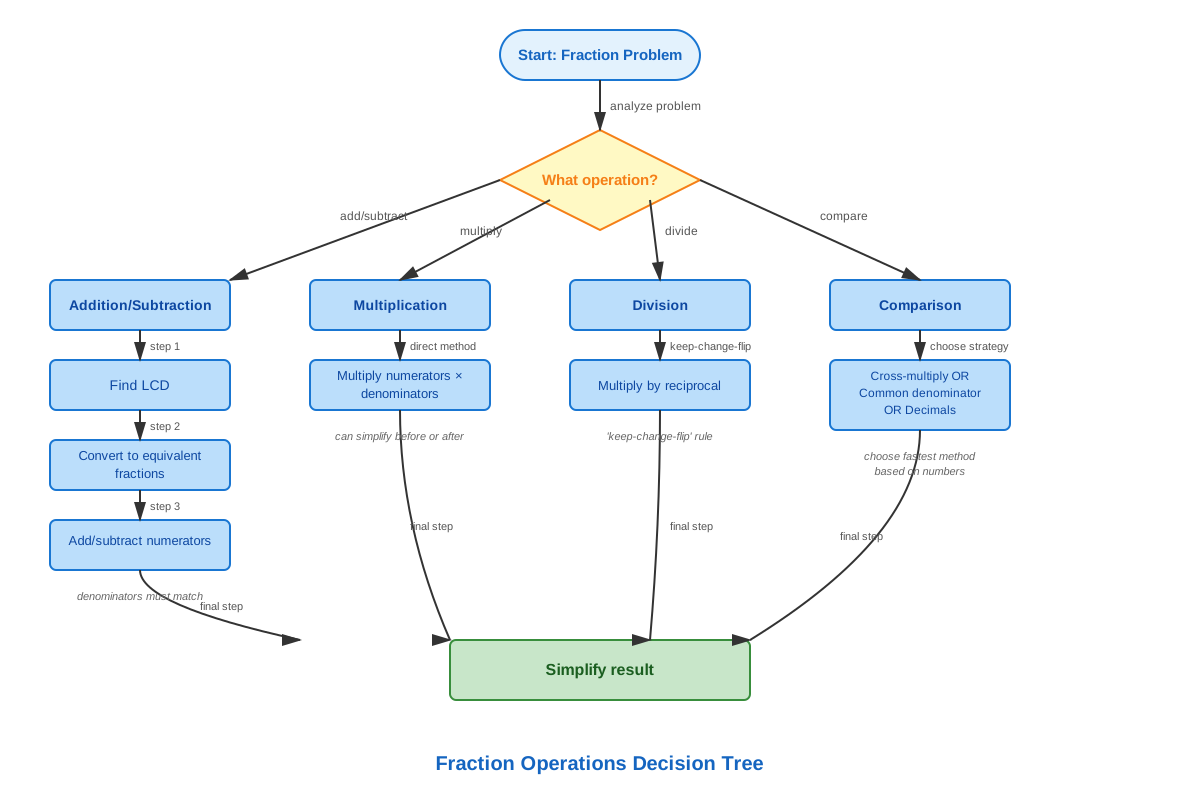
The concepts within fractions build hierarchically. Understanding fraction structure → enables simplification → which facilitates all operations. Addition and subtraction require finding common denominators, a skill that depends on understanding multiples and factors. Multiplication and division are interconnected through the reciprocal relationship, where division becomes multiplication by the reciprocal.
Fractions connect backward to prerequisite topics: factors and multiples are essential for finding common denominators and simplifying; division understanding clarifies what fractions represent; basic arithmetic operations extend to fractional contexts. Fractions connect forward to numerous advanced topics: ratios are essentially fractions comparing two quantities; percentages are fractions with denominator 100; probability expresses likelihood as a fraction; rates combine fractions with units; algebraic equations often involve fractional coefficients; and geometric calculations frequently require fractional computations.
The relationship map: Basic arithmetic → Factors/multiples → Fraction structure → Simplification → Operations (addition/subtraction require LCD; multiplication/division use reciprocals) → Complex fractions → Applications in ratios, percentages, probability, algebra, and geometry.
High-Yield Facts
⭐ To add or subtract fractions, they must have a common denominator; to multiply or divide, they do not
⭐ When dividing fractions, multiply by the reciprocal of the divisor (flip the second fraction and multiply)
⭐ A fraction is in lowest terms when the GCF of numerator and denominator is 1
⭐ Cross-multiplication provides a quick method to compare two fractions: if a/b vs c/d, compare a×d with b×c
⭐ Multiplying a number by a proper fraction makes it smaller; multiplying by an improper fraction makes it larger
- The reciprocal of a/b is b/a; the product of a number and its reciprocal always equals 1
- When converting mixed numbers to improper fractions: (whole × denominator) + numerator, all over the original denominator
- The LCD is the least common multiple (LCM) of all denominators involved
- Simplifying before multiplying (cross-canceling) reduces calculation errors and saves time
- Any integer can be expressed as a fraction with denominator 1 (e.g., 5 = 5/1)
Common Misconceptions
Misconception: When adding fractions, add both numerators and denominators (e.g., 1/2 + 1/3 = 2/5)
Correction: Only add numerators when fractions have a common denominator. First find the LCD, convert both fractions, then add numerators only: 1/2 + 1/3 = 3/6 + 2/6 = 5/6
Misconception: To divide fractions, flip both fractions
Correction: Only flip the second fraction (the divisor). The first fraction remains unchanged. For a/b ÷ c/d, calculate a/b × d/c
Misconception: A larger denominator always means a larger fraction
Correction: For fractions with the same numerator, a larger denominator actually means a smaller fraction. 1/8 < 1/4 because dividing into more pieces creates smaller pieces
Misconception: Simplifying changes the value of a fraction
Correction: Simplifying creates an equivalent fraction with the same value. 4/6 and 2/3 represent exactly the same amount; simplifying just expresses it more efficiently
Misconception: Mixed numbers are always easier to work with than improper fractions
Correction: For multiplication and division, improper fractions are typically easier. Convert mixed numbers to improper fractions before multiplying or dividing to avoid errors
Misconception: The reciprocal of a fraction is always larger than the original
Correction: The reciprocal of a proper fraction is larger (e.g., reciprocal of 1/3 is 3/1 = 3), but the reciprocal of an improper fraction is smaller (e.g., reciprocal of 5/2 is 2/5)
Worked Examples
Example 1: Multi-Step Fraction Arithmetic
Problem: Calculate: (2/3 + 3/4) ÷ (5/6 - 1/2)
Solution:
Step 1: Solve the addition in the first parentheses
- Find LCD of 3 and 4: LCD = 12
- Convert: 2/3 = 8/12 and 3/4 = 9/12
- Add: 8/12 + 9/12 = 17/12
Step 2: Solve the subtraction in the second parentheses
- Find LCD of 6 and 2: LCD = 6
- Convert: 5/6 = 5/6 and 1/2 = 3/6
- Subtract: 5/6 - 3/6 = 2/6 = 1/3
Step 3: Divide the results
- 17/12 ÷ 1/3
- Multiply by reciprocal: 17/12 × 3/1
- Calculate: (17 × 3)/(12 × 1) = 51/12
- Simplify: 51/12 = 17/4 or 4 1/4
Connection to learning objectives: This problem requires applying multiple fraction operations accurately, demonstrating mastery of addition, subtraction, division, and simplification—all core strategies for GRE fractions.
Example 2: Word Problem with Fractions
Problem: Sarah completed 2/5 of a project on Monday and 1/3 of the project on Tuesday. If the project requires 30 hours total, how many hours does she still need to work?
Solution:
Step 1: Find the total fraction completed
- Add 2/5 + 1/3
- LCD of 5 and 3 is 15
- 2/5 = 6/15 and 1/3 = 5/15
- Total completed: 6/15 + 5/15 = 11/15
Step 2: Find the fraction remaining
- Whole project = 1 = 15/15
- Remaining: 15/15 - 11/15 = 4/15
Step 3: Calculate hours remaining
- 4/15 of 30 hours
- (4/15) × 30 = (4 × 30)/15 = 120/15 = 8 hours
Connection to learning objectives: This demonstrates identifying when fractions are being tested in word problems, applying the core strategy of finding common denominators, and accurately solving a multi-step GRE-style question involving fractions of quantities.
Exam Strategy
When approaching GRE fractions questions, begin by identifying what operation is required. Look for trigger words: "sum" or "total" suggest addition; "difference" or "remaining" suggest subtraction; "of" typically indicates multiplication; "per" or "divided by" indicate division. In quantitative comparison questions, avoid calculating exact values when possible—use estimation, benchmark comparisons, or cross-multiplication to determine relationships quickly.
Key trigger phrases to recognize:
- "What fraction of..." → Set up a part/whole fraction
- "How many times greater..." → Division problem
- "Combined" or "altogether" → Addition
- "Reduced by" or "less than" → Subtraction
- Fraction × "of" × number → Multiplication
Process-of-elimination strategies:
- Eliminate answers that are unreasonable in size (e.g., if adding two proper fractions, the sum cannot exceed 2)
- Check whether the answer should be proper or improper based on the operation
- For multiplication, the result should be smaller than both factors if both are proper fractions
- For division by a proper fraction, the result should be larger than the dividend
Time management: Simple fraction operations should take 30-45 seconds. Complex multi-step problems may require 90-120 seconds. If a problem involves extensive calculation, look for shortcuts: cross-canceling before multiplying, estimating rather than calculating exact values, or converting to decimals if that's faster for you. Don't spend more than 2 minutes on any single question—mark it for review and move forward.
Always simplify fractions in your final answer unless the question specifically requests otherwise. The GRE answer choices are typically in simplified form, so an unsimplified answer may not match any option, signaling a calculation error.
Memory Techniques
KCF Rule for Division: "Keep, Change, Flip"
- Keep the first fraction
- Change division to multiplication
- Flip the second fraction (use its reciprocal)
LCD Mnemonic: "Little Cats Dance" reminds you that LCD = Least Common Denominator, and you need it for addition and subtraction (not multiplication/division)
Visualization for comparing fractions: Picture pizza slices. 3/4 of a pizza is more than 2/3 because taking 3 out of 4 equal pieces leaves less remaining than taking 2 out of 3 equal pieces.
MADSPM for operations:
- Multiply: Straight across (numerators together, denominators together)
- Add: Need common denominator
- Divide: Flip and multiply
- Subtract: Need common denominator
- Proper fraction: Numerator < denominator
- Mixed number: Whole number + proper fraction
Reciprocal reminder: "Flip it to divide it" — whenever you see division with fractions, immediately think about flipping the divisor.
Summary
Fractions represent part-to-whole relationships and constitute a foundational concept tested extensively throughout GRE Quantitative Reasoning. Mastery requires fluency in multiple skills: simplifying fractions to lowest terms by dividing by the GCF; converting between improper fractions, mixed numbers, and decimals; adding and subtracting fractions by finding common denominators; multiplying fractions straight across while using cross-canceling for efficiency; and dividing fractions by multiplying by the reciprocal. The GRE tests fractions both directly through arithmetic problems and indirectly through applications in ratios, percentages, algebra, geometry, and word problems. Success requires recognizing when fractions are being tested, selecting the appropriate strategy for each operation, and executing calculations accurately under time pressure. Students must develop both computational fluency and conceptual understanding to handle the sophisticated ways the GRE embeds fractions within complex, multi-step problems.
Key Takeaways
- Addition and subtraction require a common denominator; multiplication and division do not
- To divide fractions, multiply by the reciprocal of the divisor (Keep-Change-Flip)
- Simplify fractions by dividing numerator and denominator by their GCF
- Cross-multiplication provides the fastest method to compare two fractions
- Convert mixed numbers to improper fractions before multiplying or dividing
- Multiplying by a proper fraction decreases value; multiplying by an improper fraction increases value
- Fractions appear in approximately 15-20% of GRE Quantitative questions, making them high-yield for score improvement
Related Topics
Ratios and Proportions: Ratios are essentially fractions comparing two quantities. Mastering fractions enables quick ratio simplification and proportion solving, which appear frequently in GRE word problems and data interpretation questions.
Percentages: Percentages are fractions with denominator 100. Converting between fractions, decimals, and percentages is essential for numerous GRE questions, particularly in data interpretation and word problems.
Decimals: Understanding the relationship between fractions and decimals allows flexible problem-solving approaches. Some fraction problems are faster to solve by converting to decimals.
Algebraic Equations with Fractions: Many GRE algebra questions involve equations with fractional coefficients. Fraction fluency enables quick equation solving by multiplying through by the LCD.
Probability: Probability is expressed as a fraction (favorable outcomes/total outcomes). Fraction operations are essential for calculating compound probabilities and conditional probabilities.
Practice CTA
Now that you've mastered the core concepts, strategies, and common pitfalls for GRE fractions, it's time to solidify your understanding through active practice. Attempt the practice questions to apply these concepts in realistic GRE scenarios, and use the flashcards to reinforce key facts and procedures until they become automatic. Remember: fraction fluency is built through repeated, deliberate practice. The time you invest now in mastering fractions will pay dividends across multiple question types throughout the Quantitative Reasoning section. You've got this!
Sign up free to keep reading
Create a free AnvayaPrep account to finish this GRE guide on Fractions — plus flashcards and practice questions.