Overview
Adding fractions is a fundamental arithmetic operation that appears frequently throughout the GRE Quantitative Reasoning section. While many test-takers may consider fraction addition a basic skill from elementary mathematics, the GRE tests this concept in sophisticated ways that require both computational accuracy and conceptual understanding. Questions involving gre adding fractions often appear embedded within word problems, data interpretation scenarios, algebraic expressions, and geometry calculations. Mastery of this topic is non-negotiable for achieving a competitive score, as fraction operations form the foundation for more complex mathematical reasoning tested on the exam.
The ability to add fractions efficiently connects directly to success across multiple GRE question types. Test-makers frequently design problems where fraction addition is just one step in a multi-part solution, testing whether students can maintain accuracy under time pressure while managing denominators, simplifying results, and converting between mixed numbers and improper fractions. Beyond standalone arithmetic questions, fraction addition appears in ratio problems, probability calculations, rate problems, and algebraic manipulation—making it one of the most versatile skills in the Quantitative Reasoning arsenal.
Understanding fraction addition also builds critical number sense that helps with estimation and answer elimination strategies. Students who can quickly recognize common fraction equivalents, benchmark values, and simplification opportunities gain significant time advantages on test day. This topic serves as a gateway to more advanced concepts including fraction multiplication and division, rational expressions, and proportional reasoning—all of which appear regularly on the GRE.
Learning Objectives
- [ ] Identify when adding fractions is being tested in GRE questions
- [ ] Explain the core rule or strategy behind adding fractions
- [ ] Apply adding fractions to GRE-style questions accurately
- [ ] Convert between mixed numbers and improper fractions to facilitate addition
- [ ] Find the least common denominator (LCD) efficiently for multiple fractions
- [ ] Simplify fraction sums to lowest terms and recognize equivalent forms
- [ ] Estimate fraction sums to verify reasonableness of answers and eliminate incorrect choices
Prerequisites
- Understanding of numerators and denominators: Essential for recognizing the structure of fractions and why denominators must match before addition
- Multiplication and division of whole numbers: Required for finding common denominators and simplifying results
- Prime factorization: Enables efficient calculation of least common denominators
- Equivalent fractions: Necessary for converting fractions to common denominators without changing their values
- Basic simplification: Needed to reduce final answers to lowest terms as typically required on the GRE
Why This Topic Matters
Adding fractions represents one of the most practical mathematical skills with applications spanning finance, cooking, construction, time management, and data analysis. In professional contexts, combining fractional quantities appears in budget allocation, project timeline calculations, statistical analysis, and resource distribution. The ability to work fluently with fractions demonstrates quantitative literacy that extends far beyond test-taking.
On the GRE specifically, fraction addition appears in approximately 15-20% of Quantitative Reasoning questions either directly or as a component of multi-step problems. The exam tests this concept across all question formats: Quantitative Comparison, Multiple Choice (single and multiple answer), and Numeric Entry. Test-makers favor fraction problems because they efficiently assess multiple skills simultaneously—computational accuracy, conceptual understanding, and strategic thinking.
Common GRE manifestations include: word problems requiring combination of fractional parts (e.g., "If Sarah completes 2/5 of a project on Monday and 1/3 on Tuesday, what fraction remains?"); data interpretation questions with fractional proportions; algebraic equations containing fraction terms; geometry problems involving fractional dimensions or area calculations; and probability scenarios requiring addition of fractional probabilities. The topic also appears frequently in Quantitative Comparison questions where students must determine relationships between fraction sums without necessarily calculating exact values—rewarding strategic estimation over brute-force computation.
Core Concepts
The Fundamental Rule of Adding Fractions
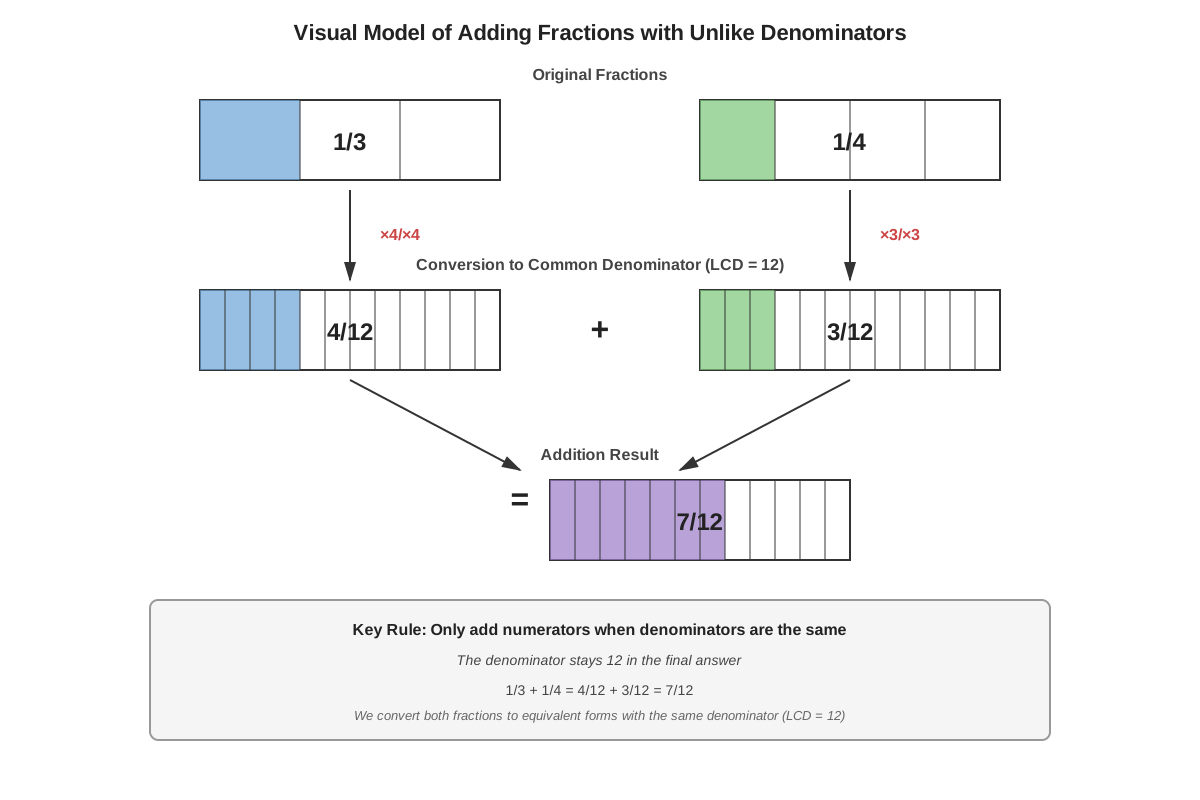
The core principle of adding fractions states that fractions can only be added directly when they share a common denominator. This requirement stems from the mathematical meaning of fractions: the denominator indicates the size of the parts being counted, while the numerator indicates how many such parts exist. Adding fractions with different denominators would be analogous to adding apples and oranges—the units must match first.
When fractions share a common denominator, addition becomes straightforward:
a/d + b/d = (a + b)/dThe denominators remain unchanged while the numerators combine. For example: 3/7 + 2/7 = 5/7. The denominator (7) tells us we're working with sevenths, and we simply count the total number of sevenths (3 + 2 = 5).
Finding Common Denominators
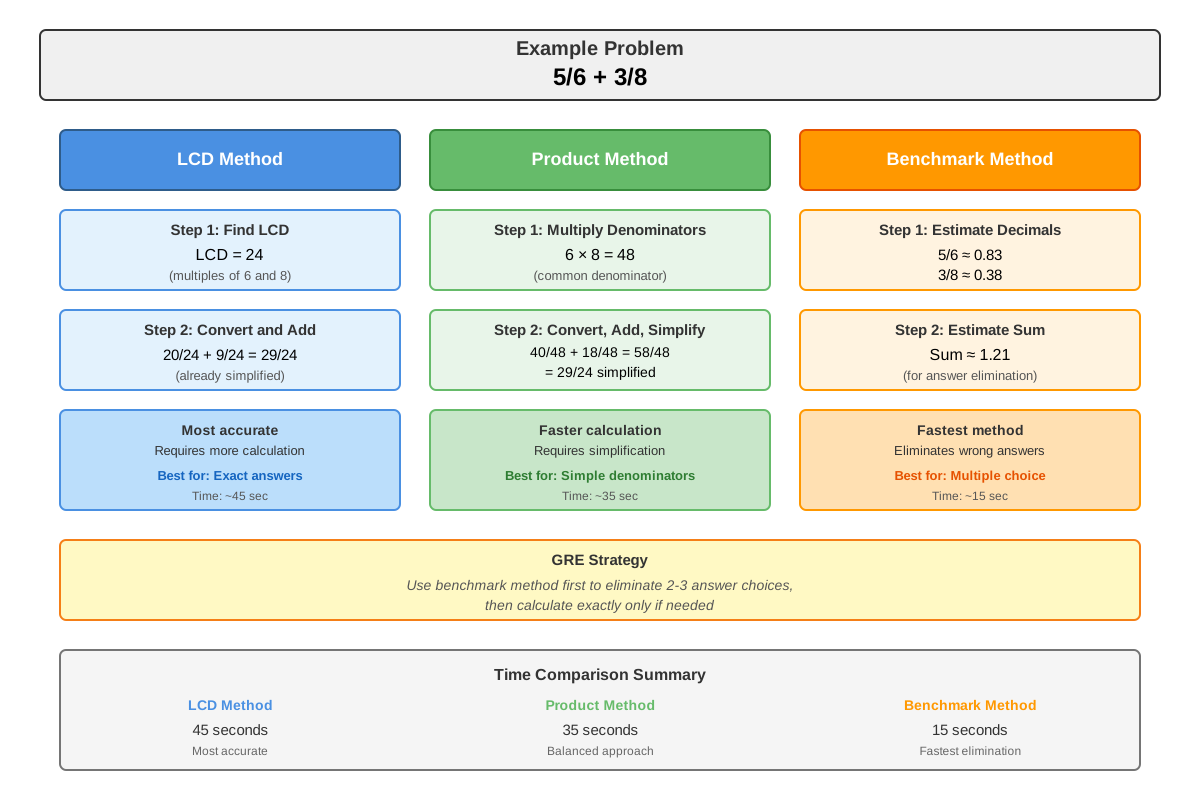
When fractions have different denominators, they must first be converted to equivalent fractions with a common denominator. While any common multiple of the denominators will work, using the least common denominator (LCD) minimizes computational complexity and reduces the need for simplification afterward.
Method 1: Listing Multiples
For simple denominators, list multiples of each until finding the smallest common value:
- To add 1/4 + 1/6: Multiples of 4: {4, 8, 12, 16...}; Multiples of 6: {6, 12, 18...}
- LCD = 12
Method 2: Prime Factorization
For larger or multiple denominators, use prime factorization:
- To add 1/12 + 1/18: 12 = 2² × 3; 18 = 2 × 3²
- LCD = 2² × 3² = 36 (take highest power of each prime factor)
Method 3: Product Method
When denominators share no common factors (are coprime), their product is the LCD:
- To add 2/5 + 3/7: Since 5 and 7 are coprime, LCD = 5 × 7 = 35
Converting to Common Denominators
Once the LCD is identified, convert each fraction by multiplying both numerator and denominator by the appropriate factor:
1/4 + 1/6 (LCD = 12)
1/4 = (1 × 3)/(4 × 3) = 3/12
1/6 = (1 × 2)/(6 × 2) = 2/12
3/12 + 2/12 = 5/12
The multiplication factor for each fraction equals LCD ÷ original denominator. This process creates equivalent fractions that represent the same values but with matching denominators.
Adding Mixed Numbers
Mixed numbers (whole numbers combined with fractions, like 2 1/3) can be added using two approaches:
Approach 1: Add Components Separately
Add whole numbers together, add fractions together, then combine:
- 2 1/3 + 1 1/4 = (2 + 1) + (1/3 + 1/4) = 3 + (4/12 + 3/12) = 3 + 7/12 = 3 7/12
Approach 2: Convert to Improper Fractions
Convert mixed numbers to improper fractions, add, then convert back if needed:
- 2 1/3 = 7/3; 1 1/4 = 5/4
- 7/3 + 5/4 = 28/12 + 15/12 = 43/12 = 3 7/12
The second approach often proves more reliable for complex problems as it eliminates the need to track multiple components separately.
Simplifying Results
After adding fractions, always check whether the result can be simplified by dividing both numerator and denominator by their greatest common factor (GCF):
- 6/8 + 3/8 = 9/8 (already in lowest terms)
- 2/6 + 1/6 = 3/6 = 1/2 (simplified by dividing by GCF of 3)
GRE answer choices typically appear in simplified form, making this step essential for matching your result to the correct option.
Adding Multiple Fractions
When adding three or more fractions, find the LCD for all denominators simultaneously:
1/2 + 1/3 + 1/4
LCD = 12
6/12 + 4/12 + 3/12 = 13/12 = 1 1/12
Attempting to add fractions sequentially (first two, then adding the third) often requires finding multiple common denominators and increases computational complexity.
Special Cases and Shortcuts
| Situation | Strategy | Example |
|---|---|---|
| Adding to 1 | Recognize complementary fractions | 3/7 + 4/7 = 7/7 = 1 |
| One denominator divides another | Use larger as LCD | 1/3 + 1/6: LCD = 6 |
| Adding fraction to whole number | Express whole as fraction with denominator 1 | 5 + 2/3 = 15/3 + 2/3 = 17/3 |
| Denominators are powers of same number | Use highest power as LCD | 1/4 + 1/8: LCD = 8 |
Concept Relationships
The process of adding fractions builds hierarchically on several interconnected concepts. Equivalent fractions serve as the foundation, enabling the conversion to common denominators without changing values. This conversion process requires multiplication of fractions (multiplying numerator and denominator by the same value) and relies on understanding the multiplicative identity property (multiplying by n/n = 1 doesn't change value).
Finding the least common denominator connects directly to factors and multiples, particularly the concepts of least common multiple (LCM) and greatest common factor (GCF). The LCD is precisely the LCM of the denominators. After addition, simplification requires finding the GCF of numerator and denominator—demonstrating how addition and factorization concepts interweave.
Mixed numbers and improper fractions represent two forms of the same values, and fluency in converting between them (using division and multiplication) enables flexible problem-solving. This conversion skill connects to division with remainders and reinforces understanding of fractions as division expressions.
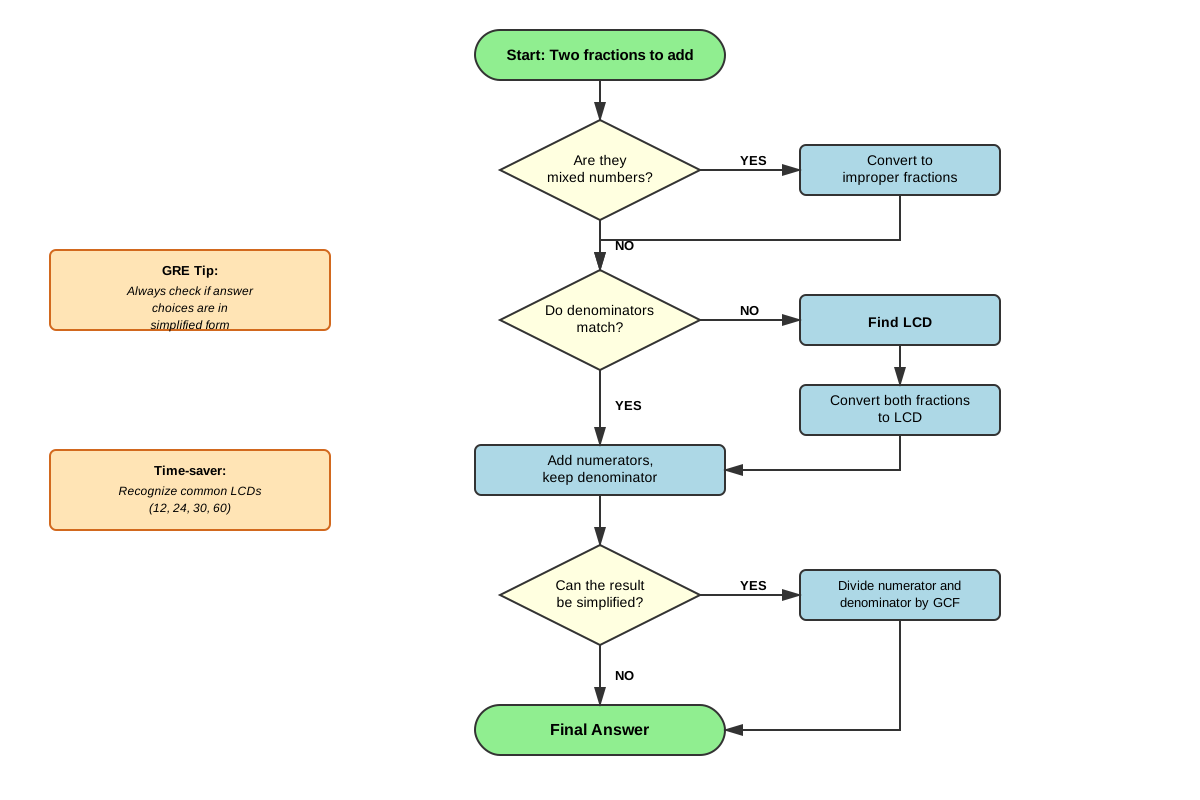
The relationship map flows as follows:
Factors/Multiples → Finding LCD → Equivalent Fractions → Converting to Common Denominator → Adding Numerators → Simplification using GCF → Final Answer
Additionally, fraction addition serves as prerequisite knowledge for subtracting fractions (identical process with subtraction instead of addition), adding algebraic fractions (same principles with variables), and solving equations containing fractions (often requiring addition to combine like terms).
Quick check — test yourself on Adding fractions so far.
Try Flashcards →High-Yield Facts
⭐ Fractions can only be added when they have the same denominator; the denominator represents the unit size that must match
⭐ When adding fractions with common denominators, add only the numerators and keep the denominator unchanged
⭐ The least common denominator (LCD) is the least common multiple (LCM) of all denominators involved
⭐ To convert a mixed number to an improper fraction: multiply the whole number by the denominator, add the numerator, and place over the original denominator
⭐ Always simplify final answers by dividing numerator and denominator by their greatest common factor (GCF)
- When denominators are coprime (share no common factors), their product is the LCD
- Adding a whole number to a fraction requires expressing the whole number as a fraction with the same denominator
- If one denominator divides evenly into another, the larger denominator is automatically the LCD
- The sum of fractions with the same denominator cannot have a denominator larger than the original (before simplification)
- Converting all mixed numbers to improper fractions before adding often reduces errors in multi-step problems
- When adding three or more fractions, find the LCD for all denominators at once rather than sequentially
- A fraction sum greater than 1 can be left as an improper fraction or converted to a mixed number depending on answer format requirements
- Prime factorization provides the most efficient method for finding LCD when dealing with larger denominators
- The numerator of a sum can never exceed the sum of the original numerators (before simplification)
- Estimation using benchmark fractions (1/4, 1/2, 3/4) helps verify reasonableness of calculated answers
Common Misconceptions
Misconception: When adding fractions, add both numerators and denominators (e.g., 1/2 + 1/3 = 2/5)
Correction: Only numerators are added when denominators are common. Denominators represent the unit size and must remain constant. The correct approach requires finding a common denominator first: 1/2 + 1/3 = 3/6 + 2/6 = 5/6.
Misconception: The least common denominator is always the product of the two denominators
Correction: The LCD is the least common multiple, which equals the product only when denominators share no common factors. For 1/4 + 1/6, the LCD is 12, not 24, because 4 and 6 share a common factor of 2.
Misconception: When adding mixed numbers, the fractional parts can be ignored if they're small
Correction: Every component must be included for accurate results. Ignoring 1/4 in the expression 3 1/4 + 2 1/2 would yield 5 instead of the correct answer 5 3/4, a significant error that would eliminate the correct answer choice.
Misconception: Fractions must always be converted to decimals before adding
Correction: While decimal conversion works, it often introduces rounding errors and is less efficient on the GRE. Fraction addition using common denominators maintains exact values and is typically faster for test purposes.
Misconception: The simplified form and unsimplified form are different answers
Correction: These represent the same value expressed differently. However, GRE answer choices appear in simplified form, so 6/8 and 3/4 are equivalent, but only 3/4 will match the answer options.
Misconception: When adding fractions to whole numbers, the whole number becomes the denominator
Correction: Whole numbers should be expressed as fractions with denominator 1, then converted to the common denominator. For 2 + 1/3: express as 2/1 + 1/3 = 6/3 + 1/3 = 7/3.
Misconception: Larger denominators always make fractions harder to add
Correction: When one denominator is a multiple of the other, addition is straightforward regardless of size. Adding 1/5 + 1/100 (LCD = 100) is simpler than adding 1/6 + 1/35 (LCD = 210) despite the smaller denominators in the latter.
Worked Examples
Example 1: Multi-Step Word Problem
Problem: A recipe calls for 2/3 cup of flour for the cake and 3/8 cup of flour for the frosting. If Maria wants to make 1 1/2 times the recipe, how many total cups of flour will she need?
Solution:
Step 1: Find total flour for single recipe
Add 2/3 + 3/8
- Find LCD: 3 and 8 are coprime, so LCD = 3 × 8 = 24
- Convert: 2/3 = 16/24 and 3/8 = 9/24
- Add: 16/24 + 9/24 = 25/24 cups
Step 2: Multiply by 1 1/2
- Convert 1 1/2 to improper fraction: 3/2
- Convert 25/24 × 3/2 = 75/48
- Simplify: Both divisible by 3: 75/48 = 25/16
Step 3: Convert to mixed number if needed
- 25 ÷ 16 = 1 remainder 9
- Answer: 25/16 or 1 9/16 cups
Connection to Learning Objectives: This problem requires identifying fraction addition within a multi-step context (Objective 1), applying the common denominator strategy (Objective 2), and accurately executing the computation (Objective 3). It also tests conversion between mixed and improper fractions (Objective 4).
Example 2: Quantitative Comparison
Problem:
Quantity A: 5/12 + 7/18 + 1/9
Quantity B: 1Solution:
Strategic Approach: Estimate before calculating
- 5/12 is slightly more than 1/3 (which would be 4/12)
- 7/18 is slightly less than 1/2 (which would be 9/18)
- 1/9 is slightly more than 1/10
Rough estimate: slightly more than 1/3 + slightly less than 1/2 + about 1/10 ≈ 0.9
This suggests Quantity A < 1, but let's verify with exact calculation.
Exact Calculation:
- Find LCD of 12, 18, and 9
- Prime factorization: 12 = 2² × 3; 18 = 2 × 3²; 9 = 3²
- LCD = 2² × 3² = 36
Convert each fraction:
- 5/12 = 15/36 (multiply by 3)
- 7/18 = 14/36 (multiply by 2)
- 1/9 = 4/36 (multiply by 4)
Add: 15/36 + 14/36 + 4/36 = 33/36 = 11/12
Since 11/12 < 12/12 = 1, Quantity A < Quantity B
Answer: Quantity B is greater
Connection to Learning Objectives: This demonstrates identifying fraction addition in Quantitative Comparison format (Objective 1), using estimation to guide strategy (Objective 7), finding LCD efficiently (Objective 5), and simplifying results (Objective 6).
Exam Strategy
Trigger Words: Watch for phrases like "combined," "total," "altogether," "sum of," "in all," and "how much more" (which often requires addition after subtraction). Questions asking for "what fraction of the whole" or "what part" frequently require adding fractional components.
Approach Framework:
- Identify the operation: Confirm that addition is required (not subtraction, multiplication, or division of fractions)
- Assess denominator relationships: Check if denominators are already common, if one divides another, or if they're coprime—this determines the most efficient LCD method
- Estimate first: For Quantitative Comparison and answer elimination, rough estimation using benchmark fractions (1/4, 1/2, 3/4) can eliminate options without full calculation
- Choose conversion strategy: Decide whether to convert mixed numbers to improper fractions or keep them separate based on complexity
- Verify simplification: Always check if your answer can be reduced, as GRE answers appear in lowest terms
Process of Elimination Tips:
- If adding two positive fractions both less than 1/2, the sum must be less than 1—eliminate any answer ≥ 1
- If adding fractions with small numerators and large denominators, the sum will be relatively small—eliminate large values
- The denominator of the simplified answer must be a factor of the LCD—eliminate answers with impossible denominators
- If one addend is close to 1 and another is positive, the sum must exceed 1—eliminate answers less than 1
Time Allocation:
For straightforward fraction addition (common denominators or simple LCD): 30-45 seconds
For mixed numbers or three+ fractions: 60-90 seconds
For multi-step word problems involving fraction addition: 2-2.5 minutes
If finding the LCD takes more than 20 seconds, consider whether estimation or answer choice back-solving might be faster.
Memory Techniques
LCD Mnemonic: "Lazy Cats Dream" → List, Compare, Decide
- List the multiples of each denominator
- Compare to find the smallest common value
- Decide on conversion factors
Addition Process Acronym: "FACES"
- Find the LCD
- Adjust fractions to common denominator
- Combine numerators
- Evaluate (simplify)
- Select answer format (improper vs. mixed)
Visualization Strategy: Picture fractions as pizza slices. Adding 1/4 + 1/2 means combining one slice from a 4-piece pizza with one slice from a 2-piece pizza. To combine them, you need to cut both pizzas into the same number of pieces (common denominator). The 4-piece pizza is already in smaller slices; cut the 2-piece pizza into 4 pieces, and now you have 1 slice + 2 slices = 3 slices out of 4 total, or 3/4.
Common Denominator Rhyme: "Different bottoms, cannot add / Make them same, then you'll be glad"
Mixed Number Conversion: "Multiply, Add, Place" (MAP)
- Multiply whole number by denominator
- Add the numerator
- Place result over original denominator
Summary
Adding fractions is a high-frequency GRE skill that requires both procedural fluency and conceptual understanding. The fundamental principle—that fractions must share a common denominator before their numerators can be combined—stems from the mathematical meaning of fractions as parts of a whole. Mastery involves efficiently finding the least common denominator through multiple methods (listing multiples, prime factorization, or recognizing coprime relationships), accurately converting fractions while maintaining equivalent values, and reliably simplifying results to match answer formats. Mixed numbers add complexity, requiring conversion to improper fractions or careful component-wise addition. Strategic test-takers leverage estimation to verify reasonableness and eliminate incorrect answers, recognize when one denominator divides another to simplify LCD calculations, and maintain accuracy under time pressure. Success with fraction addition enables progression to more complex rational number operations and appears as a component skill in algebra, geometry, data interpretation, and word problems throughout the Quantitative Reasoning section.
Key Takeaways
- Fractions require a common denominator before addition; only numerators combine while the denominator remains constant
- The least common denominator equals the least common multiple of all denominators and minimizes computational complexity
- Converting mixed numbers to improper fractions before adding reduces errors in multi-step problems
- Always simplify final answers by dividing numerator and denominator by their greatest common factor
- Estimation using benchmark fractions (1/4, 1/2, 3/4) provides a powerful strategy for Quantitative Comparison and answer elimination
- Prime factorization offers the most efficient method for finding LCD with larger or multiple denominators
- GRE fraction problems often embed addition within word problems, algebraic expressions, or data interpretation scenarios rather than testing the operation in isolation
Related Topics
Subtracting Fractions: Uses identical principles to addition (common denominators, LCD, simplification) but with subtraction of numerators; mastering addition makes subtraction straightforward.
Multiplying and Dividing Fractions: These operations follow different rules (multiply straight across; divide by multiplying by the reciprocal) but require the same simplification skills developed through addition practice.
Rational Expressions: Algebraic fractions with variables in numerators and/or denominators; adding these requires the same LCD process but with algebraic factoring to find common denominators.
Ratio and Proportion: Many ratio problems require adding fractional parts to find totals or combining proportions, directly applying fraction addition skills.
Probability: Calculating combined probabilities of mutually exclusive events requires adding fractional probabilities, making fraction addition essential for probability problems.
Rate Problems: Work rates, speed calculations, and combined rate problems frequently involve adding fractional rates (e.g., 1/3 job per hour + 1/4 job per hour).
Practice CTA
Now that you've mastered the concepts, strategies, and common pitfalls of adding fractions, it's time to solidify your skills through deliberate practice. Attempt the practice questions designed specifically for this topic, focusing on accuracy first, then building speed. Use the flashcards to reinforce the high-yield facts and procedures until they become automatic. Remember: fraction addition appears in approximately 15-20% of GRE Quantitative questions, making your investment in this foundational skill one of the highest-yield uses of your study time. Every fraction problem you solve correctly builds confidence and frees up mental energy for the more complex reasoning the GRE demands. You've got this!
Sign up free to keep reading
Create a free AnvayaPrep account to finish this GRE guide on Adding fractions — plus flashcards and practice questions.