Overview
Multiplying fractions is a fundamental arithmetic operation that appears frequently throughout the GRE Quantitative Reasoning section. This operation involves taking two or more fractional values and combining them through multiplication to produce a new fractional result. While the mechanical process of multiplying fractions is relatively straightforward—multiply numerators together and denominators together—the GRE tests this concept in sophisticated ways that require both computational accuracy and conceptual understanding. Students must recognize when fraction multiplication is required, execute the operation efficiently, and often combine it with simplification, comparison, or conversion techniques.
Understanding GRE multiplying fractions extends far beyond simple computational drills. The exam frequently embeds fraction multiplication within word problems, ratio questions, probability scenarios, and geometric calculations. Test-makers design questions that require students to multiply fractions with whole numbers, mixed numbers, and other fractions while working under time pressure. Additionally, the GRE often rewards students who can recognize opportunities to simplify before multiplying—a strategy that dramatically reduces calculation errors and saves precious testing time.
This topic serves as a cornerstone for more advanced Quantitative Reasoning concepts. Mastery of fraction multiplication directly supports understanding of ratios and proportions, percentage calculations, probability computations, and algebraic fraction manipulation. Students who develop fluency with multiplying fractions gain a significant advantage across multiple question types, as this skill appears in approximately 15-20% of GRE Quantitative questions either directly or as a component of multi-step problems. The ability to quickly and accurately multiply fractions often determines whether a student can complete the section within the allotted time while maintaining accuracy.
Learning Objectives
- [ ] Identify when Multiplying fractions is being tested
- [ ] Explain the core rule or strategy behind Multiplying fractions
- [ ] Apply Multiplying fractions to GRE-style questions accurately
- [ ] Simplify fractions before and after multiplication to minimize computational errors
- [ ] Convert between mixed numbers, improper fractions, and whole numbers when multiplying
- [ ] Recognize and apply cross-cancellation techniques to streamline calculations
- [ ] Solve multi-step word problems that require fraction multiplication as a component
Prerequisites
- Basic fraction concepts: Understanding numerators, denominators, and what fractions represent is essential for comprehending why the multiplication algorithm works
- Simplification and reducing fractions: The ability to find greatest common factors and reduce fractions ensures accurate final answers and enables pre-multiplication simplification
- Prime factorization: Recognizing prime factors allows for efficient cross-cancellation and simplification during multiplication
- Whole number multiplication: Since fraction multiplication builds on multiplying integers, fluency with basic multiplication facts is necessary
- Converting mixed numbers to improper fractions: Many GRE problems present mixed numbers that must be converted before multiplication can occur
Why This Topic Matters
Fraction multiplication appears throughout real-world applications, from cooking (scaling recipes by fractional amounts) to construction (calculating material quantities), from finance (computing fractional returns on investments) to science (determining concentrations in chemistry). The ability to multiply fractions efficiently enables professionals to make quick calculations without relying on calculators, a skill particularly valuable in time-sensitive decision-making contexts.
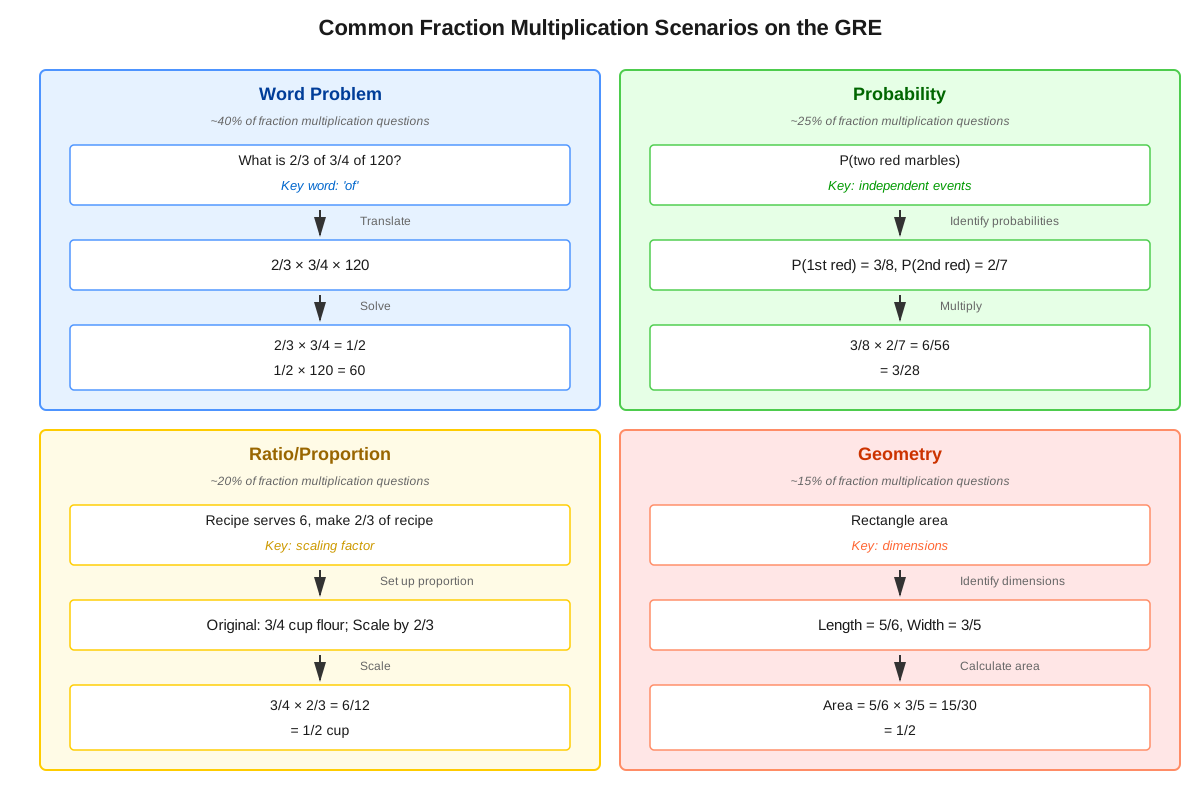
On the GRE specifically, fraction multiplication appears in approximately 15-20% of Quantitative Reasoning questions. The exam tests this skill through multiple question formats: direct computation problems in Quantitative Comparison questions, embedded calculations within word problems, probability questions requiring multiplication of fractional chances, and geometric problems involving fractional dimensions or scale factors. The GRE particularly favors questions that combine fraction multiplication with other operations, testing whether students can maintain accuracy through multi-step solutions.
Common exam presentations include: "What is 2/3 of 3/4 of 120?" (requiring recognition that "of" signals multiplication), probability scenarios like "If the probability of event A is 3/5 and the probability of event B is 2/7, what is the probability of both occurring?" (requiring multiplication of independent probabilities), and ratio problems such as "If a recipe calls for 2/3 cup of flour and you want to make 3/4 of the recipe, how much flour is needed?" The exam also frequently presents answer choices as fractions, requiring students to multiply and simplify to match the given format.
Core Concepts
The Fundamental Rule of Fraction Multiplication
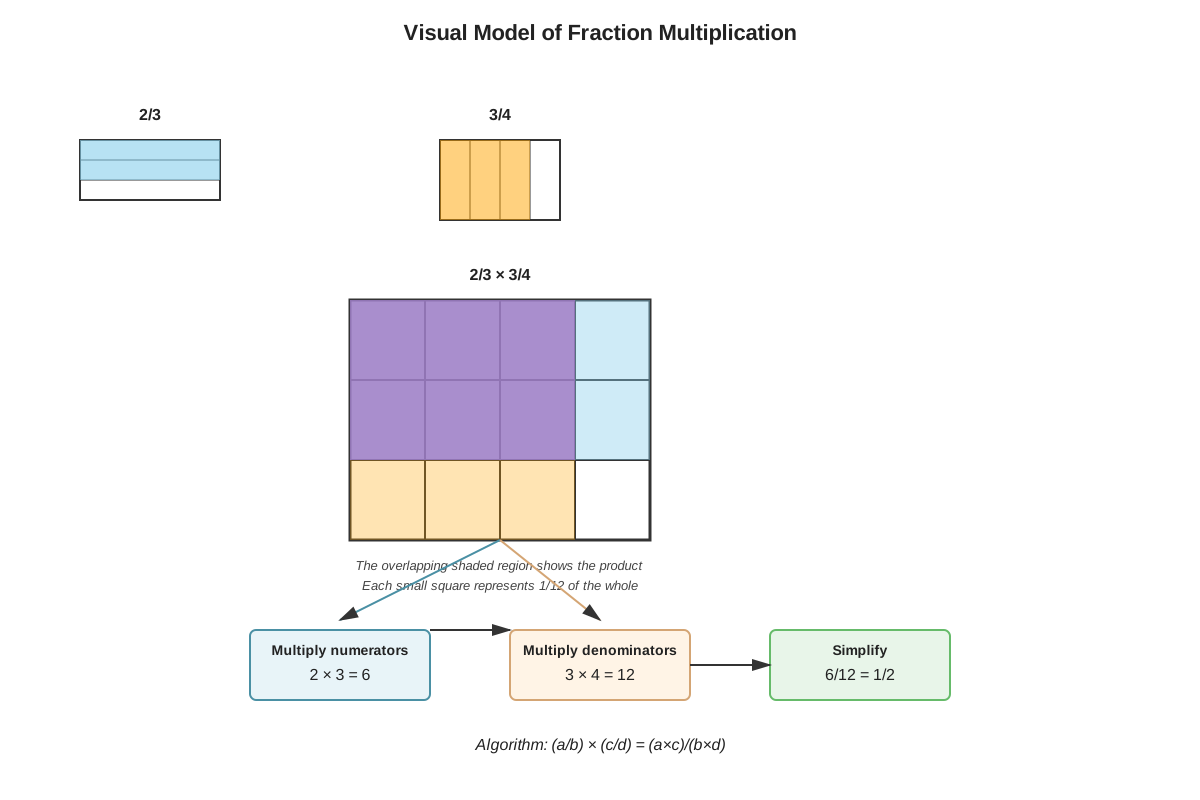
The core principle of multiplying fractions follows a straightforward algorithm: multiply the numerators together to get the new numerator, and multiply the denominators together to get the new denominator. Mathematically expressed:
a/b × c/d = (a × c)/(b × d)For example, 2/3 × 4/5 = (2 × 4)/(3 × 5) = 8/15. This rule applies universally to all fraction multiplication problems, regardless of complexity. The logic behind this rule stems from the definition of fractions as division operations: when multiplying (a ÷ b) by (c ÷ d), the result equals (a × c) ÷ (b × d).
Understanding why this algorithm works provides conceptual clarity. When multiplying 1/2 × 1/3, we're asking "what is one-half of one-third?" Visually, if we divide a whole into three equal parts and take one part (1/3), then divide that part in half, we end up with 1/6 of the original whole. The numerators multiply (1 × 1 = 1) and the denominators multiply (2 × 3 = 6), yielding 1/6.
Multiplying Fractions with Whole Numbers
When multiplying a fraction by a whole number, convert the whole number into a fraction by placing it over 1. For instance, 5 × 2/3 becomes 5/1 × 2/3 = (5 × 2)/(1 × 3) = 10/3. This conversion allows the standard multiplication algorithm to apply consistently. Alternatively, students can multiply the whole number directly by the numerator: 5 × 2/3 = (5 × 2)/3 = 10/3.
This concept frequently appears in GRE word problems where quantities are scaled by fractional amounts. For example: "A container holds 24 liters. If 3/4 of the container is filled, how many liters does it contain?" The solution requires computing 24 × 3/4 = (24 × 3)/4 = 72/4 = 18 liters.
Multiplying Mixed Numbers
Mixed numbers (combinations of whole numbers and fractions like 2 1/3) must be converted to improper fractions before multiplication. To convert a mixed number, multiply the whole number by the denominator, add the numerator, and place the result over the original denominator. For example, 2 1/3 = (2 × 3 + 1)/3 = 7/3.
When multiplying mixed numbers like 2 1/3 × 1 1/2, first convert both: 7/3 × 3/2 = 21/6 = 7/2 = 3 1/2. Attempting to multiply mixed numbers without conversion leads to errors and is a common trap on the GRE. The exam frequently presents problems with mixed numbers specifically to test whether students remember this conversion step.
Cross-Cancellation (Simplification Before Multiplying)
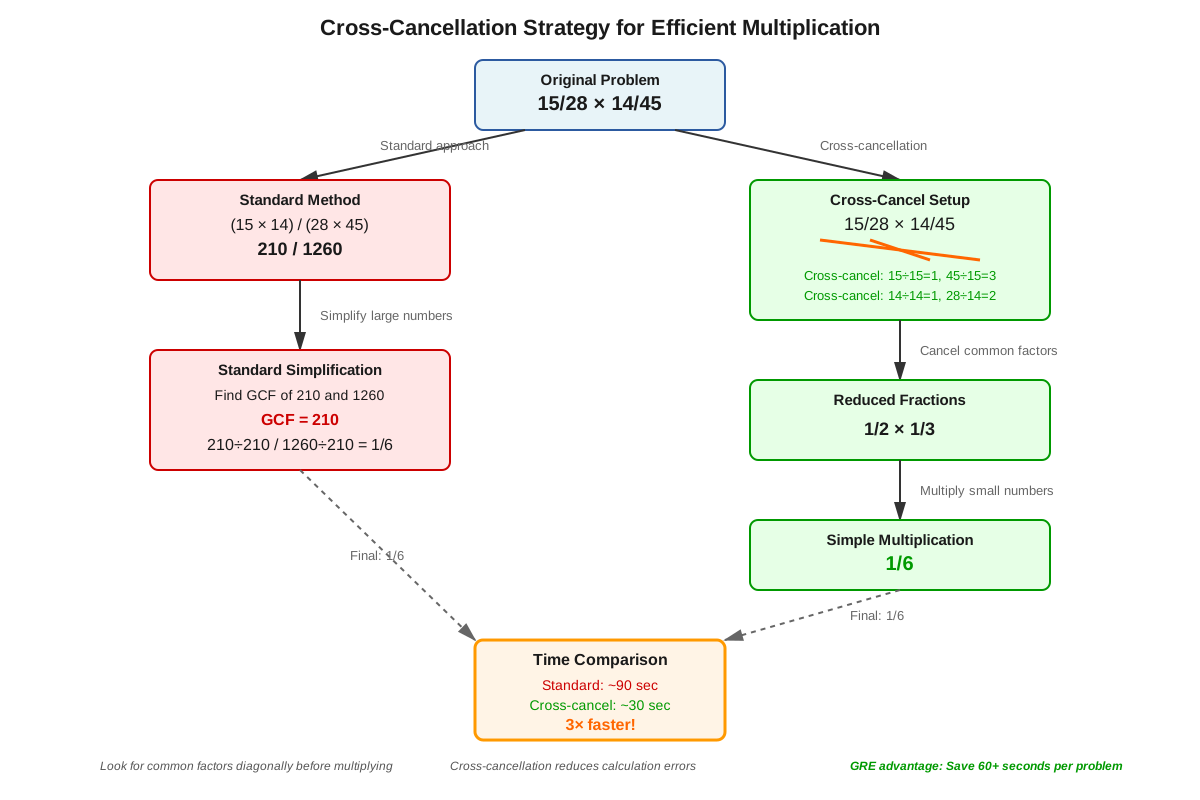
Cross-cancellation is a powerful technique that simplifies fractions before multiplication, reducing the size of numbers involved and minimizing calculation errors. When multiplying fractions, any numerator can be simplified with any denominator by dividing both by their greatest common factor.
For example, when computing 4/9 × 3/8:
- Notice that 4 (numerator) and 8 (denominator) share a factor of 4
- Notice that 3 (numerator) and 9 (denominator) share a factor of 3
- Simplify: (4÷4)/(9÷3) × (3÷3)/(8÷4) = 1/3 × 1/2 = 1/6
Without cross-cancellation, the calculation would be 4/9 × 3/8 = 12/72, requiring simplification of a larger fraction. Cross-cancellation is particularly valuable on the GRE where time efficiency matters significantly.
Multiplying Multiple Fractions
When multiplying three or more fractions, the same principle applies: multiply all numerators together and all denominators together. For example:
1/2 × 2/3 × 3/4 = (1 × 2 × 3)/(2 × 3 × 4) = 6/24 = 1/4However, cross-cancellation becomes even more valuable with multiple fractions. In the example above, notice that the 2 in the numerator cancels with the 2 in the denominator, and the 3 in the numerator cancels with the 3 in the denominator, leaving 1/4 directly without computing 6/24 first.
The Relationship Between Multiplication and "Of"
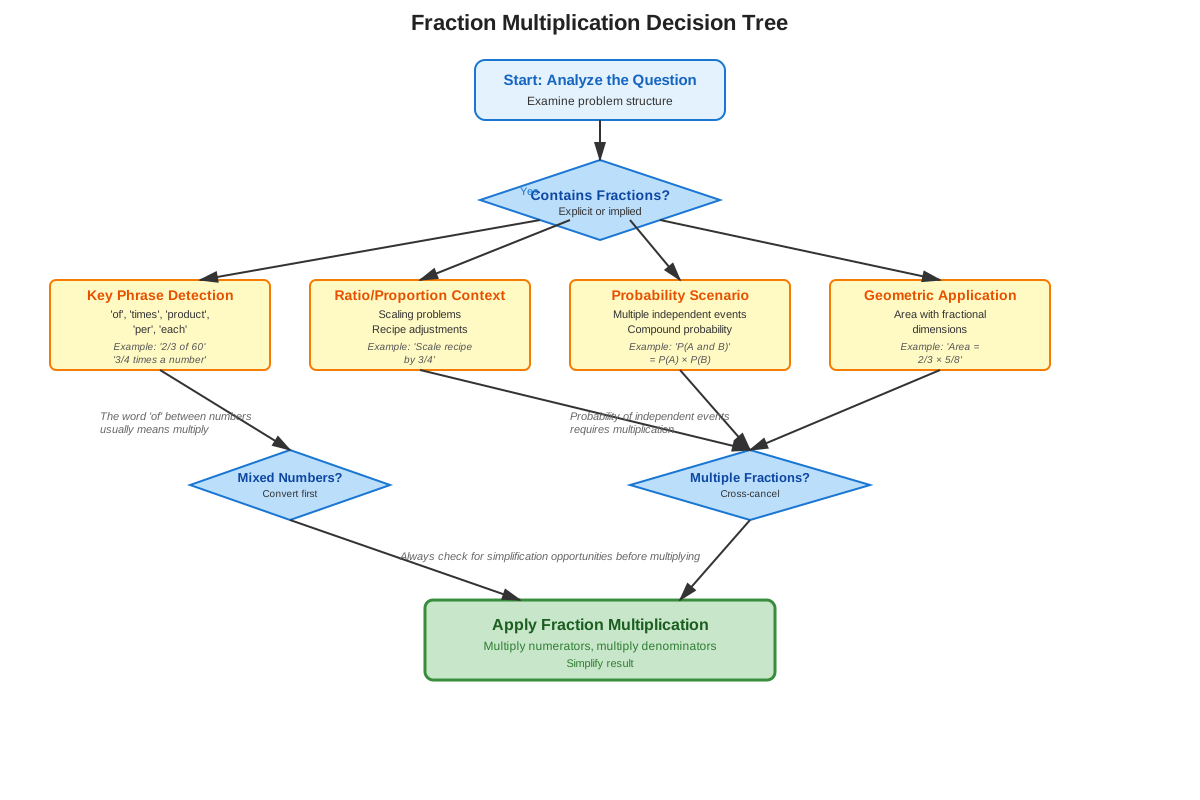
In word problems, the word "of" typically signals multiplication, especially when dealing with fractions. "What is 2/3 of 60?" translates to 2/3 × 60. "Find 3/4 of 1/2" means 3/4 × 1/2. Recognizing this linguistic cue is essential for translating GRE word problems into mathematical operations. The exam deliberately uses varied language to test whether students understand the conceptual meaning of fraction multiplication, not just the mechanical process.
Fraction Multiplication Properties
Several mathematical properties govern fraction multiplication:
| Property | Description | Example |
|---|---|---|
| Commutative | Order doesn't matter | 2/3 × 4/5 = 4/5 × 2/3 |
| Associative | Grouping doesn't matter | (1/2 × 2/3) × 3/4 = 1/2 × (2/3 × 3/4) |
| Identity | Multiplying by 1 yields the original | 3/5 × 1 = 3/5 |
| Zero | Multiplying by 0 yields 0 | 7/8 × 0 = 0 |
| Multiplicative Inverse | A fraction times its reciprocal equals 1 | 3/4 × 4/3 = 1 |
Understanding these properties helps students recognize equivalent expressions and simplify complex problems on the GRE.
Concept Relationships
The concepts within fraction multiplication build upon each other hierarchically. The fundamental multiplication rule serves as the foundation, from which all other techniques derive. Converting whole numbers and mixed numbers to fraction form enables the fundamental rule to apply universally. Cross-cancellation represents an optimization of the fundamental rule, applying simplification principles to make calculations more efficient. Multiple fraction multiplication extends the fundamental rule to longer expressions, while recognizing "of" as multiplication connects the mechanical process to word problem interpretation.
These concepts connect to prerequisite knowledge in essential ways. Prime factorization enables effective cross-cancellation by helping students identify common factors quickly. Fraction simplification skills ensure that final answers are expressed in lowest terms, matching GRE answer choices. Whole number multiplication fluency determines how quickly students can execute the numerator and denominator calculations.
Looking forward, fraction multiplication connects to numerous advanced topics. Ratio and proportion problems frequently require multiplying fractions to scale quantities. Probability calculations for independent events require multiplying fractional probabilities. Percentage problems often involve converting percentages to fractions and multiplying. Algebraic fraction operations extend these same principles to expressions containing variables. Geometric scaling problems require multiplying fractional scale factors by dimensions.
The relationship map flows: Basic Fractions → Fraction Multiplication → Cross-Cancellation → Complex Word Problems → Ratios/Probability/Percentages → Advanced Quantitative Reasoning.
Quick check — test yourself on Multiplying fractions so far.
Try Flashcards →High-Yield Facts
⭐ The fundamental rule: Multiply numerators together and denominators together (a/b × c/d = ac/bd)
⭐ Cross-cancellation before multiplying reduces calculation errors and saves time on the GRE
⭐ The word "of" in fraction problems typically indicates multiplication (2/3 of 60 = 2/3 × 60)
⭐ Mixed numbers must be converted to improper fractions before multiplication can occur
⭐ Multiplying a proper fraction by a proper fraction always yields a smaller result (the product is less than either factor)
- Whole numbers convert to fractions by placing them over 1 (7 = 7/1)
- Any fraction multiplied by 1 remains unchanged (identity property)
- Any fraction multiplied by 0 equals 0 (zero property)
- Multiplying by a fraction less than 1 decreases the value; multiplying by a fraction greater than 1 increases the value
- The reciprocal of a fraction (flipping numerator and denominator) when multiplied by the original fraction equals 1
- Simplifying before multiplying is mathematically equivalent to simplifying after, but computationally more efficient
- When multiplying multiple fractions, look for numerators that match denominators for easy cancellation
- Fraction multiplication is commutative: order doesn't affect the result
Common Misconceptions
Misconception: When multiplying fractions, add the numerators and add the denominators (like adding fractions).
Correction: Fraction multiplication requires multiplying numerators together and multiplying denominators together. The addition rule only applies when adding fractions with common denominators. For multiplication: 1/2 × 1/3 = 1/6, not 2/5.
Misconception: Multiplying two fractions always produces a larger result.
Correction: Multiplying two proper fractions (where numerator < denominator) always produces a smaller result than either original fraction. For example, 1/2 × 1/3 = 1/6, which is smaller than both 1/2 and 1/3. Only when multiplying by improper fractions (greater than 1) does the result increase.
Misconception: Mixed numbers can be multiplied by multiplying the whole numbers together and the fractions together separately.
Correction: Mixed numbers must first be converted to improper fractions. Attempting to multiply 2 1/2 × 3 1/3 by computing (2 × 3) and (1/2 × 1/3) separately yields 6 1/6, but the correct answer is 25/3 or 8 1/3. The conversion step is mandatory.
Misconception: Cross-cancellation can only be done between a numerator and denominator in the same fraction.
Correction: Cross-cancellation works between any numerator and any denominator in the multiplication expression. In 2/3 × 4/5, the 2 in the first numerator can cancel with factors in either denominator, and factors in any numerator can cancel with factors in any denominator.
Misconception: The answer must always be simplified to a proper fraction.
Correction: While answers should be in lowest terms, they may be improper fractions (numerator > denominator) or mixed numbers depending on the question format. For example, 3/4 × 8/3 = 24/12 = 2, a whole number. Always match the format of the answer choices provided.
Misconception: When a problem says "find 2/3 of 1/2," it means add 2/3 and 1/2.
Correction: The word "of" in fraction contexts signals multiplication, not addition. "2/3 of 1/2" means 2/3 × 1/2 = 2/6 = 1/3. This linguistic cue is deliberately tested on the GRE.
Worked Examples
Example 1: Direct Fraction Multiplication with Cross-Cancellation
Problem: Calculate 15/28 × 14/45
Solution:
Step 1: Set up the multiplication expression
15/28 × 14/45Step 2: Identify opportunities for cross-cancellation before multiplying
- Look at 15 (numerator) and 45 (denominator): both divisible by 15
- Look at 14 (numerator) and 28 (denominator): both divisible by 14
Step 3: Apply cross-cancellation
- 15 ÷ 15 = 1 and 45 ÷ 15 = 3
- 14 ÷ 14 = 1 and 28 ÷ 14 = 2
The expression becomes:
1/2 × 1/3Step 4: Multiply the simplified fractions
(1 × 1)/(2 × 3) = 1/6Answer: 1/6
Connection to Learning Objectives: This example demonstrates applying the core multiplication rule while using cross-cancellation to simplify calculations—a critical time-saving strategy for GRE questions. Without cross-cancellation, the calculation would yield 210/1260, requiring significant simplification work.
Example 2: Word Problem with Mixed Numbers
Problem: A recipe calls for 2 2/3 cups of flour. If you want to make 1 1/2 times the recipe, how many cups of flour are needed?
Solution:
Step 1: Identify the operation required
The phrase "1 1/2 times the recipe" indicates multiplication: 2 2/3 × 1 1/2
Step 2: Convert mixed numbers to improper fractions
- 2 2/3 = (2 × 3 + 2)/3 = 8/3
- 1 1/2 = (1 × 2 + 1)/2 = 3/2
Step 3: Set up the multiplication
8/3 × 3/2Step 4: Apply cross-cancellation
The 3 in the numerator of the second fraction cancels with the 3 in the denominator of the first fraction:
8/1 × 1/2 = 8/2Step 5: Simplify the result
8/2 = 4Step 6: Convert to appropriate format if needed
The answer is 4 cups (a whole number)
Answer: 4 cups of flour
Connection to Learning Objectives: This example demonstrates identifying when fraction multiplication is being tested (recognizing "times" as a multiplication signal), converting mixed numbers properly, and applying cross-cancellation to reach the answer efficiently. This type of word problem appears frequently on the GRE in various contexts.
Exam Strategy
When approaching GRE multiplying fractions questions, begin by carefully reading the problem to identify whether multiplication is required. Watch for trigger words and phrases: "of," "times," "product," "twice," "half of," and questions asking for scaled quantities. In Quantitative Comparison questions, consider whether multiplying fractions will make quantities larger or smaller—this can sometimes allow you to determine the relationship without complete calculation.
Before multiplying, always scan for cross-cancellation opportunities. Look for common factors between any numerator and any denominator. Even identifying one cancellation can significantly reduce calculation complexity. On the GRE's on-screen calculator, entering smaller numbers reduces keystroke errors and saves time. If the numbers are large and no obvious cancellation exists, consider prime factorization to identify hidden common factors.
For process-of-elimination strategies, use estimation to eliminate unreasonable answer choices. When multiplying two proper fractions (both less than 1), the result must be smaller than either original fraction—eliminate any answer choices that violate this principle. When multiplying a number by a fraction greater than 1, the result must be larger than the original number. These logical constraints often eliminate 2-3 answer choices immediately.
Time allocation for fraction multiplication questions should typically be 1-1.5 minutes for straightforward computational problems and 2-2.5 minutes for word problems requiring multiple steps. If a problem requires more than three minutes, mark it for review and move forward—the GRE rewards completing more questions over perfecting individual difficult ones. Practice cross-cancellation until it becomes automatic, as this single technique can save 30-45 seconds per problem.
When answer choices are presented as fractions, ensure your final answer is in lowest terms. The GRE will often include unreduced fractions as trap answers. Conversely, if answer choices are decimals or mixed numbers, convert your fractional result to match the format. Always verify that your answer makes logical sense in the context of the problem—if calculating "2/3 of 90" yields 135, recognize immediately that an error occurred since the result should be less than 90.
Memory Techniques
Mnemonic for the multiplication rule: "Numerators Need Numerators, Denominators Demand Denominators" (NN-NN, DD-DD) reminds students that numerators multiply with numerators and denominators multiply with denominators.
Visualization for "of" means multiply: Picture the phrase "2/3 of a pizza" as taking a pizza, dividing it into 3 pieces, and taking 2 of those pieces. If you then want "1/2 of that amount," you're dividing those 2 pieces in half—multiplying the fractions. This concrete visualization helps cement the connection between "of" and multiplication.
Acronym for cross-cancellation: FIND - Factors In Numerators and Denominators. Before multiplying, FIND common factors to cancel.
Memory hook for mixed number conversion: "Multiply, Add, Place" (MAP) - Multiply the whole number by the denominator, Add the numerator, Place the result over the original denominator. Following this MAP converts any mixed number correctly.
Conceptual anchor for size relationships: Remember "Proper fractions make products puny" (alliteration helps memory). When multiplying proper fractions (less than 1), the product is always smaller—"puny"—compared to the original numbers. This prevents the common error of expecting multiplication to always increase values.
Summary
Multiplying fractions is a high-yield GRE Quantitative Reasoning skill that requires both mechanical proficiency and conceptual understanding. The fundamental operation—multiplying numerators together and denominators together—applies universally but must be adapted when working with whole numbers (convert to fractions over 1) and mixed numbers (convert to improper fractions first). Cross-cancellation before multiplication dramatically improves efficiency and accuracy by reducing the size of numbers involved in calculations. Recognizing that "of" signals multiplication in word problems is essential for translating verbal descriptions into mathematical operations. Students must understand that multiplying proper fractions yields smaller results, while multiplying by improper fractions yields larger results—a conceptual distinction that enables quick answer choice elimination. The GRE tests fraction multiplication both directly and embedded within multi-step problems involving ratios, probability, percentages, and geometry. Mastery requires practicing the mechanical steps until they become automatic while developing the strategic thinking to recognize when and how fraction multiplication applies in varied problem contexts.
Key Takeaways
- Multiply numerators together and denominators together: This fundamental rule (a/b × c/d = ac/bd) applies to all fraction multiplication problems
- Cross-cancel before multiplying to simplify calculations and reduce errors—look for common factors between any numerator and any denominator
- Convert mixed numbers to improper fractions first—attempting to multiply mixed numbers without conversion leads to incorrect answers
- The word "of" signals multiplication in fraction problems—"2/3 of 60" means 2/3 × 60
- Multiplying proper fractions makes results smaller—the product of two fractions less than 1 is always less than either original fraction
- Simplify final answers to lowest terms to match GRE answer choice formats
- Practice until cross-cancellation becomes automatic—this single technique saves significant time on test day
Related Topics
Dividing Fractions: After mastering multiplication, division of fractions follows naturally by multiplying by the reciprocal. This operation appears frequently alongside multiplication in complex GRE problems.
Ratios and Proportions: Fraction multiplication is essential for solving ratio problems, particularly when scaling quantities or finding parts of wholes expressed as ratios.
Probability: Calculating probabilities of independent events requires multiplying fractional probabilities, making fraction multiplication fundamental to probability questions.
Percentages: Converting percentages to fractions and performing calculations often requires fraction multiplication, connecting these two critical GRE topics.
Algebraic Fractions: The same multiplication principles extend to fractions containing variables, enabling solutions to more complex algebraic problems.
Fraction Operations Combined: Advanced GRE problems often require multiple operations (addition, subtraction, multiplication, division) with fractions in a single problem.
Practice CTA
Now that you've mastered the concepts and strategies for multiplying fractions, it's time to solidify your understanding through practice. Attempt the practice questions designed specifically for this topic, focusing on applying cross-cancellation techniques and recognizing when multiplication is required in word problems. Use the flashcards to reinforce the key rules and common patterns until they become second nature. Remember, the difference between knowing how to multiply fractions and executing it flawlessly under timed conditions comes down to deliberate practice. Each problem you solve builds the automaticity and confidence you need to excel on test day. You've got this!
Sign up free to keep reading
Create a free AnvayaPrep account to finish this GRE guide on Multiplying fractions — plus flashcards and practice questions.