Overview
Dividing fractions represents one of the most fundamental arithmetic operations tested on the GRE Quantitative Reasoning section. While many test-takers may initially view fraction division as a basic skill from middle school mathematics, the GRE consistently incorporates this concept into complex problem-solving scenarios that require both procedural fluency and conceptual understanding. The ability to divide fractions efficiently and accurately serves as a gateway skill for tackling more sophisticated quantitative problems involving ratios, rates, proportions, and algebraic expressions.
The GRE tests fraction division not merely as an isolated computational skill but as an integrated component of multi-step problems. Questions may embed fraction division within word problems about work rates, speed and distance calculations, or data interpretation scenarios. Understanding GRE dividing fractions questions requires recognizing when division is the appropriate operation, executing the procedure correctly, and often simplifying results to match answer choices or compare quantities. The test frequently combines fraction division with other operations, testing whether students can maintain accuracy across multiple computational steps while working under time pressure.
Mastery of dividing fractions connects directly to broader Quantitative Reasoning competencies. This operation underlies the manipulation of rational expressions in algebra, the calculation of unit rates in problem-solving contexts, and the interpretation of reciprocal relationships in geometry and data analysis. Students who develop strong fraction division skills position themselves to handle complex fractions, rational equations, and proportional reasoning questions with greater confidence and speed—critical advantages when facing the GRE's challenging time constraints.
Learning Objectives
- [ ] Identify when dividing fractions is being tested in GRE questions
- [ ] Explain the core rule or strategy behind dividing fractions
- [ ] Apply dividing fractions to GRE-style questions accurately
- [ ] Convert division problems involving mixed numbers into improper fraction division
- [ ] Simplify complex fractions by recognizing them as division problems
- [ ] Determine when to use reciprocal multiplication versus alternative solution strategies
- [ ] Evaluate the reasonableness of answers obtained through fraction division
Prerequisites
- Multiplication of fractions: Dividing fractions relies fundamentally on the ability to multiply fractions, as division is performed by multiplying by the reciprocal
- Simplification and reducing fractions: Essential for expressing final answers in lowest terms and matching GRE answer choices
- Understanding of reciprocals: The entire division procedure depends on recognizing and correctly forming reciprocals
- Mixed numbers and improper fractions: Many GRE problems present mixed numbers that must be converted before division can be performed
- Basic factorization: Helpful for canceling common factors before multiplying to simplify calculations
Why This Topic Matters
Dividing fractions appears with remarkable frequency across the GRE Quantitative Reasoning section, making it a high-yield topic for focused study. Research on GRE question patterns indicates that fraction operations, including division, appear in approximately 15-20% of Quantitative Reasoning questions, either as the primary operation or as a necessary step within more complex problems. The test designers deliberately incorporate fraction division into various question formats: Quantitative Comparison questions that require evaluating expressions, Problem Solving questions involving rates and ratios, and Data Interpretation questions requiring calculation of per-unit values.
In real-world applications, fraction division underlies countless practical calculations. When determining how many servings of size 2/3 cup can be obtained from 5 1/3 cups of ingredients, dividing fractions provides the answer. When calculating unit prices to compare value (dividing a fractional price by a fractional quantity), this skill proves essential. Professional fields including engineering, finance, medicine, and data science regularly require dividing fractional quantities to determine rates, concentrations, and proportional relationships.
On the GRE specifically, dividing fractions commonly appears in: work rate problems (where individual rates are fractions of jobs per hour), speed and distance calculations (involving fractional hours or fractional distances), probability questions (dividing favorable fractional outcomes by total fractional possibilities), and geometry problems (finding dimensions when area and one fractional dimension are known). The test often disguises fraction division within word problems, requiring students to first recognize that division is the appropriate operation before executing the procedure.
Core Concepts
The Fundamental Rule: Multiply by the Reciprocal
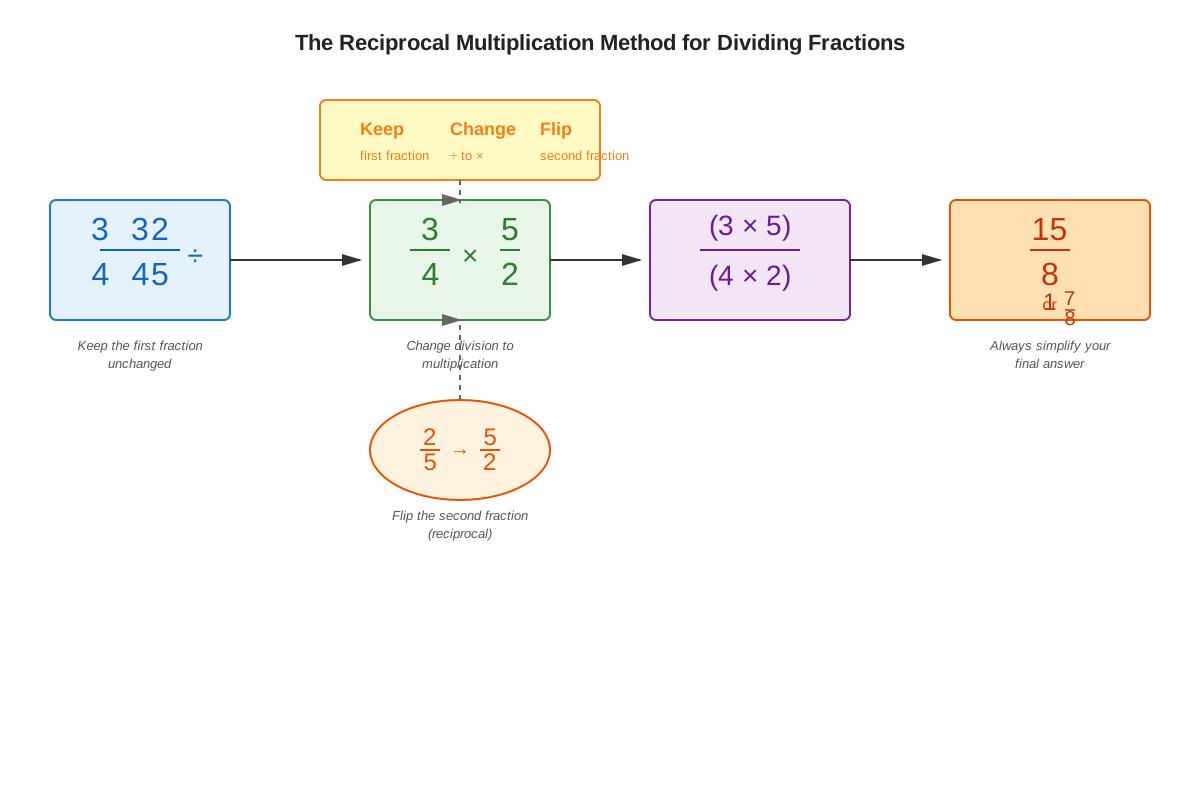
The cornerstone principle of dividing fractions states: to divide by a fraction, multiply by its reciprocal. Mathematically, this is expressed as:
a/b ÷ c/d = a/b × d/cThe reciprocal (also called the multiplicative inverse) of a fraction is obtained by exchanging the numerator and denominator. For example, the reciprocal of 3/4 is 4/3, and the reciprocal of 5/2 is 2/5. This rule transforms every division problem into a multiplication problem, which is generally easier to execute.
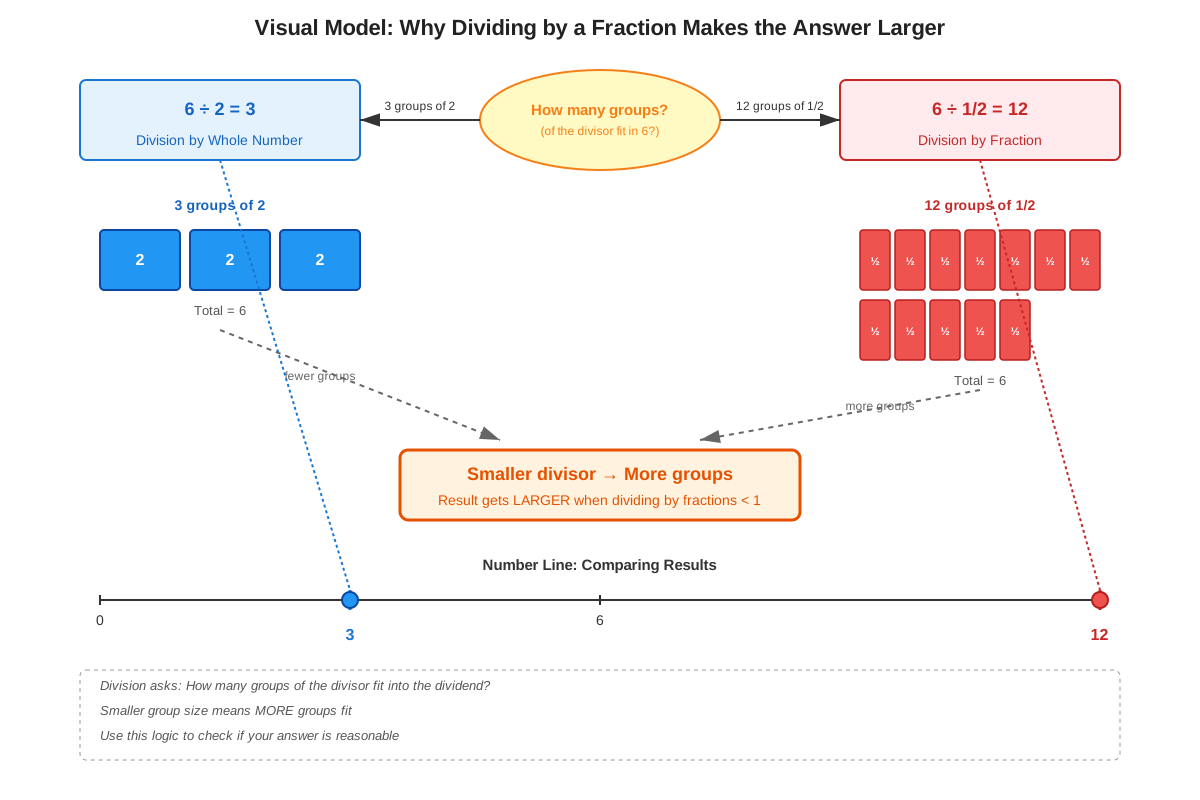
Why this rule works: Division asks "how many times does the divisor fit into the dividend?" When dividing by a fraction less than 1, the answer must be larger than the dividend (because smaller pieces fit more times into a whole). Multiplying by the reciprocal accomplishes this mathematically. For instance, dividing by 1/2 is equivalent to asking "how many halves are in this quantity?"—which is the same as multiplying by 2.
Step-by-Step Procedure
The standard procedure for dividing fractions follows these steps:
- Convert mixed numbers to improper fractions (if present)
- Identify the reciprocal of the divisor (the second fraction)
- Rewrite the division as multiplication by the reciprocal
- Multiply numerators together and denominators together
- Simplify the result by reducing to lowest terms
Working with Mixed Numbers
Many GRE problems present mixed numbers (like 2 1/3) that must be converted to improper fractions before division. To convert a mixed number:
a b/c = (a × c + b)/cFor example: 2 1/3 = (2 × 3 + 1)/3 = 7/3
When dividing mixed numbers, convert both to improper fractions first, then proceed with the standard division procedure.
Complex Fractions
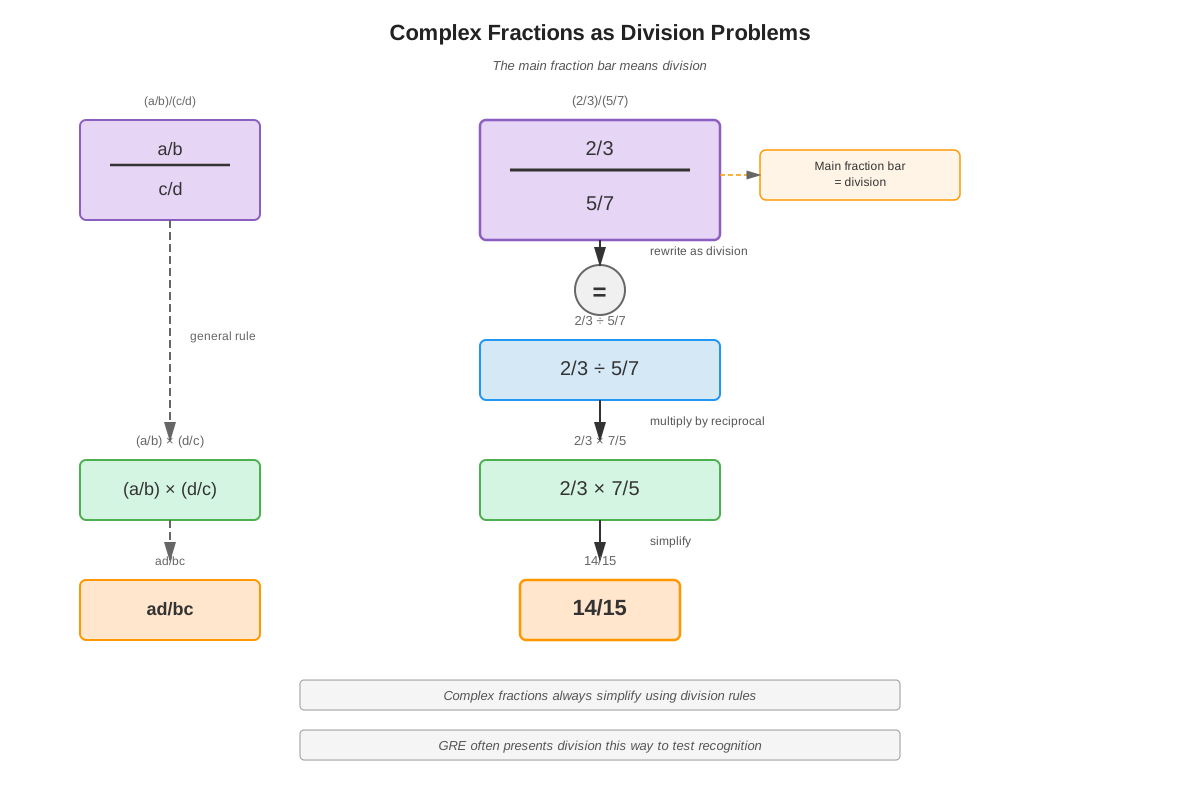
A complex fraction is a fraction where the numerator, denominator, or both contain fractions themselves. These are actually division problems in disguise. The expression:
(a/b)/(c/d)is equivalent to (a/b) ÷ (c/d), which can be solved using the reciprocal multiplication method.
Dividing a Fraction by a Whole Number
When dividing a fraction by a whole number, remember that any whole number n can be written as n/1. Therefore:
a/b ÷ n = a/b ÷ n/1 = a/b × 1/n = a/(b×n)This simplifies to: keep the numerator the same and multiply the denominator by the whole number.
Dividing a Whole Number by a Fraction
When dividing a whole number by a fraction:
n ÷ a/b = n/1 × b/a = (n×b)/aThis often results in a larger number (when dividing by a proper fraction), which makes intuitive sense: dividing something into fractional pieces yields more pieces.
Canceling Before Multiplying
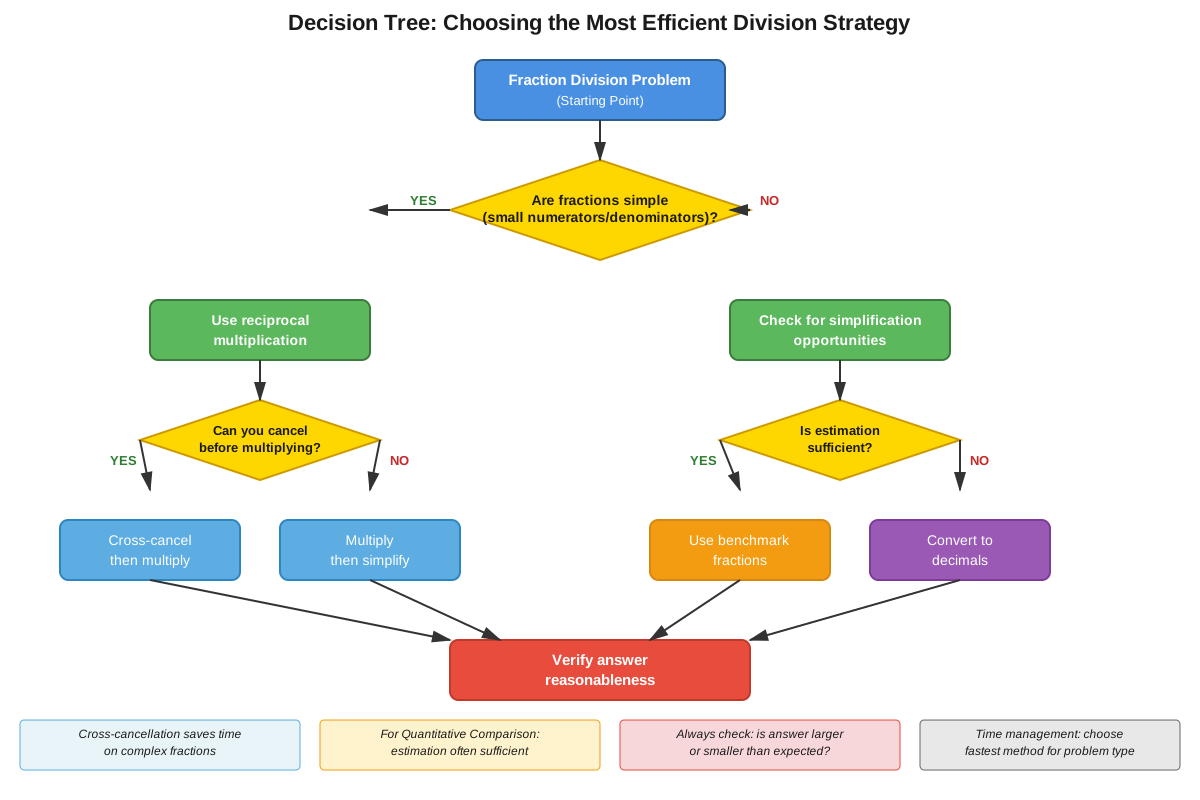
An efficient strategy involves canceling common factors before multiplying. After rewriting division as multiplication by the reciprocal, look for common factors between any numerator and any denominator:
2/3 ÷ 4/9 = 2/3 × 9/4Before multiplying, notice that 2 and 4 share a factor of 2, and 3 and 9 share a factor of 3:
= (2÷2)/(3÷3) × (9÷3)/(4÷2) = 1/1 × 3/2 = 3/2This technique reduces calculation errors and saves time on the GRE.
Comparison Table: Division vs. Multiplication
| Operation | Rule | Effect on Magnitude (proper fractions) | Example |
|---|---|---|---|
| Multiplying by a fraction < 1 | Multiply numerators, multiply denominators | Decreases the value | 6 × 1/2 = 3 |
| Dividing by a fraction < 1 | Multiply by reciprocal | Increases the value | 6 ÷ 1/2 = 12 |
| Multiplying by a fraction > 1 | Multiply numerators, multiply denominators | Increases the value | 6 × 3/2 = 9 |
| Dividing by a fraction > 1 | Multiply by reciprocal | Decreases the value | 6 ÷ 3/2 = 4 |
Concept Relationships
The concepts within dividing fractions form a hierarchical structure. At the foundation lies understanding reciprocals, which enables the fundamental rule of multiplying by the reciprocal. This rule connects directly to fraction multiplication, making multiplication a prerequisite skill. The ability to convert mixed numbers feeds into the division procedure, as does the skill of simplifying fractions.
Complex fractions represent an application of division, demonstrating how the concept extends beyond simple two-fraction problems. The technique of canceling common factors draws upon factorization skills and connects to the broader concept of equivalent fractions.
The relationship map flows as follows:
Reciprocals → Multiply by Reciprocal Rule → Basic Fraction Division → branches into → Dividing Mixed Numbers and Complex Fractions → all lead to → Simplified Results
Dividing fractions connects to prerequisite topics through its dependence on fraction multiplication and simplification. It connects forward to more advanced topics including: rational expressions in algebra (where polynomial fractions are divided), rate problems (which often require dividing fractional rates), unit conversions (dividing by fractional conversion factors), and probability (dividing fractional probabilities to find conditional probabilities).
High-Yield Facts
⭐ To divide by a fraction, multiply by its reciprocal: This is the single most important rule for dividing fractions
⭐ The reciprocal of a/b is b/a: Simply flip the numerator and denominator
⭐ Dividing by a proper fraction (< 1) makes the result larger: This helps verify answer reasonableness
⭐ Convert all mixed numbers to improper fractions before dividing: Attempting to divide mixed numbers directly leads to errors
⭐ Complex fractions are division problems: The fraction bar means division
- Dividing by a whole number n is the same as multiplying by 1/n
- Cancel common factors before multiplying to simplify calculations
- The reciprocal of a whole number n is 1/n
- Dividing by 1 leaves a fraction unchanged (a/b ÷ 1 = a/b)
- The reciprocal of 1 is 1 (the only number that is its own reciprocal besides -1)
- When dividing fractions with the same denominator, you can divide numerators and keep the denominator: (a/c) ÷ (b/c) = a/b
- Zero has no reciprocal (division by zero is undefined)
- Dividing a fraction by itself always equals 1
Quick check — test yourself on Dividing fractions so far.
Try Flashcards →Common Misconceptions
Misconception: When dividing fractions, divide the numerators and divide the denominators directly (a/b ÷ c/d = (a÷c)/(b÷d))
Correction: Division of fractions requires multiplying by the reciprocal of the divisor. The correct procedure is a/b ÷ c/d = a/b × d/c = (a×d)/(b×c). Direct division of numerators and denominators is not a valid operation.
Misconception: The reciprocal of a mixed number like 2 1/3 is found by just flipping it to 1/3 2
Correction: Mixed numbers must first be converted to improper fractions before finding the reciprocal. For 2 1/3: convert to 7/3, then the reciprocal is 3/7. There is no such thing as a "mixed number reciprocal" in standard form.
Misconception: Dividing by a fraction always makes the result smaller
Correction: Dividing by a proper fraction (less than 1) makes the result larger. For example, 4 ÷ 1/2 = 8, which is larger than 4. Only dividing by a fraction greater than 1 makes the result smaller. This is because dividing by a small fraction asks "how many of these small pieces fit into the whole?"
Misconception: In a complex fraction, you can simplify by canceling terms between the top and bottom before recognizing it as division
Correction: A complex fraction must first be interpreted as a division problem. The expression (2/3)/(4/5) means (2/3) ÷ (4/5), which equals 2/3 × 5/4 = 10/12 = 5/6. Attempting to cancel the 2 and 4, or the 3 and 5, before setting up the division leads to incorrect results.
Misconception: When dividing a fraction by a whole number, multiply both the numerator and denominator by that whole number
Correction: When dividing a fraction by a whole number, keep the numerator the same and multiply only the denominator by that number. For example: (3/4) ÷ 2 = 3/(4×2) = 3/8. Alternatively, multiply by the reciprocal: (3/4) × (1/2) = 3/8.
Misconception: The order doesn't matter in fraction division (a/b ÷ c/d = c/d ÷ a/b)
Correction: Division is not commutative. The order matters significantly. For example: (1/2) ÷ (1/4) = 2, but (1/4) ÷ (1/2) = 1/2. The first fraction is the dividend (what is being divided), and the second is the divisor (what you're dividing by).
Worked Examples
Example 1: Basic Fraction Division with Simplification
Problem: Calculate 5/6 ÷ 2/9 and express the answer in simplest form.
Solution:
Step 1: Identify the operation and set up the problem
We need to divide 5/6 by 2/9.
Step 2: Find the reciprocal of the divisor
The reciprocal of 2/9 is 9/2 (flip the numerator and denominator).
Step 3: Rewrite as multiplication
5/6 ÷ 2/9 = 5/6 × 9/2
Step 4: Look for opportunities to cancel before multiplying
Notice that 6 and 9 share a common factor of 3:
= 5/(6÷3) × (9÷3)/2
= 5/2 × 3/2
Step 5: Multiply numerators and denominators
= (5 × 3)/(2 × 2)
= 15/4
Step 6: Convert to mixed number if needed
15/4 = 3 3/4
Answer: 15/4 or 3 3/4
Connection to learning objectives: This example demonstrates the core rule of multiplying by the reciprocal and shows how to apply the procedure accurately to reach a simplified answer.
Example 2: GRE-Style Word Problem with Mixed Numbers
Problem: A recipe requires 2 2/3 cups of flour to make one batch of cookies. If Sarah has 8 cups of flour, how many complete batches can she make?
Solution:
Step 1: Identify the operation needed
This is a division problem: total flour ÷ flour per batch = number of batches
8 ÷ 2 2/3 = ?
Step 2: Convert the mixed number to an improper fraction
2 2/3 = (2 × 3 + 2)/3 = 8/3
Step 3: Rewrite the problem
8 ÷ 8/3 = ?
Step 4: Express the whole number as a fraction
8/1 ÷ 8/3
Step 5: Multiply by the reciprocal
= 8/1 × 3/8
Step 6: Cancel common factors
The 8s cancel completely:
= (8÷8)/1 × 3/(8÷8)
= 1/1 × 3/1
= 3
Answer: Sarah can make 3 complete batches of cookies.
Connection to learning objectives: This example shows how to identify when dividing fractions is being tested in a word problem context, demonstrates conversion of mixed numbers, and applies the division procedure to reach a practical answer. The problem also illustrates why dividing by a fraction greater than 1 yields a smaller result (8 cups divided into portions of 2 2/3 cups yields only 3 portions).
Exam Strategy
When approaching GRE dividing fractions questions, employ these strategic techniques:
Recognition triggers: Watch for these phrases that signal fraction division:
- "How many [fractional amounts] are in..."
- "Divided by" or "divided into"
- "Per" or "for each" (often indicates a rate requiring division)
- Complex fractions with one fraction over another
- "What fraction of" followed by a comparison
Process approach:
- Identify the operation first: Ensure the problem actually requires division rather than multiplication
- Convert immediately: Transform all mixed numbers to improper fractions before proceeding
- Write out the reciprocal: Don't try to do this mentally—write "× reciprocal" to avoid errors
- Cancel before multiplying: Look for common factors to reduce calculation complexity
- Check reasonableness: Verify whether your answer should be larger or smaller than the original dividend
Quantitative Comparison strategy: When comparing quantities involving fraction division:
- Don't calculate if you can determine relative magnitude
- Remember that dividing by a smaller fraction yields a larger result
- Consider using benchmark values (like 1) to test relationships
Time allocation: Straightforward fraction division should take 30-45 seconds. If a problem is taking longer, consider whether:
- You're using the most efficient approach (canceling before multiplying?)
- There's a conceptual shortcut (comparing rather than calculating?)
- You've made an error that's leading to complicated numbers
Answer choice analysis: GRE wrong answers often include:
- The result of multiplying instead of dividing
- The result of using the reciprocal of the wrong fraction
- The result before simplification
- The reciprocal of the correct answer
Calculator usage: On the GRE calculator-permitted sections, you can verify fraction division by:
- Converting fractions to decimals first
- Checking your simplified answer by converting back to decimal form
However, for simple fractions, manual calculation is often faster than calculator entry.
Memory Techniques
KFC Mnemonic for the division procedure:
- Keep the first fraction
- Flip the second fraction (find reciprocal)
- Change division to multiplication
"Dividing is Multiplying in Disguise": Remember that every division problem becomes a multiplication problem, making division actually easier than it first appears.
The Flip-Flop Rule: When you see the division symbol (÷), think "flip-flop the second fraction" to remember to use the reciprocal.
Visual reciprocal technique: Imagine physically rotating the second fraction 180 degrees when you see a division sign—this visual helps remember to flip numerator and denominator.
Size Check Rhyme:
"Divide by less than one, the answer's more fun (bigger)
Divide by more than one, the answer's less fun (smaller)"
This helps verify whether your answer makes sense based on the divisor's size.
CMRS for the procedure:
- Convert mixed numbers
- Multiply by reciprocal
- Reduce by canceling
- Simplify the result
Summary
Dividing fractions represents a critical computational skill for GRE success, appearing frequently across multiple question types and contexts. The fundamental procedure—multiplying by the reciprocal of the divisor—transforms every division problem into a more manageable multiplication problem. Mastery requires understanding why the reciprocal method works, executing the procedure accurately through multiple steps (converting mixed numbers, finding reciprocals, canceling common factors, and simplifying), and recognizing when fraction division is the appropriate operation in word problems and complex scenarios. The GRE tests this skill both directly and embedded within multi-step problems involving rates, ratios, and proportional relationships. Success depends on procedural fluency, conceptual understanding of how division affects magnitude (dividing by fractions less than 1 increases the result), and strategic approaches like canceling before multiplying to improve efficiency and accuracy.
Key Takeaways
- The core rule: To divide fractions, multiply by the reciprocal of the divisor (a/b ÷ c/d = a/b × d/c)
- Always convert mixed numbers to improper fractions before attempting division
- Dividing by a proper fraction (less than 1) makes the result larger; dividing by an improper fraction (greater than 1) makes it smaller
- Complex fractions are division problems in disguise—treat the main fraction bar as a division symbol
- Cancel common factors between any numerator and any denominator before multiplying to simplify calculations
- Verify reasonableness by checking whether your answer's magnitude makes sense given the divisor
- Practice recognition of when division is required in word problems, especially those involving rates, portions, and "how many fit into" scenarios
Related Topics
Multiplying Fractions: The foundation for dividing fractions, as division relies on multiplication by the reciprocal. Strengthening multiplication skills directly improves division accuracy.
Ratios and Proportions: Fraction division frequently appears in ratio problems where you must find unit rates or compare proportional relationships. Mastering division enables efficient ratio manipulation.
Rate Problems: Work rates, speed calculations, and unit conversions all require dividing fractional quantities. This topic extends fraction division into practical problem-solving contexts.
Complex Rational Expressions: In algebra, dividing polynomial fractions uses the identical reciprocal multiplication method, making fraction division a gateway to algebraic manipulation.
Percent Problems: Many percent calculations involve dividing by fractional equivalents (like dividing by 0.25 or 1/4), connecting fraction division to percentage operations.
Practice CTA
Now that you've mastered the concepts and strategies for dividing fractions, it's time to solidify your understanding through active practice. Attempt the practice questions designed specifically for this topic, focusing on applying the reciprocal multiplication method efficiently and accurately. Use the flashcards to reinforce the key rules and common patterns you'll encounter on test day. Remember: computational fluency with fraction division isn't just about memorizing a procedure—it's about building the confidence to tackle any GRE question involving fractional quantities quickly and correctly. Each practice problem you complete strengthens your pattern recognition and reduces the likelihood of errors under time pressure. You've got this!
Sign up free to keep reading
Create a free AnvayaPrep account to finish this GRE guide on Dividing fractions — plus flashcards and practice questions.