Overview
Subtracting fractions is a fundamental arithmetic operation that appears frequently throughout the GRE Quantitative Reasoning section. While the concept may seem elementary, the GRE tests this skill in sophisticated ways—embedding fraction subtraction within complex word problems, data interpretation questions, and multi-step algebraic manipulations. Mastery of this topic is non-negotiable for achieving a competitive score, as fraction operations form the foundation for more advanced mathematical reasoning including ratios, proportions, rates, and algebraic expressions.
The ability to efficiently subtract fractions distinguishes high-scoring test-takers from those who struggle with time management. Questions involving GRE subtracting fractions rarely appear in isolation; instead, they're woven into problems testing multiple concepts simultaneously. A student might encounter fraction subtraction while calculating the remaining portion of a budget, determining the difference between two probabilities, or simplifying algebraic expressions with fractional coefficients. The computational accuracy and speed developed through mastering this topic directly impacts performance across numerous question types.
Understanding fraction subtraction connects to broader Quantitative Reasoning concepts including number properties, decimal-fraction conversions, and algebraic manipulation. This topic serves as a bridge between basic arithmetic and more complex mathematical operations. Students who can fluently subtract fractions—whether with like denominators, unlike denominators, or mixed numbers—gain confidence and efficiency that translates to better performance on test day. The strategic approaches learned here apply equally to addition, multiplication, and division of fractions, creating a comprehensive framework for handling all fractional operations on the GRE.
Learning Objectives
- [ ] Identify when subtracting fractions is being tested
- [ ] Explain the core rule or strategy behind subtracting fractions
- [ ] Apply subtracting fractions to GRE-style questions accurately
- [ ] Convert mixed numbers to improper fractions before subtraction
- [ ] Find the least common denominator (LCD) efficiently for unlike denominators
- [ ] Simplify results to lowest terms and recognize equivalent forms
- [ ] Execute fraction subtraction under timed conditions with 95%+ accuracy
Prerequisites
- Basic fraction concepts: Understanding numerators, denominators, and what fractions represent is essential for performing any operation on them
- Multiplication and division of whole numbers: Finding common denominators requires multiplying denominators and cross-multiplying
- Prime factorization: Identifying the LCD efficiently often requires breaking numbers into prime factors
- Equivalent fractions: Recognizing that fractions can be expressed in multiple forms is crucial for finding common denominators
- Simplification techniques: Reducing fractions to lowest terms requires identifying common factors in numerators and denominators
Why This Topic Matters
Fraction subtraction appears in approximately 15-20% of GRE Quantitative Reasoning questions, either directly or as a component of multi-step problems. This high frequency makes it one of the most important arithmetic skills to master. The GRE tests fraction subtraction across multiple question formats: Quantitative Comparison questions that require determining which of two fractional expressions is larger, Problem Solving questions involving word problems with fractional quantities, and Data Interpretation questions where students must calculate differences between fractional data points.
In real-world applications, subtracting fractions is essential for financial calculations (determining remaining budgets or portions), scientific measurements (calculating differences in experimental results), cooking and recipe adjustments, construction and engineering (working with fractional measurements), and time management (calculating remaining portions of time). These practical applications frequently inspire GRE word problems, making the skill both academically and practically valuable.
Common exam scenarios include: calculating the difference between two probabilities expressed as fractions; determining how much more or less of a quantity one group has compared to another; finding the remaining portion after a fractional amount is removed; comparing rates or ratios that require subtraction; and simplifying algebraic expressions containing fractional terms. The GRE particularly favors questions where students must subtract fractions with unlike denominators or work with mixed numbers, as these require multiple steps and create opportunities for computational errors.
Core Concepts
Understanding the Fundamental Rule
The core principle of subtracting fractions is that subtraction can only be performed directly when fractions share a common denominator. This requirement stems from the mathematical reality that fractions represent parts of a whole, and those parts must be measured using the same unit size. Just as one cannot subtract 3 inches from 5 feet without first converting to a common unit, fractions require a common denominator before subtraction.
The general formula for subtracting fractions is:
a/b - c/d = (ad - bc)/(bd)However, this cross-multiplication approach, while always mathematically valid, isn't always the most efficient method for the GRE. Understanding when to use different strategies separates efficient test-takers from those who waste valuable time.
Subtracting Fractions with Like Denominators
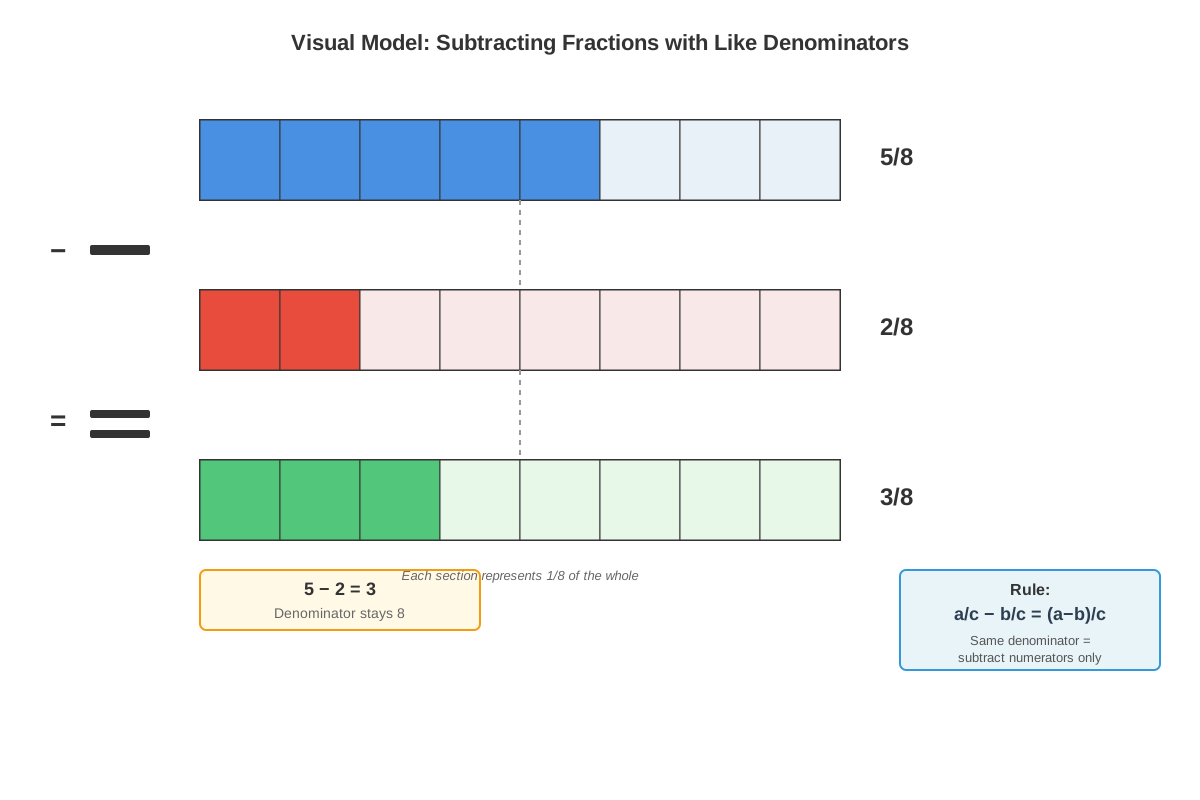
When fractions already share a common denominator, subtraction becomes straightforward:
a/c - b/c = (a-b)/cSteps for like denominators:
- Verify that denominators are identical
- Subtract the numerators
- Keep the denominator unchanged
- Simplify the result if possible
Example: 7/12 - 5/12 = (7-5)/12 = 2/12 = 1/6
This scenario represents the simplest case and appears frequently in GRE questions designed to test other concepts where fraction subtraction is merely one step in a longer solution process.
Subtracting Fractions with Unlike Denominators
When denominators differ, students must find a common denominator before subtraction can occur. The least common denominator (LCD) is the smallest number that both denominators divide into evenly.
Steps for unlike denominators:
- Identify the LCD of both denominators
- Convert each fraction to an equivalent fraction with the LCD
- Subtract the numerators
- Keep the common denominator
- Simplify the result
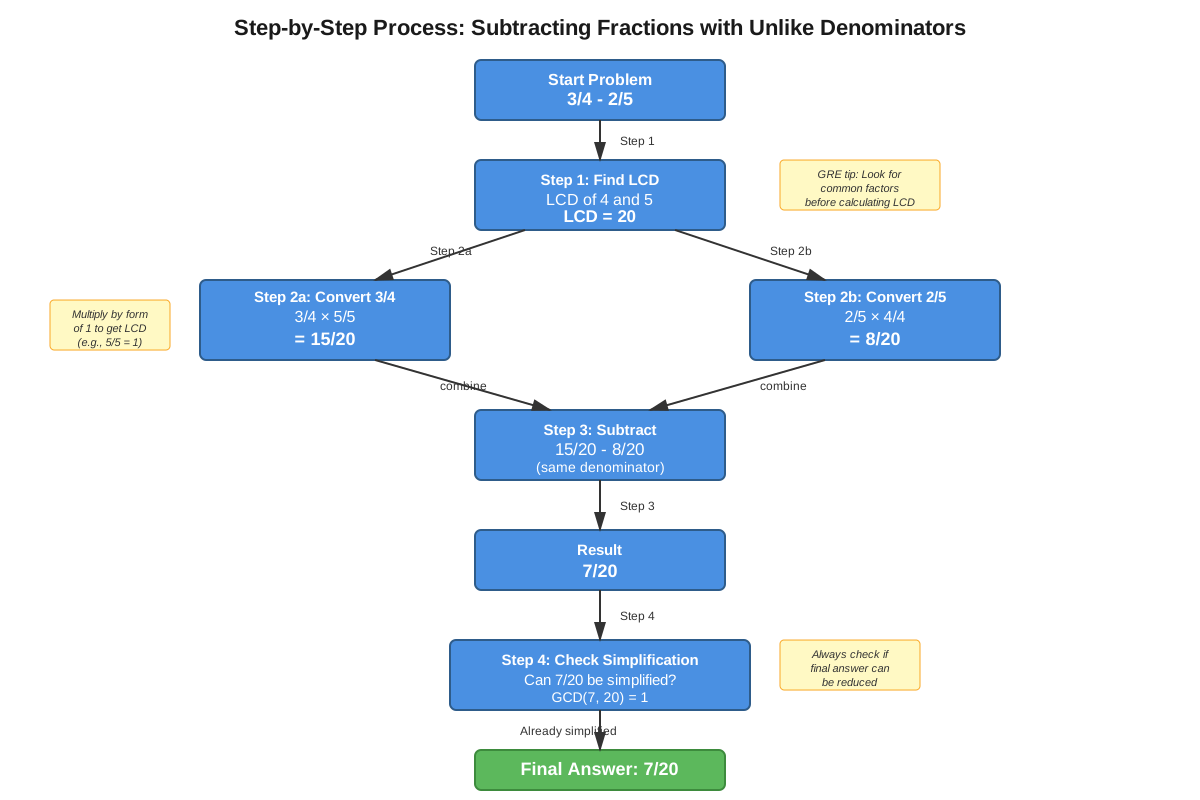
Example: 3/4 - 2/5
- LCD of 4 and 5 is 20
- Convert: 3/4 = 15/20 and 2/5 = 8/20
- Subtract: 15/20 - 8/20 = 7/20
- Result is already in simplest form: 7/20
Finding the Least Common Denominator
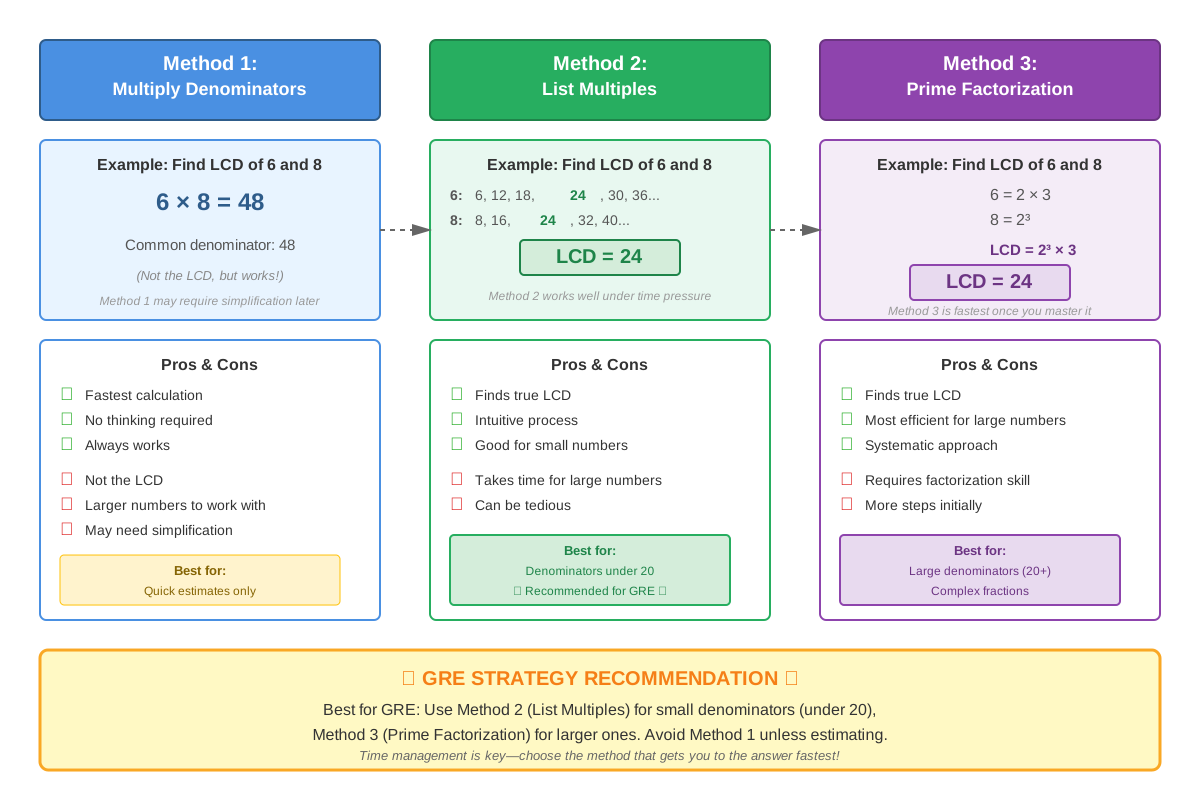
The LCD can be found through multiple methods:
| Method | When to Use | Example |
|---|---|---|
| Listing multiples | Small denominators (under 12) | For 4 and 6: multiples of 4 (4,8,12...) and 6 (6,12...) → LCD = 12 |
| Prime factorization | Larger denominators or multiple fractions | For 12 and 18: 12 = 2²×3, 18 = 2×3² → LCD = 2²×3² = 36 |
| Multiply denominators | When denominators are coprime or time is limited | For 7 and 9: LCD = 7×9 = 63 |
The prime factorization method is most efficient for GRE questions because it guarantees finding the true LCD rather than just any common denominator, minimizing subsequent simplification work.
Subtracting Mixed Numbers
Mixed numbers combine whole numbers with fractions (e.g., 3 1/2). The GRE frequently tests mixed number subtraction because it requires multiple steps and creates opportunities for errors.
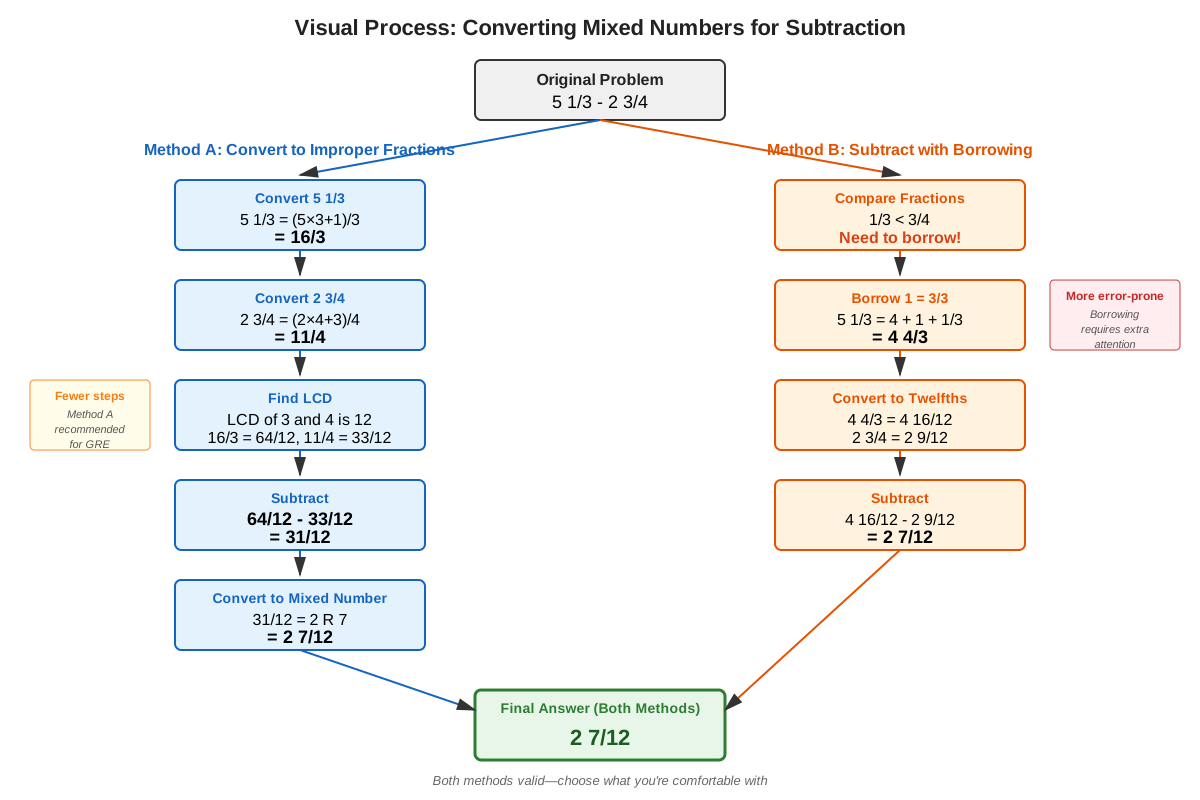
Method 1: Convert to improper fractions
- Convert both mixed numbers to improper fractions
- Find the LCD
- Subtract as with regular fractions
- Convert back to mixed number if needed
Example: 5 2/3 - 2 1/4
- Convert: 5 2/3 = 17/3 and 2 1/4 = 9/4
- LCD = 12
- Convert: 17/3 = 68/12 and 9/4 = 27/12
- Subtract: 68/12 - 27/12 = 41/12 = 3 5/12
Method 2: Subtract whole numbers and fractions separately
This method works when the fraction in the minuend (first number) is larger than the fraction in the subtrahend (second number).
Example: 7 5/6 - 3 1/6 = (7-3) + (5/6 - 1/6) = 4 + 4/6 = 4 2/3
Borrowing with Mixed Numbers
When the fraction being subtracted is larger than the fraction it's being subtracted from, borrowing becomes necessary.
Example: 5 1/4 - 2 3/4
Since 1/4 < 3/4, borrow 1 from the whole number:
- Rewrite 5 1/4 as 4 5/4 (borrowing 1 = 4/4)
- Now subtract: 4 5/4 - 2 3/4 = (4-2) + (5/4 - 3/4) = 2 2/4 = 2 1/2
This borrowing concept parallels borrowing in whole number subtraction and is frequently tested on the GRE because many students forget this step under time pressure.
Subtracting Fractions from Whole Numbers
When subtracting a fraction from a whole number, convert the whole number to a fraction with the same denominator.
Example: 3 - 2/5
- Convert 3 to fifths: 3 = 15/5
- Subtract: 15/5 - 2/5 = 13/5 = 2 3/5
Alternatively, think of the whole number as a mixed number: 3 = 2 5/5, then subtract: 2 5/5 - 2/5 = 2 3/5
Negative Results and Subtraction Order
Unlike addition, subtraction is not commutative: a - b ≠ b - a. The order matters significantly.
When the second fraction is larger than the first, the result is negative:
Example: 2/7 - 5/7 = -3/7
The GRE may test understanding of this concept in Quantitative Comparison questions or when working with number lines.
Concept Relationships
The concepts within fraction subtraction build hierarchically. Like denominator subtraction forms the foundation → Finding common denominators enables unlike denominator subtraction → LCD techniques optimize efficiency → Mixed number conversion extends the skill to more complex numbers → Borrowing handles special cases where direct subtraction isn't possible.
Fraction subtraction connects directly to prerequisite topics: equivalent fractions enable denominator conversion, multiplication is used to create equivalent fractions, prime factorization facilitates LCD finding, and simplification produces final answers in standard form.
This topic enables progression to related concepts: adding fractions uses identical denominator-finding techniques, complex fractions often require subtraction in numerators or denominators, rational expressions in algebra apply these same principles with variables, rate problems frequently involve subtracting fractional rates, and probability calculations often require finding differences between fractional probabilities.
The relationship map: Basic Fractions → Equivalent Fractions → Common Denominators → Like Denominator Subtraction → Unlike Denominator Subtraction → Mixed Number Subtraction → Algebraic Fractions → Complex Problem Solving
Quick check — test yourself on Subtracting fractions so far.
Try Flashcards →High-Yield Facts
⭐ Fractions must have a common denominator before subtraction can be performed
⭐ The least common denominator (LCD) is the smallest number divisible by all denominators involved
⭐ When subtracting fractions with like denominators: subtract numerators, keep the denominator
⭐ To convert a mixed number to an improper fraction: multiply the whole number by the denominator, add the numerator
⭐ Always simplify final answers to lowest terms unless the question specifies otherwise
- When the fraction in the minuend is smaller than the fraction in the subtrahend, borrowing from the whole number is required
- Multiplying both denominators always produces a common denominator, though not necessarily the LCD
- Prime factorization of denominators provides the most efficient method for finding the LCD
- Subtracting a larger fraction from a smaller fraction produces a negative result
- Converting all mixed numbers to improper fractions before subtraction eliminates the need for borrowing
- The GRE accepts answers in improper fraction form, mixed number form, or decimal form depending on answer choices
- Cross-multiplication (ad - bc)/(bd) works for any two fractions but may create unnecessarily large numbers
- When one denominator is a multiple of the other, the larger denominator is automatically the LCD
- Subtracting fractions from whole numbers requires converting the whole number to a fraction first
- The order of subtraction matters: a/b - c/d ≠ c/d - a/b
Common Misconceptions
Misconception: Denominators should be subtracted along with numerators → Correction: Only numerators are subtracted; the common denominator remains unchanged. The denominator represents the size of the pieces, which doesn't change during subtraction.
Misconception: Any common denominator works equally well → Correction: While any common denominator produces a correct answer, using the LCD minimizes the size of numbers involved and reduces simplification work, saving valuable test time.
Misconception: Mixed numbers can be subtracted by simply subtracting whole numbers and fractions separately → Correction: This only works when the fraction in the first number is larger than the fraction in the second number. Otherwise, borrowing is required.
Misconception: When converting mixed numbers to improper fractions, simply place the whole number over the denominator → Correction: The correct conversion requires multiplying the whole number by the denominator and adding the numerator: 3 2/5 = (3×5 + 2)/5 = 17/5, not 3/5.
Misconception: Fractions with larger denominators are always larger in value → Correction: The denominator indicates how many pieces the whole is divided into; larger denominators mean smaller pieces. 1/8 < 1/4 even though 8 > 4.
Misconception: Simplification is optional and doesn't affect correctness → Correction: While mathematically equivalent, GRE answer choices are typically in simplified form. An unsimplified answer may not match any option, leading to incorrect selection.
Misconception: Borrowing in mixed number subtraction works the same as borrowing in whole number subtraction → Correction: When borrowing from the whole number in mixed number subtraction, the borrowed 1 must be converted to a fraction with the appropriate denominator (e.g., borrowing 1 from 5 1/3 gives 4 4/3, not 4 1/3).
Worked Examples
Example 1: Unlike Denominators with Simplification
Problem: Calculate 5/6 - 3/8 and express in simplest form.
Solution:
Step 1: Identify the LCD of 6 and 8
- Prime factorization: 6 = 2×3, 8 = 2³
- LCD = 2³×3 = 24
Step 2: Convert both fractions to equivalent fractions with denominator 24
- 5/6 = (5×4)/(6×4) = 20/24
- 3/8 = (3×3)/(8×3) = 9/24
Step 3: Subtract the numerators
- 20/24 - 9/24 = 11/24
Step 4: Check if simplification is possible
- 11 is prime and doesn't divide 24
- Final answer: 11/24
Connection to learning objectives: This example demonstrates identifying when fraction subtraction is tested (unlike denominators), applying the core strategy (finding LCD), and executing accurately with proper simplification.
Example 2: Mixed Numbers Requiring Borrowing
Problem: A recipe calls for 4 1/3 cups of flour. If you've already added 1 3/4 cups, how much more flour do you need?
Solution:
This is a subtraction problem: 4 1/3 - 1 3/4
Method 1: Convert to improper fractions
Step 1: Convert mixed numbers
- 4 1/3 = (4×3 + 1)/3 = 13/3
- 1 3/4 = (1×4 + 3)/4 = 7/4
Step 2: Find LCD of 3 and 4
- Since 3 and 4 are coprime, LCD = 12
Step 3: Convert to common denominator
- 13/3 = 52/12
- 7/4 = 21/12
Step 4: Subtract
- 52/12 - 21/12 = 31/12
Step 5: Convert to mixed number
- 31/12 = 2 7/12
Method 2: Borrowing approach
Step 1: Set up the subtraction
- 4 1/3 - 1 3/4
Step 2: Find common denominator for fractions (LCD = 12)
- 4 4/12 - 1 9/12
Step 3: Since 4/12 < 9/12, borrow 1 from 4
- 4 4/12 = 3 16/12
Step 4: Now subtract
- 3 16/12 - 1 9/12 = 2 7/12
Final answer: 2 7/12 cups
Connection to learning objectives: This real-world GRE-style problem requires identifying the operation needed, choosing an efficient strategy, and handling mixed numbers with borrowing—all key learning objectives.
Exam Strategy
When approaching GRE subtracting fractions questions, first determine whether the problem explicitly requires subtraction or whether it's embedded within a larger problem. Trigger words include "difference," "how much more," "how much less," "remaining," "left over," and "decrease."
Strategic approach sequence:
- Identify the operation: Confirm that subtraction is required (not addition or another operation)
- Assess denominator relationship: Check if denominators are already common, if one is a multiple of the other, or if they're completely different
- Choose your method: For mixed numbers, decide between converting to improper fractions or using borrowing based on which seems faster
- Estimate before calculating: Quickly estimate the approximate answer to catch major errors
- Execute carefully: Perform calculations methodically, especially when finding LCD
- Simplify and match: Reduce to lowest terms and compare with answer choices
Time-saving tips:
- If denominators are small (under 12), quickly multiply them rather than finding the true LCD if time is tight
- When answer choices are in decimal form, consider converting fractions to decimals instead of subtracting
- In Quantitative Comparison questions, sometimes you can determine which is larger without calculating exact values
- If one denominator divides evenly into the other, use the larger as the LCD immediately
Process of elimination:
- Eliminate answers with incorrect denominators (if you know the LCD, the answer must have that denominator or a factor of it)
- Eliminate answers that are clearly too large or too small based on your estimation
- If the problem involves subtracting a small fraction from a larger one, eliminate negative answers
- Check if answer choices are in simplified form—if yours isn't, simplify before selecting
Common traps to avoid:
- Don't subtract denominators along with numerators
- Don't forget to simplify final answers
- Don't skip the borrowing step when needed with mixed numbers
- Don't lose track of negative signs when the result should be negative
Memory Techniques
Mnemonic for subtraction steps: "FIND-CHANGE-SUBTRACT-SIMPLIFY"
- Find the LCD
- Identify equivalent fractions
- New numerators calculated
- Denominator stays the same
- Change fractions to common denominator
- Subtract numerators only
- Simplify the result
Visualization strategy: Picture fractions as pizza slices. To subtract 1/4 from 3/4, visualize three slices minus one slice equals two slices, all from the same size pizza (same denominator). When denominators differ, imagine cutting all pizzas into the same number of slices before counting.
Acronym for LCD methods: "LPM"
- Listing multiples (for small numbers)
- Prime factorization (for efficiency)
- Multiply denominators (when time is short)
Borrowing reminder: "Borrow One Whole = Denominator" (BOWD). When borrowing from a whole number, that 1 equals the denominator over itself (1 = 4/4 if working with fourths).
Rhyme for common denominators: "Same bottom, subtract the top; different bottoms, you must stop—find the LCD, then you're free to subtract with accuracy!"
Summary
Subtracting fractions is a high-frequency GRE Quantitative Reasoning skill that requires understanding when fractions share common denominators and when conversion is necessary. The fundamental principle is that fractions must have identical denominators before subtraction can occur, requiring students to find the least common denominator for unlike fractions. Mastery involves efficiently identifying the LCD through listing multiples, prime factorization, or multiplication; converting fractions to equivalent forms; subtracting only the numerators while maintaining the common denominator; and simplifying results to lowest terms. Mixed number subtraction adds complexity through the need to convert to improper fractions or employ borrowing when the fraction being subtracted is larger than the fraction it's subtracted from. Success on GRE questions requires not only computational accuracy but also strategic thinking about which method is most efficient for each problem type, recognition of trigger words indicating subtraction, and the ability to estimate answers to verify calculations. The skill connects to broader mathematical concepts including ratios, rates, probabilities, and algebraic expressions, making it foundational for overall quantitative success.
Key Takeaways
- Fractions require a common denominator before subtraction; only numerators are subtracted while the denominator remains constant
- The least common denominator (LCD) is found through listing multiples, prime factorization, or multiplying denominators, with prime factorization being most efficient for larger numbers
- Mixed numbers should be converted to improper fractions or handled through borrowing when the fractional part being subtracted is larger
- Always simplify final answers to lowest terms and verify they match the form of answer choices (improper fraction, mixed number, or decimal)
- Strategic estimation before calculation helps catch errors and saves time by enabling process of elimination
- Common mistakes include subtracting denominators, forgetting to borrow, and failing to simplify—awareness prevents these errors
- Efficient GRE performance requires choosing the fastest method for each specific problem rather than applying one universal approach
Related Topics
Adding Fractions: Uses identical LCD-finding techniques as subtraction but combines numerators instead; mastering subtraction makes addition straightforward and enables solving problems requiring both operations.
Multiplying and Dividing Fractions: These operations don't require common denominators but frequently appear in multi-step problems alongside subtraction; understanding all four operations creates comprehensive fraction fluency.
Ratios and Proportions: Often involve fractional relationships and may require subtracting fractions to find differences between ratios; this topic builds directly on fraction operation skills.
Algebraic Fractions: Applies fraction subtraction principles to expressions with variables; mastering numerical fraction subtraction is essential before progressing to algebraic applications.
Decimal Operations: Fractions and decimals are interchangeable representations; understanding when to convert between forms optimizes problem-solving efficiency on the GRE.
Practice CTA
Now that you've mastered the concepts, strategies, and common pitfalls of subtracting fractions, it's time to solidify your understanding through active practice. Attempt the practice questions designed specifically for this topic, focusing on applying the efficient methods you've learned rather than just getting correct answers. Use the flashcards to reinforce the high-yield facts and formulas until they become automatic. Remember: the difference between knowing how to subtract fractions and executing flawlessly under timed GRE conditions comes down to deliberate practice. Each problem you work through builds the speed and confidence that translates directly to points on test day. You've got this!
Sign up free to keep reading
Create a free AnvayaPrep account to finish this GRE guide on Subtracting fractions — plus flashcards and practice questions.