Overview
Proportions represent one of the most frequently tested concepts in GRE Quantitative Reasoning, appearing in approximately 15-20% of all math questions across various formats. A proportion is an equation that states two ratios are equal, typically written as a/b = c/d or a:b = c:d. This fundamental mathematical relationship serves as the foundation for solving problems involving scaling, rates, percentages, mixtures, and comparative quantities—all common question types on the GRE.
Understanding gre proportions is essential because they bridge multiple arithmetic and algebraic concepts. Proportions connect directly to ratios, fractions, percentages, and rates, making them a cornerstone of quantitative problem-solving. The GRE tests proportions both explicitly (through direct proportion problems) and implicitly (embedded within word problems about recipes, maps, speeds, or work rates). Mastery of this topic enables efficient problem-solving across diverse question formats, from Quantitative Comparison to Data Interpretation.
The power of proportions lies in their versatility and the elegant cross-multiplication technique that simplifies complex relationships into straightforward equations. Whether calculating how much paint is needed for a larger wall, determining travel time at different speeds, or analyzing survey data, proportional reasoning provides a systematic approach. For GRE success, students must recognize proportion problems quickly, set them up correctly, and solve them efficiently—skills that directly impact both accuracy and time management during the exam.
Learning Objectives
- [ ] Identify when Proportions is being tested
- [ ] Explain the core rule or strategy behind Proportions
- [ ] Apply Proportions to GRE-style questions accurately
- [ ] Distinguish between direct and inverse proportions in problem contexts
- [ ] Set up proportion equations correctly from word problems
- [ ] Solve complex multi-step problems involving proportional relationships
- [ ] Recognize when proportional reasoning can simplify algebraic approaches
Prerequisites
- Ratios: Understanding ratios is fundamental because proportions are equations stating that two ratios are equal; without ratio fluency, proportion setup becomes difficult
- Fractions: Proportions are often expressed as equivalent fractions, requiring comfort with fraction operations and simplification
- Basic algebra: Solving proportions requires isolating variables and performing algebraic manipulations like cross-multiplication
- Multiplication and division: These operations form the computational backbone of proportion solving, particularly when scaling quantities up or down
Why This Topic Matters
Proportions appear throughout real-world applications, from adjusting recipe quantities and reading map scales to understanding medication dosages and financial calculations. In professional contexts, proportional reasoning underlies data analysis, resource allocation, project scaling, and comparative metrics—skills valued across business, science, and engineering fields. The ability to think proportionally represents a fundamental quantitative literacy skill that extends far beyond standardized testing.
On the GRE specifically, proportion questions appear in multiple formats: as standalone Quantitative Comparison problems, within Problem Solving questions, embedded in Data Interpretation sets, and disguised within word problems about rates, mixtures, or scaling. Test-makers favor proportions because they efficiently assess mathematical reasoning, problem setup skills, and computational accuracy simultaneously. Questions may involve direct proportions (as one quantity increases, another increases proportionally), inverse proportions (as one increases, another decreases proportionally), or compound proportions involving multiple variables.
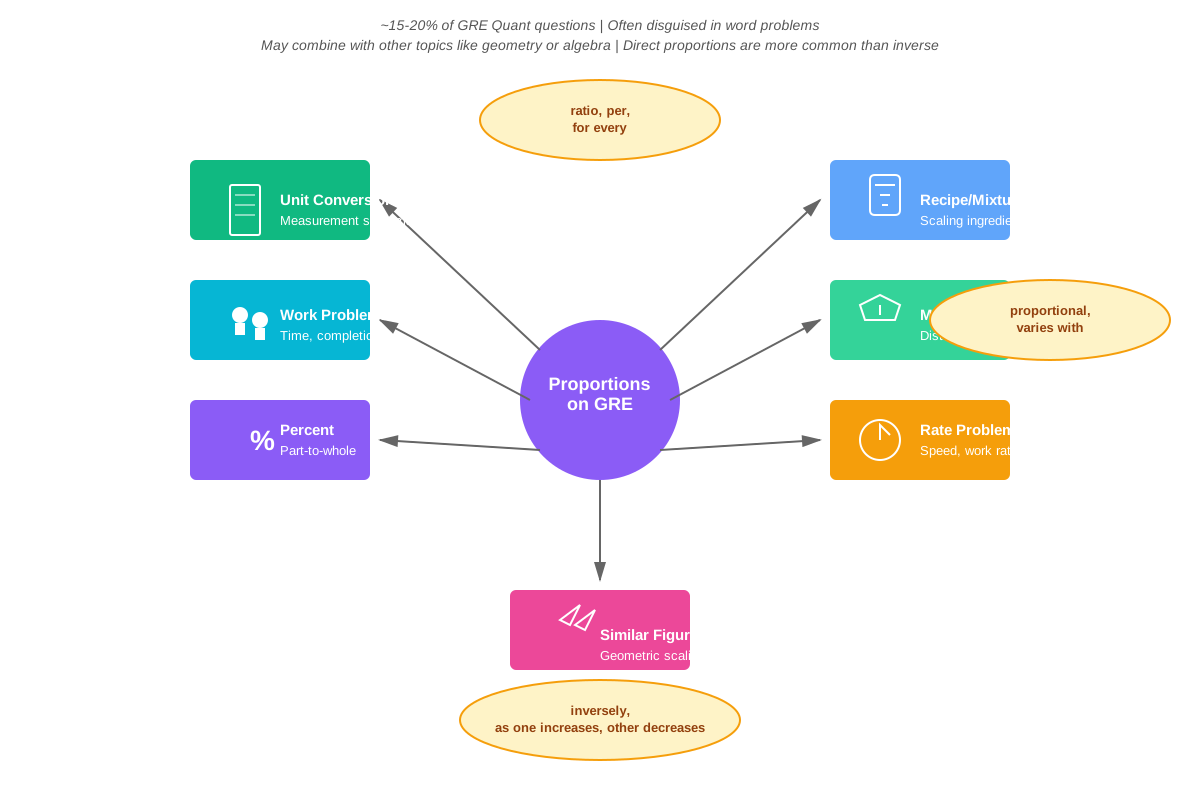
Common GRE manifestations include: recipe or mixture problems requiring ingredient scaling; map or model problems involving scale factors; rate problems with distance, speed, and time; work-rate problems with multiple workers; percentage problems requiring proportional calculations; and survey or probability problems involving part-to-whole relationships. Recognizing these patterns allows students to activate proportional reasoning automatically, saving valuable time and reducing errors.
Core Concepts
Definition and Basic Structure
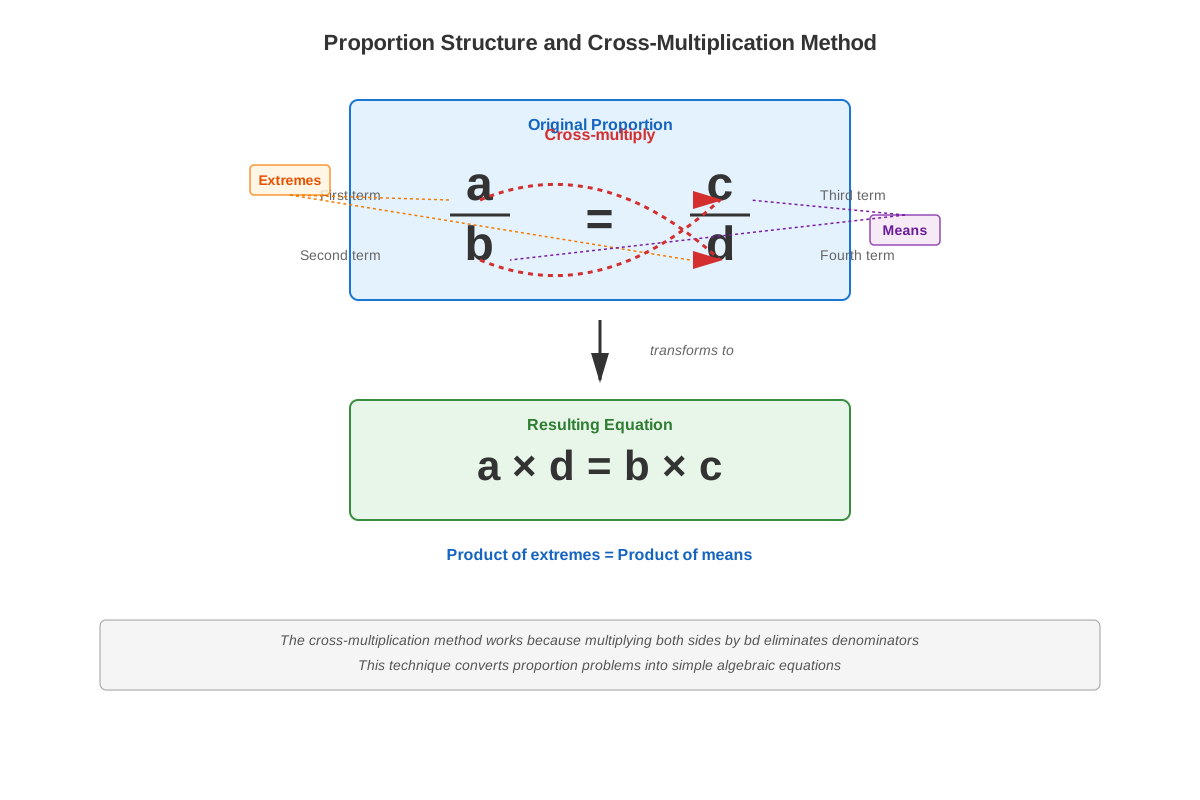
A proportion is an equation stating that two ratios are equal. The standard form is a/b = c/d, which can also be written as a:b = c:d or a:b::c:d. In this equation, the terms have specific names: 'a' and 'd' are called the extremes (outer terms), while 'b' and 'c' are called the means (inner terms). This terminology becomes relevant when applying the fundamental property of proportions.
The most powerful tool for solving proportions is cross-multiplication: if a/b = c/d, then ad = bc. This technique transforms a proportion into a simple equation that can be solved using basic algebra. Cross-multiplication works because multiplying both sides of the equation by bd eliminates the denominators, yielding the product of the extremes equals the product of the means.
Direct Proportions
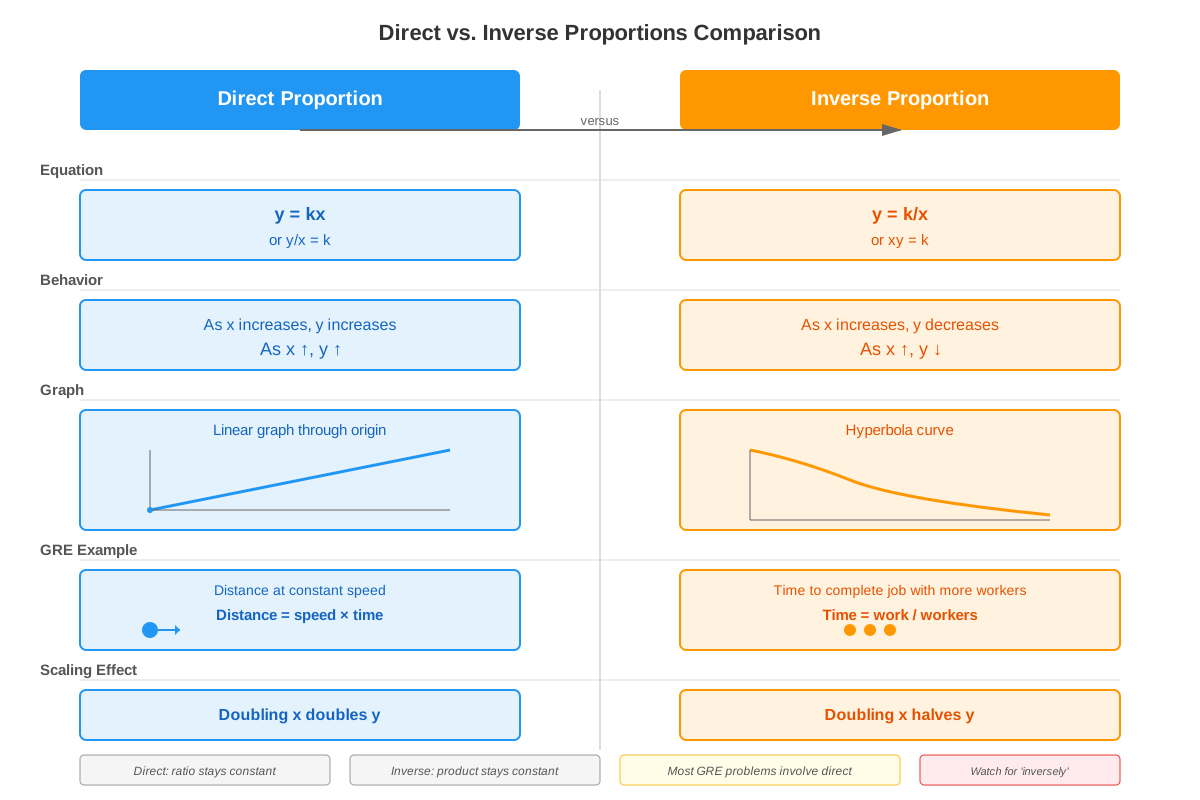
Direct proportions describe relationships where two quantities increase or decrease together at a constant rate. If y is directly proportional to x, we write y ∝ x or y = kx, where k is the constant of proportionality. In practical terms, this means doubling one quantity doubles the other, tripling one triples the other, and so forth.
Common direct proportion scenarios on the GRE include:
- Cost and quantity (more items cost more money)
- Distance and time at constant speed (longer time means greater distance)
- Ingredients in recipes (doubling a recipe doubles each ingredient)
- Map scales (actual distance is proportional to map distance)
To solve direct proportion problems, set up the equation: (quantity₁/quantity₂) = (corresponding₁/corresponding₂), then cross-multiply and solve.
Inverse Proportions
Inverse proportions (or indirect proportions) describe relationships where one quantity increases as the other decreases, maintaining a constant product. If y is inversely proportional to x, we write y ∝ 1/x or xy = k. Doubling one quantity halves the other; tripling one quantity reduces the other to one-third.
Common inverse proportion scenarios include:
- Speed and time for fixed distance (faster speed means less time)
- Number of workers and time to complete a job (more workers means less time)
- Gear ratios (larger gear rotates fewer times)
- Pressure and volume at constant temperature (Boyle's Law context)
To solve inverse proportion problems, recognize that quantity₁ × corresponding₁ = quantity₂ × corresponding₂, then solve for the unknown.
Setting Up Proportions from Word Problems
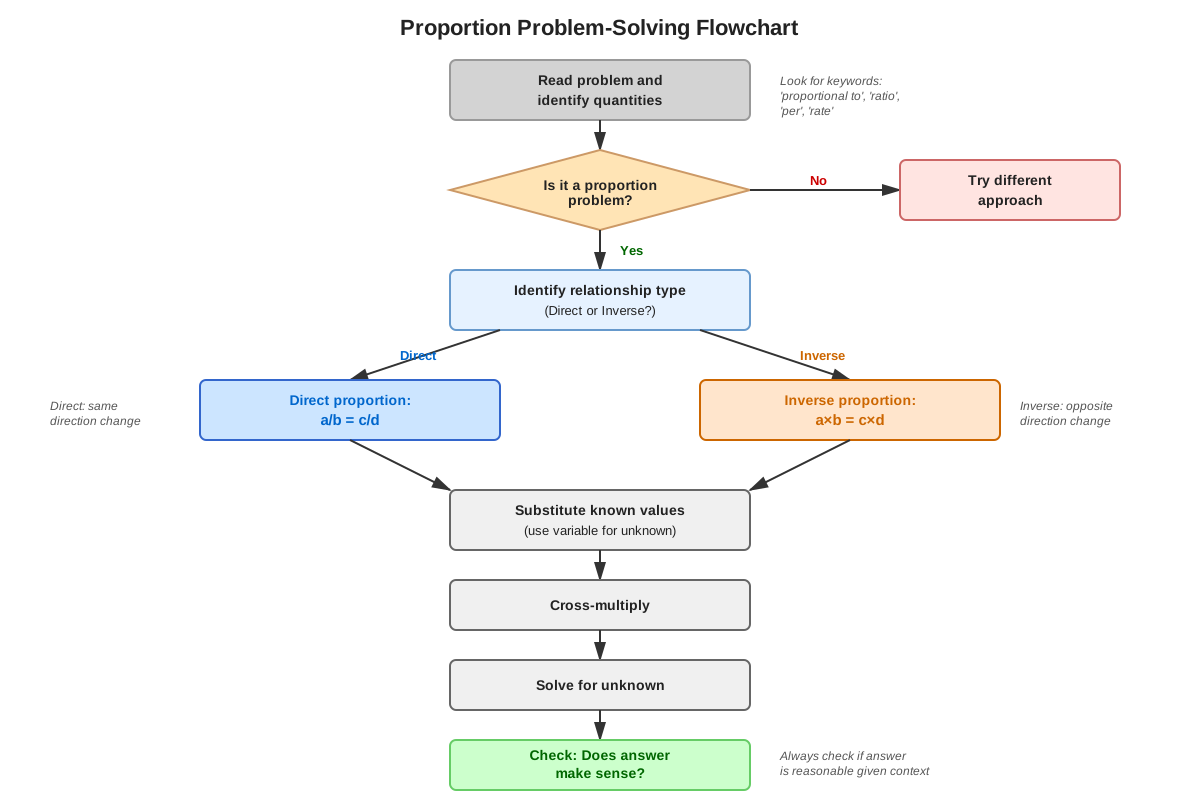
The critical skill for GRE success is translating word problems into correct proportion equations. Follow this systematic approach:
- Identify the quantities: Determine what is being compared (cost, time, distance, etc.)
- Determine the relationship type: Is it direct or inverse?
- Organize known and unknown values: Create a clear structure
- Set up the proportion: Ensure units match on each side
- Solve using cross-multiplication: Isolate the variable
Unit consistency is crucial: both numerators must have the same units, and both denominators must have the same units. For example, if comparing miles to hours, both ratios must be miles/hours or hours/miles—never mix.
Compound Proportions
Compound proportions involve three or more quantities changing simultaneously. These problems require careful analysis to determine which relationships are direct and which are inverse. The general approach:
- Fix all variables except two
- Establish the relationship between those two
- Repeat for other pairs
- Combine the relationships
For example: "If 6 workers can complete a job in 8 days working 5 hours per day, how many days will 4 workers need if they work 6 hours per day?" This involves workers (inverse to days), hours per day (inverse to days), and total days (the unknown).
Scale Factors and Proportional Scaling
Scale factors represent the multiplier relating corresponding dimensions in similar figures or scaled models. If a map uses a scale of 1:50,000, every 1 cm on the map represents 50,000 cm (or 500 m) in reality. The scale factor is 50,000.
When scaling areas, the scale factor is squared; when scaling volumes, it's cubed. If a figure's linear dimensions are multiplied by k, its area is multiplied by k², and its volume by k³. This principle frequently appears in GRE geometry problems involving similar triangles, scaled rectangles, or model-to-actual comparisons.
Proportion Tables
Organizing information in proportion tables helps visualize relationships and prevent setup errors:
| Scenario | Quantity A | Quantity B | Ratio |
|---|---|---|---|
| Original | 3 cups | 2 servings | 3:2 |
| Scaled | x cups | 5 servings | x:5 |
Setting up the proportion: 3/2 = x/5, therefore x = 7.5 cups.
Concept Relationships
Proportions serve as the connecting tissue between multiple arithmetic concepts. Ratios form the building blocks of proportions—a proportion is simply an equation stating two ratios are equal. This relationship flows naturally: understanding ratios → enables setting up proportions → which allows solving for unknown quantities in comparative situations.
Fractions and proportions are intimately connected because every proportion can be expressed as equivalent fractions. The skills of simplifying fractions, finding common denominators, and comparing fractions directly transfer to proportion work. Similarly, percentages are special ratios (parts per hundred), making percentage problems a subset of proportion problems. Converting "30% of what number is 45?" into the proportion 30/100 = 45/x demonstrates this connection.
Rates (speed, work rate, unit price) are ratios involving different units, and rate problems almost always involve proportional reasoning. The relationship flows: rates → proportions → solving for unknown quantities in rate contexts. Algebraic equations emerge from proportions through cross-multiplication, showing how proportions bridge arithmetic and algebra.
Within the topic itself, the concept map flows: Basic proportion definition → Cross-multiplication technique → Direct proportions → Inverse proportions → Compound proportions → Scale factors. Each concept builds on previous ones, with cross-multiplication serving as the universal solving technique applicable to all proportion types.
High-Yield Facts
⭐ The fundamental property of proportions: If a/b = c/d, then ad = bc (cross-multiplication)
⭐ Direct proportion indicator: "If A increases, B increases" or "A is proportional to B" → set up as A₁/B₁ = A₂/B₂
⭐ Inverse proportion indicator: "If A increases, B decreases" or "A is inversely proportional to B" → set up as A₁B₁ = A₂B₂
⭐ Unit consistency rule: In a/b = c/d, units of 'a' must match units of 'c', and units of 'b' must match units of 'd'
⭐ Scale factor for areas: If linear dimensions scale by factor k, area scales by k²
- Scale factor for volumes: If linear dimensions scale by factor k, volume scales by k³
- Proportion verification: In a/b = c/d, you can verify by checking if a×d = b×c
- Means-extremes property: The product of the means equals the product of the extremes
- Proportion chains: If a/b = c/d and c/d = e/f, then a/b = e/f (transitive property)
- Reciprocal proportions: If a/b = c/d, then b/a = d/c
- Component addition: If a/b = c/d, then (a+b)/b = (c+d)/d
- Proportion with three terms: a:b:c means a/b and b/c are both defined ratios
- Zero restriction: Proportions are undefined when any denominator equals zero
- Simplification first: Simplifying ratios before setting up proportions reduces computational errors
Quick check — test yourself on Proportions so far.
Try Flashcards →Common Misconceptions
Misconception: All proportion problems involve direct proportions where quantities increase together.
Correction: Inverse proportions are equally common on the GRE. Always analyze whether quantities move in the same direction (direct) or opposite directions (inverse). Speed-time problems at fixed distance are inverse, not direct.
Misconception: In a proportion a/b = c/d, you can add across to get (a+c)/(b+d).
Correction: Proportions do not allow simple addition across. You cannot combine a/b = c/d into (a+c)/(b+d) = c/d. Each ratio must be treated independently unless using specific proportion properties like componendo-dividendo.
Misconception: Units don't matter as long as the numbers are correct.
Correction: Unit consistency is critical. If one ratio uses miles/hour and you set it equal to a ratio using feet/minute without conversion, the proportion is invalid and will yield incorrect answers. Always ensure corresponding units match.
Misconception: Cross-multiplication can be used on any equation with fractions.
Correction: Cross-multiplication specifically applies to equations where one fraction equals another fraction (a/b = c/d). It doesn't apply to expressions like a/b + c/d = e/f without first simplifying to a single fraction on each side.
Misconception: Doubling one quantity in a proportion means doubling the answer.
Correction: The effect depends on where the quantity appears in the proportion. If you're solving for x in 3/4 = x/8, doubling the 8 to 16 would double x from 6 to 12. But doubling the 3 to 6 would also double x. The position matters, and you must solve the new proportion rather than assuming simple doubling.
Misconception: Proportions and ratios are the same thing.
Correction: A ratio is a comparison of two quantities (3:4), while a proportion is an equation stating two ratios are equal (3:4 = 6:8). Ratios are components; proportions are equations involving ratios.
Misconception: In map scale problems, a scale of 1:50,000 means 1 inch equals 50,000 inches.
Correction: While mathematically this is true, the scale means 1 unit equals 50,000 of the same unit. The key is maintaining unit consistency. If using centimeters on the map, the actual distance is in centimeters (which you'd then convert to practical units like meters or kilometers).
Worked Examples
Example 1: Direct Proportion with Recipe Scaling
Problem: A recipe for 8 servings requires 3 cups of flour. How many cups of flour are needed to make 14 servings?
Solution:
Step 1: Identify this as a direct proportion problem. More servings require more flour, so quantities increase together.
Step 2: Set up the proportion with consistent structure. Let x = cups of flour needed for 14 servings.
servings₁/flour₁ = servings₂/flour₂
8/3 = 14/x
Alternatively (and equivalently):
flour₁/servings₁ = flour₂/servings₂
3/8 = x/14
Step 3: Cross-multiply using the second setup:
3 × 14 = 8 × x
42 = 8x
x = 42/8 = 5.25
Step 4: Verify the answer makes sense. We're making 14/8 = 1.75 times the original recipe, so we need 1.75 × 3 = 5.25 cups. ✓
Answer: 5.25 cups of flour (or 5¼ cups)
Connection to Learning Objectives: This example demonstrates identifying a proportion problem (direct relationship between servings and ingredients), setting up the equation correctly with unit consistency, and solving accurately using cross-multiplication.
Example 2: Inverse Proportion with Work Rate
Problem: If 6 workers can complete a construction project in 15 days, how many days will it take 10 workers to complete the same project, assuming all workers work at the same rate?
Solution:
Step 1: Identify this as an inverse proportion problem. More workers complete the job in less time, so as workers increase, days decrease.
Step 2: For inverse proportions, the product remains constant:
workers₁ × days₁ = workers₂ × days₂Step 3: Substitute known values. Let d = days needed for 10 workers:
6 × 15 = 10 × d
90 = 10d
d = 9
Step 4: Verify using proportional reasoning. We have 10/6 = 5/3 times as many workers, so the time should be 3/5 of the original: 15 × 3/5 = 9 days. ✓
Answer: 9 days
Alternative approach using proportion setup:
Since this is inverse, we flip one ratio:
workers₁/workers₂ = days₂/days₁
6/10 = d/15
Cross-multiply:
6 × 15 = 10 × d
90 = 10d
d = 9
Connection to Learning Objectives: This example shows distinguishing between direct and inverse proportions (critical for correct setup), applying the inverse proportion formula, and verifying the answer through alternative reasoning—all essential GRE skills.
Example 3: Scale Factor with Area
Problem: A rectangular garden measures 20 feet by 30 feet. A scale model of the garden is created where 1 inch represents 5 feet. What is the area of the scale model in square inches?
Solution:
Step 1: Determine the scale factor. 1 inch : 5 feet means the linear scale factor is 1:5, or the model is 1/5 the actual size.
Step 2: Calculate model dimensions using proportions.
For length:
model/actual = 1/5
model/30 = 1/5
model = 30/5 = 6 inches
For width:
model/20 = 1/5
model = 20/5 = 4 inches
Step 3: Calculate model area:
Area = 6 × 4 = 24 square inchesStep 4: Verify using the area scale factor rule. Linear scale factor is 1/5, so area scale factor is (1/5)² = 1/25.
Actual area = 20 × 30 = 600 square feet
Model area = 600/25 = 24 square feet... wait, this should be square inches.
Converting: 600 square feet × (12 inches/foot)² = 600 × 144 = 86,400 square inches
Model area = 86,400/25 = 3,456... This doesn't match!
Correction: The scale factor 1 inch : 5 feet must be converted to consistent units.
1 inch : 60 inches (since 5 feet = 60 inches)
Linear scale factor = 1/60
Area scale factor = (1/60)² = 1/3600
Actual area in square inches = 600 × 144 = 86,400 square inches
Model area = 86,400/3600 = 24 square inches ✓
Answer: 24 square inches
Connection to Learning Objectives: This example demonstrates the importance of unit consistency, applying scale factors correctly (especially the squared relationship for area), and catching and correcting setup errors—all crucial for GRE success.
Exam Strategy
Trigger Words for Proportions: "per," "for every," "at this rate," "same rate," "scale of," "proportional to," "varies directly," "inversely proportional," "if...then how many/much"
Recognition Strategy: When you see a problem comparing two scenarios with different quantities but the same underlying relationship, immediately consider proportions. Questions asking "how many," "how much," or "how long" in a second scenario after describing a first scenario are prime proportion candidates.
Setup Decision Tree:
- Read the problem and identify all quantities
- Ask: "Do the quantities increase together or does one increase while the other decreases?"
- Together → Direct proportion → Set up as A₁/B₁ = A₂/B₂
- Opposite → Inverse proportion → Set up as A₁B₁ = A₂B₂
- Verify unit consistency before solving
- Cross-multiply and solve
- Check if the answer makes logical sense
Time Management: Proportion problems should take 1-2 minutes maximum. If you're spending longer, you may be overcomplicating. The GRE rewards efficient setup and straightforward solving. Practice recognizing proportion problems instantly to save time for more complex questions.
Quantitative Comparison Strategy: For QC questions involving proportions, often you can determine the relationship without fully solving. If Quantity A involves a larger numerator or smaller denominator in a direct proportion, it will be greater. Use estimation and proportional reasoning rather than complete calculation when possible.
Process of Elimination:
- Eliminate answers that violate the direction of change (if more of A requires more of B, eliminate answers showing less of B)
- Eliminate answers with wrong units
- Eliminate answers that are unreasonably large or small compared to given quantities
- Use benchmark values (if doubling one quantity, the answer should be roughly double)
Common Traps to Avoid:
- Don't assume all problems are direct proportions; check for inverse relationships
- Don't forget to convert units before setting up proportions
- Don't confuse ratio notation (3:4) with division (3÷4) in problem setup
- Don't round intermediate calculations; keep full precision until the final answer
Memory Techniques
CROSS Mnemonic for Proportion Solving:
- Check the relationship type (direct or inverse)
- Record all known values with units
- Organize into proportion format
- Solve using cross-multiplication
- Sanity check the answer
Direct vs. Inverse Memory Aid:
"Direct = Direction same" (both increase or both decrease)
"Inverse = In opposite directions" (one increases, other decreases)
Unit Consistency Visualization: Picture a proportion as a balanced scale. The units on the left pan must match the units on the right pan, or the scale tips (the proportion is invalid). Top units match top units; bottom units match bottom units.
Scale Factor Squares and Cubes: Remember "Linear, Area, Volume" = "LAV" = "1, 2, 3" for exponents. Linear scale factor k¹, Area scale factor k², Volume scale factor k³.
Cross-Multiplication Hand Trick: Draw an X with your finger over the proportion a/b = c/d. Your finger crosses from 'a' to 'd' and from 'b' to 'c', showing which terms to multiply: ad = bc.
Inverse Proportion Phrase: "More workers, less time" or "Faster speed, less time"—the word "less" signals inverse. Create similar phrases for common inverse relationships you encounter.
Summary
Proportions represent equations stating that two ratios are equal, forming a cornerstone of GRE Quantitative Reasoning that appears across 15-20% of math questions. Mastery requires distinguishing between direct proportions (where quantities change in the same direction) and inverse proportions (where quantities change in opposite directions), then setting up equations with strict unit consistency. The cross-multiplication technique (if a/b = c/d, then ad = bc) provides the primary solving method, transforming proportions into simple algebraic equations. GRE problems embed proportions in diverse contexts including recipe scaling, map scales, rate problems, work problems, and geometric similarity. Success demands rapid problem recognition through trigger words, systematic setup following the CROSS framework, and verification that answers align with logical expectations. Scale factors require special attention: linear dimensions scale by k, areas by k², and volumes by k³. The ability to translate word problems into correct proportion equations, maintain unit consistency throughout, and solve efficiently separates high scorers from average performers on proportion questions.
Key Takeaways
- Proportions are equations of equal ratios (a/b = c/d), solved primarily through cross-multiplication (ad = bc)
- Direct proportions show quantities changing together (more A means more B); inverse proportions show opposite changes (more A means less B)
- Unit consistency is non-negotiable: corresponding terms in a proportion must have matching units
- Recognition triggers include "at this rate," "per," "for every," "scale of," and comparative scenarios
- Scale factors affect area by k² and volume by k³ when linear dimensions scale by k
- Setup accuracy matters more than computational speed: a correctly structured proportion solves easily; an incorrect setup leads to wrong answers despite perfect arithmetic
- Verification through proportional reasoning (does doubling this quantity logically double that quantity?) catches errors and builds confidence
Related Topics
Ratios and Rates: Proportions build directly on ratio concepts, and mastering ratio simplification and comparison enhances proportion setup speed and accuracy. Rate problems (speed, work rate, unit cost) are specialized proportion applications.
Percentages: Percentage problems are proportions in disguise, with one ratio always involving 100 as the denominator. Strong proportion skills make percentage calculations more intuitive and flexible.
Similar Figures and Geometry: Geometric similarity relies entirely on proportional relationships between corresponding sides, angles, and areas. Proportion mastery enables efficient solving of triangle similarity, scale drawing, and geometric scaling problems.
Mixture Problems: These advanced problems involve proportions of components in solutions or combinations, requiring compound proportion reasoning and weighted average concepts.
Algebraic Word Problems: Many algebra problems that seem to require complex equation systems can be solved more efficiently using proportional reasoning, making proportions a powerful problem-solving shortcut.
Practice CTA
Now that you've mastered the core concepts, strategies, and common pitfalls of proportions, it's time to solidify your understanding through active practice. Attempt the practice questions designed specifically for this topic, focusing on recognizing problem types quickly and setting up proportions accurately. Use the flashcards to drill the key facts, formulas, and trigger words until they become automatic. Remember: proportion problems reward systematic thinking and careful setup more than computational prowess. Each practice problem you solve correctly builds the pattern recognition and confidence you need to excel on test day. Your investment in mastering proportions will pay dividends across multiple question types throughout the GRE Quantitative section!
Sign up free to keep reading
Create a free AnvayaPrep account to finish this GRE guide on Proportions — plus flashcards and practice questions.