Overview
Rates are among the most frequently tested quantitative concepts on the GRE, appearing in multiple question formats across both the Quantitative Comparison and Problem Solving sections. At its core, a rate describes how one quantity changes in relation to another—most commonly, how much work gets done per unit of time, how fast an object travels per unit of distance, or how costs accumulate per unit of quantity. The fundamental relationship underlying all GRE rates problems is the equation: Rate × Time = Work (or Distance = Rate × Time for motion problems). Mastering rates requires not just memorizing formulas, but developing the ability to set up equations that model complex scenarios involving multiple workers, varying speeds, or combined efforts.
Understanding rates is essential for GRE success because these problems test multiple mathematical skills simultaneously: algebraic manipulation, proportional reasoning, unit conversion, and logical problem-solving. Rate problems often appear disguised within word problems that require careful translation from English into mathematical expressions. The GRE particularly favors questions that combine rates with other arithmetic concepts such as ratios, percentages, and averages, making this topic a critical bridge between basic arithmetic and more advanced problem-solving.
Within the broader Quantitative Reasoning framework, rates connect directly to fundamental concepts of proportionality and inverse relationships. They require facility with fractions (since rates are often expressed as ratios), comfort with algebraic equations (for setting up and solving rate problems), and strong number sense (for estimating reasonable answers). Rate problems also frequently incorporate real-world contexts—travel scenarios, work completion, pipe-filling problems, and production rates—making them excellent vehicles for testing practical mathematical reasoning under timed conditions.
Learning Objectives
- [ ] Identify when Rates is being tested in GRE questions
- [ ] Explain the core rule or strategy behind Rates problems
- [ ] Apply Rates formulas to GRE-style questions accurately
- [ ] Convert between different rate units and recognize equivalent rate expressions
- [ ] Solve combined rate problems involving multiple workers or travelers
- [ ] Distinguish between and correctly apply the formulas for work rates, speed/distance rates, and unit rates
- [ ] Analyze inverse relationships between rate and time when work or distance remains constant
Prerequisites
- Basic algebraic manipulation: Essential for setting up and solving rate equations, particularly when isolating variables or combining terms
- Fraction operations: Necessary because rates are often expressed as fractions (e.g., 1/3 of a job per hour) and combined rate problems require adding fractions
- Unit awareness: Critical for ensuring dimensional consistency and converting between different measurement systems (hours to minutes, miles to kilometers)
- Proportional reasoning: Fundamental for understanding how changes in one variable affect another in rate relationships
- Word problem translation: Required to convert verbal descriptions into mathematical expressions and equations
Why This Topic Matters
Rate problems appear in approximately 15-20% of GRE Quantitative Reasoning questions, making them one of the highest-yield topics for focused study. These questions test not only computational skills but also logical reasoning and the ability to model real-world situations mathematically—competencies that graduate programs value highly. The GRE uses rate problems to differentiate between students who merely memorize formulas and those who truly understand underlying mathematical relationships.
In practical applications, rate concepts underpin countless real-world calculations: determining travel times for commutes, calculating project completion timelines, analyzing productivity metrics, understanding fuel efficiency, and comparing unit prices while shopping. Professional fields from engineering to economics rely heavily on rate analysis, making this mathematical skill valuable far beyond the exam itself.
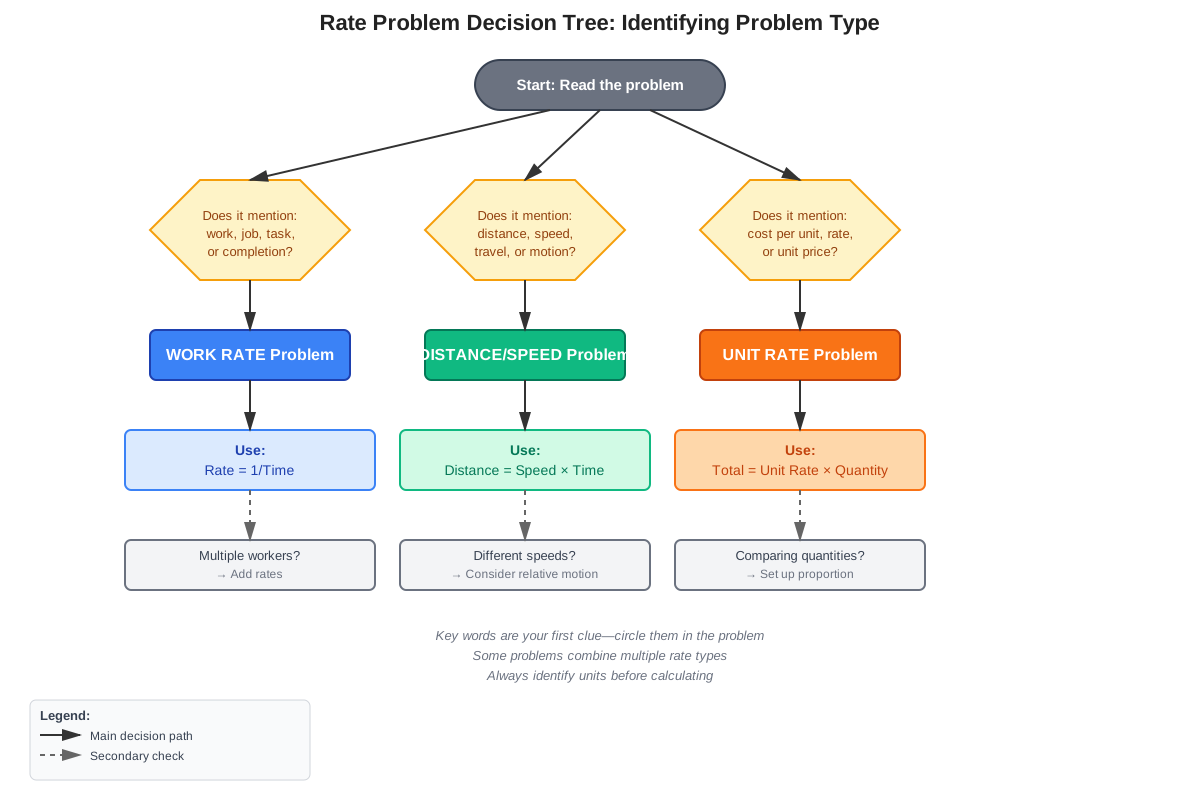
On the GRE, rate problems commonly appear as: (1) work rate questions asking how long multiple workers take to complete a task together; (2) distance-rate-time problems involving travelers moving at different speeds or in opposite directions; (3) unit rate comparisons requiring students to determine which option offers better value; (4) combined rate scenarios where rates change over time or multiple processes occur simultaneously; and (5) inverse rate relationships testing understanding of how doubling speed affects time. The exam particularly favors questions that require setting up equations rather than simple plug-and-chug calculations, rewarding students who understand the conceptual framework.
Core Concepts
The Fundamental Rate Formula
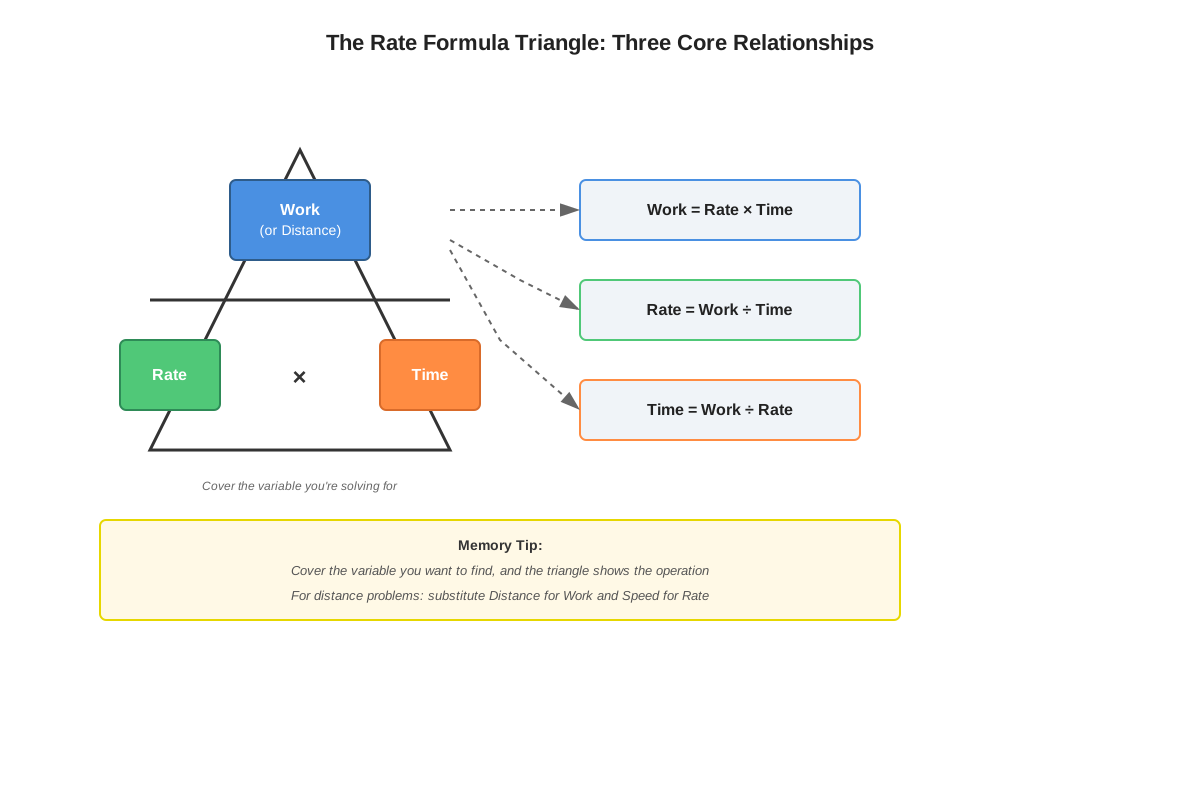
The foundation of all rate problems rests on a simple relationship between three quantities. For work rates, the formula is:
Rate × Time = Work CompletedFor distance rates (speed problems), the equivalent formula is:
Speed × Time = DistanceThese formulas can be rearranged to solve for any variable:
- Rate = Work ÷ Time (or Speed = Distance ÷ Time)
- Time = Work ÷ Rate (or Time = Distance ÷ Speed)
The key insight is that rate measures "how much per unit of time." If a painter completes 1/4 of a room per hour, their rate is 0.25 rooms/hour. If a car travels 60 miles in one hour, its rate (speed) is 60 mph. Understanding this "per unit" nature of rates is crucial for setting up problems correctly.
Individual Work Rates
When a single worker or machine completes a task, the work rate is calculated as the reciprocal of the time required. If John can paint a fence in 6 hours working alone, his rate is 1/6 of the fence per hour. This reciprocal relationship is fundamental:
Rate = 1 / Time to complete entire jobThis means if someone works at rate r, the time to complete the whole job is 1/r. For example, if a machine operates at a rate of 1/8 jobs per hour, it takes 8 hours to complete one full job. This reciprocal relationship often confuses students but is essential for combined rate problems.
Combined Work Rates
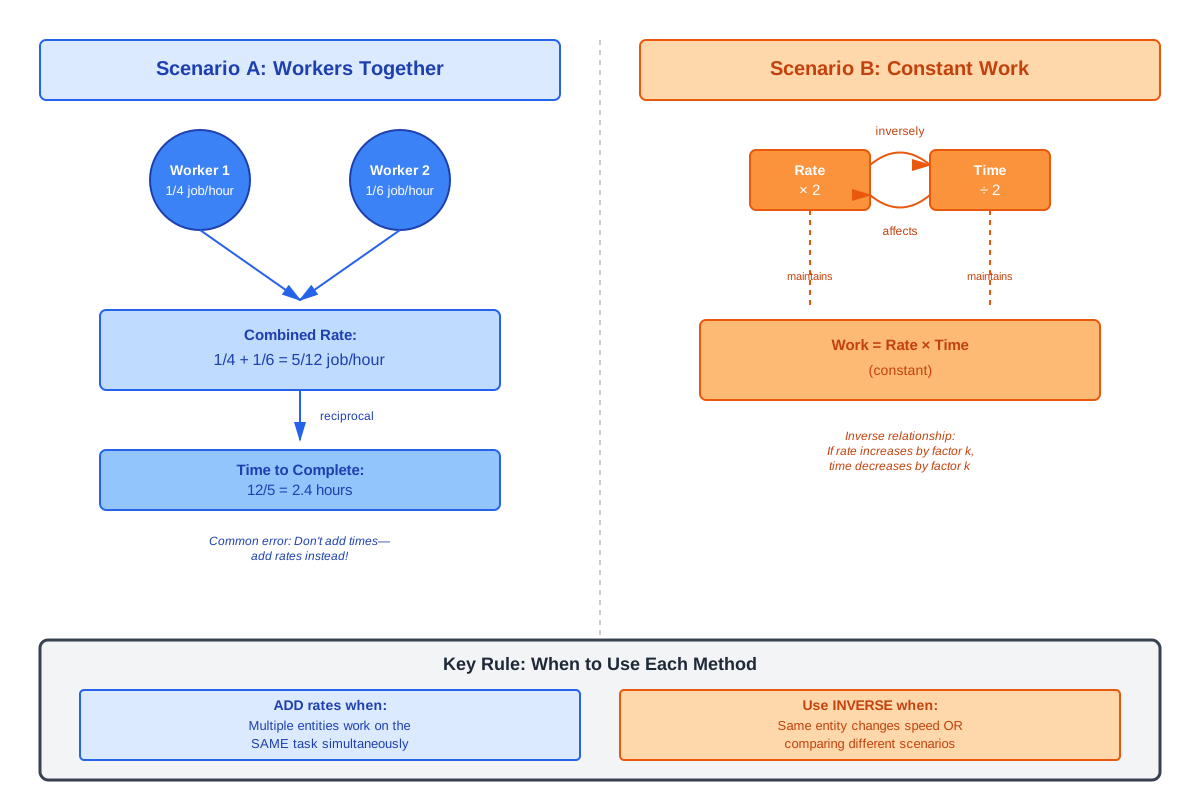
When multiple workers or machines work together simultaneously, their individual rates add together to produce a combined rate. This is perhaps the most tested concept in GRE rate problems:
Combined Rate = Rate₁ + Rate₂ + Rate₃ + ...For example, if Alice can complete a task in 4 hours (rate = 1/4 per hour) and Bob can complete the same task in 6 hours (rate = 1/6 per hour), their combined rate when working together is:
Combined Rate = 1/4 + 1/6 = 3/12 + 2/12 = 5/12 per hourTo find the time to complete the job together, take the reciprocal: 12/5 = 2.4 hours.
Exam Tip: Always add rates, never add times. A common error is to average the individual times, which produces incorrect answers.
Distance-Rate-Time Problems
Speed problems follow the same mathematical structure as work problems but use different terminology. The relationship is:
Distance = Rate × Time (D = RT)These problems often involve:
- Same direction travel: Two objects moving in the same direction with different speeds (relative speed = difference of speeds)
- Opposite direction travel: Two objects moving toward or away from each other (relative speed = sum of speeds)
- Round trip scenarios: Different speeds for different legs of a journey
For opposite direction problems, if two cars start 300 miles apart and drive toward each other at 40 mph and 50 mph respectively, their combined approach rate is 90 mph, so they meet in 300 ÷ 90 = 3.33 hours.
Average Rate vs. Average Speed
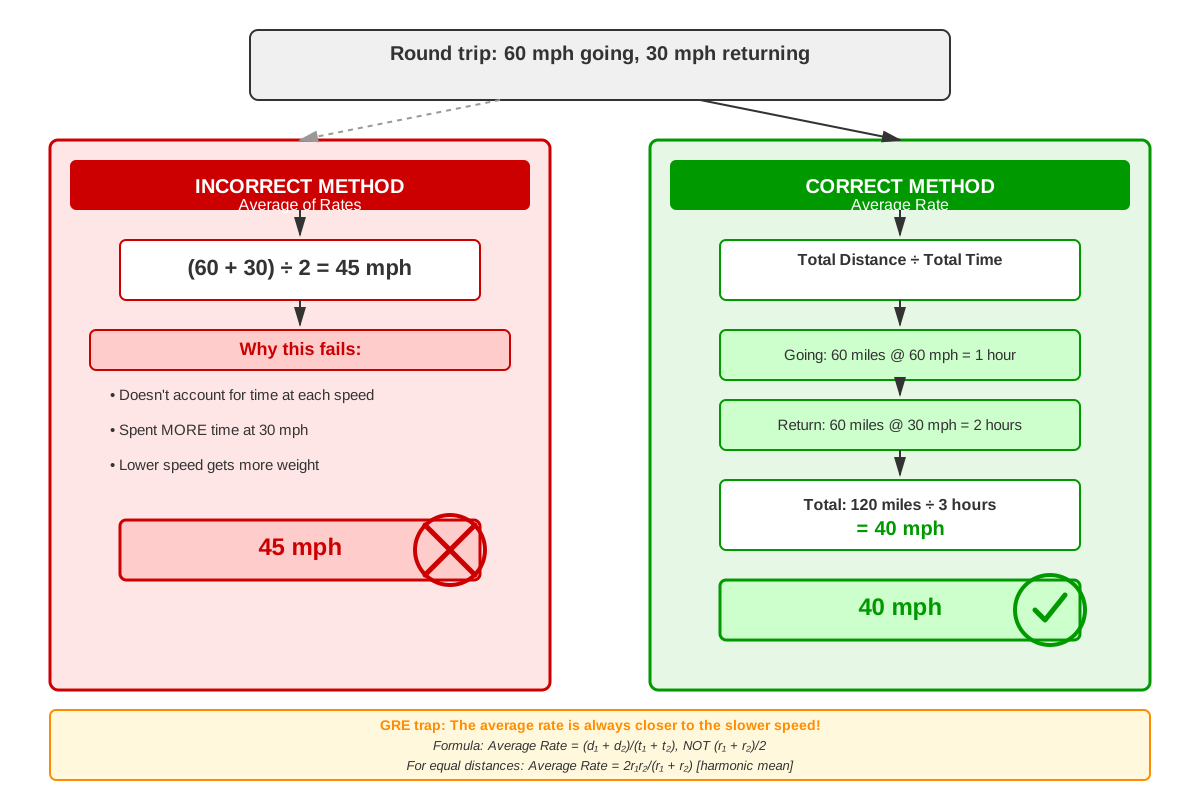
A critical distinction that the GRE frequently tests: average rate is NOT the arithmetic mean of two rates. Average rate must be calculated using the total work (or distance) divided by total time:
Average Rate = Total Work / Total TimeFor example, if you drive 60 miles at 30 mph (taking 2 hours) and then 60 miles at 60 mph (taking 1 hour), your average speed is NOT 45 mph. Instead:
Average Speed = 120 miles / 3 hours = 40 mphThis concept appears frequently in GRE questions designed to trap students who simply average the two speeds.
Unit Rates and Conversions
A unit rate expresses a rate with a denominator of 1 (e.g., $3 per pound, 25 miles per gallon). Many GRE problems require converting between different units:
| Original Rate | Conversion | New Rate |
|---|---|---|
| 60 mph | × 1.6 km/mile | 96 km/h |
| 5 dollars/hour | ÷ 60 min/hour | 1/12 dollars/minute |
| 120 words/2 minutes | ÷ 2 | 60 words/minute |
Always ensure units cancel properly when multiplying or dividing rates. The GRE often includes answer choices with incorrect unit conversions to trap careless students.
Inverse Rate Relationships
When work or distance remains constant, rate and time have an inverse relationship: if you double the rate, you halve the time. Mathematically:
Rate₁ × Time₁ = Rate₂ × Time₂This relationship enables quick proportional reasoning. If a machine operating at rate r completes a job in 8 hours, the same machine operating at rate 2r completes the job in 4 hours. Understanding this inverse proportionality allows for efficient problem-solving without extensive calculation.
Partial Work and Fractional Completion
Many GRE problems involve scenarios where work is partially completed at one rate, then finished at another rate. The key principle: the sum of all fractional work completed must equal 1 (the whole job):
(Rate₁ × Time₁) + (Rate₂ × Time₂) = 1 complete jobFor example, if a pump working alone would take 10 hours to fill a pool, and it runs for 3 hours, it completes 3/10 of the job, leaving 7/10 remaining.
Concept Relationships
The concepts within rate problems form a hierarchical structure. The fundamental rate formula (Rate × Time = Work) serves as the foundation from which all other concepts derive. Understanding individual work rates as reciprocals of completion times enables calculation of combined work rates through addition. This additive property of rates distinguishes them from times, which cannot be simply added or averaged.
Distance-rate-time problems represent a parallel application of the same fundamental formula, with distance substituting for work and speed substituting for rate. The concept of average rate builds upon the fundamental formula by requiring total work divided by total time, explicitly connecting to the prerequisite concept of weighted averages rather than simple arithmetic means.
Unit rates and conversions apply across all rate problem types, serving as a practical tool for ensuring dimensional consistency. The inverse relationship between rate and time emerges directly from the fundamental formula: when work (or distance) is held constant, rate and time must vary inversely to maintain the equality.
The relationship map flows as follows:
Fundamental Rate Formula → Individual Rates (reciprocal of time) → Combined Rates (sum of individual rates) → Time to Complete Together (reciprocal of combined rate)
Simultaneously: Fundamental Rate Formula → Distance Problems (D = RT) → Average Speed (total distance / total time) → Inverse Relationships (doubling rate halves time)
All concepts connect back to prerequisite knowledge of fractions (for expressing rates), algebra (for solving equations), and proportional reasoning (for understanding relationships between variables).
Quick check — test yourself on Rates so far.
Try Flashcards →High-Yield Facts
⭐ The combined rate of multiple workers equals the sum of their individual rates: If working together, add the rates, then take the reciprocal to find time.
⭐ Individual work rate equals 1 divided by the time to complete the entire job alone: If someone takes 5 hours alone, their rate is 1/5 per hour.
⭐ Average rate equals total work (or distance) divided by total time: Never simply average two different rates arithmetically.
⭐ When rate and time are inversely proportional: Rate₁ × Time₁ = Rate₂ × Time₂ (when work or distance is constant).
⭐ For opposite-direction travel, add the speeds: Two objects approaching each other have a relative speed equal to the sum of their individual speeds.
- For same-direction travel, subtract the speeds to find relative speed: The faster object gains on the slower at a rate equal to the difference.
- Unit conversion requires multiplying or dividing by conversion factors: Ensure units cancel properly to reach the desired unit.
- Partial work completed equals rate multiplied by time worked: If working at rate r for time t, the fraction completed is r × t.
- The reciprocal of a combined rate gives the time to complete one full job together: If combined rate is 5/12 per hour, time is 12/5 hours.
- Distance equals rate times time for each segment of a journey: For multi-leg trips, calculate each segment separately then sum.
- Rates can be expressed in various equivalent forms: 60 mph = 1 mile per minute = 88 feet per second (all equivalent).
- When a rate increases by a factor, time decreases by the same factor: Tripling speed reduces time to one-third.
Common Misconceptions
Misconception: When two workers complete a job together, the time taken is the average of their individual times.
Correction: Times cannot be averaged directly. Instead, convert to rates (reciprocals of times), add the rates, then convert back to time. If one worker takes 4 hours and another takes 6 hours, the combined time is NOT 5 hours—it's 2.4 hours (from combined rate of 1/4 + 1/6 = 5/12, reciprocal = 12/5 = 2.4).
Misconception: Average speed for a round trip equals the arithmetic mean of the two speeds.
Correction: Average speed must be calculated as total distance divided by total time. If you travel 60 miles at 30 mph and return 60 miles at 60 mph, average speed is 120/(2+1) = 40 mph, not 45 mph.
Misconception: If you double your speed, you double your distance in the same time.
Correction: This is actually TRUE and not a misconception—but students often confuse this with the false belief that doubling speed doubles the time (it actually halves the time for the same distance).
Misconception: Combined rates should be calculated by taking the reciprocal of the sum of times.
Correction: First convert times to rates (take reciprocals), then add the rates, then take the reciprocal of the sum if you need time. The formula is NOT 1/(T₁ + T₂).
Misconception: When traveling in opposite directions, you subtract speeds to find when objects meet.
Correction: For opposite-direction travel (approaching each other), you ADD the speeds. Subtraction applies only to same-direction travel when finding relative speed.
Misconception: A rate of "3 jobs per 2 hours" is the same as "1.5 jobs per hour" and can be used interchangeably without conversion.
Correction: While these are equivalent rates, you must convert to a consistent time unit before combining with other rates. Always express rates with the same denominator before adding.
Misconception: If a machine's rate increases by 50%, the time decreases by 50%.
Correction: The relationship is inverse but not by the same percentage. If rate increases by 50% (multiplied by 1.5), time is divided by 1.5, which is a decrease of 33.3%, not 50%.
Worked Examples
Example 1: Combined Work Rate Problem
Problem: Machine A can produce 200 widgets in 5 hours. Machine B can produce 200 widgets in 8 hours. If both machines work together, how long will it take them to produce 200 widgets?
Solution:
Step 1: Calculate individual rates.
- Machine A's rate: 200 widgets ÷ 5 hours = 40 widgets/hour
- Machine B's rate: 200 widgets ÷ 8 hours = 25 widgets/hour
Step 2: Calculate combined rate.
- Combined rate = 40 + 25 = 65 widgets/hour
Step 3: Calculate time to produce 200 widgets.
- Time = Work ÷ Rate = 200 widgets ÷ 65 widgets/hour
- Time = 200/65 = 40/13 ≈ 3.08 hours
Alternative approach using reciprocals:
- Machine A completes 1 job in 5 hours, so rate = 1/5 jobs/hour
- Machine B completes 1 job in 8 hours, so rate = 1/8 jobs/hour
- Combined rate = 1/5 + 1/8 = 8/40 + 5/40 = 13/40 jobs/hour
- Time for 1 job = 40/13 hours ≈ 3.08 hours
Connection to learning objectives: This problem demonstrates identifying a combined work rate scenario, applying the core strategy of adding individual rates, and accurately calculating the answer using the fundamental rate formula.
Example 2: Average Speed Problem
Problem: Sarah drives from City A to City B, a distance of 120 miles, at an average speed of 40 mph. She then drives back from City B to City A at an average speed of 60 mph. What is her average speed for the entire round trip?
Solution:
Step 1: Calculate time for each leg of the trip.
- Time from A to B: Distance ÷ Speed = 120 miles ÷ 40 mph = 3 hours
- Time from B to A: Distance ÷ Speed = 120 miles ÷ 60 mph = 2 hours
Step 2: Calculate total distance and total time.
- Total distance = 120 + 120 = 240 miles
- Total time = 3 + 2 = 5 hours
Step 3: Calculate average speed.
- Average speed = Total distance ÷ Total time = 240 miles ÷ 5 hours = 48 mph
Common trap: Students might calculate (40 + 60) ÷ 2 = 50 mph, which is incorrect. The average speed is NOT the arithmetic mean of the two speeds because Sarah spent different amounts of time traveling at each speed.
Why the answer makes sense: Sarah spent more time (3 hours) traveling at the slower speed (40 mph) than at the faster speed (2 hours at 60 mph), so the average should be weighted toward the slower speed, giving us 48 mph rather than 50 mph.
Connection to learning objectives: This problem tests the ability to identify when average rate calculation is required, explains why simple averaging fails, and demonstrates the correct application of the total distance/total time formula.
Exam Strategy
Identifying Rate Problems
Watch for these trigger words and phrases that signal rate problems:
- "How long will it take..."
- "Working together..."
- "At what speed/rate..."
- "Per hour/per day/per unit"
- "Complete the job/task/project"
- "Traveling toward/away from each other"
- "Fill/empty a tank/pool"
- "Produce/manufacture items"
Systematic Approach
- Identify what type of rate problem: Work rate, distance/speed, or unit rate comparison
- Extract the given information: Write down all rates, times, and work/distance values
- Determine what the question asks for: Time, rate, distance, or work completed
- Set up the fundamental equation: Use R × T = W or D = R × T
- Solve algebraically: Isolate the unknown variable
- Check units: Ensure your answer has the correct units and makes logical sense
Process of Elimination Tips
- Eliminate answers with wrong units: If the question asks for hours, eliminate answers in minutes
- Use estimation: If two workers each take about 10 hours alone, together they'll take less than 10 hours but more than 5 hours—eliminate answers outside this range
- Check extreme cases: If a rate doubles, time should halve—eliminate answers that don't reflect this relationship
- Verify with the average trap: If you see the arithmetic mean of two speeds as an answer choice for average speed, it's likely wrong
Time Allocation
For rate problems on the GRE:
- Simple rate problems (single worker or traveler): 1-1.5 minutes
- Combined rate problems (multiple workers): 1.5-2 minutes
- Complex multi-step problems (changing rates, partial work): 2-2.5 minutes
If a rate problem is taking longer than 2.5 minutes, mark it for review and move on. These problems should be straightforward once you identify the type and set up the equation correctly.
Common Question Formats
Quantitative Comparison: Often compares times or rates under different scenarios. Strategy: Don't calculate exact values if you can determine the relationship through proportional reasoning.
Multiple Choice: Usually requires complete calculation. Strategy: Set up the equation carefully and solve step-by-step, checking units throughout.
Numeric Entry: Demands precise calculation. Strategy: Double-check your arithmetic and ensure you're answering what's asked (e.g., hours vs. minutes).
Memory Techniques
The "RTW" Triangle
Visualize a triangle with R (Rate) at the top, and T (Time) and W (Work) at the bottom corners. Cover the variable you're solving for, and the remaining two show the operation:
- Cover R: W ÷ T = R
- Cover T: W ÷ R = T
- Cover W: R × T = W
This works identically for distance problems (D, R, T).
The "Add Rates, Not Times" Mantra
Repeat: "Rates add, times don't." When workers combine, their rates add together. Never add or average the times directly.
The Reciprocal Relationship Reminder
"Time to rate: flip it. Rate to time: flip it."
- If someone takes 6 hours → their rate is 1/6
- If combined rate is 5/12 → time is 12/5
The Average Speed Acronym: "TDT"
Total Distance over Total Time = Average Speed
Not "Average of speeds"—always TDT.
Opposite vs. Same Direction
"Opposite: Add. Same: Subtract."
- Objects moving toward/away from each other (opposite directions): add speeds
- Objects moving in the same direction: subtract speeds for relative speed
Unit Conversion Visualization
Think of conversion factors as fractions that equal 1:
- (60 minutes / 1 hour) = 1
- (1 mile / 5280 feet) = 1
Multiply by these "ones" to convert units without changing the value.
Summary
Rates represent one of the most essential and frequently tested concepts in GRE Quantitative Reasoning, appearing in approximately 15-20% of questions. The fundamental relationship—Rate × Time = Work (or Distance = Rate × Time)—serves as the foundation for all rate problems. Mastery requires understanding that rates measure "how much per unit of time" and can be added when multiple workers or travelers operate simultaneously. The critical insight for combined work problems is that individual rates (calculated as reciprocals of completion times) add together to produce a combined rate, from which the time to complete the job together can be found by taking the reciprocal. Distance-rate-time problems follow identical mathematical principles but use different terminology. A crucial distinction that the GRE frequently tests is that average rate must be calculated as total work (or distance) divided by total time, never as the arithmetic mean of different rates. Understanding inverse relationships—that doubling rate halves time when work remains constant—enables efficient problem-solving through proportional reasoning. Success on GRE rate problems requires not just formula memorization but the ability to translate word problems into mathematical equations, recognize problem types from trigger words, and systematically apply the appropriate strategy while maintaining careful attention to units and dimensional consistency.
Key Takeaways
- The fundamental formula Rate × Time = Work (or D = RT) underlies all rate problems and can be rearranged to solve for any variable
- Combined rates equal the sum of individual rates—always add rates when workers or machines operate together, never add times
- Individual work rate equals the reciprocal of time to complete the job alone: 6 hours alone means rate of 1/6 per hour
- Average rate requires total work divided by total time, not the arithmetic mean of different rates—this is one of the most common GRE traps
- Rate and time have an inverse relationship when work or distance is constant: doubling rate halves time, tripling rate reduces time to one-third
- For opposite-direction travel add speeds; for same-direction travel subtract speeds to find relative speed
- Always verify units are consistent throughout calculations and that your final answer has the correct units for what the question asks
Related Topics
Ratios and Proportions: Rates are fundamentally ratios that compare two quantities with different units. Mastering rates provides a foundation for more complex proportional reasoning problems, including scale factors and similar figures.
Work and Time Problems: An extension of basic rate concepts, these problems often involve varying rates, breaks in work, or efficiency changes. Strong rate fundamentals make these advanced problems manageable.
Mixture Problems: These combine rate concepts with weighted averages, such as determining the concentration when mixing solutions of different strengths—essentially a rate of substance per unit volume.
Percent Change and Growth: Understanding rates enables analysis of growth rates, compound interest, and percent increase/decrease over time, which are tested extensively in GRE Data Interpretation questions.
Distance and Motion Graphs: Visual representations of distance-rate-time relationships require interpreting slopes (which represent rates) and areas under curves, building on fundamental rate concepts.
Practice CTA
Now that you've mastered the core concepts, formulas, and strategies for rate problems, it's time to solidify your understanding through active practice. Attempt the practice questions associated with this topic, focusing on identifying problem types quickly and setting up equations systematically. Use the flashcards to reinforce key formulas and relationships until they become automatic. Remember: rate problems reward careful setup and methodical problem-solving more than computational speed. Each practice problem you complete builds pattern recognition that will save you valuable time on test day. You've built a strong foundation—now apply it with confidence!
Sign up free to keep reading
Create a free AnvayaPrep account to finish this GRE guide on Rates — plus flashcards and practice questions.