Overview
Repeating decimals are decimal numbers in which one or more digits repeat infinitely in a predictable pattern. On the GRE, understanding repeating decimals is crucial because these numbers frequently appear in fraction-to-decimal conversions, comparison problems, and arithmetic operations. The ability to recognize, convert, and manipulate repeating decimals efficiently can save valuable time and prevent calculation errors during the exam. Questions involving repeating decimals often test a student's number sense, pattern recognition, and understanding of rational numbers.
The GRE Quantitative Reasoning section regularly incorporates gre repeating decimals in both Quantitative Comparison and Problem Solving questions. These problems may ask test-takers to convert fractions to decimals, identify patterns in decimal expansions, or perform operations with numbers that have repeating decimal representations. Understanding repeating decimals also strengthens foundational knowledge about the relationship between fractions and decimals, which is essential for tackling more complex problems involving ratios, percentages, and proportions.
Mastery of repeating decimals connects directly to broader arithmetic concepts including fraction operations, rational numbers, and decimal place value. This topic serves as a bridge between basic fraction manipulation and more advanced quantitative reasoning skills. Students who can quickly identify and work with repeating decimals gain a significant advantage in time management and accuracy, particularly on questions that might otherwise require lengthy long division or calculator work (which is not always available on the GRE).
Learning Objectives
- [ ] Identify when Repeating decimals is being tested
- [ ] Explain the core rule or strategy behind Repeating decimals
- [ ] Apply Repeating decimals to GRE-style questions accurately
- [ ] Convert repeating decimals to their equivalent fraction form
- [ ] Recognize patterns in decimal expansions based on denominator properties
- [ ] Perform arithmetic operations involving repeating decimals efficiently
- [ ] Compare the relative size of numbers involving repeating decimals
Prerequisites
- Fraction fundamentals: Understanding numerators, denominators, and equivalent fractions is essential because repeating decimals are alternative representations of rational numbers
- Long division: Basic division skills are necessary to understand how repeating decimals are generated from fractions
- Place value: Knowledge of decimal place values (tenths, hundredths, thousandths) helps in recognizing and interpreting repeating patterns
- Basic arithmetic operations: Proficiency with addition, subtraction, multiplication, and division enables manipulation of repeating decimals in problem-solving contexts
Why This Topic Matters
Repeating decimals appear in everyday contexts ranging from calculating tips and sales tax to understanding financial ratios and statistical data. In engineering and science, repeating decimals emerge naturally when expressing measurements as fractions of standard units. Understanding that certain fractions inevitably produce repeating decimals helps in making informed decisions about when to use decimal versus fractional representations in practical applications.
On the GRE, repeating decimals appear in approximately 5-8% of Quantitative Reasoning questions, making them a medium-to-high frequency topic. They most commonly appear in Quantitative Comparison questions where students must determine relationships between fractions and decimals, in Problem Solving questions involving fraction-to-decimal conversions, and in Data Interpretation questions where repeating patterns must be recognized. The topic also appears indirectly in questions about rational numbers, number properties, and arithmetic sequences.
The GRE tests repeating decimals through several common question formats: direct conversion problems asking for the decimal equivalent of a fraction; comparison questions requiring students to order numbers that include both fractions and repeating decimals; word problems where the answer naturally produces a repeating decimal; and pattern recognition questions that test understanding of which fractions produce terminating versus repeating decimals. Questions may also involve operations with repeating decimals or require students to identify the fractional equivalent of a given repeating decimal.
Core Concepts
Definition and Notation
A repeating decimal (also called a recurring decimal) is a decimal representation of a number in which a digit or group of digits repeats infinitely. The repeating portion is called the repetend or period. Standard mathematical notation uses a bar (vinculum) over the repeating digits to indicate the pattern. For example, 0.333... is written as 0.3̄, and 0.142857142857... is written as 0.1̄4̄2̄8̄5̄7̄.
There are two types of repeating decimals: pure repeating decimals where the repetition begins immediately after the decimal point (like 0.6̄ = 0.666...), and mixed repeating decimals where some non-repeating digits appear before the repeating pattern begins (like 0.16̄ = 0.1666...). Understanding this distinction is important for conversion problems and pattern recognition on the GRE.
Converting Fractions to Repeating Decimals
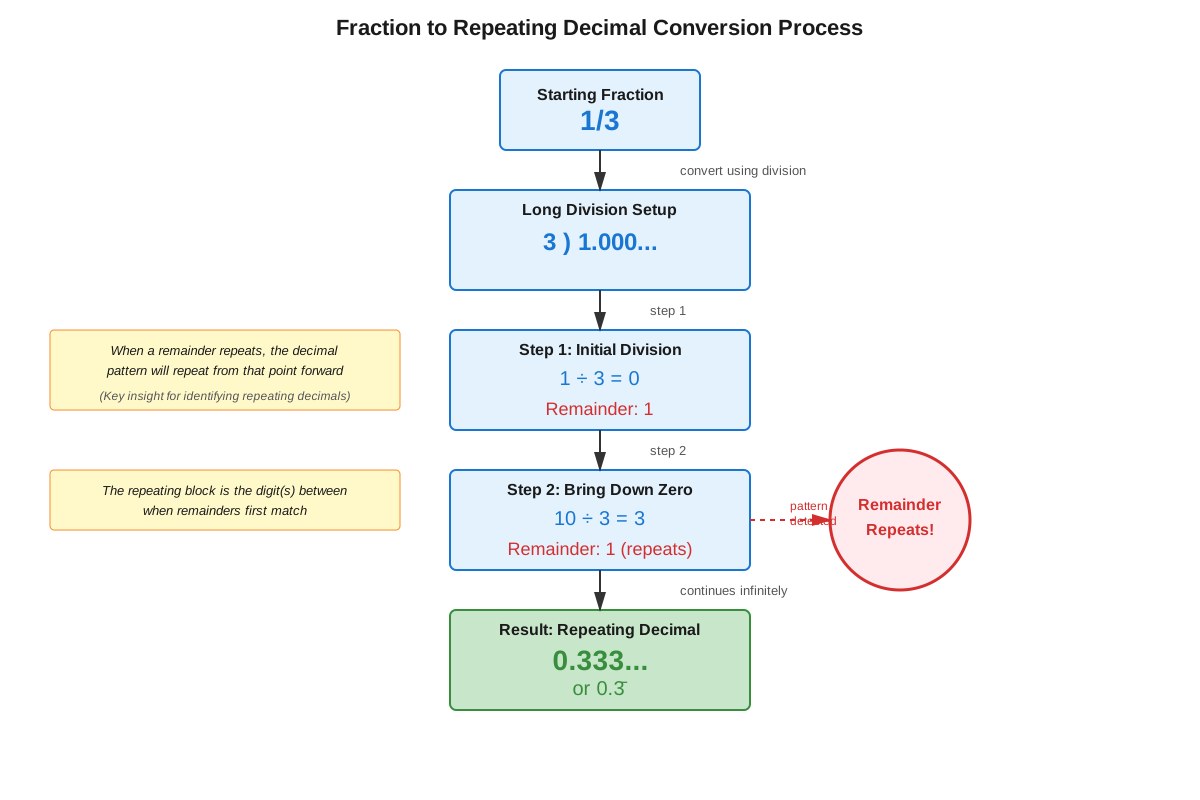
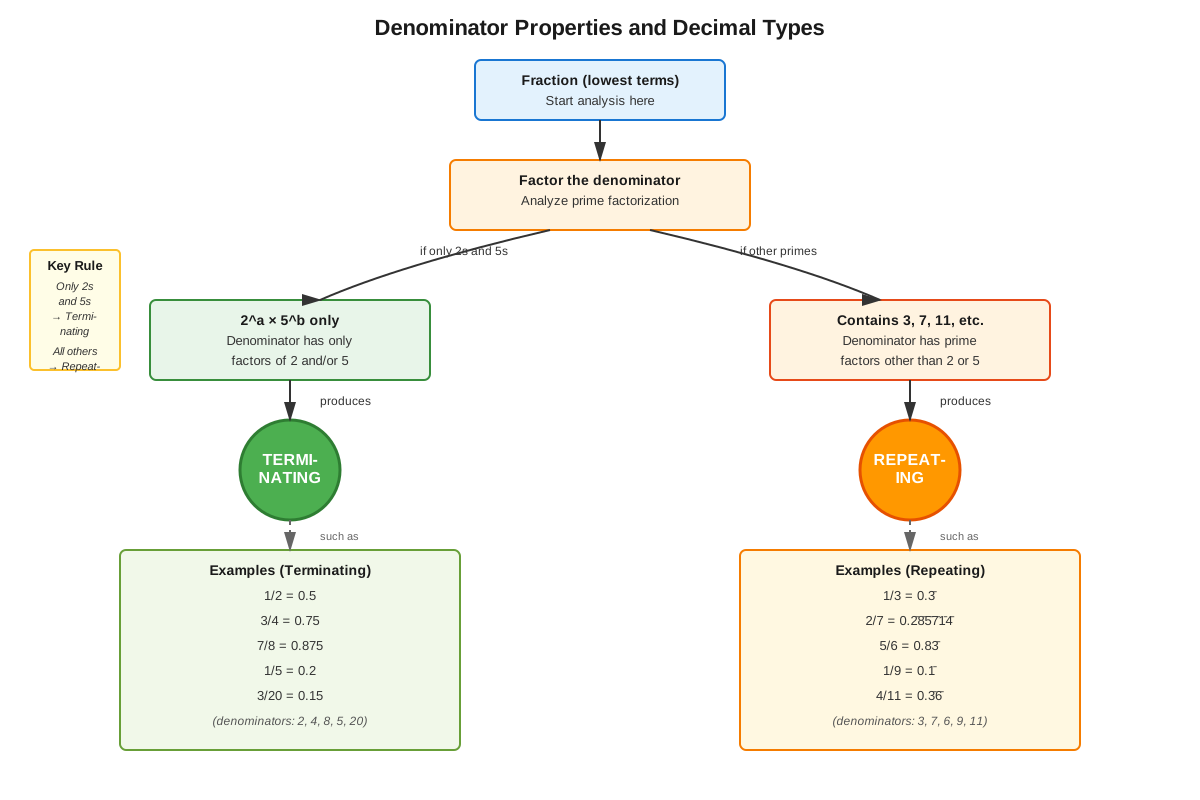
When a fraction is converted to decimal form through division, the result is either a terminating decimal (ends after a finite number of digits) or a repeating decimal. Whether a fraction produces a terminating or repeating decimal depends entirely on the prime factorization of the denominator when the fraction is in lowest terms.
A fraction in lowest terms produces a terminating decimal if and only if the denominator has no prime factors other than 2 and 5. For example, 1/8 = 0.125 (terminating) because 8 = 2³, and 3/25 = 0.12 (terminating) because 25 = 5². However, 1/3 produces a repeating decimal (0.3̄) because 3 is a prime factor other than 2 or 5.
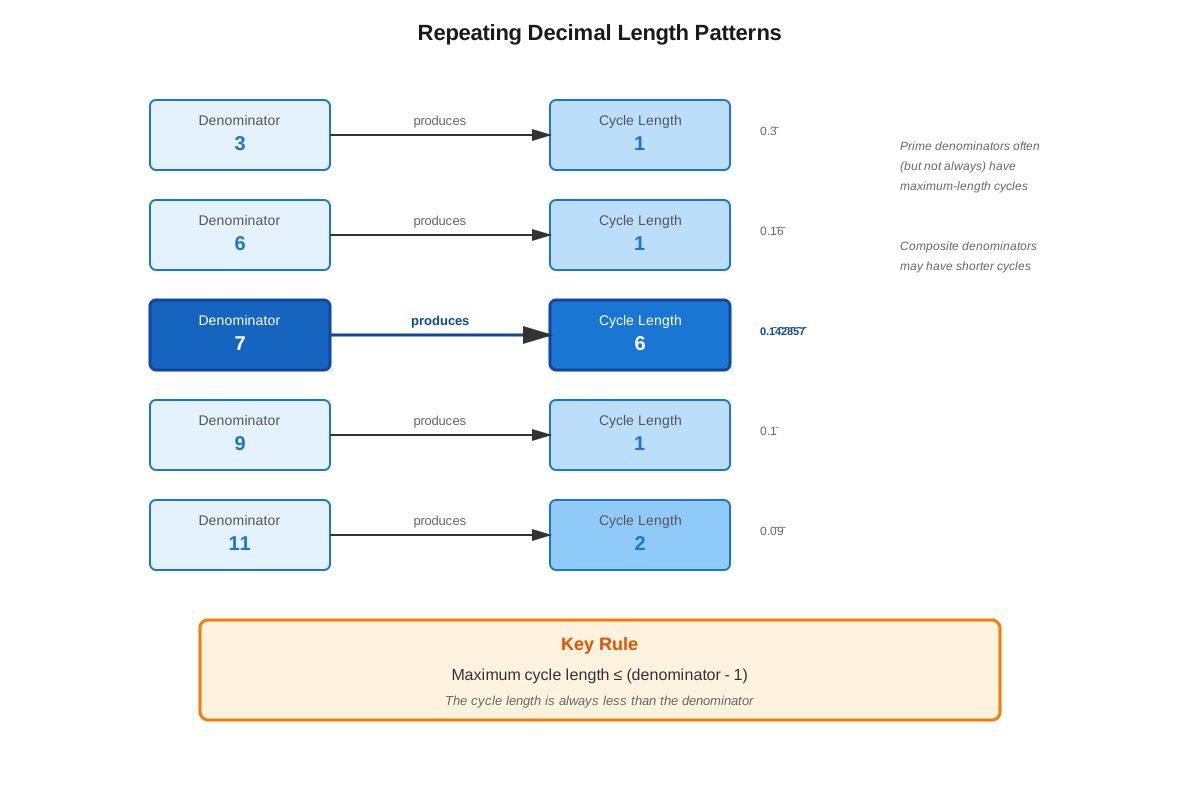
The length of the repetend (repeating block) is related to the denominator. For a fraction with denominator d (in lowest terms, with d not divisible by 2 or 5), the repetend length is at most d-1. For example, 1/7 = 0.1̄4̄2̄8̄5̄7̄ has a repetend of length 6, which equals 7-1.
Converting Repeating Decimals to Fractions
Converting a repeating decimal back to fraction form involves algebraic manipulation. For a pure repeating decimal, the process follows these steps:
- Let x equal the repeating decimal
- Multiply x by 10ⁿ where n is the length of the repetend
- Subtract the original equation from the multiplied equation
- Solve for x and simplify
For example, to convert 0.7̄ to a fraction:
- Let x = 0.777...
- Multiply by 10: 10x = 7.777...
- Subtract: 10x - x = 7.777... - 0.777...
- Simplify: 9x = 7, so x = 7/9
For mixed repeating decimals, the process is similar but requires multiplying by different powers of 10 to isolate both the non-repeating and repeating parts. For example, converting 0.58̄3̄:
- Let x = 0.583333...
- Multiply by 10: 10x = 5.83333...
- Multiply by 100: 100x = 58.3333...
- Subtract: 100x - 10x = 58.3333... - 5.8333...
- Simplify: 90x = 52.5, leading to x = 525/900 = 7/12
Common Repeating Decimal Patterns
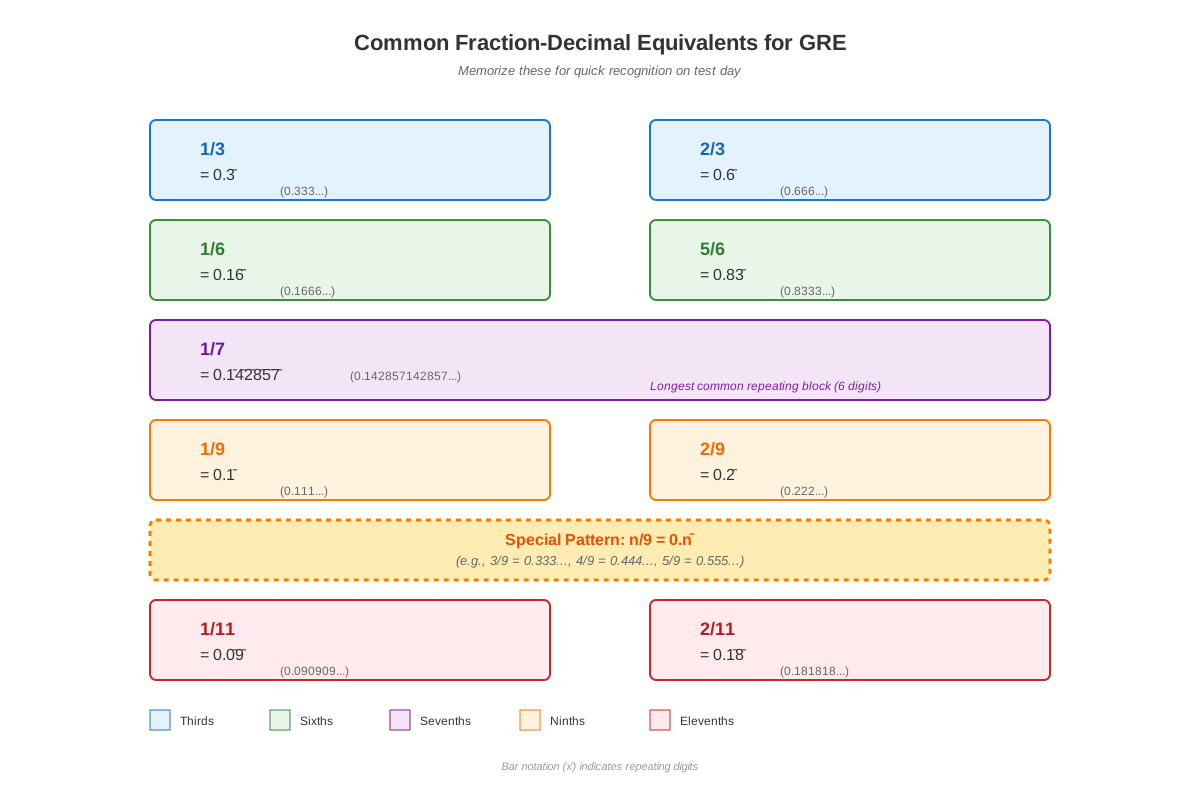
Certain fractions produce well-known repeating decimal patterns that appear frequently on the GRE:
| Fraction | Decimal | Repetend Length |
|---|---|---|
| 1/3 | 0.3̄ | 1 |
| 2/3 | 0.6̄ | 1 |
| 1/6 | 0.16̄ | 1 (mixed) |
| 1/7 | 0.1̄4̄2̄8̄5̄7̄ | 6 |
| 1/9 | 0.1̄ | 1 |
| 1/11 | 0.0̄9̄ | 2 |
| 1/12 | 0.083̄ | 1 (mixed) |
Memorizing these common conversions can significantly speed up problem-solving on the GRE. Notice that fractions with denominator 9 produce particularly simple patterns: 1/9 = 0.1̄, 2/9 = 0.2̄, 3/9 = 0.3̄, and so on.
Operations with Repeating Decimals
When performing arithmetic operations with repeating decimals, the most efficient strategy is often to convert to fraction form first, perform the operation, then convert back if necessary. For example, to add 0.3̄ + 0.6̄:
- Convert: 1/3 + 2/3
- Add: 3/3 = 1
- Result: 1.0
However, understanding that repeating decimals can be approximated for estimation purposes is also valuable. For instance, 0.3̄ ≈ 0.33 and 0.6̄ ≈ 0.67 for quick mental calculations.
Comparing Repeating Decimals
When comparing numbers that include repeating decimals, several strategies are effective:
- Convert to fractions: This provides exact comparison
- Extend the decimal: Write out several digits of the repetend to see which is larger
- Align decimal places: Compare digit by digit from left to right
For example, comparing 0.7̄ and 0.71̄:
- 0.7̄ = 0.777...
- 0.71̄ = 0.7111...
- Since 0.777... > 0.7111..., we have 0.7̄ > 0.71̄
Concept Relationships
The concept of repeating decimals is fundamentally connected to the broader understanding of rational numbers. Every repeating decimal represents a rational number (a number that can be expressed as a fraction of two integers), and conversely, every rational number can be expressed as either a terminating or repeating decimal. This bidirectional relationship forms the foundation for conversion strategies.
Fraction operations → leads to → Repeating decimals: When fractions are divided (numerator by denominator), the result may be a repeating decimal depending on the denominator's prime factorization. Understanding fraction simplification helps predict whether a decimal will terminate or repeat.
Prime factorization → determines → Decimal type: The prime factors of a fraction's denominator directly determine whether the decimal representation terminates or repeats. Denominators with only factors of 2 and 5 produce terminating decimals; all others produce repeating decimals.
Repeating decimals → connects to → Percent and ratio problems: Many GRE problems involving percentages and ratios require converting between fractions and decimals, making repeating decimal recognition essential for efficient problem-solving.
Pattern recognition → enhances → Repeating decimal mastery: Recognizing the cyclical nature of repeating decimals helps in both identifying them quickly and understanding their properties, which is crucial for comparison and estimation problems.
High-Yield Facts
⭐ Any fraction in lowest terms produces a terminating decimal if and only if its denominator contains only the prime factors 2 and 5
⭐ Every repeating decimal represents a rational number and can be converted to a fraction
⭐ 1/3 = 0.3̄, 2/3 = 0.6̄, and 1/6 = 0.16̄ are among the most frequently tested repeating decimals on the GRE
⭐ To convert a pure repeating decimal to a fraction, multiply by 10ⁿ (where n is the repetend length), subtract the original, and solve
⭐ Fractions with denominator 9 produce simple repeating decimals: k/9 = 0.k̄ (for single-digit k)
- The repetend length for 1/d (where d shares no factors with 10) is at most d-1
- Mixed repeating decimals have non-repeating digits before the repetend begins
- 1/7 produces the repeating decimal 0.1̄4̄2̄8̄5̄7̄ with a repetend length of 6
- When comparing repeating decimals, converting to fractions provides the most reliable method
- Repeating decimals can be approximated by truncating after several repetitions for estimation purposes
- The decimal 0.9̄ equals exactly 1 (this is a mathematically proven identity)
- All integers can be written as repeating decimals with repetend 0 (e.g., 5 = 5.0̄)
Quick check — test yourself on Repeating decimals so far.
Try Flashcards →Common Misconceptions
Misconception: All decimals that go on forever are irrational numbers → Correction: Only decimals that continue infinitely without any repeating pattern are irrational. Repeating decimals are rational because they can be expressed as fractions. For example, 0.3̄ = 1/3 is rational, while π = 3.14159... (no pattern) is irrational.
Misconception: A repeating decimal like 0.16̄ means only the 6 repeats, so it equals 0.1666... → Correction: This is actually correct, but students often confuse it with 0.1̄6̄, which would mean 0.161616... The bar notation is crucial: it indicates exactly which digits repeat.
Misconception: You cannot perform arithmetic operations with repeating decimals → Correction: Repeating decimals can be added, subtracted, multiplied, and divided just like any other numbers. The most efficient method is usually to convert them to fractions first, perform the operation, then convert back if needed.
Misconception: The fraction 1/2 produces a repeating decimal → Correction: 1/2 = 0.5, which is a terminating decimal. Only fractions whose denominators (in lowest terms) have prime factors other than 2 and 5 produce repeating decimals.
Misconception: Repeating decimals are approximations → Correction: Repeating decimals are exact values, not approximations. The notation 0.3̄ represents exactly 1/3, not approximately 0.333. When we write 0.333, that is an approximation, but 0.3̄ is exact.
Misconception: The repetend always starts immediately after the decimal point → Correction: While pure repeating decimals have the repetend starting immediately (like 0.3̄), mixed repeating decimals have non-repeating digits first (like 0.16̄ = 0.1666...). Both types are repeating decimals.
Misconception: Longer repetends mean larger decimal values → Correction: The length of the repetend has no relationship to the magnitude of the number. For example, 1/7 = 0.1̄4̄2̄8̄5̄7̄ (repetend length 6) is smaller than 1/3 = 0.3̄ (repetend length 1).
Worked Examples
Example 1: Converting a Repeating Decimal to a Fraction
Problem: Convert 0.45̄ (where only the 5 repeats) to a fraction in lowest terms.
Solution:
Step 1: Identify the type of repeating decimal. This is a mixed repeating decimal because 4 does not repeat, but 5 does repeat.
Step 2: Set up the equation. Let x = 0.4555...
Step 3: Multiply to isolate the non-repeating part. Since there is 1 non-repeating digit after the decimal point, multiply by 10:
- 10x = 4.555...
Step 4: Multiply to shift the repeating part. Since the repetend has length 1, multiply the previous equation by 10:
- 100x = 45.555...
Step 5: Subtract to eliminate the repeating part:
- 100x - 10x = 45.555... - 4.555...
- 90x = 41
Step 6: Solve for x:
- x = 41/90
Step 7: Check if the fraction can be simplified. Since 41 is prime and doesn't divide 90, the fraction is already in lowest terms.
Answer: 0.45̄ = 41/90
Connection to learning objectives: This example demonstrates the core strategy for converting repeating decimals to fractions and shows how to apply this technique to GRE-style problems.
Example 2: Comparing Numbers with Repeating Decimals
Problem: Which is greater: 5/6 or 0.83̄?
Solution:
Method 1 (Converting to decimals):
Step 1: Convert 5/6 to decimal form by division:
- 5 ÷ 6 = 0.8333... = 0.83̄
Step 2: Compare 0.83̄ with 0.83̄:
- They are identical
Method 2 (Converting to fractions):
Step 1: Convert 0.83̄ to a fraction.
- Let x = 0.8333...
- 10x = 8.333...
- 100x = 83.333...
- 100x - 10x = 83.333... - 8.333...
- 90x = 75
- x = 75/90 = 5/6
Step 2: Compare 5/6 with 5/6:
- They are equal
Answer: 5/6 = 0.83̄ (they are equal)
Connection to learning objectives: This example shows how to identify when repeating decimals are being tested in comparison problems and demonstrates multiple strategies for solving such problems accurately.
Example 3: Identifying Decimal Type from Fraction
Problem: Without performing long division, determine whether 7/12 produces a terminating or repeating decimal.
Solution:
Step 1: Ensure the fraction is in lowest terms. Check if 7 and 12 share any common factors:
- 7 is prime
- 12 = 2² × 3
- GCD(7, 12) = 1, so the fraction is already in lowest terms
Step 2: Find the prime factorization of the denominator:
- 12 = 2² × 3
Step 3: Apply the rule for terminating decimals. A fraction in lowest terms produces a terminating decimal if and only if the denominator has only factors of 2 and 5.
Step 4: Analyze the factorization. The denominator 12 contains the factor 3, which is neither 2 nor 5.
Answer: 7/12 produces a repeating decimal (specifically, 7/12 = 0.583̄)
Connection to learning objectives: This example demonstrates how to identify when repeating decimals appear in problems and explains the core rule behind determining decimal type from fraction form.
Exam Strategy
When approaching GRE questions involving repeating decimals, begin by identifying the question type. Trigger words and phrases include: "decimal equivalent," "express as a decimal," "which is greater," "approximate value," and any question presenting fractions with denominators like 3, 6, 7, 9, 11, or 12 (common sources of repeating decimals).
For Quantitative Comparison questions, the most efficient strategy is often to convert all numbers to the same form—either all fractions or all decimals—before comparing. If converting to decimals, write out at least 3-4 digits of any repeating decimal to ensure accurate comparison. Remember that 0.3̄ means 0.333..., not 0.3000.
Process-of-elimination tips: If answer choices include both fractions and decimals, quickly identify which fractions would produce repeating versus terminating decimals. Eliminate answers that show terminating decimals for fractions that must repeat (like 1/3), or vice versa. For estimation problems, remember that 1/3 ≈ 0.33, 2/3 ≈ 0.67, and 1/6 ≈ 0.17 for quick mental calculations.
Time allocation: Don't spend more than 30 seconds on conversion problems. If you need to convert a repeating decimal to a fraction, use the algebraic method rather than trying to "guess" the fraction. For comparison problems, if both numbers are close, convert to the same form rather than trying to estimate. Most repeating decimal questions should take 60-90 seconds total.
Exam Tip: Memorize the decimal equivalents of 1/3, 2/3, 1/6, 5/6, 1/7, 1/9, and 1/11. These appear frequently and knowing them instantly saves valuable time.
When a problem seems to require extensive calculation with repeating decimals, look for alternative approaches. Often, the GRE rewards conceptual understanding over computation. For example, if asked whether 1/3 + 1/6 is greater than 0.5, recognize that 1/3 + 1/6 = 2/6 + 1/6 = 3/6 = 1/2 = 0.5 exactly, without needing to work with 0.3̄ + 0.16̄.
Memory Techniques
Mnemonic for terminating decimals: "Two and Five stay alive" (only denominators with factors of 2 and 5 produce terminating decimals; all others repeat).
Visualization for thirds: Picture a pie cut into three equal pieces. Each piece is 0.3̄ of the whole. Three pieces of 0.3̄ must equal exactly 1, which helps remember that 0.3̄ = 1/3 exactly, not approximately.
Acronym for conversion steps: LMSS - Let x equal the decimal, Multiply by powers of 10, Subtract equations, Solve for x.
Pattern recognition for ninths: Remember "Nine makes it fine"—fractions with denominator 9 produce the simplest repeating decimals where the numerator becomes the repetend: 1/9 = 0.1̄, 2/9 = 0.2̄, 3/9 = 0.3̄, etc.
Memory palace technique: Associate common repeating decimals with familiar locations. For example, imagine your front door (1/3) with the house number 0.333, your kitchen (2/3) with 0.666 on the oven, and your bedroom (1/6) with 0.166 on the clock.
Summary
Repeating decimals are decimal representations of rational numbers in which one or more digits repeat infinitely in a predictable pattern. Understanding repeating decimals is essential for GRE success because they appear frequently in fraction-decimal conversion problems, comparison questions, and arithmetic operations. The key principle is that a fraction in lowest terms produces a repeating decimal if and only if its denominator contains prime factors other than 2 and 5. Converting between repeating decimals and fractions requires algebraic manipulation: multiply by appropriate powers of 10, subtract to eliminate the repeating portion, and solve for the variable. Common repeating decimals like 1/3 = 0.3̄, 2/3 = 0.6̄, and 1/6 = 0.16̄ should be memorized for quick recognition. Efficient problem-solving strategies include converting all numbers to the same form before comparing, recognizing patterns in decimal expansions, and understanding that repeating decimals represent exact values, not approximations. Mastery of this topic enables faster, more accurate performance on a significant portion of GRE Quantitative Reasoning questions.
Key Takeaways
- Repeating decimals are exact representations of rational numbers, not approximations, and can always be converted to fraction form
- A fraction produces a repeating decimal if its denominator (in lowest terms) has any prime factors other than 2 or 5
- Memorize common conversions: 1/3 = 0.3̄, 2/3 = 0.6̄, 1/6 = 0.16̄, 1/9 = 0.1̄, and 1/7 = 0.1̄4̄2̄8̄5̄7̄
- Convert repeating decimals to fractions using the algebraic method: let x equal the decimal, multiply by powers of 10, subtract, and solve
- When comparing numbers with repeating decimals, convert all values to the same form (all fractions or all decimals) for accurate comparison
- The bar notation indicates which digits repeat: 0.16̄ means 0.1666..., while 0.1̄6̄ means 0.161616...
- Fractions with denominator 9 produce simple patterns where k/9 = 0.k̄ for single-digit numerators
Related Topics
Rational and Irrational Numbers: Understanding the distinction between rational numbers (which include all repeating decimals) and irrational numbers (which have non-repeating, non-terminating decimal expansions) builds on repeating decimal knowledge and is essential for number theory questions.
Fraction Operations: Mastery of repeating decimals enhances efficiency in fraction addition, subtraction, multiplication, and division, as converting between forms often simplifies calculations.
Percent and Ratio Problems: Many percentage calculations involve fractions that produce repeating decimals, making this knowledge directly applicable to a large category of GRE questions.
Number Properties: Understanding which numbers produce repeating decimals connects to broader concepts about divisibility, prime factorization, and the structure of the rational number system.
Scientific Notation and Significant Figures: While more common in science-focused exams, understanding decimal representations including repeating decimals provides foundation for working with very large or very small numbers.
Practice CTA
Now that you've mastered the core concepts of repeating decimals, it's time to reinforce your learning through active practice. Attempt the practice questions to test your ability to identify, convert, and manipulate repeating decimals under timed conditions. Use the flashcards to memorize common fraction-to-decimal conversions that will save you valuable seconds on test day. Remember, the difference between knowing these concepts and being able to apply them quickly and accurately comes from deliberate practice. Each problem you solve strengthens your pattern recognition and builds the confidence you need to excel on the GRE Quantitative Reasoning section. You've got this!
Sign up free to keep reading
Create a free AnvayaPrep account to finish this GRE guide on Repeating decimals — plus flashcards and practice questions.