Overview
Decimals represent one of the most fundamental and frequently tested concepts in GRE Quantitative Reasoning. A decimal is a way of expressing numbers that are not whole, using a base-10 positional system with a decimal point to separate the integer part from the fractional part. While decimals may seem elementary, the GRE tests them in sophisticated ways that require both computational fluency and conceptual understanding. Questions involving decimals appear across multiple question types—from straightforward arithmetic to complex word problems, data interpretation, and quantitative comparisons.
Mastery of GRE decimals is essential because they form the foundation for numerous other quantitative topics. Decimals connect directly to fractions, percentages, ratios, and scientific notation—all high-frequency GRE topics. The exam frequently tests whether students can convert between these representations fluently and choose the most efficient form for calculation. Additionally, decimals appear in real-world contexts such as financial calculations, measurement conversions, and statistical data, making them indispensable for data interpretation questions.
Understanding decimals goes beyond simple arithmetic operations. The GRE assesses whether students recognize place value relationships, can estimate effectively to eliminate answer choices, understand the impact of multiplying or dividing by powers of ten, and can work with repeating and terminating decimals. Questions often combine decimal operations with other concepts like exponents, square roots, or algebraic expressions, requiring integrated knowledge. Students who develop strong decimal fluency gain significant advantages in speed and accuracy across the entire Quantitative Reasoning section.
Learning Objectives
- [ ] Identify when Decimals is being tested
- [ ] Explain the core rule or strategy behind Decimals
- [ ] Apply Decimals to GRE-style questions accurately
- [ ] Convert fluently between decimals, fractions, and percentages
- [ ] Perform operations with decimals (addition, subtraction, multiplication, division) with precision
- [ ] Recognize and work with repeating versus terminating decimals
- [ ] Estimate decimal values to eliminate incorrect answer choices quickly
Prerequisites
- Place value system: Understanding that each position in a number represents a power of 10 is essential for comprehending decimal notation and performing operations correctly
- Basic arithmetic operations: Proficiency with addition, subtraction, multiplication, and division of whole numbers provides the foundation for decimal operations
- Fraction fundamentals: Since decimals are alternative representations of fractions, understanding fraction concepts enables conversion and comparison
- Powers of ten: Recognizing how multiplying or dividing by 10, 100, 1000, etc., shifts decimal places is crucial for efficient calculation
Why This Topic Matters
Decimals appear in approximately 15-20% of GRE Quantitative Reasoning questions, either as the primary focus or as a component of more complex problems. This high frequency makes decimal fluency a critical skill for achieving competitive scores. Questions involving decimals span all question types: quantitative comparison, multiple-choice (single and multiple answer), and numeric entry. The versatility of decimal questions means students cannot afford gaps in this foundational knowledge.
In real-world applications, decimals are ubiquitous in finance (interest rates, currency exchange), science (measurements, experimental data), statistics (probabilities, averages), and everyday calculations (tips, discounts, unit prices). The GRE leverages these practical contexts to create word problems that test both computational skills and reading comprehension. Data interpretation questions frequently present information in decimal form, requiring students to perform calculations, make comparisons, and draw conclusions under time pressure.
Common exam appearances include: comparing decimal values in quantitative comparison questions; calculating with money amounts; interpreting statistical data with decimal precision; converting between fractions, decimals, and percentages; solving equations with decimal coefficients; and estimating products or quotients to identify reasonable answer choices. The GRE also tests conceptual understanding by asking which operations make numbers larger or smaller, or by presenting answer choices that differ only in decimal placement, rewarding careful calculation.
Core Concepts
Place Value and Decimal Notation
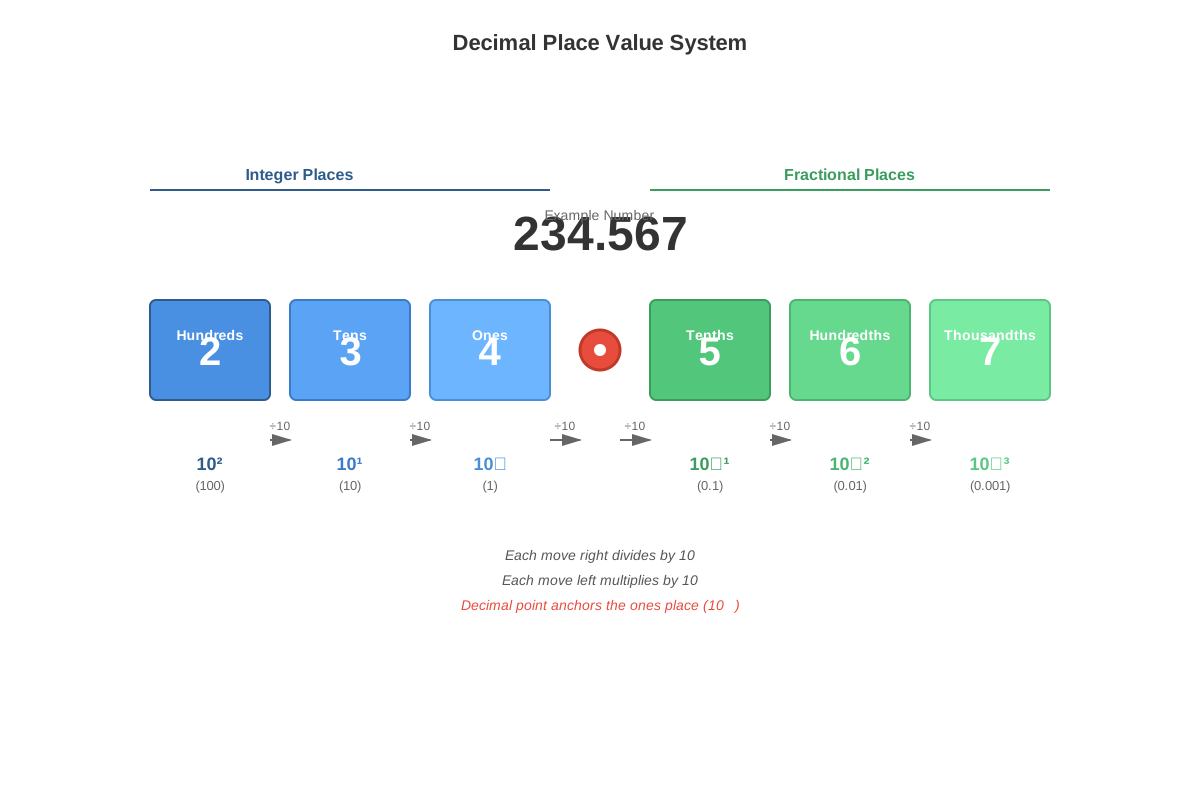
The decimal system uses a point (the decimal point) to separate the whole number portion from the fractional portion. Each position to the right of the decimal point represents a negative power of 10: tenths (10⁻¹), hundredths (10⁻²), thousandths (10⁻³), and so on. Understanding this positional system is fundamental to all decimal operations.
For example, in the number 47.3582:
- 4 is in the tens place (4 × 10¹ = 40)
- 7 is in the ones place (7 × 10⁰ = 7)
- 3 is in the tenths place (3 × 10⁻¹ = 0.3)
- 5 is in the hundredths place (5 × 10⁻² = 0.05)
- 8 is in the thousandths place (8 × 10⁻³ = 0.008)
- 2 is in the ten-thousandths place (2 × 10⁻⁴ = 0.0002)
Comparing Decimal Values
When comparing decimals, align the decimal points and compare digits from left to right. The first position where digits differ determines which number is larger. A common error is assuming that more digits after the decimal point means a larger number (e.g., incorrectly thinking 0.8 < 0.625).
Strategy: Add trailing zeros to make decimals have the same number of digits, which facilitates comparison:
- Compare 0.7 and 0.625: Rewrite as 0.700 and 0.625, making it clear that 0.700 > 0.625
Addition and Subtraction of Decimals
To add or subtract decimals, align the decimal points vertically and perform the operation as with whole numbers, keeping the decimal point in the same position in the answer.
Example: 23.45 + 7.8
  23.45
+  7.80
-------
  31.25
The key principle is that you can only add or subtract values in the same place value position (tenths with tenths, hundredths with hundredths, etc.).
Multiplication of Decimals
When multiplying decimals, ignore the decimal points initially and multiply as if working with whole numbers. Then count the total number of decimal places in both factors and place the decimal point in the product so it has that many decimal places.
Example: 2.3 × 1.5
- Multiply 23 × 15 = 345
- Count decimal places: 2.3 has 1, 1.5 has 1, total = 2
- Place decimal point: 3.45
Important principle: Multiplying by a decimal less than 1 makes the product smaller than the original number, while multiplying by a decimal greater than 1 makes it larger.
Division of Decimals
To divide decimals, convert the divisor to a whole number by moving the decimal point to the right. Move the decimal point in the dividend the same number of places. Then divide as with whole numbers, placing the decimal point in the quotient directly above its position in the dividend.
Example: 4.5 ÷ 0.15
- Move decimal point 2 places right in both: 450 ÷ 15
- Divide: 450 ÷ 15 = 30
Alternative approach: Convert to fractions, which can be easier for complex divisions.
Multiplying and Dividing by Powers of Ten
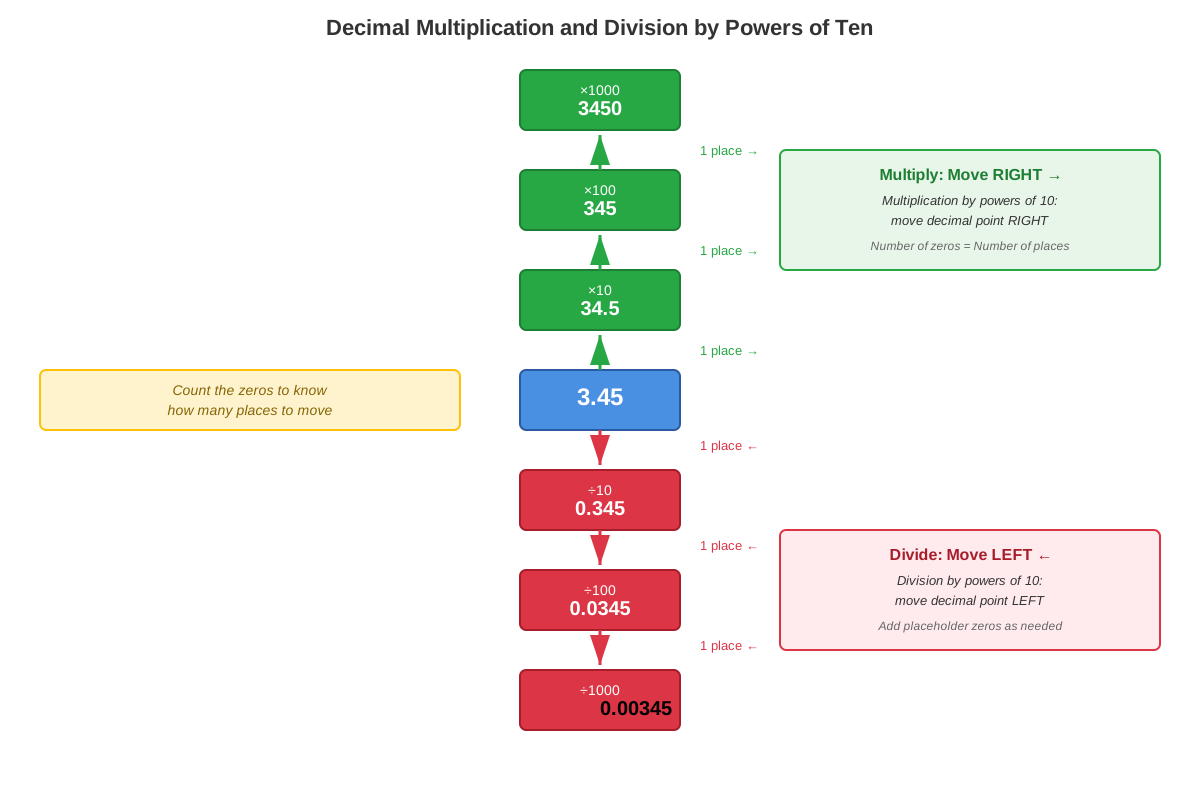
This is one of the highest-yield concepts for the GRE. Multiplying by 10ⁿ moves the decimal point n places to the right; dividing by 10ⁿ (or multiplying by 10⁻ⁿ) moves it n places to the left.
| Operation | Example | Result |
|---|---|---|
| Multiply by 10 | 3.456 × 10 | 34.56 |
| Multiply by 100 | 3.456 × 100 | 345.6 |
| Divide by 10 | 3.456 ÷ 10 | 0.3456 |
| Divide by 1000 | 3.456 ÷ 1000 | 0.003456 |
Converting Between Fractions and Decimals
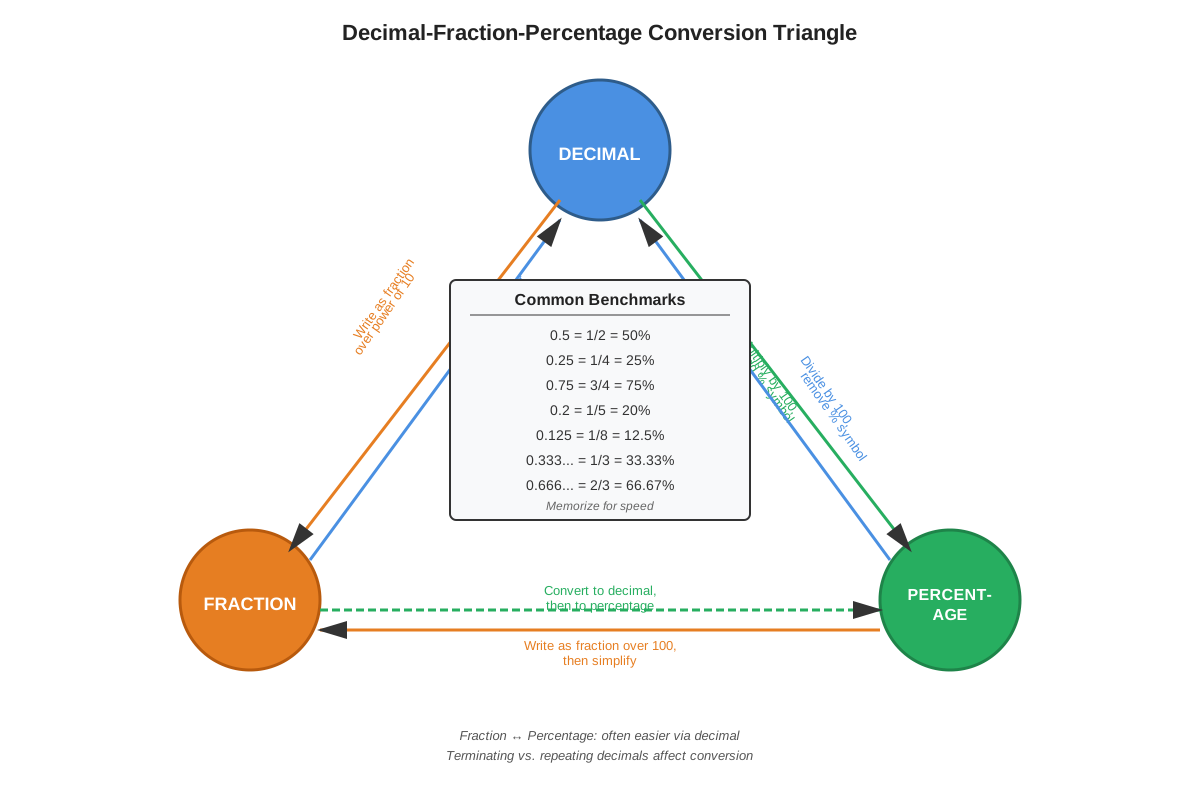
Fraction to decimal: Divide the numerator by the denominator.
- 3/4 = 3 ÷ 4 = 0.75
Decimal to fraction: Write the decimal as a fraction with a denominator that is a power of 10, then simplify.
- 0.625 = 625/1000 = 5/8 (after dividing both by 125)
Terminating vs. Repeating Decimals
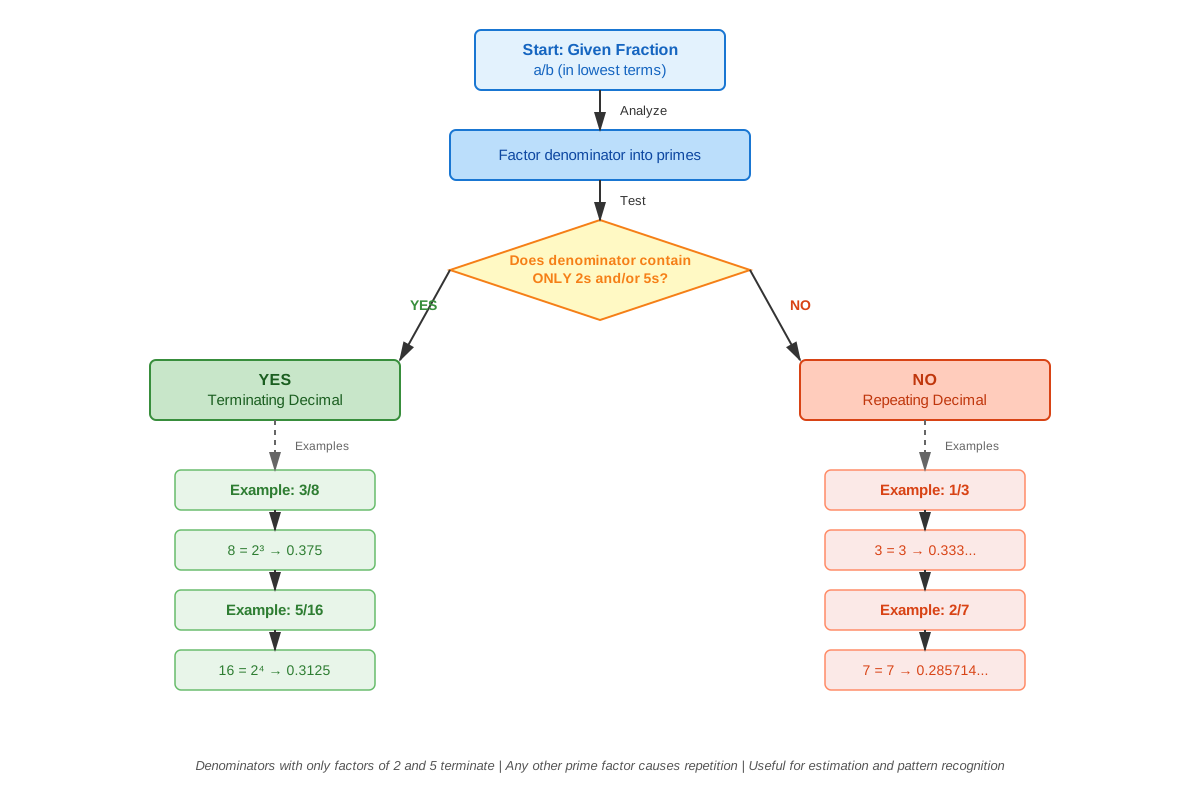
A terminating decimal has a finite number of digits after the decimal point (e.g., 0.75, 0.125). These result from fractions whose denominators have only 2 and/or 5 as prime factors when in lowest terms.
A repeating decimal has a digit or group of digits that repeats infinitely (e.g., 0.333... = 0.3̄, or 0.142857142857... = 0.1̄4̄2̄8̄5̄7̄). These result from fractions whose denominators have prime factors other than 2 and 5.
Key fractions to memorize:
- 1/2 = 0.5
- 1/3 = 0.333... = 0.3̄
- 1/4 = 0.25
- 1/5 = 0.2
- 1/6 = 0.1666... = 0.16̄
- 1/8 = 0.125
- 1/9 = 0.111... = 0.1̄
- 1/10 = 0.1
Rounding Decimals
Rounding to a specific decimal place requires examining the digit one place to the right. If it's 5 or greater, round up; if it's less than 5, round down.
Example: Round 3.4782 to the nearest hundredth
- Look at the thousandths place: 8
- Since 8 ≥ 5, round up: 3.48
Estimation with Decimals
For GRE efficiency, estimation is often faster than exact calculation. Round decimals to convenient values before computing, especially when answer choices are far apart.
Example: Estimate 4.87 × 9.23
- Round to 5 × 9 = 45
- Actual answer: 44.9501 (very close to estimate)
Concept Relationships
The concepts within decimals form an interconnected system. Place value serves as the foundation, enabling all other operations. Understanding place value leads directly to comparing decimals (by examining corresponding place values) and to multiplying/dividing by powers of ten (by recognizing how place values shift).
Addition and subtraction rely on place value alignment, while multiplication and division extend whole number operations with the additional step of decimal point placement. The relationship between fractions and decimals is bidirectional—each can be converted to the other, and choosing the optimal representation depends on the specific problem.
Terminating versus repeating decimals connects to fraction concepts, specifically to the prime factorization of denominators. This relationship helps predict whether a fraction will convert to a terminating or repeating decimal without performing division.
Rounding and estimation build upon all other decimal concepts, serving as practical tools for checking work and improving efficiency. These skills connect decimals to broader test-taking strategies like process of elimination and answer choice analysis.
Externally, decimals connect to percentages (which are decimals multiplied by 100), ratios (which can be expressed as decimals), scientific notation (which combines decimals with powers of ten), and data interpretation (where decimal precision matters for accurate analysis). Mastering decimals enables progression to these more complex topics.
Quick check — test yourself on Decimals so far.
Try Flashcards →High-Yield Facts
⭐ Multiplying by a decimal less than 1 makes the result smaller; multiplying by a decimal greater than 1 makes it larger
⭐ When multiplying decimals, the number of decimal places in the product equals the sum of decimal places in the factors
⭐ Moving the decimal point one place to the right multiplies by 10; moving it one place to the left divides by 10
⭐ To compare decimals, align decimal points and compare digit by digit from left to right
⭐ A fraction converts to a terminating decimal only if its denominator (in lowest terms) has only 2 and/or 5 as prime factors
- When dividing by a decimal, multiply both dividend and divisor by the same power of 10 to make the divisor a whole number
- Adding zeros to the right of a decimal (after the last non-zero digit) does not change its value: 0.5 = 0.50 = 0.500
- Dividing by a decimal less than 1 makes the result larger than the original number
- The decimal 0.1̄ (0.111...) equals 1/9, and 0.2̄ equals 2/9, establishing a pattern for ninths
- When rounding, examine only the digit immediately to the right of the target place value
Common Misconceptions
Misconception: More digits after the decimal point means a larger number → Correction: The leftmost digits determine magnitude. 0.8 > 0.625 because 8 tenths is greater than 6 tenths, despite 0.625 having more decimal places.
Misconception: When multiplying decimals, simply count all digits and place the decimal point that many places from the right → Correction: Count only the decimal places (digits after the decimal point) in the factors, not total digits. For 2.3 × 1.5, count 2 decimal places total, not 4 digits.
Misconception: Dividing always makes numbers smaller → Correction: Dividing by a number less than 1 makes the result larger. For example, 10 ÷ 0.5 = 20, which is larger than 10.
Misconception: 0.5 × 0.5 = 0.25 seems wrong because "multiplication makes things bigger" → Correction: Multiplying by a number less than 1 reduces the value. Think of 0.5 × 0.5 as "half of a half," which is one quarter (0.25).
Misconception: All fractions can be expressed as terminating decimals → Correction: Only fractions whose denominators (in simplest form) contain only factors of 2 and/or 5 terminate. Fractions like 1/3, 1/7, and 1/9 produce repeating decimals.
Misconception: When adding decimals, align the rightmost digits → Correction: Always align the decimal points, not the rightmost digits. This ensures you're adding corresponding place values (tenths to tenths, hundredths to hundredths).
Worked Examples
Example 1: Multi-Step Decimal Operations
Problem: Calculate (3.6 × 2.5) ÷ 0.15 and express the answer as a decimal.
Solution:
Step 1: Calculate 3.6 × 2.5
- Ignore decimals: 36 × 25 = 900
- Count decimal places: 3.6 has 1, 2.5 has 1, total = 2
- Place decimal: 9.00 = 9.0
Step 2: Divide 9.0 ÷ 0.15
- Convert divisor to whole number: multiply both by 100
- 900 ÷ 15 = 60
Answer: 60
Connection to learning objectives: This problem requires applying decimal multiplication and division rules accurately (Objective 3), demonstrating the core strategy of converting decimal division to whole number division (Objective 2).
Example 2: Quantitative Comparison with Decimals
Problem:
Quantity A: 0.8 × 0.8 × 0.8
Quantity B: 0.8Solution:
Step 1: Recognize that multiplying by 0.8 (a number less than 1) repeatedly makes the result smaller
Step 2: Calculate Quantity A
- 0.8 × 0.8 = 0.64
- 0.64 × 0.8 = 0.512
Step 3: Compare
- Quantity A = 0.512
- Quantity B = 0.8
- Since 0.512 < 0.8, Quantity B is greater
Alternative approach: Without calculating, recognize that each multiplication by 0.8 reduces the value, so three multiplications must yield a result less than 0.8.
Answer: Quantity B is greater
Connection to learning objectives: This demonstrates identifying when decimals are being tested (Objective 1), particularly the conceptual understanding that multiplying by decimals less than 1 reduces values, and applying this to a GRE-style quantitative comparison (Objective 3).
Example 3: Fraction-Decimal Conversion
Problem: Which of the following fractions is equivalent to 0.625?
(A) 5/9
(B) 5/8
(C) 3/5
(D) 2/3
(E) 7/12
Solution:
Method 1: Convert decimal to fraction
- 0.625 = 625/1000
- Simplify by dividing both by 125: 625 ÷ 125 = 5, 1000 ÷ 125 = 8
- Result: 5/8
Method 2: Convert answer choices to decimals
- (A) 5/9 = 0.555...
- (B) 5/8 = 5 ÷ 8 = 0.625 ✓
- (C) 3/5 = 0.6
- (D) 2/3 = 0.666...
- (E) 7/12 = 0.583...
Answer: (B) 5/8
Connection to learning objectives: This requires converting between decimals and fractions fluently (Objective 4) and applying this skill to a multiple-choice GRE question (Objective 3).
Exam Strategy
When approaching GRE questions involving decimals, first identify the question type. Quantitative comparisons often test conceptual understanding (e.g., whether operations increase or decrease values) rather than requiring exact calculations. Multiple-choice questions may have answer choices spaced far apart, making estimation viable, or closely spaced, requiring precise calculation.
Trigger words and phrases that signal decimal questions include: "rounded to the nearest," "expressed as a decimal," specific monetary amounts, measurements with decimal precision, and phrases like "0.x times as much." Data interpretation questions presenting tables or graphs with decimal values require careful reading to avoid misplacing decimal points.
Process-of-elimination strategies:
- Estimate before calculating—eliminate answer choices that are clearly too large or too small
- Check decimal point placement—if answer choices differ only in decimal position, focus on powers of ten
- Verify reasonableness—if multiplying by a decimal less than 1, the answer must be smaller than the original
- Use benchmark fractions—recognize that 0.5 = 1/2, 0.25 = 1/4, 0.75 = 3/4 to quickly evaluate answer choices
Time allocation: Simple decimal operations should take 30-45 seconds. Complex multi-step problems may require 90-120 seconds. If a calculation is taking longer, consider whether estimation or converting to fractions would be faster. For quantitative comparisons, spend 15-20 seconds looking for conceptual shortcuts before calculating.
Calculator usage: The GRE provides an on-screen calculator, but it's often faster to perform simple decimal operations mentally or on scratch paper. Use the calculator for complex multiplications or divisions, but always estimate first to catch input errors.
Memory Techniques
Mnemonic for common fraction-decimal conversions: "Half Quarter Fifth Eighth" reminds you of the easiest conversions:
- Half = 1/2 = 0.5
- Quarter = 1/4 = 0.25
- Fifth = 1/5 = 0.2
- Eighth = 1/8 = 0.125
Visualization for decimal place value: Picture a staircase descending to the right of the decimal point: tenths (1 step down), hundredths (2 steps), thousandths (3 steps). Each step represents dividing by 10 again.
Acronym for multiplication rule: "CPAP" = Count Places, Add, Place
- Count decimal places in each factor
- Add them together
- Place the decimal point that many places from the right in the product
Memory hook for division by decimals: "Move Together"—when dividing by a decimal, move the decimal point in both the divisor and dividend the same number of places to make the divisor whole.
Rhyme for comparing decimals: "Line them up at the dot, compare left to right on the spot"—reminds you to align decimal points and compare from left to right.
Summary
Decimals are a fundamental representation of non-whole numbers using the base-10 positional system, appearing in 15-20% of GRE Quantitative Reasoning questions across all question types. Mastery requires understanding place value, performing operations accurately, converting between fractions and decimals, and recognizing the behavior of decimals in multiplication and division. Key principles include: aligning decimal points for addition and subtraction; counting decimal places when multiplying; converting divisors to whole numbers when dividing; and recognizing that multiplying by decimals less than 1 reduces values while dividing by them increases values. The GRE tests both computational accuracy and conceptual understanding, often rewarding estimation and strategic thinking over lengthy calculations. Success with decimals enables progression to percentages, ratios, scientific notation, and data interpretation—making this topic essential for achieving competitive scores.
Key Takeaways
- Decimal place value follows powers of 10: each position to the right represents division by 10
- When multiplying decimals, the product has as many decimal places as the sum of decimal places in the factors
- Multiplying/dividing by powers of 10 shifts the decimal point right/left by the corresponding number of places
- Multiplying by a decimal less than 1 makes the result smaller; dividing by a decimal less than 1 makes it larger
- Fractions with denominators containing only factors of 2 and/or 5 (in lowest terms) produce terminating decimals
- Estimation and benchmark fraction recognition are often faster than precise calculation on the GRE
- Always align decimal points when adding or subtracting, and verify answer reasonableness by checking magnitude
Related Topics
Fractions: Decimals and fractions are alternative representations of the same values. Mastering decimal-fraction conversion enables flexible problem-solving and choosing the most efficient calculation method.
Percentages: Percentages are decimals multiplied by 100. Strong decimal skills make percentage calculations intuitive and enable quick mental math for common percentage problems.
Ratios and Proportions: Ratios can be expressed as decimals, and many proportion problems involve decimal calculations. Decimal fluency accelerates ratio problem-solving.
Scientific Notation: This combines decimals with powers of 10, extending decimal concepts to very large and very small numbers commonly appearing in data interpretation questions.
Data Interpretation: Tables, graphs, and charts frequently present data with decimal precision. Accurate decimal operations are essential for calculations and comparisons in these high-frequency question types.
Practice CTA
Now that you've mastered the core concepts of decimals, it's time to solidify your understanding through active practice. Attempt the practice questions to apply these strategies to GRE-style problems, and use the flashcards to reinforce key facts and conversions until they become automatic. Remember, decimal fluency is not just about getting the right answer—it's about getting it quickly and confidently, giving you more time for challenging problems elsewhere on the exam. Your investment in mastering this foundational topic will pay dividends across the entire Quantitative Reasoning section!
Sign up free to keep reading
Create a free AnvayaPrep account to finish this GRE guide on Decimals — plus flashcards and practice questions.