Overview
Probability basics form a critical foundation within the GRE Quantitative Reasoning section, appearing in approximately 10-15% of all quantitative questions. Understanding probability is essential not only for direct probability questions but also for data interpretation, combinatorics problems, and logical reasoning scenarios. The GRE tests probability concepts through word problems, data analysis questions, and quantitative comparison formats, making this topic one of the highest-yield areas for focused study.
Mastering GRE probability basics requires understanding fundamental principles such as calculating simple probabilities, working with independent and dependent events, applying the complement rule, and recognizing when to use addition versus multiplication rules. These concepts build upon basic arithmetic and fraction manipulation while connecting to more advanced topics like combinations, permutations, and statistical reasoning. The GRE typically presents probability questions in real-world contexts—drawing cards from decks, selecting items from groups, or analyzing outcomes of repeated events—requiring students to translate verbal descriptions into mathematical calculations.
The beauty of probability on the GRE lies in its predictability: once students internalize the core rules and develop pattern recognition skills, these questions become highly manageable within the exam's time constraints. Unlike some mathematical topics that require extensive calculation, probability questions often reward conceptual understanding and strategic thinking, making them ideal candidates for quick point gains when approached systematically.
Learning Objectives
- [ ] Identify when Probability basics is being tested in GRE questions
- [ ] Explain the core rule or strategy behind Probability basics
- [ ] Apply Probability basics to GRE-style questions accurately
- [ ] Calculate probabilities using the fundamental counting principle and probability formula
- [ ] Distinguish between independent and dependent events and apply appropriate calculation methods
- [ ] Utilize the complement rule to simplify complex probability calculations
- [ ] Solve multi-step probability problems involving both "and" and "or" scenarios
Prerequisites
- Basic fraction operations: Probability values are expressed as fractions, decimals, or percentages, requiring fluency in converting between these forms and simplifying fractions
- Ratio and proportion understanding: Probability represents the ratio of favorable outcomes to total outcomes, making ratio comprehension essential
- Set theory fundamentals: Understanding unions, intersections, and complements helps visualize probability relationships
- Basic arithmetic operations: Multiplication and addition of fractions and decimals form the computational foundation for probability calculations
Why This Topic Matters
Probability concepts extend far beyond standardized testing into everyday decision-making, risk assessment, business analytics, medical diagnosis, and scientific research. Understanding probability enables informed judgments about likelihood, uncertainty, and expected outcomes—skills that graduate programs value highly. In professional contexts, probability underpins fields from actuarial science and finance to epidemiology and machine learning.
On the GRE specifically, probability questions appear in multiple formats: discrete quantitative comparison problems, problem-solving questions embedded in word problems, and data interpretation questions requiring probability calculations from tables or graphs. Test-makers favor probability because it efficiently assesses logical reasoning, mathematical fluency, and the ability to translate real-world scenarios into mathematical models. Approximately 2-3 questions per GRE Quantitative section directly test probability concepts, with additional questions incorporating probability reasoning indirectly.
Common GRE probability scenarios include: selecting objects from containers (marbles from bags, cards from decks), analyzing outcomes of coin flips or dice rolls, calculating probabilities of committee selections, determining likelihoods in quality control scenarios, and evaluating probabilities in game or competition contexts. The exam particularly favors questions requiring students to recognize whether events are independent or dependent, apply the complement rule efficiently, and combine multiple probability principles in a single problem.
Core Concepts
Fundamental Probability Definition
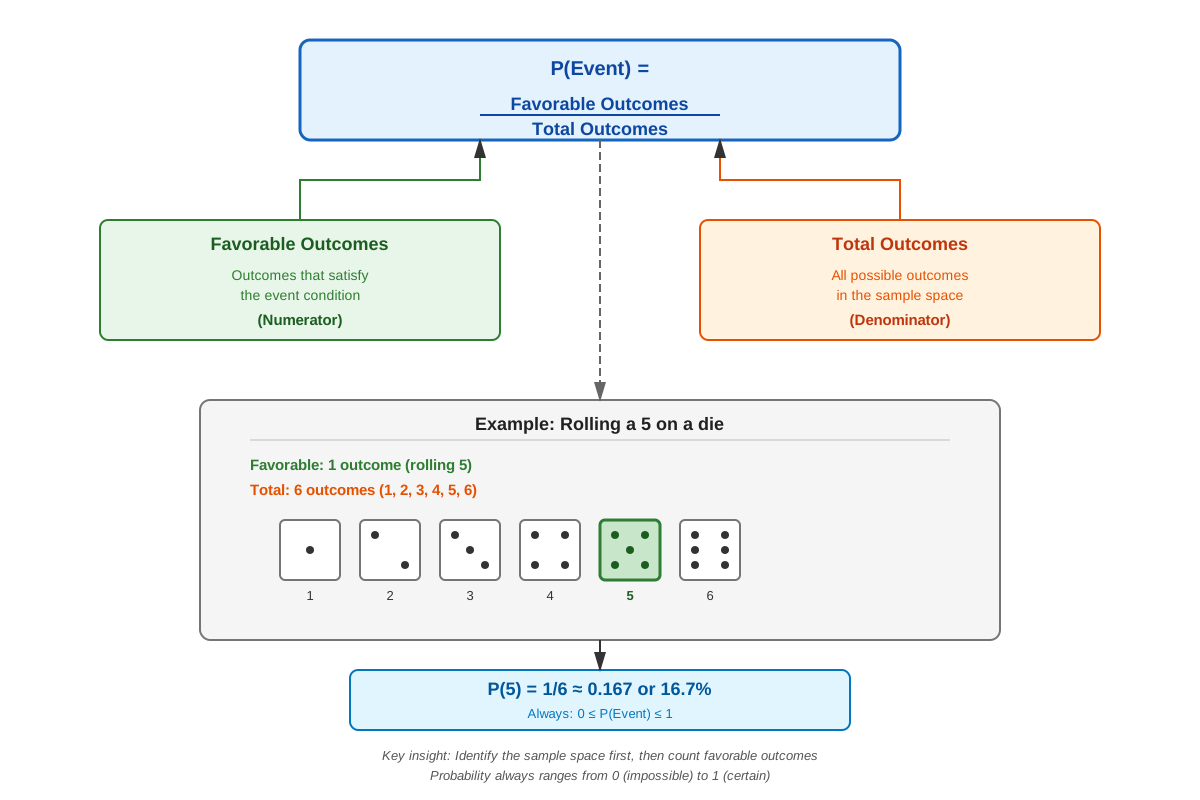
Probability measures the likelihood of an event occurring, expressed as a value between 0 and 1 (or 0% to 100%). The fundamental probability formula is:
P(Event) = Number of favorable outcomes / Total number of possible outcomesFor example, the probability of drawing a heart from a standard 52-card deck equals 13/52 = 1/4, since 13 cards are hearts among 52 total cards. A probability of 0 indicates impossibility, while a probability of 1 indicates certainty. All probabilities must fall within this range, making any calculated value outside [0,1] an immediate signal of error.
Sample Space and Events
The sample space represents the set of all possible outcomes for a probability experiment. An event is a specific outcome or collection of outcomes from the sample space. For a single six-sided die roll, the sample space is {1, 2, 3, 4, 5, 6}, containing six equally likely outcomes. The event "rolling an even number" includes outcomes {2, 4, 6}, giving probability 3/6 = 1/2.
Understanding sample spaces is crucial for GRE success because many errors stem from miscounting total possible outcomes. When the problem states outcomes are "equally likely," each outcome has the same probability, and the fundamental formula applies directly. When outcomes are not equally likely, weighted probabilities must be considered.
Independent vs. Dependent Events
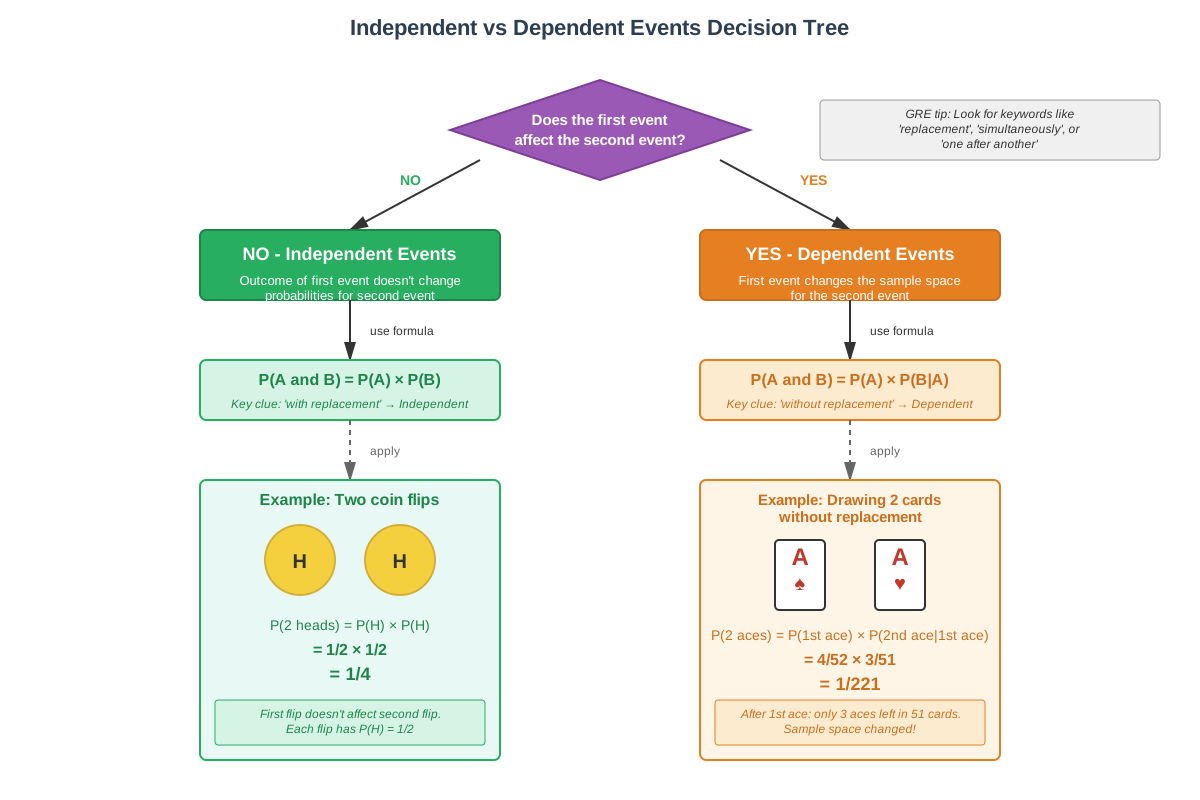
Independent events occur when one event's outcome does not affect another event's probability. Classic examples include consecutive coin flips or rolling dice multiple times—the first outcome never influences subsequent outcomes. For independent events, calculate the probability of both events occurring using the multiplication rule:
P(A and B) = P(A) × P(B)For example, the probability of flipping heads twice in a row equals (1/2) × (1/2) = 1/4.
Dependent events occur when one event's outcome changes the probability of subsequent events. Drawing cards without replacement creates dependence: after drawing one card, the deck contains fewer cards, altering subsequent probabilities. For dependent events:
P(A and B) = P(A) × P(B|A)where P(B|A) represents the conditional probability of B given that A has occurred.
| Event Type | Characteristic | Probability Calculation | GRE Example | |
|---|---|---|---|---|
| Independent | First outcome doesn't affect second | P(A) × P(B) | Rolling two dice | |
| Dependent | First outcome changes second probability | P(A) × P(B\ | A) | Drawing cards without replacement |
The Addition Rule
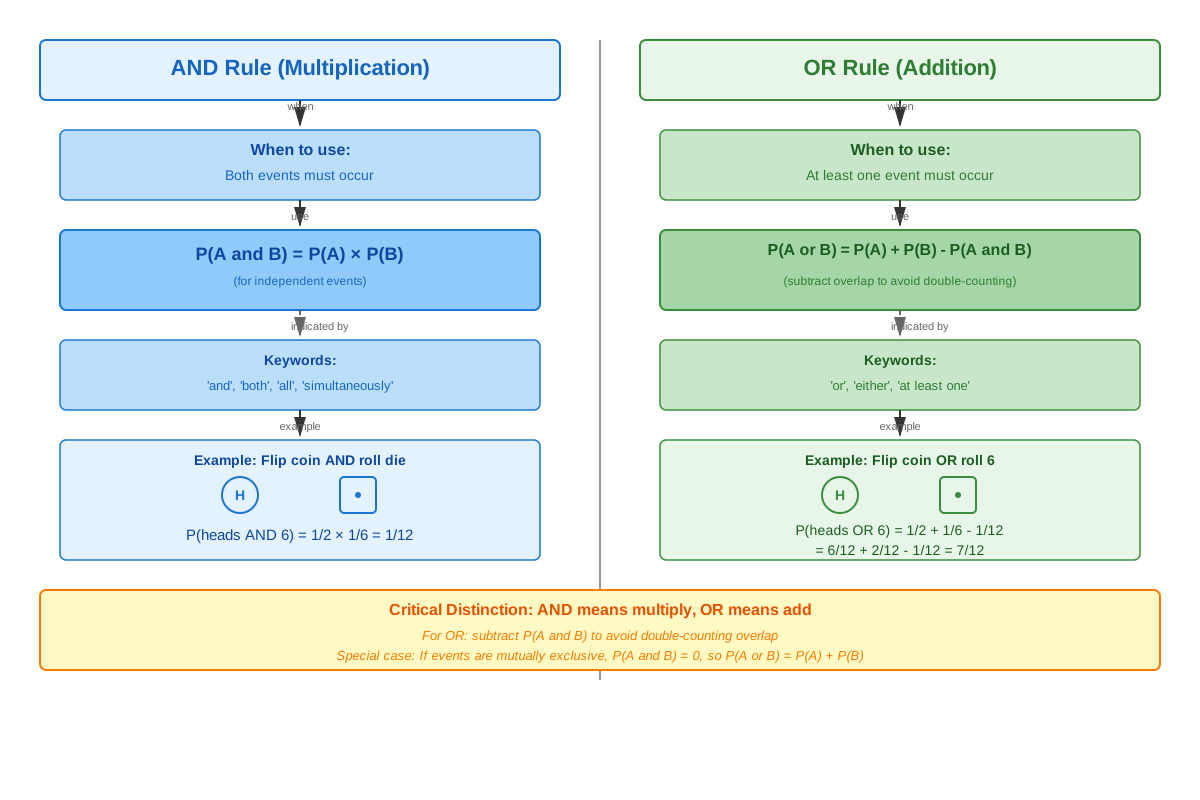
When calculating the probability that at least one of multiple events occurs, use the addition rule. For mutually exclusive events (events that cannot occur simultaneously):
P(A or B) = P(A) + P(B)For example, when rolling a die, the probability of rolling a 2 or a 5 equals 1/6 + 1/6 = 2/6 = 1/3, since these outcomes cannot occur together.
For non-mutually exclusive events (events that can occur simultaneously), subtract the overlap:
P(A or B) = P(A) + P(B) - P(A and B)This prevents double-counting outcomes where both events occur. For instance, in a deck of cards, the probability of drawing a heart or a king equals 13/52 + 4/52 - 1/52 = 16/52 = 4/13 (subtracting the king of hearts counted in both categories).
The Complement Rule
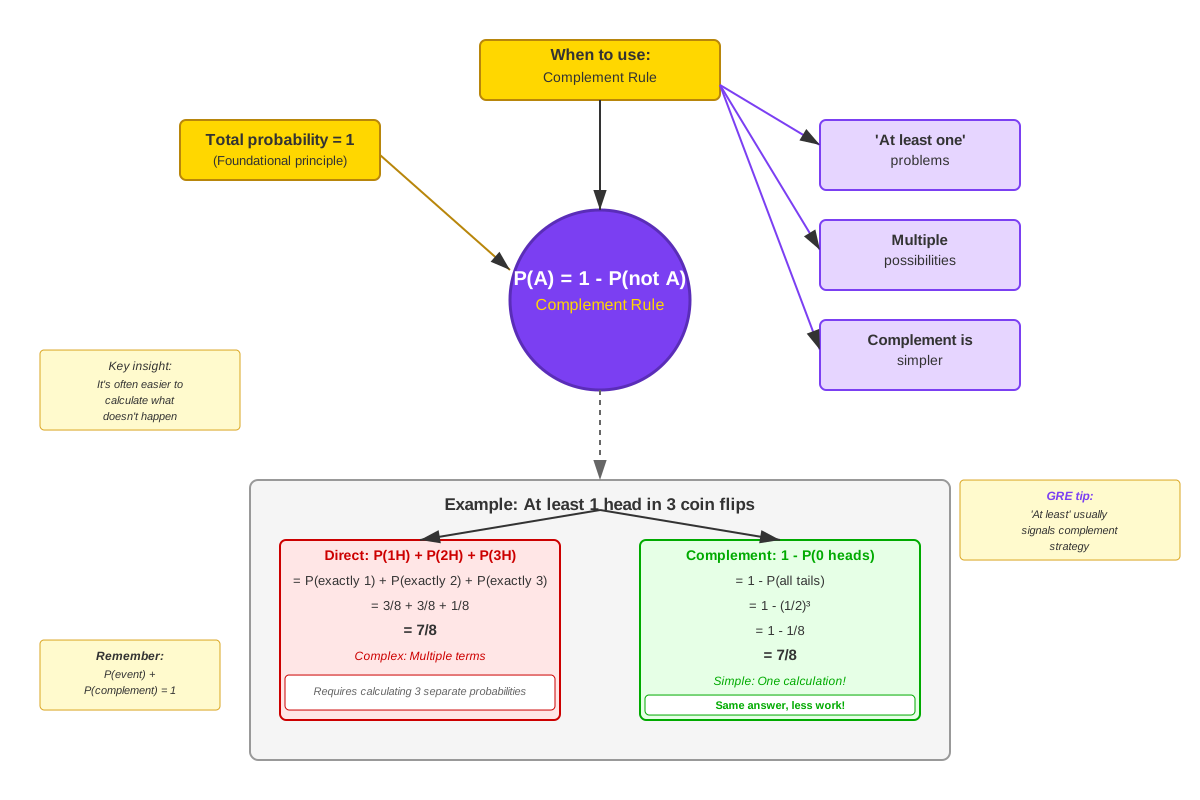
The complement of an event A, denoted A' or "not A," includes all outcomes where A does not occur. The complement rule states:
P(A) + P(not A) = 1Therefore:
P(not A) = 1 - P(A)This rule provides a powerful shortcut for GRE questions asking about "at least one" scenarios. Instead of calculating multiple possibilities, calculate the complement (usually "none") and subtract from 1. For example, finding the probability that at least one of three coin flips is heads is easier calculated as 1 - P(all tails) = 1 - (1/2)³ = 1 - 1/8 = 7/8.
GRE Tip: Whenever you see "at least one," immediately consider using the complement rule. Calculate the probability of "none" and subtract from 1.
Probability with Replacement vs. Without Replacement
With replacement means returning the selected item before the next selection, keeping the sample space constant. Each selection remains independent with unchanged probabilities. Drawing a card, recording it, returning it, and shuffling before drawing again exemplifies replacement.
Without replacement means not returning the selected item, reducing the sample space for subsequent selections. This creates dependent events with changing probabilities. Most real-world scenarios (dealing cards, selecting committee members) involve selection without replacement.
For example, drawing two aces from a standard deck:
- With replacement: (4/52) × (4/52) = 16/2704 = 1/169
- Without replacement: (4/52) × (3/51) = 12/2652 = 1/221
The without-replacement probability is lower because after drawing one ace, only three aces remain among 51 cards.
Probability of Multiple Events
When problems involve sequences of events, determine whether to multiply (for "and" scenarios) or add (for "or" scenarios):
- "And" scenarios (both/all events occur): Multiply probabilities
- "Or" scenarios (at least one event occurs): Add probabilities (adjusting for overlap if necessary)
For three independent events A, B, and C:
- P(A and B and C) = P(A) × P(B) × P(C)
- P(A or B or C) = P(A) + P(B) + P(C) - P(A and B) - P(A and C) - P(B and C) + P(A and B and C)
The "or" formula becomes complex with multiple events, making the complement rule especially valuable.
Concept Relationships
The fundamental probability formula serves as the foundation from which all other probability concepts derive. Understanding sample spaces enables accurate application of this formula by ensuring correct counting of total outcomes. The distinction between independent and dependent events determines whether to apply simple multiplication or conditional probability calculations, which directly connects to the replacement versus non-replacement distinction.
The complement rule emerges from the fundamental principle that all probabilities in a sample space sum to 1, providing an alternative calculation pathway particularly useful for "at least one" scenarios. The addition rule and multiplication rule represent two fundamental ways of combining probabilities, with the addition rule applying to "or" scenarios and the multiplication rule applying to "and" scenarios. These rules interconnect when dealing with non-mutually exclusive events, requiring subtraction of overlapping probabilities calculated through multiplication.
Relationship Map:
Sample Space Definition → Fundamental Probability Formula → Independent/Dependent Event Recognition → Multiplication Rule (for "and") / Addition Rule (for "or") → Complement Rule (alternative calculation method) → Complex Multi-Step Problems
This progression moves from definitional concepts through operational rules to strategic problem-solving approaches, with each concept building upon and refining previous understanding.
Quick check — test yourself on Probability basics so far.
Try Flashcards →High-Yield Facts
⭐ The fundamental probability formula is P(Event) = Favorable outcomes / Total outcomes, and all probabilities must fall between 0 and 1 inclusive
⭐ For independent events occurring together, multiply their individual probabilities: P(A and B) = P(A) × P(B)
⭐ The complement rule states P(not A) = 1 - P(A), providing the fastest solution for "at least one" problems
⭐ For mutually exclusive events (cannot occur simultaneously), P(A or B) = P(A) + P(B)
⭐ Without replacement creates dependent events where subsequent probabilities change based on previous outcomes
- For dependent events, P(A and B) = P(A) × P(B|A), where P(B|A) is the conditional probability of B given A
- The probability of an impossible event is 0; the probability of a certain event is 1
- When drawing without replacement from a group of n items, the denominator decreases by 1 with each draw
- For non-mutually exclusive events, P(A or B) = P(A) + P(B) - P(A and B) to avoid double-counting
- In a standard deck of 52 cards: 13 cards per suit, 4 cards per rank, 26 red cards, 26 black cards
- The probability of multiple independent events all occurring equals the product of their individual probabilities
- "At least one" scenarios are most efficiently solved using 1 - P(none)
Common Misconceptions
Misconception: Adding probabilities for "and" scenarios or multiplying for "or" scenarios
Correction: "And" scenarios require multiplication (both events must occur, reducing overall probability), while "or" scenarios require addition (either event occurring increases overall probability). Remember: AND = multiply, OR = add.
Misconception: Treating dependent events as independent, using P(A) × P(B) when replacement doesn't occur
Correction: Without replacement, the second probability must reflect the changed sample space. If drawing two red marbles from a bag with 5 red and 5 blue marbles, the calculation is (5/10) × (4/9), not (5/10) × (5/10), because after drawing one red marble, only 4 red marbles remain among 9 total.
Misconception: Believing that previous outcomes affect future independent events (the "gambler's fallacy")
Correction: For truly independent events like coin flips, previous outcomes never influence future probabilities. After flipping five heads in a row, the probability of heads on the sixth flip remains exactly 1/2—coins have no memory.
Misconception: Forgetting to subtract the overlap when using the addition rule for non-mutually exclusive events
Correction: When events can occur simultaneously, simply adding P(A) + P(B) double-counts the overlap. Always subtract P(A and B) to get the accurate probability: P(A or B) = P(A) + P(B) - P(A and B).
Misconception: Calculating P(at least one) by adding individual probabilities in multi-event scenarios
Correction: For "at least one" in multiple trials, use the complement rule: P(at least one) = 1 - P(none). This avoids the complexity of calculating multiple overlapping scenarios. For example, P(at least one head in 3 flips) = 1 - P(all tails) = 1 - (1/2)³ = 7/8.
Misconception: Expressing probability as a ratio like "3:5" instead of as a fraction of the total
Correction: Probability must be expressed as favorable outcomes divided by total outcomes. If a bag contains 3 red and 5 blue marbles, P(red) = 3/8, not 3/5. The ratio 3:5 describes the relationship between red and blue, but probability requires the part-to-whole relationship.
Worked Examples
Example 1: Multi-Step Probability with Dependent Events
Problem: A box contains 6 red balls and 4 blue balls. If two balls are drawn randomly without replacement, what is the probability that both balls are red?
Solution:
Step 1: Identify the event type. Since balls are drawn "without replacement," these are dependent events. The second probability depends on the first outcome.
Step 2: Calculate P(first ball is red). With 6 red balls among 10 total balls:
P(first red) = 6/10 = 3/5Step 3: Calculate P(second ball is red | first ball was red). After removing one red ball, 5 red balls remain among 9 total balls:
P(second red | first red) = 5/9Step 4: Apply the multiplication rule for dependent events:
P(both red) = P(first red) × P(second red | first red) = (3/5) × (5/9) = 15/45 = 1/3Answer: The probability that both balls are red is 1/3.
Connection to Learning Objectives: This problem demonstrates identifying probability testing (dependent events without replacement), applying the core strategy (multiplication rule with conditional probability), and accurately solving a GRE-style question involving multi-step reasoning.
Example 2: Using the Complement Rule for "At Least One" Scenarios
Problem: A fair coin is flipped four times. What is the probability of getting at least one head?
Solution:
Step 1: Recognize the "at least one" trigger phrase, suggesting the complement rule provides the most efficient approach.
Step 2: Identify the complement event. The complement of "at least one head" is "no heads" or "all tails."
Step 3: Calculate P(all tails). Since flips are independent:
P(all tails) = P(T) × P(T) × P(T) × P(T) = (1/2)^4 = 1/16Step 4: Apply the complement rule:
P(at least one head) = 1 - P(all tails) = 1 - 1/16 = 15/16Alternative (longer) approach: Calculate P(exactly 1 head) + P(exactly 2 heads) + P(exactly 3 heads) + P(exactly 4 heads), which requires significantly more calculation and introduces more opportunities for error.
Answer: The probability of getting at least one head is 15/16.
Connection to Learning Objectives: This example illustrates recognizing when probability is tested (independent repeated events), explaining the core strategy (complement rule for "at least one"), and demonstrating efficient problem-solving that saves valuable exam time.
Exam Strategy
When approaching GRE probability questions, follow this systematic process:
Step 1: Identify the probability scenario type. Look for trigger words:
- "At least one" → Consider complement rule
- "Both," "all," "and" → Multiplication rule
- "Either," "or" → Addition rule
- "Without replacement" → Dependent events
- "With replacement" or "independent" → Independent events
Step 2: Define the sample space clearly. Write down or mentally note the total number of possible outcomes. Many errors stem from miscounting this denominator.
Step 3: Count favorable outcomes carefully. Ensure you're counting exactly what the question asks for, not related but different scenarios.
Step 4: Choose your calculation approach. For "at least one" problems, always evaluate whether the complement rule offers a shortcut. For complex "or" scenarios, check if events are mutually exclusive before applying the addition rule.
Step 5: Verify your answer makes intuitive sense. Probabilities must fall between 0 and 1. If you calculate 3/2 or -0.3, you've made an error. Additionally, check if your answer aligns with intuition: getting at least one head in four flips should have high probability (15/16 ≈ 94% makes sense).
Time Management Tip: Probability questions typically require 1.5-2 minutes. If you're exceeding this time, you may be using an inefficient approach. Look for complement rule opportunities or simpler calculation paths.
Process of Elimination Tips:
- Eliminate any answer choice outside [0, 1] or [0%, 100%]
- For "at least one" scenarios, eliminate very small probabilities (the answer should typically be relatively large)
- For "all" or "both" scenarios with multiple events, eliminate large probabilities (the answer should be smaller than individual event probabilities)
- In quantitative comparison questions, test extreme cases (all favorable outcomes, all unfavorable outcomes) to determine relationships
Common Trigger Phrases:
- "What is the probability that..." → Direct probability calculation
- "What is the chance that..." → Same as probability
- "How likely is it that..." → Probability question
- "At least one" → Use complement rule
- "Exactly" → Count specific scenarios carefully
- "Given that" → Conditional probability (dependent events)
Memory Techniques
AND/OR Mnemonic: "AND means Multiply, OR means Add" (AMOA)
- When events must occur together (AND), multiply probabilities
- When at least one event must occur (OR), add probabilities
Complement Rule Visualization: Picture a complete circle (probability = 1). The event you want is a slice of the circle. If calculating that slice directly is complex, calculate the remaining portion (complement) and subtract from the whole circle.
Independence Check: "Does It Change Everything?" (DICE)
- Does the first outcome change the probability of the second?
- If yes → dependent events (adjust probabilities)
- If no → independent events (probabilities stay constant)
Replacement Reminder: "Replace = Repeat probabilities"
- With replacement, you can repeat the same probability for each draw
- Without replacement, probabilities change with each draw
Deck of Cards Memory Aid:
- 52 total cards (52 weeks in a year)
- 4 suits (4 seasons)
- 13 cards per suit (13 weeks per season)
- 26 red, 26 black (half and half)
"At Least One" Acronym: ALONE = Always Look for Opposite, Not Everything
- When you see "at least one," look for the opposite (none)
- Calculate P(none) and subtract from 1
Summary
Probability basics on the GRE center on understanding the fundamental formula P(Event) = Favorable outcomes / Total outcomes and recognizing when to apply multiplication versus addition rules. Independent events require multiplying probabilities when calculating "and" scenarios, while dependent events (typically without replacement) require adjusting subsequent probabilities based on previous outcomes. The complement rule provides the most efficient approach for "at least one" problems by calculating 1 - P(none). Distinguishing between mutually exclusive and non-mutually exclusive events determines whether to simply add probabilities or subtract overlapping cases. Success on GRE probability questions depends on accurately identifying the scenario type, carefully counting sample spaces and favorable outcomes, selecting the appropriate calculation method, and verifying that answers fall within the valid [0,1] range. Mastering these core concepts enables students to approach probability questions systematically and confidently, converting what initially appears complex into straightforward, high-yield point opportunities.
Key Takeaways
- The fundamental probability formula P(Event) = Favorable/Total applies when all outcomes are equally likely and forms the foundation for all probability calculations
- Multiply probabilities for "and" scenarios (events occurring together); add probabilities for "or" scenarios (at least one event occurring)
- Independent events maintain constant probabilities across trials; dependent events (especially without replacement) require adjusting probabilities after each outcome
- The complement rule P(not A) = 1 - P(A) provides the fastest solution for "at least one" problems—calculate P(none) and subtract from 1
- Always verify that calculated probabilities fall between 0 and 1, and check whether answers align with intuitive expectations
- Recognize trigger phrases: "at least one" suggests complement rule, "without replacement" indicates dependent events, "and" means multiply, "or" means add
- For non-mutually exclusive events, remember to subtract P(A and B) when using the addition rule to avoid double-counting overlapping outcomes
Related Topics
Combinatorics and Counting Principles: Building on probability basics, combinatorics explores systematic methods for counting arrangements and selections using permutations and combinations. Mastering probability provides the foundation for understanding when to apply these counting techniques in more complex probability scenarios.
Conditional Probability and Bayes' Theorem: Advanced probability topics extend the dependent events concept, exploring how to update probabilities based on new information. The conditional probability introduced in probability basics forms the gateway to these sophisticated analytical tools.
Statistics and Data Analysis: Probability concepts underpin statistical reasoning, including expected value, variance, and probability distributions. Understanding basic probability enables progression to interpreting data sets, analyzing trends, and making inferences from samples.
Set Theory and Venn Diagrams: Visual representations of probability through sets and Venn diagrams provide alternative problem-solving approaches. The addition rule for non-mutually exclusive events directly connects to set union and intersection operations.
Practice CTA
Now that you've mastered the core concepts of probability basics, reinforce your understanding by working through the practice questions and reviewing the flashcards. These resources provide targeted practice with GRE-style problems, helping you build speed and accuracy. Remember: probability questions reward systematic thinking and pattern recognition—skills that improve dramatically with focused practice. Each problem you solve strengthens your ability to quickly identify question types and apply the most efficient solution strategies. You're building a high-yield skill that will serve you well across multiple questions on test day!
Sign up free to keep reading
Create a free AnvayaPrep account to finish this GRE guide on Probability basics — plus flashcards and practice questions.