Overview
Overlapping events represent a critical category of probability and set theory problems that appear frequently on the GRE Quantitative Reasoning section. These problems involve situations where two or more events can occur simultaneously, requiring test-takers to account for elements that belong to multiple categories at once. Unlike mutually exclusive events where outcomes cannot happen together, overlapping events share common elements that must be carefully counted to avoid double-counting or omission errors.
Understanding overlapping events is essential for GRE success because these questions test logical reasoning, set manipulation, and the ability to organize complex information systematically. The GRE frequently presents these problems through Venn diagrams, two-way tables, or word problems involving groups with shared characteristics—such as students taking multiple courses, employees with various skill sets, or survey respondents with overlapping preferences. Mastery of this topic directly impacts performance on Data Analysis questions and strengthens overall quantitative problem-solving abilities.
Within the broader Quantitative Reasoning framework, gre overlapping events connects fundamental counting principles with probability theory, set operations, and logical reasoning. This topic builds upon basic arithmetic and introduces students to the inclusion-exclusion principle, which becomes foundational for more advanced probability calculations. The skills developed here transfer to other GRE question types, including data interpretation, quantitative comparison, and multi-step word problems that require systematic organization of information.
Learning Objectives
- [ ] Identify when Overlapping events is being tested
- [ ] Explain the core rule or strategy behind Overlapping events
- [ ] Apply Overlapping events to GRE-style questions accurately
- [ ] Construct and interpret Venn diagrams to visualize overlapping sets
- [ ] Apply the inclusion-exclusion principle to calculate totals with overlapping categories
- [ ] Distinguish between overlapping and mutually exclusive events in problem contexts
- [ ] Solve complex three-set overlapping problems using systematic approaches
Prerequisites
- Basic set theory notation: Understanding of sets, elements, and set membership is necessary to interpret overlapping event problems and their visual representations
- Fundamental counting principles: Addition and subtraction of quantities forms the basis for calculating totals when accounting for overlaps
- Basic probability concepts: Familiarity with sample spaces and simple probability helps contextualize overlapping events within probability frameworks
- Arithmetic operations with whole numbers: All calculations in overlapping event problems require accurate addition, subtraction, and occasionally multiplication
Why This Topic Matters
Overlapping events problems appear in approximately 10-15% of GRE Quantitative Reasoning questions, making them a high-yield topic for focused study. These questions test critical thinking and organizational skills that graduate programs value, as they mirror real-world scenarios where categories naturally intersect—market research with overlapping demographics, academic research with multiple variables, or business analytics with intersecting customer segments.
On the GRE, overlapping events questions typically appear as:
- Word problems describing groups with shared characteristics (60% of occurrences)
- Data interpretation questions with tables showing overlapping categories (25% of occurrences)
- Quantitative comparison questions requiring calculation of overlapping totals (15% of occurrences)
The practical applications extend beyond test-taking: professionals in business, medicine, research, and policy analysis regularly encounter situations requiring analysis of overlapping populations. Survey data analysis, clinical trial enrollment criteria, market segmentation, and resource allocation all involve overlapping event logic. Mastering this topic develops transferable analytical skills that support graduate-level coursework and professional decision-making.
Core Concepts
The Inclusion-Exclusion Principle
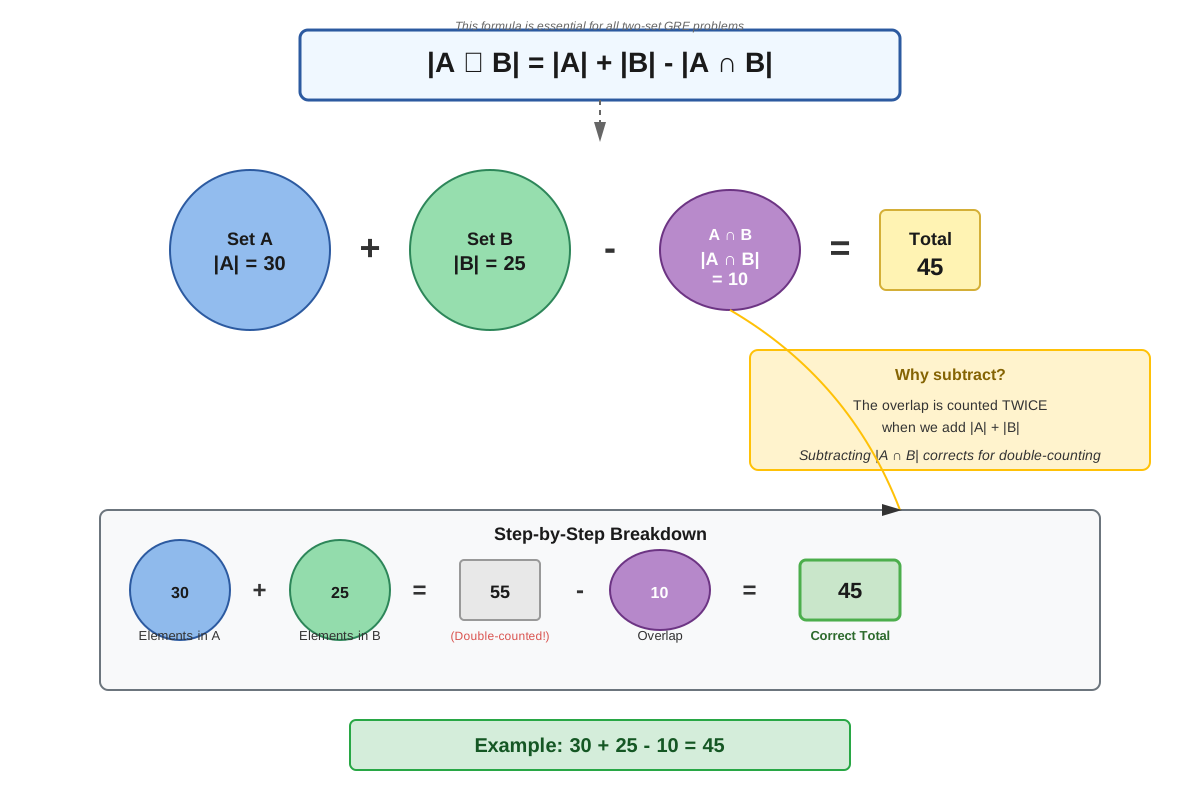
The inclusion-exclusion principle forms the mathematical foundation for all overlapping events problems. This principle states that when counting elements across multiple sets with overlap, the total equals the sum of individual sets minus the overlapping portions to avoid double-counting.
For two overlapping sets A and B:
Total = A + B - (A and B) + NeitherWhere:
- A = number of elements in set A only or including overlap
- B = number of elements in set B only or including overlap
- (A and B) = number of elements in both sets (the overlap)
- Neither = elements in neither set
This formula prevents counting shared elements twice. When a problem states "50 people like coffee, 40 like tea, and 20 like both," the total who like at least one beverage is 50 + 40 - 20 = 70, not 90.
Two-Set Overlapping Events
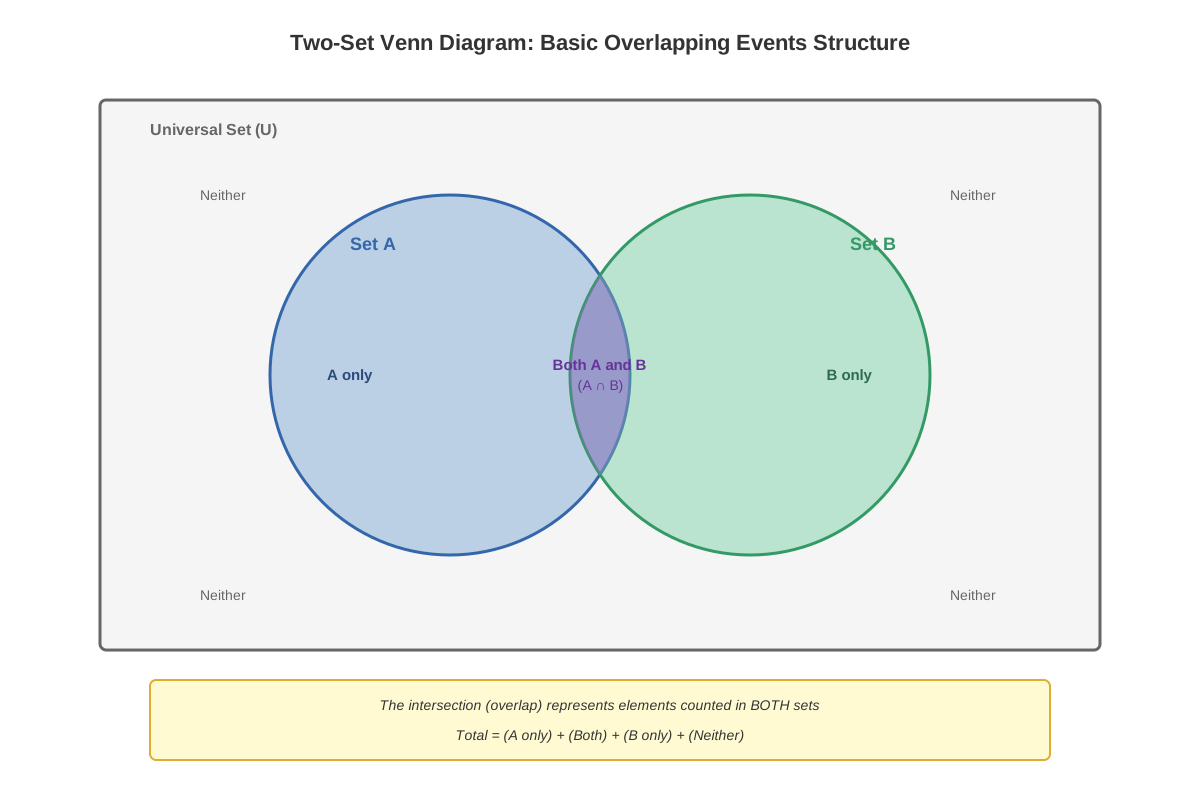
Two-set problems represent the most common overlapping events scenario on the GRE. These problems involve exactly two categories with potential overlap, creating four distinct regions:
- Only A: Elements exclusively in the first category
- Only B: Elements exclusively in the second category
- Both A and B: Elements in the overlapping region
- Neither A nor B: Elements outside both categories
The key relationship for two-set problems:
Total Population = Only A + Only B + Both + NeitherWhen given "at least one" information (elements in A or B or both), use:
At least one = Only A + Only B + BothVenn Diagram Representation
Venn diagrams provide the most intuitive visualization for overlapping events. These diagrams use overlapping circles to represent sets, with the overlapping region showing shared elements.
For two sets:
- Draw two overlapping circles within a rectangle (representing the total population)
- Label the overlap region first (this is "both")
- Calculate "only A" by subtracting the overlap from total A
- Calculate "only B" by subtracting the overlap from total B
- Place remaining elements in "neither" region outside both circles
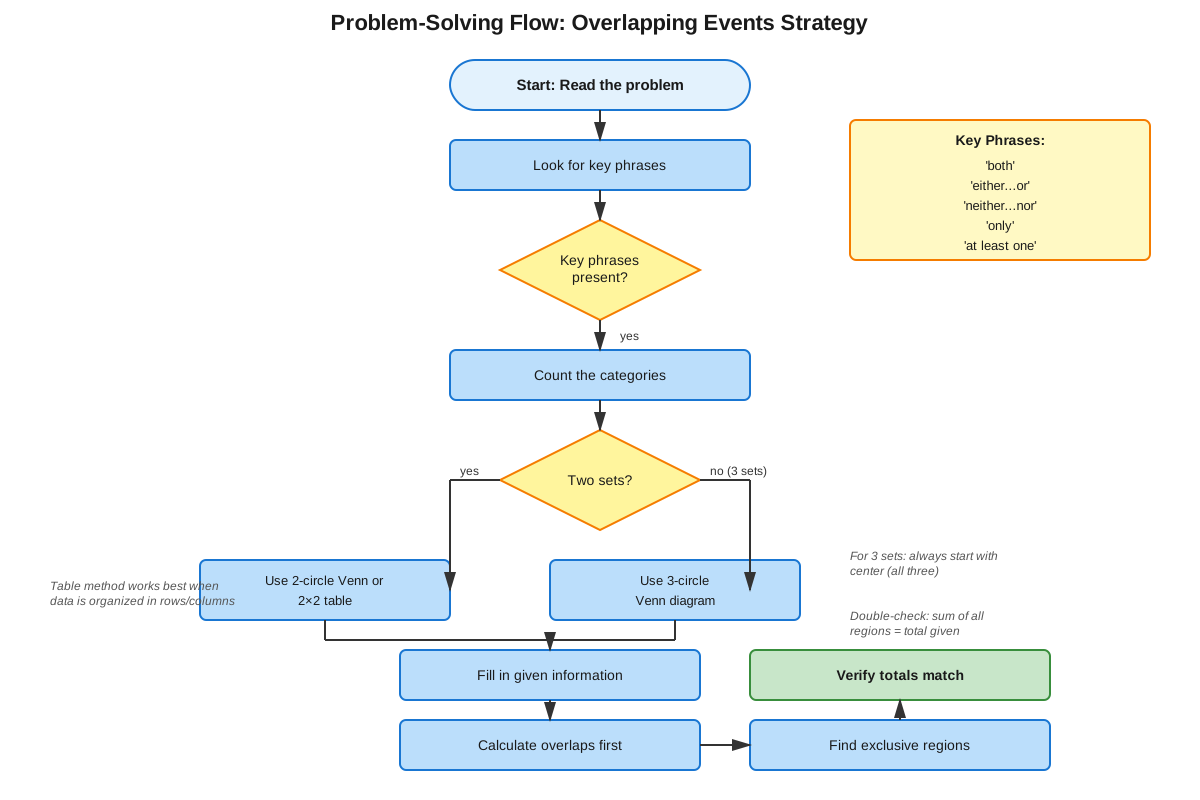
Strategic approach: Always start by filling in the overlap region, then work outward to the exclusive regions, and finally calculate the "neither" category if needed.
Three-Set Overlapping Events
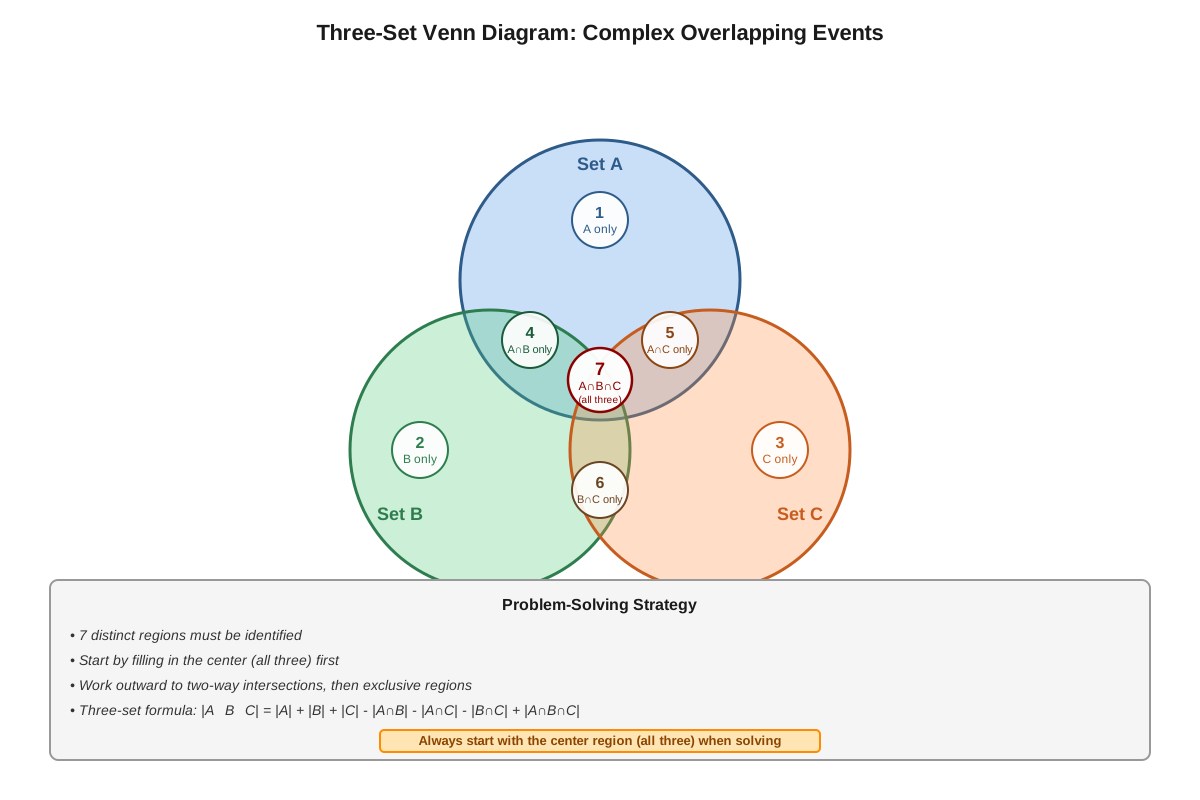
Three-set problems increase complexity by introducing seven distinct regions:
- Only A
- Only B
- Only C
- A and B only (not C)
- A and C only (not B)
- B and C only (not A)
- All three (A and B and C)
The inclusion-exclusion principle for three sets:
Total = A + B + C - (A∩B) - (A∩C) - (B∩C) + (A∩B∩C) + NeitherThe addition of (A∩B∩C) at the end corrects for removing the center region too many times in the subtraction steps.
The "At Least One" vs. "Exactly One" Distinction
GRE questions carefully distinguish between:
"At least one": Includes elements in one category OR multiple categories (includes all overlaps)
"Exactly one": Includes ONLY elements in a single category (excludes all overlaps)
For two sets:
- At least one = Only A + Only B + Both
- Exactly one = Only A + Only B (excludes Both)
This distinction frequently appears in trap answers, making careful reading essential.
Complementary Counting
When problems ask for "at least one," sometimes calculating the complement is more efficient:
At least one = Total - NeitherThis approach works particularly well when "neither" is directly given or easily calculated, avoiding complex inclusion-exclusion calculations.
Two-Way Tables for Overlapping Events
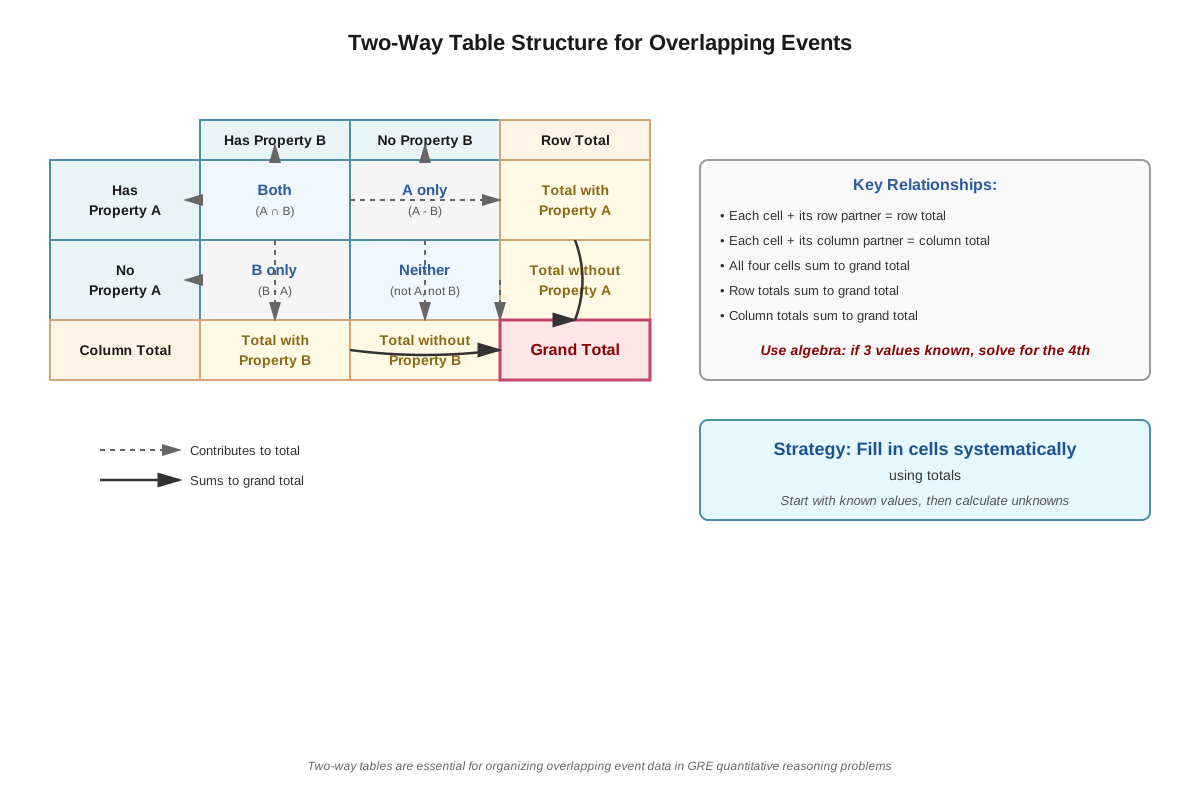
Two-way tables (also called contingency tables) organize overlapping data in rows and columns, with totals in margins. These tables represent the same information as Venn diagrams but in tabular format.
| Category | Has Property B | Lacks Property B | Row Total |
|---|---|---|---|
| Has Property A | Both A and B | Only A | Total A |
| Lacks Property A | Only B | Neither | Total not A |
| Column Total | Total B | Total not B | Grand Total |
The center cell (Both A and B) represents the overlap. Row and column totals must equal the grand total when summed.
Concept Relationships
The inclusion-exclusion principle serves as the central concept from which all other overlapping events strategies derive. This principle → enables accurate counting in Venn diagrams → which can be translated into two-way tables → supporting both "at least one" and "exactly one" calculations.
Two-set problems form the foundation → extending naturally to three-set problems through additional overlap regions. The complementary counting strategy → connects to the inclusion-exclusion principle by recognizing that "at least one" and "neither" are complementary events within the total population.
Overlapping events connects to prerequisite basic set theory by applying abstract set operations to concrete counting problems. The topic also relates forward to conditional probability, where overlapping events become the foundation for calculating P(A|B) using intersection and union concepts. Additionally, overlapping events strengthens skills needed for data interpretation questions, where tables and charts often present overlapping categories requiring careful analysis.
High-Yield Facts
⭐ The inclusion-exclusion formula for two sets: Total = A + B - Both + Neither (most frequently tested relationship)
⭐ Always identify the overlap first: In Venn diagram problems, finding "both" before calculating exclusive regions prevents errors
⭐ "At least one" equals Total minus Neither: This complementary approach often provides the fastest solution path
⭐ Row and column totals must reconcile: In two-way tables, all rows must sum to the grand total, and all columns must sum to the grand total
⭐ "Exactly one" excludes all overlaps: This differs from "at least one" and is a common trap in answer choices
- The center region of a three-set Venn diagram represents elements in all three categories simultaneously
- When given percentages instead of counts, convert to actual numbers or work entirely in percentages consistently
- "Neither" category often requires calculation by subtracting all other regions from the total population
- Overlapping events are NOT mutually exclusive; mutually exclusive events have zero overlap
- In three-set problems, pairwise overlaps (A∩B, A∩C, B∩C) include the center region unless specified as "only two"
Quick check — test yourself on Overlapping events so far.
Try Flashcards →Common Misconceptions
Misconception: Adding all given totals directly provides the correct answer → Correction: This double-counts overlapping elements; must subtract overlaps using the inclusion-exclusion principle to get accurate totals
Misconception: "Both" and "at least one" mean the same thing → Correction: "Both" refers only to the overlap region, while "at least one" includes all elements in either or both categories (Only A + Only B + Both)
Misconception: In three-set problems, A∩B means only the region where A and B overlap but not C → Correction: A∩B includes all elements in both A and B, including those also in C, unless specified as "A and B but not C"
Misconception: The "neither" category can be ignored if not explicitly mentioned → Correction: Many problems require calculating "neither" to find the total population or to use complementary counting; it's a distinct region that must be accounted for
Misconception: Venn diagrams and two-way tables represent different types of problems → Correction: These are simply different representations of the same overlapping events relationships; any Venn diagram can be converted to a two-way table and vice versa
Misconception: Percentages and counts can be mixed freely in calculations → Correction: Must maintain consistency—either convert all percentages to counts using the total, or work entirely in percentages and convert at the end
Worked Examples
Example 1: Two-Set Overlapping Events with Venn Diagram
Problem: In a survey of 100 students, 65 students study Mathematics, 48 students study Physics, and 30 students study both subjects. How many students study neither Mathematics nor Physics?
Solution:
Step 1: Identify what's given and what's asked
- Total students = 100
- Study Math (including overlap) = 65
- Study Physics (including overlap) = 48
- Study both = 30
- Find: Neither
Step 2: Visualize with a Venn diagram approach
- Both (overlap) = 30
- Only Math = 65 - 30 = 35
- Only Physics = 48 - 30 = 18
Step 3: Apply the inclusion-exclusion principle
Total = Only Math + Only Physics + Both + Neither
100 = 35 + 18 + 30 + Neither
100 = 83 + Neither
Neither = 17
Alternative approach using complementary counting:
At least one subject = Math + Physics - Both = 65 + 48 - 30 = 83
Neither = Total - At least one = 100 - 83 = 17
Answer: 17 students study neither subject
Connection to learning objectives: This problem demonstrates identification of overlapping events (two categories with shared elements), application of the core inclusion-exclusion principle, and accurate calculation using GRE-style data.
Example 2: Three-Set Problem with Two-Way Analysis
Problem: A company surveyed 200 employees about three skills: Coding (C), Design (D), and Management (M). The results showed: 120 have Coding skills, 90 have Design skills, 80 have Management skills, 50 have both Coding and Design, 40 have both Coding and Management, 35 have both Design and Management, and 20 have all three skills. How many employees have exactly one of these skills?
Solution:
Step 1: Identify the center region (all three skills)
All three (C∩D∩M) = 20
Step 2: Calculate pairwise-only overlaps (two skills but not the third)
- C and D only (not M) = 50 - 20 = 30
- C and M only (not D) = 40 - 20 = 20
- D and M only (not C) = 35 - 20 = 15
Step 3: Calculate single-skill-only regions
- Only C = 120 - 30 - 20 - 20 = 50
- Only D = 90 - 30 - 15 - 20 = 25
- Only M = 80 - 20 - 15 - 20 = 25
Step 4: Sum exactly-one regions
Exactly one skill = Only C + Only D + Only M = 50 + 25 + 25 = 100
Verification:
Total with at least one skill = 50 + 25 + 25 + 30 + 20 + 15 + 20 = 185
This should equal: C + D + M - (C∩D) - (C∩M) - (D∩M) + (C∩D∩M)
= 120 + 90 + 80 - 50 - 40 - 35 + 20 = 185 ✓
Answer: 100 employees have exactly one skill
Connection to learning objectives: This demonstrates systematic application of inclusion-exclusion to three-set problems, distinguishes between "exactly one" and overlapping categories, and shows the verification strategy that ensures accuracy on complex GRE problems.
Exam Strategy
Recognition triggers: Watch for these phrases that signal overlapping events problems:
- "both," "either," "neither," "at least one," "exactly one"
- "some students take both courses"
- "employees with multiple skills"
- "respondents who selected more than one option"
- Questions presenting two or three categories with shared elements
Systematic approach for GRE overlapping events questions:
- Read carefully and identify the total population (this anchors all calculations)
- Determine how many sets are involved (two-set vs. three-set changes strategy)
- Draw a quick Venn diagram or table (visual organization prevents errors)
- Fill in the overlap region(s) first (this is the most commonly given information)
- Work outward to exclusive regions (subtract overlaps from totals)
- Calculate "neither" if needed (often required for final answer)
- Verify your answer (check that all regions sum to the total population)
Process of elimination tips:
- Eliminate answers that exceed the total population
- Eliminate answers that ignore the overlap (usually the result of simple addition)
- For "at least one" questions, eliminate answers smaller than the largest individual category
- For "exactly one" questions, eliminate answers that equal "at least one" (they forgot to subtract overlaps)
Time allocation: Allocate 1.5-2 minutes for two-set problems and 2-2.5 minutes for three-set problems. If a problem requires more time, mark it and return after completing easier questions. Drawing a quick diagram takes 15-20 seconds but saves time by preventing calculation errors.
Quantitative comparison strategy: When comparing overlapping event quantities, calculate the specific value only if necessary. Often, logical reasoning about relationships (e.g., "at least one" must be greater than "both") allows direct comparison without full calculation.
Memory Techniques
Inclusion-Exclusion Mnemonic: "Add Both, Subtract Overlap" (ABSO)
- Add all individual categories
- Subtract overlaps to avoid double-counting
Venn Diagram Filling Order: "Center Out Neither" (CON)
- Start with Center (overlap/both)
- Work Outward to exclusive regions
- Calculate Neither last
Two vs. Three Sets: Remember "2-3-7"
- 2 sets create 3 exclusive regions (only A, only B, both)
- 3 sets create 7 regions (three singles, three pairs, one triple)
At Least vs. Exactly: "Least is Larger"
- "At Least one" includes more elements than "Exactly one"
- If your "exactly one" answer equals "at least one," you made an error
Complementary Counting: "Total Minus Neither" (TMN)
- When finding "at least one," subtract "neither" from total
- Often faster than inclusion-exclusion for two-set problems
Visualization: Picture overlapping circles as a physical Venn diagram where elements can only exist in one region at a time. The overlap isn't "extra space"—it's shared territory that must be subtracted when counting totals.
Summary
Overlapping events problems test the ability to organize and count elements that belong to multiple categories simultaneously. The inclusion-exclusion principle provides the mathematical foundation: when combining sets with overlap, add individual totals and subtract shared elements to avoid double-counting. Two-set problems create four distinct regions (only A, only B, both, neither), while three-set problems expand to seven regions. Venn diagrams and two-way tables offer equivalent visual representations that help organize information systematically. Success requires distinguishing between "at least one" (includes all overlaps) and "exactly one" (excludes overlaps), recognizing when complementary counting (Total - Neither) provides a faster path, and always starting with the overlap region when constructing diagrams. These problems appear frequently on the GRE in word problems, data interpretation questions, and quantitative comparisons, making them essential for achieving competitive scores in the Quantitative Reasoning section.
Key Takeaways
- The inclusion-exclusion principle prevents double-counting: Always subtract overlaps when combining totals from multiple categories
- Start with the overlap, work outward: Fill in "both" regions first, then calculate exclusive regions by subtraction
- "At least one" and "exactly one" are fundamentally different: The former includes overlaps; the latter excludes them
- Complementary counting often provides shortcuts: Calculate "Total - Neither" instead of complex inclusion-exclusion when possible
- Venn diagrams and two-way tables are interchangeable tools: Choose whichever representation makes the problem clearer
- All regions must sum to the total population: Use this verification check to catch calculation errors before submitting answers
- Three-set problems require systematic organization: Track seven distinct regions carefully to avoid missing or double-counting elements
Related Topics
Probability with Overlapping Events: Extends overlapping events concepts to calculate probabilities of compound events, using P(A or B) = P(A) + P(B) - P(A and B). Mastering overlapping events provides the counting foundation needed for these probability calculations.
Conditional Probability: Builds on overlapping events by examining probability within restricted sample spaces, where P(A|B) uses the overlap region divided by one set's total. Understanding overlaps is prerequisite to conditional probability.
Set Theory Operations: Formalizes overlapping events using union (∪), intersection (∩), and complement notation. This mathematical framework generalizes the counting principles learned here.
Data Interpretation with Multiple Variables: Applies overlapping events logic to complex tables and charts showing multiple characteristics simultaneously, a common GRE question type in the Data Interpretation section.
Combinatorics and Counting Principles: Extends systematic counting approaches to more complex scenarios involving arrangements, selections, and combinations where overlap considerations become more abstract.
Practice CTA
Now that you've mastered the core concepts of overlapping events, reinforce your understanding by working through the practice questions. These problems mirror actual GRE question formats and difficulty levels, giving you the opportunity to apply the inclusion-exclusion principle, construct Venn diagrams, and distinguish between "at least one" and "exactly one" scenarios. Use the flashcards to drill high-yield facts and formulas until they become automatic. Remember: overlapping events questions are highly predictable once you recognize the patterns—consistent practice transforms these from challenging problems into reliable score-boosters. Your systematic approach to these problems demonstrates the analytical thinking that graduate programs value, so invest the time to achieve mastery!
Sign up free to keep reading
Create a free AnvayaPrep account to finish this GRE guide on Overlapping events — plus flashcards and practice questions.