Overview
Arc length is a fundamental geometric concept that appears regularly on the GRE Quantitative Reasoning section, testing students' ability to work with circles and their properties. At its core, arc length represents the distance along the curved portion of a circle's circumference between two points. Understanding arc length requires synthesizing knowledge of circles, angles, proportions, and the relationship between a circle's radius and its circumference. This topic typically appears in 2-4 questions per GRE exam, either as standalone geometry problems or embedded within more complex multi-step questions involving coordinate geometry or data interpretation.
The importance of mastering gre arc length extends beyond simply calculating curved distances. Arc length problems test proportional reasoning—a critical skill that permeates the entire Quantitative Reasoning section. When students understand that an arc is simply a fraction of a circle's total circumference, they develop intuition about part-to-whole relationships that applies to probability, statistics, and algebraic reasoning. Additionally, arc length questions often combine multiple geometric concepts, requiring students to find missing angles, work with inscribed figures, or convert between degrees and radians.
Within the broader Quantitative Reasoning framework, arc length sits at the intersection of geometry and algebra. It connects directly to circumference formulas, central angles, sector area calculations, and coordinate geometry. Students who master arc length develop stronger spatial reasoning skills and gain confidence tackling the diverse geometry problems that constitute approximately 15% of GRE Quantitative questions. This topic serves as a gateway to more advanced geometric concepts while reinforcing fundamental mathematical relationships that appear throughout the exam.
Learning Objectives
- [ ] Identify when Arc length is being tested in GRE questions
- [ ] Explain the core rule or strategy behind Arc length calculations
- [ ] Apply Arc length formulas to GRE-style questions accurately
- [ ] Convert between central angles in degrees and their corresponding arc lengths
- [ ] Solve multi-step problems involving arc length combined with other geometric properties
- [ ] Recognize when to use proportional reasoning versus direct formula application
- [ ] Calculate arc length when given partial information about a circle's properties
Prerequisites
- Circle circumference formula (C = 2πr): Arc length is fundamentally a portion of the total circumference, making this formula the foundation for all arc length calculations
- Basic angle measurement in degrees: Arc length depends on the central angle that subtends the arc, requiring comfort with angle notation and measurement
- Proportional reasoning: Understanding ratios and proportions is essential since arc length represents a fractional part of the whole circumference
- Basic algebraic manipulation: Solving for unknown variables in arc length equations requires rearranging formulas and isolating terms
- Properties of circles (radius, diameter, center): Identifying these components in diagrams is necessary to set up arc length problems correctly
Why This Topic Matters
Arc length appears in real-world applications ranging from engineering and architecture to navigation and design. Architects use arc length calculations when designing curved structures, bridges, and arches. Engineers apply these principles when determining the distance traveled along circular paths, calculating belt lengths around pulleys, or designing curved roads. In navigation, arc length on Earth's surface (treating Earth as a sphere) helps determine distances between locations at different latitudes or longitudes.
On the GRE specifically, arc length questions appear with notable frequency—approximately 2-4 questions per exam across both Quantitative Reasoning sections. These questions manifest in several formats: direct calculation problems where students must find an arc's length given a radius and angle; reverse problems requiring students to find a radius or angle given the arc length; comparison questions (Quantitative Comparison) asking students to evaluate two arc lengths; and complex multi-step problems where arc length is one component of a larger geometric scenario. Data Interpretation questions occasionally incorporate arc length when presenting information in circular graphs or diagrams.
The GRE tests arc length in ways that emphasize conceptual understanding over rote memorization. Questions often omit obvious information, requiring students to deduce missing values through geometric relationships. Common scenarios include arcs within coordinate plane circles, arcs formed by intersecting lines through a circle's center, and problems combining arc length with sector area or inscribed polygons. The exam particularly favors questions where students must recognize that they're dealing with an arc length problem even when the question doesn't explicitly use that terminology.
Core Concepts
The Arc Length Formula
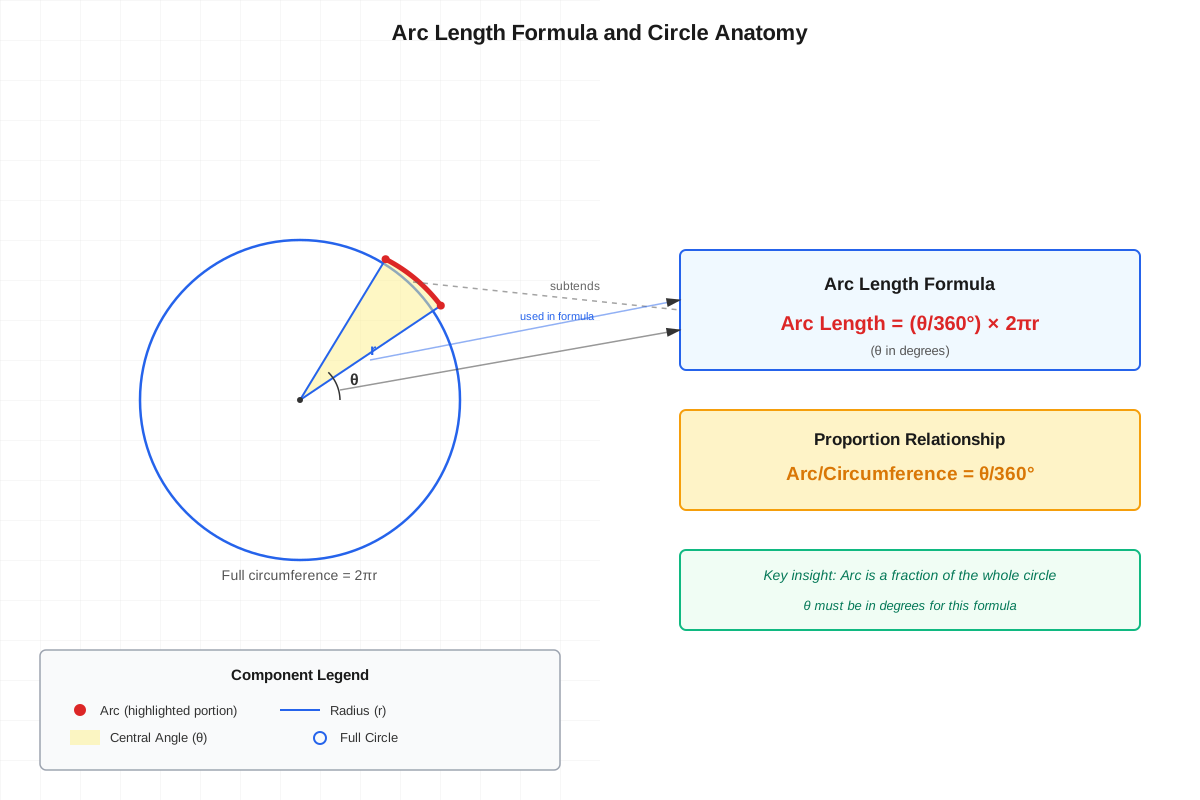
The fundamental arc length formula establishes the relationship between an arc's length (s), the circle's radius (r), and the central angle (θ) that subtends the arc:
s = (θ/360°) × 2πrThis formula can be simplified to:
s = (θ/360°) × Cwhere C represents the circle's circumference. The formula embodies a proportion: the arc length is to the total circumference as the central angle is to 360 degrees (the total degrees in a circle). This proportional relationship is the key insight that unlocks most GRE arc length problems.
The central angle θ must be measured in degrees for this formula. When working with radians (less common on the GRE but occasionally tested), the formula becomes:
s = rθwhere θ is in radians. This simpler form emerges because radians are defined such that a full circle equals 2π radians, making the conversion factor implicit.
Understanding Central Angles
A central angle is an angle whose vertex sits at the circle's center, with its two rays extending to points on the circumference. The arc length depends entirely on this central angle—larger angles create longer arcs for the same radius. On the GRE, central angles may be:
- Explicitly stated in the problem
- Shown in a diagram with angle markings
- Implied through other geometric relationships (vertical angles, supplementary angles, inscribed angles)
- Calculated from given information about intersecting chords or tangent lines
Students must develop the skill of identifying central angles even when they're not obviously labeled. For example, if two radii form an angle, that's automatically a central angle. If a problem describes "a 60-degree slice of a circular pizza," the 60 degrees refers to the central angle.
The Proportional Reasoning Approach
Rather than memorizing formulas, many GRE experts recommend understanding arc length through proportions. This approach builds flexibility and reduces formula confusion under test pressure. The proportion states:
arc length / circumference = central angle / 360°This can be rearranged to solve for any unknown variable:
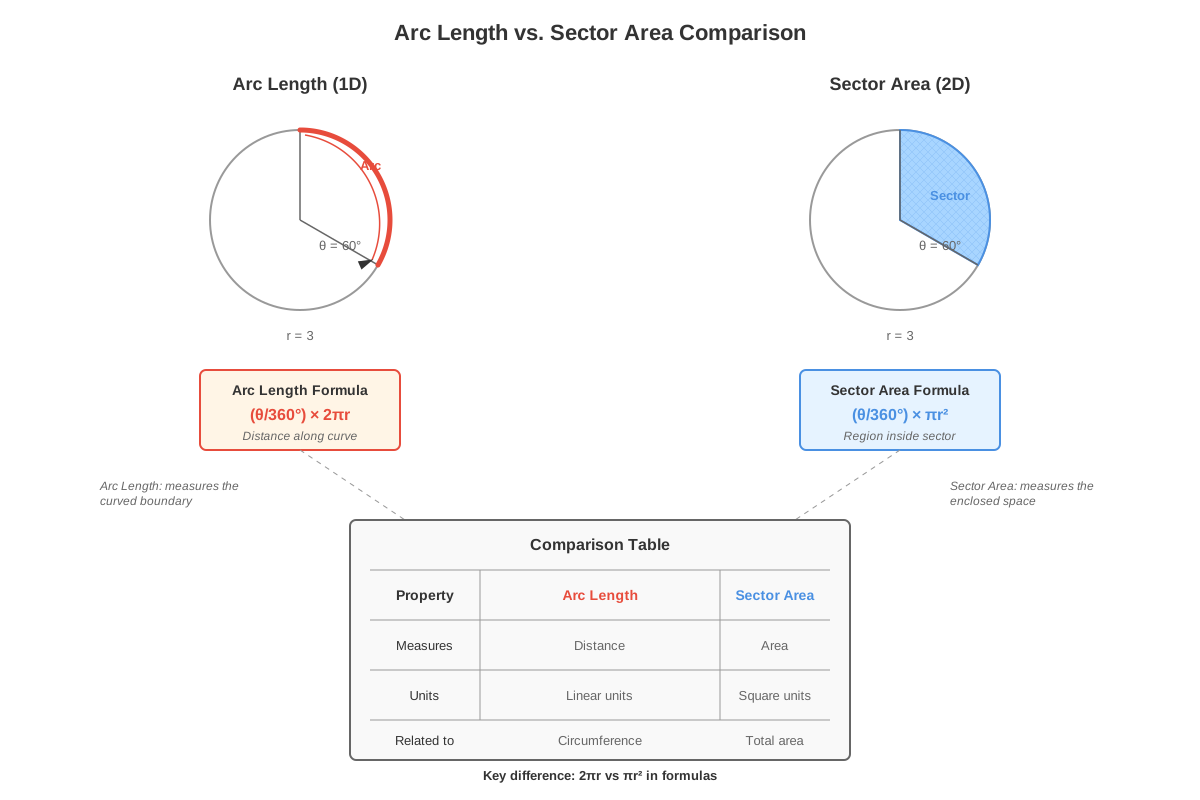
arc length = circumference × (central angle / 360°)This proportional thinking extends to related concepts. Since sector area also depends on the central angle, students can write:
arc length / circumference = sector area / circle area = central angle / 360°Working with Partial Information
GRE questions rarely provide all information directly. Common scenarios include:
Given arc length and angle, find radius:
If an arc of 5π units corresponds to a 90° angle, set up the proportion:
5π = (90/360) × 2πr
5π = (1/4) × 2πr
5π = πr/2
r = 10
Given arc length and radius, find angle:
If an arc of 6π units exists on a circle with radius 9, solve:
6π = (θ/360) × 2π(9)
6π = (θ/360) × 18π
6 = (θ/360) × 18
θ = 120°
Multiple Arcs and Composite Problems
Advanced GRE questions may involve multiple arcs on the same circle or arcs on different circles. Key strategies include:
- Same circle, different arcs: Arc lengths are proportional to their central angles
- Different circles, same angle: Arc lengths are proportional to their radii
- Complementary or supplementary arcs: If two arcs together form a semicircle (180°) or full circle (360°), their lengths sum predictably
Special Arc Length Cases
Certain angle measures produce convenient arc lengths that students should recognize instantly:
| Central Angle | Fraction of Circle | Arc Length Formula |
|---|---|---|
| 90° | 1/4 | s = πr/2 |
| 60° | 1/6 | s = πr/3 |
| 45° | 1/8 | s = πr/4 |
| 120° | 1/3 | s = 2πr/3 |
| 180° | 1/2 | s = πr |
Recognizing these common angles allows for rapid mental calculation without full formula application.
Concept Relationships
Arc length fundamentally derives from the circumference formula, making circumference the parent concept. The relationship flows: radius → circumference → arc length. Understanding that arc length is simply a fractional portion of circumference based on the central angle creates the conceptual foundation.
Arc length connects bidirectionally with central angles—each determines the other when radius is known. This relationship extends to inscribed angles, which measure half their corresponding central angles, creating an indirect path from inscribed angles to arc length through the central angle intermediary.
The proportional nature of arc length links it to sector area. Both sector area and arc length depend on the same central angle and radius, creating parallel formulas. Students who understand one concept can leverage that knowledge for the other: sector area / circle area = arc length / circumference.
In coordinate geometry, arc length connects to distance formulas and equation of a circle. When a circle is defined by (x - h)² + (y - k)² = r², finding arc length between two points on that circle requires identifying the central angle through coordinate analysis, then applying standard arc length formulas.
Arc length also relates to angular velocity and linear velocity in motion problems (less common on GRE but occasionally tested). An object moving along a circular path travels an arc length distance, connecting geometric and kinematic concepts.
The relationship map: Radius → Circumference → Arc Length ← Central Angle ← Inscribed Angle; parallel to this: Radius → Circle Area → Sector Area ← Central Angle
High-Yield Facts
⭐ The arc length formula is s = (θ/360°) × 2πr, where θ is the central angle in degrees
⭐ Arc length is proportional to the central angle: doubling the angle doubles the arc length for the same radius
⭐ A semicircular arc (180°) has length πr, exactly half the full circumference
⭐ Arc length equals radius times angle when the angle is measured in radians: s = rθ
⭐ The ratio of arc length to circumference equals the ratio of central angle to 360°
- A 90° arc on any circle equals one-quarter of that circle's circumference
- Two arcs on the same circle have lengths proportional to their central angles
- Two arcs with the same central angle on different circles have lengths proportional to their radii
- The arc length of a full circle (360°) equals the circumference 2πr
- If a central angle is given as a fraction of 360° (like "1/6 of the circle"), multiply that fraction by the circumference
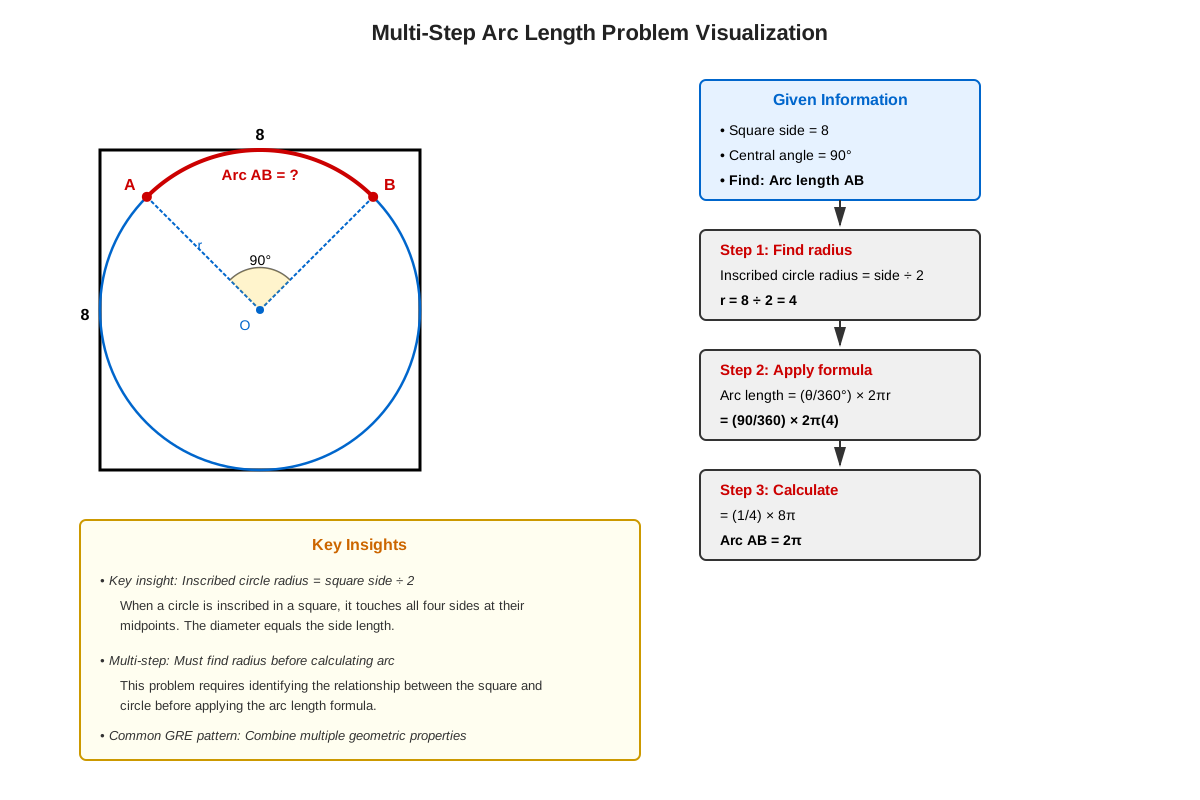
- Arc length problems often require finding the radius first from other given information
- When a problem mentions "distance along the curve" or "length of the curved path," it's testing arc length
Quick check — test yourself on Arc length so far.
Try Flashcards →Common Misconceptions
Misconception: Arc length equals the straight-line distance (chord length) between the arc's endpoints → Correction: Arc length measures the curved distance along the circle's circumference, which is always longer than the straight chord connecting the same two points. The chord length requires different formulas involving trigonometry.
Misconception: The arc length formula works with any angle unit without adjustment → Correction: The formula s = (θ/360°) × 2πr specifically requires θ in degrees. If the angle is given in radians, either convert to degrees first or use the alternative formula s = rθ where θ is in radians.
Misconception: Doubling the radius doubles the arc length → Correction: While this is true when the central angle remains constant, students often forget that arc length depends on both radius and angle. Doubling the radius doubles the arc length only if the angle stays the same.
Misconception: A larger circle always has a longer arc for a given angle → Correction: This is actually correct, but students sometimes reverse it, thinking a smaller circle could have a longer arc. The misconception appears when students confuse arc length with the central angle itself—the angle is independent of circle size.
Misconception: Arc length can be calculated using only the central angle without knowing the radius → Correction: Arc length requires both the central angle and the radius (or circumference). The angle alone tells what fraction of the circle the arc represents, but the actual length depends on the circle's size.
Misconception: The formula s = rθ always works for arc length → Correction: This simplified formula only works when θ is measured in radians. Since the GRE primarily uses degrees, students must use s = (θ/360°) × 2πr or first convert degrees to radians.
Misconception: If two arcs look similar in size on a diagram, they have equal lengths → Correction: GRE diagrams are explicitly noted as "not drawn to scale" unless stated otherwise. Never assume arc lengths are equal based on visual appearance; always calculate using given numerical information.
Worked Examples
Example 1: Direct Arc Length Calculation
Problem: A circle has a radius of 12 inches. What is the length of an arc subtended by a central angle of 150°?
Solution:
Step 1: Identify the given information
- Radius r = 12 inches
- Central angle θ = 150°
- Need to find: arc length s
Step 2: Choose the appropriate formula
Using s = (θ/360°) × 2πr
Step 3: Substitute values
s = (150°/360°) × 2π(12)
s = (150/360) × 24π
Step 4: Simplify the fraction
150/360 = 5/12 (dividing both numerator and denominator by 30)
Step 5: Calculate
s = (5/12) × 24π
s = 5 × 2π
s = 10π inches
Step 6: Verify using proportional reasoning
150° is 150/360 = 5/12 of a full circle
The full circumference is 2π(12) = 24π
Therefore, the arc is (5/12) × 24π = 10π ✓
Answer: 10π inches (approximately 31.4 inches if a decimal answer is required)
This problem directly tests the learning objective of applying arc length formulas to GRE-style questions. The key insight is recognizing that 150° represents a specific fraction of the full 360° circle.
Example 2: Finding Radius from Arc Length
Problem: An arc of length 15π centimeters corresponds to a central angle of 135°. What is the radius of the circle?
Solution:
Step 1: Identify given information
- Arc length s = 15π cm
- Central angle θ = 135°
- Need to find: radius r
Step 2: Set up the arc length formula
s = (θ/360°) × 2πr
15π = (135°/360°) × 2πr
Step 3: Simplify the angle fraction
135/360 = 3/8 (dividing both by 45)
Step 4: Substitute and solve
15π = (3/8) × 2πr
15π = (3πr)/4
Step 5: Isolate r
Multiply both sides by 4: 60π = 3πr
Divide both sides by 3π: r = 60π/3π = 20
Step 6: Verify
If r = 20, then circumference = 2π(20) = 40π
135° is 3/8 of 360°
Arc length = (3/8) × 40π = 15π ✓
Answer: The radius is 20 centimeters
This problem demonstrates the learning objective of solving for unknown variables when given partial information. It requires algebraic manipulation and reinforces the proportional relationship between arc length and circumference.
Example 3: Comparing Two Arcs (Quantitative Comparison Style)
Problem:
- Quantity A: The length of an arc with central angle 60° on a circle with radius 18
- Quantity B: The length of an arc with central angle 90° on a circle with radius 10
Which quantity is greater?
Solution:
Step 1: Calculate Quantity A
s_A = (60°/360°) × 2π(18)
s_A = (1/6) × 36π
s_A = 6π
Step 2: Calculate Quantity B
s_B = (90°/360°) × 2π(10)
s_B = (1/4) × 20π
s_B = 5π
Step 3: Compare
6π vs. 5π
Since 6π > 5π, Quantity A is greater
Answer: Quantity A is greater
This problem illustrates how GRE questions test arc length in comparison format, requiring students to calculate both values efficiently and compare them. The key strategy is recognizing that both can be expressed in terms of π, making comparison straightforward without calculating decimal approximations.
Exam Strategy
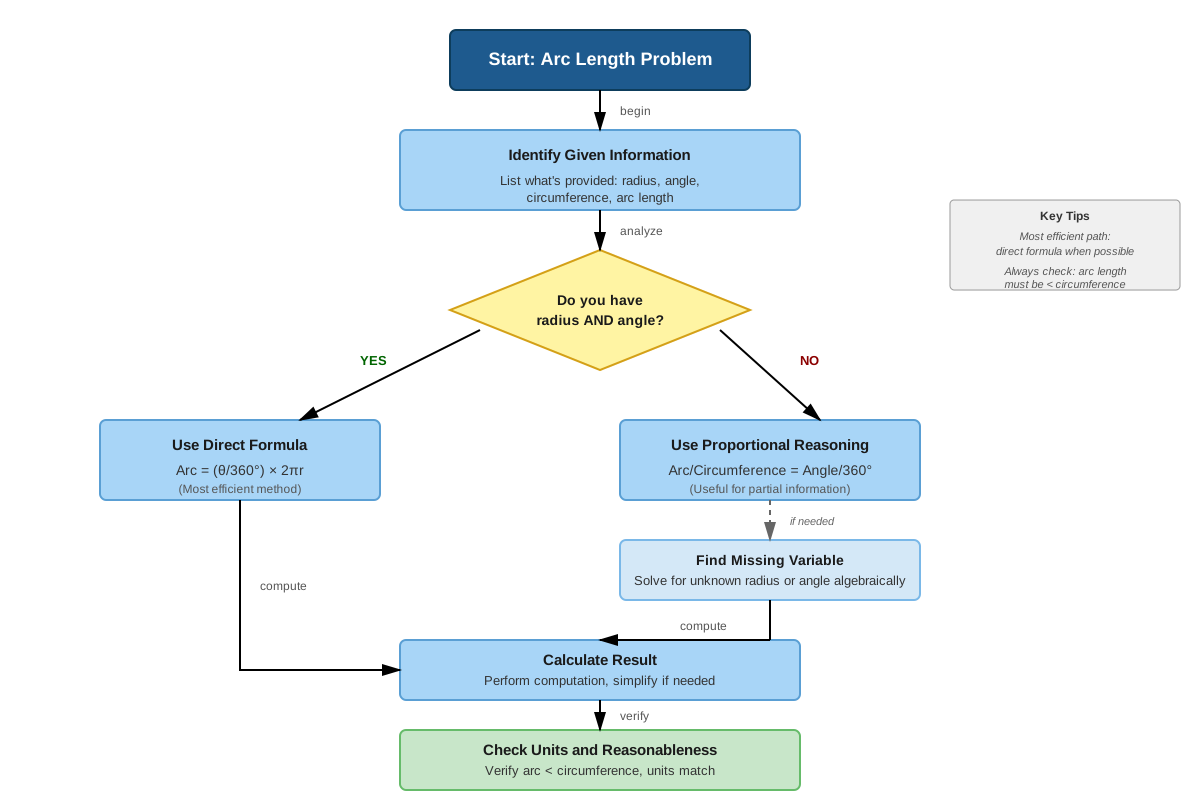
When approaching gre arc length questions, begin by identifying whether the problem explicitly mentions "arc length" or uses indirect language like "distance along the curve," "length of the curved portion," or "distance traveled along the circular path." These trigger phrases signal arc length calculations.
Step-by-step approach for arc length problems:
- Draw or annotate the diagram: Even if a figure is provided, mark the radius, central angle, and arc clearly
- Identify what's given and what's needed: List known values (radius, angle, arc length, circumference) and the target variable
- Choose your method: Decide between direct formula application or proportional reasoning based on the given information
- Check angle units: Verify whether angles are in degrees or radians and use the appropriate formula
- Simplify before calculating: Reduce fractions and cancel terms before multiplying to minimize arithmetic errors
- Leave answers in terms of π: Unless the question specifically requests a decimal approximation, keep π in the answer
Trigger words and phrases to watch for:
- "Arc," "curved distance," "length along the circle"
- "Central angle," "angle at the center"
- "Sector" (often appears with arc length)
- "Subtended by" (indicates the relationship between an angle and an arc)
- "Fraction of the circle" or "portion of the circumference"
Process-of-elimination tips:
- If answer choices include π, the correct answer likely contains π (don't approximate unless necessary)
- Eliminate answers that exceed the full circumference (2πr)
- For angles less than 180°, eliminate arc lengths greater than πr (semicircle)
- Check if answer choices are proportional to the given angle—this can reveal calculation errors
Time allocation:
Arc length problems typically require 1.5-2 minutes. Spend 20-30 seconds understanding the problem and identifying given information, 60-90 seconds on calculation, and 15-20 seconds verifying your answer. If a problem combines arc length with other concepts (sector area, coordinate geometry), allocate up to 2.5 minutes.
Exam Tip: When stuck, use proportional reasoning as a fallback. Ask yourself: "What fraction of the full circle does this arc represent?" Then multiply that fraction by the circumference. This intuitive approach often bypasses formula confusion.
Memory Techniques
Mnemonic for the arc length formula: "Some Teachers Can Really Teach" maps to S = (Theta/Total) × Circumference or Radius formula, reminding students that arc length (S) equals the angle fraction (Theta/Total 360°) times the circumference (or involves the radius).
Visualization strategy: Picture a pizza. The crust length of one slice is the arc length. If you cut the pizza into 8 equal slices, each slice has a 45° angle (360°/8), and each crust arc is 1/8 of the total crust circumference. This concrete image helps students remember that arc length is a fractional portion of circumference based on the angle.
The "Quarter-Half-Three-Quarter" rule: Memorize these three special cases:
- 90° = Quarter circle = πr/2
- 180° = Half circle = πr
- 270° = Three-quarters = 3πr/2
These appear frequently enough that instant recognition saves valuable time.
Acronym for problem-solving steps: DRAW
- Diagram: Sketch or annotate the figure
- Radius: Identify or calculate the radius
- Angle: Find the central angle
- Work: Apply the formula or proportion
Finger trick for common angles: Hold up your hand with fingers spread. Each finger represents 72° (360°/5). Two fingers = 144°, three fingers = 216°, etc. This provides a quick reference for less common angles and their fractions of a circle.
Summary
Arc length represents the distance along a circle's circumference between two points, determined by the circle's radius and the central angle subtending the arc. The fundamental formula s = (θ/360°) × 2πr (with θ in degrees) or s = rθ (with θ in radians) enables calculation of arc length when radius and angle are known. However, the deeper understanding comes from recognizing arc length as a proportional relationship: the arc length to circumference ratio equals the central angle to 360° ratio. GRE questions test this concept through direct calculations, reverse problems requiring students to find radius or angle from arc length, and complex multi-step scenarios combining arc length with other geometric properties. Success requires identifying central angles (even when not explicitly labeled), choosing between formula application and proportional reasoning based on given information, and maintaining accuracy with π in calculations. Students must also recognize indirect language signaling arc length problems and avoid common misconceptions about chord length versus arc length or angle unit requirements. Mastery of arc length strengthens proportional reasoning skills applicable throughout the Quantitative Reasoning section while building confidence with circle geometry.
Key Takeaways
- Arc length equals the central angle's fraction of 360° multiplied by the circumference: s = (θ/360°) × 2πr
- Proportional reasoning often provides the most efficient solution path: arc/circumference = angle/360°
- Central angles are the key to arc length—identify them even when not explicitly labeled in problems
- Common angles (90°, 60°, 45°, 180°) produce predictable arc length fractions that enable rapid mental calculation
- Arc length always exceeds chord length between the same two points—they are fundamentally different measurements
- Keep answers in terms of π unless specifically asked for decimal approximations—this maintains precision and matches GRE answer formats
- Arc length problems often combine with sector area, coordinate geometry, or inscribed figures—practice recognizing these compound scenarios
Related Topics
Sector Area: The area of a "pie slice" region bounded by two radii and an arc uses the same proportional relationship as arc length, with the formula A = (θ/360°) × πr². Mastering arc length provides direct preparation for sector area problems.
Inscribed and Central Angles: Understanding the relationship between inscribed angles (vertex on the circle) and central angles (vertex at center) enables solving for central angles needed in arc length calculations. An inscribed angle measures half its corresponding central angle.
Circle Equations in Coordinate Geometry: When circles are defined by equations like (x - h)² + (y - k)² = r², finding arc length between coordinate points requires extracting the radius and calculating central angles using coordinate geometry techniques.
Radians and Degree Conversion: While the GRE primarily uses degrees, understanding radians (where 2π radians = 360°) enables use of the simplified arc length formula s = rθ and appears in some advanced problems.
Angular and Linear Velocity: In motion problems involving circular paths, arc length connects to distance traveled, with angular velocity (angle per time) and linear velocity (distance per time) related through the radius.
Practice CTA
Now that you've mastered the core concepts, formulas, and strategies for arc length, it's time to solidify your understanding through active practice. Attempt the practice questions designed specifically for this topic, focusing on applying the proportional reasoning approach and recognizing the various ways the GRE disguises arc length problems. Use the flashcards to drill the essential formulas and special angle cases until they become automatic. Remember: arc length questions are highly predictable once you recognize the pattern—consistent practice transforms this medium-difficulty topic into a reliable source of points on test day. Your investment in mastering arc length pays dividends not only on direct geometry questions but also in strengthening the proportional reasoning skills that elevate performance across the entire Quantitative Reasoning section.
Sign up free to keep reading
Create a free AnvayaPrep account to finish this GRE guide on Arc length — plus flashcards and practice questions.