Overview
The sector area is a fundamental geometric concept that appears regularly on the GRE Quantitative Reasoning section. A sector is a "slice" of a circle, bounded by two radii and the arc between them—imagine a piece of pie cut from a circular pie. Understanding how to calculate the area of this slice is essential for success on circle-related geometry problems, which constitute a significant portion of GRE geometry questions.
Mastering gre sector area calculations enables students to tackle a wide range of problems, from straightforward area computations to complex multi-step questions involving proportional reasoning, angle relationships, and composite figures. The sector area concept bridges several mathematical domains: it requires understanding of circles (radius, circumference, area), angles (degrees and radians), and proportional relationships. This integration makes sector area questions particularly valuable for the GRE, as they efficiently test multiple competencies simultaneously.
The importance of this topic extends beyond isolated sector problems. Many GRE questions embed sector area calculations within larger geometric scenarios, such as finding shaded regions, comparing quantities involving circular segments, or solving optimization problems. Students who develop fluency with sector area formulas and the underlying proportional reasoning will find themselves better equipped to handle the full spectrum of circle geometry questions, making this a high-yield topic worthy of focused study and practice.
Learning Objectives
- [ ] Identify when Sector area is being tested in GRE questions
- [ ] Explain the core rule or strategy behind Sector area calculations
- [ ] Apply Sector area formulas to GRE-style questions accurately
- [ ] Derive the sector area formula from first principles using proportional reasoning
- [ ] Solve multi-step problems involving sectors combined with other geometric figures
- [ ] Convert between degrees and radians when calculating sector areas
- [ ] Determine arc length and sector area relationships efficiently
Prerequisites
- Circle fundamentals: Understanding radius, diameter, circumference (C = 2πr), and area (A = πr²) formulas is essential, as sector area is derived directly from the full circle area
- Angle measurement: Familiarity with degrees (360° in a circle) and basic angle relationships enables proper application of the sector formula
- Proportional reasoning: Sector area calculations rely on understanding that the sector is a fractional part of the whole circle
- Basic algebra: Manipulating equations and solving for unknown variables is necessary when sector area is one component of a larger problem
Why This Topic Matters
Sector area problems appear with notable frequency on the GRE, typically in 1-3 questions per Quantitative Reasoning section. These questions test spatial reasoning, proportional thinking, and formula application—all core competencies the GRE aims to assess. The topic appears in multiple question formats: Quantitative Comparison questions asking students to compare two sector areas, Problem Solving questions requiring direct calculation, and Data Interpretation questions involving pie charts where sectors represent data proportions.
In real-world applications, sector area calculations are fundamental to fields ranging from engineering (designing circular components) to urban planning (allocating land in radial city designs) to data visualization (creating and interpreting pie charts). The proportional reasoning underlying sector area extends to probability, statistics, and resource allocation problems—all relevant to graduate-level analytical thinking.
On the GRE specifically, sector area questions often serve as "medium difficulty" discriminators that separate mid-range scorers from high scorers. These questions reward students who recognize the underlying proportional structure rather than memorizing formulas blindly. Common question variations include: finding sector area given central angle and radius, determining the central angle given sector area and radius, calculating shaded regions where sectors overlap or are subtracted from other shapes, and comparing sector areas across circles of different sizes.
Core Concepts
Definition of a Sector
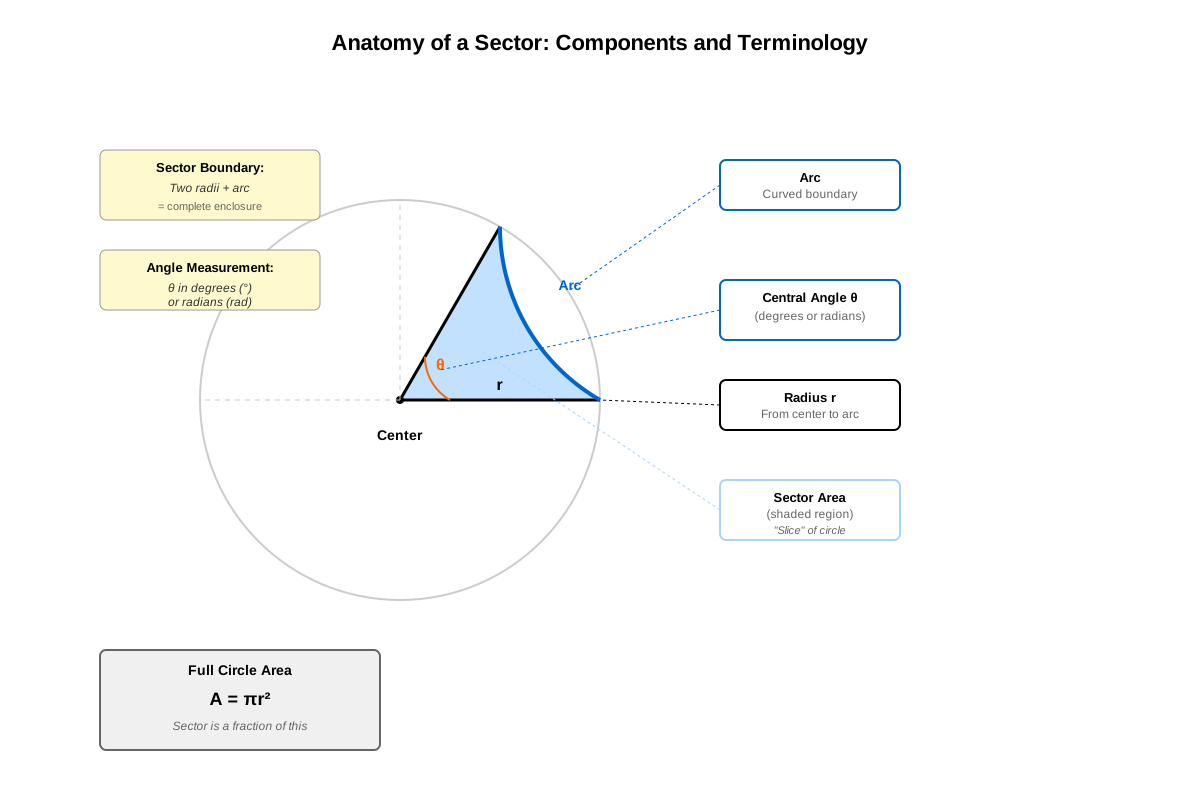
A sector is a region of a circle enclosed by two radii and the arc connecting them. Think of it as a "wedge" or "slice" cut from a circular shape. Every sector has three defining elements: the radius (r) of the circle, the central angle (θ) formed by the two radii at the circle's center, and the arc that forms the curved boundary of the sector. The sector area represents the amount of two-dimensional space contained within this wedge-shaped region.
Sectors come in two varieties: minor sectors (where the central angle is less than 180°) and major sectors (where the central angle is greater than 180°). On the GRE, most problems involve minor sectors, though recognizing when a question refers to the major sector is crucial for avoiding calculation errors.
The Fundamental Sector Area Formula
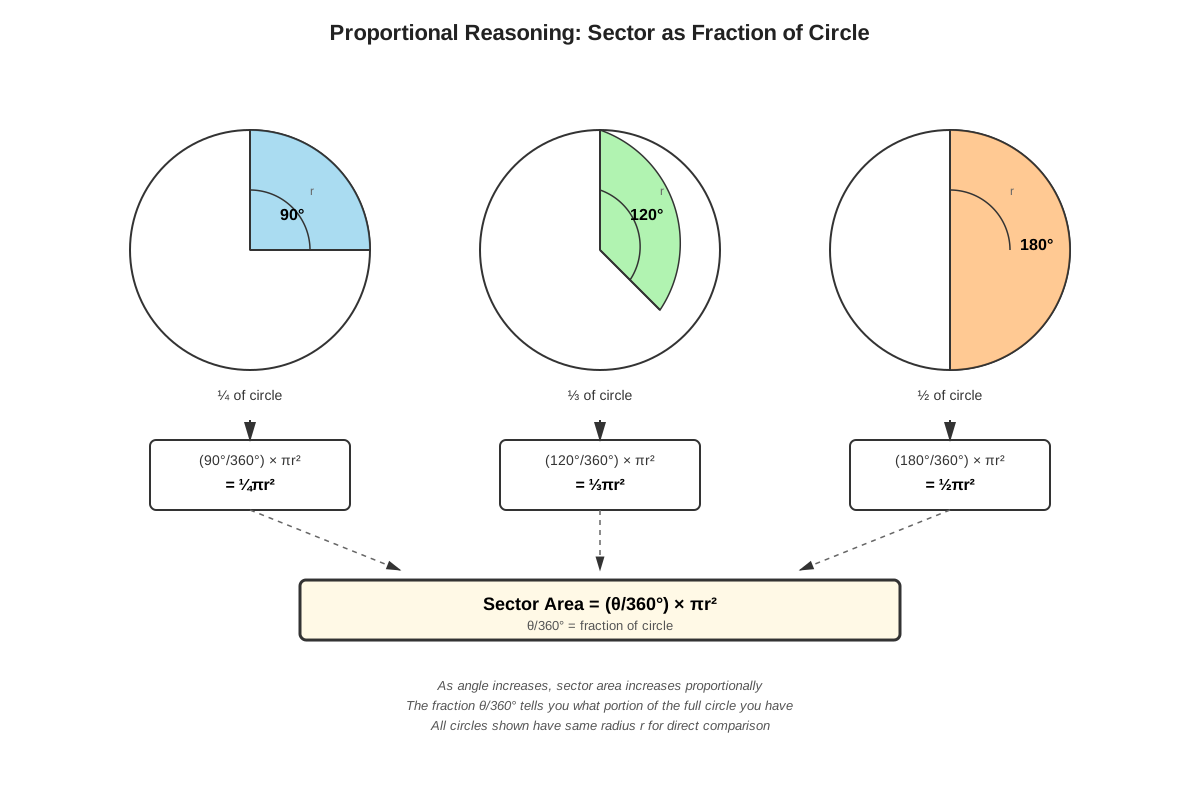
The sector area formula derives from a simple proportional relationship: a sector's area relates to the full circle's area in the same way that the sector's central angle relates to the full rotation around the circle (360°).
Sector Area = (θ/360°) × πr²Where:
- θ = central angle in degrees
- r = radius of the circle
- πr² = area of the complete circle
This formula embodies the core principle: the sector is a fraction of the whole circle. If the central angle is 90°, the sector represents 90°/360° = 1/4 of the circle, so its area is one-quarter of πr². If the central angle is 120°, the sector is 120°/360° = 1/3 of the circle, yielding an area of (1/3)πr².
Alternative Formula Using Radians
When the central angle is measured in radians rather than degrees, the sector area formula simplifies elegantly:
Sector Area = (1/2) × r² × θWhere θ is now in radians. This formula is particularly useful because it eliminates the need for the 360° denominator. Recall that 2π radians = 360°, so π radians = 180°. While GRE problems typically use degrees, occasionally a question will provide angles in radians or require conversion, making familiarity with both formulas valuable.
Step-by-Step Calculation Process
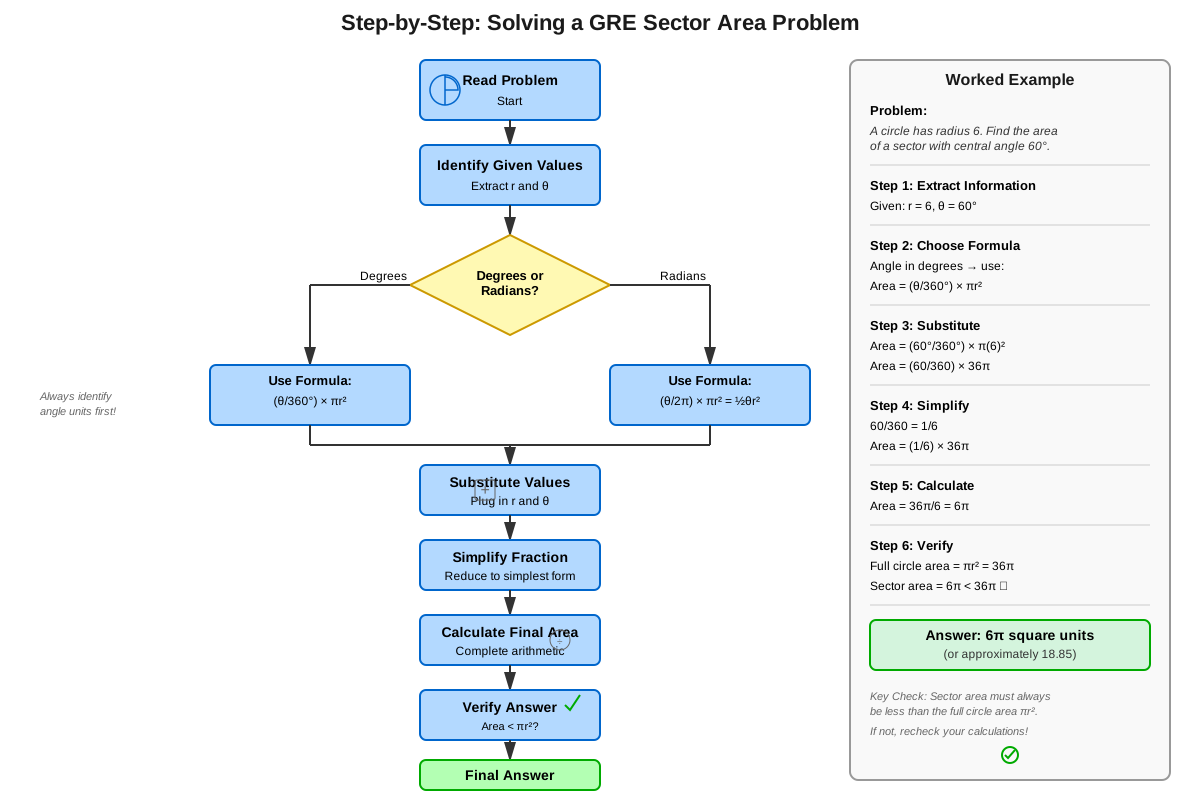
To calculate sector area systematically:
- Identify the radius (r) of the circle—this may be given directly or require calculation from diameter, circumference, or area
- Determine the central angle (θ) in degrees—look for explicit angle measures, or calculate from given information
- Apply the formula: Sector Area = (θ/360°) × πr²
- Simplify: Reduce the fraction θ/360° before multiplying by πr² when possible
- Check units and reasonableness: Ensure the sector area is less than the full circle area (unless dealing with a major sector)
Relationship Between Arc Length and Sector Area
The arc length (s) of a sector—the distance along the curved edge—relates to sector area through the radius:
Arc Length = (θ/360°) × 2πrThis parallel structure reveals an important relationship:
Sector Area = (1/2) × r × Arc LengthThis formula is particularly useful when arc length is given but the central angle is not. Understanding this relationship enables flexible problem-solving approaches on the GRE.
Proportional Reasoning Applications
Many GRE sector problems test proportional reasoning without requiring explicit formula application. For example:
| Central Angle | Fraction of Circle | Sector Area (if r = 6) |
|---|---|---|
| 30° | 30°/360° = 1/12 | (1/12) × π(6²) = 3π |
| 60° | 60°/360° = 1/6 | (1/6) × π(6²) = 6π |
| 90° | 90°/360° = 1/4 | (1/4) × π(6²) = 9π |
| 120° | 120°/360° = 1/3 | (1/3) × π(6²) = 12π |
| 180° | 180°/360° = 1/2 | (1/2) × π(6²) = 18π |
Recognizing these common fractions enables rapid mental calculation and helps verify answers for reasonableness.
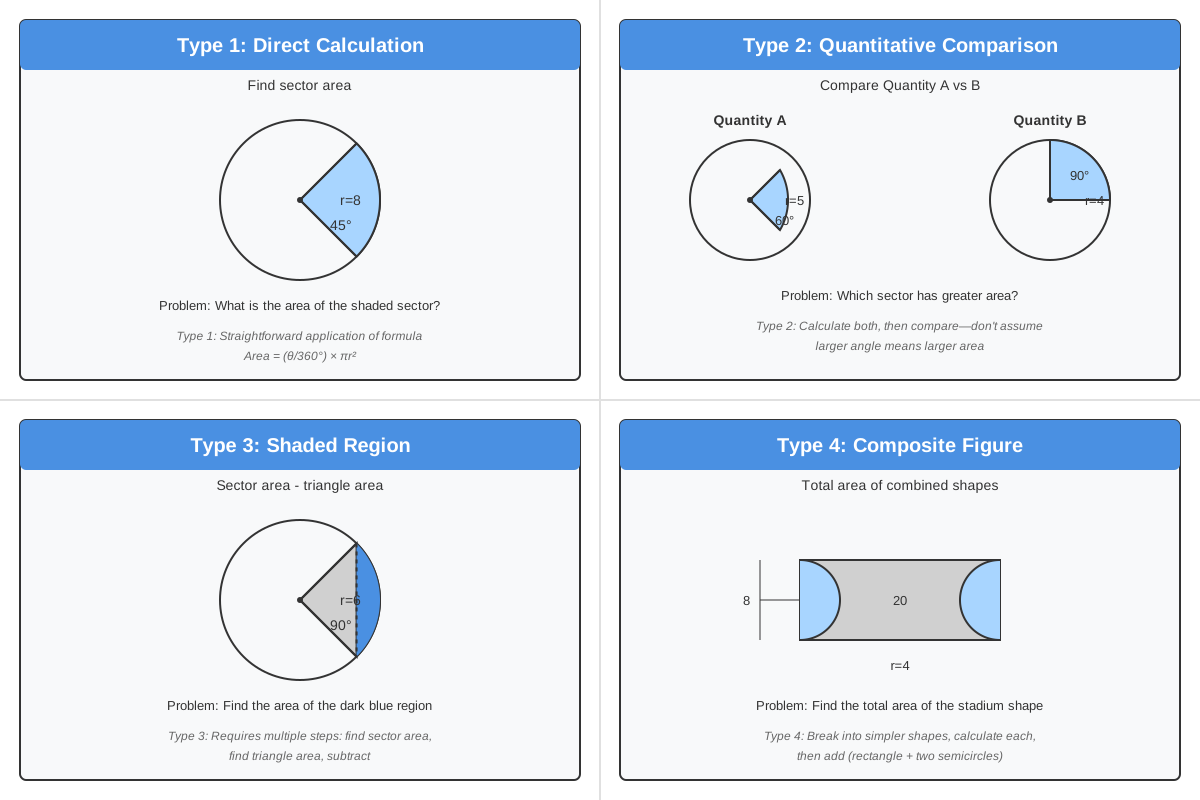
Composite Figures Involving Sectors
GRE questions frequently combine sectors with other geometric shapes. Common scenarios include:
- Shaded regions: Finding the area between a sector and an inscribed triangle, or between two concentric sectors
- Overlapping sectors: Calculating the area of intersection when two sectors share the same center
- Sectors within polygons: Determining areas when sectors are inscribed in or circumscribed around squares, triangles, or other polygons
These problems require breaking complex figures into manageable components, calculating each area separately, and then adding or subtracting as appropriate.
Concept Relationships
The sector area concept sits at the intersection of multiple geometric principles. Circle area (πr²) serves as the foundation → from which sector area is derived through proportional reasoning → which connects to angle measurement (the central angle determines the proportion). This proportional relationship extends to arc length, creating a parallel calculation structure.
Sector area connects backward to prerequisite topics: understanding radius and diameter is essential for identifying r in the formula, while angle relationships help determine central angles when not explicitly given. The concept connects forward to more advanced topics like circular segments (the region between a chord and an arc), annulus area (the region between concentric circles, which can involve sector-shaped portions), and three-dimensional geometry (sectors extend to spherical wedges and cone sectors).
Within problem-solving contexts, sector area often combines with triangle area (when radii and chords form triangles), coordinate geometry (when circles are positioned on the xy-plane), and data interpretation (pie charts are visual representations of sectors). The proportional reasoning underlying sector calculations also appears in probability problems (where sectors can represent probability regions) and ratio problems (comparing sectors of different sizes).
Quick check — test yourself on Sector area so far.
Try Flashcards →High-Yield Facts
⭐ The sector area formula is: (θ/360°) × πr², where θ is the central angle in degrees and r is the radius
⭐ A sector with a 90° central angle always represents exactly 1/4 of the circle's area
⭐ The sector area must always be less than the full circle area πr² (for minor sectors)
⭐ When the central angle doubles, the sector area doubles (direct proportionality)
⭐ Arc length and sector area are related by: Sector Area = (1/2) × r × Arc Length
- A semicircle (180° sector) has area (1/2)πr²
- Common angle fractions: 30° = 1/12 circle, 45° = 1/8 circle, 60° = 1/6 circle, 120° = 1/3 circle
- If two sectors have the same central angle but different radii, their areas relate by the square of the radius ratio
- The ratio of sector area to circle area equals the ratio of arc length to circumference
- In radian measure, a sector with central angle θ has area (1/2)r²θ
- When comparing sectors from different circles, both radius and angle matter—a larger angle doesn't guarantee a larger area if the radius is smaller
Common Misconceptions
Misconception: The sector area formula is (θ/180°) × πr² → Correction: The denominator must be 360° (the total degrees in a circle), not 180°. Using 180° would double the actual sector area, leading to answers that exceed the full circle area for angles greater than 180°.
Misconception: Doubling the radius doubles the sector area → Correction: Sector area depends on r², so doubling the radius actually quadruples the sector area. If radius increases from 3 to 6, the sector area increases by a factor of 4, not 2.
Misconception: A 60° sector in a circle with radius 6 has the same area as a 30° sector in a circle with radius 12 → Correction: The first sector has area (60°/360°) × π(6²) = 6π, while the second has area (30°/360°) × π(12²) = 12π. The second sector is twice as large because the radius effect (squared) outweighs the angle effect.
Misconception: Arc length and sector area are the same thing → Correction: Arc length is a one-dimensional measure (distance along the curve), while sector area is a two-dimensional measure (space enclosed). They're related but distinct: Sector Area = (1/2) × r × Arc Length.
Misconception: The central angle is always the angle shown inside the sector → Correction: Sometimes diagrams show the angle outside the sector or use complementary/supplementary angles. Always verify which angle represents the actual central angle of the sector in question.
Misconception: You can't find sector area without knowing the central angle → Correction: If you know the arc length and radius, you can use Sector Area = (1/2) × r × Arc Length. Alternatively, if you know the sector area and need the angle, you can rearrange the formula: θ = (Sector Area / πr²) × 360°.
Worked Examples
Example 1: Direct Sector Area Calculation
Problem: A circular pizza with radius 10 inches is cut into 8 equal slices. What is the area of one slice?
Solution:
Step 1: Identify the given information
- Radius r = 10 inches
- The pizza is divided into 8 equal slices
Step 2: Determine the central angle of one slice
- A full circle contains 360°
- Each of 8 equal slices has central angle: θ = 360° ÷ 8 = 45°
Step 3: Apply the sector area formula
- Sector Area = (θ/360°) × πr²
- Sector Area = (45°/360°) × π(10²)
- Sector Area = (1/8) × 100π
- Sector Area = 12.5π square inches
Step 4: Verify reasonableness
- The full pizza area is πr² = 100π square inches
- One-eighth of this is 12.5π ✓
- Our answer makes sense
Answer: 12.5π square inches (or approximately 39.27 square inches if using π ≈ 3.14159)
Connection to Learning Objectives: This problem demonstrates identifying when sector area is tested (dividing a circle into equal parts) and applying the formula accurately with clear step-by-step reasoning.
Example 2: Multi-Step Problem with Shaded Region
Problem: In the figure below, a square with side length 8 is inscribed in a circle. A sector is formed by drawing radii to two adjacent corners of the square. What is the area of the sector?
Solution:
Step 1: Determine the radius of the circle
- The square's diagonal equals the circle's diameter
- Using the Pythagorean theorem: diagonal = √(8² + 8²) = √128 = 8√2
- Therefore, radius r = 4√2
Step 2: Determine the central angle
- The square has 4 corners equally spaced around the circle
- The angle between adjacent corners = 360° ÷ 4 = 90°
- Therefore, θ = 90°
Step 3: Calculate the sector area
- Sector Area = (θ/360°) × πr²
- Sector Area = (90°/360°) × π(4√2)²
- Sector Area = (1/4) × π(32)
- Sector Area = 8π square units
Step 4: Alternative verification
- The full circle area = π(4√2)² = 32π
- One-quarter of this = 8π ✓
Answer: 8π square units
Connection to Learning Objectives: This problem requires recognizing sector area within a composite figure, applying prerequisite knowledge (Pythagorean theorem for the diagonal), and using proportional reasoning (recognizing the 90° angle represents 1/4 of the circle).
Exam Strategy
When approaching GRE sector area questions, begin by identifying the three essential components: radius, central angle, and what the question asks for (area, angle, or radius). Draw or annotate the diagram if one isn't provided—visualizing the sector helps prevent errors.
Trigger words and phrases that signal sector area problems include:
- "slice," "wedge," or "piece" of a circle
- "central angle" or "angle at the center"
- "arc" combined with area questions
- "shaded region" in circular diagrams
- Pie chart or circular graph contexts
- "What fraction of the circle..."
Process-of-elimination strategies:
- Immediately eliminate any answer choice greater than πr² (the full circle area) for minor sector problems
- Check if the answer choices are in terms of π or decimal approximations—this tells you whether to leave π in your answer
- For Quantitative Comparison questions, consider whether changing one variable (radius or angle) affects both quantities equally
- Estimate using common fractions: a 90° sector is 1/4 the circle, 60° is 1/6, etc.—eliminate answers that don't align with these benchmarks
Time allocation: Straightforward sector area calculations should take 45-60 seconds. Multi-step problems involving composite figures may require 90-120 seconds. If a problem requires more than 2 minutes, consider whether you're missing a simpler approach or should strategically guess and move forward.
Common shortcuts:
- Recognize that (θ/360°) simplifies to common fractions: 30°→1/12, 45°→1/8, 60°→1/6, 90°→1/4, 120°→1/3, 180°→1/2
- When comparing sectors, if angles are equal, the sector areas relate by r₁²/r₂²
- For shaded region problems, determine whether to add or subtract areas before calculating—this prevents wasted computation
Memory Techniques
Mnemonic for the sector area formula: "Theta Over Three-Sixty Times Pi R Squared" can be remembered as "TOTS-PRS" (think: "tots" are small portions, like sectors are portions of circles, and "PRS" for Pi-R-Squared).
Visualization strategy: Picture a pizza or pie being cut. The sector area formula answers: "If I cut a slice with this angle, how much pizza do I get?" The fraction θ/360° tells you what portion of the whole pizza your slice represents.
The "Quarter Circle" anchor: Memorize that a 90° sector is always exactly 1/4 of the circle. Use this as a reference point: if your angle is half of 90° (45°), your sector is half of 1/4 (which is 1/8). If your angle is twice 90° (180°), your sector is twice 1/4 (which is 1/2).
Acronym for problem-solving steps: "RAFA"
- Radius: Identify or calculate the radius
- Angle: Determine the central angle
- Formula: Apply (θ/360°) × πr²
- Answer: Simplify and verify reasonableness
Relationship reminder: "Half-R-Arc" helps remember that Sector Area = (1/2) × Radius × Arc length—the sector area is half the product of radius and arc length, similar to how triangle area is half base times height.
Summary
Sector area is a high-yield GRE Quantitative Reasoning topic that tests understanding of circles, proportional reasoning, and geometric relationships. The fundamental concept is that a sector represents a fractional portion of a circle, with the sector area calculated as (θ/360°) × πr², where θ is the central angle in degrees and r is the radius. This formula derives from the proportional relationship: the sector's area relates to the full circle's area in the same way the central angle relates to 360°. Mastery requires not just memorizing the formula, but understanding the underlying proportional structure, which enables flexible problem-solving when sector area appears in composite figures, shaded region problems, or Quantitative Comparison questions. Success on GRE sector problems depends on accurately identifying the radius and central angle, applying the formula systematically, and verifying that answers are reasonable relative to the full circle area. The topic connects broadly to circle geometry, angle relationships, and proportional reasoning—all fundamental to GRE Quantitative success.
Key Takeaways
- The sector area formula (θ/360°) × πr² expresses that sectors are proportional parts of circles based on their central angles
- Always verify that sector area is less than the full circle area πr² for minor sectors—this catches calculation errors
- Common angle fractions (90°=1/4, 60°=1/6, 45°=1/8, 30°=1/12) enable rapid mental calculation and answer verification
- Sector area scales with the square of the radius—doubling the radius quadruples the area
- The relationship Sector Area = (1/2) × r × Arc Length provides an alternative calculation method when arc length is known
- Multi-step problems often embed sector calculations within composite figures requiring addition or subtraction of areas
- Strong proportional reasoning is more valuable than formula memorization—understanding why the formula works enables adaptation to varied question formats
Related Topics
Arc Length: The distance along the curved edge of a sector, calculated using (θ/360°) × 2πr. Mastering sector area provides the foundation for arc length problems, which often appear together on the GRE.
Circular Segments: The region between a chord and an arc, found by subtracting triangle area from sector area. Understanding sector area is prerequisite to segment calculations.
Annulus Area: The region between two concentric circles, which can involve sector-shaped portions. Sector area concepts extend naturally to annulus problems.
Three-Dimensional Circular Geometry: Sectors extend to cones (where the sector "wraps" into a three-dimensional shape) and spherical wedges. Solid sector area understanding facilitates these advanced topics.
Probability and Pie Charts: Sectors represent probability regions and data proportions. The proportional reasoning developed through sector area applies directly to these quantitative reasoning contexts.
Practice CTA
Now that you've mastered the core concepts, formulas, and strategies for sector area problems, it's time to solidify your understanding through active practice. Attempt the practice questions associated with this topic, focusing on applying the systematic approach outlined in the worked examples. Use the flashcards to reinforce the sector area formula and common angle fractions until they become automatic. Remember: the GRE rewards not just knowledge, but the ability to apply that knowledge accurately under timed conditions. Each practice problem you complete builds the pattern recognition and computational fluency that will serve you on test day. You've invested the time to understand the concepts—now invest the practice time to make them second nature!
Sign up free to keep reading
Create a free AnvayaPrep account to finish this GRE guide on Sector area — plus flashcards and practice questions.