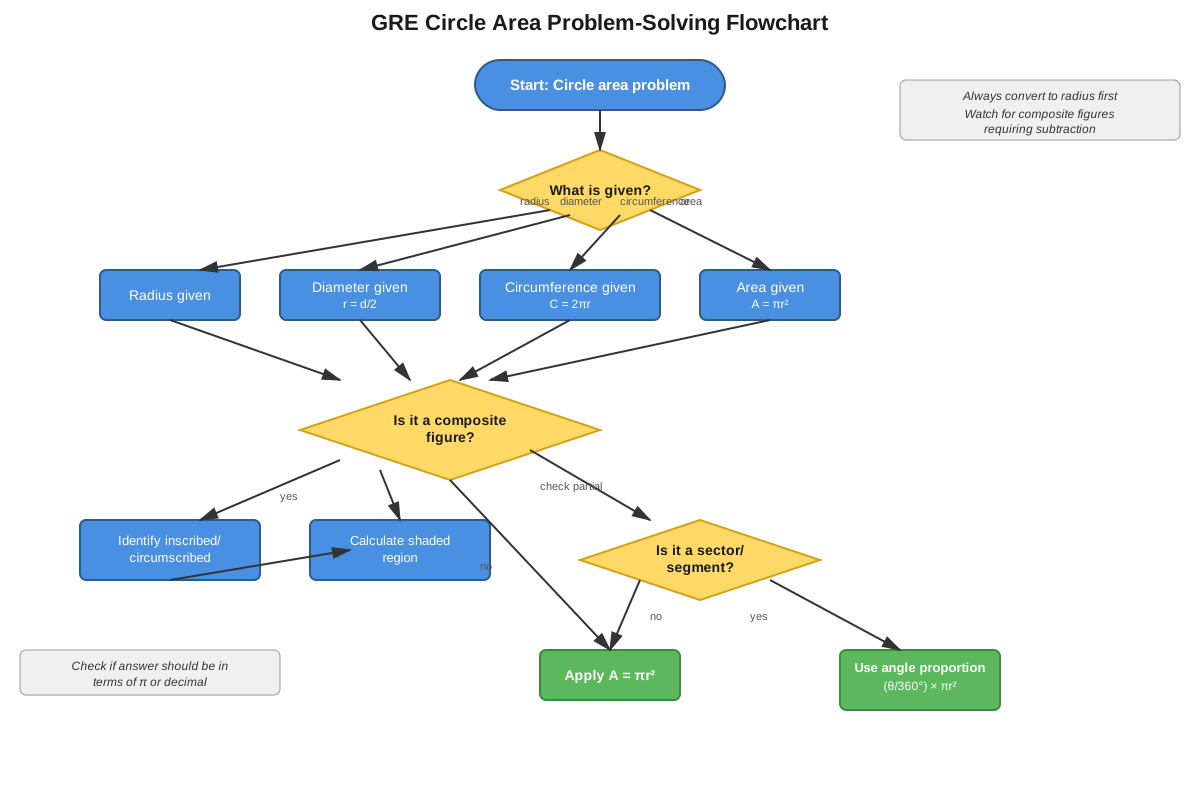
Overview
The area of circle is one of the most frequently tested geometric concepts on the GRE Quantitative Reasoning section. This fundamental topic appears not only in straightforward calculation problems but also in complex multi-step questions involving inscribed and circumscribed figures, coordinate geometry, and word problems. Mastering circle area calculations is essential because the GRE often embeds these concepts within more challenging scenarios that test spatial reasoning and algebraic manipulation simultaneously.
Understanding how to calculate and manipulate the gre area of circle formulas provides a foundation for solving problems involving sectors, segments, and composite figures. The GRE test-makers frequently combine circle area with other geometric concepts such as triangles, squares, and rectangles to create problems that assess multiple skills at once. Students who can quickly recognize when area calculations are required and execute them accurately gain a significant advantage in both speed and accuracy on test day.
This topic connects directly to broader Quantitative Reasoning skills including algebraic manipulation, ratio and proportion reasoning, and problem-solving with multiple variables. Circle area problems often require students to work backward from given information, set up equations, and solve for unknown quantities—skills that appear throughout the GRE mathematics section. The ability to visualize circular regions and understand how changes in radius affect area exponentially (due to the squared term) is crucial for avoiding common traps and selecting correct answers efficiently.
Learning Objectives
- [ ] Identify when Area of circle is being tested
- [ ] Explain the core rule or strategy behind Area of circle
- [ ] Apply Area of circle to GRE-style questions accurately
- [ ] Calculate the area of circles given diameter, circumference, or other indirect measurements
- [ ] Solve problems involving partial circles (sectors and segments) using area relationships
- [ ] Determine how changes in radius affect area using proportional reasoning
- [ ] Integrate circle area calculations with other geometric figures in composite problems
Prerequisites
- Basic algebra: Required for manipulating the area formula, solving for radius, and working with squared terms
- Understanding of π (pi): Essential for recognizing when to leave answers in terms of π versus calculating decimal approximations
- Radius and diameter relationship: Necessary because the area formula uses radius, but problems often provide diameter
- Exponent rules: Critical for understanding why doubling the radius quadruples the area (squaring operation)
- Unit conversion: Important when problems present measurements in different units that must be reconciled
Why This Topic Matters
Circle area calculations appear in approximately 10-15% of GRE Quantitative Reasoning questions, making this a high-yield topic for test preparation. The concept appears in multiple question formats including Quantitative Comparison, Multiple Choice (single and multiple answer), and Numeric Entry questions. Beyond pure geometry problems, circle area knowledge is essential for data interpretation questions involving circular graphs, optimization problems, and real-world application scenarios.
In practical applications, circle area calculations are fundamental to fields ranging from engineering and architecture to data science and economics. Understanding circular regions helps in calculating material requirements, determining coverage areas, analyzing circular motion, and interpreting pie charts and circular visualizations. The GRE values this topic because it assesses both computational accuracy and conceptual understanding of how geometric properties scale.
The GRE commonly presents circle area in these contexts: inscribed and circumscribed figures (circles within squares or vice versa), shaded region problems requiring subtraction of areas, coordinate geometry with circles centered at the origin or other points, word problems involving circular objects like pizzas or gardens, and comparison questions asking students to evaluate relative areas. The test particularly favors questions where students must recognize that area scales with the square of the radius, creating non-linear relationships that trap unwary test-takers.
Core Concepts
The Fundamental Area Formula
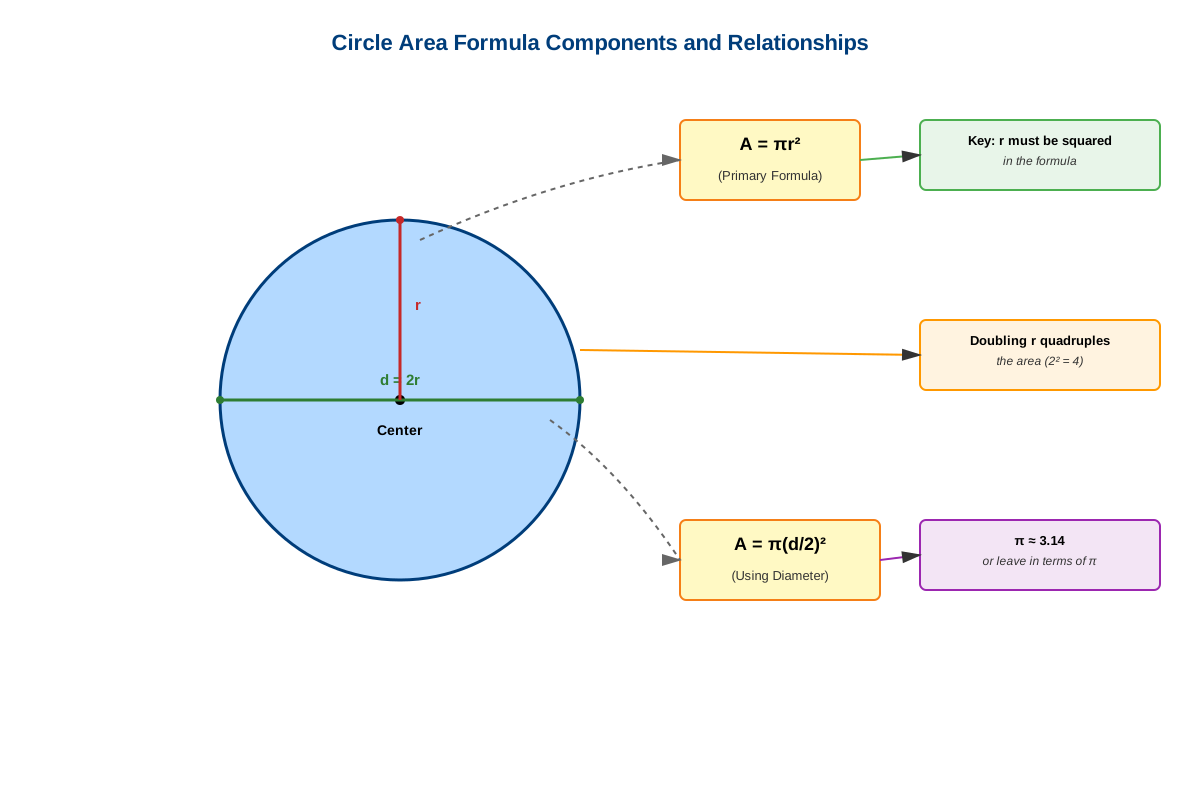
The area of circle is calculated using the formula A = πr², where A represents the area, π (pi) is the mathematical constant approximately equal to 3.14159, and r is the radius of the circle. This formula is absolutely essential and must be memorized. The radius is the distance from the center of the circle to any point on its circumference. Understanding that the radius is squared in this formula is crucial because it means that area increases exponentially, not linearly, as radius increases.
When working with gre area of circle problems, students must recognize that the formula can be manipulated algebraically. If given the area and asked to find the radius, the formula becomes r = √(A/π). If given the diameter d instead of radius, remember that r = d/2, so the formula can be rewritten as A = π(d/2)² = πd²/4. The GRE frequently tests whether students can work flexibly with these variations.
Working with Pi (π)
On the GRE, answers involving circle area may be expressed either in terms of π or as decimal approximations. When answer choices contain π, leave your calculations in terms of π rather than converting to decimals—this maintains precision and often simplifies calculations. For example, if you calculate an area as 25π, don't convert it to 78.5 unless the answer choices are in decimal form. The GRE answer choices will guide you on which form to use.
Understanding π as a constant ratio (circumference to diameter) helps conceptually, but for calculations, knowing that π ≈ 3.14 or π ≈ 22/7 suffices for estimation purposes. However, most GRE problems are designed so that π remains in the answer, avoiding messy decimal calculations. When you must approximate, π ≈ 3 provides a quick estimate for eliminating obviously wrong answers.
Radius, Diameter, and Circumference Relationships
The GRE often provides indirect information about a circle's size, requiring students to first determine the radius before calculating area. Key relationships include:
- Diameter = 2 × radius (d = 2r)
- Circumference = 2πr = πd
- If given circumference C, then r = C/(2π)
These conversions are frequently tested. A problem might state "a circle with circumference 10π" and ask for the area. Students must recognize that if C = 10π, then 2πr = 10π, so r = 5, and therefore A = π(5)² = 25π.
Scaling and Proportional Relationships
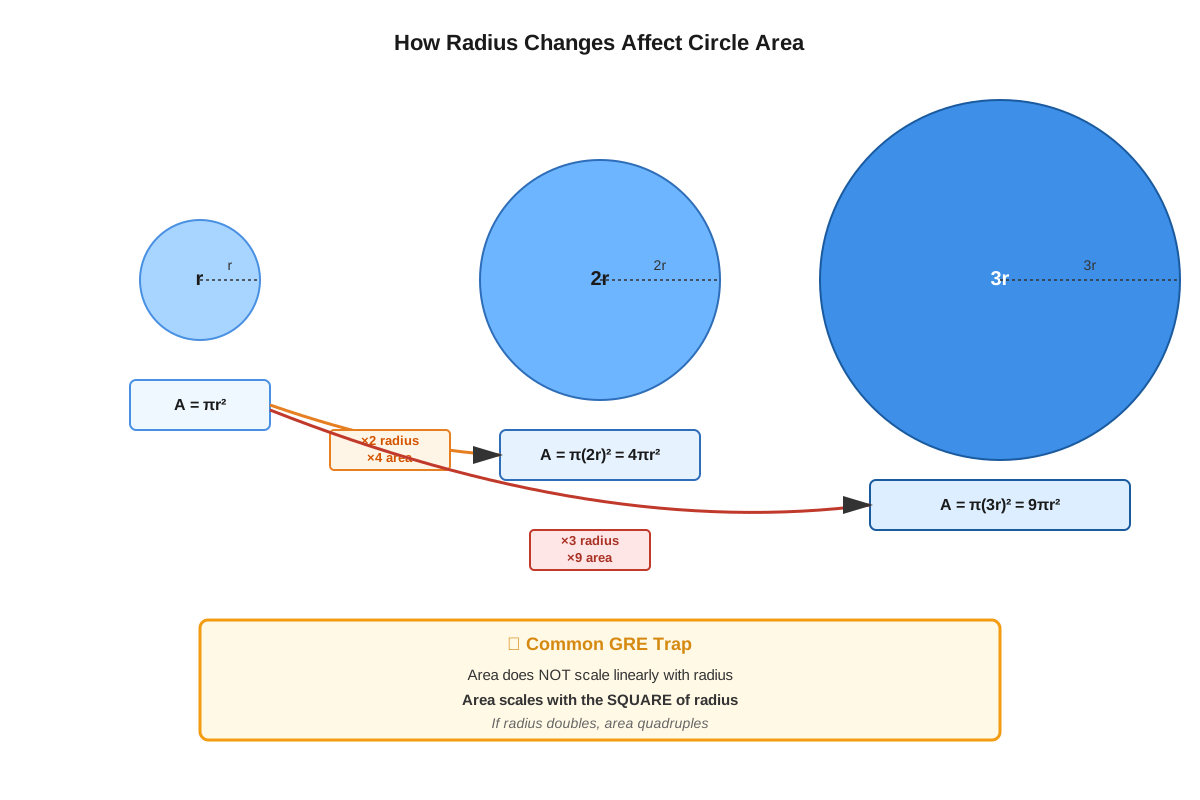
One of the most important conceptual understandings for the GRE is how area changes when radius changes. Because area depends on r², the relationship is quadratic:
- If radius doubles, area quadruples (multiplies by 2² = 4)
- If radius triples, area increases ninefold (multiplies by 3² = 9)
- If radius is halved, area becomes one-fourth (multiplies by (1/2)² = 1/4)
This non-linear relationship is a frequent source of GRE questions, particularly in Quantitative Comparison format. For example, comparing the area of a circle with radius 4 to a circle with radius 8 requires recognizing that the larger circle has 4 times the area, not twice the area.
Sectors and Partial Circles
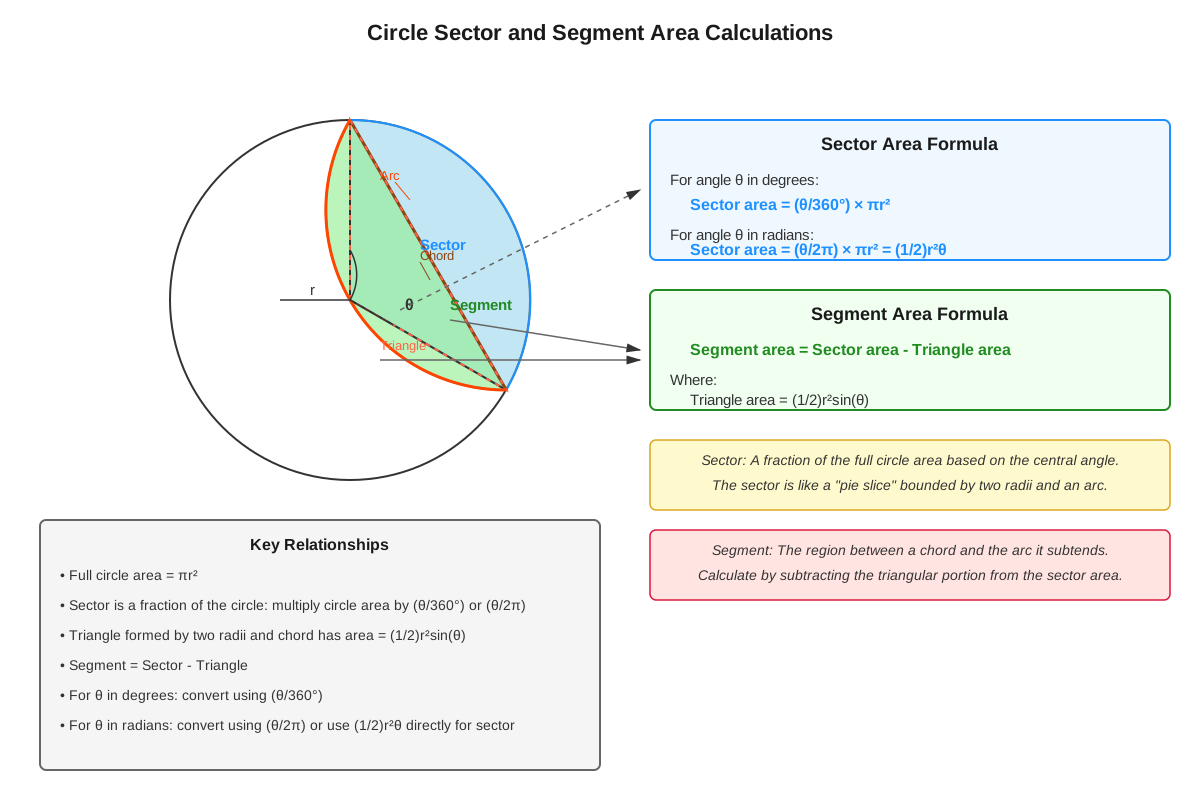
A sector is a "slice" of a circle, like a piece of pie. The area of a sector is proportional to the central angle that defines it. If a sector has a central angle of θ degrees, its area is:
Area of sector = (θ/360°) × πr²For example, a quarter-circle (90° sector) has area (90/360) × πr² = (1/4)πr². The GRE tests this concept by asking for areas of partial circles or by presenting problems where students must subtract sector areas from other shapes.
Composite Figures and Shaded Regions
The GRE frequently combines circles with other shapes, creating composite figures. Common scenarios include:
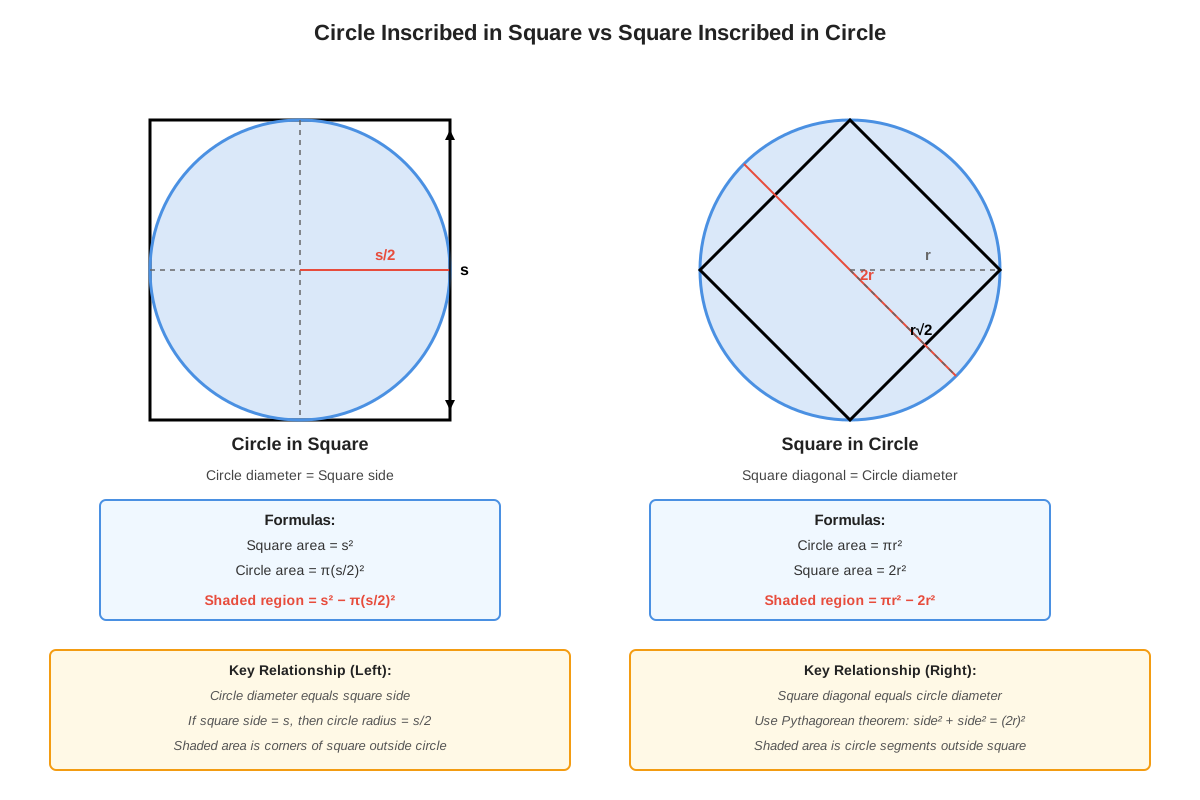
- Circle inscribed in a square: If a circle is inscribed in (fits perfectly inside) a square, the diameter of the circle equals the side length of the square
- Circle circumscribed around a square: If a circle passes through all four corners of a square, the diagonal of the square equals the diameter of the circle
- Shaded regions: Problems often show a figure with a shaded portion and ask for its area, requiring subtraction (e.g., area of square minus area of inscribed circle)
These problems require careful visualization and systematic calculation. Always identify what information is given, what needs to be found, and what intermediate calculations are necessary.
Circles in the Coordinate Plane
When circles appear in coordinate geometry, the standard form equation is (x - h)² + (y - k)² = r², where (h, k) is the center and r is the radius. To find the area, identify r² from the equation—this is already the value you need for the area formula! If the equation is x² + y² = 25, then r² = 25, so the area is 25π (no need to find r = 5 first).
Concept Relationships
The area of circle formula serves as a foundation that connects to multiple geometric concepts. The relationship begins with the radius → which determines → area through the formula A = πr² → which connects to → circumference through the shared radius → enabling → problems requiring both perimeter and area calculations.
Circle area relates to diameter through the conversion r = d/2, creating a pathway: given diameter → calculate radius → apply area formula. This chain appears frequently on the GRE when problems provide diameter but require area.
The squared term in the area formula creates a critical relationship with proportional reasoning: change in radius → squared change in area → non-linear scaling relationships. This concept connects to ratio and proportion topics elsewhere in the GRE curriculum.
For composite figures, the relationships branch: circle area + polygon area formulas → combined to solve → inscribed/circumscribed problems and shaded region calculations. These connections link circle area to triangles, squares, and rectangles.
In coordinate geometry, the relationship flows: circle equation → identifies r² → directly gives area as πr² → connects to → graphing and distance concepts.
Quick check — test yourself on Area of circle so far.
Try Flashcards →High-Yield Facts
⭐ The area of a circle is A = πr², where r is the radius—this formula must be instantly recalled
⭐ When radius doubles, area quadruples; when radius triples, area increases ninefold (area scales with r²)
⭐ Diameter = 2 × radius; if given diameter d, use A = πd²/4 or first calculate r = d/2
⭐ If circumference C is given, find radius using r = C/(2π), then calculate area
⭐ Leave answers in terms of π when answer choices contain π; only convert to decimals when necessary
- A semicircle (half circle) has area (1/2)πr²
- A quarter circle has area (1/4)πr²
- The area of a sector with central angle θ degrees is (θ/360) × πr²
- For a circle inscribed in a square with side s, the circle's diameter equals s, so r = s/2
- For a circle circumscribed around a square with side s, the circle's diameter equals s√2 (the square's diagonal)
- In the coordinate plane equation (x - h)² + (y - k)² = r², the value r² is already what you need for area = πr²
- The ratio of areas of two circles equals the ratio of their radii squared: A₁/A₂ = (r₁/r₂)²
- A ring (annulus) between two concentric circles has area π(R² - r²), where R is the outer radius and r is the inner radius
- If a circle's area is given as a multiple of π (like 36π), the radius is the square root of that multiple (r = 6)
- Shaded region problems typically require subtracting one area from another: Area_outer - Area_inner
Common Misconceptions
Misconception: Doubling the radius doubles the area → Correction: Doubling the radius quadruples the area because area depends on r². If r changes from 3 to 6, area changes from 9π to 36π (multiplied by 4, not 2).
Misconception: The area formula is A = πd² → Correction: The area formula uses radius, not diameter: A = πr². If using diameter, the correct formula is A = πd²/4 or A = π(d/2)².
Misconception: π equals exactly 3.14 → Correction: π is an irrational number approximately equal to 3.14159...; on the GRE, leave answers in terms of π unless specifically asked to approximate, and use π ≈ 3.14 only for rough estimates.
Misconception: Circumference and area use the same formula → Correction: Circumference is C = 2πr (linear in r), while area is A = πr² (quadratic in r). These are completely different formulas measuring different properties.
Misconception: A circle inscribed in a square has radius equal to the square's side → Correction: The inscribed circle's diameter equals the square's side, so the radius is half the side length. If the square has side 10, the circle has radius 5, not 10.
Misconception: When comparing areas, you can compare radii directly → Correction: To compare areas, you must compare r² values, not r values. A circle with radius 4 has area 16π, while radius 8 gives area 64π—the second is 4 times larger, not twice as large.
Misconception: The area of a semicircle is πr → Correction: The area of a semicircle is (1/2)πr², which is half the full circle's area. The formula πr is not dimensionally correct (it would give a length, not an area).
Worked Examples
Example 1: Multi-Step Problem with Circumference
Problem: A circular garden has a circumference of 20π feet. If the owner wants to cover the entire garden with grass seed, and one bag of seed covers 25 square feet, how many bags are needed?
Solution:
Step 1: Find the radius from the circumference.
- Given: C = 20π
- Formula: C = 2πr
- Calculation: 20π = 2πr → r = 20π/(2π) = 10 feet
Step 2: Calculate the area of the garden.
- Formula: A = πr²
- Calculation: A = π(10)² = 100π square feet
Step 3: Approximate the area to determine bags needed.
- Using π ≈ 3.14: A ≈ 100 × 3.14 = 314 square feet
Step 4: Determine number of bags.
- Each bag covers 25 square feet
- Number of bags = 314 ÷ 25 = 12.56
- Since you can't buy a partial bag, round up to 13 bags
Answer: 13 bags
Connection to Learning Objectives: This problem requires identifying that circle area is being tested (Objective 1), applying the strategy of first finding radius from circumference (Objective 2), and accurately executing the calculation (Objective 3). It also demonstrates working with indirect measurements (Objective 4).
Example 2: Quantitative Comparison with Scaling
Problem:
Quantity A: The area of a circle with radius 6
Quantity B: Three times the area of a circle with radius 3Solution:
Step 1: Calculate Quantity A.
- Radius = 6
- Area = π(6)² = 36π
Step 2: Calculate Quantity B.
- Radius = 3
- Area of one circle = π(3)² = 9π
- Three times this area = 3 × 9π = 27π
Step 3: Compare.
- Quantity A = 36π
- Quantity B = 27π
- Since 36π > 27π, Quantity A is greater
Answer: Quantity A is greater
Alternative Approach Using Scaling Concept:
- When radius doubles from 3 to 6, area quadruples (multiplies by 2² = 4)
- So a circle with radius 6 has 4 times the area of a circle with radius 3
- Quantity A = 4 × (area with radius 3)
- Quantity B = 3 × (area with radius 3)
- Therefore Quantity A > Quantity B
Connection to Learning Objectives: This problem tests understanding of how area scales with radius (Objective 6) and requires recognizing the non-linear relationship between radius and area. The alternative approach demonstrates the power of proportional reasoning rather than direct calculation.
Exam Strategy
When approaching gre area of circle questions, first identify what information is provided and in what form. Look for keywords like "radius," "diameter," "circumference," "inscribed," "circumscribed," and "shaded region." These trigger words indicate which relationships you'll need to apply. If the problem gives diameter or circumference, immediately convert to radius before attempting area calculations.
For Quantitative Comparison questions involving circles, consider using proportional reasoning rather than calculating exact values. If comparing two circles, look at the ratio of their radii and remember that areas scale with the square of this ratio. This approach often allows you to determine the relationship without computing actual areas.
Watch for problems that combine circle area with other geometric figures. Draw a diagram if one isn't provided—visualization is crucial for inscribed/circumscribed problems and shaded regions. Label all known measurements on your diagram and identify what you need to find. Work systematically: find any intermediate values (like radius from circumference), then proceed to the final calculation.
Time management is critical. Simple area calculations should take 30-45 seconds. Multi-step problems involving composite figures might require 90-120 seconds. If a problem seems to require extensive calculation, look for a shortcut—the GRE often rewards conceptual understanding over brute-force computation. For instance, recognizing that a circle inscribed in a square with side 10 has radius 5 (and therefore area 25π) is faster than deriving this relationship from scratch.
Process of elimination works well when answer choices are given. If you've calculated an area of 36π, immediately eliminate any choices that aren't multiples of π (unless the question asks for an approximation). For Numeric Entry questions, double-check whether the answer should be in terms of π or as a decimal—read the question carefully.
Common trigger phrases include: "circular region," "round garden/pool/table," "inscribed in," "circumscribed about," "shaded area," "what is the area," and "how much larger." When you see these, activate your circle area knowledge and identify which formula variation applies.
Memory Techniques
Mnemonic for the area formula: "Area equals Pi Radius Squared" → A-P-R-S → A = πr²
Visualization technique: Picture a pizza. The radius is from the center to the edge. The area is how much pizza you have to eat. If you double the radius (order a pizza twice as wide), you get four times as much pizza, not twice as much—this reinforces the r² relationship.
Acronym for circle formulas: CAD
- Circumference = 2πr (or πd)
- Area = πr²
- Diameter = 2r
Scaling memory aid: "Square the scale for area" → If radius scales by factor k, area scales by k². This phrase helps remember that doubling radius (k=2) means area multiplies by 2²=4.
Inscribed circle trick: "Inscribed means inside, diameter = side" → For a circle inscribed in a square, the circle's diameter equals the square's side length.
Sector formula memory: Think "part over whole" → The sector area is (angle/360°) × (whole circle area). The fraction of the angle is the fraction of the area.
Summary
The area of circle is a foundational GRE Quantitative Reasoning concept that appears frequently in various question formats. The essential formula A = πr² must be memorized and understood conceptually, particularly the critical insight that area scales with the square of the radius. This means doubling the radius quadruples the area—a relationship the GRE tests repeatedly. Students must be fluent in converting between radius, diameter, and circumference to find the radius needed for area calculations. The GRE commonly embeds circle area within composite figures, shaded regions, and coordinate geometry problems, requiring integration with other geometric concepts. Success requires both computational accuracy and strategic thinking: recognizing when to leave answers in terms of π, using proportional reasoning to avoid unnecessary calculations, and systematically working through multi-step problems. Mastery of this topic provides a foundation for more complex geometry questions and contributes significantly to overall Quantitative Reasoning performance.
Key Takeaways
- The formula A = πr² is non-negotiable knowledge; radius must be squared, and this creates quadratic scaling relationships
- Always convert diameter or circumference to radius first before calculating area
- When radius changes by a factor of k, area changes by a factor of k²—this is the most commonly tested conceptual relationship
- Leave answers in terms of π when answer choices contain π; only approximate when necessary
- For composite figures and shaded regions, draw diagrams, label all measurements, and work systematically through required calculations
- Inscribed circles have diameter equal to the square's side; circumscribed circles have diameter equal to the square's diagonal
- Sector areas are proportional to central angles: (θ/360°) × πr² for angle θ in degrees
Related Topics
Circumference of Circles: Understanding the perimeter of circles complements area knowledge and enables solving problems that provide one measurement to find another. Many GRE problems require both circumference and area calculations.
Volume of Cylinders and Spheres: These three-dimensional concepts build directly on circle area, as cylinder volume is (circle area) × height, and sphere volume involves similar radius-cubed relationships.
Coordinate Geometry with Circles: The equation (x-h)² + (y-k)² = r² connects algebraic and geometric representations, with r² directly providing the area coefficient.
Sectors and Arc Length: Advanced circle problems involve partial circles, requiring understanding of how angles relate to both area (sectors) and perimeter (arc length).
Inscribed Angles and Circle Theorems: More advanced geometry problems combine area calculations with angle relationships in circles, testing multiple concepts simultaneously.
Optimization Problems: Real-world applications often ask for maximum or minimum areas subject to constraints, combining circle area with algebraic reasoning.
Practice CTA
Now that you've mastered the core concepts of circle area, it's time to solidify your understanding through practice. Attempt the practice questions to test your ability to recognize when circle area is being tested, apply the formulas accurately, and work through multi-step problems efficiently. Use the flashcards to reinforce the key formulas, relationships, and strategies until they become automatic. Remember, the GRE rewards both accuracy and speed—consistent practice with these high-yield concepts will build the confidence and fluency you need to excel on test day. Every problem you solve strengthens your geometric intuition and brings you closer to your target score!
Sign up free to keep reading
Create a free AnvayaPrep account to finish this GRE guide on Area of circle — plus flashcards and practice questions.