Overview
The circumference of a circle is one of the most fundamental and frequently tested concepts in GRE Quantitative Reasoning. Understanding circumference is essential not only for solving direct circle problems but also for tackling complex geometry questions involving sectors, arcs, inscribed figures, and coordinate geometry. The circumference represents the distance around a circle—the perimeter of this unique shape—and mastering its calculation and application is critical for achieving a competitive score on the GRE.
On the GRE, gre circumference questions appear in multiple formats: direct calculation problems, word problems involving wheels or circular motion, questions about arc length, and complex multi-step problems that combine circumference with area, radius, or diameter relationships. The test makers frequently embed circumference concepts within data interpretation questions, quantitative comparison questions, and problem-solving questions that require spatial reasoning. Because circumference connects to so many other geometric concepts, it serves as a gateway topic that enables students to solve a wide range of geometry problems efficiently.
The relationship between circumference and other Quantitative Reasoning concepts is extensive. Circumference directly relates to radius and diameter through the constant π (pi), connects to area calculations for circles, enables arc length computations, and appears in problems involving rates, ratios, and proportions. Understanding circumference also supports work with coordinate geometry (circles on the xy-plane), three-dimensional geometry (cylinders and spheres), and even trigonometry. This interconnectedness makes circumference a high-yield topic that rewards thorough understanding with the ability to solve numerous question types across the Geometry unit.
Learning Objectives
- [ ] Identify when Circumference is being tested
- [ ] Explain the core rule or strategy behind Circumference
- [ ] Apply Circumference to GRE-style questions accurately
- [ ] Calculate circumference given radius, diameter, or area
- [ ] Determine arc length as a fraction of total circumference
- [ ] Solve multi-step problems combining circumference with other circle properties
- [ ] Convert between different representations of π in answer choices
Prerequisites
- Basic algebra: Solving for variables in equations is necessary when working with circumference formulas where one value is unknown
- Understanding of π (pi): Recognizing π as approximately 3.14159 or 22/7, and knowing when to use exact versus approximate values
- Ratio and proportion: Essential for solving arc length problems and comparing circumferences of different circles
- Basic geometry vocabulary: Understanding terms like radius, diameter, and chord provides the foundation for circumference problems
Why This Topic Matters
Circumference appears in numerous real-world applications that make it both practically relevant and frequently tested. Engineers use circumference calculations when designing wheels, gears, and circular components. Urban planners calculate circumference when designing roundabouts and circular parks. Athletes and coaches use circumference to measure track distances and calculate running speeds on curved paths. The concept appears in manufacturing (pipe dimensions), astronomy (planetary orbits), and even everyday activities like determining how much fencing is needed for a circular garden.
On the GRE, circumference questions appear in approximately 15-20% of geometry problems, making it one of the most frequently tested geometric concepts. The Educational Testing Service (ETS) includes circumference in multiple question formats: quantitative comparison questions that ask students to compare circumferences of different circles, problem-solving questions requiring multi-step calculations, and data interpretation questions where circumference appears in graphs or tables. The topic's high frequency reflects its fundamental importance in mathematical reasoning and its connections to other testable concepts.
Common exam presentations include: wheels or circular objects rolling a certain distance (requiring students to calculate how many rotations occur); circular tracks where runners travel different distances based on their lane positions; problems involving the relationship between circumference and area; arc length calculations for sectors; and questions about inscribed or circumscribed figures where circumference relationships determine other measurements. The GRE also frequently tests whether students can work flexibly with π, leaving it in symbolic form or approximating when appropriate.
Core Concepts
The Fundamental Circumference Formula
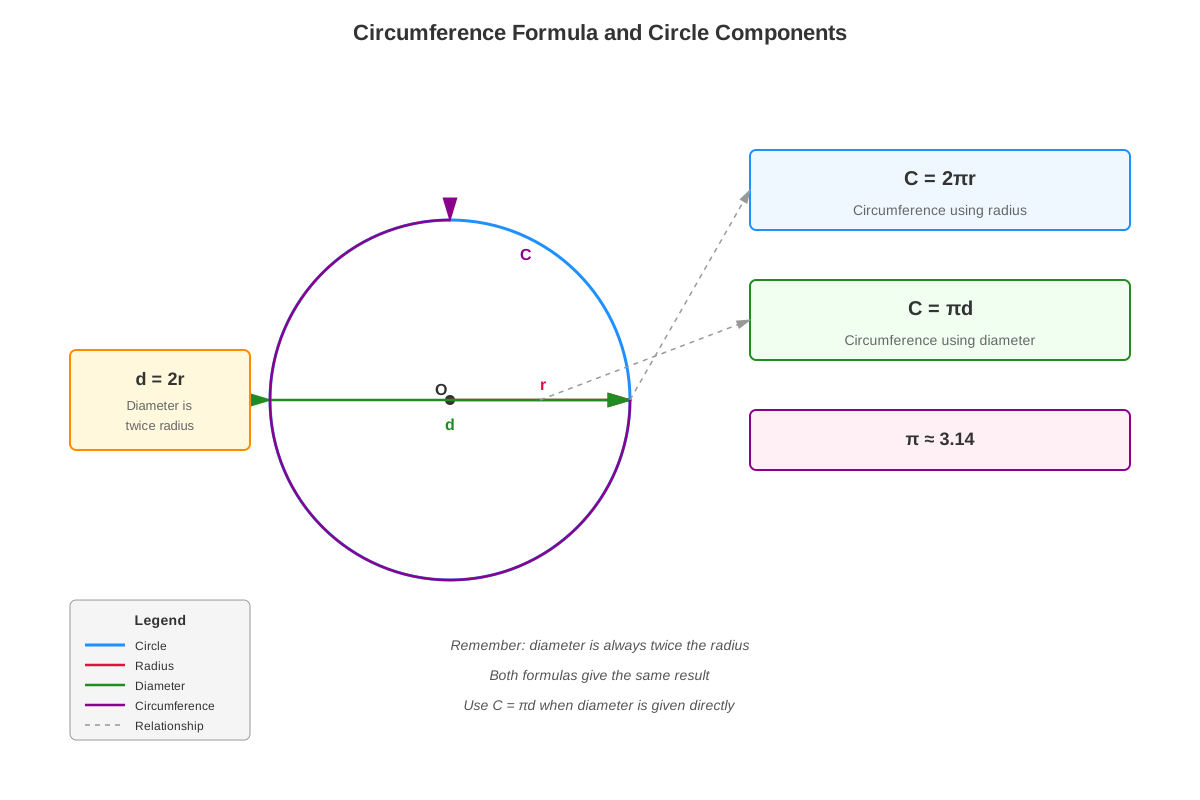
The circumference of a circle is calculated using one of two equivalent formulas, depending on whether the radius or diameter is given:
C = 2πror
C = πdwhere C represents circumference, r represents radius, d represents diameter, and π (pi) is the mathematical constant approximately equal to 3.14159. These formulas are equivalent because the diameter equals twice the radius (d = 2r). The circumference formula represents a direct proportional relationship: as the radius doubles, the circumference doubles; as the radius triples, the circumference triples.
Understanding why these formulas work provides deeper insight. The ratio of any circle's circumference to its diameter always equals π, regardless of the circle's size. This fundamental relationship (C/d = π) has been known since ancient times and represents one of the most important constants in mathematics. On the GRE, students must recognize this relationship and apply it flexibly in various contexts.
Working with π in GRE Questions
The GRE tests students' ability to work with π in multiple ways. Sometimes answer choices contain π in symbolic form (like 6π or 12π), while other times they provide numerical approximations. Understanding when to leave π in the answer versus when to calculate a decimal approximation is crucial for efficiency and accuracy.
Key principles for working with π:
- When answer choices contain π, leave it in symbolic form throughout calculations
- When answer choices are decimals, use π ≈ 3.14 or the calculator's π button
- Recognize that π ≈ 22/7 is useful for mental math with fractions
- Never round π too early in multi-step calculations, as this compounds error
Relationship Between Circumference, Radius, and Diameter
The three fundamental measurements of a circle—circumference, radius, and diameter—are interconnected through simple relationships:
| Given | Find Radius | Find Diameter | Find Circumference |
|---|---|---|---|
| Radius (r) | — | d = 2r | C = 2πr |
| Diameter (d) | r = d/2 | — | C = πd |
| Circumference (C) | r = C/(2π) | d = C/π | — |
These relationships enable students to find any measurement when given another. GRE questions frequently provide one measurement and ask for another, testing whether students can manipulate the formulas algebraically. For example, if given that a circle's circumference is 18π, students should immediately recognize that the diameter is 18 (since C = πd) and the radius is 9.
Arc Length as a Fraction of Circumference
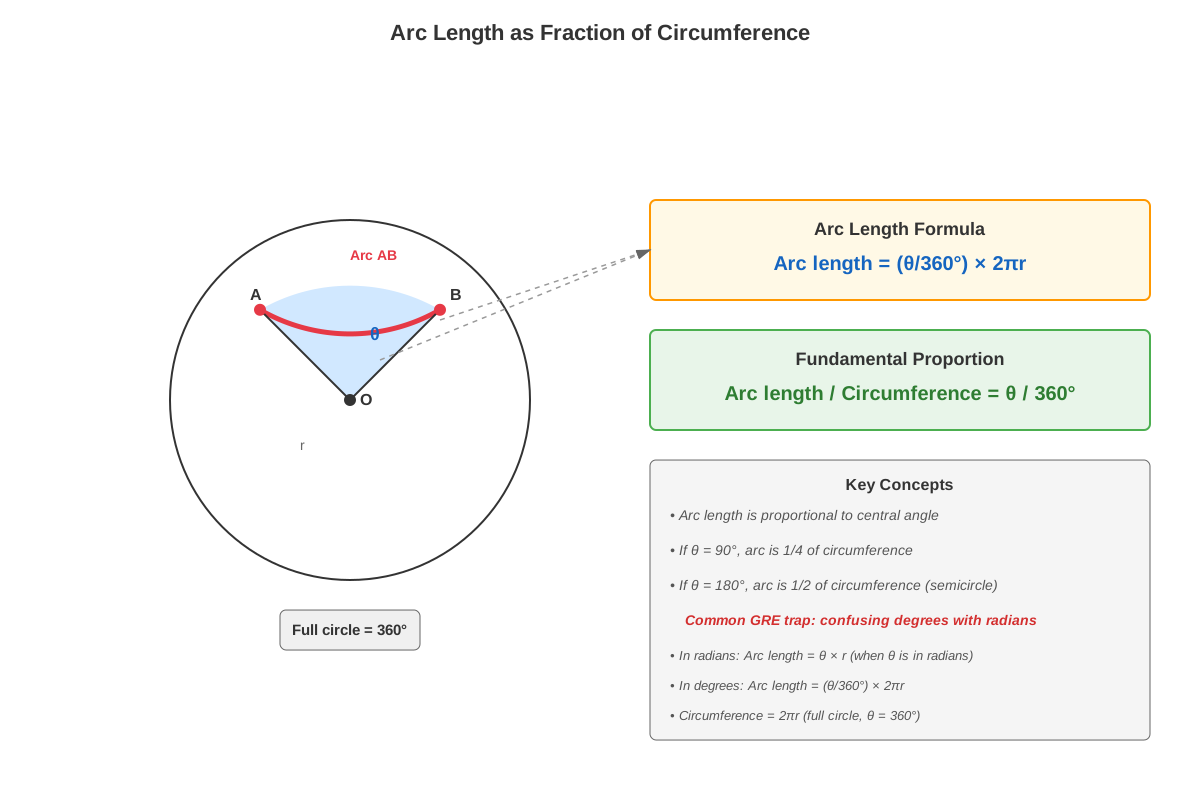
An arc is a portion of a circle's circumference. Arc length problems are extremely common on the GRE and require understanding that an arc's length is proportional to the central angle that defines it. The fundamental relationship is:
Arc Length = (θ/360°) × 2πrwhere θ is the central angle in degrees. Alternatively, if the central angle is given in radians:
Arc Length = θ × rThe key insight is that arc length represents a fraction of the total circumference. If a central angle is 60°, the arc length is 60/360 = 1/6 of the total circumference. This proportional reasoning appears frequently in GRE questions and enables quick mental calculations.
Circumference in Applied Problems
The GRE frequently embeds circumference in real-world scenarios, particularly involving circular motion. The most common application involves wheels or circular objects rolling along a surface. When a wheel completes one full rotation, it travels a distance equal to its circumference. This principle enables solving problems about:
- Distance traveled: If a wheel with radius r completes n rotations, the distance traveled is n × 2πr
- Number of rotations: If a wheel with circumference C travels distance d, the number of rotations is d/C
- Comparative speeds: Objects traveling on circular paths at different radii but the same angular velocity cover different linear distances
Circumference and Area Relationships
While circumference and area are distinct measurements, they're related through the radius. Understanding this relationship helps solve complex problems where both measurements appear:
- Circumference: C = 2πr
- Area: A = πr²
From these formulas, students can derive that:
r = C/(2π)and therefore:
A = π[C/(2π)]² = C²/(4π)This relationship occasionally appears in GRE questions that provide circumference and ask for area, or vice versa. Recognizing these connections enables efficient problem-solving without memorizing additional formulas.
Circumference in Coordinate Geometry
When circles appear on the coordinate plane, circumference calculations combine with coordinate geometry concepts. The standard form equation of a circle is:
(x - h)² + (y - k)² = r²where (h, k) is the center and r is the radius. Once the radius is identified from this equation, circumference follows immediately from C = 2πr. GRE questions may present a circle equation and ask for circumference, testing whether students can extract the radius from the equation's structure.
Concept Relationships
The concepts within circumference form a hierarchical structure where the fundamental formula serves as the foundation for all other applications. The basic relationship C = 2πr leads directly to the diameter version C = πd, which then enables solving for radius or diameter when circumference is given. This algebraic manipulation skill connects to arc length calculations, where understanding that arcs represent fractional portions of the total circumference allows proportional reasoning.
Circumference connects backward to prerequisite topics through its reliance on ratio and proportion (comparing circumferences of different circles, or relating arc length to total circumference) and algebraic manipulation (solving for unknown variables in circumference equations). It connects forward to more advanced topics including area of circles (both measurements depend on radius), sectors and segments (which combine arc length with area), and three-dimensional geometry (where circumference appears in surface area and volume formulas for cylinders, cones, and spheres).
The relationship map flows as follows: Basic formula (C = 2πr) → Algebraic manipulation → Finding radius/diameter from circumference → Arc length as fractional circumference → Applied problems (wheels, motion) → Combined circumference-area problems → Coordinate geometry applications. Each step builds on previous understanding, making mastery of the fundamental formula essential for all subsequent applications.
Quick check — test yourself on Circumference so far.
Try Flashcards →High-Yield Facts
⭐ The circumference formula is C = 2πr or C = πd, where r is radius and d is diameter
⭐ When a circle's radius doubles, its circumference doubles (direct proportion)
⭐ Arc length equals (central angle/360°) × circumference when angle is in degrees
⭐ A wheel with circumference C travels distance C in one complete rotation
⭐ The ratio of circumference to diameter always equals π for any circle
- If circumference is given as a multiple of π (like 12π), the diameter is the coefficient (12)
- Two circles with radii in ratio a:b have circumferences in ratio a:b
- The circumference of a semicircle's curved portion is πr (half the full circumference)
- When comparing circumferences in quantitative comparison questions, compare radii or diameters instead
- A 60° arc represents 1/6 of the total circumference; a 90° arc represents 1/4
- The perimeter of a semicircle includes both the curved portion (πr) and the diameter (2r), totaling πr + 2r
- Circumference has linear units (inches, centimeters, meters), not square units
Common Misconceptions
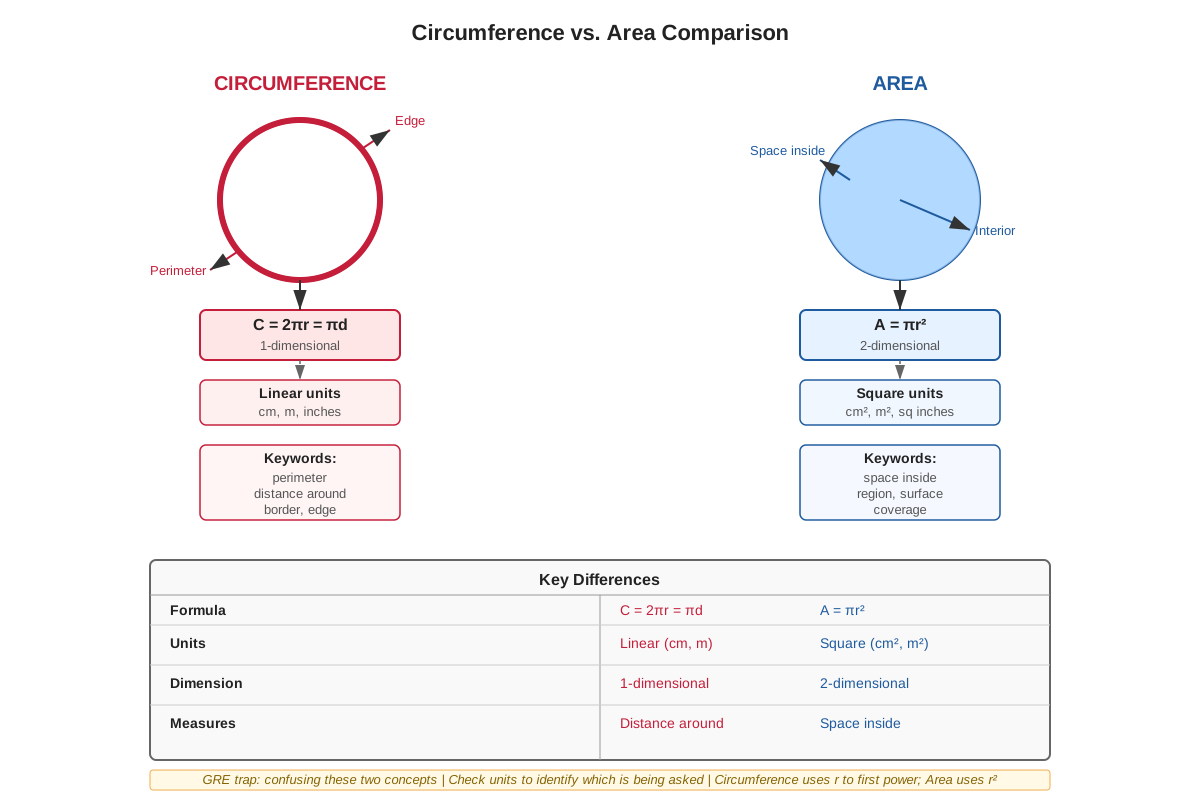
Misconception: Circumference and area formulas are interchangeable or can be confused.
Correction: Circumference (C = 2πr) measures distance around the circle in linear units, while area (A = πr²) measures space inside the circle in square units. The formulas have different structures and applications.
Misconception: When radius doubles, circumference quadruples.
Correction: Circumference has a direct linear relationship with radius. When radius doubles, circumference exactly doubles (not quadruples). The quadrupling relationship applies to area, not circumference.
Misconception: π should always be approximated as 3.14 in calculations.
Correction: When answer choices contain π in symbolic form, leave π as a symbol throughout calculations. Only approximate π when answer choices are decimals or when the question specifically requests an approximation.
Misconception: The perimeter of a semicircle is half the circumference of the full circle.
Correction: The perimeter of a semicircle includes both the curved arc (which is πr, half the full circumference) and the straight diameter (2r). The total perimeter is πr + 2r, not just πr.
Misconception: Arc length can be calculated without knowing the central angle.
Correction: Arc length requires knowing both the radius (or circumference) and the central angle. The arc length is the fraction (angle/360°) of the total circumference, so both pieces of information are essential.
Misconception: Diameter equals radius.
Correction: Diameter equals twice the radius (d = 2r). This is one of the most fundamental relationships in circle geometry, and confusing these measurements leads to answers that are off by a factor of 2.
Worked Examples
Example 1: Multi-Step Circumference and Distance Problem
Question: A bicycle wheel has a radius of 14 inches. If the bicycle travels 880 inches, how many complete rotations does the wheel make?
Solution:
Step 1: Identify what's being asked. We need to find the number of complete rotations, which requires knowing how far the wheel travels in one rotation (its circumference).
Step 2: Calculate the circumference using C = 2πr.
C = 2π(14) = 28π inchesStep 3: Determine the number of rotations by dividing total distance by circumference.
Number of rotations = 880/(28π)Step 4: Simplify the expression.
Number of rotations = 880/(28π) = 880/(28 × 3.14159...) ≈ 880/87.96 ≈ 10Alternatively, we can simplify algebraically before approximating:
880/(28π) = 880/(28π) = 31.43/π ≈ 31.43/3.14159 ≈ 10Answer: The wheel makes 10 complete rotations.
Connection to learning objectives: This problem requires identifying that circumference is being tested (through the wheel rotation context), applying the core formula C = 2πr, and accurately calculating through multiple steps—demonstrating all three primary learning objectives.
Example 2: Arc Length and Proportional Reasoning
Question: Circle O has a circumference of 36π. If arc AB is defined by a central angle of 40°, what is the length of arc AB?
Solution:
Step 1: Recognize that arc length is a fraction of the total circumference, where the fraction is determined by the central angle.
Step 2: Set up the proportion. Since a full circle has 360°, a 40° arc represents 40/360 of the circle.
Fraction of circle = 40°/360° = 1/9Step 3: Calculate arc length by multiplying the fraction by total circumference.
Arc length = (1/9) × 36π = 4πStep 4: Verify the answer makes sense. Since 40° is slightly more than 1/9 of 360° (which would be exactly 40°), and 4π is exactly 1/9 of 36π, our answer is correct.
Answer: The length of arc AB is 4π.
Connection to learning objectives: This problem demonstrates applying circumference concepts to arc length calculations, using proportional reasoning (a key strategy), and working efficiently with π in symbolic form—all essential GRE skills.
Exam Strategy
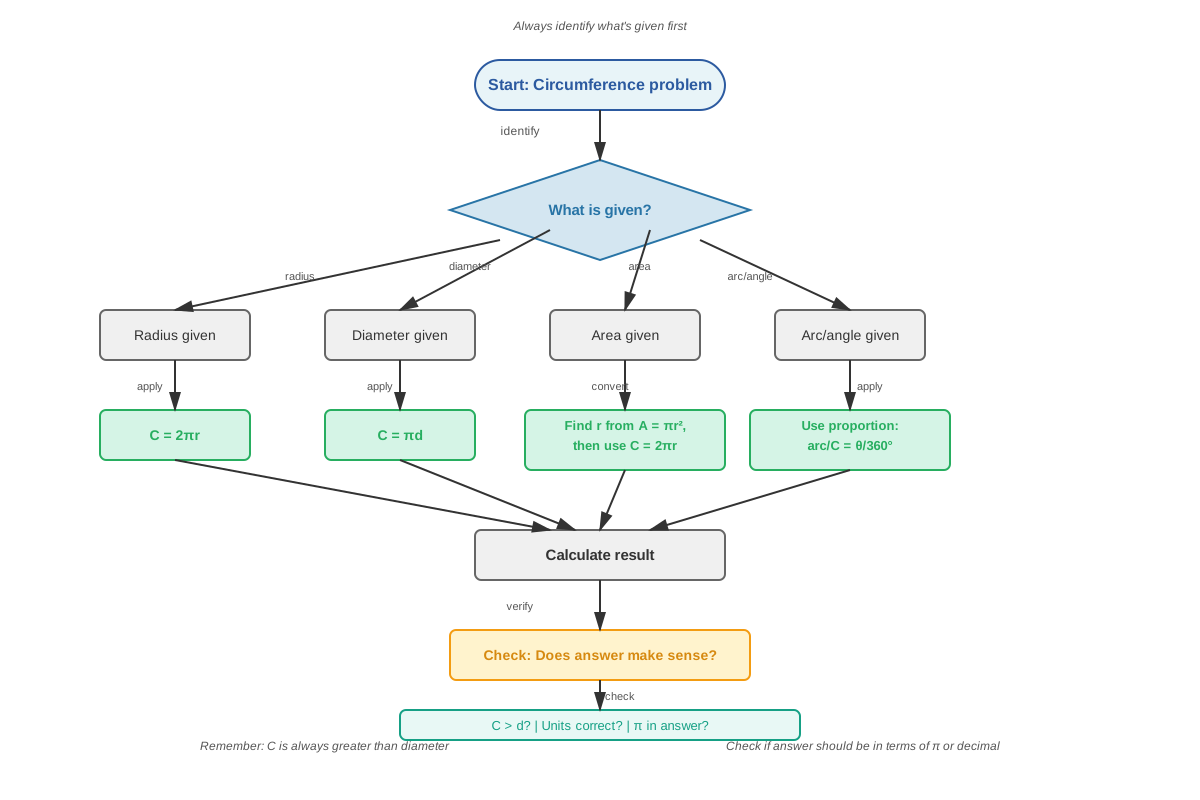
When approaching gre circumference questions, begin by identifying what information is provided and what is being asked. Draw a diagram if one isn't provided, labeling all known measurements. Determine whether you're working with radius, diameter, or circumference, and identify which formula version is most efficient for the given information.
Trigger words and phrases to watch for:
- "Distance around" or "perimeter of a circle" → circumference
- "Wheel," "rotation," "revolution" → likely involves circumference for distance traveled
- "Arc" with an angle measurement → fractional circumference
- "Diameter" or "radius" given → direct circumference calculation
- "Inscribed" or "circumscribed" → may involve circumference relationships
Process-of-elimination strategies:
- Check units: Circumference answers should have linear units (inches, meters), not square units
- Compare magnitudes: Circumference is always larger than diameter (by a factor of π ≈ 3.14)
- Look for π: If the question provides measurements as multiples of π, correct answers likely contain π
- Test extreme cases: If radius is very small, circumference should be small; if radius is large, circumference should be large
- Verify proportions: If comparing two circles, the one with larger radius must have larger circumference
Time allocation advice:
Basic circumference calculations should take 30-45 seconds. Multi-step problems involving circumference and other concepts may require 90-120 seconds. If a problem requires more than two minutes, consider whether you're missing a shortcut or should make an educated guess and move on. Practice recognizing when to leave π in symbolic form versus when to calculate decimals—this decision can save 15-30 seconds per problem.
For quantitative comparison questions involving circumference, often the most efficient approach is to compare radii or diameters directly rather than calculating both circumferences. Since circumference is directly proportional to radius, if Quantity A has a larger radius, it automatically has a larger circumference.
Memory Techniques
Mnemonic for the circumference formula: "Circles Take Two Pi Radii" → C = 2πr (or remember "Two pies are round" → 2πr)
Visualization strategy: Picture a string wrapped exactly once around a circle. When you unwrap and straighten the string, its length is the circumference. This mental image helps distinguish circumference (one-dimensional) from area (two-dimensional).
Acronym for circle relationships: CRAD - Circumference, Radius, Area, Diameter are all interconnected through π.
Memory aid for arc length: Think "PART of the circle" → Proportion × All the way Round = The arc. The proportion (angle/360°) times the full circumference (2πr) gives the arc length.
Diameter-Circumference relationship: Remember "Diameter Plus Pi" → C = πd. The circumference is π times the diameter, so if you know the diameter, just multiply by π.
Wheel rotation memory trick: "One turn, one circumference burned" → Each complete rotation covers a distance equal to the circumference.
Summary
Circumference represents the distance around a circle and is calculated using C = 2πr or C = πd, where r is radius, d is diameter, and π is the mathematical constant approximately equal to 3.14159. This fundamental measurement appears frequently on the GRE in various contexts including direct calculations, arc length problems, wheel rotation scenarios, and combined problems involving area or other geometric properties. Mastering circumference requires understanding its direct proportional relationship with radius, knowing when to work with π symbolically versus numerically, and recognizing how arc length represents a fractional portion of total circumference based on central angles. The ability to manipulate circumference formulas algebraically—solving for radius when given circumference, or finding circumference from diameter—is essential for GRE success. Students must also understand how circumference connects to real-world applications like circular motion and how it relates to other circle properties including area, sectors, and inscribed figures. Efficient problem-solving requires recognizing trigger words, drawing diagrams, and choosing the most direct solution path.
Key Takeaways
- The fundamental circumference formulas are C = 2πr and C = πd; memorize both and know when each is most efficient
- Circumference has a direct linear relationship with radius: double the radius, double the circumference
- Arc length equals (central angle/360°) × total circumference, making it a proportional calculation
- When a wheel completes one rotation, it travels a distance equal to its circumference
- Leave π in symbolic form when answer choices contain π; only approximate when answers are decimals
- The ratio of circumference to diameter always equals π, regardless of circle size
- Draw diagrams for circumference problems to visualize relationships and avoid calculation errors
Related Topics
Area of Circles: After mastering circumference, students should study circle area (A = πr²), which shares the radius relationship but measures two-dimensional space rather than one-dimensional distance. Both concepts frequently appear together in GRE problems.
Sectors and Arc Length: Building on circumference knowledge, sectors combine arc length with area calculations for wedge-shaped portions of circles, requiring proportional reasoning with both linear and area measurements.
Coordinate Geometry of Circles: Understanding circumference enables work with circles on the xy-plane, where the standard form equation (x - h)² + (y - k)² = r² provides the radius needed for circumference calculations.
Three-Dimensional Geometry: Circumference appears in surface area and volume formulas for cylinders, cones, and spheres, making it essential for advanced geometry problems.
Inscribed and Circumscribed Figures: These problems involve circles combined with polygons, where circumference relationships help determine other measurements through geometric principles.
Practice CTA
Now that you've mastered the core concepts of circumference, it's time to solidify your understanding through active practice. Attempt the practice questions to test your ability to identify circumference problems, apply the formulas accurately, and solve multi-step GRE-style questions under timed conditions. Use the flashcards to reinforce key formulas, relationships, and strategies until they become automatic. Remember: circumference is one of the highest-yield geometry topics on the GRE, and every minute spent practicing these concepts directly translates to points on test day. Your investment in mastering this fundamental topic will pay dividends across numerous question types!
Sign up free to keep reading
Create a free AnvayaPrep account to finish this GRE guide on Circumference — plus flashcards and practice questions.