Overview
Congruent triangles are triangles that have exactly the same size and shape, meaning all corresponding sides are equal in length and all corresponding angles are equal in measure. This fundamental concept in geometry serves as a cornerstone for solving numerous problems on the GRE Quantitative Reasoning section. Understanding congruence allows test-takers to identify when two triangles are identical in every geometric property, even when they may be positioned differently or oriented in various ways on the coordinate plane or within geometric figures.
The concept of GRE congruent triangles appears frequently in multiple question formats, including quantitative comparison questions, multiple-choice problems, and numeric entry items. Mastery of this topic enables students to solve complex geometry problems efficiently by recognizing when triangles share identical properties, which often provides shortcuts to finding missing measurements, calculating areas, or determining relationships between geometric figures. The GRE tests congruent triangles both directly—asking students to identify congruent triangles or apply congruence postulates—and indirectly, embedding the concept within larger geometric reasoning problems.
Within the broader landscape of GRE Quantitative Reasoning, congruent triangles connect intimately with other geometry topics including similar triangles, properties of polygons, coordinate geometry, and area calculations. The ability to recognize and apply triangle congruence criteria forms the foundation for understanding more advanced geometric relationships and proofs. This topic also reinforces logical reasoning skills that extend beyond geometry, as students must evaluate which combinations of information are sufficient to establish congruence—a type of reasoning that appears throughout the GRE.
Learning Objectives
- [ ] Identify when Congruent triangles is being tested
- [ ] Explain the core rule or strategy behind Congruent triangles
- [ ] Apply Congruent triangles to GRE-style questions accurately
- [ ] Distinguish between the five congruence postulates (SSS, SAS, ASA, AAS, HL) and determine which applies to a given situation
- [ ] Recognize when insufficient information is provided to establish triangle congruence
- [ ] Use properties of congruent triangles to find missing side lengths, angle measures, and other geometric quantities
- [ ] Apply congruence concepts to solve multi-step problems involving overlapping triangles or complex figures
Prerequisites
- Basic triangle properties: Understanding that triangles have three sides, three angles, and that angle measures sum to 180° is essential for recognizing corresponding parts in congruent triangles
- Angle relationships: Knowledge of vertical angles, supplementary angles, and complementary angles helps identify equal angles that establish congruence
- Basic algebraic manipulation: Setting up and solving equations is necessary when using congruence to find unknown measurements
- Coordinate geometry fundamentals: Understanding how to calculate distances between points supports problems involving congruent triangles on the coordinate plane
Why This Topic Matters
Congruent triangles represent one of the most practical applications of geometric reasoning in both academic and real-world contexts. Architects and engineers use congruence principles to ensure structural stability and symmetry in buildings and bridges. Computer graphics and animation rely on triangle congruence to render consistent shapes across transformations. Even in navigation and surveying, congruence concepts help determine distances and positions through triangulation methods.
On the GRE specifically, congruent triangles appear in approximately 10-15% of geometry questions, making them a high-yield topic for test preparation. The Educational Testing Service (ETS) frequently incorporates congruence into quantitative comparison questions where students must determine whether two geometric quantities are equal, greater, or if the relationship cannot be determined. These questions test not only geometric knowledge but also logical reasoning—a core skill the GRE aims to assess.
Common question formats include: identifying which congruence postulate applies to a given pair of triangles; using congruence to find missing measurements in complex figures containing multiple triangles; determining whether sufficient information exists to prove triangles congruent; and applying congruence within coordinate geometry problems. The topic also appears embedded within word problems involving symmetry, reflections, and geometric constructions. Understanding congruent triangles provides a significant strategic advantage because recognizing congruence often reveals shortcuts that save valuable time during the exam.
Core Concepts
Definition of Congruent Triangles
Two triangles are congruent if and only if all three corresponding sides are equal in length and all three corresponding angles are equal in measure. When triangles are congruent, they are essentially identical copies of each other, though they may be rotated, reflected, or translated to different positions. The symbol for congruence is ≅, so if triangle ABC is congruent to triangle DEF, this relationship is written as △ABC ≅ △DEF.
The order of vertices in the congruence statement matters significantly. When writing △ABC ≅ △DEF, the correspondence indicates that angle A equals angle D, angle B equals angle E, angle C equals angle F, side AB equals side DE, side BC equals side EF, and side AC equals side DF. This correspondence principle is crucial for correctly identifying which parts of the triangles match.
The Five Congruence Postulates
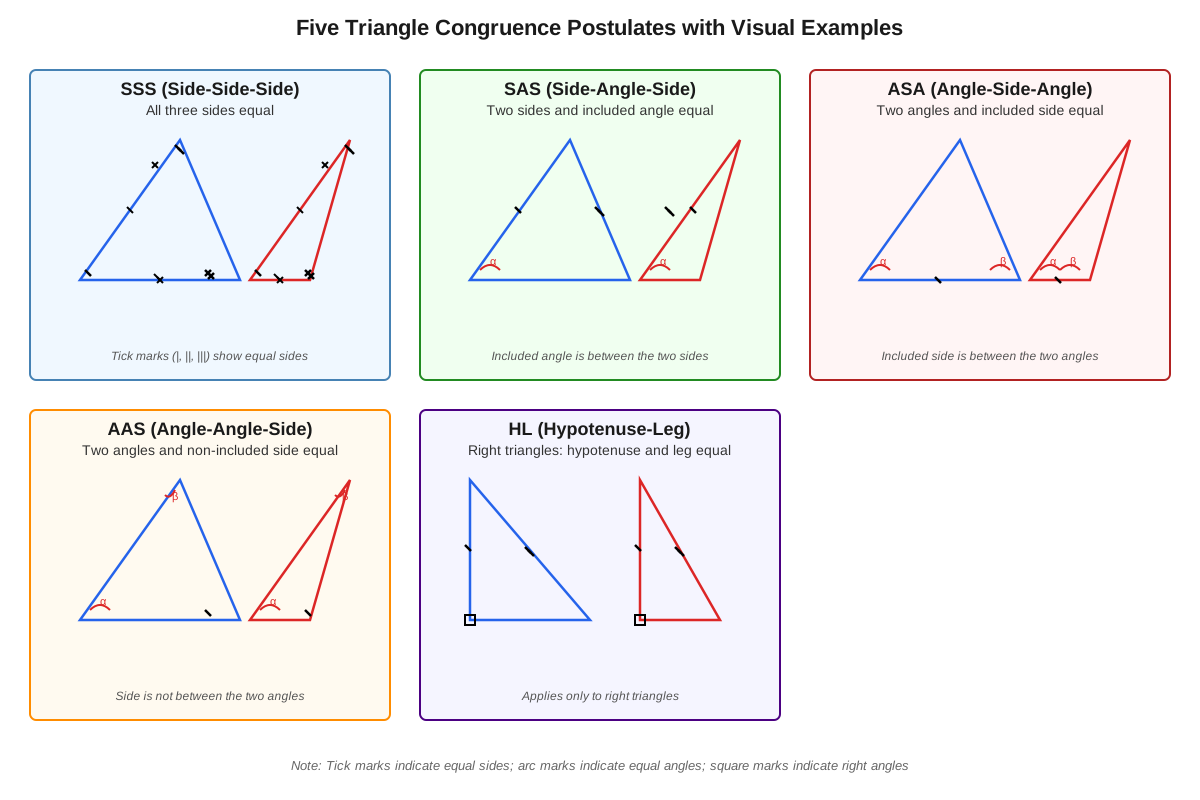
Rather than proving all six parts (three sides and three angles) are equal, mathematicians have established five sufficient conditions that guarantee triangle congruence. These postulates represent the minimum information needed to conclude that two triangles are congruent.
Side-Side-Side (SSS) Congruence
If all three sides of one triangle are equal in length to the corresponding three sides of another triangle, the triangles are congruent. This postulate relies on the principle that three specific side lengths uniquely determine a triangle's shape. For example, if triangle ABC has sides of length 5, 7, and 9, and triangle DEF also has sides of length 5, 7, and 9, then △ABC ≅ △DEF by SSS congruence.
Side-Angle-Side (SAS) Congruence
If two sides and the included angle (the angle between those two sides) of one triangle are equal to the corresponding two sides and included angle of another triangle, the triangles are congruent. The angle must be between the two sides for this postulate to apply. For instance, if AB = DE, AC = DF, and angle A = angle D, then △ABC ≅ △DEF by SAS congruence.
Angle-Side-Angle (ASA) Congruence
If two angles and the included side (the side between those two angles) of one triangle are equal to the corresponding two angles and included side of another triangle, the triangles are congruent. For example, if angle A = angle D, angle B = angle E, and side AB = side DE, then △ABC ≅ △DEF by ASA congruence.
Angle-Angle-Side (AAS) Congruence
If two angles and a non-included side of one triangle are equal to the corresponding two angles and non-included side of another triangle, the triangles are congruent. This differs from ASA because the known side is not between the two known angles. Since knowing two angles automatically determines the third angle (because angles in a triangle sum to 180°), and having one side with all three angles determines the triangle uniquely, AAS establishes congruence.
Hypotenuse-Leg (HL) Congruence
This postulate applies exclusively to right triangles. If the hypotenuse and one leg of a right triangle are equal to the hypotenuse and corresponding leg of another right triangle, the triangles are congruent. This is actually a special case of SSS or SAS, but it's particularly useful because right triangles appear frequently on the GRE.
Important Non-Congruence Conditions
Understanding what does NOT guarantee congruence is equally important for the GRE. The combination Angle-Angle-Angle (AAA) does not prove congruence; it only proves similarity. Two triangles can have all the same angles but be different sizes. Similarly, Side-Side-Angle (SSA) where the angle is not included between the two sides does not guarantee congruence, as this combination can sometimes produce two different triangles (the ambiguous case).
Corresponding Parts of Congruent Triangles are Congruent (CPCTC)
Once triangle congruence has been established using one of the five postulates, all remaining corresponding parts are automatically equal. This principle, abbreviated as CPCTC, is frequently used in multi-step GRE problems. After proving triangles congruent, CPCTC allows students to conclude that any corresponding sides or angles are equal, which often provides the information needed to solve for unknown quantities.
Congruence in Complex Figures
GRE questions often embed congruent triangles within larger geometric figures. Common scenarios include:
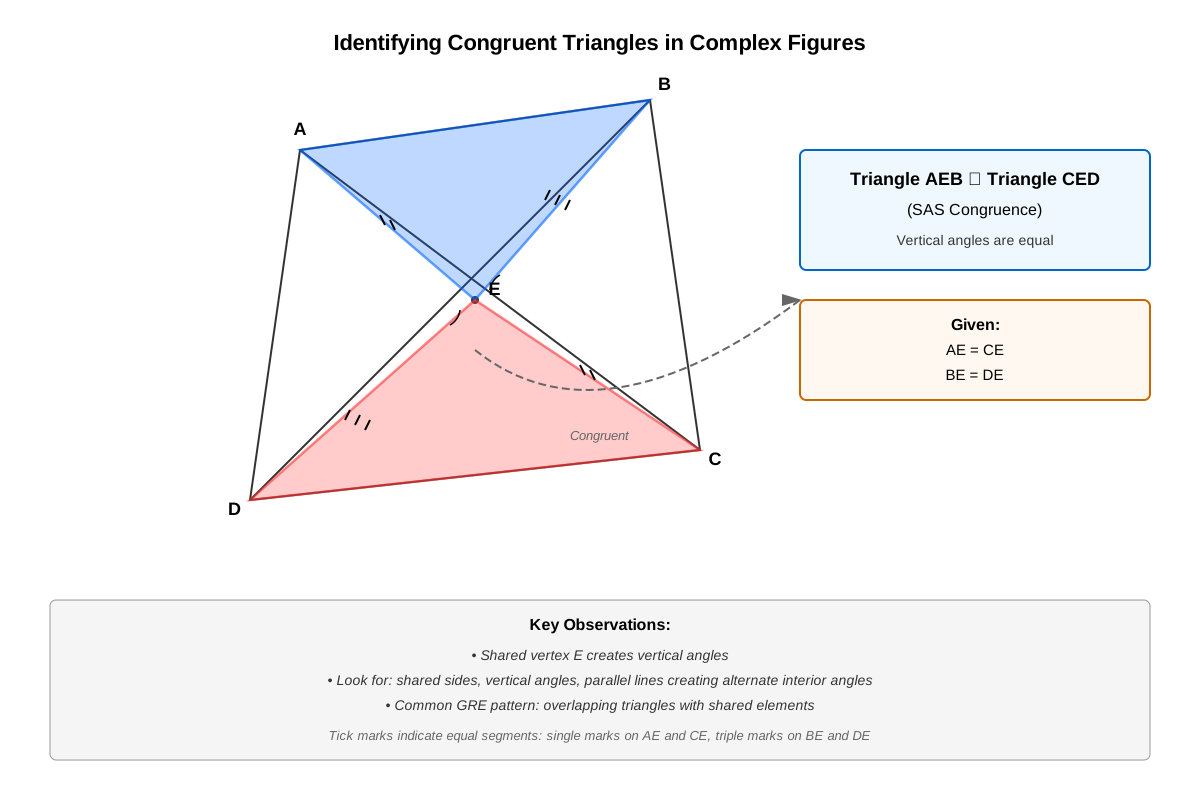
- Overlapping triangles: Two triangles sharing a common side or angle
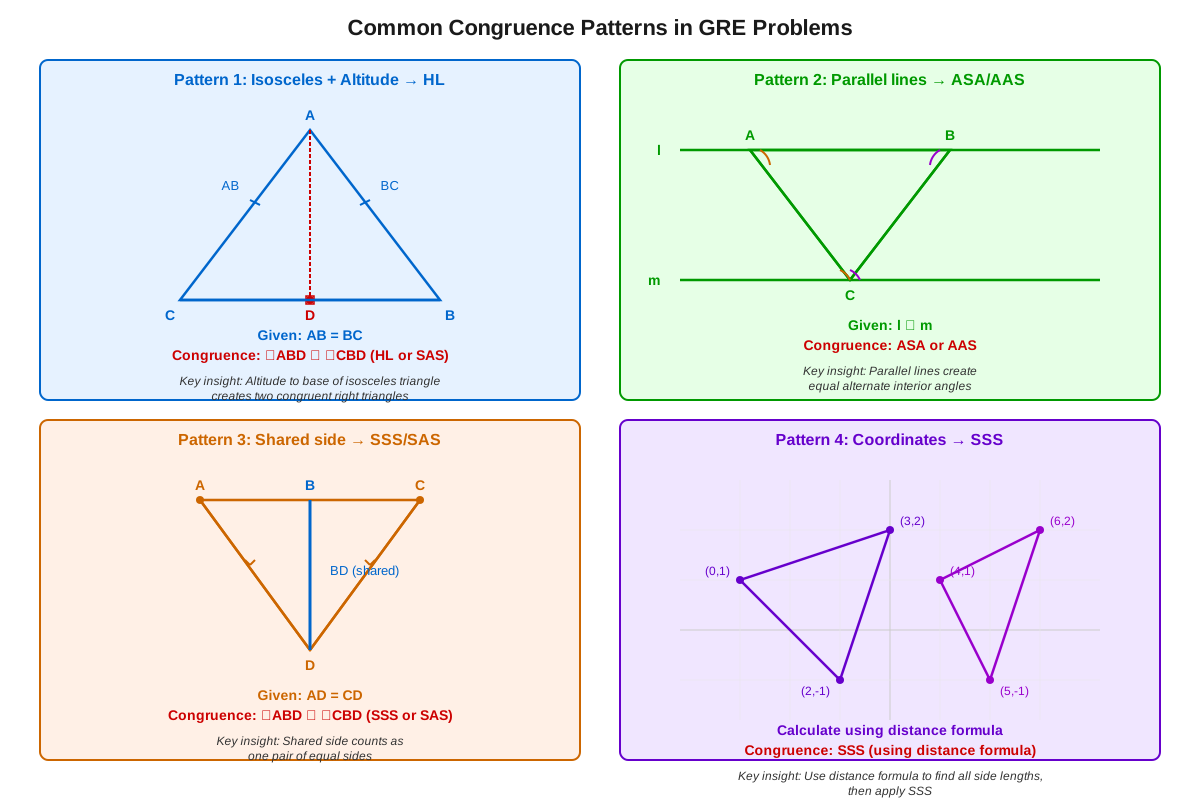
- Triangles formed by diagonals: Diagonals of parallelograms, rectangles, or other polygons creating congruent triangles
- Reflected triangles: Triangles on opposite sides of a line of symmetry
- Triangles in coordinate geometry: Using distance formula to establish equal side lengths
Recognizing these patterns quickly is essential for efficient problem-solving on the timed GRE exam.
Concept Relationships
The five congruence postulates form a hierarchical relationship where each provides a different pathway to establishing the same conclusion: complete triangle congruence. SSS → focuses purely on side relationships, while ASA and AAS → emphasize angle relationships with minimal side information. SAS → represents a balanced approach requiring both side and angle information, and HL → serves as a specialized tool for right triangle problems.
Congruent triangles connect directly to the prerequisite knowledge of basic triangle properties, as understanding angle sums and side relationships enables recognition of corresponding parts. The topic builds toward more advanced concepts: congruent triangles → leads to → similar triangles (where proportional rather than equal relationships exist), and congruent triangles → supports → polygon properties (such as proving diagonals bisect each other in parallelograms).
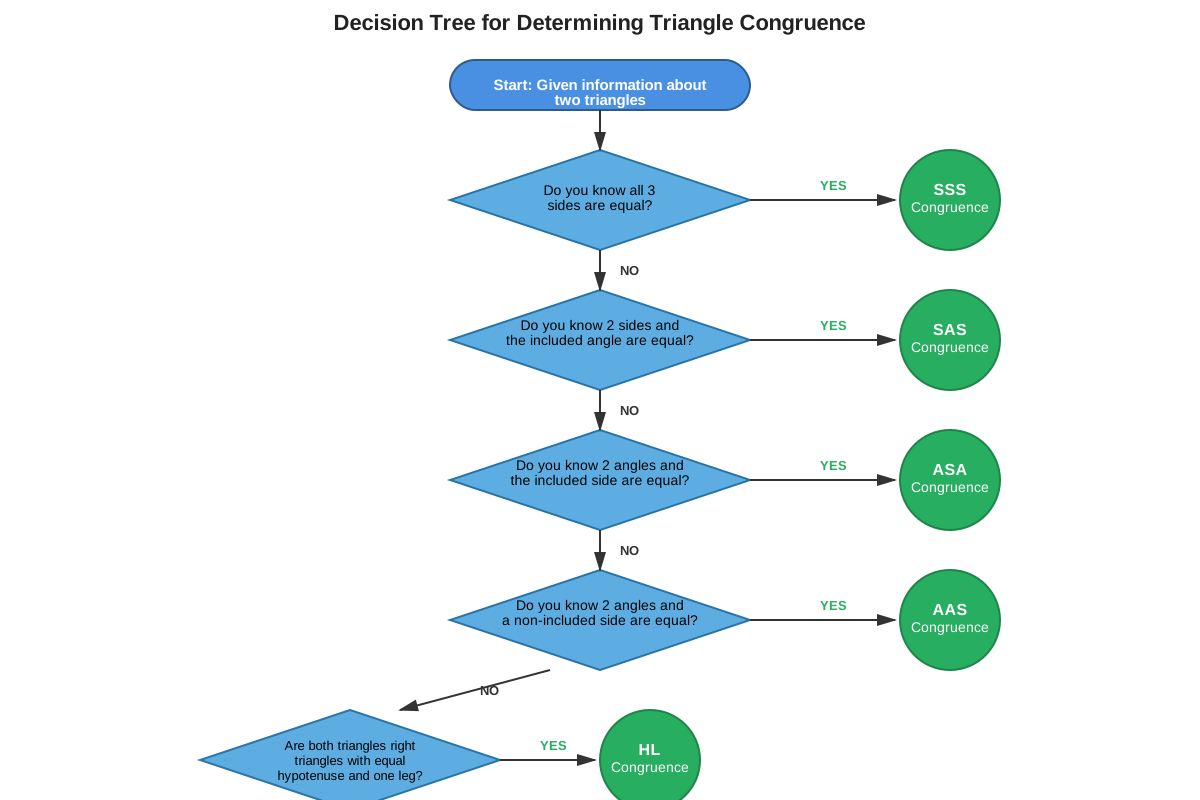
Within problem-solving strategies, the relationship flows: identify given information → determine which congruence postulate applies → establish congruence → apply CPCTC → solve for unknown quantities. This logical sequence appears repeatedly in GRE geometry questions and represents a reliable framework for approaching congruence problems systematically.
High-Yield Facts
- ⭐ Two triangles are congruent if all three corresponding sides and all three corresponding angles are equal
- ⭐ SSS, SAS, ASA, AAS, and HL are the five sufficient conditions to prove triangle congruence
- ⭐ The angle in SAS must be the included angle between the two sides
- ⭐ AAA (three angles) proves similarity but NOT congruence
- ⭐ Once congruence is established, CPCTC guarantees all corresponding parts are equal
- SSA (side-side-angle with non-included angle) does NOT guarantee congruence
- HL congruence applies only to right triangles
- The order of vertices in a congruence statement indicates which parts correspond
- Vertical angles and shared sides/angles are common elements used to establish congruence in overlapping triangles
- Isosceles triangles contain two congruent triangles when an altitude is drawn from the vertex angle to the base
- Congruent triangles have equal areas and equal perimeters
- Reflections, rotations, and translations preserve congruence
- In coordinate geometry, the distance formula can establish equal side lengths for SSS congruence
- Congruence is transitive: if △ABC ≅ △DEF and △DEF ≅ △GHI, then △ABC ≅ △GHI
Quick check — test yourself on Congruent triangles so far.
Try Flashcards →Common Misconceptions
Misconception: If two triangles have the same area, they must be congruent. → Correction: Triangles can have equal areas but completely different shapes and side lengths. Congruence requires all corresponding sides and angles to be equal, not just equal areas.
Misconception: Knowing three angles (AAA) is sufficient to prove triangles congruent. → Correction: AAA only proves triangles are similar (same shape but potentially different sizes). For congruence, at least one side length must be known in addition to angle information.
Misconception: SSA (two sides and a non-included angle) proves congruence. → Correction: SSA is the ambiguous case and can produce two different triangles or no triangle at all. Only when the angle is included between the two sides (SAS) does congruence follow.
Misconception: Congruent triangles must have the same orientation or position. → Correction: Congruent triangles can be rotated, reflected, or translated. They maintain congruence regardless of position or orientation in space.
Misconception: If corresponding sides are equal, the triangles are automatically congruent without checking angles. → Correction: While SSS congruence uses only sides, this is because three sides uniquely determine all angles. However, if only two sides are known to be equal, angles must also be verified unless using a specific postulate like SAS.
Misconception: The HL postulate can be used for any triangle. → Correction: HL (Hypotenuse-Leg) applies exclusively to right triangles. For non-right triangles, one of the other four postulates must be used.
Misconception: In a congruence statement like △ABC ≅ △DEF, any vertices can correspond to each other. → Correction: The order matters precisely. The first vertex in the first triangle corresponds to the first vertex in the second triangle, and so on. Angle A corresponds to angle D, not to angle E or F.
Worked Examples
Example 1: Identifying Congruence in Overlapping Triangles
Problem: In the figure described below, line segments AC and BD intersect at point E. It is given that AE = DE and BE = CE. Prove that △ABE ≅ △DCE and find the measure of angle DCE if angle ABE = 65°.
Solution:
Step 1: Identify the given information.
- AE = DE (one pair of corresponding sides)
- BE = CE (another pair of corresponding sides)
- Point E is the intersection point
Step 2: Identify additional equal parts.
When two line segments intersect, they form vertical angles. Therefore, angle AEB and angle DEC are vertical angles, which means angle AEB = angle DEC.
Step 3: Determine which congruence postulate applies.
We now have:
- AE = DE (side)
- Angle AEB = angle DEC (angle)
- BE = CE (side)
This matches the SAS (Side-Angle-Side) congruence postulate, where the angle is included between the two sides.
Step 4: State the congruence.
Therefore, △ABE ≅ △DCE by SAS congruence.
Step 5: Apply CPCTC to find the requested angle.
Since △ABE ≅ △DCE, all corresponding parts are congruent (CPCTC). Angle ABE corresponds to angle DCE because B and C are in the same position in the congruence statement. Therefore, angle DCE = angle ABE = 65°.
Connection to Learning Objectives: This example demonstrates how to identify when congruent triangles are being tested (overlapping triangles with shared vertex), explains the core strategy (identifying given equal parts and vertical angles, then applying SAS), and shows accurate application to find a missing angle measure using CPCTC.
Example 2: Using Congruence in Coordinate Geometry
Problem: Triangle ABC has vertices at A(1, 2), B(4, 2), and C(1, 6). Triangle DEF has vertices at D(7, 1), E(7, 4), and F(11, 1). Determine whether the triangles are congruent.
Solution:
Step 1: Calculate the side lengths of triangle ABC using the distance formula: d = √[(x₂-x₁)² + (y₂-y₁)²]
AB = √[(4-1)² + (2-2)²] = √[9 + 0] = 3
BC = √[(1-4)² + (6-2)²] = √[9 + 16] = √25 = 5
AC = √[(1-1)² + (6-2)²] = √[0 + 16] = 4
Step 2: Calculate the side lengths of triangle DEF.
DE = √[(7-7)² + (4-1)²] = √[0 + 9] = 3
EF = √[(11-7)² + (1-4)²] = √[16 + 9] = √25 = 5
DF = √[(11-7)² + (1-1)²] = √[16 + 0] = 4
Step 3: Compare the side lengths.
Triangle ABC has sides of length 3, 4, and 5.
Triangle DEF has sides of length 3, 4, and 5.
Step 4: Apply the appropriate congruence postulate.
Since all three corresponding sides are equal, the triangles are congruent by SSS (Side-Side-Side) congruence.
Therefore, △ABC ≅ △DEF.
Step 5: Additional observation.
Both triangles are actually right triangles (3-4-5 is a Pythagorean triple), which could also be verified by checking that the sides satisfy the Pythagorean theorem: 3² + 4² = 9 + 16 = 25 = 5².
Connection to Learning Objectives: This example shows how to identify congruent triangles in coordinate geometry, applies the SSS congruence postulate accurately, and demonstrates the systematic approach of calculating all necessary measurements before drawing conclusions.
Exam Strategy
When approaching GRE questions involving congruent triangles, begin by carefully reading the problem to identify all given information about sides and angles. Mark equal sides with identical tick marks and equal angles with identical arc marks on any provided diagrams, or create a quick sketch if no diagram is given. This visual organization prevents confusion about which parts correspond.
Trigger words and phrases that signal congruent triangle questions include: "prove the triangles are congruent," "corresponding parts," "identical triangles," "same size and shape," "which postulate," and "if the triangles are congruent, find..." Questions asking whether "sufficient information" exists to determine a relationship often test whether congruence can be established.
For quantitative comparison questions, determine whether establishing congruence would make the two quantities equal. If congruence can be proven, corresponding parts are equal, making Quantity A equal to Quantity B. If congruence cannot be established with certainty, the answer is typically "the relationship cannot be determined."
Process-of-elimination strategy: When asked which congruence postulate applies, immediately eliminate any answer choices that represent invalid conditions (like AAA or SSA). If the triangles are right triangles, consider whether HL might be the most efficient postulate. If an angle is mentioned with two sides, check whether it's the included angle (SAS) or not (potentially insufficient).
Time allocation: Most congruent triangle questions should take 1.5-2 minutes. If a problem requires proving congruence as an intermediate step before finding a final answer, allocate up to 2.5 minutes. Avoid spending excessive time trying to prove congruence if the given information clearly doesn't match any of the five postulates—the answer may be that congruence cannot be determined.
Always verify that you're using the correct correspondence when applying CPCTC. Double-check which vertex in the first triangle corresponds to which vertex in the second triangle based on the congruence statement or the order in which equal parts were identified.
Memory Techniques
Mnemonic for the five congruence postulates: "Sally Sells Seashells, So Anna Sells Apples Sometimes, And Always Sells Honey Later" represents SSS, SAS, ASA, AAS, and HL.
Visualization for included vs. non-included: Picture a sandwich where the angle is the filling. In SAS, the angle (filling) must be between the two sides (bread slices). In ASA, the side (filling) must be between the two angles (bread slices). This "sandwich rule" helps remember that the middle element must be between the other two.
Acronym for CPCTC: "Corresponding Parts of Congruent Triangles are Congruent" can be remembered as "Cool People Can Tell Congruence" for a more memorable phrase.
The "NO" list: Remember that No One uses AAA or SSA for congruence. These two combinations are the primary invalid conditions, and keeping them grouped as the "NO list" helps avoid common errors.
Right triangle reminder: Associate HL with "Holy Legs" to remember it applies only to right triangles (which might be considered "holy" or special triangles). The hypotenuse is the longest side, and you need it plus one leg.
Summary
Congruent triangles are triangles with identical size and shape, meaning all corresponding sides and angles are equal. The GRE tests this concept through five valid congruence postulates: SSS (three sides), SAS (two sides and the included angle), ASA (two angles and the included side), AAS (two angles and a non-included side), and HL (hypotenuse and leg for right triangles only). Understanding which combinations of information sufficiently prove congruence is essential, as is recognizing that AAA proves only similarity and SSA does not guarantee congruence. Once congruence is established through any of the five postulates, CPCTC (Corresponding Parts of Congruent Triangles are Congruent) allows all remaining parts to be concluded equal. GRE questions embed congruent triangles in various contexts including overlapping figures, coordinate geometry, and multi-step problems requiring both the establishment of congruence and subsequent application of that congruence to find unknown measurements. Mastery requires recognizing trigger patterns, systematically identifying given information, selecting the appropriate postulate, and accurately applying CPCTC to reach final answers.
Key Takeaways
- Congruent triangles have all corresponding sides equal and all corresponding angles equal, making them identical in size and shape
- Five postulates prove congruence: SSS, SAS, ASA, AAS, and HL (right triangles only)
- The included angle (SAS) or included side (ASA) must be between the two other known parts
- AAA proves similarity but not congruence; SSA does not reliably prove congruence
- CPCTC allows you to conclude all corresponding parts are equal once congruence is established
- Vertical angles, shared sides, and reflexive properties are commonly used to identify equal parts in overlapping triangles
- The order of vertices in congruence statements indicates which parts correspond to each other
Related Topics
Similar Triangles: After mastering congruent triangles, similar triangles extend the concept to triangles with the same shape but different sizes, where corresponding sides are proportional rather than equal. Understanding congruence provides the foundation for recognizing when triangles are similar (AAA or AA) versus congruent.
Properties of Quadrilaterals: Many quadrilateral properties are proven using congruent triangles, such as showing that diagonals of a rectangle are equal by proving the triangles they form are congruent. Mastering triangle congruence enables deeper understanding of polygon properties.
Coordinate Geometry: Congruent triangles frequently appear in coordinate plane problems where the distance formula establishes equal side lengths. This topic builds on congruence concepts while integrating algebraic skills.
Geometric Proofs: Formal geometric proofs often rely on establishing triangle congruence as a key step. Understanding the five postulates and CPCTC provides the logical framework for constructing valid geometric arguments.
Practice CTA
Now that you've mastered the core concepts of congruent triangles, it's time to solidify your understanding through active practice. Attempt the practice questions to apply these strategies to GRE-style problems, and use the flashcards to reinforce the five congruence postulates and key facts. Remember, recognizing congruence patterns quickly is a skill that improves with deliberate practice—each problem you solve strengthens your geometric intuition and builds the confidence you need to excel on test day. You've built a strong foundation; now put it to work!
Sign up free to keep reading
Create a free AnvayaPrep account to finish this GRE guide on Congruent triangles — plus flashcards and practice questions.