Overview
Quadrilaterals represent one of the most frequently tested geometric concepts on the GRE Quantitative Reasoning section. A quadrilateral is any four-sided polygon, and understanding the properties, formulas, and relationships among different types of quadrilaterals is essential for success on test day. The GRE tests quadrilaterals through direct calculation problems, comparison questions, and complex multi-step geometry scenarios that require students to identify which properties apply to specific shapes.
Mastery of GRE quadrilaterals extends beyond simple memorization of formulas. Test-makers design questions that require students to recognize when a shape qualifies as a specific type of quadrilateral, apply the appropriate properties, and often work backward from given information to find missing measurements. Questions may involve finding areas, perimeters, angles, diagonal lengths, or determining relationships between different quadrilaterals. The ability to quickly identify which quadrilateral properties are relevant to a problem can save valuable time and prevent costly errors.
Within the broader Quantitative Reasoning framework, quadrilaterals connect directly to coordinate geometry, triangles, circles, and algebraic problem-solving. Many GRE questions combine quadrilateral properties with concepts like the Pythagorean theorem, similar triangles, or coordinate plane calculations. Understanding how quadrilaterals relate to these other topics creates a comprehensive geometric toolkit that enables students to tackle even the most challenging problems with confidence.
Learning Objectives
- [ ] Identify when Quadrilaterals is being tested
- [ ] Explain the core rule or strategy behind Quadrilaterals
- [ ] Apply Quadrilaterals to GRE-style questions accurately
- [ ] Distinguish between different types of quadrilaterals based on their defining properties
- [ ] Calculate areas and perimeters for all major quadrilateral types using appropriate formulas
- [ ] Determine angle measures within quadrilaterals using angle sum properties and special relationships
- [ ] Solve multi-step problems involving quadrilaterals in coordinate geometry contexts
Prerequisites
- Basic angle properties: Understanding supplementary, complementary, and vertical angles is necessary for calculating interior angles of quadrilaterals
- Triangle properties: Many quadrilateral problems involve dividing shapes into triangles or applying the Pythagorean theorem
- Area and perimeter concepts: Fundamental understanding of how to measure two-dimensional shapes provides the foundation for quadrilateral calculations
- Coordinate geometry basics: Problems often place quadrilaterals on the coordinate plane, requiring knowledge of distance and midpoint formulas
- Algebraic manipulation: Setting up and solving equations is frequently required when working with quadrilateral properties
Why This Topic Matters
Quadrilaterals appear in approximately 15-20% of GRE Quantitative Reasoning geometry questions, making them one of the highest-yield geometry topics to master. The GRE tests quadrilaterals through multiple question formats: Quantitative Comparison questions that ask students to compare areas or perimeters, Multiple Choice questions requiring calculation of specific measurements, and Numeric Entry questions where students must determine exact values without answer choices to guide them.
In real-world applications, quadrilateral properties are fundamental to architecture, engineering, design, and spatial reasoning. Understanding how rectangles, squares, parallelograms, and trapezoids behave enables professionals to calculate materials needed for construction, optimize space utilization, and solve practical measurement problems. The logical reasoning skills developed through quadrilateral problem-solving transfer directly to analytical thinking required in graduate-level coursework across disciplines.
On the GRE, quadrilaterals commonly appear in questions involving: coordinate geometry where vertices are given as points; word problems describing real-world scenarios like gardens, rooms, or plots of land; diagram-based questions requiring visual analysis; and complex multi-shape problems where quadrilaterals interact with circles, triangles, or other polygons. Recognizing these patterns helps students quickly identify the relevant properties and formulas needed to solve each problem efficiently.
Core Concepts
Definition and Classification of Quadrilaterals
A quadrilateral is any closed two-dimensional polygon with exactly four sides, four vertices, and four interior angles. The sum of all interior angles in any quadrilateral always equals 360 degrees, regardless of the shape's specific properties. This fundamental angle sum property derives from the fact that any quadrilateral can be divided into two triangles, each contributing 180 degrees.
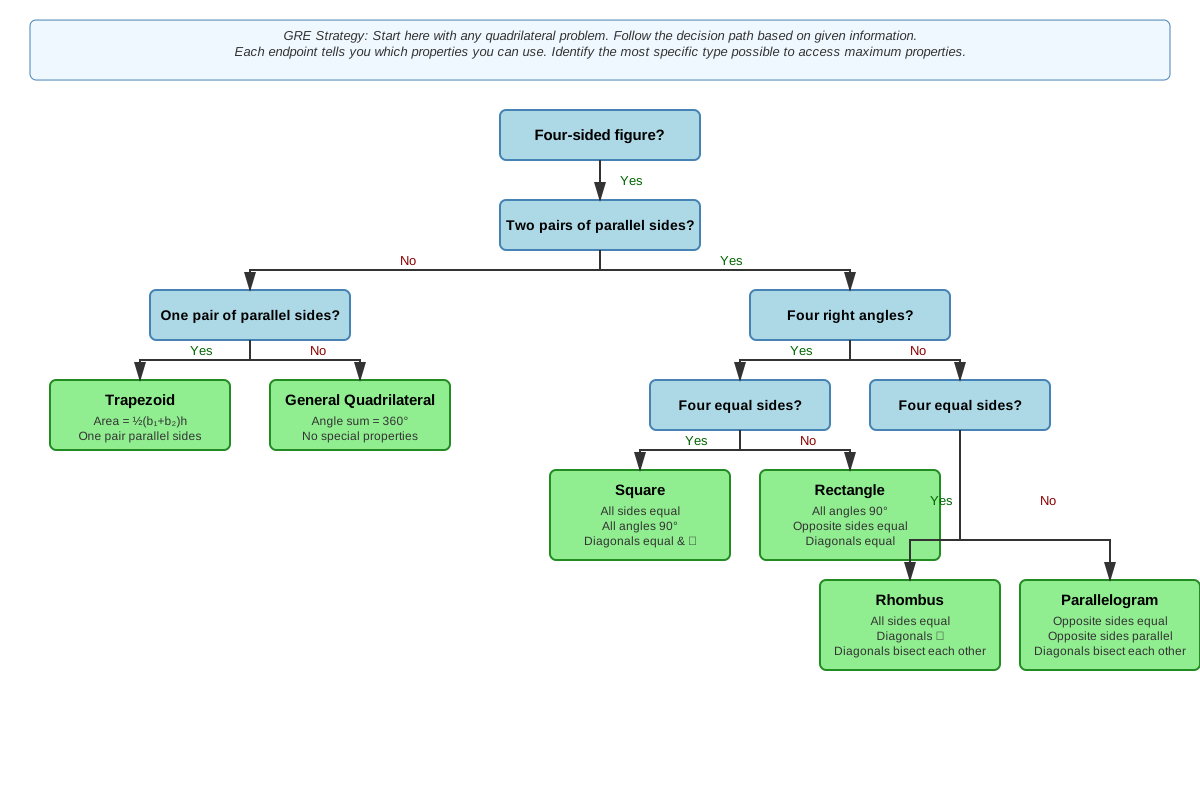
Quadrilaterals are classified into several categories based on their properties:
| Quadrilateral Type | Defining Properties | Special Characteristics |
|---|---|---|
| Parallelogram | Opposite sides parallel and equal | Opposite angles equal; consecutive angles supplementary; diagonals bisect each other |
| Rectangle | Parallelogram with four right angles | All properties of parallelograms; diagonals are equal in length |
| Square | Rectangle with all sides equal | All properties of rectangles and rhombuses; diagonals are equal, perpendicular, and bisect angles |
| Rhombus | Parallelogram with all sides equal | Diagonals are perpendicular and bisect angles |
| Trapezoid | Exactly one pair of parallel sides | Parallel sides called bases; non-parallel sides called legs |
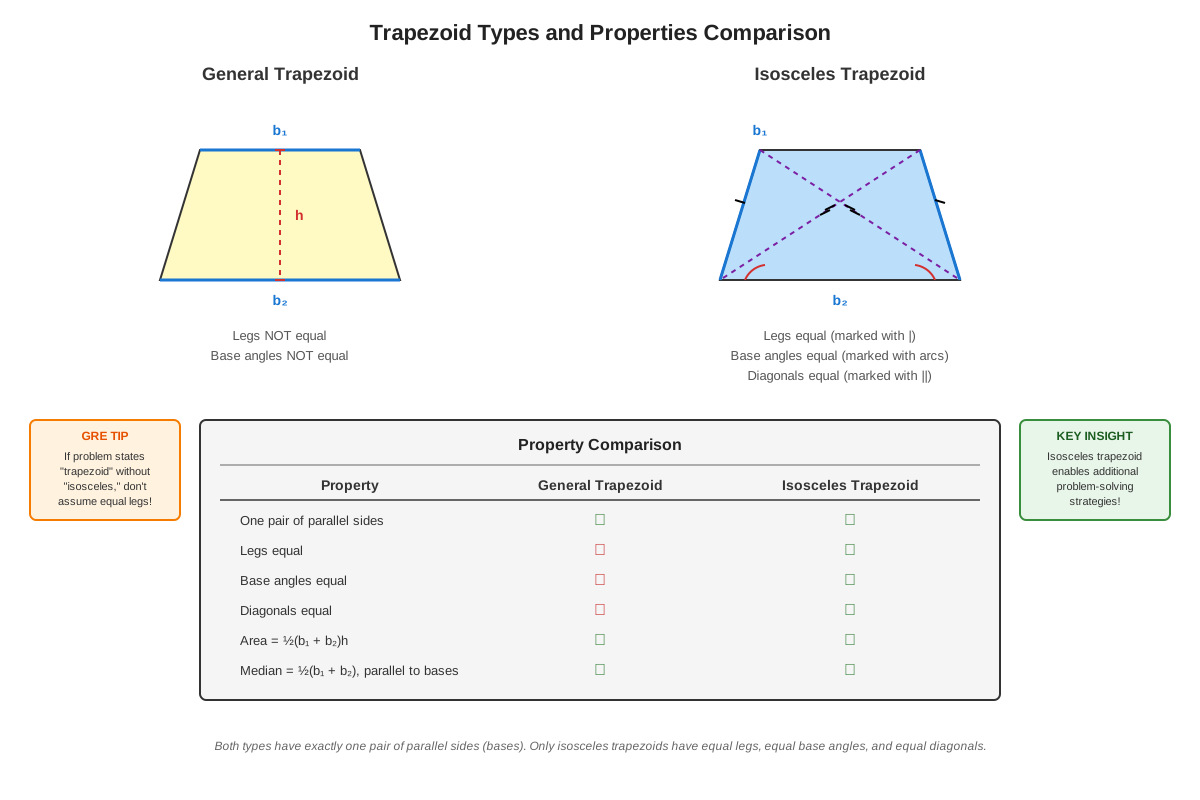
| Isosceles Trapezoid | Trapezoid with equal legs | Base angles are equal; diagonals are equal in length |
| Kite | Two pairs of consecutive equal sides | Diagonals are perpendicular; one diagonal bisects the other |
Parallelograms
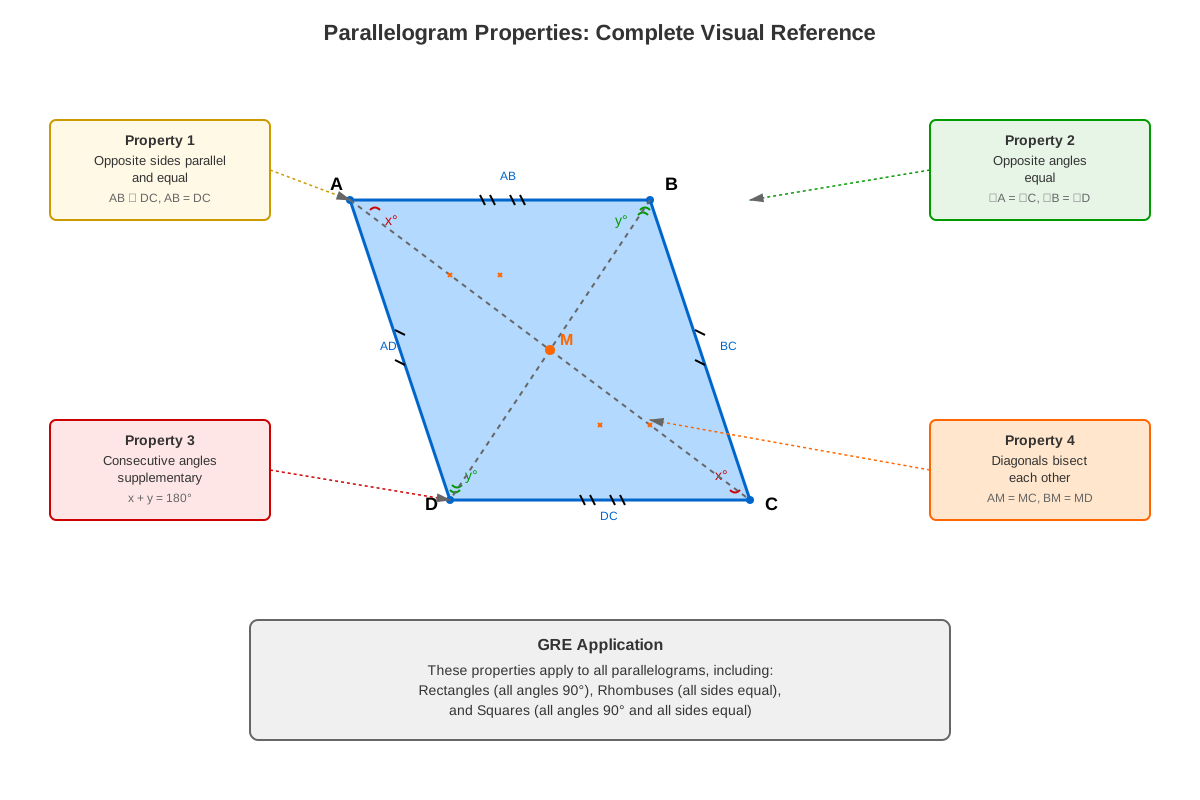
A parallelogram is a quadrilateral where both pairs of opposite sides are parallel. This single defining property generates numerous other characteristics that the GRE frequently tests. In a parallelogram, opposite sides are not only parallel but also equal in length. Opposite angles are equal, while consecutive angles are supplementary (sum to 180 degrees). The diagonals of a parallelogram bisect each other, though they are not necessarily equal in length or perpendicular.
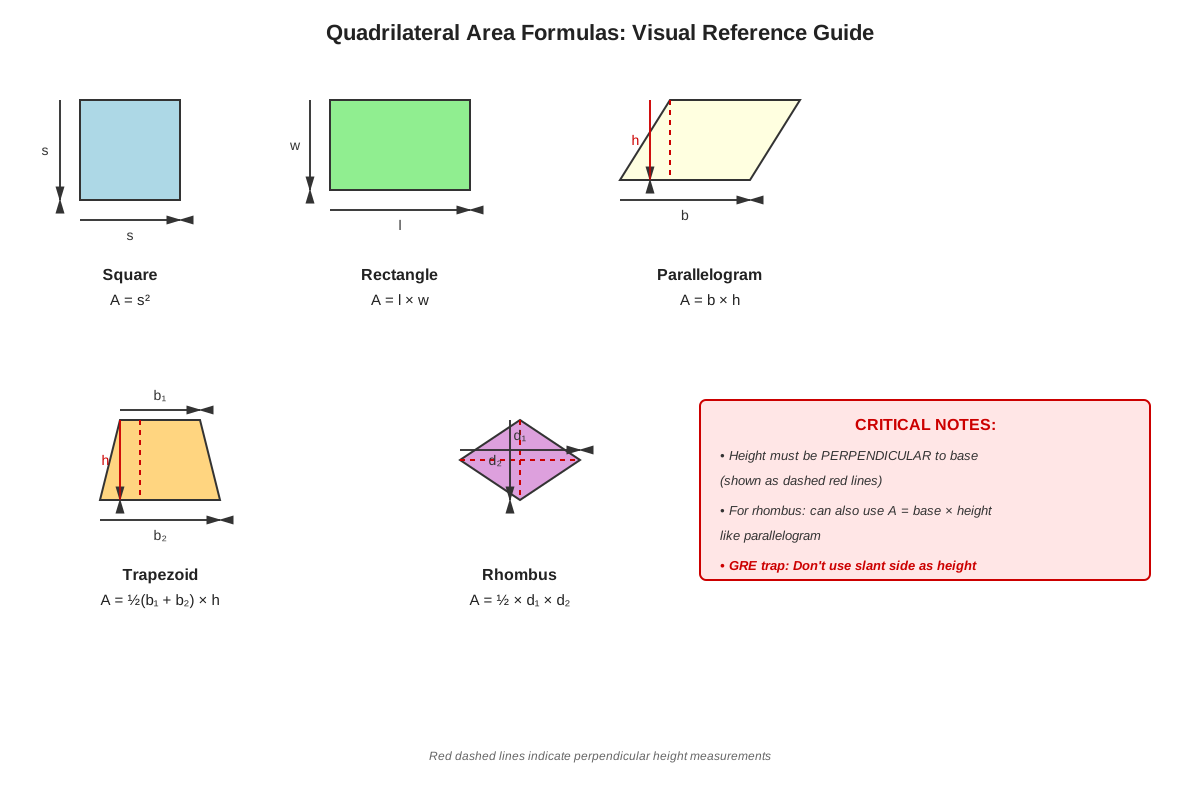
The area formula for a parallelogram is:
Area = base × heightThe height must be measured perpendicular to the base, not along the slanted side. The perimeter equals the sum of all four sides, which simplifies to 2(a + b) where a and b represent the lengths of two adjacent sides.
Rectangles
A rectangle is a special parallelogram where all four angles are right angles (90 degrees). Because rectangles are parallelograms, they inherit all parallelogram properties: opposite sides are parallel and equal, and diagonals bisect each other. Additionally, the diagonals of a rectangle are equal in length, a property that distinguishes rectangles from general parallelograms.
The area formula for a rectangle is:
Area = length × widthThe perimeter formula is:
Perimeter = 2(length + width)When a rectangle is placed on the coordinate plane with sides parallel to the axes, calculating area becomes straightforward by finding the differences in x-coordinates and y-coordinates.
Squares
A square is simultaneously a rectangle (four right angles) and a rhombus (four equal sides), inheriting properties from both. The diagonals of a square are equal in length, perpendicular to each other, and bisect the corner angles, creating four 45-degree angles. Each diagonal divides the square into two congruent isosceles right triangles.
The area formula for a square is:
Area = side²Alternatively, if only the diagonal length d is known:
Area = d²/2The perimeter is simply 4 times the side length. The relationship between the side length s and diagonal d follows from the Pythagorean theorem: d = s√2.
Rhombuses
A rhombus is a parallelogram with all four sides equal in length. While all sides are equal, the angles are not necessarily 90 degrees (if they were, the rhombus would be a square). The diagonals of a rhombus are perpendicular to each other and bisect the corner angles. This perpendicularity property is crucial for area calculations.
The area formula for a rhombus can be expressed in two ways:
Area = base × heightor, using the diagonals d₁ and d₂:
Area = (d₁ × d₂)/2The diagonal formula is particularly useful on the GRE when the problem provides diagonal lengths rather than base and height.
Trapezoids
A trapezoid (called a trapezium in some countries) is a quadrilateral with exactly one pair of parallel sides. The parallel sides are called bases (often labeled b₁ and b₂), while the non-parallel sides are called legs. The height of a trapezoid is the perpendicular distance between the two bases.
The area formula for a trapezoid is:
Area = (b₁ + b₂)/2 × heightThis formula represents the average of the two base lengths multiplied by the height. An isosceles trapezoid is a special trapezoid where the legs are equal in length, resulting in equal base angles and equal diagonals.
Kites
A kite is a quadrilateral with two pairs of consecutive sides that are equal in length. Unlike a rhombus, the opposite sides are not equal. The diagonals of a kite are perpendicular, and one diagonal (the "main diagonal") bisects the other. The main diagonal also bisects the angles at the vertices it connects.
The area formula for a kite uses its diagonals:
Area = (d₁ × d₂)/2This formula is identical to the diagonal-based rhombus formula, reflecting the perpendicular diagonal property both shapes share.
Concept Relationships
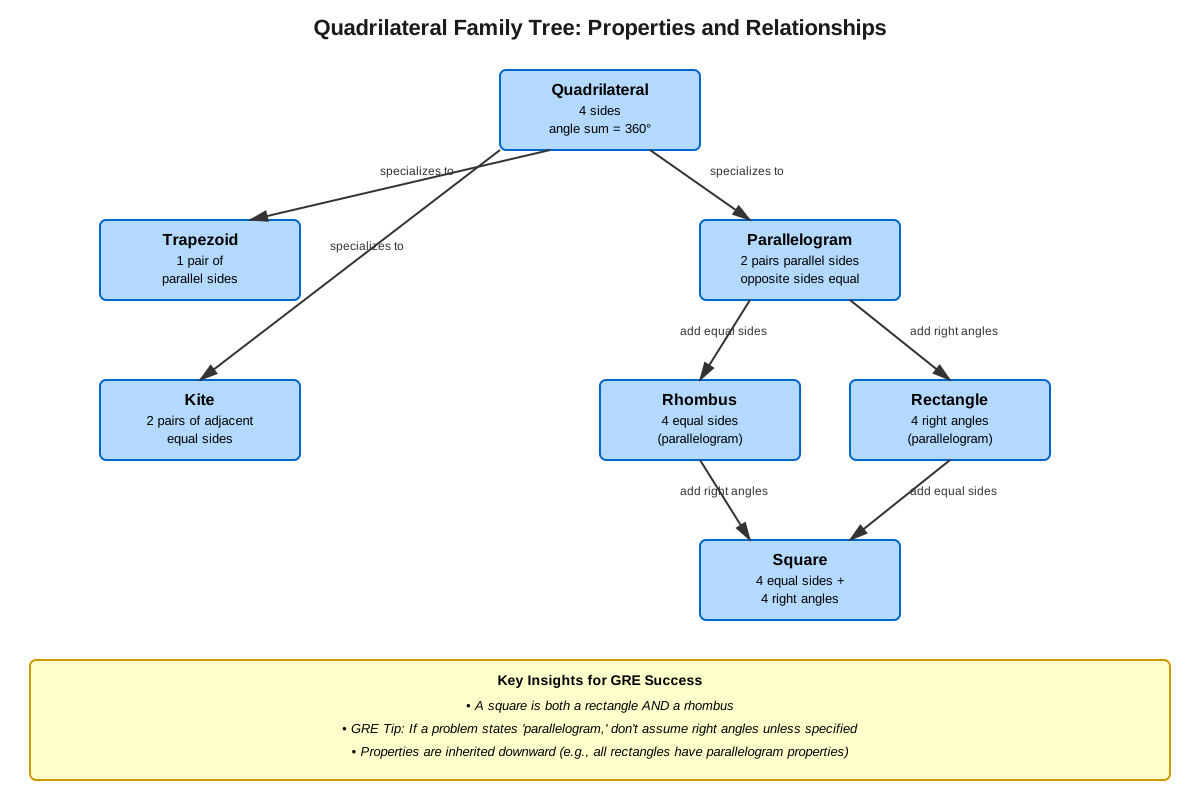
The hierarchy of quadrilaterals forms a logical structure where more specific shapes inherit properties from more general ones. At the broadest level, all quadrilaterals share the 360-degree angle sum property. Parallelograms represent a major category with specific properties (opposite sides parallel and equal), and from parallelograms branch three important special cases: rectangles (adding right angles), rhombuses (adding equal sides), and squares (combining both right angles and equal sides).
This relationship can be mapped as: Quadrilateral → Parallelogram → Rectangle → Square and Quadrilateral → Parallelogram → Rhombus → Square. The square sits at the intersection, possessing all properties of both rectangles and rhombuses.
Trapezoids represent a separate branch from parallelograms, defined by having only one pair of parallel sides rather than two. Isosceles trapezoids add symmetry to the basic trapezoid structure. Kites form another distinct category, defined by consecutive equal sides rather than parallel sides.
Understanding these relationships helps on the GRE because a problem might provide information about a "parallelogram" that actually has additional properties making it a rectangle or square. Recognizing when a shape qualifies for multiple classifications allows application of the most useful properties for solving the problem efficiently. The prerequisite knowledge of triangles connects through the fact that diagonals divide quadrilaterals into triangles, enabling use of triangle properties and the Pythagorean theorem within quadrilateral problems.
Quick check — test yourself on Quadrilaterals so far.
Try Flashcards →High-Yield Facts
⭐ The sum of interior angles in any quadrilateral always equals 360 degrees
⭐ In a parallelogram, opposite sides are equal and parallel, and opposite angles are equal
⭐ The area of a parallelogram equals base times height, where height is perpendicular to the base
⭐ A rectangle has all properties of a parallelogram plus four right angles and equal diagonals
⭐ The area of a trapezoid equals the average of the two bases multiplied by the height: (b₁ + b₂)/2 × h
- A square's diagonal equals the side length multiplied by √2
- In a rhombus, diagonals are perpendicular and bisect each other
- The diagonals of a rectangle are equal in length and bisect each other
- An isosceles trapezoid has equal legs, equal base angles, and equal diagonals
- The area of any quadrilateral with perpendicular diagonals equals (d₁ × d₂)/2
- In a parallelogram, consecutive angles are supplementary (sum to 180 degrees)
- A kite has two pairs of consecutive equal sides and perpendicular diagonals
- The perimeter of any quadrilateral is simply the sum of all four side lengths
Common Misconceptions
Misconception: All quadrilaterals with four equal sides are squares → Correction: A rhombus has four equal sides but does not necessarily have right angles. Only when a rhombus also has right angles (or when a rectangle also has equal sides) does it become a square.
Misconception: The diagonals of all parallelograms are equal in length → Correction: Only rectangles (and squares, which are special rectangles) have equal diagonals. General parallelograms and rhombuses have diagonals of different lengths.
Misconception: The height of a parallelogram or trapezoid is the same as the length of the slanted side → Correction: Height must always be measured perpendicular to the base. The slanted side is typically longer than the height, and using the slanted side length in area calculations produces incorrect results.
Misconception: A trapezoid has two pairs of parallel sides → Correction: A trapezoid has exactly one pair of parallel sides. If both pairs of opposite sides are parallel, the shape is a parallelogram, not a trapezoid.
Misconception: The area formula base × height only works for rectangles → Correction: This formula works for all parallelograms (including rectangles, squares, and rhombuses) as long as the height is measured perpendicular to the chosen base.
Misconception: All properties of a parallelogram apply to trapezoids → Correction: Trapezoids do not have opposite sides equal or opposite angles equal. Only the specific properties of trapezoids (one pair of parallel sides, area formula using average of bases) apply.
Worked Examples
Example 1: Parallelogram with Coordinate Geometry
Problem: A parallelogram has vertices at points A(2, 3), B(7, 3), C(9, 7), and D(4, 7). What is the area of the parallelogram?
Solution:
Step 1: Identify the shape's orientation. Notice that points A and B share the same y-coordinate (3), and points C and D share the same y-coordinate (7). This means AB and CD are horizontal sides.
Step 2: Calculate the base length. The base AB has length = 7 - 2 = 5 units.
Step 3: Calculate the height. Since the sides are horizontal, the height is simply the vertical distance between the parallel sides: height = 7 - 3 = 4 units.
Step 4: Apply the area formula:
Area = base × height = 5 × 4 = 20 square unitsConnection to learning objectives: This problem requires identifying that quadrilaterals are being tested (vertices given on coordinate plane), applying the core parallelogram area formula, and accurately calculating the result. The key strategy is recognizing that when sides are parallel to the axes, calculations become straightforward.
Example 2: Trapezoid with Unknown Height
Problem: A trapezoid has parallel bases of length 8 and 14. The non-parallel sides each have length 5. If the trapezoid is isosceles, what is its area?
Solution:
Step 1: Visualize the trapezoid. Draw the longer base (14) at the bottom and the shorter base (8) at the top. The legs drop down from the ends of the top base to the bottom base.
Step 2: Find the horizontal projection of each leg. The difference in base lengths is 14 - 8 = 6. Since the trapezoid is isosceles, this difference is split equally on both sides: 6/2 = 3 units on each side.
Step 3: Apply the Pythagorean theorem. Each leg forms the hypotenuse of a right triangle with base 3 and unknown height h:
5² = 3² + h²
25 = 9 + h²
h² = 16
h = 4
Step 4: Calculate the area using the trapezoid formula:
Area = (b₁ + b₂)/2 × h = (8 + 14)/2 × 4 = 11 × 4 = 44 square unitsConnection to learning objectives: This problem demonstrates the strategy of combining quadrilateral properties with prerequisite knowledge (Pythagorean theorem). It requires explaining the core rule (trapezoid area formula) and applying it accurately after finding the missing height through multi-step reasoning.
Exam Strategy
When approaching GRE questions involving quadrilaterals, begin by identifying exactly which type of quadrilateral is being described. Look for trigger words such as "parallel sides," "right angles," "equal sides," or "perpendicular diagonals." These phrases indicate which properties apply and which formulas are relevant.
Exam Tip: If a problem describes a quadrilateral with multiple properties (e.g., "a parallelogram with equal diagonals"), recognize that it's actually a more specific shape (in this case, a rectangle). Use the most specific classification to access all applicable properties.
For Quantitative Comparison questions involving quadrilaterals, avoid calculating exact values unless necessary. Instead, compare properties directly. For example, if comparing the area of a square with side 5 to a rectangle with dimensions 4 by 6, recognize that 5² = 25 while 4 × 6 = 24 without performing multiplication.
Process of elimination works effectively when answer choices represent common calculation errors. If you calculate a trapezoid area and your answer isn't listed, check whether you forgot to divide by 2 or whether you used the slanted side instead of the height. Wrong answer choices often reflect these predictable mistakes.
Time allocation for quadrilateral problems should be approximately 1.5-2 minutes for straightforward calculation problems and up to 2.5 minutes for complex multi-step problems involving coordinate geometry or multiple shapes. If a problem requires finding an unknown measurement before calculating area, budget extra time for the preliminary steps.
Watch for problems that provide excess information. The GRE sometimes gives more measurements than necessary to solve the problem, testing whether students can identify which information is relevant. For example, knowing all four side lengths of a rectangle is redundant—only the length and width are needed.
Memory Techniques
PRSQ Hierarchy: Remember the parallelogram family hierarchy with "Parallelogram Rectangle Square" and "Parallelogram Rhombus Square" - the square is where both paths meet.
"All Quadrilaterals Add to 360": The simple rhyme helps recall that interior angles always sum to 360 degrees, regardless of the quadrilateral type.
Diagonal Properties Visualization: Picture a rectangle with equal diagonals forming an "X" where they cross at the center. Now imagine pushing the top to the right—the diagonals become unequal (general parallelogram). Push until the sides become equal—the diagonals become perpendicular (rhombus). This mental animation helps remember which shapes have which diagonal properties.
Trapezoid Area = "Average Base Times Height": Think of the trapezoid formula as finding the "average base" first (add the bases and divide by 2), then multiplying by height. This conceptual understanding prevents formula confusion.
"Right angles = Equal diagonals": For parallelograms, remember that having right angles (rectangle) guarantees equal diagonals, while having equal sides (rhombus) guarantees perpendicular diagonals.
Summary
Quadrilaterals represent a high-yield GRE topic requiring mastery of multiple shape types, their defining properties, and associated formulas. All quadrilaterals share the fundamental property that interior angles sum to 360 degrees. The parallelogram family—including rectangles, squares, and rhombuses—shares properties of opposite sides being parallel and equal, with each specific type adding additional characteristics. Rectangles add right angles and equal diagonals; rhombuses add equal sides and perpendicular diagonals; squares combine all these properties. Trapezoids, defined by exactly one pair of parallel sides, require a different area formula using the average of the bases. Success on GRE quadrilateral questions depends on quickly identifying which type of quadrilateral is being tested, recalling the relevant properties and formulas, and applying them accurately within the context of coordinate geometry, angle relationships, or multi-step problem-solving scenarios.
Key Takeaways
- All quadrilaterals have interior angles summing to 360 degrees, regardless of shape type
- Parallelograms have opposite sides parallel and equal, opposite angles equal, and diagonals that bisect each other
- Area formulas vary by type: base × height for parallelograms, (b₁ + b₂)/2 × h for trapezoids, and (d₁ × d₂)/2 for shapes with perpendicular diagonals
- Squares possess all properties of both rectangles and rhombuses, making them the most constrained quadrilateral
- Height must always be measured perpendicular to the base, not along slanted sides
- Recognizing when a quadrilateral qualifies as a more specific type unlocks additional properties useful for problem-solving
- Coordinate geometry problems often simplify when quadrilateral sides align with the axes
Related Topics
Triangles and the Pythagorean Theorem: Many quadrilateral problems involve dividing shapes into triangles or using the Pythagorean theorem to find heights or diagonal lengths. Mastering quadrilaterals strengthens triangle problem-solving skills.
Coordinate Geometry: Quadrilaterals frequently appear on the coordinate plane, requiring integration of distance formulas, midpoint calculations, and slope concepts with quadrilateral properties.
Polygons: Understanding quadrilaterals provides the foundation for working with polygons having more than four sides, including angle sum formulas and area calculations.
Circles and Inscribed Shapes: Advanced problems may involve quadrilaterals inscribed in or circumscribed around circles, combining quadrilateral properties with circle theorems.
Three-Dimensional Geometry: Rectangular prisms, cubes, and other 3D shapes have faces that are quadrilaterals, making this topic essential for solid geometry problems.
Practice CTA
Now that you've mastered the core concepts, properties, and strategies for GRE quadrilaterals, it's time to reinforce your learning through active practice. Attempt the practice questions to apply these concepts in realistic GRE scenarios, and use the flashcards to ensure instant recall of key formulas and properties. Remember, the difference between knowing quadrilateral properties and scoring points on test day lies in repeated, deliberate practice. You've built a strong foundation—now strengthen it through application!
Sign up free to keep reading
Create a free AnvayaPrep account to finish this GRE guide on Quadrilaterals — plus flashcards and practice questions.