Overview
Similar triangles are one of the most frequently tested geometry concepts on the GRE Quantitative Reasoning section. These are triangles that have the same shape but not necessarily the same size—their corresponding angles are equal, and their corresponding sides are proportional. Understanding similar triangles is crucial because this concept appears not only in standalone geometry problems but also integrates with coordinate geometry, data interpretation, and word problems involving scale, maps, and indirect measurement.
The power of similar triangles lies in their predictability: once you establish that two triangles are similar, you can set up proportions to find unknown side lengths, areas, and other measurements. This makes them invaluable problem-solving tools on the GRE, where time efficiency is paramount. Questions involving GRE similar triangles often test your ability to recognize similarity conditions, set up correct proportions, and manipulate ratios—skills that extend beyond geometry into algebraic reasoning.
Mastering similar triangles creates a foundation for understanding more complex geometric relationships, including trigonometric ratios, area and volume scaling, and coordinate geometry proofs. The topic connects directly to concepts like the Pythagorean theorem, properties of parallel lines, and proportional reasoning—all high-yield areas for GRE success. Given that geometry comprises approximately 15% of GRE Quantitative questions, and similar triangles appear in roughly one-third of those geometry problems, this topic represents a significant scoring opportunity.
Learning Objectives
- [ ] Identify when Similar triangles is being tested
- [ ] Explain the core rule or strategy behind Similar triangles
- [ ] Apply Similar triangles to GRE-style questions accurately
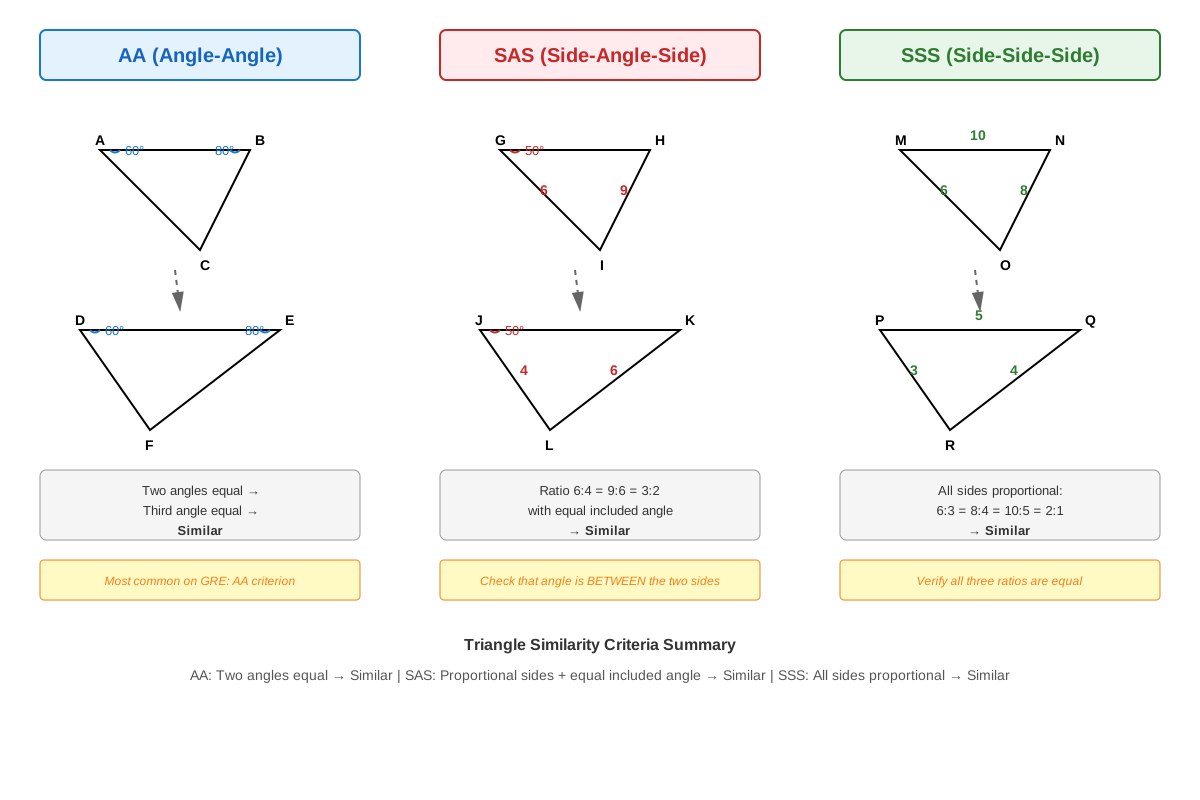
- [ ] Determine triangle similarity using AA (Angle-Angle), SAS (Side-Angle-Side), and SSS (Side-Side-Side) criteria
- [ ] Calculate unknown side lengths using proportional relationships in similar triangles
- [ ] Solve problems involving nested or overlapping similar triangles
- [ ] Apply the relationship between linear scale factors and area ratios in similar triangles
Prerequisites
- Basic triangle properties: Understanding angle sum (180°), triangle inequality, and classification by angles and sides is essential for recognizing when triangles share structural characteristics
- Ratio and proportion: Similar triangles rely entirely on proportional relationships between corresponding sides, requiring fluency with cross-multiplication and ratio simplification
- Angle relationships: Knowledge of vertical angles, corresponding angles with parallel lines, and complementary/supplementary angles helps identify equal angles that establish similarity
- Basic algebra: Setting up and solving equations from proportions requires comfort with variables, cross-multiplication, and algebraic manipulation
Why This Topic Matters
Similar triangles have practical applications far beyond standardized testing. Architects use them to create scale models, surveyors employ them to measure distances indirectly (such as determining building heights using shadows), and engineers apply similarity principles in structural design and computer graphics. Navigation systems, map reading, and even photography rely on similar triangle principles to translate three-dimensional reality into two-dimensional representations.
On the GRE, similar triangles appear in approximately 3-5 questions per test, making them one of the highest-yield geometry topics. They commonly appear in three formats: (1) direct geometry problems asking for side lengths or angle measures, (2) quantitative comparison questions comparing ratios or measurements, and (3) word problems involving indirect measurement, shadows, or scale drawings. The GRE particularly favors problems that combine similar triangles with other concepts—such as coordinate geometry where you must recognize similar triangles formed by lines and axes, or data interpretation problems involving scale factors.
The exam frequently embeds similar triangle problems within more complex scenarios, testing whether students can extract the relevant geometric relationships from diagrams with multiple triangles, parallel lines creating similar triangles, or right triangles sharing an altitude. Recognizing these patterns quickly is essential for time management, as similar triangle problems can often be solved in under 90 seconds once the similarity is identified, but may consume 3+ minutes if approached through more laborious methods.
Core Concepts
Definition and Fundamental Properties
Similar triangles are triangles whose corresponding angles are congruent (equal in measure) and whose corresponding sides are proportional. The symbol for similarity is ~, so if triangle ABC is similar to triangle DEF, we write △ABC ~ △DEF. This notation indicates a specific correspondence: angle A corresponds to angle D, angle B to angle E, and angle C to angle F, while side AB corresponds to side DE, side BC to side EF, and side AC to side DF.
The scale factor (or ratio of similitude) is the constant ratio between corresponding sides of similar triangles. If △ABC ~ △DEF with scale factor k, then AB/DE = BC/EF = AC/DF = k. This proportionality is the key to solving most similar triangle problems on the GRE.
Criteria for Establishing Similarity
Three primary methods establish triangle similarity, each requiring different information:
Angle-Angle (AA) Similarity: If two angles of one triangle are congruent to two angles of another triangle, the triangles are similar. Since the sum of angles in any triangle equals 180°, knowing two angles automatically determines the third, making AA the most efficient similarity criterion. On the GRE, this is the most commonly applicable method, particularly when dealing with parallel lines (which create corresponding angles) or when angle measures are explicitly given.
Side-Side-Side (SSS) Similarity: If the three sides of one triangle are proportional to the three sides of another triangle, the triangles are similar. This requires knowing all six side lengths and verifying that the ratios are equal: AB/DE = BC/EF = AC/DF. This method appears less frequently on the GRE but is crucial for problems where only side lengths are provided.
Side-Angle-Side (SAS) Similarity: If two sides of one triangle are proportional to two sides of another triangle, and the included angles (the angles between those sides) are congruent, the triangles are similar. This criterion requires both measurement types and is occasionally tested in more complex GRE problems.
Setting Up Proportions
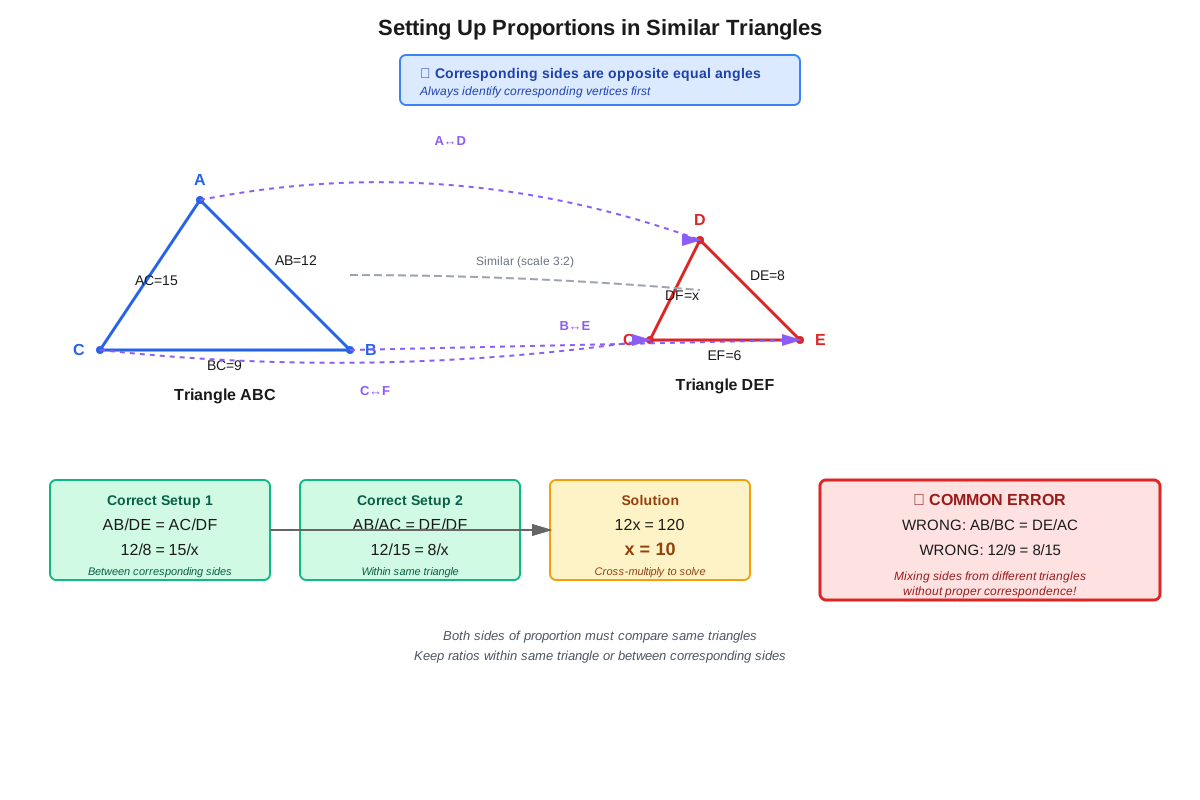
Once similarity is established, solving for unknown lengths requires careful proportion setup. The critical step is maintaining correct correspondence. Consider △ABC ~ △DEF with sides AB = 6, BC = 8, AC = 10 and DE = 9, EF = 12, DF = 15. The scale factor is 9/6 = 12/8 = 15/10 = 3/2.
If a problem provides three known sides and one unknown, set up the proportion using corresponding sides:
AB/DE = BC/EF = AC/DFFor example, if AB = 6, BC = 8, and DE = 9, but EF is unknown:
6/9 = 8/EF
6 × EF = 9 × 8
EF = 72/6 = 12
Common Similar Triangle Configurations
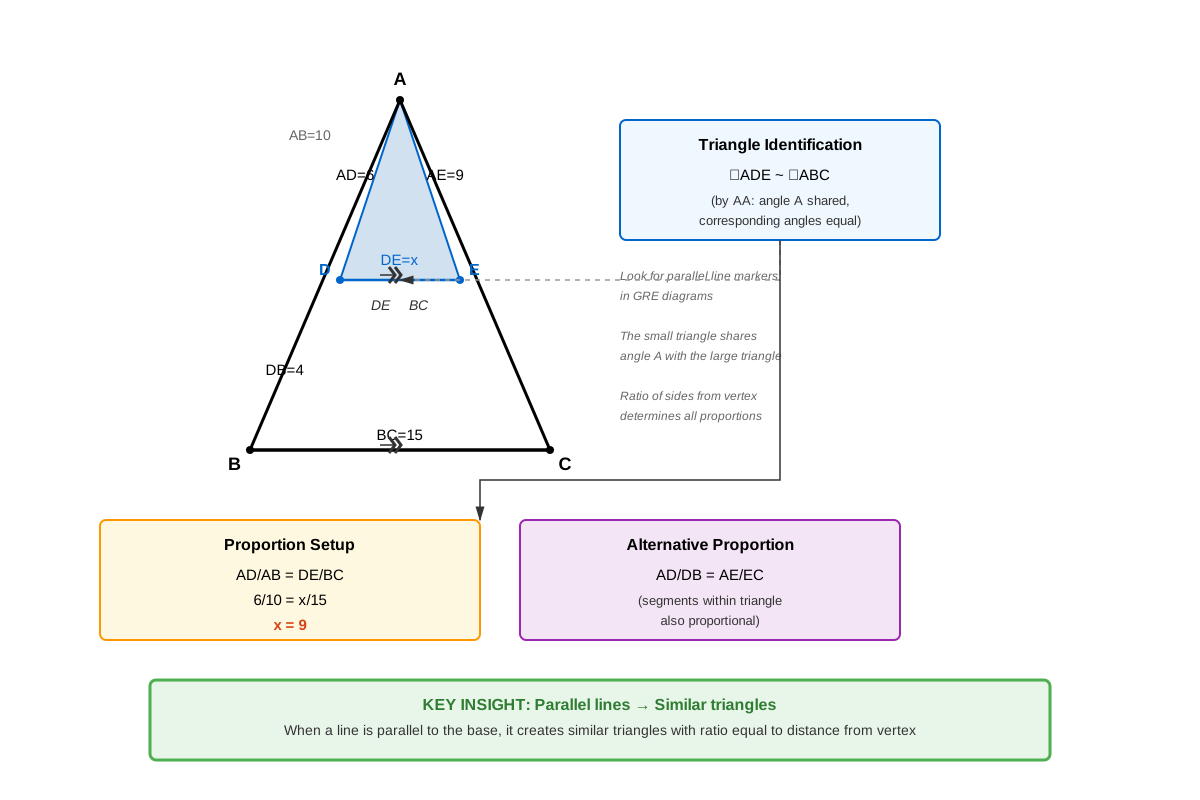
Parallel Lines Creating Similar Triangles: When a line parallel to one side of a triangle intersects the other two sides, it creates a smaller triangle similar to the original. This configuration appears frequently on the GRE. If line DE is parallel to side BC in triangle ABC, then △ADE ~ △ABC.
Triangles Sharing an Angle: When two triangles share a common angle and have another pair of equal angles, they are similar by AA. This often occurs with overlapping triangles or triangles formed by intersecting lines.
Right Triangles with Shared Altitude: When an altitude is drawn from the right angle to the hypotenuse in a right triangle, it creates three similar triangles: the original triangle and the two smaller triangles formed. This is a high-yield configuration that combines similar triangles with the Pythagorean theorem.
Area Relationships in Similar Triangles
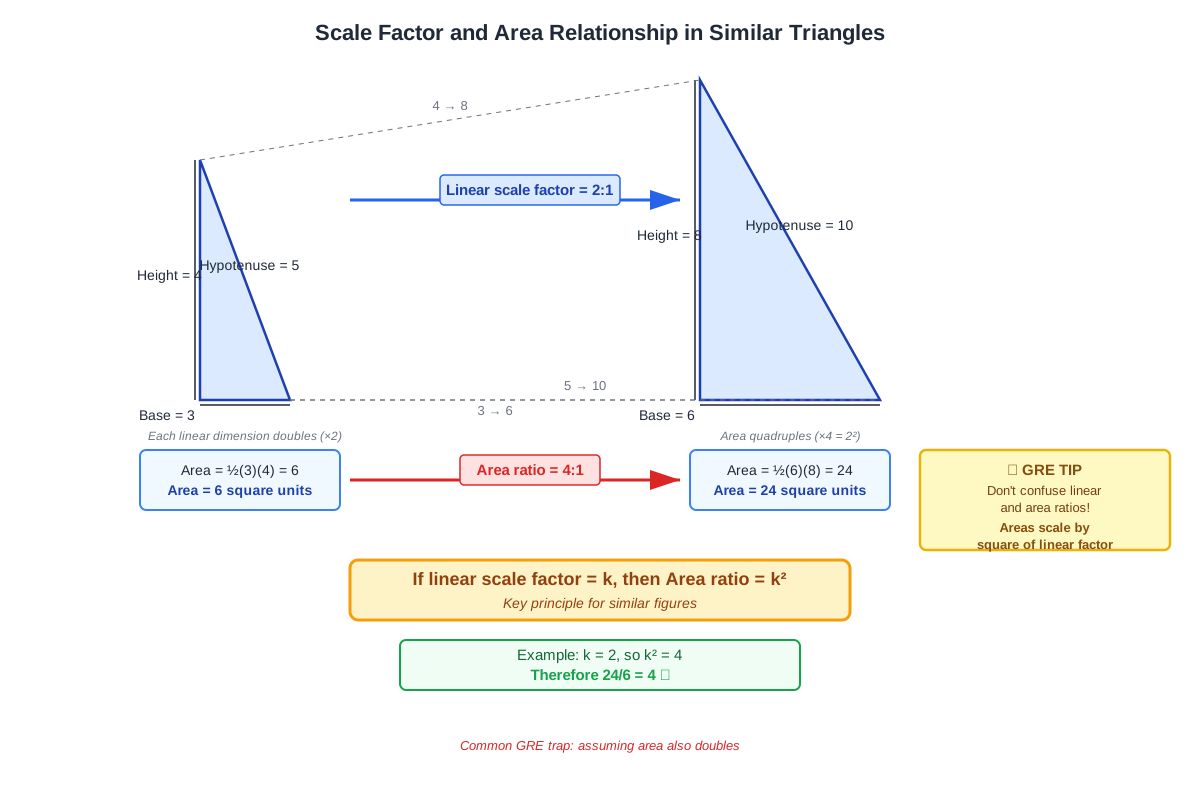
The relationship between areas of similar triangles follows a squared ratio rule. If △ABC ~ △DEF with scale factor k (meaning each side of △ABC is k times the corresponding side of △DEF), then:
Area of △ABC / Area of △DEF = k²This is because area depends on two dimensions (base and height), both of which scale by factor k. For example, if the sides of one triangle are twice the sides of a similar triangle, the area is 2² = 4 times as large. This relationship is frequently tested in GRE quantitative comparison questions.
Nested and Overlapping Triangles
GRE problems often feature multiple similar triangles within a single figure. The key strategy is to identify each pair of similar triangles separately, then combine the information. Look for:
- Triangles sharing a vertex with parallel sides
- Triangles formed by transversals crossing parallel lines
- Triangles created by angle bisectors or medians
- Right triangles subdivided by altitudes
Concept Relationships
Similar triangles serve as a bridge between pure angle geometry and proportional reasoning. The concept flows from fundamental angle relationships → similarity criteria → proportional sides → applications in measurement and area.
Angle relationships (vertical angles, corresponding angles with parallel lines) → establish angle equality → trigger AA similarity → enable proportion setup → solve for unknown measurements
The connection to parallel lines is particularly strong: parallel lines cut by transversals create corresponding angles, which immediately establish similar triangles through AA similarity. This links similar triangles to the broader topic of parallel line properties.
Right triangles form a special subset where similar triangles intersect with the Pythagorean theorem. The altitude-to-hypotenuse configuration creates a system where similar triangles and the Pythagorean theorem work together, enabling solutions to problems that would be intractable using either concept alone.
The scale factor concept connects similar triangles to ratio and proportion throughout mathematics. Understanding that linear measurements scale by factor k while areas scale by k² prepares students for volume scaling (k³) in three-dimensional geometry and provides intuition for dimensional analysis in physics and chemistry.
Similar triangles also connect forward to coordinate geometry, where recognizing similar triangles formed by lines, axes, and points enables efficient calculation of slopes, distances, and areas without resorting to distance formulas or coordinate-based calculations.
High-Yield Facts
⭐ If two angles of one triangle equal two angles of another triangle, the triangles are similar (AA criterion)
⭐ In similar triangles, the ratio of corresponding sides is constant (the scale factor)
⭐ When a line parallel to one side of a triangle intersects the other two sides, it creates a similar triangle
⭐ The ratio of areas of similar triangles equals the square of the scale factor
⭐ In a right triangle, the altitude to the hypotenuse creates three mutually similar triangles
- Corresponding sides in similar triangles must be identified carefully based on angle correspondence, not position
- The scale factor can be expressed as either k or 1/k depending on which triangle is considered the reference
- Similar triangles have equal corresponding angles but not necessarily equal side lengths
- If △ABC ~ △DEF with scale factor 3, then the perimeter of △ABC is also 3 times the perimeter of △DEF
- Two equilateral triangles are always similar to each other, as are any two isosceles right triangles (45-45-90 triangles)
- The symbol ~ means "is similar to" while ≅ means "is congruent to" (same shape and size)
- Vertical angles in intersecting lines often create similar triangles when combined with other angle relationships
Quick check — test yourself on Similar triangles so far.
Try Flashcards →Common Misconceptions
Misconception: Similar triangles must be oriented the same way or have the same size.
Correction: Similar triangles can be rotated, reflected, or scaled to any size. Similarity depends only on angle equality and proportional sides, not orientation or absolute size.
Misconception: If two triangles have one equal angle, they are similar.
Correction: One equal angle is insufficient. You need at least two equal angles (AA), or the appropriate side conditions (SSS or SAS). A single equal angle only guarantees similarity in special cases like right triangles where you know both have a 90° angle and share another angle.
Misconception: The ratio of areas equals the scale factor.
Correction: The ratio of areas equals the square of the scale factor. If sides are in ratio 2:1, areas are in ratio 4:1. This is because area is two-dimensional while length is one-dimensional.
Misconception: Corresponding sides are those in the same position in the diagram.
Correction: Corresponding sides are determined by angle correspondence, not visual position. The side opposite the largest angle in one triangle corresponds to the side opposite the largest angle in the similar triangle, regardless of how the triangles are drawn.
Misconception: All triangles with the same angles are congruent.
Correction: Triangles with the same angles are similar but not necessarily congruent. Congruence requires both equal angles and equal side lengths. Similar triangles have equal angles but proportional (not necessarily equal) sides.
Misconception: Setting up proportions doesn't require careful attention to correspondence.
Correction: Incorrect correspondence is the most common error in similar triangle problems. Always verify that you're comparing corresponding sides: AB/DE = BC/EF, not AB/EF = BC/DE. One way to ensure correctness is to write the proportion with both ratios in the same order (both smallest-to-largest or both in the same positional sequence).
Worked Examples
Example 1: Parallel Lines Creating Similar Triangles
Problem: In triangle ABC, point D lies on side AB and point E lies on side BC such that DE is parallel to AC. If AD = 4, DB = 6, and AC = 15, find the length of DE.
Solution:
Step 1: Identify the similar triangles. Since DE || AC, we know that △BDE ~ △BAC by AA similarity (angle B is shared, and the parallel lines create equal corresponding angles).
Step 2: Determine the scale factor. The total length AB = AD + DB = 4 + 6 = 10. Since D divides AB such that DB = 6, the smaller triangle uses 6 units while the larger uses 10 units. The scale factor from △BAC to △BDE is 6/10 = 3/5.
Step 3: Set up the proportion using corresponding sides:
DE/AC = BD/BA
DE/15 = 6/10
DE = 15 × (6/10)
DE = 15 × 0.6
DE = 9
Step 4: Verify the answer makes sense. Since DE is in the smaller triangle and the scale factor is 3/5, DE should be smaller than AC. Indeed, 9 < 15, and 9/15 = 3/5. ✓
Connection to Learning Objectives: This problem demonstrates identifying similar triangles (parallel line configuration), explaining the strategy (AA similarity from parallel lines), and applying proportions accurately to find unknown lengths.
Example 2: Nested Right Triangles with Altitude
Problem: In right triangle ABC with right angle at C, an altitude is drawn from C to the hypotenuse AB, meeting it at point D. If AD = 4 and DB = 9, find the length of CD.
Solution:
Step 1: Recognize the configuration. When an altitude is drawn from the right angle to the hypotenuse, three similar triangles are created: △ABC ~ △ACD ~ △CBD.
Step 2: Identify which triangles to use. We need CD, which appears in both △ACD and △CBD. We can use the geometric mean relationship: in this configuration, the altitude to the hypotenuse is the geometric mean of the segments it creates.
Step 3: Apply the geometric mean relationship:
CD² = AD × DB
CD² = 4 × 9
CD² = 36
CD = 6
Step 4: Alternative approach using similar triangles. We could also solve this by recognizing △ACD ~ △CBD:
AD/CD = CD/DB
4/CD = CD/9
CD² = 36
CD = 6
Step 5: Verify using the Pythagorean theorem. In △ACD: AC² = AD² + CD² = 16 + 36 = 52, so AC = √52. In △CBD: BC² = CD² + DB² = 36 + 81 = 117, so BC = √117. In △ABC: AB = AD + DB = 13, and AC² + BC² = 52 + 117 = 169 = 13². ✓
Connection to Learning Objectives: This problem illustrates a high-yield similar triangle configuration, demonstrates multiple solution approaches using similarity, and shows how similar triangles integrate with other geometric concepts like the Pythagorean theorem.
Exam Strategy
When approaching GRE similar triangles questions, follow this systematic process:
Step 1: Scan for similarity triggers. Look for these visual and verbal cues:
- Parallel lines (stated explicitly or shown with arrows)
- Shared angles between triangles
- Right triangles with altitudes
- Phrases like "proportional," "scale," "ratio," or "corresponding"
- Multiple triangles in a single figure
Step 2: Establish similarity. Determine which criterion applies (AA is most common). Mark equal angles on your diagram and note which triangles are similar. Write the similarity statement with correct correspondence: △ABC ~ △DEF.
Step 3: Set up proportions carefully. Write out the correspondence explicitly before creating equations. Use the format: "Side opposite angle A / Side opposite angle D = Side opposite angle B / Side opposite angle E."
Step 4: Solve algebraically. Cross-multiply and solve for unknowns. Check that your answer is reasonable given the scale factor.
Exam Tip: In quantitative comparison questions, you often don't need to calculate exact values. If you can determine the scale factor or relationship between quantities, you can compare without solving completely.
Time allocation: Allocate 1.5-2 minutes for straightforward similar triangle problems. If a problem involves nested triangles or combines similarity with other concepts, allow up to 2.5 minutes.
Process of elimination for multiple choice:
- Eliminate answers that violate the scale factor (if one triangle is clearly larger, its sides must all be proportionally larger)
- Eliminate answers where the ratio doesn't match the given information
- Check extreme cases: if the scale factor is 1, triangles are congruent; if very large, one triangle is much bigger
Trigger words and phrases:
- "Parallel to" → likely creates similar triangles
- "Corresponding" → similarity is relevant
- "Proportional" → set up ratios
- "Scale factor," "scale drawing," "model" → similar triangles with given ratio
- "Shadow problems" → similar triangles with sun creating parallel rays
Memory Techniques
AA-SSS-SAS Mnemonic: "All Angles Show Similarity Surely, Sides And Sandwiched angles too" — Remember the three similarity criteria in order of usefulness on the GRE.
Correspondence Checker: Use the phrase "Largest to Largest, Medium to Medium, Smallest to Smallest" (LMS) to remember that corresponding sides are opposite equal angles, ordered by size.
Area Squared Rule: Visualize a square to remember that area ratios are squared. If you double the sides of a triangle, you can fit four of the original triangles inside (2² = 4).
Parallel Lines Similarity: Remember "Parallel Creates Copies" — parallel lines create smaller triangular copies similar to the original.
Altitude to Hypotenuse: The phrase "Three for the price of one" reminds you that drawing an altitude to the hypotenuse in a right triangle creates three similar triangles total.
Proportion Setup: Use the acronym COPS — Corresponding sides, Opposite equal angles, Proportion setup, Solve. This gives you a four-step process for any similar triangle problem.
Summary
Similar triangles are triangles with equal corresponding angles and proportional corresponding sides, making them one of the most powerful problem-solving tools in GRE geometry. The three criteria for establishing similarity—AA (Angle-Angle), SSS (Side-Side-Side), and SAS (Side-Angle-Side)—provide multiple pathways to recognize when triangles share this relationship, with AA being the most frequently applicable on the exam. Once similarity is established, the constant ratio between corresponding sides (the scale factor) enables calculation of unknown lengths through proportions. Critical configurations include parallel lines creating similar triangles, right triangles with altitudes to the hypotenuse, and nested or overlapping triangles. The relationship between linear scale factor k and area ratio k² is frequently tested in quantitative comparisons. Success with similar triangles requires careful identification of corresponding parts, accurate proportion setup, and recognition of how similarity integrates with other geometric concepts like parallel lines, angle relationships, and the Pythagorean theorem. Mastering this topic provides both direct scoring opportunities and enhanced efficiency on complex multi-concept problems.
Key Takeaways
- Similar triangles have equal corresponding angles and proportional corresponding sides; the constant ratio is the scale factor
- AA similarity is the most efficient criterion: two equal angles guarantee similarity and appear most frequently on the GRE
- Parallel lines create similar triangles: when a line is parallel to one side of a triangle, it forms a smaller similar triangle
- Corresponding sides must be identified by angle correspondence, not by position in the diagram; always verify which sides are opposite equal angles
- Area ratios equal the square of the scale factor: if sides are in ratio k, areas are in ratio k²
- The altitude-to-hypotenuse configuration in right triangles creates three mutually similar triangles, enabling powerful solution strategies
- Careful proportion setup is essential: write out the correspondence explicitly before creating equations to avoid the most common error
Related Topics
Coordinate Geometry and Similar Triangles: Similar triangles frequently appear in coordinate plane problems where lines, axes, and points create triangular configurations. Mastering similar triangles enables efficient calculation of slopes and areas without relying solely on formulas.
Trigonometry and Similar Triangles: Trigonometric ratios (sine, cosine, tangent) are fundamentally based on similar right triangles. Understanding similarity provides the conceptual foundation for why these ratios remain constant for a given angle.
Three-Dimensional Geometry and Scaling: The principles of similar triangles extend to similar solids, where linear dimensions scale by k, surface areas by k², and volumes by k³. This topic builds directly on two-dimensional similarity.
Pythagorean Theorem Applications: Many advanced Pythagorean theorem problems involve similar triangles, particularly the altitude-to-hypotenuse configuration. These topics are frequently tested together.
Ratio and Proportion in Word Problems: Similar triangles provide geometric applications of ratio reasoning, reinforcing proportional thinking that applies across quantitative reasoning topics.
Practice CTA
Now that you've mastered the core concepts of similar triangles, it's time to solidify your understanding through active practice. Work through the practice questions to apply these strategies under test-like conditions, and use the flashcards to reinforce the high-yield facts and similarity criteria. Remember: recognizing similar triangle configurations quickly is a skill that improves dramatically with deliberate practice. Each problem you solve builds pattern recognition that will save you valuable time on test day. You've built a strong foundation—now transform that knowledge into automatic, confident problem-solving ability!
Sign up free to keep reading
Create a free AnvayaPrep account to finish this GRE guide on Similar triangles — plus flashcards and practice questions.