Overview
The equation of a line is one of the most fundamental and frequently tested concepts in GRE Quantitative Reasoning. This topic encompasses understanding how to represent linear relationships algebraically, interpret the meaning of slope and intercepts, and manipulate different forms of linear equations to solve problems efficiently. Mastery of this topic is essential because linear equations appear not only in dedicated geometry questions but also in data interpretation, word problems, and coordinate geometry scenarios throughout the exam.
On the GRE, questions involving the GRE equation of a line test both conceptual understanding and computational fluency. Students must recognize when a problem involves linear relationships, choose the most efficient form of the equation to work with, and extract meaningful information from graphs or algebraic expressions. The ability to quickly convert between different forms of linear equations—slope-intercept, point-slope, and standard form—often determines whether a student can solve these problems within the tight time constraints of the exam.
This topic serves as a bridge between pure algebra and coordinate geometry, connecting concepts like slope, distance, and graphical interpretation. Understanding linear equations provides the foundation for more advanced topics including systems of equations, inequalities in the coordinate plane, and even certain data interpretation questions where trend lines must be analyzed. The versatility of this topic makes it one of the highest-yield areas for GRE preparation, appearing in approximately 10-15% of all Quantitative Reasoning questions.
Learning Objectives
- [ ] Identify when Equation of a line is being tested
- [ ] Explain the core rule or strategy behind Equation of a line
- [ ] Apply Equation of a line to GRE-style questions accurately
- [ ] Convert fluently between slope-intercept, point-slope, and standard forms of linear equations
- [ ] Determine the equation of a line given two points, a point and slope, or graphical information
- [ ] Interpret the geometric meaning of slope, y-intercept, and x-intercept in context
- [ ] Recognize parallel and perpendicular lines through their equations
Prerequisites
- Basic algebraic manipulation: Ability to solve for variables, distribute terms, and simplify expressions is essential for converting between equation forms and isolating variables
- Coordinate plane fundamentals: Understanding ordered pairs (x, y), plotting points, and the four quadrants enables visualization of linear equations
- Slope concept: Familiarity with rise over run and the meaning of positive, negative, zero, and undefined slopes provides the foundation for understanding line behavior
- Fraction operations: Proficiency with adding, subtracting, multiplying, and dividing fractions is necessary since slopes are often expressed as fractions
Why This Topic Matters
Linear equations model countless real-world phenomena, from calculating rates of change in business contexts to predicting trends in scientific data. In practical applications, understanding linear relationships helps in analyzing cost structures, determining break-even points, projecting growth patterns, and interpreting statistical correlations. The ability to work with linear equations translates directly to data literacy skills valued across professional fields.
On the GRE specifically, equation of a line questions appear with high frequency—typically 2-4 questions per exam section. These questions manifest in multiple formats: pure coordinate geometry problems asking for specific equation forms, word problems requiring translation of verbal descriptions into linear equations, data interpretation questions involving trend analysis, and quantitative comparison questions testing conceptual understanding of slope and intercepts. The topic's versatility means it can appear in both discrete quantitative questions and as part of more complex multi-step problems.
Common exam presentations include: determining whether a point lies on a given line, finding where two lines intersect, identifying parallel or perpendicular lines, calculating the area of regions bounded by lines and axes, and interpreting the meaning of slope in context (such as rate of change in word problems). The GRE particularly favors questions that test conceptual understanding over rote computation, such as asking how changing one parameter affects the graph or comparing slopes without calculating exact values.
Core Concepts
Forms of Linear Equations
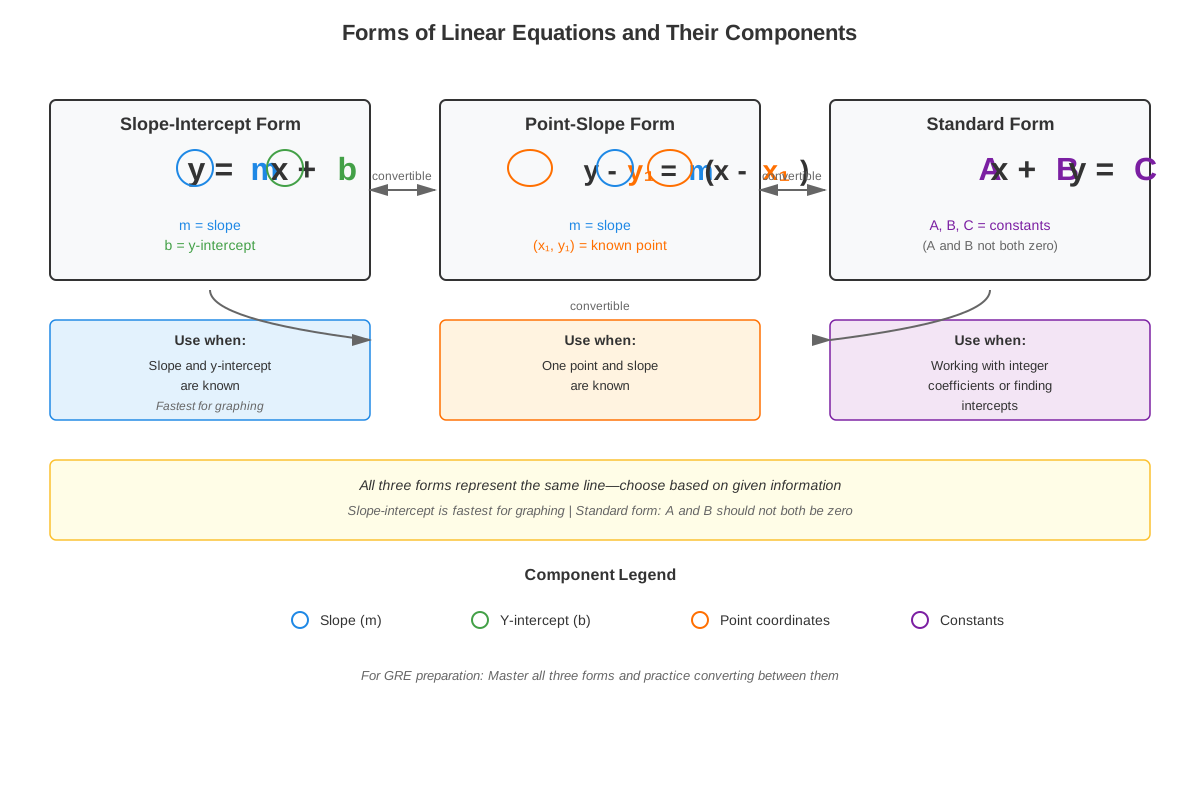
The equation of a line can be expressed in several standard forms, each offering distinct advantages depending on the problem context.
Slope-intercept form is expressed as y = mx + b, where m represents the slope (rate of change) and b represents the y-intercept (the y-coordinate where the line crosses the y-axis). This form is most useful when you need to quickly identify the slope and y-intercept or when graphing a line. For example, the equation y = 3x - 5 immediately tells us the line has a slope of 3 and crosses the y-axis at (0, -5).
Point-slope form is written as y - y₁ = m(x - x₁), where m is the slope and (x₁, y₁) is a known point on the line. This form is particularly efficient when you're given a point and a slope, or when you need to find the equation using two points (after calculating the slope). For instance, if a line passes through (2, 7) with slope 4, the equation is immediately y - 7 = 4(x - 2).
Standard form appears as Ax + By = C, where A, B, and C are integers and A is typically non-negative. This form is useful for finding both intercepts quickly and is the preferred form for certain algebraic manipulations. The equation 3x + 4y = 12 is in standard form and allows easy calculation of intercepts by setting x or y to zero.
Calculating Slope
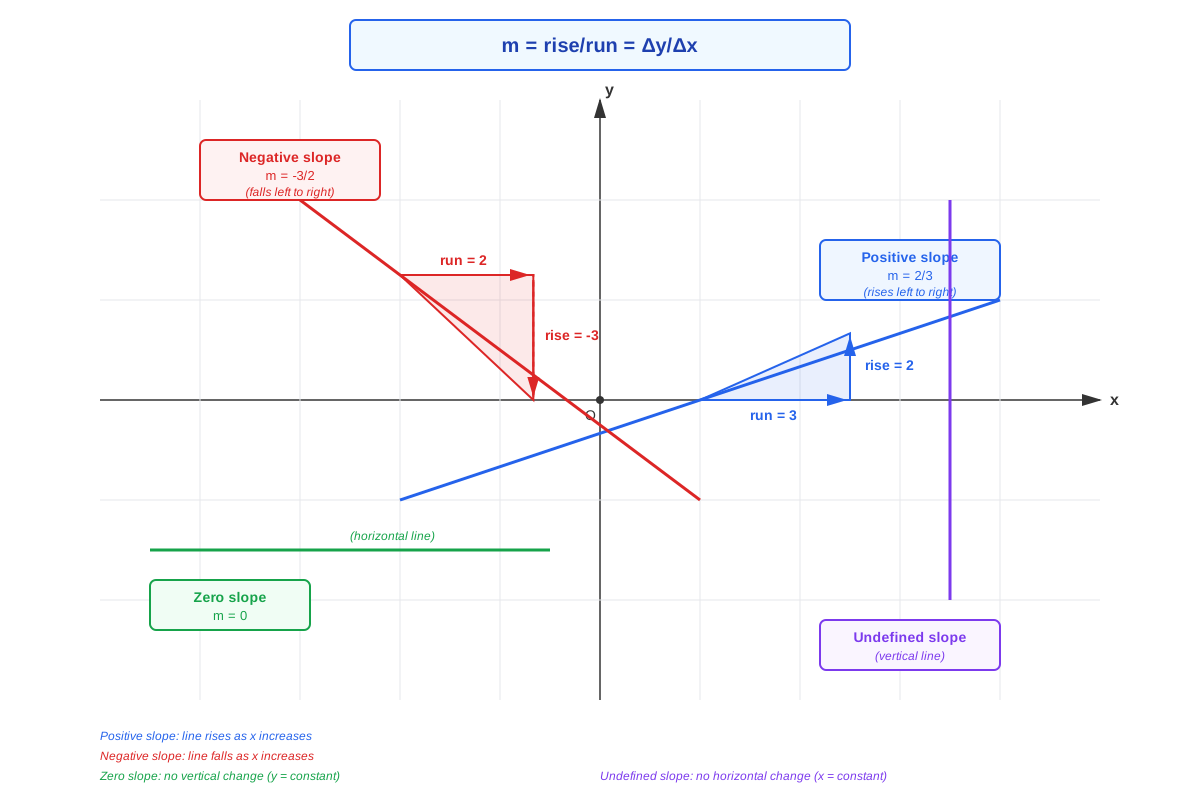
The slope of a line measures its steepness and direction, calculated as the ratio of vertical change to horizontal change. Given two points (x₁, y₁) and (x₂, y₂), the slope formula is:
m = (y₂ - y₁)/(x₂ - x₁)The numerator represents the rise (vertical change) and the denominator represents the run (horizontal change). A positive slope indicates the line rises from left to right, while a negative slope indicates it falls. A slope of zero describes a horizontal line (no vertical change), and an undefined slope describes a vertical line (no horizontal change, making the denominator zero).
For example, finding the slope between points (1, 3) and (5, 11):
m = (11 - 3)/(5 - 1) = 8/4 = 2
This slope of 2 means for every 1 unit moved right, the line rises 2 units.
Finding Equations from Given Information
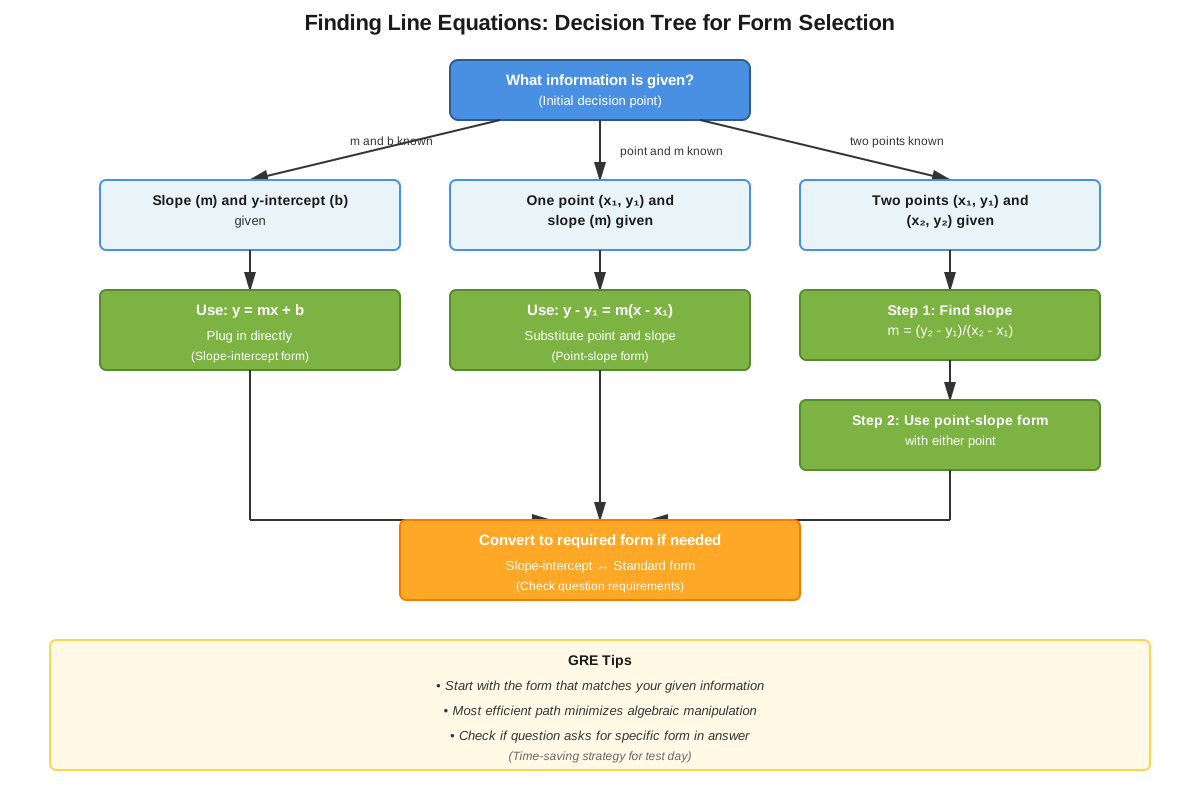
| Given Information | Most Efficient Approach | Example |
|---|---|---|
| Slope and y-intercept | Use slope-intercept form directly | m = 2, b = -3 → y = 2x - 3 |
| Point and slope | Use point-slope form, then convert if needed | Point (4, 5), m = -1 → y - 5 = -1(x - 4) |
| Two points | Calculate slope first, then use point-slope | (1, 2) and (3, 8) → m = 3, then y - 2 = 3(x - 1) |
| x-intercept and y-intercept | Use intercept form or standard form | x-int = 4, y-int = 3 → x/4 + y/3 = 1 |
When given two points, the systematic approach is:
- Calculate the slope using the slope formula
- Substitute the slope and one point into point-slope form
- Simplify to slope-intercept form if required
Parallel and Perpendicular Lines
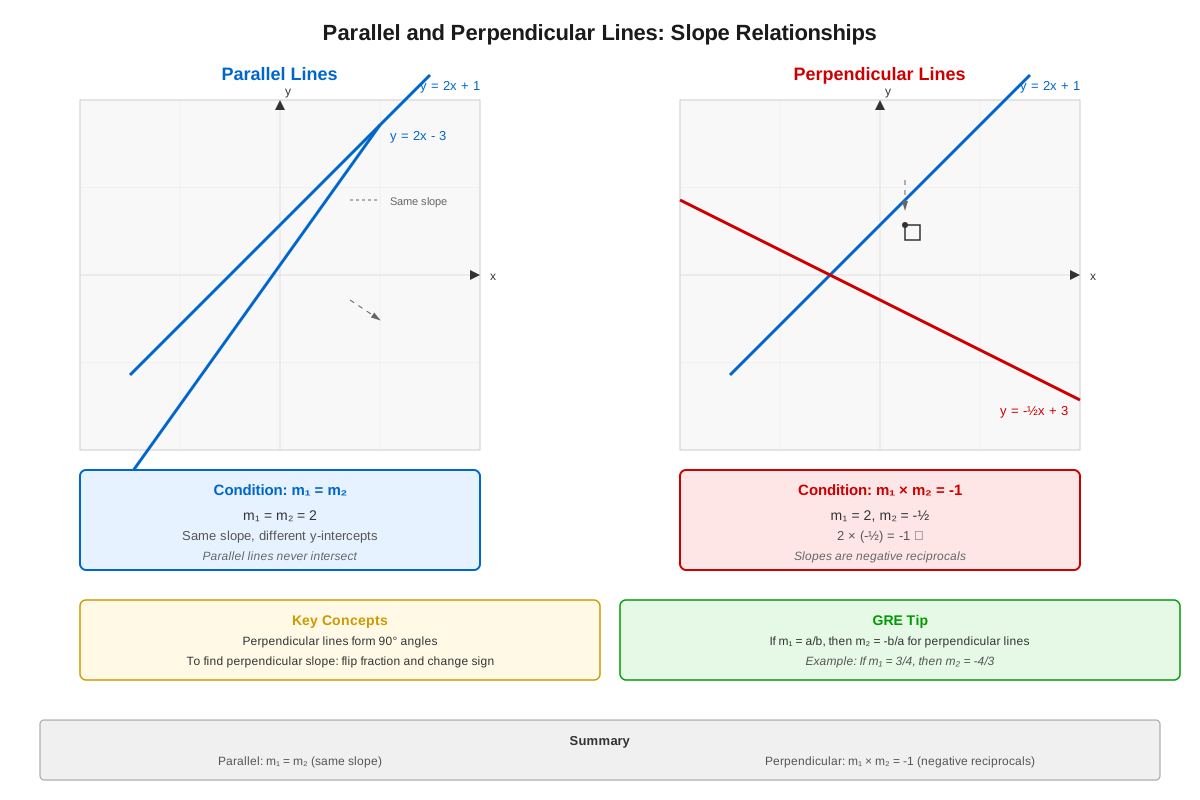
Parallel lines never intersect and have identical slopes. If line 1 has equation y = m₁x + b₁ and line 2 has equation y = m₂x + b₂, the lines are parallel if and only if m₁ = m₂ (and b₁ ≠ b₂, otherwise they're the same line).
Perpendicular lines intersect at right angles, and their slopes are negative reciprocals. Lines are perpendicular if m₁ × m₂ = -1, or equivalently, m₂ = -1/m₁. For example, a line with slope 3/4 is perpendicular to any line with slope -4/3.
Special cases include:
- Horizontal lines (slope = 0) are perpendicular to vertical lines (undefined slope)
- Any horizontal line is parallel to every other horizontal line
- Any vertical line is parallel to every other vertical line
Intercepts
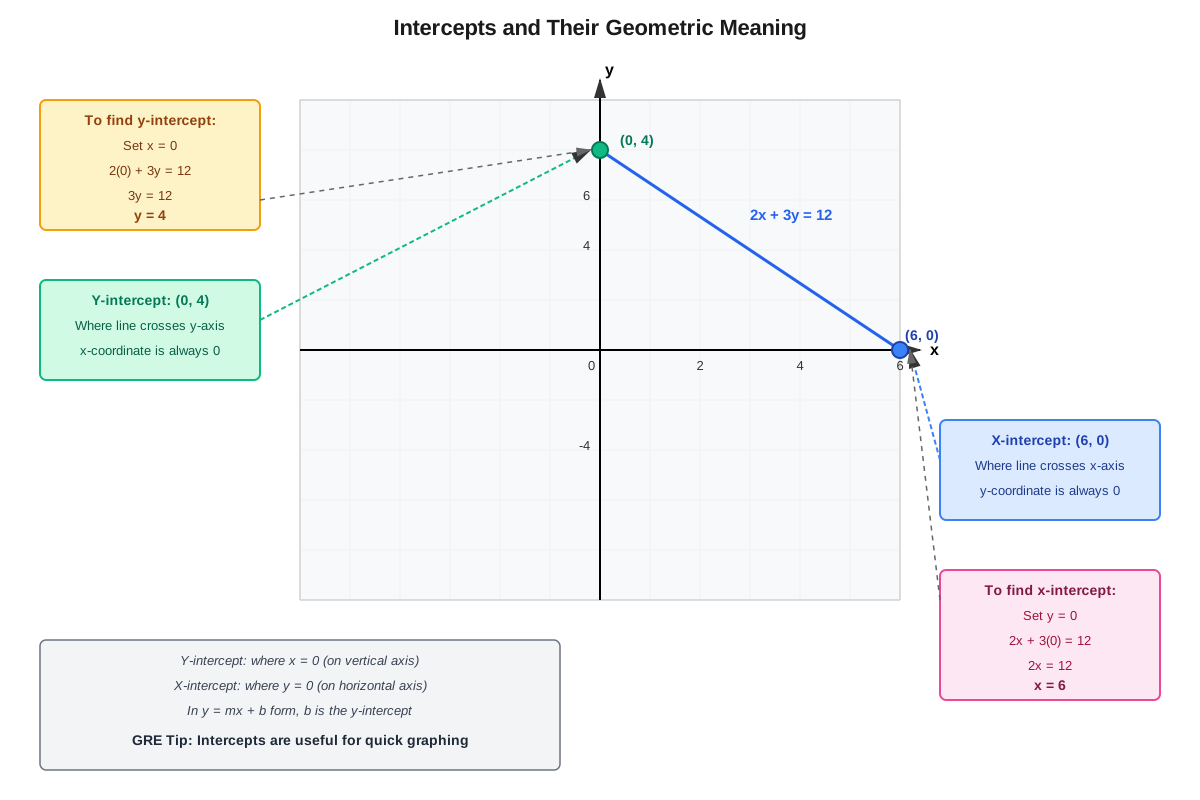
The x-intercept is the point where the line crosses the x-axis (where y = 0). To find it, set y = 0 in the equation and solve for x.
The y-intercept is the point where the line crosses the y-axis (where x = 0). To find it, set x = 0 in the equation and solve for y.
For the equation 2x + 3y = 12:
- x-intercept: Set y = 0 → 2x = 12 → x = 6, giving point (6, 0)
- y-intercept: Set x = 0 → 3y = 12 → y = 4, giving point (0, 4)
Understanding intercepts is crucial for graphing lines quickly and for solving word problems where intercepts have meaningful interpretations (such as initial values or break-even points).
Concept Relationships
The various forms of linear equations are interconnected through algebraic manipulation. Slope-intercept form serves as the central hub, as it's the most intuitive for visualization and the target form for most conversions. Point-slope form naturally leads to slope-intercept form through distribution and simplification, while standard form can be converted to slope-intercept form by isolating y.
The slope concept is fundamental to all equation forms and directly connects to the geometric interpretation of lines. Slope determines whether lines are parallel (equal slopes) or perpendicular (negative reciprocal slopes), creating a bridge between algebraic and geometric reasoning. The calculation of slope from two points feeds into the point-slope form, which then can be expanded into any other form.
Intercepts emerge naturally from any equation form by strategic substitution (setting x or y to zero). These intercepts provide anchor points for graphing and connect to the broader coordinate geometry concept of points on the plane. The relationship between intercepts and standard form is particularly elegant, as standard form Ax + By = C yields intercepts of C/A and C/B respectively.
The conceptual flow follows this pattern:
Two Points → Slope Calculation → Point-Slope Form → Slope-Intercept Form → Graphical Representation
↓
Standard Form → Intercepts
This interconnected web means that mastering conversions between forms and understanding the geometric meaning of algebraic parameters enables flexible problem-solving approaches on the GRE.
Quick check — test yourself on Equation of a line so far.
Try Flashcards →High-Yield Facts
⭐ The slope-intercept form y = mx + b immediately reveals slope (m) and y-intercept (b)
⭐ Parallel lines have equal slopes; perpendicular lines have slopes that are negative reciprocals
⭐ The slope formula m = (y₂ - y₁)/(x₂ - x₁) works for any two distinct points on a line
⭐ A horizontal line has slope 0 and equation y = k; a vertical line has undefined slope and equation x = k
⭐ To find the x-intercept, set y = 0; to find the y-intercept, set x = 0
- Point-slope form y - y₁ = m(x - x₁) is the fastest way to write an equation when given a point and slope
- Standard form Ax + By = C is useful for finding both intercepts quickly
- The product of perpendicular slopes always equals -1 (except for horizontal/vertical pairs)
- A line with positive slope rises from left to right; negative slope falls from left to right
- Two lines with the same slope and different y-intercepts are parallel and never intersect
- The slope represents the rate of change: how much y changes for each unit change in x
- Converting from standard form to slope-intercept form requires solving for y: y = (-A/B)x + (C/B)
Common Misconceptions
Misconception: The slope formula can be applied in any order without attention to which point is first.
Correction: While you can designate either point as (x₁, y₁), you must be consistent—if you use y₂ - y₁ in the numerator, you must use x₂ - x₁ in the denominator. Mixing the order (like (y₂ - y₁)/(x₁ - x₂)) produces the negative of the correct slope.
Misconception: The y-intercept is the value of x when y = 0.
Correction: The y-intercept is the value of y when x = 0. It's the point where the line crosses the y-axis. The x-intercept is where y = 0. These are frequently confused, leading to incorrect interpretations.
Misconception: A steeper line always has a larger slope value.
Correction: Steepness relates to the absolute value of the slope. A line with slope -5 is steeper than a line with slope 2, even though -5 < 2. When comparing steepness, compare |m₁| and |m₂|.
Misconception: Perpendicular lines have slopes that are opposite in sign.
Correction: Perpendicular lines have slopes that are negative reciprocals, not just opposite signs. A line with slope 3 is perpendicular to a line with slope -1/3, not -3. The relationship is m₁ × m₂ = -1.
Misconception: The equation y = 5 represents a vertical line.
Correction: The equation y = 5 represents a horizontal line where every point has y-coordinate 5. Vertical lines have equations of the form x = k, where every point has the same x-coordinate. This confusion stems from mixing up which variable is constant.
Misconception: In standard form Ax + By = C, the coefficients must be in lowest terms.
Correction: While it's conventional to reduce coefficients to lowest terms and make A positive, any multiple of a standard form equation represents the same line. The equations 2x + 4y = 6 and x + 2y = 3 represent identical lines.
Worked Examples
Example 1: Finding an Equation from Two Points
Problem: Find the equation of the line passing through points (2, -3) and (6, 5). Express your answer in slope-intercept form.
Solution:
Step 1: Calculate the slope using the slope formula.
m = (y₂ - y₁)/(x₂ - x₁) = (5 - (-3))/(6 - 2) = 8/4 = 2Step 2: Use point-slope form with either point. Using (2, -3):
y - (-3) = 2(x - 2)
y + 3 = 2(x - 2)
Step 3: Distribute and simplify to slope-intercept form:
y + 3 = 2x - 4
y = 2x - 7Verification: Check that both original points satisfy this equation:
- Point (2, -3): y = 2(2) - 7 = 4 - 7 = -3 ✓
- Point (6, 5): y = 2(6) - 7 = 12 - 7 = 5 ✓
This example demonstrates the standard workflow for the most common GRE question type involving equations of lines. The systematic approach—calculate slope, apply point-slope form, convert to slope-intercept form—works reliably under time pressure.
Example 2: Parallel and Perpendicular Lines
Problem: Line L has equation 3x - 4y = 12.
(a) Find the equation of a line parallel to L that passes through point (0, 5).
(b) Find the equation of a line perpendicular to L that passes through point (4, 1).
Solution:
First, convert line L to slope-intercept form to identify its slope:
3x - 4y = 12
-4y = -3x + 12
y = (3/4)x - 3
So line L has slope m = 3/4.
(a) Parallel line:
Parallel lines have equal slopes, so our line has slope m = 3/4.
Using point-slope form with point (0, 5):
y - 5 = (3/4)(x - 0)
y = (3/4)x + 5
(b) Perpendicular line:
Perpendicular lines have slopes that are negative reciprocals.
The negative reciprocal of 3/4 is -4/3.
Using point-slope form with point (4, 1):
y - 1 = (-4/3)(x - 4)
y - 1 = (-4/3)x + 16/3
y = (-4/3)x + 16/3 + 1
y = (-4/3)x + 19/3
This example addresses Learning Objective 7 (recognizing parallel and perpendicular lines) and demonstrates the importance of first converting to slope-intercept form to easily identify the slope, then applying the parallel/perpendicular relationships.
Exam Strategy
When approaching GRE equation of a line questions, first identify what information is given and what form would be most efficient for the solution. If the question provides a graph, extract coordinates of clear points (especially intercepts) rather than trying to estimate slope visually. If given an equation in standard form but asked about slope or y-intercept, immediately convert to slope-intercept form.
Trigger words and phrases that signal equation of a line questions include:
- "What is the slope of the line..."
- "Which equation represents..."
- "A line passes through points..."
- "Parallel to" or "perpendicular to"
- "x-intercept" or "y-intercept"
- "Rate of change" (in word problems)
- "For every increase of..."
For quantitative comparison questions, avoid unnecessary calculation. If comparing slopes, you may be able to determine the relationship by observing whether lines rise or fall, or by comparing rise/run ratios without computing exact values. If comparing y-intercepts, look at where lines cross the y-axis on a graph rather than solving algebraically.
Process of elimination is particularly effective when answer choices are given in different forms. Quickly eliminate options with incorrect slopes or intercepts. For example, if you know a line has positive slope, immediately eliminate any answer choices showing negative slopes. If a line must pass through a specific point, substitute that point's coordinates into each answer choice—only the correct equation will satisfy the point.
Time allocation: Most equation of a line questions should take 60-90 seconds. If you find yourself doing extensive algebraic manipulation, reconsider whether there's a more direct approach. For questions involving two points, don't waste time converting to standard form unless specifically requested—slope-intercept form is usually sufficient and faster to obtain.
Exam Tip: When finding equations from two points, use the point with simpler coordinates (like one with a zero) in your point-slope form to minimize arithmetic errors.
Memory Techniques
Slope-Intercept Mnemonic: "y = mx + b" can be remembered as "You Must Xamine Before" to recall the order of variables and parameters.
Parallel vs. Perpendicular: Think "Parallel = Product is Positive (same slopes)" and "Perpendicular = Product is Negative one (slopes multiply to -1)."
Intercept Memory: "X-intercept: X-out the y (set y = 0)" and "Y-intercept: Yank out the x (set x = 0)."
Slope Direction: Visualize a skier: positive slope = skiing downhill from left to right (going up on the graph), negative slope = skiing downhill from right to left (going down on the graph).
Negative Reciprocal: For perpendicular slopes, remember "flip and negate"—flip the fraction (reciprocal) and change the sign (negative). So 2/3 becomes -3/2.
Form Selection Acronym - SIP:
- Slope-intercept: for Seeing slope and intercept quickly
- Intermediate (point-slope): for Initial equation writing
- Plain (standard): for Practical intercept finding
Summary
The equation of a line is a cornerstone topic in GRE Quantitative Reasoning, requiring fluency with multiple equation forms and the ability to convert between them efficiently. The three primary forms—slope-intercept (y = mx + b), point-slope (y - y₁ = m(x - x₁)), and standard (Ax + By = C)—each serve specific purposes, with slope-intercept being most useful for quick interpretation and graphing. Mastery requires understanding that slope measures rate of change and steepness, that parallel lines share identical slopes while perpendicular lines have slopes that are negative reciprocals, and that intercepts are found by strategic substitution of zero. Success on GRE questions demands not just computational accuracy but also conceptual understanding of how changing parameters affects the line's position and orientation, the ability to extract information from graphs efficiently, and recognition of when linear relationships appear in word problems and data interpretation contexts. The systematic approach of identifying given information, selecting the most efficient form, and converting as needed provides a reliable framework for solving these high-frequency questions within the exam's time constraints.
Key Takeaways
- The slope-intercept form y = mx + b is the most versatile for quick interpretation, revealing both slope and y-intercept immediately
- Calculate slope from two points using m = (y₂ - y₁)/(x₂ - x₁), maintaining consistent point order
- Parallel lines have equal slopes (m₁ = m₂); perpendicular lines have slopes that multiply to -1 (m₁ × m₂ = -1)
- Find intercepts by substituting zero: x-intercept when y = 0, y-intercept when x = 0
- Point-slope form is most efficient when given a point and slope or when working with two points
- Horizontal lines have slope 0 and equations y = k; vertical lines have undefined slope and equations x = k
- Converting between forms through algebraic manipulation is a core skill that enables flexible problem-solving
Related Topics
Systems of Linear Equations: Building on single-line equations, systems involve finding where two or more lines intersect, requiring techniques like substitution and elimination. Mastering equation of a line provides the foundation for understanding when systems have one solution (intersecting lines), no solution (parallel lines), or infinitely many solutions (identical lines).
Inequalities in the Coordinate Plane: Linear inequalities extend the concept of linear equations to regions rather than lines, involving shading and boundary line determination. Understanding equation of a line is essential for identifying boundary lines and testing points.
Distance and Midpoint Formulas: These coordinate geometry concepts work hand-in-hand with linear equations, as finding the equation of a perpendicular bisector requires both midpoint calculation and perpendicular slope determination.
Functions and Their Graphs: Linear equations represent the simplest class of functions, and understanding their behavior provides the foundation for analyzing more complex functions including quadratics, exponentials, and absolute value functions.
Practice CTA
Now that you've mastered the core concepts of equations of lines, it's time to solidify your understanding through active practice. Work through the practice questions to apply these strategies under test-like conditions, and use the flashcards to reinforce the key formulas and relationships until they become automatic. Remember, the GRE rewards both accuracy and speed—consistent practice with these high-yield concepts will build the confidence and fluency you need to excel on test day. Every problem you solve strengthens your pattern recognition and deepens your conceptual understanding, bringing you closer to your target score.
Sign up free to keep reading
Create a free AnvayaPrep account to finish this GRE guide on Equation of a line — plus flashcards and practice questions.