Overview
The coordinate plane is a fundamental framework in geometry that allows for the precise representation of points, lines, and shapes using numerical coordinates. On the GRE, mastery of the GRE coordinate plane is essential because it appears in approximately 15-20% of Quantitative Reasoning questions, either as the primary focus or as a tool for solving more complex geometric problems. Understanding the coordinate plane enables test-takers to visualize algebraic relationships, calculate distances and slopes, determine midpoints, and analyze geometric figures with precision and efficiency.
The coordinate plane serves as a bridge between algebra and geometry, making it one of the most versatile topics in the GRE Quantitative Reasoning section. Questions may ask students to find the distance between two points, determine whether three points are collinear, calculate the area of a polygon given its vertices, or identify the equation of a line. The coordinate plane also appears in data interpretation questions where scatter plots require analysis, and in word problems where spatial relationships must be modeled mathematically.
This topic integrates seamlessly with other Quantitative Reasoning concepts including linear equations, quadratic functions, circles, triangles, and polygons. A strong command of coordinate plane fundamentals not only helps students answer direct questions about coordinates but also provides powerful problem-solving strategies for questions involving geometric properties, optimization, and spatial reasoning. The coordinate plane transforms abstract geometric relationships into concrete numerical calculations, making it an indispensable tool for achieving a high score on the GRE.
Learning Objectives
- [ ] Identify when Coordinate plane is being tested
- [ ] Explain the core rule or strategy behind Coordinate plane
- [ ] Apply Coordinate plane to GRE-style questions accurately
- [ ] Calculate distances between points using the distance formula with speed and accuracy
- [ ] Determine slopes of lines and apply slope concepts to parallel and perpendicular lines
- [ ] Find midpoints and use coordinate geometry to solve problems involving polygons
- [ ] Recognize and apply the equations of lines and circles in coordinate form
Prerequisites
- Basic algebra skills: Ability to manipulate equations and solve for variables is essential for working with coordinate formulas and line equations
- Understanding of the number line: The coordinate plane extends the one-dimensional number line concept to two dimensions
- Pythagorean theorem: This theorem underlies the distance formula and many coordinate plane calculations
- Properties of geometric shapes: Knowledge of triangles, rectangles, and circles helps when these shapes are placed on the coordinate plane
- Signed numbers and absolute value: Understanding positive and negative values is crucial for interpreting coordinates and calculating distances
Why This Topic Matters
The coordinate plane provides a universal language for describing spatial relationships with mathematical precision. In real-world applications, coordinate systems are used in GPS navigation, computer graphics, engineering design, architecture, data visualization, and countless scientific fields. The ability to translate between visual geometric information and numerical coordinates is a fundamental skill in quantitative reasoning that extends far beyond standardized testing.
On the GRE, coordinate plane questions appear with high frequency across multiple question formats. Approximately 2-3 questions per Quantitative Reasoning section directly test coordinate plane concepts, while many additional questions incorporate coordinate geometry as part of more complex problems. These questions appear as Quantitative Comparison questions (comparing distances, slopes, or areas), Multiple Choice questions (finding coordinates, equations, or geometric properties), and Numeric Entry questions (calculating specific values like distances or midpoint coordinates).
Common GRE question patterns include: finding the distance between two points; determining the slope of a line through given points; identifying the midpoint of a line segment; calculating the area or perimeter of a polygon given its vertices; determining whether points are collinear; finding the equation of a line given specific conditions; analyzing the intersection of lines or curves; and solving optimization problems involving coordinates. The coordinate plane also frequently appears in data interpretation questions featuring scatter plots, where understanding coordinate relationships helps identify trends and outliers.
Core Concepts
The Coordinate System
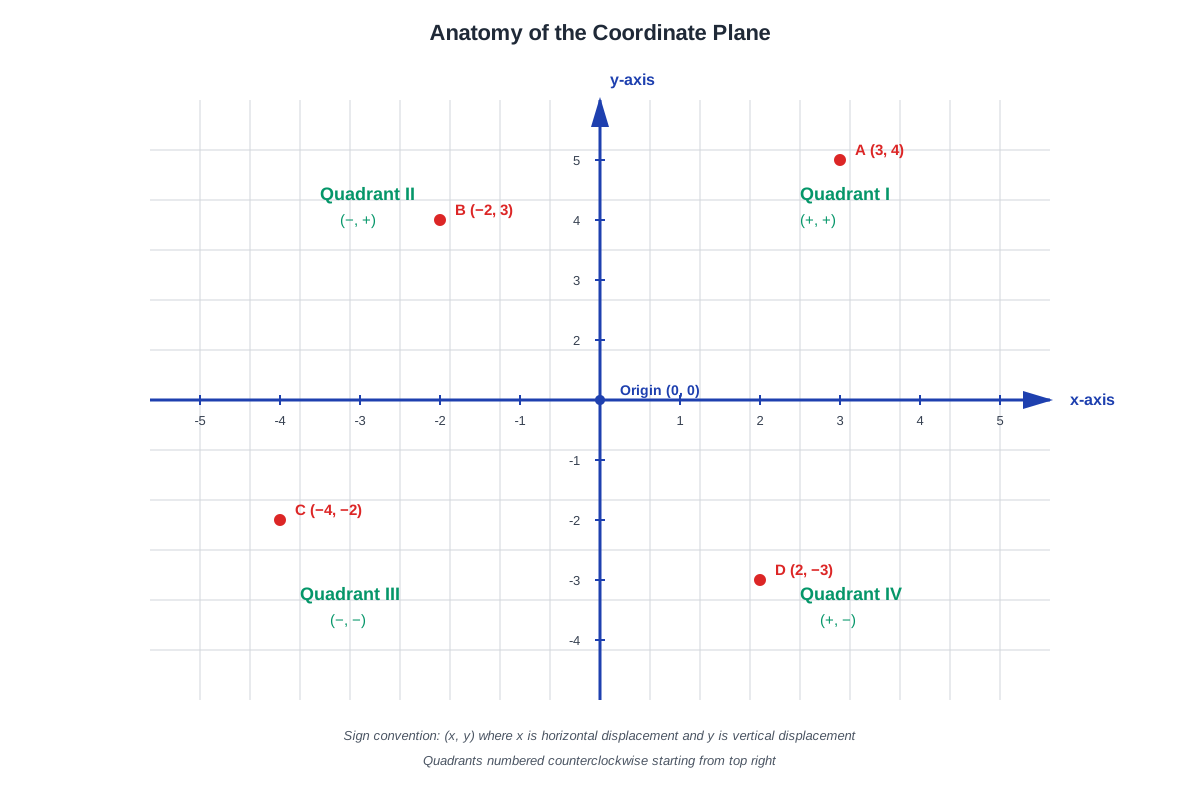
The coordinate plane, also called the Cartesian plane, consists of two perpendicular number lines that intersect at a point called the origin. The horizontal number line is the x-axis, and the vertical number line is the y-axis. Every point in the plane is identified by an ordered pair (x, y) where x represents the horizontal distance from the origin and y represents the vertical distance from the origin. Positive x-values extend to the right, negative x-values to the left, positive y-values upward, and negative y-values downward.
The coordinate plane is divided into four quadrants, numbered counterclockwise starting from the upper right:
- Quadrant I: Both x and y are positive (x > 0, y > 0)
- Quadrant II: x is negative, y is positive (x < 0, y > 0)
- Quadrant III: Both x and y are negative (x < 0, y < 0)
- Quadrant IV: x is positive, y is negative (x > 0, y < 0)
Points on the axes themselves are not considered to be in any quadrant. Understanding which quadrant a point occupies helps quickly assess relationships and eliminate incorrect answer choices on the GRE.
Distance Formula
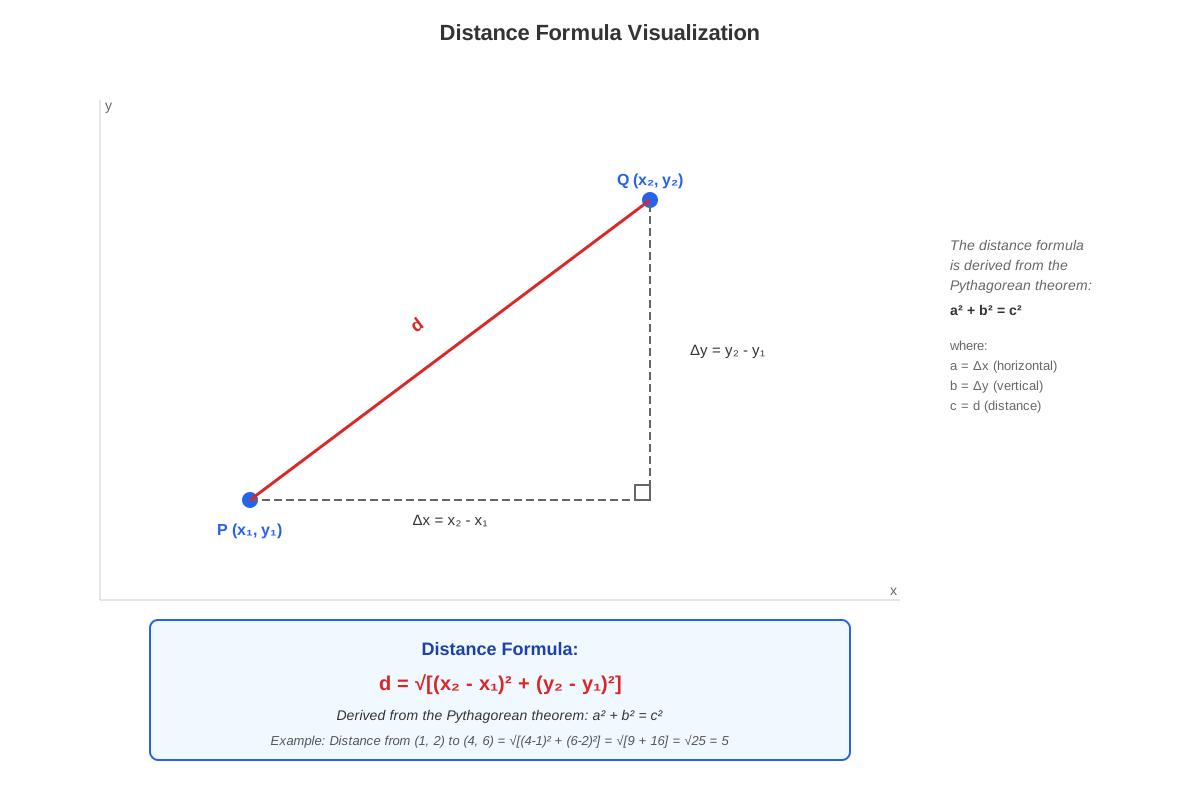
The distance formula calculates the straight-line distance between any two points in the coordinate plane. For points (x₁, y₁) and (x₂, y₂), the distance d is:
d = √[(x₂ - x₁)² + (y₂ - y₁)²]This formula derives directly from the Pythagorean theorem by treating the horizontal and vertical distances as legs of a right triangle. The distance formula is one of the most frequently tested concepts on the GRE coordinate plane questions. When applying this formula, be careful with negative coordinates—subtracting a negative number becomes addition, which students sometimes miscalculate under time pressure.
Special case: When two points share the same x-coordinate (forming a vertical line) or the same y-coordinate (forming a horizontal line), the distance simplifies to the absolute value of the difference in the varying coordinate. For example, the distance between (3, 5) and (3, -2) is simply |5 - (-2)| = 7.
Midpoint Formula
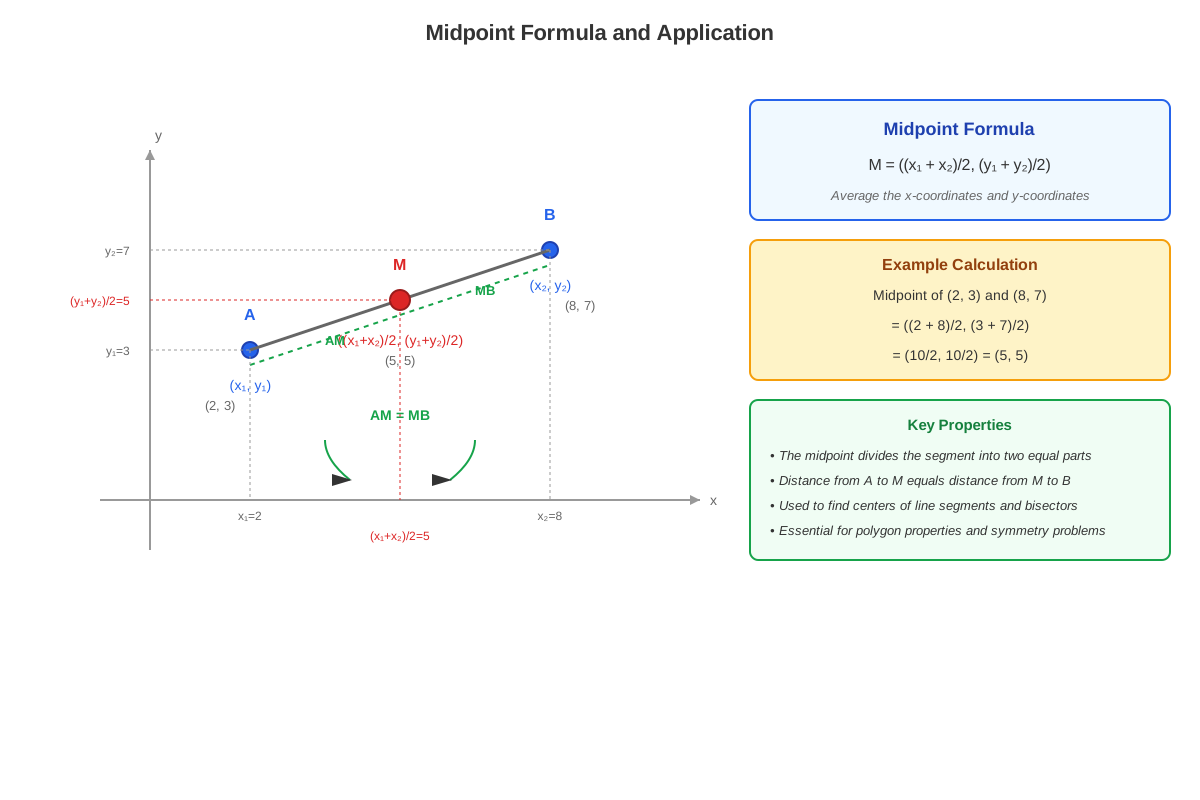
The midpoint of a line segment is the point exactly halfway between the two endpoints. For points (x₁, y₁) and (x₂, y₂), the midpoint M is:
M = ((x₁ + x₂)/2, (y₁ + y₂)/2)The midpoint formula simply averages the x-coordinates and y-coordinates separately. This concept frequently appears in GRE questions involving bisectors, centers of rectangles or circles, and problems requiring you to work backward from a midpoint to find an endpoint.
Slope
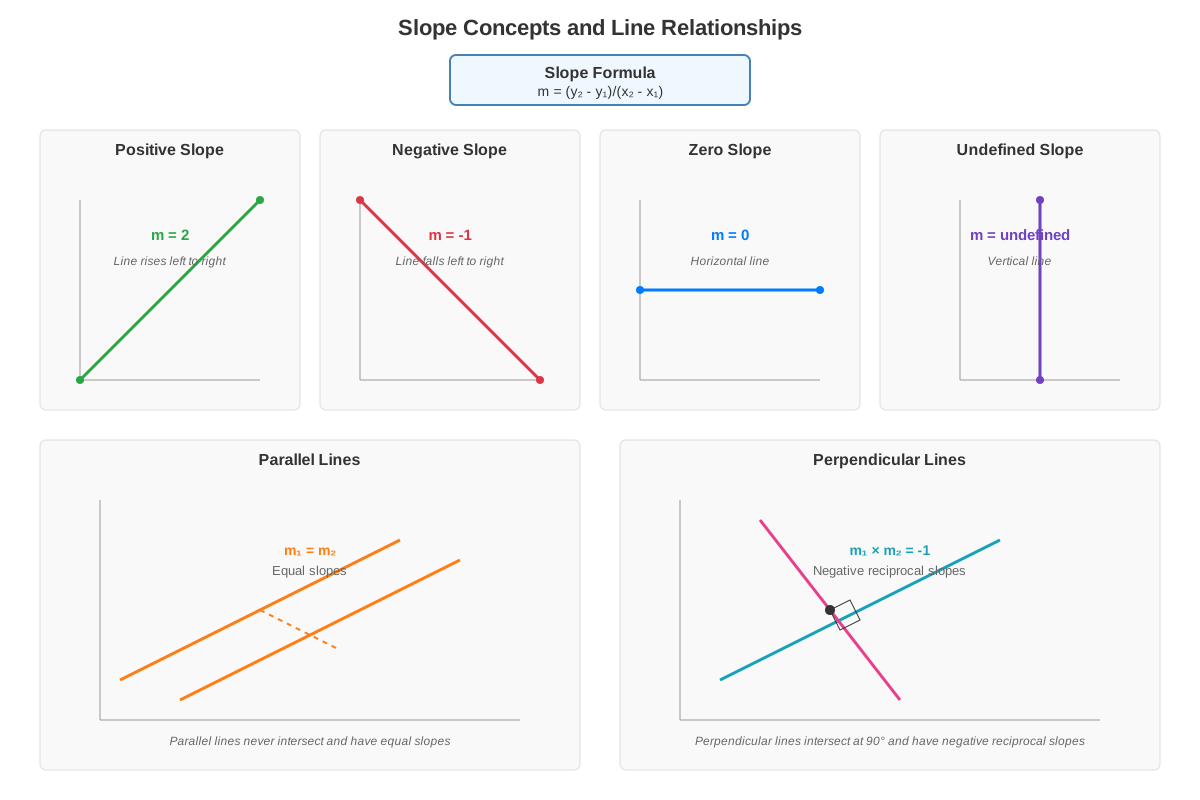
The slope of a line measures its steepness and direction. For a line passing through points (x₁, y₁) and (x₂, y₂), the slope m is:
m = (y₂ - y₁)/(x₂ - x₁) = rise/runSlope represents the rate of change in y with respect to x. Key slope properties include:
| Slope Value | Line Characteristic | Example | ||||
|---|---|---|---|---|---|---|
| Positive | Line rises from left to right | m = 2 | ||||
| Negative | Line falls from left to right | m = -3 | ||||
| Zero | Horizontal line | m = 0 | ||||
| Undefined | Vertical line | Division by zero | ||||
| Greater absolute value | Steeper line | m | = 5 vs | m | = 0.5 |
Parallel lines have equal slopes (m₁ = m₂), while perpendicular lines have slopes that are negative reciprocals of each other (m₁ × m₂ = -1, or m₂ = -1/m₁). These relationships are frequently tested on the GRE, particularly in questions asking whether lines are parallel, perpendicular, or neither.
Equations of Lines
Lines in the coordinate plane can be expressed in several forms:
Slope-intercept form: y = mx + b, where m is the slope and b is the y-intercept (the y-coordinate where the line crosses the y-axis). This is the most common form on the GRE because it immediately reveals both the slope and y-intercept.
Point-slope form: y - y₁ = m(x - x₁), useful when you know a point (x₁, y₁) on the line and the slope m.
Standard form: Ax + By = C, where A, B, and C are constants. This form is less intuitive but sometimes appears in GRE questions.
Horizontal lines: y = k (where k is a constant), with slope = 0
Vertical lines: x = h (where h is a constant), with undefined slope
Circles in the Coordinate Plane
The equation of a circle with center (h, k) and radius r is:
(x - h)² + (y - k)² = r²This equation derives from the distance formula—every point (x, y) on the circle is exactly distance r from the center (h, k). A circle centered at the origin simplifies to x² + y² = r². GRE questions may ask you to identify the center and radius from an equation, determine whether a point lies on a circle, or find the equation of a circle given specific conditions.
Area and Perimeter Using Coordinates
When a polygon's vertices are given as coordinates, you can calculate its area and perimeter using coordinate geometry techniques:
For rectangles and squares: Find the lengths of sides using the distance formula or by counting units, then apply standard area formulas.
For triangles: Use the formula Area = ½|base × height|, where you can identify a convenient base along a horizontal or vertical line and calculate the perpendicular height. Alternatively, use the Shoelace formula for any polygon with known vertices.
For irregular polygons: Break the shape into triangles and rectangles, calculate each area separately, and sum them.
Perimeter: Calculate the distance between consecutive vertices using the distance formula and sum all side lengths.
Concept Relationships
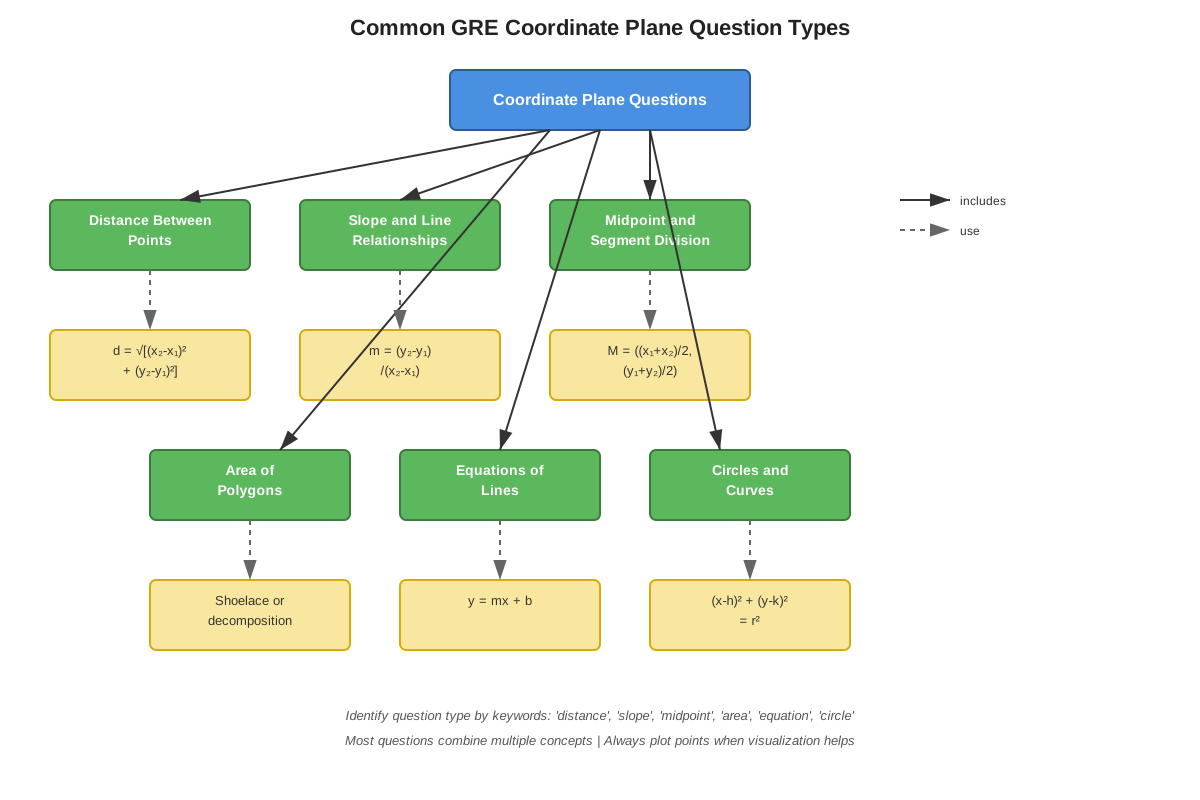
The coordinate plane concepts form an interconnected system where each element builds upon and reinforces the others. The coordinate system (axes, quadrants, and ordered pairs) provides the foundation → enabling the distance formula (which applies the Pythagorean theorem to coordinates) → which connects to the midpoint formula (averaging coordinates to find the center point) → and the slope concept (measuring the rate of change between points).
Slope serves as a central hub connecting multiple concepts: it determines whether lines are parallel or perpendicular, it appears in line equations (particularly slope-intercept form), and it helps identify geometric properties of shapes in the coordinate plane. The equation of a line integrates slope, y-intercept, and specific points, allowing algebraic manipulation of geometric relationships.
Circle equations extend the distance formula concept by defining all points equidistant from a center, connecting coordinate geometry to the study of curves. Area and perimeter calculations synthesize multiple concepts—using the distance formula for side lengths, recognizing right angles through perpendicular slopes, and applying coordinate-based decomposition strategies.
These coordinate plane concepts also connect to prerequisite knowledge: the Pythagorean theorem underlies the distance formula; algebraic manipulation enables solving for unknown coordinates; and properties of geometric shapes (triangles, rectangles, circles) provide the context for applying coordinate methods. Mastering coordinate plane concepts enables progression to more advanced topics including quadratic functions, systems of equations (finding intersection points), transformations (translations, reflections, rotations), and optimization problems in two dimensions.
High-Yield Facts
⭐ The distance formula is d = √[(x₂ - x₁)² + (y₂ - y₁)²] and derives directly from the Pythagorean theorem
⭐ The midpoint formula is M = ((x₁ + x₂)/2, (y₁ + y₂)/2), simply averaging both coordinates
⭐ Slope m = (y₂ - y₁)/(x₂ - x₁) represents rise over run and determines line direction and steepness
⭐ Parallel lines have equal slopes (m₁ = m₂) while perpendicular lines have negative reciprocal slopes (m₁ × m₂ = -1)
⭐ The slope-intercept form y = mx + b immediately reveals slope m and y-intercept b
- Horizontal lines have slope 0 and equation y = k; vertical lines have undefined slope and equation x = h
- The four quadrants have sign patterns: I (+,+), II (-,+), III (-,-), IV (+,-)
- A circle with center (h, k) and radius r has equation (x - h)² + (y - k)² = r²
- The origin is the point (0, 0) where the x-axis and y-axis intersect
- When calculating distance between points with the same x or y coordinate, use the simplified formula: absolute value of the difference in the varying coordinate
- The x-intercept occurs where y = 0; the y-intercept occurs where x = 0
- Steeper lines have larger absolute values of slope; a slope of 1 or -1 indicates a 45-degree angle
Quick check — test yourself on Coordinate plane so far.
Try Flashcards →Common Misconceptions
Misconception: The distance between two points can be found by simply adding the differences in x and y coordinates.
Correction: Distance requires the Pythagorean theorem: √[(x₂ - x₁)² + (y₂ - y₁)²]. Simply adding the coordinate differences gives the "Manhattan distance" (distance if you can only move horizontally and vertically), not the straight-line distance.
Misconception: When calculating slope, the order of points doesn't matter, so (y₁ - y₂)/(x₂ - x₁) gives the same result as (y₂ - y₁)/(x₂ - x₁).
Correction: While the order of points doesn't matter if you're consistent, mixing the order (subtracting in different directions for numerator and denominator) produces the negative of the correct slope. Always subtract coordinates in the same order: (y₂ - y₁)/(x₂ - x₁) or (y₁ - y₂)/(x₁ - x₂).
Misconception: A line with a large negative slope (like -10) is less steep than a line with a small positive slope (like 0.5).
Correction: Steepness is determined by the absolute value of the slope. A slope of -10 indicates a very steep line falling from left to right, much steeper than a line with slope 0.5. The sign indicates direction; the magnitude indicates steepness.
Misconception: If two lines are perpendicular, their slopes must be opposite signs (one positive, one negative).
Correction: While perpendicular lines often have opposite-sign slopes, the defining relationship is that their slopes are negative reciprocals: m₁ × m₂ = -1. The exception is horizontal and vertical lines (slopes 0 and undefined), which are perpendicular but don't follow the negative reciprocal rule in the traditional sense.
Misconception: The equation (x - 3)² + (y + 2)² = 25 represents a circle centered at (3, 2).
Correction: The center is at (3, -2), not (3, 2). In the standard circle equation (x - h)² + (y - k)² = r², the center is (h, k). The equation shows (y - (-2))², which equals (y + 2)², so k = -2. Always pay attention to the signs in the equation.
Misconception: To find the area of a triangle with vertices at coordinates, you must use the distance formula to find all three side lengths, then use Heron's formula.
Correction: While this method works, it's inefficient. For triangles on the coordinate plane, identify a convenient base (preferably horizontal or vertical) and calculate the perpendicular height, then use Area = ½ × base × height. This approach is much faster and less error-prone on the GRE.
Misconception: Points on the axes belong to one of the four quadrants.
Correction: Points on the x-axis or y-axis are not in any quadrant. Only points with both coordinates non-zero belong to quadrants. For example, (5, 0) is on the x-axis, not in Quadrant I or IV.
Worked Examples
Example 1: Multi-Concept Coordinate Problem
Question: Point A is at coordinates (2, 5) and point B is at coordinates (8, -3). Find: (a) the distance between A and B, (b) the midpoint of segment AB, (c) the slope of line AB, and (d) determine if a line through the origin with slope 2 would be perpendicular to line AB.
Solution:
(a) Distance between A and B:
Using the distance formula with (x₁, y₁) = (2, 5) and (x₂, y₂) = (8, -3):
d = √[(x₂ - x₁)² + (y₂ - y₁)²]
d = √[(8 - 2)² + (-3 - 5)²]
d = √[6² + (-8)²]
d = √[36 + 64]
d = √100 = 10
The distance is 10 units.
(b) Midpoint of segment AB:
Using the midpoint formula:
M = ((x₁ + x₂)/2, (y₁ + y₂)/2)
M = ((2 + 8)/2, (5 + (-3))/2)
M = (10/2, 2/2)
M = (5, 1)
The midpoint is at (5, 1).
(c) Slope of line AB:
Using the slope formula:
m = (y₂ - y₁)/(x₂ - x₁)
m = (-3 - 5)/(8 - 2)
m = -8/6
m = -4/3
The slope is -4/3.
(d) Perpendicularity check:
For two lines to be perpendicular, their slopes must be negative reciprocals: m₁ × m₂ = -1.
Line AB has slope -4/3. The line through the origin has slope 2.
Check: (-4/3) × 2 = -8/3 ≠ -1
These lines are NOT perpendicular. For a line to be perpendicular to AB (slope -4/3), it would need slope 3/4 (the negative reciprocal of -4/3).
Connection to learning objectives: This problem demonstrates identification of coordinate plane concepts (objective 1), application of core formulas (objective 2), and accurate calculation in a GRE-style multi-part question (objective 3).
Example 2: Circle and Distance Problem
Question: A circle has the equation (x - 3)² + (y + 1)² = 25. Point P is at coordinates (7, 2). Determine whether point P lies inside, on, or outside the circle.
Solution:
First, identify the circle's center and radius from the equation (x - h)² + (y - k)² = r²:
- Center: (h, k) = (3, -1) [Note: y + 1 = y - (-1), so k = -1]
- Radius: r² = 25, so r = 5
To determine P's position relative to the circle, calculate the distance from P(7, 2) to the center C(3, -1):
d = √[(7 - 3)² + (2 - (-1))²]
d = √[4² + 3²]
d = √[16 + 9]
d = √25 = 5
The distance from P to the center is exactly 5, which equals the radius.
Conclusion: Point P lies ON the circle (not inside or outside).
Alternative approach: Substitute P's coordinates directly into the circle equation:
(7 - 3)² + (2 + 1)² = 4² + 3² = 16 + 9 = 25 ✓
Since the equation is satisfied (left side equals right side), P is on the circle. If the left side were less than 25, P would be inside; if greater than 25, P would be outside.
Connection to learning objectives: This problem requires recognizing circle equations in coordinate form, applying the distance formula strategically, and demonstrating the relationship between algebraic and geometric representations—all key GRE coordinate plane skills.
Exam Strategy
When approaching GRE coordinate plane questions, begin by sketching a quick diagram even if one isn't provided. A rough coordinate system with labeled points helps visualize relationships and often reveals shortcuts. Mark known information directly on your sketch, including coordinates, distances, and any special properties mentioned.
Trigger words and phrases that signal coordinate plane questions include: "in the xy-plane," "coordinates," "origin," "x-axis," "y-axis," "distance between points," "midpoint," "slope," "parallel," "perpendicular," "equation of a line," "circle with center," and "vertices of a polygon." When you see these terms, immediately activate your coordinate geometry toolkit.
For Quantitative Comparison questions involving coordinates, look for shortcuts before calculating. If comparing distances, check whether points form horizontal or vertical segments (allowing simple subtraction instead of the full distance formula). If comparing slopes, remember that steepness depends on absolute value, not sign. Consider special cases: what if a coordinate were zero? What if points were in different quadrants?
Process of elimination strategies:
- Eliminate answer choices that place points in the wrong quadrant based on coordinate signs
- For slope questions, eliminate choices with the wrong sign (positive vs. negative) based on whether the line rises or falls
- For distance questions, use estimation—the distance must be at least as large as the greater of the horizontal and vertical separations
- For circle questions, eliminate radii that are clearly too large or small based on the equation
Time allocation: Simple coordinate calculations (finding one distance, midpoint, or slope) should take 30-45 seconds. Multi-step problems involving several calculations or requiring you to set up equations may take 90-120 seconds. If a problem requires more than 2 minutes, consider whether you're missing a shortcut or should mark it for review and move on.
Common shortcuts:
- For points with the same x or y coordinate, skip the distance formula and use simple subtraction
- When finding the area of a rectangle with sides parallel to the axes, multiply the differences in coordinates rather than using the distance formula
- For perpendicular line problems, immediately write the negative reciprocal of the given slope
- When a problem asks about multiple properties (distance, midpoint, slope), calculate them in the order that builds on previous results
Memory Techniques
Distance Formula Mnemonic: "Difference Squared Sum Root" (DSSR) - Take the Difference of x's, Square it; difference of y's, Square it; Sum them; take the Root.
Midpoint Memory: Think "AVERAGE" - the midpoint is simply the average of the x-coordinates and the average of the y-coordinates. "Meet in the middle by averaging."
Slope Direction Visualization:
- Positive slope: "Going UP as you go RIGHT" (like climbing uphill)
- Negative slope: "Going DOWN as you go RIGHT" (like skiing downhill)
- Zero slope: "HORIZONTAL = ZERO hero" (flat, no rise)
- Undefined slope: "VERTICAL = UNDEFINED" (can't divide by zero)
Perpendicular Slopes Acronym: "FLIP and NIP" - FLIP the fraction (reciprocal) and NIP the sign (make it negative). If slope is 2/3, perpendicular is -3/2.
Quadrant Signs Memory: Starting from Quadrant I and going counterclockwise, remember "All Students Take Calculus":
- All (Quadrant I): All positive (+, +)
- Students (Quadrant II): Sin positive, meaning y positive (-, +)
- Take (Quadrant III): Tan positive, but for coordinates, both negative (-, -)
- Calculus (Quadrant IV): Cos positive, meaning x positive (+, -)
Circle Equation Memory: "Center OPPOSITE, Radius SQUARED" - In (x - h)² + (y - k)² = r², the center coordinates have the opposite sign from what appears in the equation, and the radius is the square root of the right side.
Summary
The coordinate plane is a high-yield GRE topic that bridges algebra and geometry by representing points, lines, and shapes using numerical coordinates. Mastery requires fluency with the coordinate system (axes, quadrants, ordered pairs), the distance formula (√[(x₂ - x₁)² + (y₂ - y₁)²]), the midpoint formula (averaging coordinates), and slope calculations (rise over run). Understanding that parallel lines have equal slopes while perpendicular lines have negative reciprocal slopes is essential. Line equations, particularly slope-intercept form (y = mx + b), and circle equations ((x - h)² + (y - k)² = r²) frequently appear on the GRE. Success on coordinate plane questions requires the ability to translate between visual geometric information and algebraic representations, recognize when coordinate methods provide efficient solutions, and apply formulas accurately under time pressure. Students who can quickly sketch diagrams, identify shortcuts for special cases (horizontal/vertical lines, points on axes), and connect coordinate concepts to broader geometric principles will confidently handle the 15-20% of GRE Quantitative Reasoning questions that test this material.
Key Takeaways
- The coordinate plane uses ordered pairs (x, y) to precisely locate points, with the plane divided into four quadrants based on coordinate signs
- The distance formula √[(x₂ - x₁)² + (y₂ - y₁)²] and midpoint formula ((x₁ + x₂)/2, (y₁ + y₂)/2) are essential tools that appear frequently on the GRE
- Slope m = (y₂ - y₁)/(x₂ - x₁) determines line direction and steepness; parallel lines have equal slopes, perpendicular lines have negative reciprocal slopes
- The slope-intercept form y = mx + b immediately reveals a line's slope and y-intercept, making it the most useful form for GRE questions
- Circle equations (x - h)² + (y - k)² = r² encode center (h, k) and radius r; watch for sign changes in the equation
- Always sketch a quick diagram for coordinate problems—visualization reveals relationships and shortcuts that pure calculation might miss
- Look for special cases (horizontal/vertical lines, points on axes, shared coordinates) that allow simplified calculations instead of full formulas
Related Topics
Linear Equations and Systems: Coordinate plane mastery enables solving systems of equations graphically by finding intersection points and understanding how line equations relate to their visual representations.
Transformations: Understanding coordinates is prerequisite for studying translations (shifting points), reflections (flipping across axes or lines), and rotations (turning around a point) in the plane.
Quadratic Functions and Parabolas: The coordinate plane provides the framework for graphing parabolas, finding vertices, and analyzing quadratic relationships visually.
Polygons and Area: Advanced applications include using coordinate methods to find areas of complex polygons, prove geometric properties algebraically, and solve optimization problems.
Data Interpretation with Scatter Plots: Many GRE data interpretation questions present scatter plots where understanding coordinate relationships helps identify trends, outliers, and correlations.
Practice CTA
Now that you've mastered the fundamentals of the coordinate plane, it's time to solidify your understanding through practice! Attempt the practice questions to test your ability to apply these concepts under GRE-like conditions, and use the flashcards to reinforce key formulas and relationships until they become automatic. Remember, coordinate plane questions reward both conceptual understanding and computational accuracy—the more you practice, the faster and more confident you'll become. Each practice problem you solve strengthens the neural pathways that will help you excel on test day. You've built a strong foundation; now make it unshakeable through deliberate practice!
Sign up free to keep reading
Create a free AnvayaPrep account to finish this GRE guide on Coordinate plane — plus flashcards and practice questions.