Overview
Equilateral triangles represent one of the most frequently tested geometric figures on the GRE Quantitative Reasoning section. These perfectly symmetrical three-sided polygons, where all sides are equal in length and all angles measure exactly 60 degrees, appear in approximately 15-20% of geometry questions. Their mathematical elegance makes them ideal for testing multiple concepts simultaneously—from basic angle relationships to advanced area calculations and coordinate geometry applications.
Understanding GRE equilateral triangles goes far beyond memorizing that all sides are equal. The GRE tests your ability to recognize when an equilateral triangle is embedded within a larger figure, to derive its height using the Pythagorean theorem, to calculate its area using multiple methods, and to apply these properties in coordinate plane problems. Questions often disguise equilateral triangles within hexagons, circles, or three-dimensional figures, requiring pattern recognition and spatial reasoning skills.
Mastery of equilateral triangles connects directly to broader Quantitative Reasoning competencies including right triangle properties, special angle values (30-60-90 triangles), circle geometry, and algebraic problem-solving. This topic serves as a gateway to understanding regular polygons, trigonometric ratios, and optimization problems. The principles learned here apply to questions involving inscribed and circumscribed figures, coordinate geometry, and even data interpretation questions that use geometric representations.
Learning Objectives
- [ ] Identify when Equilateral triangles is being tested
- [ ] Explain the core rule or strategy behind Equilateral triangles
- [ ] Apply Equilateral triangles to GRE-style questions accurately
- [ ] Derive the height formula for an equilateral triangle using the Pythagorean theorem
- [ ] Calculate the area of an equilateral triangle using multiple approaches
- [ ] Recognize equilateral triangles embedded within complex geometric figures
- [ ] Apply equilateral triangle properties to solve coordinate geometry problems
Prerequisites
- Basic triangle properties: Understanding that interior angles sum to 180° is essential for recognizing why each angle in an equilateral triangle must be 60°
- Pythagorean theorem: Required to derive the height formula and understand the relationship between side length and altitude
- Area formulas for triangles: The foundation for understanding why the equilateral triangle area formula works
- Square roots and radical simplification: Necessary for working with the √3 that appears in all equilateral triangle calculations
- 30-60-90 triangle ratios: Equilateral triangles split into two 30-60-90 triangles, making this relationship fundamental
Why This Topic Matters
Equilateral triangles appear in real-world applications ranging from structural engineering (truss designs leverage their stability) to molecular chemistry (trigonal planar molecular geometry) to computer graphics (triangular mesh generation). Their perfect symmetry makes them the most efficient shape for distributing forces evenly, which is why they appear in bridge construction, geodesic domes, and architectural designs.
On the GRE, equilateral triangle questions appear in approximately 3-5 questions per exam across both Quantitative Reasoning sections. They manifest in multiple question formats: Quantitative Comparison questions asking you to compare areas or perimeters, Multiple Choice questions requiring area or perimeter calculations, and Numeric Entry questions where you must calculate exact values. The test makers favor equilateral triangles because they can efficiently test multiple concepts—geometry, algebra, and numerical reasoning—within a single question.
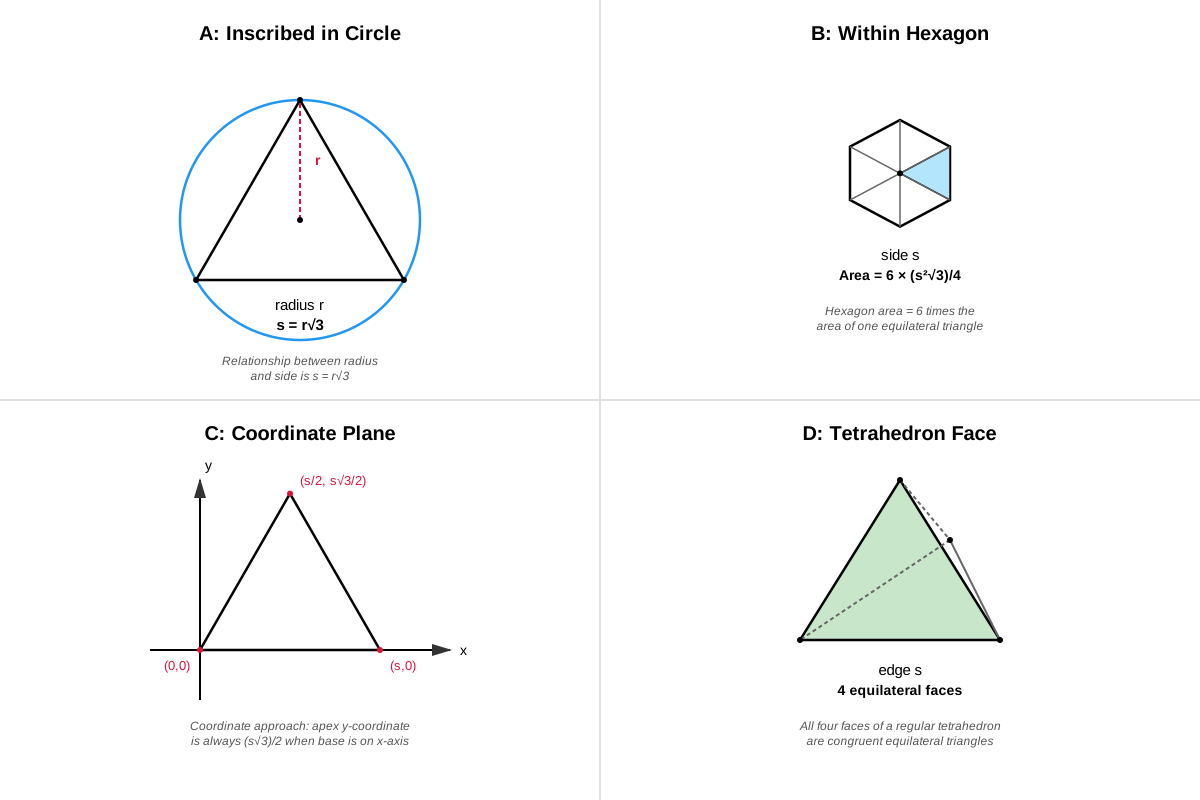
Common GRE presentations include: equilateral triangles inscribed in circles (requiring knowledge of radii and circumference), equilateral triangles forming parts of regular hexagons (which decompose into six equilateral triangles), equilateral triangles in coordinate planes (testing distance formulas and symmetry), and three-dimensional problems where equilateral triangles form faces of tetrahedrons or other polyhedra. Questions frequently require you to recognize that a triangle is equilateral based on given information rather than stating it explicitly, testing your ability to identify the pattern from angle measures or side relationships.
Core Concepts
Fundamental Properties of Equilateral Triangles
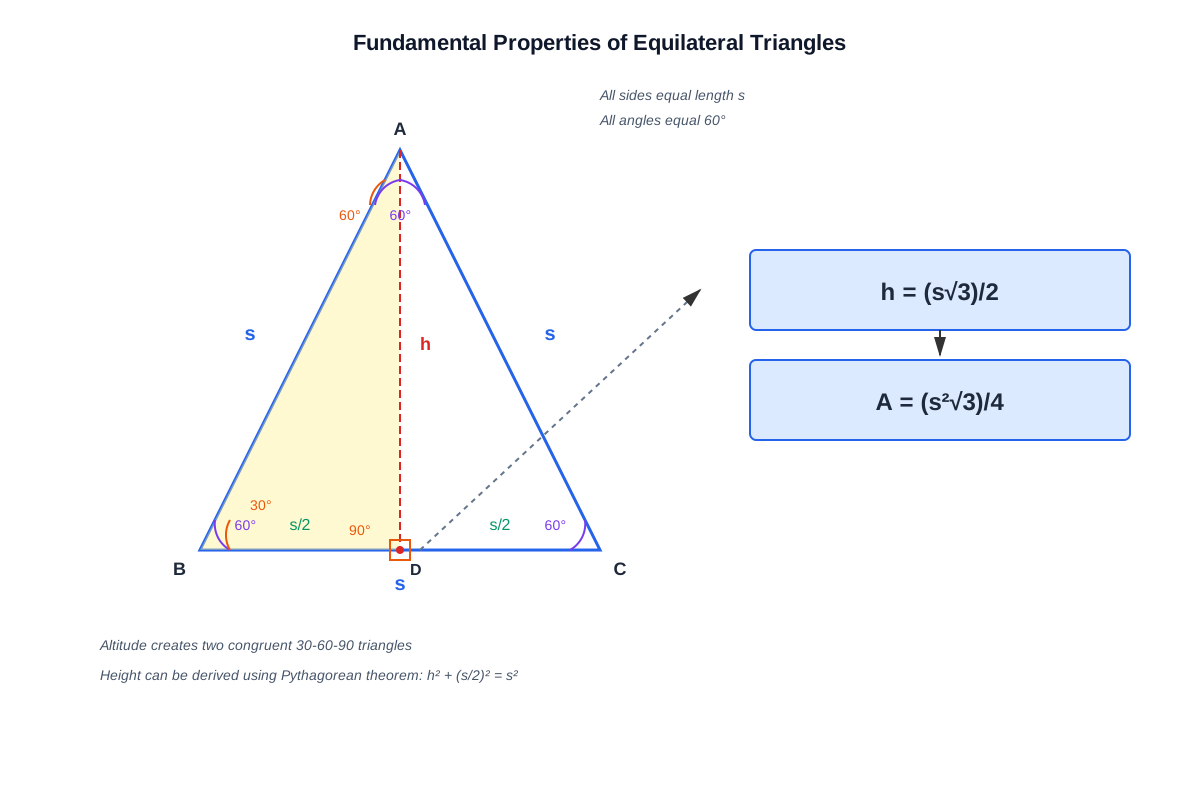
An equilateral triangle is defined as a triangle with three congruent sides. This single defining characteristic creates a cascade of other properties. Because all three sides are equal, all three angles must also be equal. Since the sum of interior angles in any triangle equals 180°, each angle in an equilateral triangle measures exactly 60° (180° ÷ 3 = 60°). This makes equilateral triangles both equilateral (equal sides) and equiangular (equal angles).
The symmetry of equilateral triangles is exceptional. They possess three lines of symmetry—each altitude, median, angle bisector, and perpendicular bisector of a side are all the same line. This means that when you draw a line from any vertex perpendicular to the opposite side, that line simultaneously bisects the angle at the vertex, bisects the opposite side, and represents the shortest distance from the vertex to that side. This property dramatically simplifies calculations and is frequently exploited in GRE questions.
The Height Formula
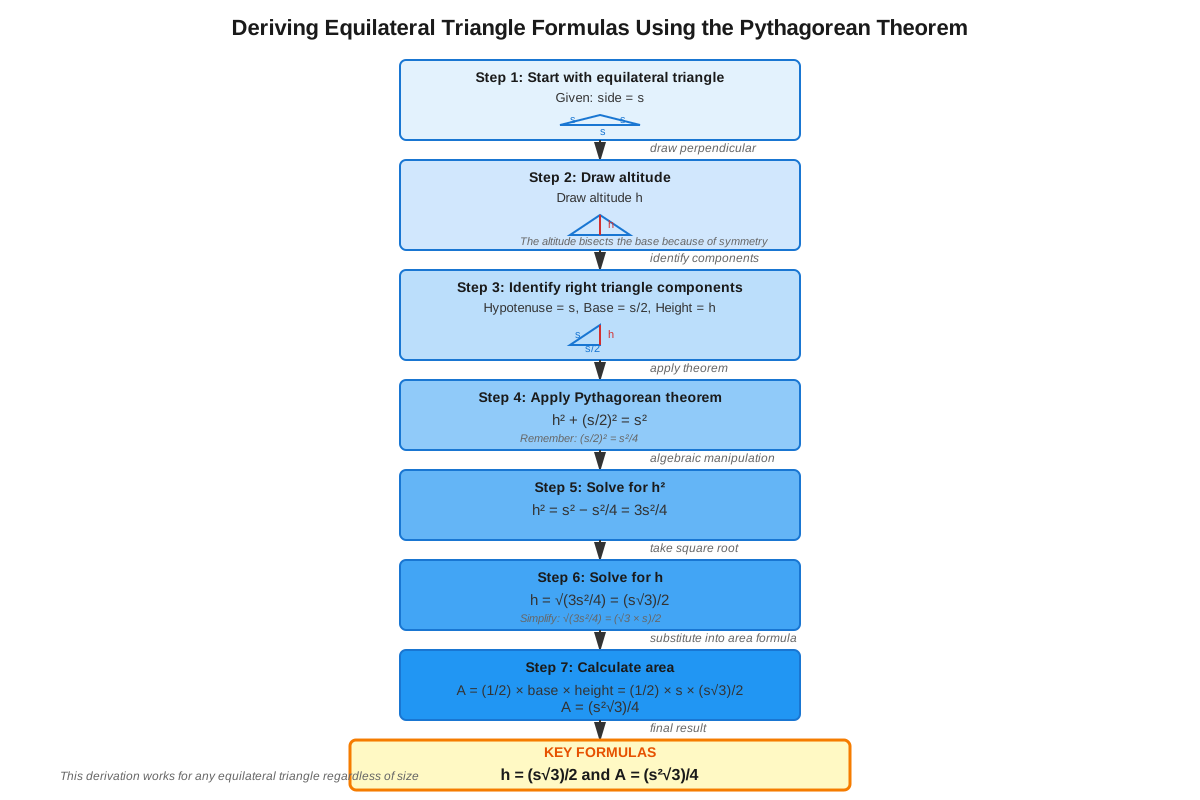
The height (or altitude) of an equilateral triangle is one of the most tested relationships on the GRE. Given an equilateral triangle with side length s, the height can be derived using the Pythagorean theorem. When you draw an altitude from any vertex to the opposite side, it creates two congruent 30-60-90 right triangles.
In each 30-60-90 triangle:
- The hypotenuse equals s (the original side)
- The base equals s/2 (half the original side, since the altitude bisects it)
- The height equals h (what we're solving for)
Applying the Pythagorean theorem:
h² + (s/2)² = s²
h² + s²/4 = s²
h² = s² - s²/4
h² = 3s²/4
h = (s√3)/2
This formula, h = (s√3)/2, is absolutely critical for GRE success. Memorize it, understand its derivation, and practice applying it rapidly.
Area Calculations
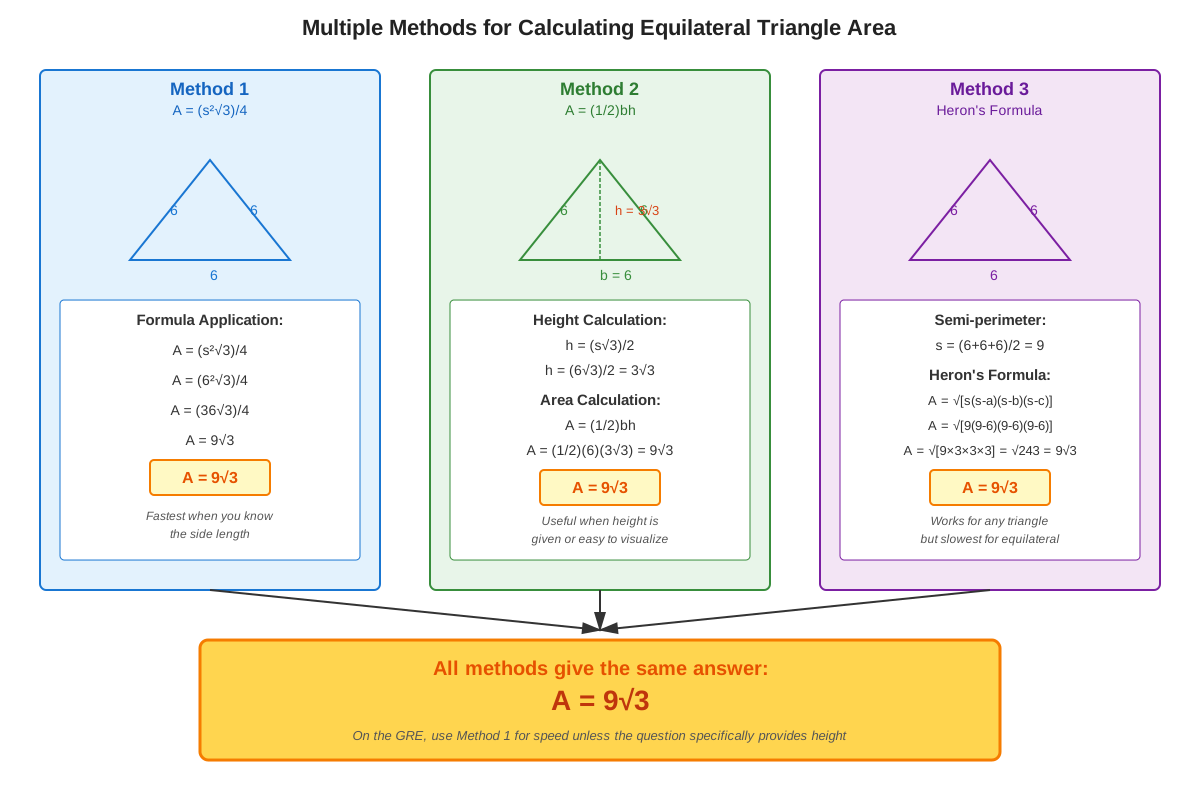
The area of an equilateral triangle can be calculated using multiple approaches, and the GRE may require any of them:
Method 1: Standard Triangle Area Formula
Using Area = (1/2) × base × height, and substituting our height formula:
Area = (1/2) × s × (s√3)/2
Area = (s²√3)/4
Method 2: Heron's Formula
With all sides equal to s, the semi-perimeter is (3s)/2:
Area = √[s_p(s_p - a)(s_p - b)(s_p - c)]
Area = √[(3s/2)(s/2)(s/2)(s/2)]
Area = √[(3s/2)(s³/8)]
Area = (s²√3)/4
Method 3: Trigonometric Formula
Using Area = (1/2)ab sin(C) with two sides s and included angle 60°:
Area = (1/2) × s × s × sin(60°)
Area = (1/2) × s² × (√3/2)
Area = (s²√3)/4
All methods yield the same formula: Area = (s²√3)/4. This is the second critical formula to memorize.
Perimeter and Side Relationships
The perimeter of an equilateral triangle is simply three times the side length: P = 3s. Conversely, if given the perimeter, the side length is s = P/3. This relationship appears frequently in GRE questions that provide perimeter information and ask for area, requiring you to first find the side length.
Relationship to 30-60-90 Triangles
Every equilateral triangle contains two 30-60-90 triangles when an altitude is drawn. The side ratios in a 30-60-90 triangle are 1 : √3 : 2, which directly correspond to:
- Short leg (opposite 30°): s/2
- Long leg (opposite 60°): (s√3)/2
- Hypotenuse (opposite 90°): s
Understanding this relationship allows you to quickly solve problems involving partial information about equilateral triangles.
Inscribed and Circumscribed Circles
An equilateral triangle can be inscribed in a circle (all vertices touching the circle) or have a circle inscribed within it (circle touching all three sides).
For an equilateral triangle with side length s:
- Circumradius (radius of circumscribed circle): R = s/√3 = (s√3)/3
- Inradius (radius of inscribed circle): r = (s√3)/6
Note that the circumradius is exactly twice the inradius: R = 2r. The center of both circles is the same point—the centroid of the triangle, located at the intersection of the three altitudes.
Coordinate Geometry Applications
When an equilateral triangle appears in the coordinate plane, common scenarios include:
- One side lying on the x-axis or y-axis
- One vertex at the origin
- Vertices at specific coordinate points requiring distance calculations
To verify a triangle is equilateral in coordinates, calculate all three side lengths using the distance formula and confirm they're equal. To find the third vertex given two vertices, use the side length and height formulas along with perpendicular line concepts.
Concept Relationships
The properties of equilateral triangles form an interconnected web of relationships. The fundamental definition (three equal sides) → leads to → equal angles of 60° each → which creates → the 30-60-90 triangle relationship when an altitude is drawn → enabling → derivation of the height formula using the Pythagorean theorem → which allows → calculation of area using the standard triangle formula.
The symmetry properties → connect to → the fact that altitude, median, angle bisector, and perpendicular bisector are identical → simplifying → geometric proofs and calculations. This symmetry also → relates to → inscribed and circumscribed circle properties, where the center point (centroid) is equidistant from all vertices and all sides.
Equilateral triangles → serve as building blocks for → regular hexagons (six equilateral triangles sharing a common center) → and → tetrahedrons (four equilateral triangular faces). Understanding equilateral triangles → is prerequisite to → solving problems involving these more complex figures.
The coordinate geometry applications → require integration of → distance formula, midpoint formula, and perpendicular line concepts → combined with → the algebraic expressions for height and area. The 30-60-90 triangle ratios → directly derive from → equilateral triangle properties and → extend to → trigonometric function values for 30° and 60° angles.
Quick check — test yourself on Equilateral triangles so far.
Try Flashcards →High-Yield Facts
⭐ All sides of an equilateral triangle are equal in length, and all angles measure exactly 60°
⭐ The height of an equilateral triangle with side length s is h = (s√3)/2
⭐ The area of an equilateral triangle with side length s is A = (s²√3)/4
⭐ Drawing an altitude in an equilateral triangle creates two congruent 30-60-90 right triangles
⭐ The perimeter of an equilateral triangle is P = 3s, where s is the side length
- The altitude, median, angle bisector, and perpendicular bisector from any vertex are all the same line segment
- An equilateral triangle has three lines of symmetry and rotational symmetry of order 3
- The circumradius (radius of circumscribed circle) is R = (s√3)/3, exactly twice the inradius
- The inradius (radius of inscribed circle) is r = (s√3)/6
- A regular hexagon can be divided into six congruent equilateral triangles
- The centroid, circumcenter, incenter, and orthocenter of an equilateral triangle are all the same point
- If an equilateral triangle has perimeter P, its area is A = (P²√3)/36
- The ratio of height to side length is always √3 : 2
Common Misconceptions
Misconception: The height of an equilateral triangle equals the side length.
Correction: The height is always shorter than the side length. Specifically, h = (s√3)/2 ≈ 0.866s. The height is approximately 87% of the side length, not 100%.
Misconception: The area formula is (s²)/2 or s²/4 without the √3.
Correction: The area formula must include √3: A = (s²√3)/4. Forgetting the √3 is one of the most common errors on the GRE and will lead to incorrect answers on every equilateral triangle area question.
Misconception: Any triangle with one 60° angle is equilateral.
Correction: A triangle must have all three angles equal to 60° (or equivalently, all three sides equal) to be equilateral. A single 60° angle is insufficient. For example, a 30-60-90 triangle has a 60° angle but is not equilateral.
Misconception: The altitude divides an equilateral triangle into two equal equilateral triangles.
Correction: The altitude divides an equilateral triangle into two congruent 30-60-90 right triangles, not equilateral triangles. These right triangles have sides in the ratio 1 : √3 : 2.
Misconception: If you know the height, you can find the side by multiplying by 2.
Correction: If you know the height h, the side length is s = (2h)/√3 = (2h√3)/3, not 2h. You must account for the √3 factor in the relationship.
Misconception: The perimeter and area have the same numerical relationship as in squares.
Correction: Unlike squares where A = (P/4)², equilateral triangles have A = (P²√3)/36. The relationship involves √3 and different coefficients due to the triangular geometry.
Misconception: All equilateral triangles are similar but not congruent.
Correction: All equilateral triangles are indeed similar (same shape, different size), but two equilateral triangles are congruent if and only if they have the same side length. Similarity is guaranteed; congruence requires equal dimensions.
Worked Examples
Example 1: Finding Area from Perimeter
Problem: An equilateral triangle has a perimeter of 24. What is its area?
Solution:
Step 1: Find the side length from the perimeter.
- Perimeter = 3s = 24
- Side length s = 24/3 = 8
Step 2: Apply the area formula.
- Area = (s²√3)/4
- Area = (8²√3)/4
- Area = (64√3)/4
- Area = 16√3
Step 3: If a numerical approximation is needed:
- √3 ≈ 1.732
- Area ≈ 16 × 1.732 = 27.712
Answer: The exact area is 16√3 square units (approximately 27.71 square units).
Connection to Learning Objectives: This problem demonstrates identifying equilateral triangle properties (perimeter relationship), applying the core formulas (area formula), and executing accurate calculations—addressing objectives 1, 2, and 3.
Example 2: Coordinate Geometry Application
Problem: In the coordinate plane, an equilateral triangle has two vertices at (0, 0) and (6, 0). If the third vertex is in the first quadrant, what are its coordinates?
Solution:
Step 1: Identify the side length.
- The distance between (0, 0) and (6, 0) is 6 units
- Therefore, all sides must be 6 units long
Step 2: Find the x-coordinate of the third vertex.
- By symmetry, the third vertex must be directly above the midpoint of the base
- Midpoint of base = ((0+6)/2, (0+0)/2) = (3, 0)
- So the x-coordinate is 3
Step 3: Find the y-coordinate using the height formula.
- Height h = (s√3)/2 = (6√3)/2 = 3√3
- Since the base is on the x-axis, the height is the y-coordinate
Step 4: State the coordinates.
- Third vertex: (3, 3√3)
Step 5: Verify using distance formula (optional but recommended).
- Distance from (0, 0) to (3, 3√3): √[(3-0)² + (3√3-0)²] = √[9 + 27] = √36 = 6 ✓
- Distance from (6, 0) to (3, 3√3): √[(3-6)² + (3√3-0)²] = √[9 + 27] = √36 = 6 ✓
Answer: The third vertex is located at (3, 3√3) or approximately (3, 5.196).
Connection to Learning Objectives: This problem requires recognizing an equilateral triangle from given information (objective 1), applying the height formula in a coordinate context (objectives 2 and 4), and demonstrating mastery of coordinate geometry applications (objective 7).
Exam Strategy
When approaching GRE equilateral triangle questions, begin by identifying the trigger phrases: "equilateral triangle," "all sides equal," "all angles are 60°," or "regular triangle." Sometimes the question won't explicitly state the triangle is equilateral but will provide information like "triangle ABC with AB = BC = CA" or "triangle with angles measuring 60°, 60°, and 60°."
Immediate action steps:
- Draw a diagram if one isn't provided—visual representation prevents errors
- Label the side length as s (or the given value)
- Mark all angles as 60°
- If the question involves height or area, immediately draw an altitude
Process-of-elimination strategies:
- Eliminate any answer choice that doesn't include √3 when the question asks for area or height (unless the √3 cancels algebraically)
- For Quantitative Comparison questions, if both quantities involve the same equilateral triangle, look for relationships between perimeter, area, and side length
- Eliminate answers that suggest the height equals the side length (impossible)
- Watch for answer choices that use the wrong formula (like s²/2 instead of s²√3/4)
Time allocation: Straightforward equilateral triangle questions should take 60-90 seconds. If a question involves multiple steps (finding side from perimeter, then calculating area, then comparing to another value), allocate up to 2 minutes. If you're spending more than 2 minutes, mark the question and return to it later.
Common question patterns:
- Pattern 1: Given perimeter, find area (requires P → s → area formula)
- Pattern 2: Given area, find perimeter (requires area → s → perimeter)
- Pattern 3: Equilateral triangle inscribed in or circumscribed around a circle
- Pattern 4: Equilateral triangle as part of a hexagon or other regular polygon
- Pattern 5: Coordinate geometry with vertices at specific points
Red flags that indicate complexity:
- Three-dimensional figures with equilateral triangle faces
- Multiple equilateral triangles in the same figure
- Equilateral triangles combined with other geometric shapes
- Questions requiring you to prove a triangle is equilateral
Memory Techniques
Mnemonic for the area formula: "Square the Side, Sprinkle Some root-three, Split it into four" → A = (s²√3)/4
Mnemonic for the height formula: "Half the Side gets Stretched by root-three" → h = (s√3)/2
Visual memory technique: Picture an equilateral triangle as a "perfect pyramid" where everything is balanced. The number 3 appears everywhere: 3 sides, 3 angles, perimeter = 3s. The √3 appears in both height and area formulas.
Acronym for properties: SAME - Sides all equal, Angles all 60°, Medians are altitudes, Everything is symmetric
Ratio memory: Remember "1-root3-2" for the 30-60-90 triangle that appears when you draw an altitude. The "root3" is the height side, which connects to why √3 appears in all formulas.
Finger trick: Hold up three fingers to remember: 3 sides, 3 angles, divide by 3 for perimeter-to-side, multiply by 3 for side-to-perimeter. The triangle shape your three fingers make can remind you of the √3 in formulas.
Summary
Equilateral triangles are fundamental geometric figures characterized by three equal sides and three 60° angles, appearing frequently on the GRE in various contexts. Mastery requires memorizing two critical formulas: height h = (s√3)/2 and area A = (s²√3)/4, both derivable from the Pythagorean theorem and 30-60-90 triangle relationships. The exceptional symmetry of equilateral triangles means that altitudes, medians, angle bisectors, and perpendicular bisectors coincide, simplifying many calculations. GRE questions test these concepts through direct calculation problems, embedded figures where equilateral triangles form parts of hexagons or circles, and coordinate geometry applications. Success requires recognizing when a triangle is equilateral (even when not explicitly stated), rapidly applying the appropriate formulas, and understanding the relationships between perimeter, side length, height, and area. The √3 factor appears consistently in all non-perimeter calculations and must never be forgotten. With these tools and the ability to visualize how altitudes create 30-60-90 triangles, students can confidently tackle any equilateral triangle question on the GRE.
Key Takeaways
- All equilateral triangles have three equal sides and three 60° angles—these properties are inseparable and define the figure
- The two essential formulas are height h = (s√3)/2 and area A = (s²√3)/4; memorize both and understand their derivation
- Drawing an altitude creates two 30-60-90 right triangles with side ratios 1 : √3 : 2, which is the foundation for all other formulas
- The √3 factor appears in every formula except perimeter; forgetting it is the most common error on GRE questions
- Equilateral triangles possess perfect symmetry—altitude, median, angle bisector, and perpendicular bisector are all the same line
- In coordinate geometry, use symmetry to find unknown vertices and the distance formula to verify side lengths
- Regular hexagons decompose into six equilateral triangles, a relationship frequently tested on the GRE
Related Topics
30-60-90 Triangles: These special right triangles are created when an altitude is drawn in an equilateral triangle. Mastering equilateral triangles provides the foundation for understanding why 30-60-90 triangles have side ratios of 1 : √3 : 2.
Regular Polygons: Equilateral triangles are the simplest regular polygon. Understanding their properties extends to regular hexagons (which contain six equilateral triangles), regular dodecagons, and other polygons with equal sides and angles.
Circle Geometry: Equilateral triangles frequently appear inscribed in circles or with circles inscribed within them. The relationships between circumradius, inradius, and side length connect these topics.
Trigonometry: The 60° angles in equilateral triangles provide the basis for exact trigonometric values: sin(60°) = √3/2, cos(60°) = 1/2, and tan(60°) = √3.
Three-Dimensional Geometry: Tetrahedrons (triangular pyramids with four equilateral triangle faces) and other polyhedra build upon equilateral triangle properties, extending two-dimensional concepts into three dimensions.
Practice CTA
Now that you've mastered the core concepts of equilateral triangles, it's time to solidify your understanding through active practice. Attempt the practice questions to test your ability to recognize equilateral triangles in various contexts, apply the formulas under timed conditions, and develop the pattern recognition skills essential for GRE success. Use the flashcards to drill the key formulas and properties until they become automatic—speed and accuracy on test day depend on having these relationships committed to memory. Remember, every practice problem you solve builds the confidence and competence needed to excel on the actual exam. You've got this!
Sign up free to keep reading
Create a free AnvayaPrep account to finish this GRE guide on Equilateral triangles — plus flashcards and practice questions.